


Introduction
Worry is a core feature of generalized anxiety disorder (GAD; American Psychiatric Association, 2013). Two types of worries have been distinguished: worries about current situations and worries about hypothetical situations, which are future oriented and may not happen (Dugas and Ladouceur, Reference Dugas and Ladouceur2000). An effective cognitive and behaviour therapy has been developed for the treatment of both types of worries using problem solving for worries about current problems, and cognitive exposure for hypothetical fears (Dugas and Ladouceur, Reference Dugas and Ladouceur2000). The latter consists of listening repeatedly to a detailed scenario of one's worst hypothetical fear coming true recorded on a looped tape or CD. Its efficacy has been supported as part of a treatment package in randomized controlled trials (RCT) with remission rates varying from 76 to 84% at 6- and 12-month follow-ups (Dugas et al., Reference Dugas, Ladouceur, Léger, Freeston, Langlois, Provencher and Boisvert2003; Ladouceur et al., Reference Ladouceur, Dugas, Freeston, Léger, Gagnon and Thibodeau2000; Dugas et al., Reference Dugas, Brillon, Savard, Turcotte, Gaudet and Ladouceur2010). The unique efficacy of problem solving for worries about current problems and cognitive exposure for worries about hypothetical situations using a looped tape was assessed in a case replication series conducted among 18 participants diagnosed with GAD. Each treatment produced significant improvements in anxiety and worry. Post-treatment, 66.7% of the treatment completers no longer met GAD diagnostic criteria and gains were maintained at a 6-month follow-up (Provencher et al., Reference Provencher, Dugas and Ladouceur2004). Support for the use of cognitive exposure to worry as a stand-alone treatment using imagery was also found in an RCT conducted among 73 outpatients diagnosed with GAD who were allocated either to worry exposure using imaginal exposure, applied relaxation or a waiting list control group (Hoyer et al., Reference Hoyer, Beesdo, Gloster, Runge, Höfler and Becker2009). Both active treatment groups produced comparable and significantly larger decreases in anxiety and worry than the waitlist group with improvements maintained for up to a year.
While imaginal exposure can be efficient (Hoyer et al., Reference Hoyer, Beesdo, Gloster, Runge, Höfler and Becker2009), the use of a looped tape to perform cognitive or imaginal exposure presents several advantages, such as the minimization of neutralization (Goldman et al., Reference Goldman, Dugas, Sexton and Gervais2007). However, a major limitation is that the scenario cannot be easily modified during treatment, which can interfere with fear extinction (Goldman et al., Reference Goldman, Dugas, Sexton and Gervais2007). In an attempt to further increase efficacy by allowing changes in the scenarios, a written exposure technique was developed by Goldman and collaborators (Goldman et al., Reference Goldman, Dugas, Sexton and Gervais2007) based on Pennebaker's expressive writing paradigm (Pennebaker and Beall, Reference Pennebaker and Beall1986). The written exposure technique consisted of three to five 20- to 30-minute writing sessions held on consecutive days and focusing on one's worst hypothetical fear coming true. Its efficacy was tested in two RCTs (Fracalanza et al., Reference Fracalanza, Koerner and Antony2014; Goldman et al., Reference Goldman, Dugas, Sexton and Gervais2007). A first RCT was conducted among 30 non-clinical worriers allocated to either a written exposure group, focusing on one's worst hypothetical fear, or a neutral writing group (Goldman et al., Reference Goldman, Dugas, Sexton and Gervais2007). Large within-group improvements in worry were found in the written exposure condition, but no significant between-group differences were observed. Using a similar methodology, Fracalanza and colleagues (Reference Fracalanza, Koerner and Antony2014) hypothesized that varying the imagined threatening scenario across exposure sessions would produce better outcomes. Forty-eight participants diagnosed with GAD were randomly assigned to either a consistent, varied or neutral exposure condition. Consistent exposure produced significant within-group improvements in worry and other GAD symptoms, but again, no significant between-group differences were found.
Sloan and collaborators used a similar protocol for the treatment of post-traumatic stress disorder (PTSD) and also reached inconclusive findings (Sloan et al., Reference Sloan, Marx and Greenberg2011). They hypothesized that the therapeutic dose of exposure in expressive writing (three 20-minute writing sessions) may not have been sufficient and developed Written Exposure Therapy (WET). WET is a 5-week programme including psychoeducation and five 30-minute weekly writing sessions (Sloan et al., Reference Sloan, Marx, Bovin, Feinstein and Gallagher2012). An RCT conducted among 46 motor vehicle accident survivors diagnosed with PTSD revealed significant and large improvements in PTSD post-treatment over a wait-list condition (Sloan et al., Reference Sloan, Marx, Bovin, Feinstein and Gallagher2012). At an 18-week follow-up, none of the participants in the WET group met PTSD diagnostic criteria compared with two-thirds in the wait list. A pilot study conducted among seven veterans diagnosed with PTSD also produced clinically significant results, adding further support to this treatment approach (Sloan et al., Reference Sloan, Lee, Litwack, Sawyer and Marx2013).
WET could easily lend itself to an internet-based intervention given the nature of the task involving brief writing sessions and its limited duration and amount of clinical guidance. Meta-analyses and a systematic review support guided internet-based cognitive behavioural therapy (iCBT) for the treatment of anxiety disorders with large between- and within-group improvements (e.g. Andrews et al., Reference Andrews, Cuijpers, Craske, McEvoy and Titov2010; Olthuis et al., Reference Olthuis, Watt, Bailey, Hayden and Stewart2016; Spek et al., Reference Spek, Cuijpers, Nyklicek, Riper, Keyzer and Pop2007; Titov et al., Reference Titov, Andersson, Paxling, Lindefors and Andersson2016). An internet-delivered therapy using writing exposure, guided online Structured Writing Therapy, has also received empirical support for the treatment of PTSD and complicated grief (oSWT; for a review, see Ruwaard and Lange, Reference Ruwaard, Lange, Lindefors and Andersson2016). oSWT is a 5-week treatment package including four 45-minute written exposure sessions over 2 weeks during which detailed narratives of the traumatic event are produced. So far, its efficacy has been assessed in 10 studies including six RCTs with results suggesting that oSWT can be a feasible and acceptable treatment alternative for the treatment of PTSD and complicated grief. Its effectiveness in a routine clinical setting was also supported among 478 patients of an online mental health clinic suffering from post-traumatic stress. Large short-term reductions up to 6 weeks post-treatment were found in PTSD symptomatology (Ruwaard et al., Reference Ruwaard, Lange, Schrieken, Dolan and Emmelkamp2012).
This study aims to assess the feasibility of a guided internet-based adaptation of WET, Mind at Peace, for the treatment of hypothetical worries related to GAD [iWET; see Sloan et al. (Reference Sloan, Marx, Bovin, Feinstein and Gallagher2012) for a description of the original WET protocol].Footnote 1 Feasibility outcomes were attrition, treatment adherence, acceptability and a preliminary assessment of intervention efficacy on anxiety, worry, depression and life satisfaction. We expected attrition to be low and treatment adherence and satisfaction to be high. In addition, it was hypothesized that Mind at Peace would produce significant improvements in anxiety and worry and that gains would be maintained at a 3-month follow-up. The assessment of Mind at Peace’s preliminary efficacy on depression and life satisfaction was exploratory, so no hypotheses were formulated. Effective engagement, defined as engagement with the intervention that is sufficient to achieve intended outcomes, was also explored. It was used to determine if participants who did not complete the intervention stopped as a result of having sufficiently engaged with the intervention to get the intended benefits or gave up before reaching a minimum therapeutic dosage for the intervention to work (Yardley et al., Reference Yardley, Spring, Riper, Morrison, Crane and Curtis2016). The selection and reporting of feasibility objectives was made in accordance with recommended guidelines (Eldridge et al., Reference Eldridge, Chan, Campbell, Bond, Hopewell, Thabane and Lancaster2016).
Method
Participants
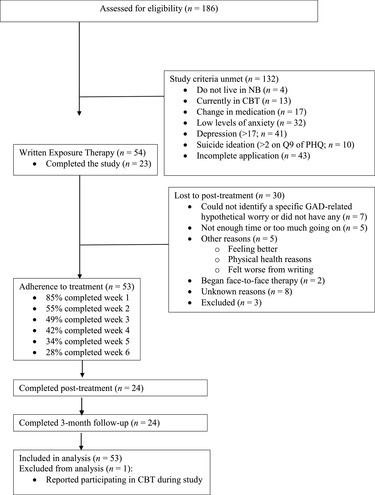
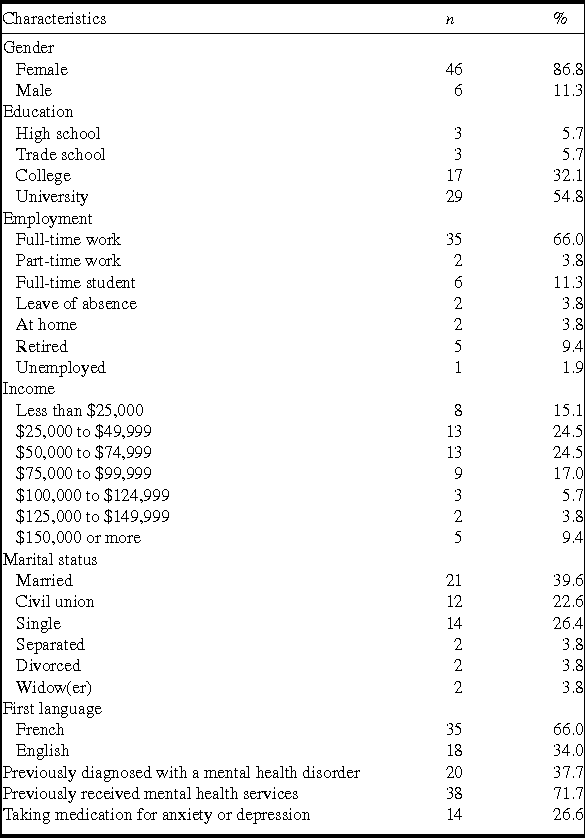
Participants were recruited from the general population in New Brunswick, Canada, using advertisements in different media. Recruitment took place between July and September 2015. In total, 186 individuals applied and 54 met the following inclusion criteria: resident of New Brunswick of at least 18 years of age, reliable internet access and clinical levels of anxiety based on two established measures of anxiety. An initial inclusion criterion was for applicants to show clinical levels of anxiety and worry as indicated by a total score ≥10 on the Generalized Anxiety Disorder-7 (GAD-7) and ≥55 on the Penn State Worry Questionnaire (PSWQ). Considering the number of applicants who did not meet this criterion, the cut-off scores were reduced to 8 and 45, respectively, which are acceptable (Behar et al., Reference Behar, Alcaine, Zuellig and Borkovec2003; Kroenke et al., Reference Kroenke, Spitzer, Williams, Monahan and Löwe2007). The exclusion criteria were: currently experiencing significant levels of depression or suicidal ideation (defined as a total score ˃17 or responding > 2 to Question 9 [suicidal ideation] on the Patient Health Questionnaire-9); currently participating in cognitive behaviour therapy (CBT); a change of psychotropic medication intake 1 month prior to the study or anticipated changes in the following month. Participant flow, including treatment attrition and adherence, is illustrated in Fig. 1. A total of 53 participants were included in intent-to-treat analyses. The sociodemographic and mental health characteristics of the sample are presented in Table 1.
Mind at Peace study flow chart

Participant sociodemographic and mental health characteristics (n = 53)

Percentages may not add up to 100% due to missing data.
Feasibility outcome measures
Treatment adherence
Treatment adherence was measured using the percentage of participants who completed the 6-week intervention, i.e. who sent to the primary investigator their hypothetical worry and scenarios.
Attrition
The percentage of participants who did not complete the post-test or follow-up was used as a measure of attrition.
Treatment acceptability
Acceptability was assessed post-treatment using four multiple choice or yes/no questions (adapted from Titov et al., Reference Titov, Dear, Johnston, Lorian, Zou and Wootton2013): (1) ‘Overall, how satisfied are you with the intervention?’ (unsatisfied/somewhat satisfied/mostly satisfied/satisfied), (2) ‘How would you evaluate the quality of the material?’(unsatisfactory/neutral/good/excellent), (3) ‘Would you recommend this intervention to a friend with anxiety?’ (yes/no), and (4) ‘Was the intervention worth your time?’ (yes/no). Four open-ended questions were also included to inquire about what was the most and least helpful and suggestions for improvements. A telephone interview was also conducted to review participants’ answers on the satisfaction questionnaire, the perceived level of difficulty of the writing sessions and the adequacy of their duration.
Screening and treatment efficacy
Brief self-report measures were administered online in English or French. Pre-treatment Cronbach's alpha values are reported, and were all adequate.
Screening and primary outcome measures
Generalized Anxiety Disorder 7-item scale (GAD-7; Spitzer et al., Reference Spitzer, Kroenke, Williams and Löwe2006; French translation by MAPI Research Institute, 2016): the GAD-7 includes seven items assessing GAD symptoms and severity based on DSM-IV criteria. A threshold score of 8, with a sensitivity of 0.92 and a specificity of 0.76, was identified as an adequate cut-off score for identifying possible cases of anxiety disorders (Kroenke et al., Reference Kroenke, Spitzer, Williams, Monahan and Löwe2007). Items are rated on a 4-point scale with higher scores reflecting greater symptom severity (Spitzer et al., Reference Spitzer, Kroenke, Williams and Löwe2006; α = .80).
Penn State Worry Questionnaire (PSWQ; Meyer et al., Reference Meyer, Miller, Metzger and Borkovec1990; French translation by Gosselin et al., Reference Gosselin, Dugas, Ladouceur and Freeston2001): the PSWQ consists of 16 items measuring the worry component of GAD using a 5-point rating scale. Its discriminant validity to distinguish GAD from other anxiety disorders has been supported. A cut-off score of 45, with a sensitivity of 0.99 and a specificity of 0.98, has been used to identify probable cases of GAD (Behar et al., Reference Behar, Alcaine, Zuellig and Borkovec2003). Higher scores represent higher levels of worry (α = .83).
Patient Health Questionnaire 9-item scale (PHQ-9; Kroenke et al., Reference Kroenke, Spitzer and Williams2001; French translation by MAPI Research Institute): the PHQ-9 includes nine items assessing the symptoms and severity of major depression based on DSM-IV criteria. Answers are rated on a 4-point scale with higher scores representing higher levels of depression (α = .72).
Satisfaction with Life Scale (SWLS; Diener et al., Reference Diener, Emmons, Larsen and Griffin1985; French translation by Blais et al., Reference Blais, Vallerand, Pelletier and Brière1989): the SWLS consists of five items assessing perceived global life satisfaction. Items are rated on a 7-point scale with higher scores representing greater life satisfaction (α = .84).
Intervention
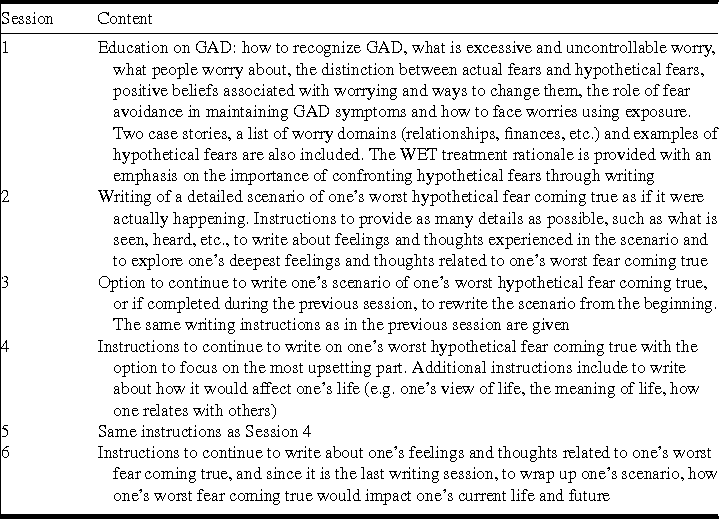
The intervention Mind at Peace is a 6-week internet-delivered WET for hypothetical fears consisting of a psychoeducation session followed by five weekly 30-minute writing sessions on one's worst fear coming true. Presented like an online course, Mind at Peace is delivered using a secure and encrypted website that is hosted on the WordPress platform by Accra Solutions Inc. Access to the website is username and password protected and the intervention is available in either English or French. Session 1 includes printable psychoeducation material from a public website on anxiety and its treatmentFootnote 2 and a list of worry domains similar to the one used by Fracalanza et al. (Reference Fracalanza, Koerner and Antony2014). The treatment rationale is provided with a reminder that the writing task is about a hypothetical fear, not a real one, and that writing about such a fear would not make it happen. During that session, one's worst hypothetical fear is also identified. Participants emailed their chosen fear to the research coordinator, a clinical doctorate psychology student, to check for appropriateness. In doubt, additional information was requested. When the chosen fear was about a current problem, participants received an email reminding them of the distinction between fears about current problems and hypothetical situations and asking them to change their fear and email it to us. General instructions about the writing tasks (e.g. to write in a quiet area, to not be concerned about spelling, grammar, etc.) were provided in Session 2 along with a reminder to write, as part of exposure, about the same worst hypothetical fear during each writing session. After each session, encouragement was given to allow oneself to experience any feelings, images or thoughts that may come up during the week in relation to one's hypothetical fear rather than pushing them away. Sessions 2 to 6 included specific instructions pertaining to the writing task for each session (see Table 2 for a description of all sessions).
Content of weekly sessions

Standardized weekly emails were provided by the research coordinator using Titov and collaborators’ email protocol.Footnote 3 Emails were delivered using an encrypted email account by the research coordinator and were personalized using participants’ first name. They aimed to (1) provide downloadable instructions on the writing task; (2) send reminders; (3) reinforce progress; (4) normalize the challenges of exposure; and (5) reinforce the importance of repeated exposure. All scenarios were reviewed by the research coordinator to monitor adherence to the treatment protocol. In the presence of deviations, minimal clinical guidance was provided by the research coordinator on an as-needed basis under the supervision of the second author, a clinical psychologist. A telephone contact pre- and post-treatment was also included to review study procedures, to encourage motivation and adherence (Carlbring et al., Reference Carlbring, Bohman, Brunt, Buhrman, Westling, Ekselius and Andersson2006; Nordin et al., Reference Nordin, Carlbring, Cuijpers and Andersson2010), to answer any questions and to get feedback on the intervention.
Safety protocol
Participants’ state was monitored on a weekly basis. Those whose PHQ-9 and GAD-7 total scores increased from pre-treatment by more than 5 points and had a total score of 15 and above on the PHQ-9 or the GAD-7 were contacted by email to provide instructions about how to contact crisis services if needed. Those whose PHQ-9 total score was above 20 or who scored ‘3’ to Question 9 were telephoned by the second author to assess the situation and to provide a management plan.
Statistical analyses
One-way repeated measures analyses of variance (ANOVAs) were performed to assess differences between T1 (pre-treatment), T2 (post-treatment) and T3 (3-month follow-up) followed by post hoc comparisons with Bonferroni correction. Intention-to-treat and study completer analyses were conducted. The former were performed using the baseline observation carried forward (BOCF). Study completers were defined as participants who provided both pre-treatment and post-treatment data. t-tests and chi-squared tests were conducted to compare study completers with study non-completers based on sociodemographic characteristics and pre-treatment outcome measures. To assess effective engagement, GAD-7 scores of participants who completed the post-test were compared across adherence levels using a repeated measures ANOVA with group [completion of Week 1 only (Group 1), completion of Week 2 only (Group 2), etc.] by time (pre-test/post-test). Remission rates were calculated for study completers using the GAD-7, PSWQ and PHQ-9 to assess the clinical significance of the findings. Remission rates were defined as the proportion of participants who scored above the clinical cut-off score at T1 and below the clinical cut-off at T2 or T3 on the GAD-7 (score ≥ 8), the PSWQ (score ≥ 45) or the PHQ-9 (score ≥ 10).
Results
Attrition
As shown in Fig. 1, the attrition rate was 56.6% (n = 30/53). Most of participants who withdrew from the study did not take part in exposure (n = 24; 80%) while the others dropped out after one or two writing sessions. Chi-squared tests revealed no significant differences between the study completers (n = 23) and non-completers (n = 30) on sociodemographic characteristics, grouped in larger categories to allow a sufficient number of participants in each cell, previous use of mental health services and mental health diagnoses (all p-values > .05). t-tests revealed no significant differences on all pre-treatment outcome measures (all p-values > .05).
Treatment adherence
Twenty-eight per cent of participants completed all sessions of the intervention Mind at Peace. About half of the participants received one to two emails for clinical guidance (n = 26; 49%), mostly to help them identify a GAD-related hypothetical fear (n = 19/26; 73%). Of those, nine participants (47%) received additional information on what a hypothetical fear is, 10 (53%) were asked to choose another fear as the one that they identified was not GAD-related, and eight (42%) were asked if their hypothetical fear was a current issue (e.g. fear of losing one's job). Seven out of the 26 who received guidance to identify a hypothetical fear dropped out at that time (27%). Nine participants (35%) received additional clinical guidance on exposure principles (e.g. differences with journaling). The majority of study completers finished four to six sessions (n = 20/23; 87%).
Acceptability
Thirty-five per cent of the study completers (n = 8/23) reported being satisfied with the intervention, 26% (n = 6/23) mostly satisfied and 35% (n = 8/23) somewhat satisfied. One participant reported being unsatisfied. He did not participate in the writing task, which did not appeal to him, and expressed a reluctance to send his texts. The majority of participants rated the quality of the material as good to excellent (n = 19/23; 83%), while 17% (n = 4/23) rated it as neither good nor bad. All but one participant indicated that the therapy was worth their time and that they would recommend it to a friend (96%). In the open-ended questions and over the telephone (n = 21/23; 91%), the majority of participants reported finding the intervention helpful, interesting, or even enjoyable (n = 14; 60%). Half of the study completers (n = 12; 52%) reported finding the writing task difficult, but half of them nevertheless reported finding the intervention helpful or interesting. When asked about potential improvements, a few participants (n = 5; 24%) found that there were too many writing sessions, that they had nothing else to write about or were repeating themselves. Others mentioned that they would have liked to get feedback on their texts (n = 4; 19%) or would have appreciated additional psychoeducation (n = 3; 14%).
Preliminary efficacy of ‘Mind at Peace’
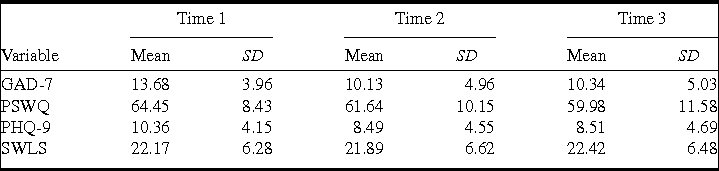
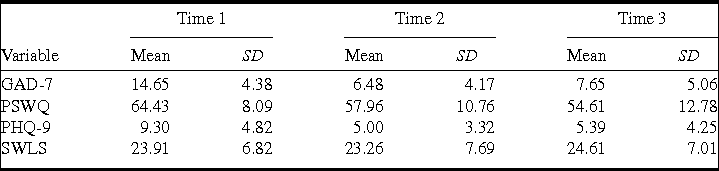
Means and standard deviations for all outcome measures are presented in Tables 3 and 4. All assumptions for one-way repeated measures ANOVAs were met, excluding, for most of the analyses, the assumption of sphericity. As a result, multivariate test results are reported.
Entire sample's pre-treatment, post-treatment and follow-up means and standard deviations on all outcome measures

GAD-7, Generalized Anxiety Disorder-7; PSWQ, Penn State Worry Questionnaire; PHQ-9, Patient Health Questionnaire-9; SWLS, Satisfaction with Life Scale.
Study completers’ pre-treatment, post-treatment and follow-up means and standard deviations on all outcome measures

GAD-7, Generalized Anxiety Disorder-7; PSWQ, Penn State Worry Questionnaire; PHQ-9, Patient Health Questionnaire-9; SWLS, Satisfaction with Life Scale.
Primary outcome measures
Intent-to-treat
A significant and large time effect was found on the GAD-7, F (2,51) = 14.43, p < .001, multivariate partial eta squared = .36. Post hoc tests showed that GAD-7 scores decreased significantly from T1 to T2, p < .001, with no significant change from T2 to T3. Similar results were found for the PSWQ, with a large time effect F (2,51) = 7.72, p = .001, multivariate partial eta squared = .23, with a significant decrease from T1 to T2, p = .004, and no significant difference from T2 to T3.
Study completers
A one-way repeated measures ANOVA indicated a significant and large time effect on the GAD-7, F (2,21) = 44.76, p < .001, multivariate partial eta squared = .81. Post hoc tests revealed that GAD-7 scores decreased significantly from T1 to T2, p < .001, with no significant change from T2 to T3. A significant and large time effect, F (2,21) = 10.77, p = .001, multivariate partial eta squared = .51, was found on the PSWQ with a significant decrease from T1 to T2, p = .002, and no significant difference from T2 to T3.
Effective engagement
A repeated measures ANOVA with group (defined according to treatment adherence) by time (pre-treatment, post-treatment) was conducted on GAD-7 scores. Groups consisted of study completers who completed Week 1 only (Group1), Week 4 or Week 5 only (Group 2) or all six weeks of the intervention (Group 3) and completed the post-test. No participants completed Week 2 or Week 3 only. As two participants stopped after Week 4, and three stopped after Week 5, these two groups were combined (n = 5). A significant time effect was found, F (1,20) = 53.28, p < .001, but no significant group effect (F (2,20) = .44) or group by time interaction (F (2,20) = 1.93). Examination of participants’ GAD-7 scores revealed that scores decreased from the moderate range to the mild range of anxiety for the three groups.
Secondary outcome measures
Intent-to-treat
A significant and large time effect was found on the PHQ-9, F (2,51) = 8.09, p = .001, multivariate partial eta squared = .24. Post hoc comparisons showed significant reductions in scores from T1 to T2, p = .001, with no significant changes from T2 to T3. No significant change was observed on the SWLS
Study completers
Analyses revealed a significant and large time effect on the PHQ-9, F (2,21) = 12.04, p < .001, multivariate partial eta squared = .53. Post hoc comparisons showed significant reductions in scores from T1 to T2, p < .001, with no significant changes from T2 to T3. No significant change was found on the SWLS.
Clinical significance
Remission
At T1, 21 of the study completers (n = 23) had anxiety at or above the cut-off score for the GAD-7.Footnote 4 Of those participants, 15 (71%) were below the cut-off score at T2, and 13 (62%) at T3. Twenty-three participants scored at or above the clinical PSWQ cut-off score. Five (22%) and seven (30%) of those participants scored below the PSWQ's cut-off score at T2 and T3. Twelve (12) participants had scores at or above the clinical cut-off score on the PHQ-9. Of those, 10 (83%) and eight (67%) scored below the cut-off score at T2 and T3.
Discussion
This study examined the feasibility of a brief guided iWET, Mind at Peace, for the treatment of hypothetical worries associated with generalized anxiety. Over the course of 3 months, we successfully recruited 53 eligible adults. Hypotheses regarding preliminary treatment efficacy were supported, but challenges were encountered with attrition and adherence. This study provided valuable information on areas to refine or adapt in relation to these feasibility outcomes. Suggestions for improvement in future research are provided.
Despite the use of several procedures to promote study completion beside email messages, including clinical guidance on an as-needed basis and a scheduled pre-post telephone interview (Nordin et al., Reference Nordin, Carlbring, Cuijpers and Andersson2010), attrition in the current study (57%) was higher than WET for PTSD (9%; Sloan et al., Reference Sloan, Marx, Bovin, Feinstein and Gallagher2012), iCBT for anxiety (Titov et al., Reference Titov, Dear, Schwencke, Andrews, Johnston, Craske and McEvoy2011, Reference Titov, Dear, Johnston, Lorian, Zou and Wootton2013) and for face-to-face cognitive exposure for GAD (19%, Hoyer et al., Reference Hoyer, Beesdo, Gloster, Runge, Höfler and Becker2009; 17%, Provencher et al., Reference Provencher, Dugas and Ladouceur2004). Half the study completers reported that the intervention was challenging, but it did not prevent them from making improvements and completing the study. Furthermore, other exposure-based studies involving flooding have lower attrition rates (Hoyer et al., Reference Hoyer, Beesdo, Gloster, Runge, Höfler and Becker2009; Provencher et al., Reference Provencher, Dugas and Ladouceur2004), therefore suggesting that the attrition rate in this study is unlikely to be primarily related to the nature of the task. There were no pre-treatment differences between study completers and non-completers, suggesting that the drop-out rate is also unlikely to have been driven by participants with higher levels of worry or depression. Rather, it appears to have resulted primarily from the identification of hypothetical worries at Week 1. This phase required more guidance than anticipated with most participants dropping out during that phase of the intervention.
Future studies may benefit from including, as part of the screening process, a telephone interview to identify core hypothetical worries related to generalized anxiety using questions, such as the ones suggested by Meares and Freeston (Reference Meares and Freeston2015) and techniques such as the vertical arrow (Dugas and Robichaud, Reference Dugas and Robichaud2007). The inclusion of a diagnostic interview would also reduce the likelihood of including participants who do not have worries about hypothetical situations but about current problems. The treatment of hypothetical worries using WET may also present additional challenges than the treatment of PTSD or other anxiety disorders given their future-orientated nature. The provision of scheduled weekly therapist contact, as provided in WET or oSWT for PTSD, as opposed to guidance on a needed basis may be indicated.
Despite our best efforts, treatment adherence was lower than in guided transdiagnostic iCBT for anxiety and depression using the same standardized email messages protocol as Titov and colleagues (58–81%; Titov et al., Reference Titov, Dear, Schwencke, Andrews, Johnston, Craske and McEvoy2011, Reference Titov, Dear, Johnston, Lorian, Zou and Wootton2013). Adherence was also lower than in guided oSWT (59–84%; Knaevelsrud and Maercker, Reference Knaevelsrud and Maercker2007; Knaevelsrud et al., Reference Kanevelrsrud, Brand, Lange, Ruwaard and Wagner2015). A number of participants dropped out of the study after Week 1, which lowered the adherence rate. The suggestions made above to increase attrition would be likely to improve treatment adherence as well. Higher treatment adherence was obtained once exposure was initiated with half the participants completing all writing sessions. Moreover, participants who did not complete the intervention, but completed the study, showed significant improvements post-treatment, suggesting that they may have stopped the intervention after having sufficiently engaged with it to obtain the intended benefits. A few of them stopped after Week 1 which offered psychoeducation only. This is consistent with a meta-analysis showing that even passive psychoeducation in the form of pamphlets can have a significant impact on psychological distress (Donker et al., Reference Donker, Griffiths, Cuijpers and Christensen2009). These findings highlight the relevance, in future iWET studies, to assess effective engagement with the intervention to obtain a more accurate picture of treatment adherence and treatment response.
Findings on acceptability also provided insight in ways to improve the future use of Mind at Peace. Varying levels of treatment satisfaction were obtained among study completers. Lower levels may have been obtained when considering participants who dropped out of the study as well, but no data were available in this regard. The possibility remains that participants who dropped out may have done so as a result of being dissatisfied. About 60% of the study completers were mostly satisfied to satisfied with the intervention, which is lower than in other iCBT studies (71–93% reporting being mostly satisfied to very satisfied; Titov et al., Reference Titov, Andrews, Johnston, Robinson and Spence2010, Reference Titov, Dear, Schwencke, Andrews, Johnston, Craske and McEvoy2011). A few participants found that there were too many writing sessions, that they had nothing else to write about, or that they were repeating themselves. This may have affected their treatment satisfaction. Scheduled weekly therapist guidance would be helpful to address this issue and to ensure that fear avoidance would not be involved. Only one participant reported being unsatisfied. All but one study completer rated Mind at Peace as worthwhile and reported that they would recommend it to a friend. Participants’ suggestions to provide additional psychoeducation and personalized feedback on their scenarios may prove to be valuable in further increasing acceptability.
Preliminary findings on treatment efficacy, including remission rates, are encouraging with similar results obtained in the intent-to-treat and study completers analyses. The results are similar to the moderate to large within-group improvements found in written exposure for GAD associated hypothetical worries using the expressive writing paradigm (Fracalanza et al., Reference Fracalanza, Koerner and Antony2014; Goldman et al., Reference Goldman, Dugas, Sexton and Gervais2007). The significant improvement in symptoms is also similar to oSWT for PTSD and complicated grief (Ruwaard and Lange, Reference Ruwaard, Lange, Lindefors and Andersson2016), as well as guided iCBT for GAD (Olthuis et al., Reference Olthuis, Watt, Bailey, Hayden and Stewart2016; Titov et al., Reference Titov, Andersson, Paxling, Lindefors and Andersson2016). The large improvements found on anxiety and worry in this study also compare favourably to those reported for face-to-face therapy including WET for PTSD (Sloan et al., Reference Sloan, Marx, Bovin, Feinstein and Gallagher2012) and traditional face-to-face cognitive exposure therapy for GAD (Hoyer et al., Reference Hoyer, Beesdo, Gloster, Runge, Höfler and Becker2009; Provencher et al., Reference Provencher, Dugas and Ladouceur2004). Secondary gains on depression were also observed. No change in life satisfaction was found, but this is probably because pre-test scores were comparable to those found among healthy populations (Diener et al., Reference Diener, Emmons, Larsen and Griffin1985).
Remission rates among study completers based on the GAD-7 were elevated. Lower remission rates were found in the current study using the PSWQ than the GAD-7. The GAD-7 may measure changes in more general anxiety symptoms associated with GAD and as such be more sensitive to initial treatment change than the PSWQ (Dear et al., Reference Dear, Titov, Sunderland, McMillan, Anderson, Lorian and Robinson2011). Mind at Peace may primarily target remission from more general anxiety symptoms associated with GAD than worry, which may take more time to change. This may explain increasing PSWQ-based remission rates in worry from post-treatment to follow-up observed in this study and in another iCBT study (e.g. Paxling et al., Reference Paxling, Almlöv, Dahlin, Carlbring, Breitholtz, Eriksson and Andersson2011).
This study has a number of limitations. Being a feasibility study, the sample was small, and no control or comparison group was included. A larger randomized controlled clinical trial is needed before any conclusions can be drawn about the efficacy of Mind at Peace. Most participants were women, had a post-secondary education, and worked full-time, which may affect the generalization of the findings. No diagnostic interview was used pre- and post-treatment, which can also limit the generalization of the findings. However, clinical levels of generalized anxiety were determined using clinical cut-off scores on two well-established screening measures for GAD in an attempt to simulate the use of Mind at Peace on an automated and publicly available website (Titov et al., Reference Titov, Dear, Johnston, Lorian, Zou and Wootton2013). This procedure also aimed to allow people who would not fully meet diagnostic criteria to access treatment.
Conclusion
This feasibility study allowed us to gain meaningful experience in how iWET for hypothetical worries could be delivered in a more feasible and acceptable way. It is believed that the intervention Mind at Peace is feasible with methodological modifications. As a first-line intervention, iWET has the potential to ease access to care while reducing costs. Exposure-based treatments for GAD may be a more parsimonious treatment option for people struggling mostly with hypothetical fears than available treatment packages. Exposure being a core treatment component for a number of anxiety disorders, and anxiety disorders being highly comorbid, transdiagnostic iWET or tailored iWET based on client preferences and symptom profile may prove to be efficient interventions (Andersson and Titov, Reference Andersson and Titov2014). Such treatment venues would be worth exploring as they may further facilitate access to evidence-based care.
Acknowledgements
The authors acknowledge D.M. Sloan and contributors, N. Titov and contributors, as well as AnxietyBC for sharing their material. We also thank Accra Solutions Inc. for the provision of technical assistance throughout the study.
Conflicts of interest: Margaux Roch-Gagné and France Talbot have no conflicts of interest with respect to this publication.
Ethical statement: The authors have abided by the Ethical Principles of Psychologists and Code of Conduct. This study was approved by the research ethics committee of the Université de Moncton (reference number: 1415-031).
Funding: This work was supported by the Faculté des études supérieures et de la recherche of the Université de Moncton.



Comments
No Comments have been published for this article.