Introduction
Recent progress in in vitro maturation (IVM) and in vitro fertilization (IVF) technologies has promoted the use of porcine embryos for the study of early zygotic development (Tatemoto et al., Reference Tatemoto, Ootaki, Shigeta and Muto2001, Reference Tatemoto, Muto, Sunagawa, Shinjo and Nakada2004; Brad et al., Reference Brad, Bormann, Swain, Durkin, Johnson, Clifford and Krisher2003; Marchal et al., Reference Marchal, Caillaud, Martoriati, Gerard, Mermillod and Goudet2003). However, in porcine IVF, the abnormally high incidence of polyspermy, which often exceeds 50% (Nagai et al., Reference Nagai, Niwa and Iritani1984; Wang et al., Reference Wang, Abeydeera, Okuda and Niwa1994; Asano & Niwa, Reference Asano and Niwa2004), remains a major impediment.
Various improvements have been applied to the method of porcine IVF to decrease the polyspermy rate while maintaining a high sperm penetration rate. The addition of oviductal epithelial cells (Nagai & Moor, Reference Nagai and Moor1990; Kano et al., Reference Kano, Miyano and Kato1994), oviductal fluid (Kim et al., Reference Kim, Funahashi, Abeydeera, Moon, Prather and Day1996), or porcine oviduct-specific glycoprotein (Kouba et al., Reference Kouba, Abeydeera, Alvarez, Day and Buhi2000; McCauley et al., Reference Marchal, Caillaud, Martoriati, Gerard, Mermillod and Goudet2003) to IVF medium has been used to reduce the incidence of polyspermy in porcine oocytes, suggesting that factor(s) secreted from the oviduct may be associated with the functional block of polyspermy during IVF. Our recent study clearly demonstrated that chondroitin sulfate A-derived oligosaccharide (ChSAO) strictly inhibited the hyaluronidase activity extracted from boar spermatozoa, and the incidence of polyspermy was effectively reduced to 30% by the addition of 10 μg/ml ChSAO to IVF medium in cumulus-free oocytes while maintaining high sperm penetrability (Tatemoto et al., Reference Tatemoto, Muto, Yim and Nakada2005). From these results, it is expected that the high incidence of polyspermy will be repressed by blocking sperm hyaluronidase activity during IVF. However, since the addition of anti-hyaluronidase ChSAO to IVF medium significantly decreased the number of sperm bound to the zona pellucida (ZP) in a concentration-dependent manner, it is not clear whether the prevention of polyspermy by ChSAO during IVF results from inhibiting sperm hyaluronidase activity or blocking primary sperm-ZP binding related to carbohydrate-mediated events.
In general, the hyaluronidase in sperm plasma mem-brane is thought to hydrolyse hyaluronic acid in the extracellular matrix of the expanded cumulus cells to allow sperm to penetrate the cumulus layer and proceed to fertilize the egg (McRorie & Williams, Reference McRorie and Williams1974; Yanagimachi, Reference Yanagimachi, Knobil and Neill1994; Thaler & Cardullo, Reference Thaler and Cardullo1995). Although the various mammalian hyaluronidases are derived from different genes, they share certain struc-tural and biological characteristics with one another and with other glycosidases. Sperm hyaluronidase activity is provided by the PH-20 molecule, which is a glycosyl phosphatidylinositol-anchored membrane protein (Phelps et al., Reference Phelps, Primakoff, Koppel, Low and Myles1988). PH-20 homologues have been identified in guinea pigs (Primakoff & Myles, Reference Primakoff and Myles1983; Primakoff et al., Reference Primakoff, Hyatt and Myles1985), mice (Lin et al., Reference Lin, Mahan, Lathrop, Myles and Primakoff1994; Baba et al., Reference Baba, Kashiwabara, Honda, Yamagata, Wu, Ikawa, Okabe and Baba2002), monkeys (Cherr et al., Reference Cherr, Meyers, Yudun, VandeVoort, Myles, Primakoff and Overstreet1996, Reference Cherr, Yudin, Li, Vines and Overstreet1999), horses (Meyers, Reference Meyers2001) and humans (Gmachl et al., Reference Gmachl, Sagan, Ketter and Kreil1993). The 64 kDa membrane-bound isoform has a broad optimal pH range, with the strongest activity at neutral pH (pH 7.0), while the 53 kDa soluble form exhibits activity only at acidic pH (pH 4.0) (Cherr et al., Reference Cherr, Meyers, Yudun, VandeVoort, Myles, Primakoff and Overstreet1996, Reference Cherr, Yudin and Overstreet2001; Li et al., Reference Li, Cherr, Yudin and Overstreet1997a, Reference Li, Yudin, Robertson, Cherr and Overstreet2002). According to the findings reported by Fléchon et al. (Reference Fléchon, Degrouard, Kopečný, Pivko, Pavlok and Motlik2003), when porcine oocytes were prevented from accumulating hyaluronidase-sensitive extracellular matrix in the perivitelline space and the ZP surface during IVM, although there was no effect on meiotic division, the incidence of polyspermy was increased during subsequent in vivo fertilization. In short, these data are the first experimental evidence that the extracellular matrix synthesized on both sides of the ZP during oocyte maturation may constitute a favourable factor for appropriate sperm penetration. However, to our knowledge there have been no reports directly demonstrating interactions between hyaluronidase activity and sperm penetration during IVF of porcine oocytes.
Interestingly, a previous investigation showed that some polyphenols are potent inhibitors of commercial bull testis hyaluronidase (Kuppusamy et al., Reference Kuppusamy, Khoo and Das1990). Tannic acid, apigenin and quercetin have also been shown to inhibit the hyaluronidase activity of guinea pig sperm PH-20 (Hunnicutt et al., Reference Hunnicutt, Primakoff and Myles1996) and cynomolgus monkey sperm PH-20 (Li et al., Reference Li, Yudin, VandeVoort, Sabeur, Primakoff and Overstreet1997b; Meyers et al., Reference Meyers, Yudin, Cherr, VandeVoort, Myles, Primakoff and Overstreet1997), as well as the recombinant form of cynomolgus monkey sperm PH-20 (Lin et al., Reference Lin, Mahan, Lathrop, Myles and Primakoff1994). Thus, it appeared possible that the addition of anti-hyaluronidase polyphenols to IVF medium might decrease the incidence of polyspermy in porcine oocytes. To test this possibility the following experiments were undertaken: (1) an examination of the inhibitory effects of three polyphenols ― tannic acid, apigenin and quercetin ― on the hyaluronidase activity extracted from boar sperm; (2) an evaluation of the effects of the addition of polyphenols to IVF medium on fertilization responses, including the penetration rate and incidence of polyspermy in porcine oocytes matured in vitro; (3) an examination of the effects of polyphenols on zona solubility, proteolytic activity of acrosomal contents and sperm binding to ZP.
Materials and methods
All chemicals used in the study were purchased from Sigma-Aldrich (St Louis, MO) unless otherwise stated.
Culture media
The culture medium used for oocyte maturation was North Carolina State University (NCSU) 37 medium (Petters & Wells, Reference Petters and Wells1993) supplemented with 0.57 mM cysteine, 200 μM ascorbic acid 2-O-α-d-glucoside (Hayashibara Biochemical Laboratory, Okayama, Japan), 0.04 units/ml ovine FSH, 0.02 units/ml ovine LH and 10% (v/v) porcine follicular fluid. Porcine follicular fluid was aspirated from follicles 2―6 mm in diameter, centrifuged at 10 000 g for 15 min at 4 °C to remove cellular debris, and stored at −30 °C until use. The basic medium used for IVF was essentially the same as the modified Tris-buffered medium (mTBM) used by Abeydeera & Day (Reference Abeydeera and Day1997). This mTBM was designated as IVF medium when supplemented with 2 mM caffeine sodium benzoate and 0.1% (w/v) bovine serum albumin (BSA), and as sperm preincubation medium when supplemented with 2 mM caffeine sodium benzoate, 0.1% (w/v) BSA and 0.5% (v/v) porcine follicular fluid.
Extraction of sperm hyaluronidase
Hyaluronidase was extracted from boar sperm according to the method of Li et al. (Reference Li, Yudin, VandeVoort, Sabeur, Primakoff and Overstreet1997b). For sperm preparation, frozen-ejaculated Landrace spermatozoa (three pellets of volume 100 μl and containing about 5 × 10⁷ sperm/pellet) were thawed (39 °C) and washed twice by centrifugation at 400 g for 4 min in 4 ml of Dulbecco's phosphate-buffered saline (PBS; Invitrogen, Carisbad, CA) supplemented with 0.1% (w/v) polyvinyl alcohol (PVA) at pH 7.2. The sperm pellet was resuspended at 4 × 10⁸ sperm/ml in the sperm preincubation medium, and then incubated for 90 min at 39 °C in an atmosphere of 5% (v/v) CO2 in air to induce capacitation. After preincubation, sperm suspens-ions were washed by centrifugation at 400 g for 10 min in HEPES-buffered saline (HBS; 5 mM HEPES, 150 mM NaCl, pH 7.0). The sperm pellet was resuspended in 3 ml of HBS, layered onto 3 ml of 40% Percoll (Amersham Pharmacia Biotech), then centrifuged at 300 g for 15 min to remove BSA. After washing three times by resuspension in 10 ml of HBS and centrifug-ation, the sperm pellet was resuspended at 2 ×10⁸ sperm/ml in an appropriate volume of cold HBS containing protease inhibitors (20 mM EDTA, 1 mM (p-hydroxymercuro)benzoate, 5 mM N-ethymaleimide and 1 mM benzamidine). After addition of Triton X-100 to a final concentration of 1% (v/v), the sperm suspension was vortexed for 5 min and then centrifuged at 10 000 g for 15 min at 4 °C. The supernatant was stored at −80 °C until assayed for hyaluronidase activity. The concentration of protein in sperm extract solution was determined using a Bradford protein assay reagent kit (Bio-Rad Corp., Hercules, CA).
Measurement of hyaluronidase activity
The polyphenols were dissolved in dimethylsulfoxide (DMSO) with the exception of tannic acid, which was dissolved in absolute ethanol. Aliquots (25 μl) of the polyphenol solution in the final concentration range of 0―10 μg/ml were mixed with 25 μl of sperm extract solution and preincubated for 1 h at room temperature with shaking. Control assays that contained the sperm extract and the solvent (DMSO or ethanol) without polyphenols were carried out simultaneously. The final concentration of the solvents was less than 0.1% (v/v). Hyaluronidase activity was measured by the color-imetric method using Alcian Blue 8 GX, as described previously (Baba et al., Reference Baba, Kashiwabara, Honda, Yamagata, Wu, Ikawa, Okabe and Baba2002). Human umbilical cord hyaluronic acid was dissolved at a concentration of 90 μg/ml in 50 mM sodium acetate buffer (pH 7.0) containing 50 mM MgCl2. The reaction was conducted in a mixture of 450 μl of hyaluronic acid solution and 50 μl of the sperm extract―polyphenol solution. Following incubation at 37 °C for 100 min, the reaction mixture was mixed with 700 μl of 0.02% (w/v) Alcian blue solution, and centrifuged at 10 000 g for 5 min. Absorbance of the supernatant solution at 603 nm was measured using a spectrophotometer (Shimadzu Co.). Blanks containing only the buffer and polyphenol or solvent were assayed in parallel. The units of hyaluronidase activity were determined based on the standard curve of hyaluronidase activity of bull testicular hyaluronidase with a specific activity of 500 units/mg (Sigma, H-3506).
Substrate gel assay for hyaluronidase activity
To detect proteins exhibiting the hyaluronidase activity, SDS-PAGE in the presence of hyaluronic acid was carried out under non-reducing conditions as described previously (Cherr et al., Reference Cherr, Meyers, Yudun, VandeVoort, Myles, Primakoff and Overstreet1996). Non-reducing SDS-sample buffer (62.5 mM Tris–HCl, pH 6.8, 10% glycerol, 1% SDS, and 0.5% bromphenol blue, final concen-trations) was added to sperm extract solution at 4 °C. Then, the samples were subjected to SDS-PAGE on 7.5% polyacrylamide gels copolymerized with 200 μg/ml human umbilical cord hyaluronic acid (Biozyme Laboratories). Following electrophoresis, gels were washed with Tris-buffered saline, pH7.0, containing 3% (v/v) Triton X-100 at room temperature for 2 h to remove SDS and then incubated in 100 mM sodium acetate buffer with or without supplementation with 10 μg/ml polyphenol at either pH 4.0 or pH 7.0 at 37 °C for 30 h. To visualize regions of digestion of hyaluronic acid in the gels, the gels were stained with 0.5% (w/v) Alcian blue 8 GX in 3% (v/v) acetic acid for 3 h, and then destained in 7% (v/v) acetic acid. The presence of activity was revealed by lack of colouration in the gel. The relative enzyme activities within a given lane were determined using an Image PC (Scion).
In vitro maturation
Ovaries were collected from maturing gilts at a local slaughterhouse and transported to the laboratory in 0.9% (w/v) NaCl containing 100 mg/l kanamycin sulfate (Meiji Seika) at 30 °C. Within 2 h of slaughter, the follicular contents were recovered by excising the visible small antral follicles (about 2―6 mm in diameter) on the ovarian surface using a razor, and by scraping the inner surface of the follicle walls with a disposable surgical blade. Only cumulus―oocyte complexes (COCs) with uniform ooplasm and a compact cumulus cell mass were collected and washed three times with HEPES-buffered Tyrode medium containing 0.01% (w/v) PVA (H-TL-PVA). After washing in IVM medium, groups of 20 COCs were transferred into 100 μl droplets of IVM medium that had pre-viously been covered with mineral oil and equilibrated in a 5% CO2 incubator. After 20 h of maturation culture, the oocytes were washed and transferred to 100 μl droplets of IVM medium without hormonal supple-mentation for an additional 24 h of culture. After a total 44 h of maturation culture, a proportion of the COCs were freed from their cumulus cells by treatment with H-TL-PVA containing 0.1% (w/v) hyaluronidase, followed by repeated passage through a narrow-bore pipette.
Effect on IVF of different concentrations of tannic acid
Cumulus-intact and cumulus-free oocytes were washed three times with IVF medium, and 25―30 oocytes were transferred to 50 μl droplets of IVF medium containing 0, 0.5, 1, 2, 5 or 10 μg/ml tannic acid, which had been covered with warm mineral oil. The droplets containing oocytes were kept in an incubator for 1 h until spermatozoa were added for fertilization. After thawing and washing frozen-ejaculated spermatozoa as described above, the sperm pellets were resuspended at 4 × 10⁸ cells/ml in sperm preincubation medium and then incubated for 90 min at 39 °C in an atmosphere of 5% CO2 in air. After sperm preincubation, 50 μl of diluted sperm suspension in IVF medium containing 0, 0.5, 1, 2, 5 or 10 μg/ml tannic acid was added to a droplet containing oocytes at a final sperm concentration of 1 × 10⁶ cells/ml. Oocytes were co-incubated with spermatozoa for 7 h at 39 °C in an atmosphere of 5% (v/v) CO2 in air. After insemination, oocytes were removed from the fertilization drops, washed three times and cultured in 50 μl drops of NCSU 37 medium at 39 °C in an atmosphere of 5% CO2 in air.
Effect on IVF of different polyphenols at a fixed concentration
Cumulus-free oocytes were washed three times with IVF medium, and 25–30 oocytes were transferred to 50 μl droplets of IVF medium containing 5 μg/ml of tannic acid, apigenin or quercetin, which had been covered with warm mineral oil. The concentration of polyphenols was determined at 5 μg/ml based on the data from the treatment with tannic acid in order to examine whether the reduction of the polyspermy rate during IVF was attributable to an anti-hyaluronidase action of polyphenols. The following procedures were the same as described above, except that 50 μl of diluted sperm suspension in IVF medium containing 5 μg/ml of tannic acid, apigenin or quercetin was used.
Examination of oocytes
At 10 h post-insemination, groups of 30–40 oocytes were mounted, fixed in acetic acid–ethanol (1:3, v/v) for 72 h, stained with 1% (w/v) lacmoid in 45% (v/v) acetic acid, and examined for fertilization parameters under a phase-contrast microscope at ×400 magnification. Oocytes were designated as penetrated when one or more sperm heads and/or male pronuclei and corresponding sperm tails were present. The rates of polyspermy, male pronucleus formation and mean num-ber of sperm per oocyte were determined from the oocytes that had been penetrated.
Effect on IVF of pretreatment of oocytes and/or spermatozoa with 5 μg/ml tannic acid
Cumulus-free oocytes matured in vitro were treated in the presence or absence of 5 μg/ml tannic acid in pre-equilibrated IVF medium for 90 min, washed three times in tannic-acid-free IVF medium, and transferred to droplets of tannic acid-free IVF medium. Washed spermatozoa were resuspended at 4 × 10⁸ cells/ml in sperm preincubation medium with or without 5 μg/ml tannic acid, and incubated for 90 min at 39 °C in an atmosphere of 5% (v/v) CO2 in air. Preincubated spermatozoa were washed once by centrifugation at 400 g for 4 min in tannic acid-free IVF medium, and diluted in the same medium. Several combinations of pretreated oocytes and spermatozoa were co-incubated at a final sperm concentration of 1 × 10⁶ cells/ml for 7 h at 39 °C in an atmosphere of 5% (v/v) CO2 in air. After insemination, oocytes were removed from the fertilization drops, washed three times and cultured in 50 μl drops of NCSU 37 medium at 39 °C in an atmosphere of 5% CO2 in air.
Assessment of ZP solubility
Cumulus-free oocytes matured in vitro were cultured for 4 h in IVF medium with or without 5 μg/ml polyphenols, and then washed three times in H-TL-PVA. Fifteen or 20 oocytes were transferred into 100 μl of H-TL-PVA containing 0.1% (w/v) protease and were continuously observed for dissolution of the ZP at room temperature under an inverted microscope at ×200 magnification. The time required for dissolution of the ZP in a given oocyte was recorded as the ZP dissolution time.
Assessment of proteolytic activity of acrosomal contents
The proteolytic activity of the acrosomal contents was assessed by the gelatin substrate slide method, as described previously (Maeda et al., Reference Maeda, Tatemoto, Terada and Tsutsumi1990; Thundathil et al., Reference Thundathil, Palomino, Barth, Mapletoft and Barros2001). Slides were cleaned with alcohol and cooled by keeping them in a moist chamber at 4 °C for 2 h. A 3% (w/v) gelatin suspension was prepared by dissolving gelatin in distilled water at 50 °C. A volume of 40 μl of gelatin suspension supplemented or not with 5 μg/ml polyphenol and 5 μg/ml trypsin inhibitor ovomucoid, as a negative control, was placed across on one clean slide and smeared uniformly with another slide by rubbing the two slides together. The gelatin-film-covered slides were placed horizontally in a moist chamber, and stored at 4 °C for 24 h. The slides were then fixed for 10 min by immersion in 0.05% (v/v) glutaraldehyde solution, and stored vertically in a moist chamber at 4 °C until use. Before use for digestion by spermatozoa, the gelatin slides were warmed at room temperature for 5 min.
After 90 min of preincubation, 20 μl of sperm sus-pension was placed on one end of a slide and smeared with a cover glass taking care not to disrupt the gelatin film. After air-drying, the smears were covered with a cover glass (24 × 50 mm), which was held in place with nail polish at the four corners. The slides covered with the gelatin membrane were incubated in a moist chamber at 37 °C for 2 h. Halos produced around acrosomes of spermatozoa on the gelatin film were observed under a phase-contrast microscope. The horizontal diameter of individual halos around 40–50 sperm heads was measured with a micrometer, and regarded as an indication of the proteolytic activity of the acrosomal contents.
Sperm–ZP binding assay
After IVM culture, cumulus-free oocytes were trans-ferred to IVF medium and co-incubated with capacit-ated spermatozoa for 2 h in the presence or absence of 5 μg/ml polyphenol as described above. After the co-incubation, the oocytes and bound sperm were gently pipetted 10 times with a wide-bore pipette to remove loosely bound sperm in H-TL-PVA, and fixed at room temperature for 40 min with 2% formaldehyde. The oocytes were then placed in 50 μl drops of H-TL-PVA containing 10 μg/ml of bis-benzimide Hoechst 33342 and incubated for 10 min. The oocytes were washed in H-TL-PVA, mounted, and the sperm tightly bound to ZP were counted under a fluorescent microscope (Olympus, Tokyo, Japan).
Statistical analysis
Values are presented as the mean of four independent experimental replicates. Variation between experiments is illustrated using SEM. For evaluation of the differences between groups, data on the percentage of fertilization parameters were checked for homogeneity, pooled, and then subjected to contingency table ana-lysis followed by the Tukey test for non-parametric multiple comparisons (Ryan, Reference Ryan1960). Statistical analyses of data on hyaluronidase activity, mean number of spermatozoa per penetrated oocyte, the ZP dissolution time, the halo diameter and the number of sperm bind-ing to ZPs were carried out by the Shapiro–Wilk norm-ality test and one-way or two-way ANOVA followed by the Tukey–Kramer test. All statistical analyses were carried out with the Statistical Analysis System R soft-ware package (Cary). A probability of p < 0.05 was considered to be statistically significant.
Results
Effect of polyphenols on hyaluronidase activity
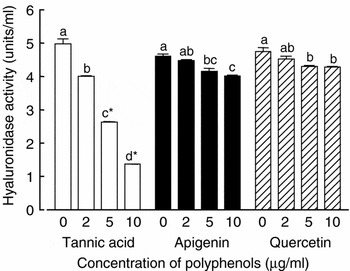
The data in Fig. 1 show the effect of three polyphenols – tannic acid, apigenin and quercetin – on the hy-aluronidase activity of preincubated boar spermatozoa extracts. Among them, tannic acid markedly inhibited hyaluronidase activity in a concentration-dependent manner over the range of 2–10 μg/ml (p < 0.05). A significant decrease in hyaluronidase activity (2.63 ±0.02 units/ml and 1.37 ± 0.01 units/ml) was found at the concentrations of 5 and 10 μg/ml, respectively, compared with that in the absence of tannic acid (4.97 ±0.16 units/ml) (p < 0.05). In contrast, both apigenin and quercetin exerted weak inhibition in a concentration-dependent fashion, but substantial hyal-uronidase activities (4.02 ± 0.03 units/ml and 4.28 ±0.03 units/ml, respectively) were still observed when these agents were added at a concentration of 10 μg/ml.
Inhibitory effect of polyphenols on the hyaluro-nidase activity of preincubated boar sperm extract. Values are expressed as the mean ± SEM. a–dValues with different superscripts within each polyphenol are significantly dif-ferent (p < 0.05). *Values are significantly different compared with those of other polyphenols at a given concentration (p < 0.05).

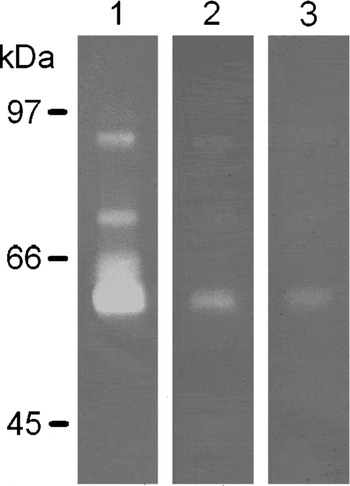
To detect the isoenzymes of hyaluronidase in the extracts of preincubated boar spermatozoa, hyaluronic acid substrate gel analyses were performed. As shown in Fig. 2, the hyaluronidase activity at pH 7.0 was associated with the 89, 73, 64 and 59 kDa proteins (lane 1). However, this activity was reduced to less than 12% at pH 4.0, and the hyaluronidase which corresponds to the 53 kDa protein activity was not detected (lane 2). Moreover, tannic acid (10 μg/ml) inhibited the hyaluronidase activity, as indicated by the relative digested regions of the gels at pH 7.0 (less than 6%, lane 3), but apigenin and quercetin showed no such inhibition (data not shown).
Hyaluronic acid substrate SDS-PAGE of preincu-bated boar sperm extracts. The samples (approximately 5.6 μg protein/lane) were subjected to non-reducing SDS-PAGE, and the gels were incubated at 37 °C for 30 h at pH 7.0 (lanes 1 and 3) and pH 4.0 (lane 2). Tannic acid (10 μg/ml) was added to the incubation buffer (lane 3). Positions of molecular weight standards (kDa) are shown on the left. The analysis was repeated four times; the figure shown is from a representative experiment.

Effect on IVF of different concentrations of tannic acid
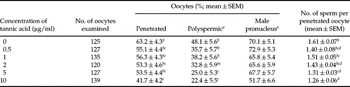
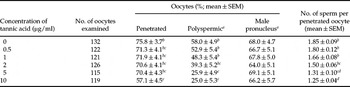
In both cumulus-intact (Table 1) and cumulus-free oocytes (Table 2), penetration rates were significantly reduced to 41.7% and 57.1%, respectively (p < 0.05), in the presence of 10 μg/ml tannic acid compared with when no tannic acid was added (63.2% and 75.8%, res-pectively). However, in the presence of 5 μg/ml tannic acid, no decrease in penetration rate was observed but the incidence of polyspermy and mean number of sperm per penetrated oocyte were significantly reduced (p < 0.05) compared with in the absence of tannic acid. Male pronucleus formation was not affected by the presence of tannic acid and its concen-tration in either cumulus-intact or cumulus-free oocytes. Consequently, the addition of 5 μg/ml poly-phenols to the IVF medium in cumulus-free oocytes was selected for the subsequent experiments to exam-ine whether there was a direct correlation between the inhibition of hyaluronidase activity and polyspermic fertilization.
Effect of tannic acid on fertilization parameters of cumulus-intact porcine oocytes matured and fertilized in vitro

aPercentage of oocytes that were penetrated.
b–dValues with different superscripts within a column are significantly different (p < 0.05).
Effect of tannic acid on fertilization parameters of cumulus-free porcine oocytes matured and fertilized in vitro

aPercentage of oocytes that were penetrated.
b–dValues with different superscripts within a column are significantly different (p < 0.05).
Effect on IVF of different polyphenols at a fixed concentration
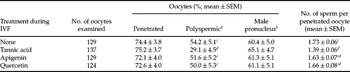
No difference was found in the incidences of penetration and male pronucleus formation irrespective of the addition of polyphenols to IVF medium (Table 3), but the rate of polyspermy in oocytes treated with tannic acid was significantly lower than that in oocytes treated with apigenin or quercetin or without polyphenols (p < 0.05). In addition, prevention of polyspermy was not detected in the oocytes fertilized in the presence of apigenin and quercetin.
Effect of polyphenols on fertilization parameters of cumulus-free porcine oocytes matured and fertilized in vitroa

aConcentrations of all polyphenols were 5 μg/ml.
bPercentage of oocytes that were penetrated.
c, dValues with different superscripts within a column are significantly different (p < 0.05).
Pretreatment of oocytes and spermatozoa prior to IVF
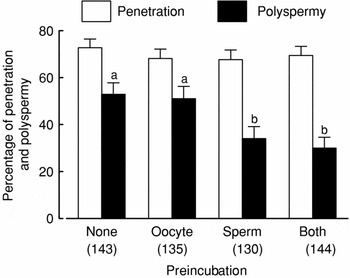
The optimal concentration of tannic acid (5 μg/ml, as determined above) was used in this experiment. Pretreatment of oocytes did not decrease the incidence of penetration (68.2%) or polyspermy (51.1%), but pretreatment of spermatozoa significantly reduced the polyspermy rate (34.1%) compared with the control (52.9%), without affecting the rate of penetration (p < 0.05) (Fig. 3). No synergistic effect was observed when both spermatozoa and oocytes were pretreated with tannic acid.
Effects of pretreatment of oocytes and/or sper-matozoa with tannic acid on the penetration and poly-spermy rates. In vitro matured oocytes and/or spermatozoa were incubated in the presence or absence of 5 μg/ml tannic acid for 90 min immediately before insemination. Values are expressed as the mean ± SEM. The numbers of oocytes examined are indicated in parentheses. Within the same category, values with different superscripts are significantly different (p < 0.05).

Effect of polyphenols on ZP solubility
No effect was observed on the ZP dissolution time of the oocytes incubated for 4 h in the presence of tannic acid, apigenin or quercetin (5.0 ± 0.1 min, 5.0 ± 0.1 min and 5.1 ± 0.1 min, respectively), compared with that in the absence of polyphenols (5.1 ± 0.2 min).
Effect of polyphenols on proteolytic activity of acrosomal contents
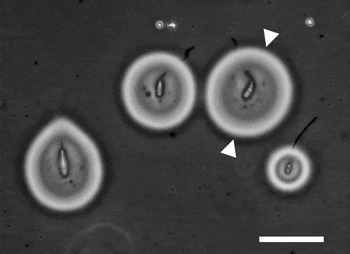
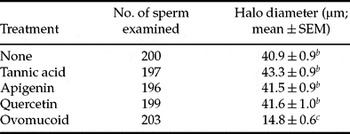
As shown in Fig. 4, preincubated spermatozoa pro-duced halos on the gelatin substrate slide as a result of gelatin digestion by the acrosomal contents from spermatozoa. Treatment with the trypsin inhibitor ovomucoid significantly decreased the halo diameter (14.8 ± 0.6 μm) compared with the control (40.9 ±0.9 μm) (p < 0.05), but no significant difference in the halo diameter was observed with any treatments with polyphenols (Table 4).
Halos made by the digestion with acrosomal contents from preincubated boar spermatozoa on a gelatin substrate slide in the presence of 5 μg/ml tannic acid. Halo diameter is the distance between arrowheads. Scale bar represents 50 μm.

Effect of polyphenols on the halo diameter as an indication of the proteolytic activity of acrosomal contents in preincubated boar spermatozoaa

a Concentration of all reagents was 5 μg/ml.
b, c Values with different superscripts within a column are significantly different (p < 0.05).
Effect of polyphenols on sperm binding to ZP
No difference was observed in the number of sperm bound to the ZP regardless of treatment with tannic acid, apigenin or quercetin (114.5 ± 9.1, 116.5 ± 9.6 or 115.5 ± 6.7 sperm/oocyte, respectively), compared with the control (104.5 ± 6.8 sperm/oocyte).
Discussion
Polyphenols such as tannic acid, apigenin and quercetin are known to be competitive hyaluronidase inhibitors (Kuppusamy et al., Reference Kuppusamy, Khoo and Das1990). In the present study, tannic acid inhibited the hyaluronidase activity associated with 89, 73, 64 and 59 kDa proteins in the extracts from preincubated boar spermatozoa more effectively than apigenin and quercetin (Figs. 1, 2). In agreement with these results, it has been reported that tannic acid more potently blocks the activity of commercial bull testis hyaluronidase than luteolin, apigenin, kaempferol and quercetin (Kuppusamy et al., Reference Kuppusamy, Khoo and Das1990).
When cumulus-intact and cumulus-free oocytes were inseminated in IVF medium containing 0–10 μg/ml tannic acid, the penetration and the poly-spermic fertilization rates were significantly decreased in a concentration-dependent manner, and the inci-dence of polyspermy was significantly reduced to 25.0% and 25.9%, respectively, by tannic acid at a concentration of 5 μg/ml without an effect on the penetration rate (Tables 1, 2). However, the presence of apigenin or quercetin at the same concentrations as tannic acid could not prevent polyspermy (Table 3). Inhibitory effects of anti-hyaluronidase polyphenols on sperm penetration into cumulus-intact oocytes were observed in monkeys (Li et al., Reference Li, Yudin, VandeVoort, Sabeur, Primakoff and Overstreet1997b). It is interesting that mouse sperm lacking PH-20 show delayed cumulus dispersion and a significantly lower rate of fertilization than wild-type sperm (Baba et al., Reference Baba, Kashiwabara, Honda, Yamagata, Wu, Ikawa, Okabe and Baba2002). This suggests that fertilization still occurs despite the absence of sperm PH-20, presumably because of the presence of other hyaluronidase(s) within the acrosome of mouse sperm. The data in the present study indicate that the effective decrease in the incidence of polyspermy is well correlated with the potency of hyaluronidase inhibition by polyphenols. However, to our knowledge there is no report describing the possible role of hyaluronidase in sperm penetration of the ZP.
According to the findings reported by Honda et al. (Reference Honda, Siruntawineti and Baba2002), analysis of acrosin-deficient mouse sperm-atozoa demonstrates that acrosin is not essential for sperm–ZP interactions, including sperm penetration of the ZP, and these authors suggested that acrosin is presumably involved in the limited proteolysis and/or processing of other proteins in the acrosome and on the membranes during the acrosome reaction. Furthermore, anti-acrosin IgG had no effect on sperm penetration of the macaque ZP in vitro, while anti-PH-20 IgG was capable of blocking sperm penetration of the ZP by interference with secondary sperm–ZP binding with no effect on primary sperm–ZP binding or the zona-induced acrosome reaction (Yudin et al., Reference Yudin, Vandevoort, Li and Overstreet1999). As reported by Cherr et al. (Reference Cherr, Meyers, Yudun, VandeVoort, Myles, Primakoff and Overstreet1996), the neutral-active (pH 7.0) form of PH-20 is present on the plasma and inner acrosomal membranes and gives rise to the soluble acid-active (pH 4.0) form at the time of the acrosome reaction, and the soluble form of PH-20 may be generated as a result of protease, glycosidase and phospholipase activities that can alter the neutral-active form of PH-20. The recent report by Fléchon et al. (Reference Fléchon, Degrouard, Kopečný, Pivko, Pavlok and Motlik2003) made it clear that the extracellular matrix and its hyaluronan moiety are accumulated in the perivitelline space and the ZP surface during the maturation of porcine oocytes, and can be partially extracted with hyaluronidase but not with neuraminidase. Those authors also found that in oocytes matured in the presence of tunicamycin, an inhibitor of glycopro-tein synthesis, meiotic division was not prevented, although the amount of glycoproteins in the peri-vitelline space was significantly decreased, and the incidence of polyspermic penetration was relatively increased subsequently during in vivo fertilization. From these results, it seems that the interaction between the sperm hyaluronidase activity and the glycoproteins accumulated on both sides of the ZP during oocyte maturation may play a crucial role in preventing polyspermic fertilization in pigs. The present study confirmed that the penetration and the polyspermy rates were reduced by treatment with tannic acid, which did not disturb the proteolytic activity of acrosomal contents of preincubated spermatozoa (Table 4). In addition, we are now establishing that there is no toxic effect of treatment with 5 μg/ml tannic acid during IVF on embryo development to the blastocyst stage (20.7%) and the nucleus number in blastocysts (49.4 ± 2.4) as compared with no treatment (15.0% and 48.9 ± 2.6, respectively) (unpublished data). It is therefore speculated that treatment with tannic acid at an appropriate concentration during porcine IVF prevents polyspermy through the inhibition of hyaluronidase activity, which may be responsible for sperm penetration of the ZP.
Although treatment with tannic acid reduced the incidence of polyspermy, it is still uncertain whether the effect of tannic acid was limited to inhibition of the hyaluronidase activity or extended to blocking other events of polyspermic fertilization. To address this question, we examined the resistance of the ZP to dissolution by protease and the number of zona-bound spermatozoa. In mammalian species, spermatozoa activate oocytes by triggering calcium oscillations that persist for more than 1 h after sperm penetration (Miyazaki, Reference Miyazaki1990; Kline & Kline, Reference Kline and Kline1992; Miyazaki et al., Reference Miyazaki, Yuzaki, Nakada, Shirakawa, Nakanishi, Nakada and Mikoshiba1992; Wu et al., Reference Wu, Smyth, Luzzi, Fukami, Takenawa, Black, Allbritton and Fissore2001; Gordo et al., Reference Gordo, Roodrigues, Kurokawa, Jellerette, Exley, Warner and Fissore2002). The increase in cytoplasmic free-Ca2+ is recognized as the primary intracellular signal responsible for initiating the activ-ation process, which evokes exocytosis of cortical granules, followed by modification of ZP glycoproteins. This ZP modification is mandatory for an effective block to polyspermy (Wolf & Hamada, Reference Wolf and Hamada1977). We previously reported that the complete ZP modi-fication of porcine oocytes was seen after 3.5 h of oocyte activation, accompanied by delayed exocytosis of cortical granules (Tatemoto & Terada, Reference Tatemoto and Terada1999a,Reference Tatemoto and Teradab). This delayed ZP modification in porcine oocytes may account for the notable increase in the frequency of polyspermy during IVF. This notion was experi-mentally supported by the finding that polyspermic fertilization after insemination with spermatozoa at a concentration of 1 × 10⁶ cells/ml was inhibited in porcine oocytes that were pretreated with an appropriate concentration (6.25 μM) of calcium iono-phore A23187 to induce moderate exocytosis of cortical granules in advance (Asano & Niwa, Reference Asano and Niwa2004). In the present study, pretreatment of spermatozoa with tan-nic acid prior to insemination reduced the polyspermy rate, whereas pretreatment of oocytes with tannic acid showed no effect on the incidence of polyspermy after insemination with untreated spermatozoa (Fig. 3). In addition, the treatment of oocytes with tannic acid had no effect on the protease digestion of ZP. These findings clearly imply that the reduction in the rate of polyspermy by treatment with tannic acid during porcine IVF does not result from effects on physiological functions related to ZP modific-ation.
In the present study, the number of zona-bound spermatozoa was not decreased by the addition of three polyphenols to IVF medium, indicating that tannic acid and the other two polyphenols do not form a physical barrier to sperm binding or modify sperm binding sites on ZP. In contrast, treatment with porcine oviduct-specific glycoprotein strongly reduced the incidence of polyspermy in porcine oocytes through a reduction of the number of zona-bound spermatozoa (Kouba et al., Reference Kouba, Abeydeera, Alvarez, Day and Buhi2000; McCauley et al., Reference McCauley, Buhi, Wu, Mao, Caamano, Didion and Day2003), and the same phenomenon was detected with oocytes fertilized in the presence of ChSAO (Tatemoto et al., Reference Tatemoto, Muto, Yim and Nakada2005). Therefore, the present study is the first to show directly that inhibition of the sperm hyaluronidase activity can protect porcine oocytes against polyspermic fertilization during IVF without affecting carbohydrate-mediated events during primary sperm–ZP binding.
In summary, the data reported here demonstrate that tannic acid potently blocked the hyaluronidase activity extracted from boar spermatozoa, resulting in an effective reduction in the polyspermy rate in in vitro matured oocytes during IVF. This lower incidence of polyspermy elicited by tannic acid was not due to protective proteolytic modification of the ZP matrix before fertilization, nor to reduction of the proteolytic activity of acrosomal contents or the number of zona-bound spermatozoa. It is concluded that the anti-hyaluronidase action of tannic acid can promote the normal fertilization process by preventing polyspermy during porcine IVF. Further studies will be required to investigate the detailed mechanism of hyaluronidase functions during sperm penetration of the ZP in porcine oocytes.
Acknowledgements
This study was supported by a Grant-in-Aid for Scientific Research (C) (no. 147580247 to H.T.) from the Ministry of Education, Culture, Sports, Science and Technology of Japan, and a Research Project for Utilizing Advanced Technologies in Agriculture, Forestry and Fisheries of Japan. We are grateful to the staff of the Meat Inspection Office of the city of Oosato, Japan, for supplying the porcine ovaries.