January 9, 1877: “On this date, Fermina Castro became obliged to pay six pesos to José Velasquez within the term of ten days.” January 23: “On this date, the citizen Francisco Ortiz voluntarily promised before me to have delivered within the term of fifteen days counted from this date to the citizen Ildefonso Ordoñez the sum of fifty-seven pesos that he owes him.” February 3: “On this date the citizen Saturnino Ramirez obliged himself to pay within the term of fifteen days, the sum of sixteen pesos one real to the citizen Pioquinto Serrano for a debt of the maid Maria Estanislao Lopez who enters his authority.”Footnote 1 Each entry was signed by those parties who knew how, along with Juan Dávila, the municipal magistrate.Footnote 2 The second two were accompanied by a 5 cent stamp marked out with the municipal seal. The second two were also scrawled across with the word “cancelled (chanselado).”
This is the first page of the earliest extant libro de conocimientos in the municipal archive of the town of Tapachula in far southern Mexico. The cover page simply states “No. 12, 1877, Libro de conocimientos, Juzgado 1°.” There is no explanation of which authority this register represented, as any number of authorities could legally stand as judges of first instance. Nor is there any indication of who maintained the register, by which statute or procedure it was mandated to be kept, or what it contained. The “No. 12” could refer to the twelfth libro de conocimientos created at the court, the twelfth book of any kind in the court, or the twelfth book of 1877 on the court's shelves.Footnote 3 The title “libro de conocimientos” could not be vaguer. It translates, more or less, as “book of recognized transactions,” or, literally, “book of that which is known.”Footnote 4
The lack of explicatory details signals that this was not the first of these registers to be kept. What it contains was, when created, not a new set of practices requiring justification and context. We as historians are catching an established exercise midstream. A municipal official was carrying out responsibilities to which he was accustomed. His constituents were showing up at his offices to avail themselves of the protections and privileges of law that they knew to exist. The language used by both was relatively formulaic and the entries were quite brief. Neither clerk nor judge nor claimant made recourse to statute; no one legitimized their contracts based on the explicit citation of chapter and article of one code or another.
Whereas the participants leaving their traces in the local court may have considered these activities humdrum, historians will find them a rare and enticing, if still elusive, glimpse into a complex world of credit and debt. The libros, as I will refer to them throughout this piece, capture an active, functional small-time provincial credit market with established if evolving norms. This credit market took place at least in part in an official space, the joint municipal court and council, and involved a familiarity with if not an explicit citation of the liberal civil codes recently instated. Whereas historians in Europe and the United States have managed to recapture popular engagement with credit and debt and its regulation, Latin American historians have had great difficulty in locating the means to illuminate similar phenomena. These libros, incomplete and concise as they are, open a small window into the ways that non-elites in nineteenth-century Mexico integrated new projects of codification into their economic lives. They also illuminate how those same non-elites cemented the law and its institutions in everyday practice, both in the courtroom and beyond it, far from centers of political or economic power.Footnote 5 After initially relying on the official performance of inscription to undergird contracts that legally required no registration, people later moved their contractual activity back into private spaces and only turned to the law when enforcement was needed. In doing so, they became essential actors in the circulation and normalization of capital and in the formal and informal institutions that governed it.
The location of these registers of debts in the local court has prompted me to integrate the economic history of this era with a large literature on popular legal culture and political liberalism in the nineteenth century. Latin American economic historians looking at credit have largely focused on banking, public finance, and the investments that supported large estates. In doing so, they have moved discussions of elite politics and policy away from a focus on crony capitalism and corruption and toward a deeper understanding of the complexities of capital circulation.Footnote 6 Yet as political historians of the region have turned to popular engagement with new ideologies and practices, economic historians have not followed.Footnote 7
It is generally now taken as a given that popular classes across Latin America eagerly took up and shaped notions and practices of individual rights and liberties from Independence onward.Footnote 8 Villagers and soldiers and housewives and workers created the meanings and activities of republican citizenship—whether labeled “conservative” or “liberal”—in Latin America as much as the elite politicians who wrote constitutions. Along with the ballot box, the army, and the penny press, the courtroom was frequently host to men and women claiming and making rights as citizens within their national and local communities. In Mexico, historians have clearly shown how a context of popular demands for participation and access to justice, understood as inclusive and applicable to all, molded the political and legal reforms that defined the mid-nineteenth century and what it meant to be a Mexican citizen.Footnote 9
In the libros de conocimientos, we can see how economic activity, too, became a site for constructing both the bureaucratic state and the broader legal institutions that would endure beyond its current iterations. Law, as scholars of juridical culture assert, was never made solely by writ. By incorporating the language of the civil code into the kinds of small value contracts and transactions that they had long engaged in, everyone from petty bureaucrats to day laborers to shopkeepers transformed elite institutional aspirations into concrete practical realities. The institutions they shaped, however, were not solely or even necessarily Mexican. Rather, through the libros de conocimiento, we can see how non-elites took part in the normalization of economic tools and terms meant to facilitate commerce across the North Atlantic.
Although it covers 30 years of profound upheaval in rural Mexico, when both the global economy and local engagement with national reforms reoriented the countryside toward export production, this article is as much about continuity as it is about change. People continued to buy bricks from each other, secure a domestic worker's labor by paying her up front, and lend their neighbors a little extra cash. Local courts and legal discourse, much as they had been in the Colonial Era, remained a key site for mediation within communities and between communities and outsiders. Yet within this daily economic activity and its invocation of the law, the libros and the lawsuits held at the municipal court illustrate a gradual and incomplete transformation in the kinds of legal understandings and tools at play among non-elites.
Writ large, the nineteenth century in Latin America saw a shift from law understood as an agglomeration of norms and dictates handed down by a divinely mandated monarch to law understood as arising from the rational and collective will of the populace, uniform and applicable to all.Footnote 10 Transactional activity around credit, debt, and exchange had always held a place in the courts alongside the management of familial and other social relations, negotiations with local authorities, and issues of honor and status. In the libros de conocimiento, the new legal language of contract and equality before the law became increasingly visible across the late nineteenth century. As time passed, most activity recorded at the municipal court came to center on transaction and contract. By the turn of the century, many of those contracts and transactions moved out of the public registers, only to appear in court when agreements were not fulfilled. Norms changed not because one legal system or code abruptly replaced an older one, but because people across the social spectrum found new legal understandings and language ever more useful and gradually integrated them into their repertoire of everyday economic activities.
The uncertain authorship and concision of the documents at this article's heart mean that I can only say so much about how deeply a specific understanding of new civil and commercial codes seeped into the local vernacular. What I can do here is assemble a patchwork of close readings from the municipal court that illustrates the permeation of a basic understanding of contract law into everyday aspects of economic life. Reading the decreased per capita use of this form of contract registration by 1900 alongside moments when individuals turned to the court for enforcement illuminates how small-time players shaped new legal norms to meet their needs both inside and outside institutional spaces.Footnote 11 Increasingly enmeshed in a globalizing economy, elites and non-elites alike confronted a shift in the scale on which they produced and consumed by reworking similarly global legal tools to fit within their very localized context. Rather than building a specifically Mexican state through their engagement with its language and bureaucratic structures, people in Tapachula used that language and those structures to maintain their small economic autonomies. In so doing, they created enduring forms of engagement with legal institutions whose norms facilitated commercial activity across the globe.Footnote 12
Latin America's Expanding Economies
The libros de conocimiento that form the heart of this article are an as yet unexplored, and perhaps anomalous, means of examining a widespread set of generally unformalized or unwritten practices around credit. Scholarship on petty credit markets in Latin America is quite sparse. Instead, evidence of such markets comes in legal historians’ glancing mentions of creditors pursuing defaulting debtors through local courts. Rarely is there evidence of poor people showing up in court to formalize a loan or advance contract in an official space.Footnote 13 Yet both the libros de conocimientos and these underexplored suits around default point to a general recognition of the legal basis behind even informal credit agreements. Whether initially registered or not, people knew that their contracts were subject to the law. Even when lending sums equivalent to a few days’ wages or a load of bricks, non-elites laid claim to legal institutions primarily designed to serve their economic betters.
Before returning to this more generalized legal history of credit and contract, it is useful to have some context for understanding the particular set of agreements explored in this article. Covering the years between 1877 and 1913, the twenty-one libros de conocimiento examined herein come from the municipal archives of the town of Tapachula in Mexico's southernmost state of Chiapas.
This chronology is both convenient and misleading for historians of Mexico, as it maps almost perfectly onto the reign of Porfirio Díaz, who was the president from his military seizure of Mexico City in 1876 until his precipitous departure in the early days of the Mexican Revolution in 1911. Generally called the “Porfiriato,” Díaz's regime capitalized on the institution building and coffer filling done by its predecessors to cement state power, oversee the first significant growth of the Mexican economy since independence from Spain, implement liberal policies that advanced the privatization of landholding and disentailment of both the church and many indigenous communities, and enshrine export agriculture as the driver of the national economy. Counter to the chronology suggested by the libros, the state consolidation often attributed to Díaz relied heavily on prior administrations’ innovations as it institutionalized a functional state bureaucracy at the federal level. Even so, the federal government's penetration of regional society remained imperfect and imprecise. While claiming the label of “liberal,” Díaz and his supporters emphasized the economic rather than political aspects of that ideology. They set aside individual rights and political participation in favor of a positivist belief in the importance of order and progress. Technocrats ruled the day. National policy favored capital, whether Mexican or foreign, and an interest in modernizing projects that put scientific advances into action and integrated the Mexican economy into global markets.Footnote 14 New civil codes and procedures that created uniform and stable modes of facilitating contractual agreements were part and parcel of this push.
The chronology is also convenient for those who look at Latin American economies more broadly, as it coincides with the period of export-oriented growth across the region generally known as the export boom. Although people inscribing contracts in Tapachula's libros de conocimientos might nominally be governed from Mexico City, their lives were at least as influenced by the global commodity chains of which they were a part. In some ways, they had more in common with coffee producers in Colombia or El Salvador than they did with ranchers in northern Mexico, and their legal experiences and experiments can provide insights into non-elite engagement with credit and debt across the region. Throughout Latin America, the late nineteenth century saw governments consolidate state power after decades of civil and foreign wars. The pacification of the countryside both facilitated and fed on increased national and foreign investment in commodities and the infrastructure to export them. Although most countries also saw investment in industry, the increased demand for raw materials, foodstuffs, and tropical goods to supply industrializing Europe and the United States favored the growth of primary sectors. Beef and wheat in Argentina; guano and other sources of nitrates in Peru; coffee, rubber, and sugar in Brazil; more coffee from Venezuela, Colombia, and much of Central America; more sugar from the Caribbean and Mexico; industrial fibers from Mexico; and, soon enough, oil from throughout the region made their way across oceans to meet the ever-growing needs of industrial and individual consumers. This production resulted in the transformation of ecological and social landscapes. Although scholarship has long emphasized plantation-style agriculture and the concentration of wealth that resulted from this boom, producers of all sizes took part in remaking their lands to serve new demands. And although much has been written about how national governments rewrote legal codes and procedures to facilitate extraction and foreign investment, small-time players also seized new legal tools to shore up their own interests.Footnote 15
The town of Tapachula and the district of which it was the seat, called the Soconusco, capture in miniature the dynamism of this period in both Mexican and Latin American history. A collection of sleepy cattle towns in the early 1870s, the region was Mexico's pre-eminent exporter of coffee by 1910. Over these years, Tapachula grew from a town of less than 5,000 people to one of more than 20,000.Footnote 16 The Soconusco experienced similarly explosive growth, driven in large part by immigration to invest and labor in the coffee economy.
Local and migrant residents produced the export crop on a mix of large plantations and small-holdings held as either private property or in usufruct through municipal land grants called ejidos. Even when they technically held land in common, producers tended to approach even these usufruct rights as sites for individual investment in the new commodity. Profits from growing coffee, as well as the small debts recorded in the libros, financed villagers’ experimentation with new export crops and the diversification of their commercial endeavors. By engaging with production for market alongside subsistence, small-holders secured enough economic power to shore up their claims to land and a degree of political autonomy. Alongside these indigenous and mixed-race village producers, local and immigrant plantation owners from across Mexico, the United States, Europe, and East Asia cemented Pacific and Atlantic trade routes that facilitated the export of everyone's coffee. Even with their monopoly on trade, plantation owners found their scope of activity delimited by the number of workers that they could secure and the land claims of their village neighbors.Footnote 17
Turning the region to coffee production also required the transformation of local legal and economic institutions. Coffee, unlike the previously dominant cattle, required a secure hold on property given the 4 years that the bush takes to come into fruit. Coffee, unlike cattle, required a substantial and reliable workforce to clear, plant, tend, and harvest the land. Coffee, unlike cattle, required up-front capital investments to finance property and labor as well as build necessary market connections. As both village and plantation production grew, each of these needs facilitated the enactment of legal forms and norms, particularly pertaining to contracts, that had been on the books for years but not yet put into common usage.Footnote 18
As the economy grew, so did the number of contracts registered in the legal spaces that will be discussed subsequently. The libros de conocimientos at the heart of this article contain glimpses of the multitude of kinds of contracts—for land, for supplies, for seasonal labor, for capital investments, for transportation—that proliferated across the region. Capital, whether Guatemalan or Mexican pesos, British pounds, German marks, American dollars, or goods traded in kind, passed from hand to hand on paper and in person at an ever-accelerating speed, with booming coffee exports as the end result. Whereas national and international actors laid out the legal language and tools to govern contracts they assumed to involve large sums of money and quantities of goods, those trading in a few pesos or a few kilograms also sought out the security of a legal forms and norms. Both elites and non-elites slowly reworked the use of codes and procedures to better suit their needs. Far more numerous than their elite counterparts, villagers, small time merchants, laborers, and craftspeople turned the abstract and as yet primarily aspirational civil code into a concrete and quotidian institution of legal and commercial activity.
An Overview of Localized Lending and Borrowing
In November of 1890, Alejandro Córdova, a local farmer, loaned CySA$50 to Francisco Enriques, also a local farmer.Footnote 19 The loan took the form of cash handed over and was to be paid back in a week. Córdova was in his mid-30s, married, and sometimes worked as a merchant. Enriques was sometimes a carpenter, single, not married. Both could sign their names, although Córdova's signature was clearly more practiced.Footnote 20 I only know this much about each man because, at a different moment, each bought or sold land in the district, a transaction that generated more detailed information than was inscribed in the libros de conocimientos. The vast majority of actors represented in the libros remain more or less anonymous to me beyond their names, whether or not they could sign their names, and their gender.
Before delving into the legal and institutional contexts for contracts such as that between Córdova and Enriques, it is useful to think about those appearing in court and the contracts that they signed in both particulars and aggregate. Most people were much like Córdova or Enriques, male farmers from the region, and most contracts were like the one they put their names to, short-term agreements regarding small debts and advances. Frustratingly, most contracts are also similarly lacking any details as to their use. The small amounts of capital trading hands between people such as Córdova and Enriques are miniscule compared with the sums invested in the plantations whose mortgages fill other legal spaces. Yet because coffee lacks much in the way of economies of scale, Enriques was likely using his loan in much the same way as the British, American, or Spanish investors who took up the new crop on a larger piece of property. Everyone, whether working half a hectare or a few hundred, needed funds to improve land, purchase seed, pay for labor, and facilitate processing and transportation for their crop.
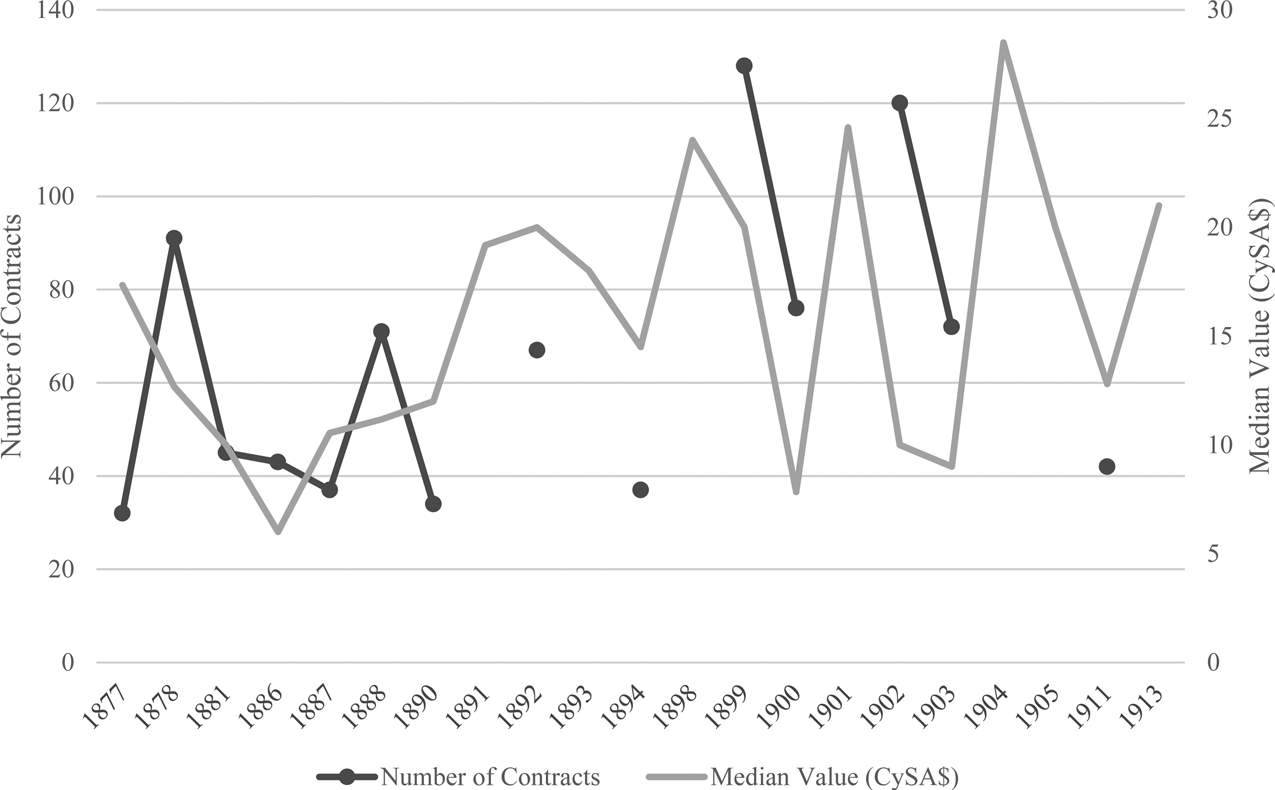
The contracts under analysis here represent the contents of the twenty-one extant libros de conocimientos held at the municipal archives in Tapachula. All but seven contain entries from across the entire year, suggesting that they are complete, whereas the remainder only represent half of the year in question.Footnote 21 In total, the libros contain 1,008 contracts involving the future promised repayment of an obligation in either cash, goods, or service. The data extracted from these contracts present no straightforward narrative. Instead, they capture the messy realities of people trying to figure out how and when to publicly register their economic activity and the multiplicity of norms that remained a part of legal culture across the period in question. Both the number and median value of loans vary from year to year and do not correlate exactly (see Figure 1). The median loan value ranged from CySA$7, approximately 2 weeks’ wages on a coffee plantation, in the mid-1880s, to CySA$36, or approximately 2 months’ wages, in the late 1890s. The number of loans ranges from a low of approximately 30 per year to a high of almost 130. The rise and fall in both numbers very roughly follow the rise and fall of the Soconusco's economy as measured in the value of coffee exports.
Number of contracts and median value of contracts, 1877–1913. I have only included the number of contracts for years for which I can be reasonably certain of having the complete register. Source: Archivo Histórico Municipal de Tapachula.

Notably, when compared with the region's population growth, the per capita usage of this form of contracting as recorded in a public space experienced a substantial downturn across the period in question. People clearly continued to draw on understandings of the civil code when agreeing to contracts in private spaces, as is made apparent when they later brought each other to court. By the turn of the century, non-elites took seriously the civil code's language regarding the validity of even unwritten contracts for small sums, a topic I will return to, and no longer relied on the act of writing down and officially registering small-time economic agreements to signal their seriousness.
Although covering more than 30 years of activity, there are many aspects of the libros that remained relatively consistent no matter the ups and downs of the market. The median term of a loan was between 2 weeks and 1 month, with some loans to be paid back in as little as a day and only two or three out of the entire sample to be paid back in more than 6 months. The majority of contracts involved at least one party who could not sign his or her name. Women represented between 20% and 40% of the lenders and 10–40% of the borrowers, depending on the year. The median loan for women was smaller than that for men, approximately CySA$12 as opposed to CySA$20 for men. Women also tended to lend out smaller sums than men.
Although the extant libros in no way represent all agreements made between 1877 and 1913, the fact that the majority of participants appear only once in the records suggests that this was a widespread but not regular activity for residents of Tapachula. Of the roughly 1,400 individuals who appear in the libros, 22%, or 307 people, registered more than one contract. Creditors were more likely to make repeat appearances, with approximately one quarter making more than one loan. Only 16% of debtors appeared more than once. Alejandro Córdova and Francisco Enriques were unusual in that each appeared in the record more than once. Córdova in particular was part of a very small cohort of multiple repeat lenders, advancing cash or transferring the debt of an employee at least fifteen times between 1888 and 1904.
Beyond the breadth of participation, the libros also suggest that the use of municipal court and its credit-recording activities was not concentrated among the sort of middling to upper class actors who dominate work on early modern Europe.Footnote 22 Yes, a few merchant-farmers such as Córdova and a couple of well-placed local politicians made more appearances in the records than anyone else, but they were rarities, not the norm. Lending was more concentrated than borrowing, but both were inclusive activities available to many people who could make no claims to affluence.
The demographic details that allow for this kind of assessment come not from the libros themselves, but rather by cross-referencing records from the municipal court with those from two other legal spaces: the district-level (as opposed to municipal) court and the public registry of property.Footnote 23 Only in cases where transactions exceeded MX$500 (CySA$750) in value did information such as place of birth, age, marital status, and occupation enter the record. The libros contain only a few transactions valued at such a sum; most transactions of greater value instead took place in one of Tapachula's other legal spaces.
By cross-referencing the libros with records from the district court and public registry, I am able to gather more detailed information about 7% of debtors and 14% of creditors, or 25% of participants overall. This cross-referenced data primarily give me insights into those who had the means to conduct transactions valued above MX$500, a hefty sum for small farmers such as Francisco Enriques whose lands were worth a few hundred pesos, if that. Day laborers on coffee plantations earned between 30 and 50 cents a day and had even less chance of seeing such a sum.
Some small-holders, such as Enriques, did appear in other official spaces and therefore made more about themselves known. Of the cross-referenced individuals, approximately one third (that is 8% of all the participants) appeared at the public records office to register property transactions pertaining to a few hectares of land. As the coffee economy expanded, individuals who had previously held land communally or informally took it upon themselves or were forced to acquire and register titles for that land. When they resold this newly titled land, many small-holders, such as Enriques, turned to the public records office to register the transfer of title. As with the small credit arrangements recorded in the libros de conocimientos, the law did not require that these transactions be recorded in any official manner, because their value was so low. Yet people nonetheless reached out for available legal forms and used them to undergird their hold on their property. Most of these select few were male agricultores, or farmers, from Tapachula or the next town over; approximately half of them were married, and half of them were not. Enriques was pretty much typical. The capital he borrowed, a transaction recorded more than a decade before he appeared at the public records office to transfer title of his land to another local farmer, was likely intended to help either secure title to his land or invest in some means of improving it for future commercial activity.Footnote 24
The remaining two thirds of the cross-referenced group—approximately 16% of the total participants—were individuals approaching if not definitively well-to-do, and were outliers in their use of both municipal and district judicial spaces: the Spanish and German merchants, the local politicians, and the prosperous farmers such as Córdova. They were also unusual among their economic peers, with less than 10% of the more than 3,000 individuals who used the institutional spaces of the public registry and the district (rather than municipal) court to cement more complex and costly contractual forms also recording business at the municipal court.Footnote 25 Again, neither set of records is anywhere near complete and there was likely at least a little more overlap than this sample suggests.Footnote 26 Yet the paucity of people appearing in both makes clear that individuals self-segregated into different institutional spaces based in part on class.
Most of those who accumulated additional demographic detail, both debtors and creditors, were married agricultores from Tapachula. Merchant lenders such as Guillermo Henkel tended to loan more than farmers such as Córdova, and were also more likely than farmers to appear as creditors more than once, as were public officials and politicians. Debtors’ recorded professions were quite diverse, but agricultor is the only occupation to appear more than once.Footnote 27
Regarding the 75% of participants who did not conduct business in other legal spaces, I can only say definitively that their overall literacy was low, women represented approximately one third of parties, and most were lending or borrowing the equivalent of a month or two's wages for a few weeks’ or a few months’ time. In general, loans’ short repayment periods indicate that repayment was expected to be in cash rather than in kind, even if the money was being put to agricultural ends and repayment in coffee was commonplace for mortgage-backed loans. That said, those details about repayment that did get written into the libros include a great deal of renegotiation and extension of terms. Even if both parties intended repayment to be in cash, local agricultural realities may have instead led to terms that extended into harvest and in-kind repayment.
Use of the libros de conocimientos at the municipal court declined in per capita terms across time. That said, people across the social spectrum continued to use the court to pursue the enforcement of contracts. Even when official registration was no longer a regularly used option, people continued to draw on the legal norms of contract law that had made it appealing in the first place. As the following section will illustrate, neither the civil code nor the code of civil procedures required or even facilitated the registration and officialization of contracts such as these in front of a judge or municipal official. The longer history of popular use of the courts and the slow emergence of republican civil jurisprudence in Latin America provide the necessary context to understand why these libros existed and why their popularity declined over the turn of the century.
The Evolution of Popular Republican Legal Culture
The loans recorded in the libros de conocimientos were not a new thing in the 1870s. Nor was the popular use of the court system to regulate debt. Communities long functioned on the informal exchange of advances, cash, and favors, backed by the social accountability of small towns and, when necessary, the mediation of municipal magistrates or, in earlier eras, the equivalent colonial officials. What was changing in this moment was the increasing registration and formalization, as opposed to solely adjudication and enforcement, of such loans at the municipal court.Footnote 28 Because of this, the location and form of the libros de conocimientos require some explanation. The changes in their contents point to the ways in which engagement with national and international legal norms and codes first diversified and then consolidated around primarily transactional activities across the nineteenth century. Increasingly tied to global circuits of credit and commodities, small time actors in the Soconusco, like their counterparts across export-producing regions, embraced contractual norms that leveraged liberal ideas of private property and its uses to secure their interests.
Until the 1850s, most of Latin America lacked explicit civil, commercial, and penal codes and procedures. Instead, the often-confusing layers of imperial Spanish legal codes continued to govern newly made and supposedly equal citizens. Spanish law depended on a hierarchy of royal, imperial, and colonial law that was written to manage a multiplicity of juridical subjects. Although the same body of law governed all subjects, that body of law treated different groups—members of the military, the church, the aristocracy, enslaved people, indigenous people—differently.Footnote 29 After Independence, most new countries’ new constitutions explicitly stated that this structure was unsuitable for their new republican forms.Footnote 30
Yet as new officials took up new posts in new judicial offices, they often lacked explicit legislative definitions of individual rights and the procedural dictates for ensuring those rights.Footnote 31 Even where attempts to generate and promulgate new legal practices were made, a multiplicity of legal norms and forms continued to play a part in how people encountered and made use of the law. Alongside republican ideals of equality before the law and liberal emphasis on private property and contract, honor, a concept over which colonial and early Independence Era historians have spilled a great deal of ink, continued to help both judicial officials and those coming before them define justice.Footnote 32 There was no singular understanding of law at work, but rather a multiplicity of older and newer modes of managing conflict through institutional mediation. New legal codes, as written from national or state capitals, often represented an ideal or an ideology rather than the reality of the place that they governed.Footnote 33
Throughout the nineteenth century, courts remained spaces in which non-elites negotiated their relationships with the state and with each other, in the process shaping the institutions that defined the law. Lack of literacy or wealth were no barriers to use of the courts, either in the colonial or in the national period. A plethora of minor officials and legal professionals, often without formal training, served as intermediaries between the overlapping doctrines of imperial Spanish law and the new regimes of republican jurisprudence slowly being created.Footnote 34 Judges served as guarantors as well as arbiters of justice, and people approached them with matters that ran the gamut from questions of honor as it related to marital fidelity or insult to minor financial disputes over the sale of a pig or an advance on a salary. In Tapachula, before the first libros de conocimientos appear in the archive and without any separate judge to appear before, the municipal council served as default courtroom. Villagers and ranchers came before the municipal president to resolve disputes over cattle grazing and the planting of corn.Footnote 35 Even as elites in Mexico City reworked the idioms in which official legal practice took place, popular use of the courts continued to engage with the multiplicity of norms available as people asserted their rights to equitable access to whatever law stood.
Across the first decades of Independence, a multitude of legislative projects slowly replaced the colonial body of law with new codes that worked to define and protect individual rights and equality before the law in Mexico, as elsewhere.Footnote 36 Regular political upheaval and the generalized lack of state consolidation meant that many of these projects failed to find their way into practice. Yet many considered this work to be essential to their nation's future. Failure to complete it, as legal historian Óscar Cruz Barney writes, was seen to be “one of the great ills suffered by Mexican society.”Footnote 37 Battles between centralists looking to use a universal national legal code as a means of control and federalists emphasizing the rights of state governments to draft their own jurisprudence continued to inspire debates over who even had the authority to issue new laws.
By mid-century, however, a larger Atlantic moment of codification provided the source material and motivation for new drafting commissions. Chile's effort in this direction was not the first, but it became the most influential. Andrés Bello's 1855 Chilean Civil Code was adopted either fully or in part by eleven other countries in the region. Itself drawing on Roman, Spanish, French, and British codes, treatises, and legal commentary, Bello's code also considered the particular context of postcolonial Latin America. Legislators across Latin America, in turn, amended and revised Bello's template as its weaknesses became apparent. New European codes also inspired continual revision. The highest goal of these codes was to protect and promote liberal rights, but they also served to facilitate commerce by standardizing both laws and procedures across national bounds.Footnote 38
The passage of civil codes and codes of procedures to accompany them was neither a smooth process nor one that had immediate impacts on the actual practice of law. Legal cultures remained diverse, as those who made use of the courts continued to draw on older traditions alongside newly legislated possibilities.Footnote 39 In Mexico, despite efforts going back to the 1820s, the first federal civil code was not enacted until 1866. Because of ongoing civil wars, it was quickly revised again before reissue in 1870. The code drew on earlier compilations of legal practices, the Chilean Civil Code previously mentioned, and the Spanish Civil Code of 1852.
The federal code, however, only applied on passage to the Federal District and territories. The liberal, federalist government left states to pass their own codes in turn.Footnote 40 Using the federal code as a model, states began to implement the new hierarchies of administrative and judicial bureaucracy that their new codes required across the coming decade. As always, shortages of funds and trained personnel impeded the process. Though the new codes were much easier to navigate, reprint, and circulate than their Spanish predecessors, they could not replace older practices or norms overnight. Both magistrates and those appearing before them drew on old and new forms of law to manage their affairs, in the process slowly remaking legal culture to suit their needs.
Whether or not the codes were put into practice, their language made clear that legislators intended their new civil codes to primarily facilitate the legal and commercial affairs of the middling and upper echelons of society. In the same way that they assumed an Atlantic context of civil statutes and contract law, they also assumed legal actors well-to-do enough to need articles governing sizeable inheritances, expanses of property big enough to back mortgages, and dowries worth ensuring. According to the civil code, the sorts of contracts registered in the municipal court in Tapachula had legal standing without any recourse to the legal bureaucracy. Simple mutual consent by two competent parties validated any contract.Footnote 41 Said consent obliged both parties to fulfill the expressly agreed-to terms and any consequences that resulted naturally or through the law.Footnote 42 The 1870 civil code did not require any formalization of basic contracts, only that they follow the precepts of the law. Only those contracts exceeding a certain value, either MX$300 or MX$500, or those involving property worth at least that much, required a written and registered form to be formalized by a notary or public official.Footnote 43 Whether or not contracts were registered, the civil code allowed for the use of the courts in their enforcement if one party or the other failed to fulfill their obligations.Footnote 44 With a daily wage of between 30 and 50 cents in the Soconusco, the benchmark for registering contracts represented approximately 4 years’ work. Most people would never see such a sum in their lives.
This is the context out of which Tapachula's libros de conocimientos grew. Although the libros primarily contain small contracts regarding outstanding debts, iterations from the 1870s through early 1890s, alongside the rest of the court's archive, point to the multiple legal traditions at play in this space. Small-time disputes over infidelities, missing animals, stolen guavas, and accusations of abduction and rape sit alongside steadily more rote inscriptions of credits and debts.Footnote 45 In one 1892 libro entry, two men signed a contract acknowledging that they had a history of fighting and pledging to not offend each other with either deeds or words going forwards. If one of them broke this pledge, he would owe the other CySA$20.Footnote 46 Over time, the contents and language of the libros consolidated around a formulaic, transactional set of contractual agreements that signaled a shift in how people understood and made use of the court. The libros were one mode among many to access and enforce small amounts of credit in the nineteenth century, some more formalized than others. Yet many of these modes—particularly use of pawn shops and running up accounts at general stores—increasingly involved similar inscriptions of petty advances in a formulaic manner.Footnote 47 Each represented a means of putting the written word to work even as the type and language of those words changed.
The phrase “libro de conocimientos” was itself a holdover from Spanish rule, and its use in Tapachula's municipal court traces the evolution of jurisprudence across the nineteenth century. Throughout the colonial era and into the nineteenth century, the term encompassed the array of registers that courts, judges, notaries, and government officials had to keep of all business conducted under their purview.Footnote 48 Spanish legal tradition was remarkable in its regulation of the written form, down to the type of paper used for court petitions and the specific way in which registers had to be bound.Footnote 49 Into the nineteenth century, Spanish collections of administrative and judicial decrees and regulations for both the peninsula and the colonies used the phrase “libro de conocimientos” as a catch-all for the more specific types of registers required for different aspects of a court's business.Footnote 50 For example, when the state of Chiapas drew up the first regulations for its Congress, it obliged the congressional secretary to maintain a libro de conocimientos to record the legislature's activities.Footnote 51
The name of the register, then, indicated little regarding its contents and soon fell out of official favor. Instead, following the civil codes’ trend toward specialized administrative structures, regulations of record keeping also assumed increased specificity. This meant new names for new forms of documentation, each more granulated than the last. Codes dictated that the civil register of each municipality had to maintain four separate registers for births, tutelage, marriages, and deaths, and that the public registry of property had to maintain another four for properties, mortgages, rentals, and sentences.Footnote 52 Any court case required a multitude of types of documentation, both on the part of the litigants and on the part of the court officials.Footnote 53 Merchants had to maintain at least three books containing their inventory and balances, their running accounts, and their daily business.Footnote 54 “Libro de conocimientos” was far too generic a term for the idealized liberal order of specialization and standardization imagined by the codes’ authors.
Yet many local courts and administrative institutions maintained older forms, as multiple understandings of the law remained in practice, resources were scarce, and popular iterations of liberal doctrine tended to emphasize a very localized notion of sovereignty and law. Even though drawn up by a liberal government, the 1870 code still represented an attempt at centralizing government affairs that not all in Mexico's far reaches found appealing. The decision to maintain the label “libro de conocimientos” may not have been an explicit pushback against centralization, but it was certainly part of a broader trend of ignoring such edicts from Mexico City.Footnote 55
More practically, the complexity of practices mandated by the new codes had little use in a place where commerce and daily life remained relatively straightforward. Although Tapachula's municipal court archives also contain more complicated records for more complicated cases, much of its business each year was noted solely in the libros de conocimientos. Business that either required more intricate contractual forms or dealt with larger sums of money tended to take place in the district level court, rather than before municipal magistrates. For those who did turn to the most local of courts, the short, formulaic mishmash of business represented in the libros was more than enough for local needs.Footnote 56
The formalization of contracts for small debts by municipal officials also points to a disconnect between the federally imagined administrative state and local abilities to staff the mandated bureaucracy.Footnote 57 At the time when legislators wrote new civil codes, the hierarchies they assumed to be in place were lacking in many parts of Latin America. Just as in the colonial era, legal functionaries were few and far between. Judicial codes of procedures required that multiple levels of judges with attendant secretaries oversee legal matters in a hierarchy that reached from small towns through district seats through state capitals to Mexico City. The civil code also required the creation and staffing of a public registry of property, and the commercial code required a separate public registry of commerce,Footnote 58 and codes assumed that notaries and other administrative functionaries would be present to officiate contracts wherever necessary. This assumption was not always a reasonable one. For reasons that are still unclear to me, the Soconusco only had one notary until the first years of the twentieth century, and his time was taken up with the affairs of merchants and large-scale planters. The idea that the region had enough educated, qualified bureaucrats to fill the plethora of positions within the various registries and courts required by the codes was laughable.
The solution in many places was to maintain a more mixed-use approach to institutional spaces and allow members of municipal councils to sit in judgment when the appropriate officials were not present.Footnote 59 In 1863, before the passage of the Mexican Civil Code but in the midst of attempts to regularize justice and administration throughout the country, the governor of Chiapas decreed that judges of first instance should formalize legal documents (instrumentos públicos) when a locality was lacking in clerks. If there was no judge of first instance, the local alcalde, or municipal councilor, could serve in his stead in “the formalization and authorization of all classes of public instruments.” He was then required to send the original documents he authorized to the nearest court of first instance where they would be recorded.Footnote 60 In 1890, this accommodation for the lack of personnel was reinforced when the state legislature, having adopted the federal civil code of 1884, made additional amendments to suit local uses. According to the state's version of the civil code, juezes menores—also called rural judges—and alcaldes were granted the right to “conocer” or recognize and register any contract worth less than MX$100.Footnote 61
In this way, the local municipal court, generally overseen by one of the municipal councilors, was designated a space in which small-time business could occur. These local alcaldes were not granted the authority to oversee contracts or lawsuits pertaining to greater sums, matters that had to be referred to the judge of first instance if not a district-level magistrate. The federally drafted civil code only included language facilitating the formalization of contracts or disputes exceeding either MX$300 or MX$500. State-level versions of these codes, however, expanded to include language covering smaller operations. Although the original federal code that served as model for the later state versions clearly stated that, by default, verbal consent was binding in contracts unless they exceeded certain value, the revised state civil code of procedures provided for but did not require the registration of such matters. At least in the Soconusco, the libro de conocimientos was the form in which such small-time contracting and commerce was recorded.
The endurance of the libro de conocimientos as a physical object indicates the all-purpose nature of the local court whose business it recorded. Its existence points to the use of the local court by those who lacked the means to engage with the regulations for transactions over MX$300 but who still saw the potential benefits of doing so. A growing number of scholars have pointed to Colonial Era and nineteenth-century lawsuits and legal proceedings as a means by which the general populace made claims to the political sphere of citizenship and rights. Here, we see how villagers and workers made alternate use of the courts to make claims to the economic sphere and the kind of protections more generally explored with relation to the world of finance inhabited by merchants, planters, and bankers. Although the federal civil and commercial code certainly pertained primarily to that circle, at the state level, legislators recognized and facilitated the claims of less prosperous individuals. People far from the halls of power, in turn, formulated and normalized their own ways of using legal forms and spaces originally designed for those far beyond their ken. In the process, they built and routinized contract law in practice.
Adapting the Civil Code to Local Usage
Although in no way mandated to do so, villagers in and around Tapachula engaged with the slow expansion and reworking of jurisprudence and legal bureaucracy that marked nineteenth-century Latin America. They did so because they found it a useful means of undergirding activities that they were already undertaking. Returning to the particulars of the libros de conocimientos, it becomes clear that even without citing the civil code by chapter and article, those registering contracts in front of an alcalde or judge were making use of new legal forms and norms. The following section reads the libros de conocimientos and a number of cases regarding the enforcement of debt through the lens of the civil code and illuminates how villagers, shopkeepers, farmers, tradespeople, and laborers put the new jurisprudence to work.Footnote 62 Although it was the court clerk or judge or, in a few cases, the participant's legal representative, who actually wrote down the contract, it was those coming to the court who saw the potential for undergirding transactional agreements through their inscription and enforcement in this legal institution. The libros de conocimiento did not create new kinds of economic activity, but rather gave people a means to better regulate, ensure, and signal the weight of their transactions and contracts.
In general, the contracts registered at the municipal court lacked specifics as to their purpose and legal grounding. Of the more than 1,000 contracts examined in this sample, less than 40% include any explanation of the reason for the agreement being registered or any citation of legal formulations. The rest took more or less the following form:
In the city of Tapachula on the twenty-fourth of June of 1902, before the third citizen alcalde and secretary of the office, appeared Señora Ventura Sánchez and Don Aureliano Andrade, both of age and resident in this municipality, who stated that: the second owes to the first the sum of $25 pesos Central and South American, which reduced to national currency give the quantity of $20, which he promises to pay in partial installments of $4 each month with the first payment to be made the 24th of the coming July and the same in the following.
Having read the present to them, they give their agreement and only Andrade signs as Señora Sánchez does not know how.Footnote 63
They were the kinds of generic loans that had been made, unregulated, for centuries. Now, although lacking particulars, such agreements began to include the necessary language to validate the contract according to the law; namely, that both parties were of age and taking part willingly in the contract.Footnote 64 Beyond this, such contracts specified neither the rationale for the loan nor the legal precepts that would serve to make the contract binding. Already validated by simple accord between the involved parties, such contracts required no registration, let alone detail that might appease curious future historians. With or without official record of their agreement or the rationale behind it, a creditor could take a debtor to court and claim his or her current and future goods if the terms of their contract were not met.
As per capita usage of the libro de conocimientos declined across the decades, so too did the inclusion of particulars about the purpose or legal terms of loans registered therein. Until 1900, approximately 50% of agreements included additional details that took advantage of various aspects of the new civil code. From that point onward, the majority of contracts looked like the one cited. Yet more specific uses of the legal tools and modes laid out in the civil code did not disappear. Rather, they moved into other spaces, usually private ones, a shift I will explore at the end of this article. First, however, I will look at how court scribes and those who appeared before them drew on creative and legally unnecessary uses of the civil code to structure their contracts.
Incentivizing and Protecting Lending
Only 4 of the 1,000 contracts examined here explicitly cited the civil code.Footnote 65 That said, almost all fell within its parameters and many made use of the various tools it laid out for incentivizing lending and ensuring repayment. The phrasing of the contracts was often close enough to that of the civil code to make me believe that, at the least, the clerks inscribing the contracts had a considerable degree of familiarity with it. Although many of the legal tools and terms in use in the civil code long predated it, the formulaic structure of entries in the libros points to their authors’ embrace of the code's standardization. Most agreements fit within what the civil code labeled a préstamo con mutuo simple, or simple mutual loans. Such loans were in no way new, but the civil code standardized their terms and legal implications. Simple mutual loans could be exchanges of either currency or goods. They were to be for a set time, dictated by the two interested parties or by the harvest if the loan covered agricultural products.Footnote 66 The code provided for a number of means for incentivizing and insuring lending, including interest, collateral, guarantors, contingencies, and various kinds of penalties. Most of these tools predated the civil code, but here they were brought together and formalized.
Those 40% of loans that included additional details about the contract drew on a good number of these tools. One they did not touch, surprisingly, was interest. The permitting of interest at 6% or higher annually is often lauded by historians as a key innovation to come out of liberal legal reform.Footnote 67 Yet, out of the entire sample, only five contracts contain mention of interest to be charged, and three of those only in cases of the initial term of the loan expiring without payment.Footnote 68 Interest, as understood by economists now and policy makers then, was supposed to incentivize the extension of credit by legalizing means of making money by lending money. It may be that interest was implicitly included in the sums inscribed by court secretaries or dictated by the participants, or it may be that interest was not the norm, when most appearing in court knew each other relatively well. Interest was quite common when it came to larger loans registered in the district level court and at the public registry of property, but at the municipal court, with regard to loans for a few months’ wages, it was not to be found.Footnote 69
Means of guaranteeing and enforcing loans, however, were quite common. Lenders insisted on including fiadores or guarantors in a good number of loans.Footnote 70 Many of these related to labor contracts, which will be discussed further on, as when Bonifacia López agreed to serve as guarantor of her son Benigno's contract in case he ran away from his place of employment.Footnote 71 In other cases, participants appeared in court to add a guarantor to a previous agreement that may or may not have been registered in court. José María Adriano stepped forward in 1899 to stand as guarantor for a multitude of debts owed by Jesús Alfaro, who readily admitted to the sums he had not paid, although none of these agreements appear elsewhere in the archive.Footnote 72 Sometimes, a guarantor stepped forward to take on a prior debt or a third party transferred ownership of an outstanding debt to him or herself. In all such cases, the tensions at the heart of these small contracts are quite clear: sometimes people did or could not pay back what they owed. The court registers served as a place to try to ameliorate a potentially contentious dispute before an actual suit was filed.
Collateral, broadly defined, was also a relatively frequent addition to those loans that included more than the bare bones description of a transaction. The specific types of collateral that the civil code allowed, including property, houses, and goods, were rare. Although omnipresent in mortgage-backed loans recorded nearby at the public registry, less than 2% of agreements registered at the municipal court included a specific piece of property (or in three cases a mule or cow) to be handed over in case of default.Footnote 73 More common, although still only representing 5% of the loans registered, was the general statement that a creditor could pursue a debtor's current and future possessions or interests in case of failure to comply with the terms of the loan.Footnote 74 This language appeared in the civil code, although again, it was not cited chapter and article in the libros.Footnote 75
Language that specified that the debtor would be responsible for costs and damages in case of failure to comply with the contract also appeared in both the civil code and the libros. The phrase “daños y perjuicios,” included in the civil code's regulation of civil responsibility in case of breach of contract, is quite common.Footnote 76 This, at least in theory, was a way to ensure the protection of the creditor's interests and make up for any lost incomes or profits that might result from failure to repay. In some early contracts related to the prepayment of labor to be performed, employers went as far as to state that a runaway worker would be responsible for the costs of his own recovery if he abandoned the contract before its fulfillment.Footnote 77
Guarantors, collateral, and language around costs and damages all served to secure the creditor's interests against the debtor's failure to repay. Although the civil code allowed for the inclusion of explicit types of collateral, particular kinds of guarantors, or specific anticipated costs, the generic version of each of these precepts was legally applicable in any contract. Whether or not a contract included the phrase “costs and damages,” the debtor was legally responsible for such in case of default. Whether or not the creditor laid claim to the debtor's personal interests in writing, those interests could be claimed. And if no particular guarantor was specified, most obligations had to be met by next of kin.Footnote 78 Even though these legal norms did not have to be written out within a contract to apply, for the first decades of the civil code's existence, contracts in Tapachula's municipal registers nonetheless included them. When people for whatever reason felt that a contract merited or required the burnish and weight of formalization, they brought it to the municipal court for registration in the libros.
The Many Means of Advancing Money
The Mexican civil code did not only dictate the means for securing and enforcing contracts, it also facilitated a wide variety of types of lending beyond the exchange of cash for future repayment. In the first decade and a half covered by the libros de conocimiento, approximately half of the contracts indicated that the cash being advanced was to cover either goods or services to be delivered. Although distinct from loans, advance payments also represented a key form of capital circulation that facilitated producers’ and workers’ investments in new kinds of economic activities. Beginning with the libros from the 1890s, these types of contracts more or less disappear from the registers. Some may have been made more generic by the court scribes in their inscriptions, but others moved into private spaces, only to reappear in court when enforcement was needed. It is in these kinds of contractual agreements that it can be seen how knowledge about and embrace of the legal code was not constrained to the space of the courthouse. People cemented contracts within their homes, offices, and shops in anticipation of their enforcement by public and private actors alike.
In the 1870s and 1880s, individuals regularly registered contracts in which a farmer or craftsman or woman promised future delivery of goods in return for advance payment. Sacks of corn and woven cloth were the most common subjects of these sorts of contracts, but the libros also included contracts for sugar, cacao, and bricks. Every year also a few animals were sold, generally horses or mules, with payment to be made over the coming months.Footnote 79 Both the 1870 and 1884 civil codes regulated these sorts of transactions, but the language of each was primarily directed toward the immediate exchange of cash for goods, rather than toward advanced purchases.Footnote 80 Each code made glancing mention of payment in advance or in installments, but, again, neither required the formalization or registration of such transactions unless they involved property worth more than MX$500.
Even if these contracts more or less disappeared from the libros de conocimientos, they remained quite common in both other legal spaces and in private agreements, only being brought to court when things went awry. Merchants and planters commonly officialized mortgage-backed advance purchases of coffee at the public registry, as they were required to do given that the property underwriting the loan was worth far more than MX$500.Footnote 81 Small time producers and artisans regularly appear in the books of local shopkeepers, which were kept in their stores rather than at the courthouse. The inventory of Herlinda Bado's general store, which had to be sold to cover debts in the late 1890s, was full of running accounts for customers and sacks of coffee and other goods presumably delivered to cover those debts.Footnote 82 Although they did not, as far as I have found, sign contracts specifying that Bado would extend her customers a particular quantity of store credit to be repaid in coffee at a later date, the norms governing the more informal nature of this transaction would have been the same. These outstanding accounts in turn served as assets for Bado as she tried to cover her own accounts with merchants abroad.
Labor contracts also represented a variable but significant portion of the contracts filed at the municipal court in the early years, generally taking one of two forms. The first governed advance payment for a particular job to be done, such as constructing a building. The second governed wage advances made by employers to new laborers, both domestic and agricultural. In both cases, most contracts within the libros specified an amount paid on the date of the contract, to be repaid by the worker or craftsperson in services to be delivered over a set period of time at a set rate. Camilo Rodas paid Fidencio Casarribia CySA$40 in advance for the repair and re-plastering of an oven he had constructed, to be completed within the month.Footnote 83 Both the 1870 and the 1884 civil codes included provision for contracts for work to be performed.Footnote 84 Although advance payments for a specific job to be done could be paid up front, along the way, or at the end of the job, the code did not explicitly allow for advance payment of either domestic or agricultural labor. It mandated a fixed period for such loans and payment at either the local going rate or a salary or fee agreed to by the parties involved. It included protections for both employers and employees, although it favored those doing the hiring when it came to matters of early cancellation or dismissal.
Indebted labor was commonplace in Chiapas and across southern Mexico and Central America in the late nineteenth century. Although the federal civil code did not include provision for advances, legislators in Chiapas provided ample protections for employers seeking to secure workers through debt. Although accusations of coercive debt peonage were merited in some locales, by the mid-1890s, most labor debts in the Soconusco were better understood as credit incentives offered to secure a scarce workforce.Footnote 85 In the early years of the coffee economy, however, the libros de conocimientos make clear that coercion was a regular part of the employer–employee relationship. Labor contracts included extensive provisions for guarantors as well as costs and damages in cases of failure to repay or, in a number of cases, abandonment or flight from the place of work. Two workers went as far as to cede the rights granted them by the law and agree to be imprisoned if they ran away.Footnote 86 None of this was permissible under the federal civil code, but the law in Chiapas, as in Guatemala and the Yucatán, provided for the enforcement of such clauses.Footnote 87
Yet as the coffee economy grew and the demand for labor increased, coercion became less feasible. In the mid-1890s, legal reforms at the state level erased the coercive power of debt unless approved by the district jefe político, or political chief, on a yearly basis. That said, the new labor law was rarely followed to the letter and even at the time was seen as having little impact.Footnote 88 Instead, material changes in the Soconusco proved more important in reshaping the use of contracted debt. New plantation owners from outside the small local elite of Tapachula lacked the connections to local court officials that facilitated enforcement of contracted debt elsewhere in the state. As coffee plantations moved higher into the foothills of the Sierra Madre, farther from town, it became less feasible to go to the municipal court every time a new worker was hired or his or her debt grew. Extensions of credit in exchange for promised work in no way disappeared, but the contractual language surrounding them moved from the public space of the municipal court into the private space of plantation offices.
Enforcement and the Spread of Contractual Norms
A guarantor stepped forward belatedly to cover his son's debts. A laborer disputed his employer's account book. Two farmers debated whether someone was obliged to sign an IOU. A man demanded the return of the cows his brother had traded for a pistol and a promise of pesos. Each of these situations represents a moment when individuals in the Soconusco turned to the local court to enforce contracts they had not signed before the local court. Each represents a kind of agreement that once appeared in the libros de conocimientos but, by the mid-1890s, had mostly moved into the home, the office, or the field. Each also illustrates that transactional contracts, understood to be backed by the civil code, had entered into common parlance beyond the courthouse.
In general, it is difficult to figure out how frequently contracts registered with the court, let alone those signed elsewhere, were successfully fulfilled. Debtors rarely returned to the court to formally mark the repayment of their loans. In 1881 and 1902, just over half of the registered contracts included information about their cancellation. In all other years, only between a quarter and a third of contracts noted that the parties involved had returned to declare their contract fulfilled. Additional contracts each year included information about installment payments made toward repayment, but never noted cancellation. As in many other places in both Latin America and Europe, it may have been that formalization served as a backstop for contractual activity rather than as the preferred means of conducting business. In the Spanish legal tradition, much of which continued to condition Mexican legal practices, verbal settlement was preferable to filing written legal claims.Footnote 89 It may have been that, although the municipal court and the language of the civil code served a purpose in signaling the seriousness of the matter at the time of contract, the same contract's satisfactory conclusion required no such fanfare. The commonality of contractual language drawn from the civil code did not mean that older juridical cultural norms had disappeared.
Similarly, enforcement is hard to trace in the Soconusco. Most archives, including that of the municipal court, are quite spotty. Sentences and decisions, in accord with the code of civil procedures, were recorded in separate registers from those containing case proceedings. I have not found most of those registers. I do not, therefore, know the outcomes in the cases I mentioned, nor do I know the outcomes of many of the contracts registered in the libros de conocimientos. I have almost no records of lenders pursuing borrowers for outstanding debts recorded in those libros. Despite the inclusion of legal terms related to responsibility in case of default, and despite most debtors being late in making payment, creditors do not seem to have taken up the legal tools available to them when it came time to repay, or at least not in a way that left an archival mark.
The extant archival documents do make clear, however, that the language of transaction and contract was not contained solely within the courthouse. Scattered throughout the latter years of the municipal court's files are cases related to contracts never registered in the libros but nonetheless tried before the municipal judge. Francisco Lorenzo ran away from his place of work without repaying his advanced wages, and the municipal judge placed him in jail while he figured out the particulars of the case. The particulars of the case, however, were as much about whom Lorenzo had a contract with as they were about the quantity of the loan. Was it the official document signed by the district political chief that dictated the amount Lorenzo owed, or was it the account books that his employer Anselmo Muguerza provided, or did neither count because Lorenzo said that, in fact, he was working for someone else? All three situations had some sort of document that resembled a contract to back them up.Footnote 90
In another case involving the transfer of the laborer Luis Pérez's debt from one employer to another, the dispute was not with Pérez but rather between his two employers. His former employer, Luis Ceballos Ochoa, sued his new employer, Juan Ureña, for refusing to sign an IOU or pagaré that Ceballos Ochoa had drawn up to cover Pérez's debt. The paper was the thing that mattered. And not just the pagaré, but, according to Ureña, the paper signed by the district jefe político acknowledging and noting down Pérez's debt in a different official space. It mattered whether or not Ceballos Ochoa had properly documented his contract with Pérez and, having failed to do so, Ureña now refused to sign a contract in turn.Footnote 91
In a third case, Diego Baté brought his landlord, Adeodato Suárez, to court in 1903 to contest Suárez's refusal to pay him for improvements to the cacao orchard he had been renting. The two men, Baté insisted, had a verbal contract going back 2 years. In this contract, as Baté recalled it, Suárez had agreed that Baté could add to the property's buildings and plantings in any way necessary to make his living. If residence on the property ended, Suárez would pay Baté for any buildings or new plants he had added. Now, Suárez was refusing to pay for the house and the sugar cane and yuca that Baté had labored over. There was no written contract to be put forward in this case, but given that the sum involved was CySA$60, there did not legally have to be one. Although he did not cite the civil code, Baté knew that he was within his rights to demand the fulfillment of the spoken contract, and the judge agreed.Footnote 92
When a merchants went bankrupt, all the small extensions of credit that she had noted in her account books turned into assets to be collected by her own creditors. When a plantation owner died, the credits he had extended his laborers became part of the valuation of his property. Ceballos Ochoa and Lorenzo and the shopkeeper and the planter's heirs all couched their complaints and demands in terms of unfulfilled contracts between willing parties. They pointed to the document where someone agreed to a fixed date for the return of payment. They pointed to the properly compiled spreadsheets of credits and hours worked. They pointed to exchanges of value to be repaid in equal value. And they used the legal space of the court to make these claims to economic rights of transaction.
The libros de conocimientos became more opaque, more formulaic, and less detailed across time, and also less popular in their use. Yet the language and rationale of transaction and contract employed by borrowers, lenders, and court clerks became the norm both inside and outside the courtrooms that produced the libros. The bounds between public and private activities here remained thin, as small-time actors drew on experience in public venues to manage their private business and vice versa. I am not positing a causal argument here, which is to say that the libros de conocimiento and the court clerks’ deployment of the civil code's terms were not the sole catalyst for people in Tapachula to start using phrases such as “costs and damages,” “current and future goods.” Rather, the libros concentrate in one archival space a broader shift in legal culture later made apparent in account books, civil suits, labor transactions, and probate cases.
The libros de conocimientos also reveal one means among many by which people facilitated the circulation of capital and the norms that governed it. Most capital in nineteenth-century Latin America circulated in the hands of elite merchants, national debts, and large landowners. Yet most people in nineteenth-century Latin America who wanted to circulate capital had to do so on a much smaller, more local scale. As this article has illustrated, they embraced legal tools designed for their more affluent counterparts and turned them to popular use, both within and beyond the courtroom. As in the realm of political participation, credit and debt became a place for non-elites to exercise new kinds and forms of legal rights and language. In the libros de conocimiento from one far-flung town, we can see the determination of everyday people to make good on the protections promised by abstract, distant liberal fiscal policy. Twenty pesos may not have been much in the grand scheme of things, but its management and availability could mean a new cow, a new plot of land, or a new economic endeavor. In these small ways, the libros de conocimientos capture and help us understand the remaking of Latin American peripheral spaces during an era of profound economic integration.