Introduction
It seems widely accepted that bilinguals have separate lexical stores for different languages but the question to what degree they have a conceptual store shared by their first (L1) and second (L2) languages appears to be a complex one. For example, it is not clear whether representations of different types of semantic relations can be activated in L2 in the same way as they can be in L1. The present paper tries to address this problem with two experiments investigating senior Chinese high school students’ awareness of taxonomic and thematic associations depending on stimuli being presented in English and in Chinese.
Taxonomic and thematic relations
Based on similarities among their exemplars, taxonomic categories are organized in a hierarchical system (Rosch, Mervis, Gray, Johnson & Boyes-Braem, Reference Rosch, Mervis, Gray, Johnson and Boyes-Braem1976). Base-level categories of entities such as tables, pigs and parrots have the clearest boundaries, are expressed in the simplest linguistic forms and are more consistent across different cultures than are categories at other levels. Items in thematic categories are associated by external relations, as in part of a whole (e.g. the roof of a house); function (e.g., use of chalk to write on a blackboard); cause (e.g., electricity makes a light bulb glow); and temporal sequence (e.g., bills typically come after meals in restaurants) (Lin & Murphy, Reference Lin and Murphy2001). In a thematic category, individual items have different and complementary roles in the same scene or event.
Knowledge of taxonomic categories can be promoted to a great extent by education (Vygotsky, Reference Vygotsky1999). In contrast, knowledge of thematic associations is developed through life experiences. For example, a toddler may put a toy car and a toy person together and say “A person is driving a car”. The thematic association between a dog and a leash will be stronger for a person who lives in a city than for one who resides in the countryside, since dogs are more often treated as pets in cities than they are in the countryside. Similarly, the word rain can be expected to activate more concepts for Londoners than for Tibetans. Because of the influences of factors such as age, language and education, the relevant significance of taxonomic and thematic relations can be different for different groups of people. Farmers who receive little education are more likely than secondary school students to use thematic relations rather than taxonomic ones to categorize entities (Scribner, Reference Scribner1974). Young children can develop clearer awareness of thematic relations than they can of taxonomic relations (Scheuner, Bonthoux, Cannard & Blaye, Reference Scheuner, Bonthoux, Cannard and Blaye2004). Older people tend to prefer thematic to taxonomic relations more than young adults do in categorization tasks (Pennequin, Fontaine, Bonthoux, Scheuner & Blaye, Reference Pennequin, Fontaine, Bonthoux, Scheuner and Blaye2006). Sass, Sachs, Krach and Kircher’ (Reference Sass, Sachs, Krach and Kircher2009) neuroimaging study suggested that “processing of thematic and taxonomic categories leads to activation of distinct brain areas” (p. 78) The processing of taxonomic relations needs greater involvement of precuneus than the processing of thematic associations does, indicating that taxonomic relations might be less prominent than thematic associations in the structure of knowledge (Sachs et al., Reference Sachs, Weis, Zellagui, Huber, Zvyagintsev, Mathiak and Kircher2008). Actually, thematic associations can be in some cases more powerful than taxonomic relations in the semantic organizations of human beings (Lin & Murphy, Reference Lin and Murphy2001). For example the spatial complementary association between chalk and blackboard is stronger than the taxonomic relation between chalk and marker pen. Furthermore, thematic associations can be culture-specific. For instance, in an exercise of associating single Korean words, the primary response of Korean college students to the stimulus “horse” was “carrot”. The explanation was that in a traditional Korean story a horse eats a carrot.
The development of bilinguals’ semantic networks
Bilinguals develop semantic networks in different ways, depending on their proficiency in L2, how often they use the language and how old they were when they acquired it. Linguistic proficiency is common and interdependent across languages (Cummins, Reference Cummins2001). Because of this, people who acquire L2 when they are young and have the opportunity to use their two languages equally as much in their daily lives can develop patterns of awareness of conceptual relations in L2 in the same way as they can in L1. For instance, Peña, Bedore and Zlatic-Giunta (Reference Peña, Bedore and Zlatic-Giunta2002) found that Spanish–English bilinguals of between four and seven years of age were as able in L2 as they were in L1 to produce taxonomic categories and slot–filler categories (Lucariello & Nelson, Reference Lucariello and Nelson1985). Slot-filler categories (e.g., lunch foods) are categories that are based on events (e.g., eaten at lunch), the actions of which are complemented by concrete things (e.g., steamed bread, rice or salted fish). By comparison with the younger group (M = 5.1 years), the older group (M = 6.5 years) tended to produce more taxonomic than slot–filler categories. This finding was consistent with the results of Lucariello and Nelson's (Reference Lucariello and Nelson1985) study of monolingual children. Peña, Bedore and Rappazzo (Reference Peña, Bedore and Rappazzo2003) conducted a series of semantic exercises with three different groups of four-to-seven-year-old Spanish–English bilinguals. Balanced bilinguals were tested in both Spanish and English; Spanish-dominant bilinguals in Spanish; and English-dominant bilinguals in English. The performance of the balanced bilinguals in Spanish was generally similar to that of the Spanish-dominant bilinguals and in English similar to that of the English-dominant bilinguals. Sheng, McGregor and Marian (Reference Sheng, McGregor and Marian2006) conducted a word association exercise with a group of five-to-eight-year-old Mandarin–English bilinguals (M = 7.1 years). These bilinguals had been immersed in an English-speaking environment for at least 13 months. Their responses were compared to responses of English monolinguals of the same age. According to the results, the bilinguals and monolinguals appeared to share the same pattern of awareness of thematic and taxonomic relations.
Elsewhere, there is a large population of bilinguals who have not learnt L2 at an early age and do not have many opportunities to practice it in everyday life. For example, most Chinese students begin to learn English when they are 12–14 years old and they learn and use it mostly in a classroom. How can such bilinguals be aware of different conceptual relations in L2? Students of L2 who already possess a highly sophisticated and structured L1 lexicon are unlikely to be able to structure L2 lexical knowledge from the outset when presented with new words from L2. For L2 lexical knowledge to be assimilated and structured, conceptual modification is needed to restructure the existing network, which varies among bilinguals of different levels of proficiency in L2 (Wolter, Reference Wolter2006). However, existing theories about the mental lexicons of bilinguals provide no ready answer to the question of whether in their second languages the way in which low-proficiency bilinguals are aware of thematic and taxonomic relations is different from the way they are aware of them in L1.
Scientific studies into the mental lexicons of bilinguals started in the 1950s (French & Jacquet, Reference French and Jacquet2004) and during the past several decades different theories have been advanced about how the conceptual store is shared by L1 and L2. The word association model (Scarborough, Gerard & Cortese, Reference Scarborough, Gerard and Cortese1984) assumes that L2 words cannot be understood without being translated into L1 words, but, on the other hand, the concept mediation model (Potter, So, Eckardt & Feldman, Reference Potter, So, Eckardt and Feldman1984) suggests that there is no direct interaction between the L1 and L2 lexicons, which are independently connected to the conceptual memory, and that the lexicon of L1 can be bigger than that of L2. The word association model can be appropriate for a low level of proficiency in L2 and the concept mediation model can be appropriate for a high level of proficiency in L2 (French & Jacquet, Reference French and Jacquet2004). Kroll and Stewart (Reference Kroll and Stewart1990) found that low-proficiency bilinguals understood L2 words by translating them into L1 words, as predicted by the word association model, but that the more proficient the bilinguals were in L2 the more independent their two lexicons became, as predicted by the concept mediation model. They also found that bilinguals translated faster from L2 to L1 than from L1 to L2, a phenomenon that neither the word association model nor the concept mediation model can explain. Kroll and Stewart (Reference Kroll and Stewart1994) combined the two models and proposed the revised hierarchical model (RHM), which has become one of the most cited models in bilingualism research.
In the RHM, the three memory stores are assumed to be connected to each other but connected by links of different strengths. The link between the L1 lexical store and the conceptual store is strong while the link between the L2 lexical store and the conceptual store is weak. Low-proficiency bilinguals can understand the meanings of L2 words by associating them with the corresponding L1 translation equivalents. As proficiency in L2 rises, the strength of the link between the L2 lexical store and the conceptual store can increase.
Results of research have tended to support the RHM. In a masked semantic priming exercise of lexical decision, highly proficient Basque–Spanish bilinguals were found to develop early and automatic links between languages at the semantic level (Perea, Duñabeitia & Carreiras, Reference Perea, Duñabeitia and Carreiras2008). Basnight-Brown and Altarriba (Reference Basnight-Brown and Altarriba2007) investigated the organization of memory of Spanish–English bilinguals and found that the priming effects of both semantics and translation were larger in the direction of the dominant to less-dominant language. Similarly, the results of an exercise in recognizing translation suggested that both early and late proficient Spanish–Catalan bilinguals were more sensitive to manipulation of semantics than of form but that the performance of late non-proficient bilinguals exhibited larger effects of manipulation of form than of semantics (Ferré, Sánchez-Casas & Guasch, Reference Ferré, Sánchez-Casas and Guasch2006). Low-fluency Chinese–English bilinguals can gain access to conceptual representations of L2 via lexical representations of L1 in an implicit memory task, revealing reliable effects of long-term, cross-language, repetitive priming (Li, Mo, Wang, Luo & Chen, Reference Li, Mo, Wang, Luo and Chen2009).
From the RHM one might infer that late bilinguals of low proficiency in L2 can be aware of thematic and taxonomic relations in L2 in the same way as they can be in L1. However there appear to be some arguments suggesting that how access to conceptual representations is obtained in L2 might be different from how it is obtained in L1. For example, in an exercise of word association in Hong Kong, Chinese adult students of English heard words in L2 and then in L1 and were required to write down the first word that entered their minds for each stimulus (O'Gorman, Reference O'Gorman1996). The results indicated that different languages produced different systems of storage and retrieval, and that the conceptual representations might not be completely shared by L1 and L2. Similarly Blot, Zárate and Paulus (Reference Blot, Zárate and Paulus2003) conducted a brainstorm experiment with Spanish–English and English–Spanish bilinguals concerning life changes that might result from having an additional thumb on each hand. The results indicated not only that switching from L2 to L1 permits strong activation of concepts but also that concepts activated by L1 are different from those activated by L2. The researchers suggested that “the RHM be re-specified to accommodate the notion that L1 and L2 access relatively different concepts” (Blot et al., Reference Blot, Zárate and Paulus2003, p. 171). In studying the relationship between concepts brought to mind by equivalent words in the vocabularies of two languages, Dong, Gui and MacWhinney (Reference Dong, Gui and MacWhinney2005) showed that Chinese–English bilinguals tended to integrate conceptual differences between the equivalent words of the two languages. These Chinese–English bilinguals were also found to display a “separatist” tendency to maintain the L1 conceptual system in the representation of L1 words and adopt the L2 conceptual system in the representations of L2 words.
Another important theory is the distributed conceptual feature model (DCFM; de Groot, Reference de Groot1992). In this model, conceptual features are assumed to overlap to varying degrees between meanings in L1 and L2 depending on what type of word is represented. De Groot (Reference de Groot, Schreuder and Weltens1993) argued that conceptual features overlap more with translation equivalents for concrete words than they do for abstract words. The RHM has difficulty explaining the masked translation priming asymmetry (masked primes in L1 facilitate decision times on targets in L2 in lexical decision but not vice versa) because of its under-specification of how an L2 form is connected to its meaning (Finkbeiner, Forster, Nicol & Nakamura, Reference Finkbeiner, Forster, Nicol and Nakamura2004). At the same time the DCFM cannot account for asymmetries in translation priming because it assumes balanced overlap of conceptual features between translation equivalents. Based on the DCFM, Finkbeiner et al. (Reference Finkbeiner, Forster, Nicol and Nakamura2004) developed the sense model. According to the sense model, each sense of a word constitutes a distinct mental representation within a lexical-semantic representation and existence of a representational asymmetry between related words is possible. The sense model can be used to solve the problem that both the RHM and the DCFM encounter (Finkbeiner et al., Reference Finkbeiner, Forster, Nicol and Nakamura2004) but does not seem to indicate clearly whether in L2 late bilinguals can be aware of conceptual relations in a way that is different from the way they can be in L1.
The process of acquiring vocabulary in L2 is complex (Henriksen, Reference Henriksen1999). Likewise, as the result of the experiences bilinguals have in learning and using L2, the development of conceptual organizations in bilinguals and access to those organizations are complex processes (Marian & Fausey, Reference Marian and Fausey2006). For example, lexical association and false memory (Lee, Chiang & Hung, Reference Lee, Chiang and Hung2008), and the styles of reasoning (Ji, Zhang & Nisbett, Reference Ji, Zhang and Nisbett2004) are under the influence of both culture and language. For bilinguals, conceptual representations for taxonomic categories are readily retrievable in both L1 and L2 since knowledge of mathematics and science is universal and can be transferred across languages. However it is quite possible that bilinguals who have low proficiency in L2, know little about the associated culture and have little experience of practicing the language in their daily life will be less able to gain access to culture-specific concepts such as those for thematic associations than to concepts for taxonomic relations in L2.
The present study
In the Chinese educational environment, students usually begin learning English as a foreign language when they are enrolled in junior middle school. A second language should be learnt by using it. However, the style of teaching in China is largely examination-oriented and most of what Chinese students of English learn and memorize is vocabulary and grammar. As a result, students can achieve high scores in examinations but have little ability to use English as a language. Therefore, senior Chinese high school students can be taken to be bilinguals who have acquired L2 at a relatively late age, who have a low level of proficiency in it and who have learnt the language in a classroom.
Li and Sun (Reference Li and Sun2007) did a study of word association on Chinese high school students, on college students who were engineering majors and on college students who were English majors. The results showed that students with low proficiency in L2 associated English words mainly by orthographical and phonological features but the proportion of semantic associations between L2 words increased with proficiency in the language. This is consistent with Namei's (Reference Namei2004) discussion of the development of bilinguals’ mental lexicons in general. Obviously, if it could be shown that even bilinguals who had both low proficiency and weak semantic associations between words in L2 were aware of conceptual relations in a different way in L2 from the way they were aware in L1, then the findings would be of great significance as a reminder that in teaching and learning words in L2 different dimensions of lexical competence should be balanced and related (Henriksen, Reference Henriksen1999). If these bilinguals could be shown to have the same degree of awareness of taxonomic relations in L2 as they had in L1, then the finding would be another strong piece of evidence in support of the RHM.
An exercise in word association is a good way to begin comparing relative awareness of thematic and taxonomic relations, for two reasons. First, it is an easy exercise in which participants respond to each stimulus with the first word crossing their mind. By analyzing the strengths of associations between the stimuli and the responses, the specific tendencies of individual participants in associating concepts can be revealed (Chaffin, Reference Chaffin1997). Probably for this reason, word association is often used to study the conceptual structure of human beings (see Borghi & Caramelli, Reference Borghi and Caramelli2003, for a review) and it can be used to investigate the mental lexicons of both native speakers and bilinguals (see Namei, Reference Namei2004, for a review). In fact various forms of this exercise have been used to study the mental lexicons of bilinguals of different levels of proficiency in L2 (Li & Sun, Reference Li and Sun2007; Nissen & Henriksen, Reference Nissen and Henriksen2006; O'Gorman, Reference O'Gorman1996; Schmitt, Reference Schmitt1998; Wolter, Reference Wolter2001). Second, word association has been used in the past to compare the awareness that bilinguals have of thematic and taxonomic relations (Sheng et al., Reference Sheng, McGregor and Marian2006) and thus a comparison can be made with previous findings.
Strict experimental controls appear difficult to manipulate in word association (Dong, Reference Dong1998). How participants perform can be a function of individual linguistic ability (see Namei, Reference Namei2004, for a review) and responses can be difficult to interpret (Fitzpatrick, Reference Fitzpatrick2007). However, word associations seem able to “tell us something about the development and organization” of L2 lexicon (Fitzpatrick, Reference Fitzpatrick2007, p. 319). That is the responses of bilinguals in word association are likely to reflect to some extent the bilinguals’ awareness of conceptual relations, whether the exercise is performed in L1 or L2. Besides, the patterns of awareness of conceptual relations that bilinguals have in different languages can be better confirmed with another exercise that has more potential for producing convincing results. One such approach is the exercise in forced-choice decision-making that Lin and Murphy (Reference Lin and Murphy2001) used to compare the relative significance of thematic and taxonomic relations for adults. In an exercise of forced-choice decision-making, three items A, B and C make a triangular contour with A the apex and B and C the two base angles. Participants decide whether A is conceptually related to B more than to C. Suppose A is thematically associated with C and taxonomically related to B. If the thematic association is stronger than the taxonomic relation then A can be judged conceptually related to C more than to B.
Word association was used to study the relative awareness that children had of thematic and taxonomic relations (Sheng et al., Reference Sheng, McGregor and Marian2006). Children aged between five and eight years were found to have parallel development in their L1 and L2 lexical–semantic skills. This was reasonable since young children might develop their conceptual organizations using both of the languages in their everyday life. However, the study by Ordóñez, Carlo, Snow and McLaughlin (Reference Ordóñez, Carlo, Snow and McLaughlin2002) suggested that Spanish–English bilinguals of fourth or fifth grade were aware of thematic and taxonomic relations in L2 in a different way from the way they were aware of these relations in their L1. As they grew older, children might be able to develop their conceptual organizations and gain access to them in ways that were language-specific, probably because of their different degrees of dependence on different languages in daily life. There appear to be no similar studies of older bilinguals, such as those who began to learn their second language relatively late. The present study was made using exercises in word association and forced-choice decision-making to test the following hypothesis:
If senior Chinese high school students gained access to their representations for thematic and taxonomic relations in L2 in a way that was different from the way they gained access to them in L1, then they might have a pattern of performance that reflected different patterns of awareness of these two types of conceptual relations for L2 and L1.
Experiment 1
In an exercise of word association, the associations between stimuli and the responses of participants “are often coded as paradigmatic (dog–cat) or syntagmatic (dog–bark)” (Sheng et al., Reference Sheng, McGregor and Marian2006). Nevertheless they can be analyzed in other ways to make the results more meaningfully transparent (Fitzpatrick, Reference Fitzpatrick2007). Marschark, Convertino, McEvoy and Masteller (Reference Marschark, Convertino, McEvoy and Masteller2004) used word association to investigate the conceptual organizations of deaf college students. For stimuli the authors used words for taxonomic categories of basic level (e.g., snake) and of super-ordinate levels (e.g., fruits), which were selected from the USF Word Association Norms (Nelson, McEvoy & Schreiber, Reference Nelson, McEvoy and Schreiber1998). Analysis of the primary responses indicated that deaf college students had weaker associations from words for taxonomic categories of super-ordinate levels to words for those categories of basic level than vice versa, in comparison with hearing college students. Borghi and Caramelli (Reference Borghi and Caramelli2003) used nouns for taxonomic categories of super-ordinate, basic and subordinate levels as stimuli in a word association exercise with subjects aged five, eight and ten years. By analyzing the types of conceptual relations between the stimuli and the responses, they found that not only concepts of basic or subordinate levels but also concepts of super-ordinate levels elicited attributive relations and that the production of thematic associations outnumbered that of taxonomic relations.
Similarly, high school students were expected to show their patterns of awareness of different types of conceptual relations in their responses in the present experiment of word association. If bilinguals with low proficiency can gain access to their conceptual representations in L2 in the same way as they do in L1, then the strengths of associations between their responses and the stimulus words will show similar patterns of awareness of taxonomic and thematic associations in L2 and L1. Otherwise, if they cannot gain access to their conceptual representations in L2 in the same way as they do in L1, the strengths of associations between their responses and the stimulus words will reflect different patterns of awareness of taxonomic and thematic associations for L2 and L1.
Method
Participants
A questionnaire was distributed to the senior students at a high school to learn about their experience of acquiring English. The results showed that all the 394 students surveyed were from the countryside. Of those students, 79 percent reported that they had begun learning English when they were in junior middle school. Another 6.2 percent had begun learning English in fifth grade in primary school and another 14.8 percent had begun in third-grade. Although 80 percent of them wished to be proficient in English, only 21 percent were interested in the subject and only 27 percent were working hard at it. In summary, the students at the high school were mostly bilinguals who had begun learning L2 after the age of ten years, had learnt L2 at school but had low proficiency in L2.
One hundred and twenty-two students (55 males, aged 18.3 ± .7 years) from three randomly selected classes attended the word association exercise in the present experiment. Each participant was assigned a code number at random, ranging from 1 to 122. Participants with odd numbers (27 males) did word association in Chinese and those with even numbers (28 males) did it in English.
Materials
Thirty-three conceptual words were selected from textbooks of English for middle school students: basketball, television, East, piano, telephone, snake, bus, park, moon, bridge, apple, run, red, rain, duck, pencil, doctor, monkey, railway, shoe, rabbit, taxi, key, bird, plane, dog, library, mountain, shirt, hand, ear, egg and restaurant. These were selected on two considerations: (i) the English teacher (the second author) thought that the words were familiar to the high school students, and (ii) the Chinese language equivalents had been used to test the awareness of thematic and taxonomic relations in Chinese deaf and hearing adolescents (Li & Zhang, Reference Li and Zhang2009; Zhang, Li & Wu, Reference Zhang, Li and Wu2008). The first 17 words of the list were typical exemplars of ordinary taxonomic categories; the remainder of the words were ones likely to induce thematic associations. For example, apple is a typical exemplar of fruits and the primary response to it can be banana, while railway is usually associated with train. The familiarity of the conceptual words in Chinese and their English equivalents was evaluated by another 35 senior high school students on a seven-point scale: 1 = not familiar, 7 = very familiar. The score for evaluation of familiarity was 6.14 ± .48 for the Chinese words and 6.04 ± .47 for the English equivalents (t (32) = 1.204, p = .237, d = .21).
Procedure
The Chinese words were randomized 61 times to make 61 word lists and so were the English-language equivalents, in order that each participant would have a differently randomized list of the same stimulus words. At the top of every list, the following instruction was printed in Chinese:
There are parentheses on the right of each word. In the parentheses write the first word that comes to mind for every stimulus word. There is no time limit, but you are required to finish it as quickly as you can. If the stimulus words are in Chinese, responses are required in Chinese; if they are in English, responses are required in English.
Results
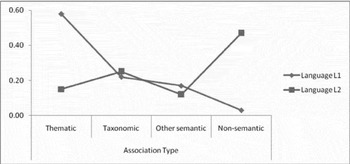
No participant responded with Chinese words to English stimuli or with English words to Chinese stimuli. This was probably because written Chinese is quite different from written English and/or because participants were being very serious about their performance in the presence of their English teacher (the experimenter). If a response to a stimulus word was missing or illegible then it was treated as invalid. The percentage of invalid data was 4.3 percent. Working independently, two teachers of English from the high school judged whether the association between each response word and its stimulus word was one of the four types: (i) thematic association; (ii) taxonomic relation; (iii) other semantic relation (semantic relation other than thematic or taxonomic relations); (iv) non-semantic association (orthographical or phonological association or incorrectly spelled response word). For example, the associations between response words chicken, meat, eat and leg and stimulus word egg would be regarded as thematic association, taxonomic relation, other semantic relation and non-semantic association, respectively. The ratio of inter-observer agreement was 97.6 percent. Responses which the two scorers did not agree upon accounted for a minor proportion of the total number and were taken to be invalid. Finally, the strength for each type of association was calculated: the number of each type for each stimulus word was divided by the corresponding number of valid responses. The results are illustrated in Figure 1.
Average strengths of different types of associations for stimulus words in different languages (L1 and L2).

The strengths of taxonomic, thematic, other semantic and non-semantic associations for L1 appeared quite different from those for L2. Three comparisons of strengths of associations were made. First, the sum of strengths of taxonomic, thematic and other semantic associations was obtained for each language in order to make a comparison of the difference in semantic associations in general between L1 and L2. A paired-sample t-test of the sum of strengths indicated that participants had a significantly higher ratio of semantic associations in L1 (.97 ± .03) than in L2 (.52 ± .10), t (32) = 23.962, p < .001, d = 4.19. They were relatively less likely in L2 than in L1 to provide a response that was semantically associated with the corresponding stimulus. They were more likely in L2 (.48 ± .10) than in L1 (.03 ± .03) to provide a response word that was orthographically or phonologically associated with its corresponding stimulus word or was incorrectly spelled, t (32) = 23.881, p < .001, d = 4.14. For example, handsome, had, handy, candy, handle, land, husband, sand, and, hander and head were the responses to hand and ear, age, eye, eagle, leg, pig, fog, dog and bag to egg. Second, as indicated in a study on adolescents (D. Li et al., Reference Li, Zhang, He, Chen, Zhang, Lin and Li2009), participants’ responses should in the main be thematically or taxonomically associated with the stimuli in L1. A paired-sample t-test of the sum of strengths of taxonomic and thematic associations showed that participants had a significantly higher ratio of categorical associations (taxonomic and thematic associations) in L1 (.81 ± .12) than they did in L2 (.40 ± .14), t (32) = 14.934, p < .001, d = 2.60. This means that participants could not provide English response words that were thematically or taxonomically related to the English stimulus words as they could with word association in Chinese. Third, the ratio of strength of thematic associations to the sum of strengths of thematic and taxonomic associations for each language was calculated. A paired-sample t-test of this ratio indicated that participants had a significantly higher ratio of thematic associations in L1 (.72 ± .21) than they did in L2 (.42 ± .30), t (32) = 7.172, p < .001, d = 1.24, suggesting a lower awareness of thematic associations in L2 than in L1, in comparison with taxonomic relations.
Discussion
In Experiment 1 participants were required to respond to each stimulus with the first word that came to mind. When stimuli were in L1, they responded with words from L1; when stimuli were in L2, they responded with words from L2. Participants seldom based their associations on the forms of words in L1; almost all their response words from L1 were semantically associated with L1 stimulus words. This result was consistent with the general conclusion on bilinguals’ responses in word association in L1 (Namei, Reference Namei2004). For L2 stimulus words, participants seemed heavily dependent on the forms of the words, although they were also able to make semantic associations to some extent. Having studied English for at least five years, they had evidently developed a rich knowledge of English words which, because they consist of sub-lexical parts, have clear structures. They did appear to depend on awareness of orthographical rules to make responses, for example basket to basketball, vision to television and rainy to rain. They also used rhymes and, for example, provided fog, fridge and leg as responses to dog, bridge and egg respectively. Non-native speakers can give response words that are visually similar to stimulus words when they fail to make meaningful associations (Fitzpatrick, Reference Fitzpatrick2007) and participants in the present experiment were inclined to provide response words by making changes to the forms of stimulus words. For example, a response was produced by adding one letter to the stimulus word (change from ear to tear) or by taking one letter away from it (change from hand to and), and age was taken as a response to egg, perhaps because the letters g and e are common to both words. In addition, Chinese characters are rich in spatial information and can be meaningful by their appearance. Referring to semantic exercises, Chen, d'Arcais and Cheung (Reference Chen, d'Arcais and Cheung1995) observed that “phonological information may not be automatically activated during the processing of meanings of Chinese characters” (p. 144). Through this perspective, Chinese students might be understood as having developed a habit of depending heavily on the visual information of characters. If they did follow this practice with Chinese characters, then they perhaps followed it when they were dealing with English written words. In summary, the high incidence of non-semantic associations in the L2 response words of participants was quite probably due to the participants’ excessive dependence on the forms of words in L2. This surmise is consistent with the conclusion that less proficient Chinese–English bilinguals are relatively more dependent on forms than they are on meanings in L2 (Li & Sun, Reference Li and Sun2007).
Participants were able to make semantic associations with stimulus words in L2, apparently reflecting their special pattern of awareness of the conceptual relations that were being tested. Their semantic associations in L2 were generally much weaker than those in L1 but the strength of associations that were evaluated as taxonomic relations in their second language (.25 ± .18) was not significantly different from the strength of associations in their first language (.22 ± .17). In other words, the extent to which students were aware of taxonomic relations might have been the same with both L2 and L1 words. This surmise suggests that the students were able to gain access to conceptual representations for taxonomic categories mainly by translating L2 stimulus words into L1 words. This is assumed to be the case in the RHM. Another important finding was that the patterns of semantic associations which participants had in L2 tended to be different from the ones they had in L1. In L1 participants were more likely to respond with words that were thematically related to stimulus words than with words that were taxonomically related to them. However, they appeared to provide more L2 response words that were taxonomically related to L2 stimulus words than ones that were thematically related to them. Participants might have been less aware of thematic than of taxonomic relations in L2 but more sensitive to thematic than to taxonomic relations in L1.
One might make a different deduction from the same data. There were more responses of thematic relations in L1, probably because of not only strong awareness of this type of conceptual relation but also lexical associations, since words often go together. There were fewer responses of thematic relations in L2, probably because of not only weak awareness of this type of conceptual relation but also poor proficiency in the language. It is true that participants can enlarge their responses in word association because of their skill in use of their mother tongue (see Namei, Reference Namei2004, for a review) but their associations should not be much weaker for thematically related words than they are for taxonomically related words since thematic relations cannot be of lesser significance than taxonomic relations in the conceptual organizations of human beings (Lin & Murphy, Reference Lin and Murphy2001; Sachs et al., Reference Sachs, Weis, Zellagui, Huber, Zvyagintsev, Mathiak and Kircher2008). However, the strength of association that participants showed in L2 tended to be less for thematic relations (.15 ± .13) than for taxonomic (.25 ± .18) relations, t (32) = 1.947, p = .060, d = .34. Thus, a more reasonable explanation for the present results might be that the conceptual representations participants possessed for taxonomic relations were more readily shared by L1 and L2 than the representations they possessed for thematic associations. The argument might still not sound so convincing since participants had a much bigger proportion of non-semantic associations in L2 (.47 ± .11) than in L1 (.03 ± .03), but similar results were obtained in Experiment 2
Sheng et al. (Reference Sheng, McGregor and Marian2006) conducted a similar study on a group of children and found that “word association performance [of participants] was comparable and correlated between 1st and 2nd languages” and that “bilingual and monolingual children demonstrated similar patterns of responses” (p. 572). The participants in their study were twelve young children, six of whom had been born in America and six of whom had been immersed in an English-speaking environment for more than one year. In contrast, the participants in the present study had had quite limited experience of using L2 in their daily life, a factor that might explain the differences between the patterns of performance they showed in word association and the patterns shown by the children in the study of Sheng et al. (Reference Sheng, McGregor and Marian2006). Since word association is a relatively simple exercise, this interesting finding needed to be confirmed with an exercise formulated to make comparisons between thematic and taxonomic relations.
Experiment 2
Method
It was expected that results obtained with a forced-choice decision-making exercise would be similar to the finding of Experiment 1: low-proficiency bilinguals were less readily aware of thematic than of taxonomic relations in L2 but more readily aware of thematic than of taxonomic relations in L1. One trial for this exercise requires three words for three ordinary objects between which a taxonomic and/or thematic association exists. However, the number of words that can be grouped to make such trials is quite limited. To increase the number of trials, the same stimuli were presented in the form of pictures as well as in written words. Low-proficiency bilinguals who did not begin to learn L2 in their early childhood should nevertheless have well-developed conceptual organizations from their use of L1. They can have access to the same conceptual representations for ordinary objects with both L1 words and pictures. Pictures can be memorized and conceptually processed better than written words (Stenberg, Reference Stenberg2006). If the performance of participants with written words as stimuli was the same as that with pictures as stimuli, then the pattern of awareness of conceptual relations reflected by the participants’ responses would be of high validity. It is possible that the performance of participants in response to L2 words was different from that in response to both L1 words and pictures. If this was the case then it would reinforce the inference that access to different conceptual representations can be gained in L2 and L1.
In line with these considerations the design formed a 3 (presentation mode: picture, Chinese and English) × 3 (stimulus set) factorial of repeated measurement. The three levels of stimulus set were structured as follows: item A was thematically related to C and taxonomically to B to make a thematic–taxonomic set; thematically related to C but not conceptually to B to make a thematic set; and taxonomically related to B but not conceptually to C to make a taxonomic set. The dependent variable was accuracy. If participants had a stronger awareness of the thematic than of the taxonomic relations among the stimuli, then they would have a higher accuracy for the thematic than for the taxonomic sets. They would be likely to decide that for a thematic–taxonomic set A was more closely related to C than to B. If in L1 their pattern of awareness of these two semantic relations was different from what it was in L2, then the patterns of their performance in Chinese and English in response to the stimuli would also be different.
Participants
The participants were 36 (18 males, aged 18.1 ± .7 years) students selected at random from class and assigned to this task. The males and females were randomly divided into two groups of equal size. Then two groups of participants were formed, G1 and G2, each consisting of nine males and nine females.
Materials
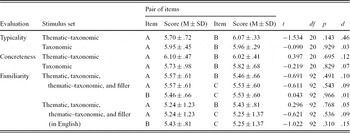
Thirty-three words made 11 thematic–taxonomic sets; 33 words made 11 thematic sets; and 33 words made 11 taxonomic sets (see Appendix). In addition, 42 words made 14 no-category-relation stimulus sets as fillers, in none of which was A conceptually related to B or to C. The words for items A and B in each taxonomic set were typical exemplars of an ordinary taxonomic category and so were those in each thematic–taxonomic set. The materials were evaluated in the same way as they were in Experiment 1. The average score for evaluation of strength of association between items A and C was 5.24 ± .71 for the thematic–taxonomic sets and 5.46 ± .41 for the thematic sets. The results of t-tests conducted on the scores of other evaluations of the materials are summarized in Table 1.
Scores of different evaluations and the t-test results between different item pairs for different stimulus sets.

The 47 sets of stimuli were regrouped into two types of stimulus sets in the following way: six thematic–taxonomic, five thematic, six taxonomic and seven filler sets were selected at random to be presented in Chinese and the rest in English, making stimulus set type one. The Chinese sets of stimulus set type one were presented in English and the English sets of stimulus set type one were presented in Chinese, making stimulus set type two. Following Murphy (Reference Murphy2001), a picture for each concept was selected from the Internet. The score for evaluation of picture–word consistency achieved by another 35 senior high school students was 6.12 ± .79. All the pictures were made of 150 ×150 pixels. The sets of pictorial stimuli were put together with stimulus sets type one and two to make two groups of stimuli, each consisting of 94 stimulus sets. Stimulus set type one and two were used for participating groups G1 and G2 respectively.
Procedure
A program was designed with SuperLab 4.0. The instruction was as follows:
Three words/pictures will be presented simultaneously to form a triangular contour. The word/picture at the top angle might be conceptually related to the two words/pictures at the base angles. Decide whether the top word/picture is conceptually related to the bottom left word/picture more than it is to the right one. If so, press the key “z”. Otherwise, press the key “/”.
All the trials were randomized for each participant. For each trial, a red cross “+” appeared and remained in the centre of the screen for 500 ms. Then three items, A, B and C, were presented simultaneously to make a triangular contour with A at the apex and B and C at the two base angles. Whether B was at the base angle on the left or right was determined randomly. When a key-stroke was received, the screen was cleared and the next trial started. The experiment was conducted individually with a personal computer in a quiet room.
Results
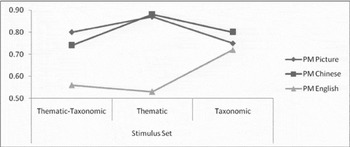
The data for the trials were eliminated if key-strokes other than the required ones were received. The percentage of valid data was 95.3 percent. The means of the accuracies are illustrated in Figure 2. The responses were correct if “z” was pressed for the thematic associations for the thematic–taxonomic sets.
Average accuracies under different treatments of presentation mode (PM) and stimulus set (reactions were correct if thematic associations were preferred for thematic–taxonomic sets).

The data for accuracy of reaction were subjected to a 3 (presentation mode) × (stimulus set) variance analysis of repeated measurement. The results indicated that the main effect was significant for presentation mode: F(2,70) = 63.819, p < .001, η 2 = .790. The interaction between presentation mode and stimulus set was significant: F(4,140) = 26.557, p < .001, η 2 = .610. Analysis of simple effect showed that when the stimuli were presented in L2, the accuracies of participants’ reactions to thematic–taxonomic (t (35) = 2.682, p < .05) and thematic (t (35) = 5.546, p < .001) sets were significantly lower than they were when the stimuli were presented in L1. When the stimuli were presented in L2, the accuracies were significantly lower for thematic–taxonomic (t (35) = 4.274, p < .05) and thematic (t (35) = 6.759, p < .001) sets than they were when the stimuli were presented in pictures. They were significantly higher for thematic sets than for taxonomic sets when the stimuli were presented in pictures (t (35) = 3.035, p < .01) and in L1 (t (35) = 2.297, p < .05) but significantly lower for thematic than for taxonomic sets when the stimuli were presented in L2 (t (35) = –2.892, p <.05). The remaining effects were not significant.
Discussion
In the forced-choice decision-making exercise, three items A, B and C were presented simultaneously. Participants had to decide whether A was conceptually related to B more than to C, no matter whether the three items in one trial were presented as pictures, L1 words or L2 words. The pattern of their performance for pictures was no different to what it was for L1 words, indicating consistency of participants’ conceptual behavior between pictures and L1 words. For taxonomic sets, reactions seemed not to be influenced as the result of change in mode of presentation. That is when only taxonomic relations existed among the three simultaneously presented items, participants could activate the representations for conceptual relations in response to stimuli in L2 as accurately as they could in response to stimuli in L1. However, in response to L2 stimuli their performance for thematic sets was significantly poorer than it was in response to L1 stimuli. They might have been less able in L2 than in L1 to activate the representations for thematic associations. Similarly, when the stimuli were in L2, performance for thematic–taxonomic sets was significantly worse than it was when the stimuli were in L1. When both thematic and taxonomic relations existed between the three simultaneously presented items, participants were less likely to prefer thematic to taxonomic relations when the stimuli were in L2 than they were when the stimuli were in L1. Obviously, these results are consistent with the results of Experiment 1: the performance of participants for taxonomic relations was no different in L2 from what it was in L1. Moreover, participants appeared more sensitive to thematic than to taxonomic relations when the stimuli were presented in L1 or in pictures but more sensitive to taxonomic than to thematic associations when the stimuli were presented in L2.
General discussion
It was hypothesized that, in L2 low-proficiency, bilinguals might have a pattern of relative awareness of thematic and taxonomic relations that was different from the pattern they had in L1. One word association exercise and one forced-choice decision-making exercise were conducted on a group of senior students from a Chinese (mainland) high school and consistent results were achieved: (i) awareness of taxonomic relations that participants had when stimuli were in L2 was no different from that when the stimuli were in L1; and (ii) participants tended to be more sensitive to thematic than to taxonomic relations in L1 but more sensitive to taxonomic than to thematic association in L2. This means that not all types of conceptual representations are accessible in L2 and L1 in the same way. The representations for some concepts such as taxonomic relations can be accessible in L2 to a relatively greater extent than can others such as thematic relations, which are developed on life experience.
According to the spreading activation model (Collins & Loftus, Reference Collins and Loftus1975), the representations for category-related exemplars are semantically close to one another. When one representation is activated, the activation can spread to others that are conceptually related to it. In Experiment 1, participants could provide responses in the corresponding language that were semantically related to the stimuli, irrespective of whether the stimuli were presented in L1 or L2. However, when the exercise was conducted in L2, semantic association between stimuli and participants’ responses was significantly weaker than it was when the exercise was conducted in L1. This is as predicted by the RHM. In other words, because L2 words activate corresponding concepts in the semantic store less than L1 words do, the activations that reach other semantically associated conceptual representations are weaker. This results in a lower probability of association with the corresponding L2 words than with L1 words. This is clearly in agreement with what the RHM predicts: with low-proficiency bilinguals, links between L2 words and corresponding concepts are weak.
Taxonomic relations are semantic relations that are based on similarities between exemplars of categories. For example a sparrow has a pair of wings and a beak and can fly. Because of this, it is called a bird. If one sees an object that has something like a beak and a pair of things like wings that help it fly, then one will take it to be a bird. This kind of deductive skill is very helpful for human beings in developing their thinking ability. Thematic associations are more dependent on life experiences. When we see a dog that from time to time has a bone in its mouth we build up an association between a dog and a bone. Although young children have difficulty developing representations for taxonomic relations (Vygotsky, Reference Vygotsky1999), they develop thematic associations quite easily. In their performance, participants consistently showed that thematic associations tended to be preferred to taxonomic relations when stimuli were presented in L1 (in Experiments 1 and 2) and in pictures (in Experiment 2). This may be understood by the personal backgrounds of participants and the materials used in the experiments. The participants were high school students from the countryside. The words used for the tests were names for ordinary things such as dog, bowl and car. The reason why the students’ representations of thematic associations could be activated more readily than those of taxonomic relations was probably rich experience with concrete things in country life and enhanced opportunity to employ thematic association in everyday activity. This argument is consistent with the view that the relative salience of different semantic relations is influenced by background knowledge. For example, uneducated Mayan adults are more likely than secondary school students to depend on thematic associations instead of taxonomic relations (Scribner, Reference Scribner1974).
According to the RHM, bilinguals have a common semantic store shared with different languages. Low-proficiency bilinguals can gain access to common concepts for L2 words by means of translations through L1. As suggested by Kroll, Michael and Sankaranarayanan (Reference Kroll, Michael, Sankaranarayanan, Healy and Bourne1998), new forms of words in L2 are attached to concepts through L1 words when (the words are) acquired through formal instruction. If participants in the present study preferred thematic to taxonomic relations in L1 then they might also have shown a preference for thematic over taxonomic relations in L2 as the result of translating L2 words into L1 words. However, a phenomenon that appears to contradict the RHM to some extent was consistently revealed in the two experiments: in their L1 responses to L1 stimuli in the word association exercise, participants tended to demonstrate a stronger awareness of thematic relations than of taxonomic associations. In L2, participants revealed a pattern of awareness of the two semantic relations that appeared to be just an upside-down image of the one they showed in their performance in L1. Similar results were obtained in Experiment 2. Participants had to decide whether stimulus item A could be thematically associated with C more than it could be related taxonomically to B. The accuracies of their reactions clearly indicated that they were more sensitive to taxonomic than to thematic associations when the stimuli were presented in L2 but more sensitive to thematic than taxonomic relations when the stimuli were presented in L1.
It was proved that both L1–L2 and L2–L1 semantic and translation priming effects can be achieved for unbalanced bilinguals (Schoonbaert, Duyck, Brysbaert & Hartsuiker, Reference Schoonbaert, Duyck, Brysbaert and Hartsuiker2009). Conceptual representations for L2 words can be formed after only one session of instruction in the vocabulary of L2. This applies to college students (Altarriba & Mathis, Reference Altarriba and Mathis1997) and even to children (Comesaña, Perea, Piñeiro & Fraga, Reference Comesaña, Perea, Piñeiro and Fraga2009). Similarly, although their experience of L2 was mainly focused on textbooks and they might have a limited vocabulary in L2, participants were able to get access to semantic representations with L2 words since they had been studying L2 for more than five years. Furthermore, twelve years of education must have helped them develop their taxonomic organization (Vygotsky, Reference Vygotsky1999) and enabled them to transfer their taxonomic knowledge across different languages. This was why they tended to have the same degree of awareness of taxonomic relation in L2 as they had in L1. However, none of the participants had experienced life in a community where English was the main language. As shown by the survey of the way they had learnt English, the linguistic expressions they encountered might not have been more than those in their textbooks. They seldom had any communication in the target language, even with their own teacher. Thus, they may have had few opportunities to experience thematic associations in the target language and therefore had relatively weak sensitivity to thematic associations in L2. Probably because thematic associations are more likely to be based on life experiences, participants seemed unable to transfer this kind of knowledge across languages.
Findings of neuroimaging studies of the differences between thematic and taxonomic relations suggest the relations are based on different sensory-motor processes and may have different roles in the formation and processing of concepts (Kalénine et al., Reference Kalénine, Peyrin, Pichat, Segebarth, Bonthoux and Baciu2009). Representations of thematic relations seem accessible in a way that is different from the way taxonomic relations are. If so, the conceptual representations can probably be thought of as systematically organized into different layers of conceptual networks. The categories that are more universally understandable across different cultures or languages can be represented to make up universal layers of conceptual networks, such as representations of taxonomic categories of basic levels and the taxonomic relations between them. In L2, the performance of participants concerning taxonomic relations did not appear different from what it was in L1, for both Experiments 1 and 2. Other representations, such as culturally specific ones may be organized as specific layers. The RHM could well be applicable to universal layers of conceptual networks but bilinguals might experience great difficulty in gaining access to specific layers of conceptual networks. Universal knowledge such as mathematics and science can be learnt from instruction and drill but culture-specific and language-specific knowledge is better acquired through life experiences. Those who participated in the present study might be able to memorize some of the meanings of particular English words but they might also be ignorant of the meanings of words that are specific to the language and the corresponding culture. Therefore they might be less conscious of thematic relations than of taxonomic ones in L2 than they were in L1. This argument seems consistent with the following: new words in L2 may not only be stored in the lexicon of L2 but also represented as both lexical and conceptual entries, if the words are acquired in an environment in which both form and meaning are emphasized (Altarriba, Reference Altarriba2000). “Although bilingual children could generate similar numbers of items in each language . . . a large proportion (68.40%) of items was unique to either language” (Peña et al., Reference Peña, Bedore and Zlatic-Giunta2002, p. 938). Jiang and Forster (Reference Jiang and Forster2001) argued that for late learners, knowledge of L2 lexical items might be represented differently from the way it is in L1. Dong et al. (Reference Dong, Gui and MacWhinney2005) also showed that Chinese–English bilinguals who acquired L2 at a relatively late age displayed a tendency to segregate; they were inclined to maintain the L1 conceptual system in the representation of L1 words and adopt the L2 conceptual system in the representation of L2 words.
Students whose study of a second language is confined mainly to a classroom have inadequate experience of life using that language as a language of daily communication. Nevertheless scope may exist for creation of microenvironments in which students can have some experience of using thematic associations in the target language. In fact, some teaching faculties in China appear to have realized this and have set up establishments to facilitate students’ practice of English. For example, an “English town” was built on campus at China Petroleum University, so that students could go shopping or have a drink there and interact through the medium of English. There are also “English villages” in Korea where people can live for a period of time without being permitted to use languages other than English. However, probably the best option most students have for learning English and the culture related to it is practicing as much as possible in the target language, in particular by reading and listening.
In conclusion, low-proficiency bilinguals may have the same degree of awareness of taxonomic relations in L2 as they have in L1. In L1, low-proficiency bilinguals might be more easily aware of thematic relations than they are of taxonomic relations but in L2 less readily aware of thematic relations than of taxonomic relations. The RHM may well explain how access to general knowledge can be obtained in L2 but might be less helpful in explaining how access to culture-specific knowledge is gained in L2, especially for low-proficiency bilinguals.
Appendix. The stimuli for the exercise in forced-choice decision-making