Introduction
A lichen is a symbiotic association in which a mycobiont provides water, mineral nutrients, shelter and chemical defence for its photosynthetic partners living inside a fungus-made growth cabinet (but see Spribille et al. (Reference Spribille, Tuovinen, Resl, Vanderpool, Wolinski, Aime, Schneider, Stabentheimer, Toome-Heller and Thor2016) reporting additional basidiomycete yeasts in most lichen cortices). In return, autotrophic partners provide the fungal host(s) with fixed carbon derived from photosynthesis. Lichens play important functional roles (Asplund & Wardle Reference Asplund and Wardle2016); they participate in water and nutrient cycles (Ellis Reference Ellis2012) by increasing canopy interception of precipitation and trapping airborne nutrients (Van Stan & Pypker Reference Van Stan and Pypker2015). Lichens with cyanobacteria as their only or secondary photobiont also fix atmospheric nitrogen (e.g. Green et al. Reference Green, Horstmann, Bonnett, Wilkins and Silvester1980; Antoine Reference Antoine2004), with benefits for their ecosystems. Moreover, epiphytic lichens constitute fodder for microfauna and, by facilitating large arthropods, they improve the foraging habitat quality for birds (Pettersson et al. Reference Pettersson, Ball, Renhorn, Esseen and Sjöberg1995). Finally, lichens serve as indicators to monitor environmental factors, such as ecological continuity in forests (Rose Reference Rose1976; Nordén & Appelqvist Reference Nordén and Appelqvist2001) and ambient hydration sources (e.g. Gauslaa Reference Gauslaa2014; Giordani et al. Reference Giordani, Incerti, Rizzi, Rellini, Nimis and Modenesi2014; Matos et al. Reference Matos, Pinho, Aragón, Martínez, Nunes, Soares and Branquinho2015).
Lichens, as poikilohydric organisms, lack active regulation of water uptake and loss (Kranner et al. Reference Kranner, Beckett, Hochman and Nash2008; Green et al. Reference Green, Sancho and Pintado2011). Thus, external factors drive their desiccation and rehydration cycles (Lakatos Reference Lakatos2011), although morphological modifications can be important (see below). Most lichens with green algae as their only or main photobiont (chloro- and cephalolichens, respectively) can reactivate photosynthesis in humid air, whereas cyanolichens require liquid water such as rain or dew (Lange et al. Reference Lange, Kilian and Ziegler1986; Schlensog et al. Reference Schlensog, Schroeter and Green2000). A poikilohydric strategy enables the majority of lichens to survive long dry periods and to recover quickly upon rehydration (Lakatos Reference Lakatos2011), and thus to dominate habitats characterized by severe environmental stresses such as Arctic and alpine regions, upper tree canopies and rocks.
Although enhancing survival, a poikilohydric strategy comes with a price. For instance, prolonged exposure to light while desiccated can cause lasting photoinhibitory damage (Gauslaa et al. Reference Gauslaa, Coxson and Solhaug2012). The longer the period of desiccation, the longer the time lichens need to re-establish normal carbon fixation rates (as reviewed by Kranner et al. Reference Kranner, Beckett, Hochman and Nash2008). Moreover, desiccation entails increased ROS (i.e. reactive oxygen species) formation. Therefore resources have to be devoted to defence mechanisms, such as antioxidants (Kranner et al. Reference Kranner, Beckett, Hochman and Nash2008) and energy dissipating mechanisms (Heber et al. Reference Heber, Bilger, Türk and Lange2010). Most damage occurs when drought occurs at higher light intensities (Gauslaa et al. Reference Gauslaa, Coxson and Solhaug2012; Färber et al. Reference Färber, Solhaug, Esseen, Bilger and Gauslaa2014), despite drying reducing cortical light transmittance (Gauslaa & Solhaug Reference Gauslaa and Solhaug2001) and inducing the curling of lobes which reduces light exposure (Barták et al. Reference Barták, Solhaug, Vrábliková and Gauslaa2006). Such processes are not always sufficient to prevent high light-induced damage in desiccated lichens (Gauslaa et al. Reference Gauslaa, Coxson and Solhaug2012), particularly in shade-adapted old forest species (Gauslaa & Solhaug Reference Gauslaa and Solhaug1996).
A useful functional parameter for assessing hydration of lichens is the water-holding capacity per unit area (WHC; reviewed by Gauslaa Reference Gauslaa2014), which translates to millimetres of rain needed for saturation. Cyanolichens have higher WHC than cephalo-/chlorolichens (Gauslaa & Coxson Reference Gauslaa and Coxson2011), partly compensating for the cyanolichen dependency on infrequent rain/dew events (Lange et al. Reference Lange, Kilian and Ziegler1986) versus the frequent activation in humid air by green-algal lichens (Lange Reference Lange2003). Water content drives the duration of photosynthetic periods in lichens (Gauslaa & Solhaug Reference Gauslaa and Solhaug1998); no carbon gain occurs in dry thalli.
The WHC not only depends on photobiont type but also on parameters such as growth form, surface area to volume ratio, thickness of cortex, hydrophobicity of thallus surface and presence/absence of a tomentum (Larson Reference Larson1987; Gauslaa & Solhaug Reference Gauslaa and Solhaug1998; Lakatos Reference Lakatos2011; Esseen et al. Reference Esseen, Olsson, Coxson and Gauslaa2015). Thin growth forms activate photosynthesis faster during water uptake and lose water more rapidly than thicker ones (Kershaw Reference Kershaw1985; Hartard et al. Reference Hartard, Cuntz, Máguas and Lakatos2009). Specific thallus mass (STM=dry mass (DM) per hydrated thallus area (Awet), a proxy of thallus thickness, is a main driver for internal water holding capacity, WHCinternal (Gauslaa & Coxson Reference Gauslaa and Coxson2011; Gauslaa Reference Gauslaa2014; Merinero et al. Reference Merinero, Hilmo and Gauslaa2014). The strong positive correlation between WHCinternal and STM across growth forms (Esseen et al. Reference Esseen, Olsson, Coxson and Gauslaa2015) indicates the need for increased DM investments per unit thallus area in order to enhance the water storage. In addition to species-specific differences, STM and thus WHCinternal can acclimate to increasing light and evaporative force (Merinero et al. Reference Merinero, Martínez, Rubio-Salcedo and Gauslaa2015). However, little is known about external water holding capacity (WHCexternal) in lichens.
Here, we study three foliose cephalolichens in Lobaria (s. lat.): L. pulmonaria (L.) Hoffm., L. virens (With.) J. R. Laundon and L. amplissima (Scop.) Forssell. The two latter species are also reported as Ricasolia amplissima (Scop.) De Not. (Moncada et al. Reference Moncada, Lücking and Betancourt-Macuase2013) and R. virens (With.) H. H. Blom & Tønsberg (Tønsberg et al. Reference Tønsberg, Blom, Goffinet, Holtan-Hartwig and Lindblom2016), and are thus taxonomically more closely related to each other than to L. pulmonaria. They often co-occur with cyanolichens and form the old forest Lobarion community favoured by ecological continuity (Rose Reference Rose1976). Lobarion is widely distributed globally, however, the community is declining (Nascimbene et al. Reference Nascimbene, Casazza, Benesperi, Catalano, Cataldo, Grillo, Isocrono, Matteucci, Ongaro and Potenza2016). The Lobaria species are red-listed in most European countries (e.g. Türk & Hafellner Reference Türk and Hafellner1999; Scheidegger et al. Reference Scheidegger, Clerc, Dietrich, Frei, Groner, Keller, Roth, Stofer and Vust2002; Martínez et al. Reference Martínez, Aragon, Sarrion, Escudero, Burgaz and Coppins2003; ArtDatabanken Reference ArtDatabanken2015) but not in Norway (Timdal Reference Timdal2015) where the local abundance of these species allows access to lichen material. Lobaria pulmonaria is among the most frequently studied lichens worldwide; it has a well-documented size-dependent WHCinternal (Gauslaa & Coxson Reference Gauslaa and Coxson2011; Merinero et al. Reference Merinero, Hilmo and Gauslaa2014). However, little is known about hydration traits in L. amplissima (Lidén et al. Reference Lidén, Jonsson Cabrajic, Ottosson-Löfvenius, Palmqvist and Lundmark2010) and L. virens (Honegger & Peter Reference Honegger and Peter1994). An understanding of hydration traits in these species is useful for the development of species-specific conservation strategies such as reintroduction programmes by transplantation (e.g. Gilbert Reference Gilbert2002; Smith Reference Smith2014). Since hydration traits are subjected to acclimation (Merinero et al. Reference Merinero, Martínez, Rubio-Salcedo and Gauslaa2015) and depend on habitat conditions (Gauslaa & Coxson Reference Gauslaa and Coxson2011), a search for species-specific traits should compare species in mixed populations. Therefore, in the present work we quantify the species-specific size-dependency of WHCinternal and WHCexternal in sympatric populations of the three epiphytic cephalolichens and test the hypothesis that the closely related L. amplissima and L. virens share more hydration traits than they do with the more distantly related and more widespread L. pulmonaria. Finally, we aim to discuss the implications of possible species-specific hydration traits on the ecological niches of these species.
Material and Methods
Lichen material
The epiphytic cephalolichens Lobaria amplissima, L. pulmonaria and L. virens were sampled from three sites with broadleaved deciduous forests in south and south-eastern Norway: 1) Kristiansand, Vest-Agder (58·1932–58·1960°N, 8·0094–8·0145°E, 70–80 m a.s.l.) with Quercus petraea-dominated forests; 2) Larvik, Vestfold (59·0966–59·0992°N, 9·8337–9·428°E, 120–160 m a.s.l.) with mixed forests of Q. robur, Acer platanoides, Fagus sylvatica; 3) Porsgrunn, Telemark (59·112–59·113°N, 9·832–9·835°E, 130–160 m a.s.l.) with mixed forests of Q. robur, Fraxinus excelsior, Tilia cordata, Ulmus glabra and A. platanoides. In each site, we searched for trees with many thalli of all three lichen species in mixed populations on the trunk. Sampled trees should be spaced >100 m apart to ensure a variation in the local habitat. The only tree species fulfilling these requirements were Q. petraea in the southernmost site (Kristiansand), and Q. robur and A. platanoides in the two other sites. All trees found were in open old forests with canopy gaps due to rocks, yet partly shaded from direct sun. We collected <50% of all thalli of each species present on each trunk at 1–3 m height in October 2015, with an emphasis on collecting a variety of thallus sizes. Debris, tree bark and bryophytes were removed. Then, the lichens were air-dried at room temperature and stored in a freezer at −18 °C until the start of the experiment in February 2016. In total, we collected 478 thalli: 109 L. amplissima, 144 L. pulmonaria and 225 L. virens; 176 from site 1, 200 from site 2 and 103 from site 3.
Quantification of functional traits
Before measurement, thalli were repeatedly sprayed on the upper surface with deionized water until full hydration, meaning that additional sprayings did not lead to any gain in wet mass. We measured wet mass (WM) in three steps: each fully water-saturated thallus was first weighed (WMmax), then gently shaken until no more drops were falling before weighing the wet mass (WMshaking), followed by blotting twice with dry filter paper to quantify WMblotting. The hydrated thallus area (Awet) was measured with a Licor Leaf Area Meter (LI 3100). Afterwards, lichens were dried at 20°C to a constant mass before recording their air-dry mass. On each weighing day, three thalli of each species were sacrificed in order to calculate a correction factor to estimate the oven-dry mass (DM). The sacrificed thalli were dried at 70 °C for 24 h before measuring DM. The ratio between DM and air-dry mass for these thalli was used as a correction factor to estimate the DM of all thalli.
The specific thallus mass (STM) was calculated as DM/Awet. To calculate the water-holding capacity before (WHCmax), after shaking (WHCshaking), as well as after blotting (WHCblotting), we used WMmax, WMshaking and WMblotting, respectively, as WM in the formula WHC=(WM−DM)/Awet. We considered the water left after blotting as internal water (WHCinternal=WHCblotting), whereas the external water was computed as WHCexternal=WHCshaking − WHCblotting. Percent water content, WC=(WM−DM)/DM, was calculated both after shaking and blotting.
Statistical analyses
Means, standard errors and medians were given for all traits. For each species, linear regressions with 95% confidence intervals were calculated to evaluate species-specific differences in the size-dependency of STM and WHC-parameters, and to investigate various relationships between traits. Even though log transformation was applied to improve data distributions, a nonparametric test (Kruskal-Wallis one-way analysis of variance on ranks with all pairwise multiple comparison procedures, Dunn’s method) was used to assess differences between species. These analyses were run in SigmaPlot (Systat Software, San Jose, CA, USA). Finally, we ran a GLM in Minitab 16 (Minitab Inc., State College, PA, USA) on log-transformed WHCinternal with study site and lichen species as factors and thallus area as a covariate.
Results
The influence of collection site and tree species on response variables was assessed. Measured parameters did not differ between the tree species. The variation in hydration traits between sites was weak and inconsistent between species. For example, the site-specific mean WHCinternal ranged between 66·3 (site 3) and 67·4 mg H2O cm−2 (site 1) for L. amplissima, 21·4 (site 1) and 30·4 mg H2O cm−2 (site 2) for L. pulmonaria and 31·9 (site 2) and 40·6 mg H2O cm−2 (site 3) for L. virens. In a general linear model on log-transformed WHCinternal, with site and lichen species as fixed factors and thallus area (Awet) as a covariate (r 2 adj=0·548), species and area were highly significant (P<0·001), but not the site (P=0·058). Thus, further analyses focused only on effects of thallus size and lichen species.
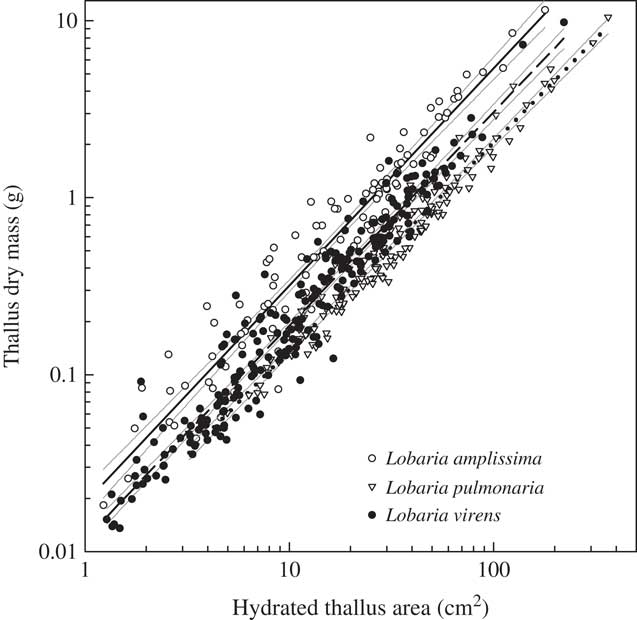
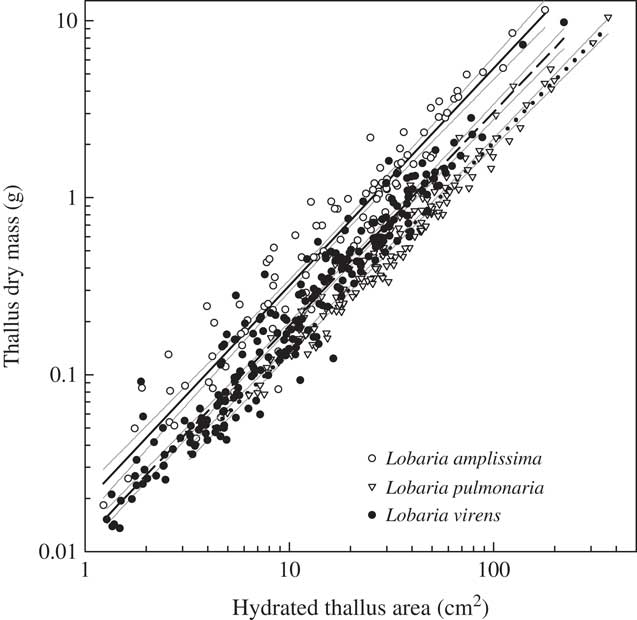
In all species, lichen DM tightly followed Awet in the log-log plot (r 2 adj=0·922–0·964; Fig. 1). For parallel lines in a log-log plot, the uppermost line has a steeper slope in a linear plot than a line located beneath. Thus, along linear DM (g) and Awet (cm2) scales, the rise in DM with Awet was fastest in L. amplissima (slope=0·061), more slowly in L. virens (slope=0·038), and slowest in L. pulmonaria (slope=0·026).
Relationship between thallus dry mass and hydrated thallus area (Awet) in three cephalolichen species (note log scales). Regression lines (black) for each species with corresponding 95% confidence intervals (grey lines) are given. For regression equations, r 2 adj and P-values, see Table 1. Solid line=Lobaria amplissima; dashed line=L. virens; dotted line=L. pulmonaria.
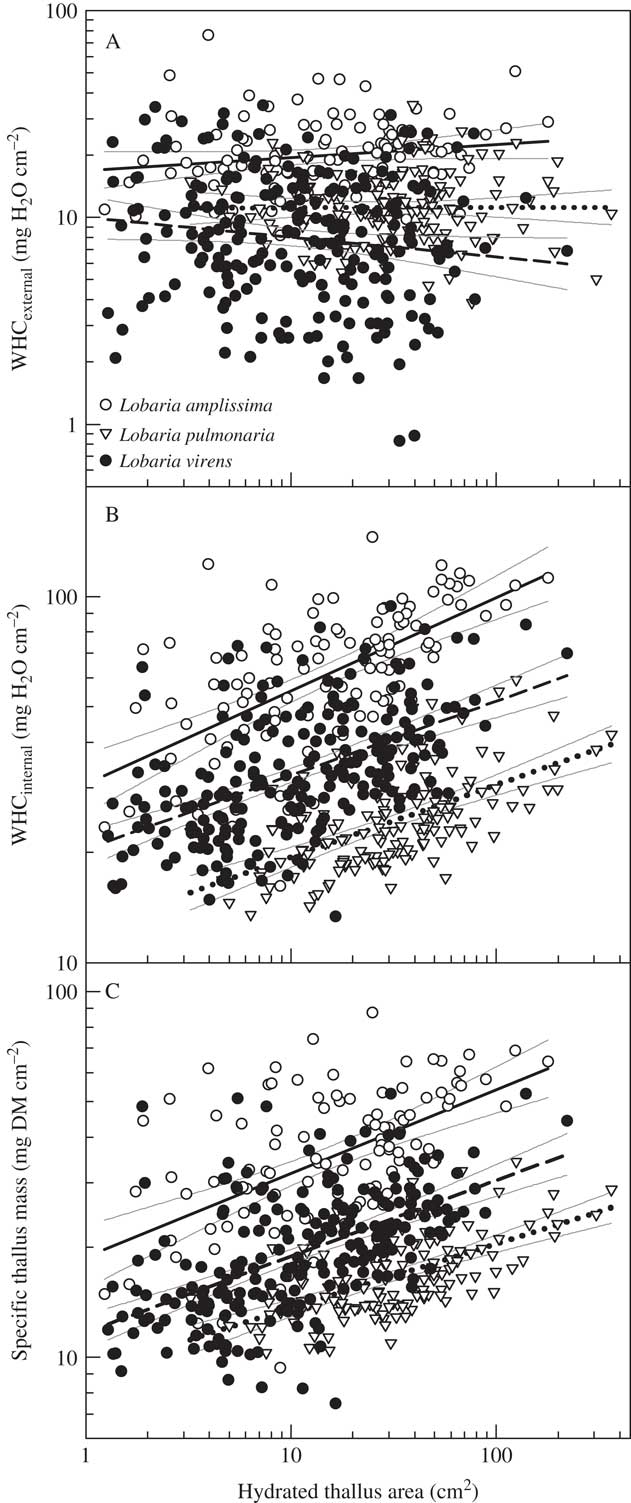
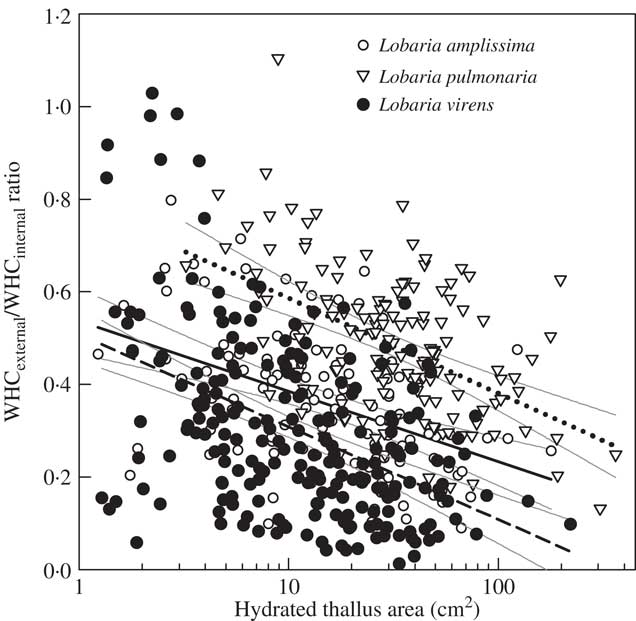
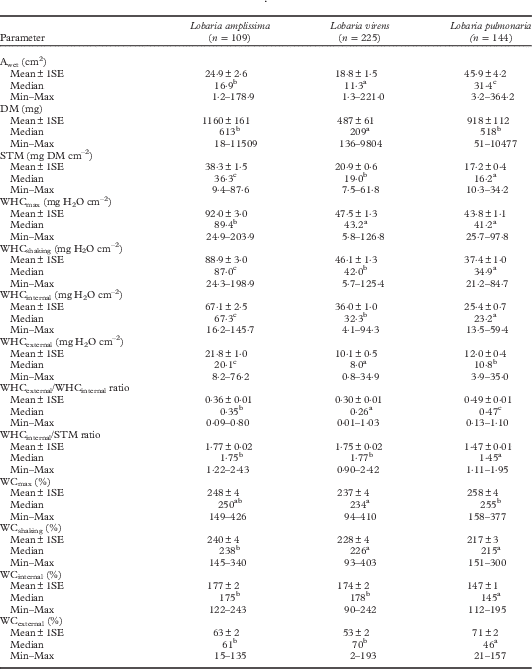
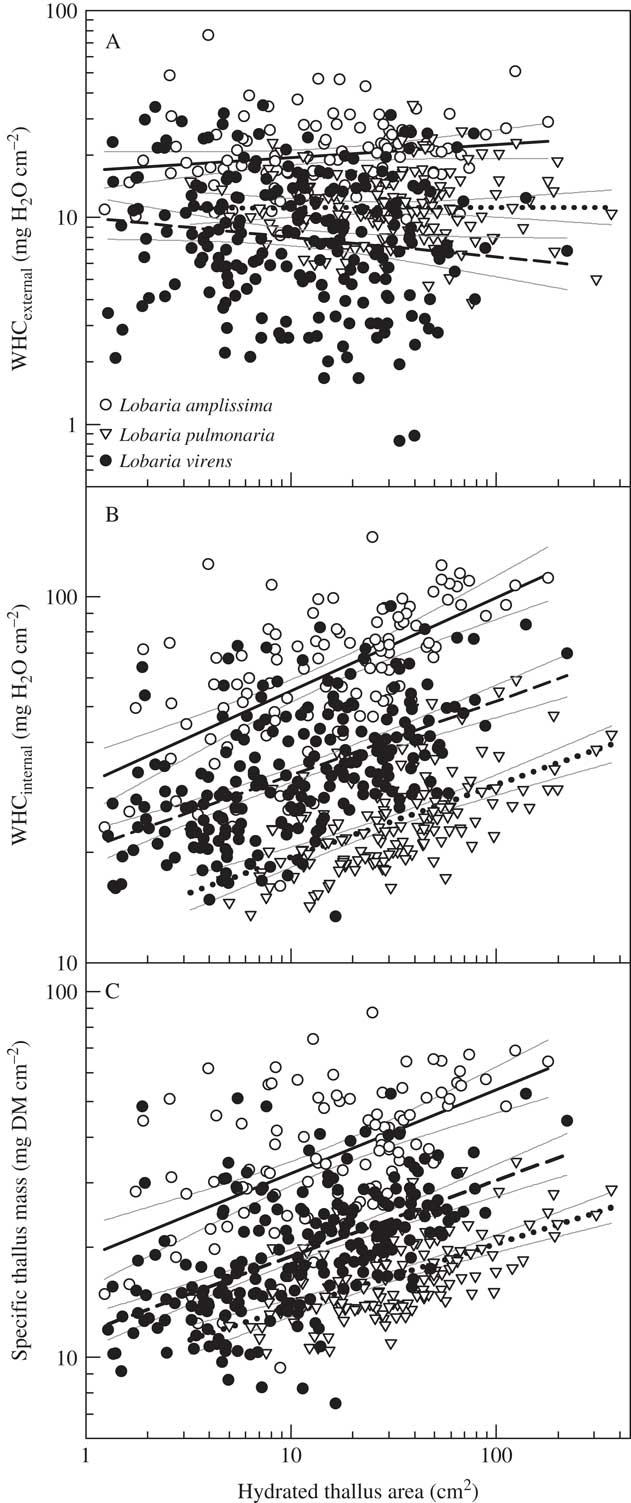
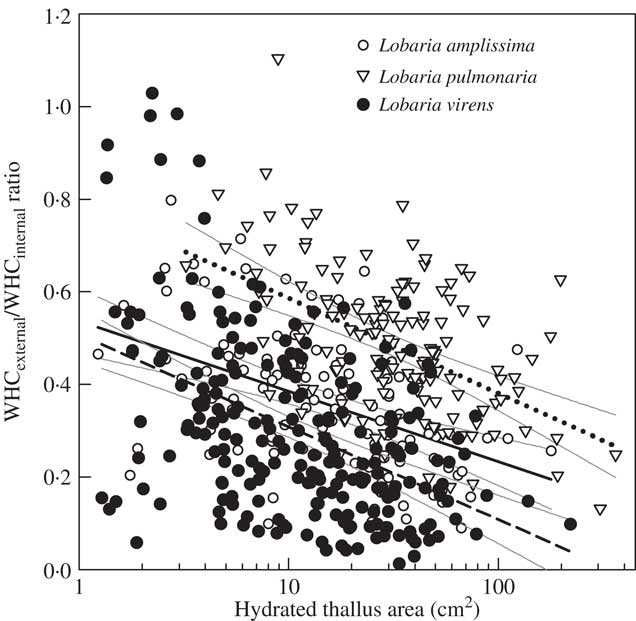
In log-log plots, STM (Fig. 2C) and WHCinternal (Fig. 2B) significantly increased with hydrated thallus area (Awet) in all three species (P<0·001) (Table 1). Along linear scales (data not shown), WHCinternal increased rapidly with size in L. amplissima (slope=0·56), more slowly in L. virens (slope=0·31) and slowest in L. pulmonaria (slope=0·08); the slope was highly significant for all species. WHCinternal was 2·1 (L. pulmonaria) – 3·6 (L. virens) times higher than WHCexternal (Table 2). Unlike WHCinternal, WHCexternal hardly depended on size (Fig. 2A; Table 1). Due to different size responses of WHCexternal (Fig. 2A) and WHCinternal (Fig. 2B), the WHCexternal/WHCinternal ratio declined with size in L. pulmonaria and L. virens from 0·79 and 0·51 in small thalli (1 cm2) to 0·28 and 0·02 in large thalli (300 cm2), respectively (Fig. 3; Table 1). Thus, the proportion of external to internal water was higher in smaller thalli. Shaking removed minor amounts of water, ranging from 1·4 (L. virens; 3·0 % of WHCmax) to 6·4 mg H2O cm−2 (L. amplissima; 14·6 % of WHCmax). Most water was stored inside the thallus in these species, evinced by their low WHCexternal (Table 2).
Relationship between hydrated thallus area (Awet) and (A) external (WHCexternal), (B) internal water-holding capacity (WHCinternal) and (C) specific thallus mass (STM) in three cephalolichen species (note log scales) Regression lines (black) for each species with corresponding 95% confidence intervals (grey lines) are given. For regression equations, r 2 adj and P-values, see Table 1. Solid line=Lobaria amplissima; dashed line=L. virens; dotted line=L. pulmonaria.
Relationship between hydrated thallus area (Awet) and the WHCexternal/WHCinternal ratio in three cephalolichen species. Regression lines (black) for each species with corresponding 95% confidence intervals (grey lines) are given. For regression equations, r 2 adj and P-values, see Table 1. Solid line=Lobaria amplissima; dashed line=L. virens; dotted line=L. pulmonaria.
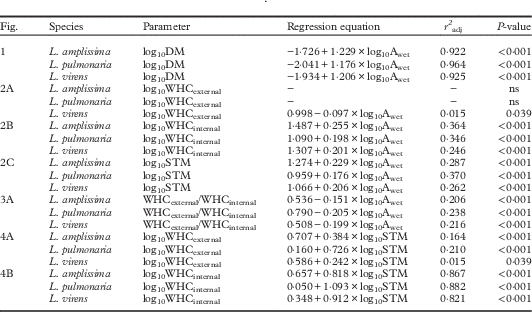
Regression equations, r 2 adj , and P-values for the relationships shown in Figs 1–4 for Lobaria amplissima (n=109), L. pulmonaria (n=144), and L. virens (n=225)
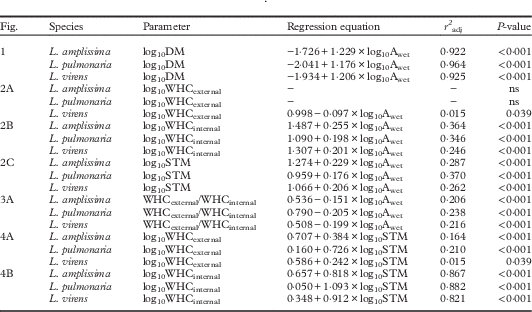
Awet=hydrated thallus area; STM=specific thallus mass; WHCexternal (external water-holding capacity)=WHCshaking − WHCblotting; ns=not significant, P≥0·05.
Thallus area (Awet), dry mass (DM), specific thallus mass (STM), water-holding capacity (WHC) and water content (WC) for the three Lobaria species used in this study
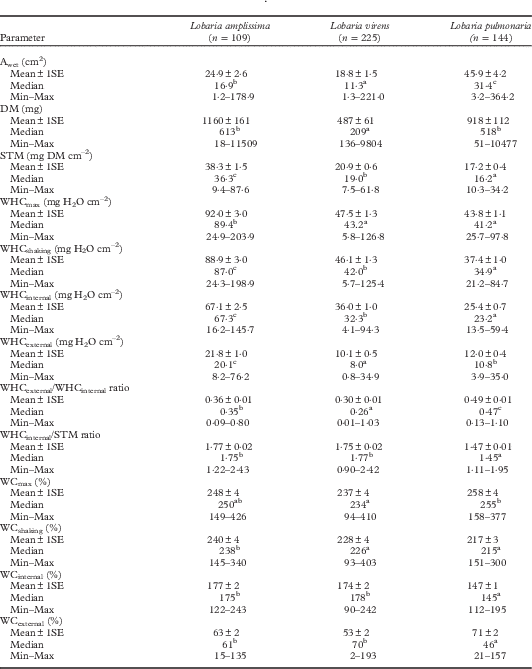
WHCmax=Water Holding Capacity in wet thalli before shaking; WHCshaking=WHC after shaking; WHCinternal=WHC after blotting; WHCexterna=WHCshaking – WHCblotting; WCshaking and WHCblotting=percentage water content after shaking and blotting, respectively. P-values according to a Kruskal-Wallis one-way ANOVA, all parameters significantly differed among species (P<0·001). Within a parameter, species sharing the same superscript letter do not differ significantly from each other (Dunn’s pairwise method).
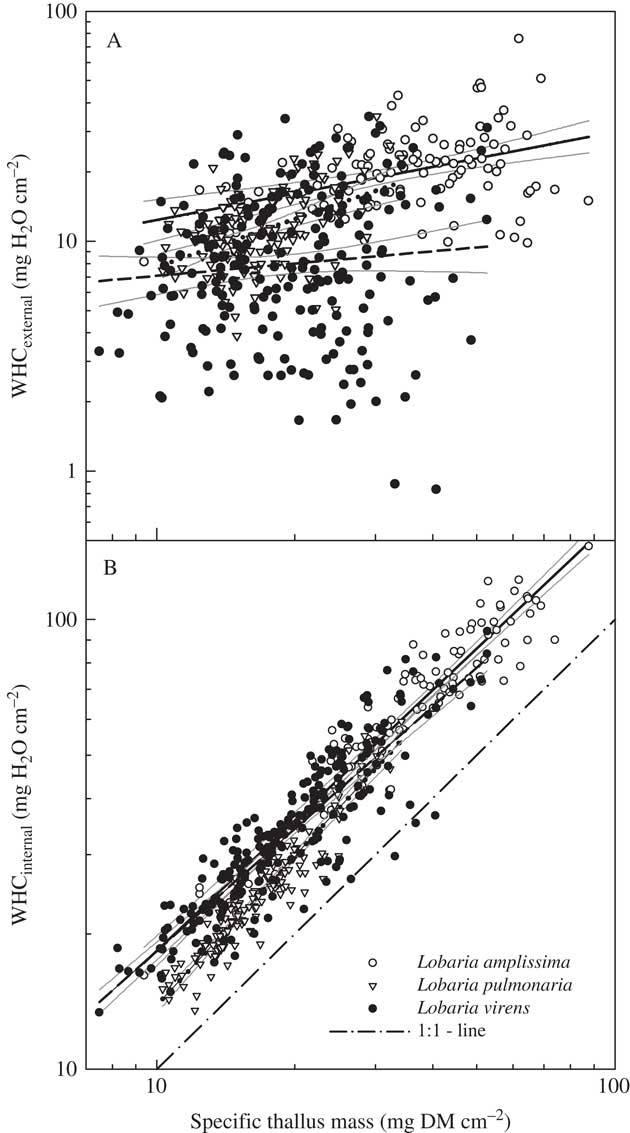
STM was the main driver for the internal water (WHCinternal) in all species (Fig. 4B); linear regression of log-transformed values showed that STM accounted for >88% of the variation in WHCinternal (Table 1). There was substantial overlap between L. amplissima and L. virens, whereas the smaller thalli of L. pulmonaria in particular had lower WHCinternal (Fig. 4B). WHCexternal increased with STM in all species (Fig. 4A). However, STM accounted for just 21% or less of the variation in WHCexternal for L. amplissima and L. pulmonaria (P<0·001; Table 1), whereas the regression was just marginally significant for the thin L. virens (Fig. 4A; Table 1).
Relationship between specific thallus mass (STM) and (A) external (WHCexternal) and (B) internal water-holding capacity (WHCinternal). Regression lines (black) for each species with corresponding 95% confidence intervals (grey lines) are given. For regression equations, r 2 adj and P-values, see Table 1. Solid line=Lobaria amplissima; dashed line=L. virens; dotted line=L. pulmonaria.
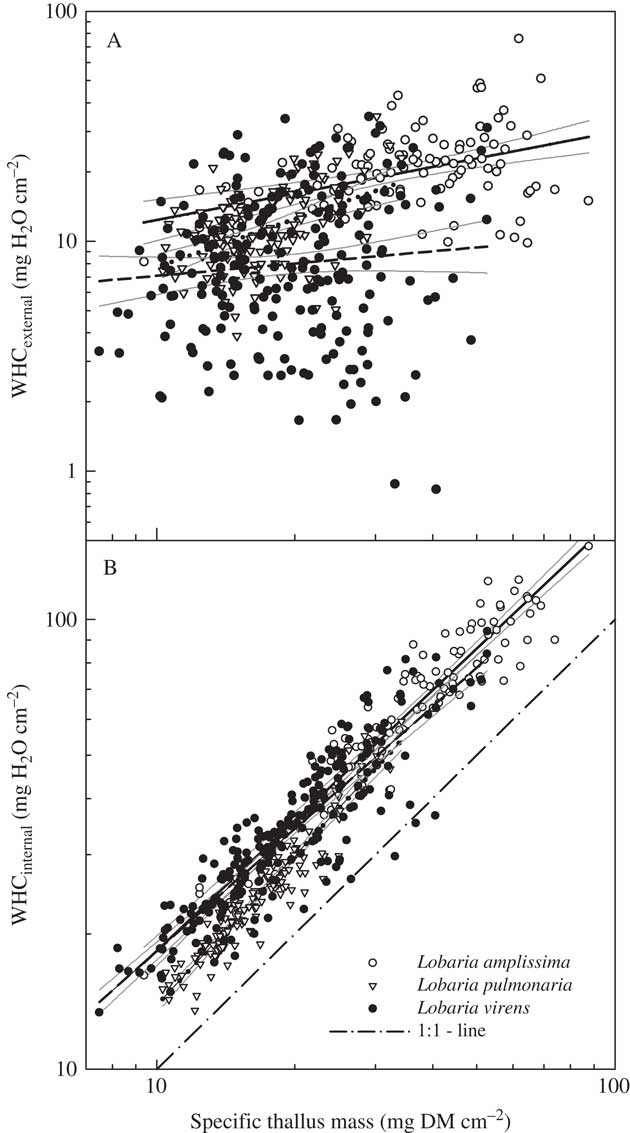
All hydration parameters studied differed significantly between species (Table 2), also evidenced by the mostly non-overlapping 95% confidence interval lines (Figs 2–4). Lobaria amplissima had the highest STM (38·3±1·5 mg DM cm−2), 1·8 times higher than in L. virens (20·9±0·6 mg DM cm−2; Table 2) and 2·2 times higher than in L. pulmonaria (17·2±0·4 mg DM cm−2). Likewise, L. amplissima had a WHCmax, WHCshaking and WHCinternal more than twice that of L. pulmonaria (Table 2), despite L. pulmonaria thalli having a significantly larger thallus area than the other species (Table 2). By contrast, L. pulmonaria had the highest WHCexternal/WHCinternal-ratio (Table 2). Lobaria amplissima had most external water (21·8±1·0 mg H2O cm−2), and L. pulmonaria (12·0±0·4 mg H2O cm−2) had slightly more external water than L. virens (10·1±0·5 mg H2O cm−2; Fig. 4A, Table 2).
The dependency of WCinternal and WCshaking on thallus area (Awet), as well as their relationships with STM, were less clear (data not shown). Even when a relationship was significant, the regression model accounted only marginally for the variation in WC (r 2 adj≤0·071). There was a stronger negative relationship between WCshaking and STM in L. amplissima (r 2 adj=0·240, P<0·001) and L. virens (r 2 adj=0·108, P<0·001), but it was not significant for L. pulmonaria. Lobaria amplissima and L. virens had higher WCinternal than L. pulmonaria (Table 2).
Discussion
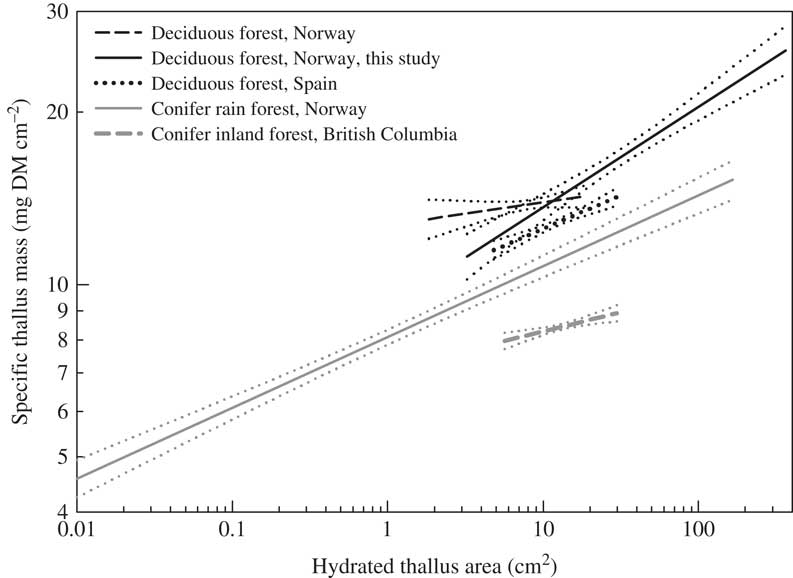
This study demonstrates strong links between STM and WHCinternal in cephalolichen members of Lobaria. The STM-WHCinternal regression lines for these Lobaria species (Fig. 4B) fall between those of cyanolichens (Gauslaa & Coxson Reference Gauslaa and Coxson2011) and a wide range of chlorolichens including foliose, fruticose and alectorioid growth forms (Gauslaa Reference Gauslaa2014; Esseen et al. Reference Esseen, Olsson, Coxson and Gauslaa2015). Lobaria pulmonaria followed the 1:1·5 ratio between STM and WHCinternal consistent with earlier studies of this species (Gauslaa & Coxson Reference Gauslaa and Coxson2011; Merinero et al. Reference Merinero, Hilmo and Gauslaa2014). However, L. amplissima and L. virens had a 1:1·8 ratio, closer to the 1:2 ratio in cyanolichens such as L. scrobiculata, L. hallii and L. retigera (Gauslaa & Coxson Reference Gauslaa and Coxson2011) than to the 1:1 ratio characterizing a wide range of chlorolichens (Gauslaa Reference Gauslaa2014; Esseen et al. Reference Esseen, Olsson, Coxson and Gauslaa2015). The high STM in L. amplissima compared to the two other species is the result of its thicker thallus which has been reported as 475–645 μm (Degelius Reference Degelius1940) and 295–610 μm (Hale Reference Hale1957). By contrast, the low STM in L. pulmonaria is consistent with a thinner thallus; 135–275 μm for pits versus 260–400 μm for veins (Jordan Reference Jordan1973). However, STM in L. pulmonaria has been shown to vary substantially in the literature (Fig. 5). STM was significantly higher in L. pulmonaria thalli on trunks in deciduous forests than those from branches of evergreen, more shaded spruce canopies. The two uppermost regression lines in Fig. 5, comprising populations with the thickest thalli and overlapping STM values, were from open deciduous forests where L. pulmonaria grew together with L. amplissima and L. virens which had high STM and WHC (Table 2). Lobaria pulmonaria from drier Spanish oak trunks, where humid air is probably an important hydration source (Merinero et al. Reference Merinero, Martínez, Rubio-Salcedo and Gauslaa2015), had lower STM than populations on trunks in Norway. Additionally, significantly lower STM occurred in less attached thalli on thin spruce branches in boreal rainforests, whereas the lowest mean STM so far measured in L. pulmonaria was from similarly thin spruce branches in inland forests in British Columbia (Fig. 5) where night-time humid air is the important hydration source (Bidussi & Gauslaa Reference Bidussi and Gauslaa2015). This large phenotypic plasticity in STM in L. pulmonaria (Fig. 5) may represent acclimation to site-specific dominant hydration sources.
Relationship between specific thallus mass (STM) and hydrated thallus area (Awet) in Lobaria pulmonaria from various forest types and climates. Black regression lines represent populations sampled on trunks in broadleaved deciduous forests, grey lines represent populations sampled from conifer branches. Solid lines show allometric studies; the upper black line comprising data from this study, the lower grey line, thalli from spruce branches in boreal Norwegian rainforest (Merinero et al. Reference Merinero, Hilmo and Gauslaa2014). Dashed and dotted lines represent populations sampled for transplantation experiments, consequently neither large nor small thalli were included. The dashed black line represents data from Norwegian forests with populations mixed with L. amplissima and L. virens (Gauslaa et al. Reference Gauslaa, Lie, Solhaug and Ohlson2006). The bold dotted black line represents data from oak forests in central Spain (Merinero et al. Reference Merinero, Martínez, Rubio-Salcedo and Gauslaa2015). The dashed grey line represents data from spruce branches in inland forests of southern British Columbia (Gauslaa & Goward Reference Gauslaa and Goward2012; Bidussi et al. Reference Bidussi, Goward and Gauslaa2013). Dotted lines represent 95% confidence intervals.
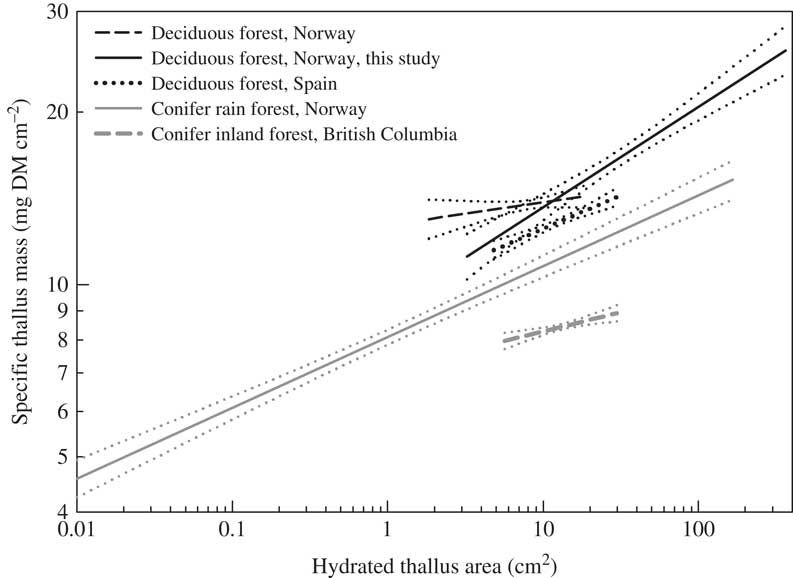
A strong size dependency of both STM and WHCinternal was demonstrated in the species studied, although regressions (Fig. 2; Table 1) were weaker than those found for foliose lichens on thin spruce branches (Merinero et al. Reference Merinero, Hilmo and Gauslaa2014) and for fruticose lichens on oak branches (Gauslaa Reference Gauslaa2014). In general, lichens on branches are smaller and younger (foliose lichens; see Fig. 5) or fruticose. The WHCinternal-STM relationships in these studies were probably stronger because specimens of such lichens were easier to define than were specimens on old tree trunks. Long-lived and old thalli often fragment and lose large portions. Additionally, small specimens on trunks also often merge and form one larger thallus. Such processes are likely reasons for the weaker size-dependent regressions in our study. A size-dependency complicates comparison of species. However, non-overlapping 95% confidence intervals (Figs 2–4) are consistent with species-specific hydration traits. Furthermore, despite sampling fewer small thalli and more large ones for L. pulmonaria, it had the lowest STM and WHCinternal.
Values of WHCexternal in lichens are not well known. There are few data on WHCshaking, and only for a small number of lichens (Green et al. Reference Green, Snelgar and Wilkins1985; Gauslaa Reference Gauslaa2014). The WHCexternal/WHCinternal ratios in the cephalolichens studied (0·26–0·47; Table 2) are substantially lower than the ratios reported by Gauslaa (Reference Gauslaa2014) in the chlorolichens Xanthoria aureola (1·3) and Hypogymnia occidentalis (1·1), as well as in the cyanolichen Pseudocyphellaria dissimilis (0·9; Green et al. Reference Green, Snelgar and Wilkins1985) and in the hair lichen genus Bryoria in particular (4–5; Essen et al 2017). Therefore, external water is less important in cephalolichens than in the other lichens measured so far. The lack of response of WHCexternal to increased thallus size (Fig. 2A), but weakly positive responses to increasing STM (Fig. 4A), suggest more irregular upper surfaces in thicker thalli that can hold more external water than thinner ones. For example, the higher WHCexternal/WHCinternal ratio in L. pulmonaria than in the other two species is likely due to its reticulate pattern facilitating water retention in the many depressions on the upper surface.
Excess hydration often causes depression of photosynthesis in lichens (Lange & Green Reference Lange and Green1996). A low WHCexternal may reduce the risk of prolonged suprasaturation in cephalolichens studied, and might explain not only why such lichens were much less damaged than a range of chlorolichens during a prolonged, very wet period (Gauslaa Reference Gauslaa2002) but also why these cephalolichens often characterize rainforests (Ellis Reference Ellis2016).
The low variation in hydration traits between sites is probably because the shared ecological niche for all species is narrower than the niche for individual species: mixed populations of three species inhabit a more specific habitat than populations of single species. Yet in sympatric populations with all species sampled from the same trunks, the species-specific contrasts in hydration traits were strong. This is consistent with a genetic basis for measured contrasts. Despite its high intraspecific flexibility (Fig. 5), L. pulmonaria differs from the two other species (Table 2), not only in its lower STM and WHCinternal, but also in its looser and less attached pendulous, spoon-shaped lobe ends exposed to ambient air. The other two lichens, L. amplissima and L. virens, have higher STM and WHCinternal and grow closely attached to the tree bark. We believe that there are functional links between growth form and hydration traits such as WHCinternal. A lower STM and a less attached growth form in L. pulmonaria secure faster photosynthetic activation from humid air and/or dew (Larson & Kershaw Reference Larson and Kershaw1976; Larson Reference Larson1981) in the absence of rain or stem flow. By contrast, the two other lichens, L. amplissima in particular, with its thick and more prostrate lobes, depend more on rain flowing down the trunk. Their average WHCinternal (67·1 mg H2O cm−2) largely exceeds the threshold level that humid air or dew can fill during one night; dew is ≤0·2 mm water (Jacobs et al. Reference Jacobs, Heusinkveld and Berkowicz2002, Reference Jacobs, Heusinkveld, Kruit and Berkowicz2006; Richards Reference Richards2002; Xiao et al. Reference Xiao, Meissner, Seeger, Rupp, Borg and Zhang2013), equivalent to ≤20 mg H2O cm−2, as reviewed by Gauslaa (Reference Gauslaa2014). Thus, there is a trade-off between low STM and the associated flexible use of various hydration sources versus high STM and a more conservative hydration strategy depending on rain and/or stem flow. The latter strategy as typified by L. amplissima and L. virens, requires greater water storage in order to prolong the rarer hydration periods than the L. pulmonaria strategy. Such a trade-off might explain why L. pulmonaria often grows abundantly on thin branches in humid forests (e.g. Larsson & Gauslaa Reference Larsson and Gauslaa2011; MacDonald & Coxson Reference MacDonald and Coxson2013) whereas the other two cephalolichens are more restricted to trunks, with stem flow feeding these prostrate lichens with water. The more oceanic distribution of L. amplissima and L. virens, for example in Britain (Ellis Reference Ellis2016) and Norway (see maps generated in Timdal (Reference Timdal2017)), is consistent with a stronger dependency of these species on rain.
Lobaria virens is a rarer and more oceanic species than the other two. With respect to hydration traits, it is neither as flexible as the common and widespread L. pulmonaria, nor as efficient in storing water as L. amplissima. Furthermore, L. virens is particularly susceptible to high light, especially when desiccated, and high light-induced damage is not easily reversible (Gauslaa & Solhaug Reference Gauslaa and Solhaug1996). Relative to the other two species, L. virens grows on lower portions of trunks and in more shielded positions (Asplund et al. Reference Asplund, Larsson, Vatne and Gauslaa2010). A combination of less specialized hydration traits and low tolerance to high light likely jeopardize its survival outside rainforests. Finally, pure cyanomorphs have been shown to act as early juvenile stages of L. virens (Tønsberg et al. Reference Tønsberg, Blom, Goffinet, Holtan-Hartwig and Lindblom2016). This might also explain the highly oceanic distribution of this species, although it is not yet known if all early L. virens juveniles are cyanomorphs.
In conclusion, the three cephalolichens L. amplissima, L. pulmonaria and L. virens differ in all measured hydration traits, even when collected from mixed populations on trunks where all species occurred together. The most widespread species, L. pulmonaria, benefits from a flexible strategy due to its low STM, likely allowing rapid activation in humid air, whereas the two rarer species depend more on rain, particularly L. amplissima with the highest STM and associated high WHCinternal.
The authors are grateful to the Erasmus+ programme for funding the travel of Sara Longinotti to Norway. Thanks also to Per-Anders Esseen and an anonymous reviewer for detailed and useful comments.