Introduction
Archaea were once thought of as obligate extremophiles, inhabiting niches that were too stressful for other organisms. Until recently, the only Archaea that had been successfully cultured were extremophiles, inhabiting salty brines, geothermal environments and anaerobic habitats (Stein & Simon Reference Stein and Simon1996). But, as Archaea are now known to be notoriously difficult to culture, this resulted in their misunderstanding and misrepresentation. As culture-independent methods have developed, based on the 16S rRNA gene, it is now clear that Archaea have a widespread occurrence and are abundant in diverse environments (Delong et al. Reference DeLong, Wu, Prezelin and Jovine1994, Karner et al. Reference Karner, Delong and Karl2001, Leininger et al. Reference Leininger, Urich, Schloter, Schwark, Qi, Nicol, Prosser, Schuster and Schleper2006, Gillan & Danis Reference Gillan and Danis2007). However, Archaea have not been described from Antarctic sea ice (Brown & Bowman Reference Brown and Bowman2001).
The sea ice environment is unique. It provides a stable platform for colonization by a diverse range of microbes yet has extreme gradients of salinity, temperature, light and dissolved organic matter (DOM) (Arrigo & Thomas Reference Arrigo and Thomas2004, Mock & Thomas Reference Mock and Thomas2005). Despite these harsh conditions, microbial communities survive and thrive throughout the sea ice matrix (Brown & Bowman Reference Brown and Bowman2001, Brinkmeyer et al. Reference Brinkmeyer, Knittel, Jürgens, Weyland, Amann and Helmke2003, Martin et al. Reference Martin, Hall, O'Toole, Davy and Ryan2008). The first study investigating the Antarctic sea ice microbial community (SIMCO) described sea ice diatoms (Hooker Reference Hooker1847). Since then, ciliates, flagellates, protists, bacteria and viruses in Antarctic pack ice have been discovered (for reviews see Deming Reference Deming2002, Mock & Thomas Reference Mock and Thomas2005, Murray & Grzymski Reference Murray and Grzymski2007). In comparison with other ecosystems, ecological information about the Antarctic sea ice prokaryotes is still in its infancy. Antarctic sea ice research has predominantly focused on the community structure and physiology of eukaryotic communities (e.g. McMinn et al. Reference McMinn, Ryan, Ralph and Pankowshi2007, Ryan et al. Reference Ryan, Cowie, Liggins, McNaughtan, Martin and Davy2009), but this information from the prokaryotic population is still lacking (Mock & Thomas Reference Mock and Thomas2005, Murray & Gryzymski Reference Murray and Grzymski2007, Martin et al. Reference Martin, Hall, O'Toole, Davy and Ryan2008).
Archaea were first identified in Antarctic ecosystems in 1988 (Franzmann et al. Reference Franzmann, Stackebrandt, Sanderson, Volkman, Cameron, Stevenson, McMeekin and Burton1988) and have been found in Antarctic marine waters, frozen lakes and sediments (Delong et al. Reference DeLong, Wu, Prezelin and Jovine1994, Murray et al. Reference Murray, Preston, Massana, Taylor, Blakis, Wu and DeLong1998, Reference Murray, Wu, Moyer, Karl and DeLong1999, Bano et al. Reference Bano, Ruffin, Ransom and Hollibaugh2004, Karr et al. Reference Karr, Ng, Belchik, Sattley, Madigan and Achenbach2006, Gillan & Danis Reference Gillan and Danis2007). In Antarctic marine waters, Archaea can be found in high abundances where they contribute up to 34% of the prokaryotic biomass (Delong et al. Reference DeLong, Wu, Prezelin and Jovine1994, Murray et al. Reference Murray, Wu, Moyer, Karl and DeLong1999, Kalanetra et al. Reference Kalanetra, Bano and Hollibaugh2009). Despite this abundance, Archaea have not been described, nor have they been discovered in Antarctic sea ice (Brown & Bowman Reference Brown and Bowman2001). Recently, Archaea have been detected in Arctic winter sea ice using fluorescent in situ hybridization (FISH, Junge et al. Reference Junge, Eicken and Deming2004), although they were not detected using the same methods in Arctic summer sea ice (Brinkmeyer et al. Reference Brinkmeyer, Knittel, Jürgens, Weyland, Amann and Helmke2003). Fluorescent in situ hybridization only provided limited resolution into the phylogenetic diversity of Archaea using domain-level probes. However, it gave evidence that Archaea in Arctic sea ice are in low abundance comprising ≤ 3.4% of total cells (Junge et al. Reference Junge, Eicken and Deming2004). Collins et al. (Reference Collins, Rocap and Deming2010) have since described Archaea in wintertime Arctic sea ice using 16S rRNA techniques. The majority of Archaea clustered within the phyla Thaumoarchaeota and the rest within the Euryarchaeota.
The domain Archaea consists of five distinct phyla, the Crenarchaeota, the Euryarchaeota (Woese et al. Reference Woese, Kandler and Wheelis1990), the Nanoarchaeota (Huber et al. Reference Huber, Hohn, Rachel, Fuchs, Wimmer and Stetter2002), Korarchaeota (Elkins et al. Reference Elkins, Podarc, Graham, Makarovae and Wolfe2008) and a recently proposed phylum the Thaumarcheota of which many are mesophilic and psychrophilic organisms (Brochier-Armanet et al. Reference Brochier-Armanet, Boussau, Gribaldo and Forterre2008). In marine environments, two groups are predominant; the Group I (GI) Crenarchaeota, now termed Thaumarcheota, and the Group II (GII) Euryarchaeota. Thaumarcheota are found in higher abundance in the oceans than the Euryarchaeota, particularly at depth (Karner et al. Reference Karner, Delong and Karl2001, Church et al. Reference Church, DeLong, Ducklow, Karner, Preston and Karl2003). Only two Thaumarcheota have been well characterized; Candidatus Nitrosopumilus maritimus was the first Thaumarchaeota culture recently isolated from a marine aquarium (Konneke et al. Reference Konneke, Bernhard, de la Torre, Walker, Waterbury and Stahl2005) and Cenarchaeum symbiosis, a psychrophile isolated from a marine sponge (Preston et al. Reference Preston, Wu, Molinski and DeLong1996). It is probable that Thaumoarchaeota may play an important role in the nitrogen cycle in many ecosystems (Leininger et al. Reference Leininger, Urich, Schloter, Schwark, Qi, Nicol, Prosser, Schuster and Schleper2006, Kalanetra et al. Reference Kalanetra, Bano and Hollibaugh2009). Nitrosopumilus maritimus is involved in nitrification, growing as chemolithoautotrophs by oxidizing ammonia to nitrite (Konneke et al. Reference Konneke, Bernhard, de la Torre, Walker, Waterbury and Stahl2005).
This study seeks to gain more information about the organisms in sea ice environments. Our aim was to detect and quantify archaeal abundance and describe their diversity using 16S rRNA gene molecular methods. This work forms a part of the New Zealand's Latitudinal Gradient Project (LGP), a multination and multidisciplinary research programme studying marine and terrestrial ecosystems along the Victoria Land coastline, Antarctica (Howard-Williams et al. Reference Howard-Williams, Peterson, Lyons, Cattaneo-Vietti and Gordon2006).
Methods
Core collection
A powered ice corer (Kovacs, USA) was used to collect sea ice cores from Antarctic fast-ice. The sea ice microbial community was collected from Gondwana Station, Terra Nova Bay (TNB, 74°43′S, 164°8′E) on 6 December 2007, on 24 November 2006 and at McMurdo Station (McM, 77°51′S, 166°39′E) on 30 November 2008. The sea ice thickness and chlorophyll a (chl a, as an indicator for algal biomass) were also measured. Chlorophyll a was measured on site where 100 ml of the melted sea ice sample was filtered onto a 47 mm GF/F filter and extracted in 10 ml of methanol over 12 h in the dark at 4°C. The extracted chl a was subsequently measured on a digital fluorometer (10AU Turner Designs, USA) using the acidification protocol of Evans et al. (Reference Evans, O'Reilly and Thomas1987). The bottom 10 cm of the core was removed for community analysis and to avoid contamination from the underlying water and from human-borne prokaryotes, a 10 x 10 x 4 cm block was cut from within the bottom section of the sea ice core. This block was melted over a period of 12 h in three times the volume of autoclaved 0.22 μM filtered seawater (following the procedure found in Ryan et al. Reference Ryan, Ralph and Mcminn2004). This process of ice melt maintains the temperature at -1.8°C and reduces salinity shock. The microbes were concentrated onto 0.22 μm mixed cellulose acetate filters (Pall Life Sciences, USA) using a diaphragm vacuum pump and stored at -80°C until processing.
DNA extraction
DNA was extracted using a modified version of the phenol: chloroform method (Moeseneder et al. Reference Moeseneder, Winter, Arrieta and Herndl2001). Briefly, filters were cut into pieces, placed into 1 ml of lysis buffer (40 mM EDTA, 50 mM Tris-HCl (pH 7.4), 0.75 M sucrose and 15% Tween 80), and incubated with lysozyme at 37°C overnight. The sample was then incubated at 55°C for 2 h with 200 μl of 10% SDS and 40 μl 20 mg ml-1 proteinase K. DNA was extracted using an equal volume of phenol-chloroform-isoamyl alcohol (25:24:1) and chloroform-isoamyl alcohol (24:1). DNA was precipitated at -20°C overnight using 5 μg ml-1 linear acrylamide (Ambion Ltd, USA), 0.25 vol 5 M sodium acetate and 1 x volume isopropanol.
Quantitative PCR
Quantitative PCR reactions were performed on the CFX96™ Real Time PCR System (Bio-Rad, CA, USA). The archaeal 16S rRNA gene was amplified using the primers Arch-1017F (5′-GAGAGGWGGTGCATGGCC) and Arch-1392R (5′-TGACGGGCGGTGTGTGCTTG, Barns et al. Reference Barns, Fundyga, Jeffries and Pace1994). The bacterial 16S rRNA gene was amplified using the universal primers Bac-F518 (5′-CCAGCAGCCGCGGTAATACG) and Bac-R800 (5′-TACCAGGGTATCTAATCC). Amplifications were carried out in triplicate in 1 x SsoFast™ Eva Green SuperMix (SYBR based system, Bio-Rad), containing specific primers (0.1 mM) and a final concentration of DNA at 1 ng μl-1. PCR cycling conditions were 95°C for 3 min, followed by 40 cycles of 95°C 10 s, 57°C 20 s and 72°C 30 s. Melt curves profiles were analysed for both 16S rRNA genes. Standards for Archaea and Bacteria 16S rRNA gene were amplicons cloned from environmental samples. Standard curves were based on a dilution series ranging from 101 to 108 gene copies μl-1 and were run in triplicate. High amplification efficiencies of 95–104% were obtained from both genes, with r 2 values between 0.990 and 0.997. The gene copies μl-1 of template DNA was converted to gene copies ml-1 of melted sea ice core by taking into account the volume filtered, the final volume of DNA extracted and assuming that 100% of the DNA had been extracted from each sample.
PCR conditions and clone library construction
The 16S rRNA gene was amplified with the primer pair Arch-21F, and Arch-958R (Delong Reference DeLong1992) using illustra Ready-To-Go™ PCR beads (GE healthcare, Piscataway, NJ). Each PCR reaction contained 10 ng of DNA in two 25 μl reactions and denatured at 95°C prior to amplification with 30 cycles consisting of denaturation at 95°C for 45 s, primer annealing at 50°C for 60 s, and elongation at 72°C for 60 s. PCR products were checked using gel electrophoresis and a faint band was seen. This band was gel purified (GE Healthcare, Piscataway, NJ) and 5 μl was added to a second PCR reaction under the same conditions as above. PCR products were again visualized using gel electrophoresis and quantified using the sensitive fluorescent nucleic acid stain PicoGreen (Molecular Probes, OR, USA). Amplicons were cloned using TOPO TA (Invitrogen, Carlsbad, USA) and pGEM-T (Promega, Maddison, WI) cloning vectors and transformed into DH5-α (Invitrogen, Carlsbad, USA) chemically competent cells with a 3:1 insert:vector molar ratio. Individual colonies were amplified using the vector specific M13F and M13R primers. Clones containing the 16S rRNA gene were detected by gel electrophoresis and column cleaned (Zymogen, Orange, CA).
Sequence analysis
The M13 PCR products were sequenced using an ABI Prism 3100 genetic analyser. Chimera sequences were eliminated using Chimera-Check (Cole et al. Reference Cole, Chai, Marsh, Farris, Wang and Kulam2003) and Pintail (Ashelford et al. Reference Ashelford, Chuzhanova, Fry, Jones and Weightman2005). The non-chimeric sequences have been submitted to Genbank (Accession numbers, FN564099–FN564147). Sequences were aligned in ARB (http://www.arb-home.de, Ludwig et al. Reference Ludwig, Strunk, Westram, Richter and Meier2004) using evolutionary-conserved primary sequence and secondary structure (Lane Reference Lane1991) and the total number of bases analysed was 804. Evolutionary distances were calculated from sequence pair dissimilarities using only unambiguously sequenced positions. The phylogenetic analyses were performed in PHYLIP (Felsenstein Reference Felsenstein1989) based on the majority rule consensus tree using the neighbor-joining algorithm with Jukes-Cantor correction (Jukes & Cantor Reference Jukes and Cantor1969). Trees were visualized using the programme dendroscope (Huson et al. Reference Huson, Richter, Rausch, Dezulian, Franz and Rupp2007).
Results and discussion
The sea ice cores collected were from annual sea ice with no snow cover. The sea ice was the thickest at Terra Nova Bay (TNB) in 2006 measuring 260 cm in thickness. At both TNB in 2007 and McM in 2008 the sea thickness was 190 cm. At all sites there was a significant algal population, identified by a thick brown layer visible at the bottom of the sea ice core. The algal biomass was highest at TNB in 2007 where chl a concentrations were 245 mg m-2. At the other two sites, the algal population was still considerable but chl a levels were lower at 71 mg.m-2 and 94 mg.m-2 for TNB 2006 and McM 2008 respectively.
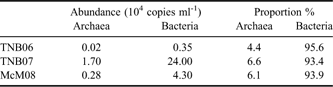
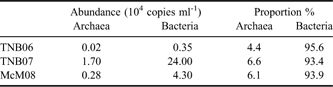
The abundance of bacterial and archaeal 16S rRNA sequences were investigated using quantitative PCR. Prokaryotes were defined as the sum of bacterial and archaeal 16S rRNA genes. In the three samples archaeal 16S rRNA genes were 4.4–6.6% of the total prokaryotes (Table I). Archaea can contribute significantly to Antarctic picoplankton communities where in late winter they comprise 21–34% of the total prokaryotic rRNA (Delong et al. Reference DeLong, Wu, Prezelin and Jovine1994). However, this high abundance of Archaea disappears with the onset of spring resulting in low abundances in Antarctic summer waters (Murray et al. Reference Murray, Preston, Massana, Taylor, Blakis, Wu and DeLong1998). Murray et al. (Reference Murray, Wu, Moyer, Karl and DeLong1999) found Archaea were also in low abundance in surface waters in McMurdo Sound, but numbers increased to almost 10% of the total picoplankton rRNA at depth. Archaea are also found in low abundance in winter Arctic sea ice (Junge et al. Reference Junge, Eicken and Deming2004) which was comparable to the archaeal abundance in Arctic surface waters during autumn (Wells & Deming Reference Wells and Deming2003), but not to winter Antarctic seawaters (Murray et al. Reference Murray, Preston, Massana, Taylor, Blakis, Wu and DeLong1998, Reference Murray, Wu, Moyer, Karl and DeLong1999). The low abundance of Archaea in Antarctic summer sea ice may reflect the numbers that are found in summer surface waters (Murray et al. Reference Murray, Preston, Massana, Taylor, Blakis, Wu and DeLong1998, Reference Murray, Wu, Moyer, Karl and DeLong1999). Collins et al. (Reference Collins, Rocap and Deming2010) found a high degree of similarity between prokaryotic sea ice and seawater communities in the Arctic during winter. This suggests that the extreme change in environmental conditions from seawater to sea ice does not exert any negative effects on the community. In contrast, the Antarctic sea ice bacterial community was found to differ from the underlying water column in the spring and summer seasons (Delille Reference Delille1992, Bowman et al. Reference Bowman, McCammon, Brown, Nichols and McMeekin1997).
Archaeal and bacterial 16S rRNA gene copy numbers and relative proportions in Antarctic sea ice samples as determined by qPCR.
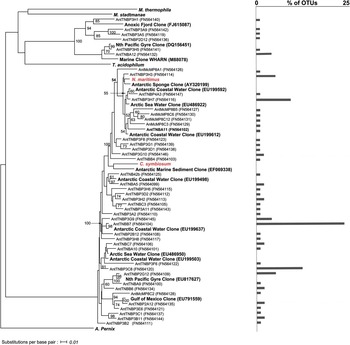
To investigate the community structure of the sea ice archaeal community we extensively sequenced one clone library from Antarctic sea ice at TNB in 2007. All 88 of these 16S rRNA sequences were identified as Archaea and were associated with the Thaumoarchaeota and the Euryarchaeota. To confirm this presence of Archaea, 20 clones from the two other sites, TNB in 2006 and McM in 2008 were also sequenced. All these sequences were identified as Thaumoarchaeota. Phylogenetic analysis of the 16S rRNA sequences placed the majority (90.8%) of the sequences within the Thaumoarchaeota and the remaining clones (9.2%) clustered with the GII Euryarchaeota. These results reflect those of Collins et al. (Reference Collins, Rocap and Deming2010) who found the majority (91%) of Arctic sea ice Archaea was Thaumoarchaeota with a small group within the Euryarchaeota. Our most abundant operational taxonomic units (OTUs) were grouped within the Thaumoarchaeota and the majority of these were closely related to the cultured marine ammonia-oxidizing Nitrosopumilus maritimus or archaeal clones that have been described from Antarctic and Arctic waters (Fig. 1). One group identified was more distantly related to Antarctic and Arctic OTUs and closer to clones from temperate waters. One OTU, FN564104, was 99% identical to an Antarctic coastal water clone (Kalanetra et al. Reference Kalanetra, Bano and Hollibaugh2009) and occurred in almost a quarter of the sequences obtained from the clone libraries. This OTU shared 92% phylogenetic similarity with N. maritimus. Archaeal sequences isolated from Arctic seawater (Collins et al. Reference Collins, Rocap and Deming2010) were also closely related with our Thaumoarchaeota sequences. Prokaryotic phylotypes appear to be similar between the Arctic and Antarctic regions. Bacteria share many 16S rRNA phylotypes in sea ice (Brinkemeyer et al. 2003) and Thaumoarchaeota show similar diversity in Arctic and Antarctic waters (Bano et al. Reference Bano, Ruffin, Ransom and Hollibaugh2004, Kalanetra et al. Reference Kalanetra, Bano and Hollibaugh2009). Thaumoarchaeota are ubiquitous and abundant, found in global cold waters (Karner et al. Reference Karner, Delong and Karl2001) and it is probable that adaptation and diversification has led to its survival in polar environments. Our Euryarchaeota OTUs were found in low abundance, consistent with numbers found in Antarctic waters (Murray et al. Reference Murray, Preston, Massana, Taylor, Blakis, Wu and DeLong1998, Reference Murray, Wu, Moyer, Karl and DeLong1999). The Euryarchaeota clones had a high degree of variability where many of the sequences had less than 94% sequence homology. They were more diverse than the Thaumoarchaeota sequences, which has also been reported in marine and Antarctic waters (Massana et al. Reference Massana, Delong and Pedros-Alio2000, Bano et al. Reference Bano, Ruffin, Ransom and Hollibaugh2004). Their closest relatives were clones identified from marine waters and shared > 85% similarity with a marine archaeal species, clone WHARN (M88078, Delong Reference DeLong1992). They were distantly related to the cultured aerobic moderate thermophile Thermoplasma acidophilum.
Dendrogram showing the phylogenetic relationships between archaeal 16S rRNA gene sequences from Antarctic sea ice. The bar graph shows the relative abundance of the sequences in library. Reference sequences are in black apart from Nitrosopumilis maritimus and Cenarchaeum symbiosum shown in red. Bootstrap values greater than 50% are shown and 804 bases were analysed. One sequence represented a group of sequences with similarity > 98.5% with the abundance of each sequence graphed on the right. Aeropyrum pernix was used as an outgroup.

The predominance of Thaumoarchaeota has been documented in Antarctic marine picoplankton, where they comprise ∼95% of the archaeal community. However, during the Antarctic summer months, Thaumoarchaeota are in low abundance in the surface waters and at numbers similar to that of the Euryarchaeota. They are found in high abundance at depths below the photozone but will migrate to the surface during winter (Church et al. Reference Church, DeLong, Ducklow, Karner, Preston and Karl2003). The low numbers of Euryarchaeota in sea ice may be a reflection of the rarity of this group in Antarctic waters (Bano et al. Reference Bano, Ruffin, Ransom and Hollibaugh2004). The dominance of Thaumoarchaeota over Euryarchaeota in Antarctic sea ice may be due to the growth of ice during winter months, when the Thaumoarchaeota are dominant in surface waters, followed by their migration down the sea ice core. Or perhaps the low irradiance beneath the sea ice, typically only 1% of the incident irradiance at the surface (McMinn et al. Reference McMinn, Ryan, Ralph and Pankowshi2007), enables Thaumoarchaeota communities to persist in the surface seawater into the summer months. A large proportion of bacteria are active in sea ice (Brinkemeyer et al. 2003, Martin et al. Reference Martin, Hall, O'Toole, Davy and Ryan2008) and are predominantly psychrophiles compared to the underlying sea water (Delille Reference Delille1992, Bowman et al. Reference Bowman, McCammon, Brown, Nichols and McMeekin1997). The Thaumoarchaeota contains psychrophilic members (Brochier-Armanet et al. Reference Brochier-Armanet, Boussau, Gribaldo and Forterre2008) that may be able to survive and grow under harsh sea ice conditions. Bacterial communities are also influenced by a range of biotic and abiotic factors (Fuhrman et al. Reference Fuhrman, Hewson, Schwalbach, Steele, Brown and Naeem2006), variables that were not investigated in this study.
To the best of our knowledge, our study is the first to describe archaeal diversity in Antarctic sea ice using the 16S rRNA gene. This phylogenetic information provides the first step into understanding the ecology of archaeal communities in Antarctic sea ice. Further investigations are required to shed light into their activity and role in Antarctic biogeochemical cycles.
Acknowledgements
The authors would like to thank the anonymous reviewers for their invaluable comments that improved the quality of the paper. The authors also thank Antarctica New Zealand for logistical support, especially Shulamit Gordon and Brian Staite. We would also like to thank Andrew Martin, Eileen Koh, Stuart Donachie, Libby Liggins, Daniel McNaughtan and Simon Davy for assistance with sample collection. KGR acknowledges the support of the Foundation of Research Science and Technology (FRST): contract number VICX0706. This research was also funded in part by a FRST scholarship awarded to ROMC.