Introduction
Ever since post-colonial theory revolutionized the archaeological study of colonial encounters, the notion of rigid boundaries defining social or cultural entities has been abandoned. Fluid practices have replaced static cultures, ethnicities or origins in our narratives. This paper seeks to supplement these post-colonial studies by asking a very simple question. Why is it that we question the a priori validity of boundaries and categories within the social or cultural sphere, but still work with exactly such fixed boundaries and categories when analysing the archaeological record? It seems like a distorted state of affairs to start an analysis of material culture by separating it into predefined categories only to conclude that similar predefined categories are too easy a way out of interpreting the complex entanglements of a colonial encounter. Does this somehow reflect a lingering perception of the first stage of analysis as a ‘neutral’ description, one in which we are allowed to toss about etic labels such as ‘terra sigillata’, ‘Dragendorff 37’, or ‘Dressel 2/4’? This paper argues that we need to revisit the fundamental principles of artefact analysis in order to stretch the potential of post-colonial insights to its fullest extent.
This issue raises broader concerns to do with epistemology and the status of archaeological knowledge, which are all but new. New Archaeology already adopted the Kuhnian model of science (Binford Reference Binford1983; Trigger Reference Trigger2006), which posits that facts are embedded within a matrix of practices (cf. Wylie Reference Wylie, Yoffee and Sherratt1993). Pioneers of New Archaeology introduced complex ways of classifying material culture – from attributes to Clarke's polythetic analysis (Reference Clarke1968) – often tailored to the identification of change (Rice Reference Rice, van der Leeuw and Pritchard1984). But aside from the much-critiqued passive view of material culture as ‘man's extrasomatic means of adaptation’ (following Leslie White), the questions they used the classifications for were often pitched at such a large scale that they seemed too far removed from the world of attributes. Around the 1980s the poles of subjectivity and objectivity were increasingly questioned in ceramic analysis (Miller Reference Miller1985; Van der Leeuw Reference Van der Leeuw, van der Leeuw and Pritchard1984). Now, in the wake of reflexive archaeology (e.g. Andrews, Barrett and Lewis Reference Andrews, Barrett and Lewis2000; Hodder Reference Hodder1997; Reference Hodder2000) and feminist critiques (e.g. Gero Reference Gero and Wright1996; Reference Gero2007; Wylie Reference Wylie2007) the problematic isolation of observation of a static material record and interpretation of this record in terms of dynamic material practices has been put back on the agenda. Calls for an ‘erosion of the notion of fixed objective categories’ (Hodder Reference Hodder1997, 696) were repeated more than a decade ago, but admittedly their implementation in archaeological practice turns out to be far less radical than expected (Hassan Reference Hassan1997). This paper argues that archaeologists should not give up on the project of rethinking the divide between observation and interpretation. It suggests that recent developments in material-culture studies questioning the material/social dichotomy might open up a new avenue (Ingold Reference Ingold2000; Latour Reference Latour1993; Tilley et al. Reference Tilley, Keane, Kuechler, Rowlands and Spyer2006).
This claim runs parallel to a concern recently voiced by Silliman (Reference Silliman2009; Reference Silliman2010), who worries about privileging those cultural affiliations based on artefacts’ origins over the less evident affiliations linked to their uses. Following this logic, the category of terra sigillata would be unadjusted to the complexity of the practices involved in a colonial encounter, since it immediately privileges its colonial origin (‘Italian’) over the cultural ties of those using it (slaves, farmers, citizens of Narbonne, etc.). While this is a valid and timely observation, the present paper attempts to trace the roots of this problem in order to fully appreciate its consequences for the way we do archaeology of colonial interactions. It focuses on post-colonial archaeology as a laboratory in which the issues at stake can be clearly articulated. The colonial space featuring as the case study throughout this paper is that of the so-called southern Gaulish pre-sigillata production. Even though, in what follows, explicit discussion of scholarship is limited to works dealing with colonial encounters in the ancient Mediterranean area, most claims with respect to method and theory can easily be extrapolated to other times and places.
The colonial encounter in southern France, 1st century B.C.
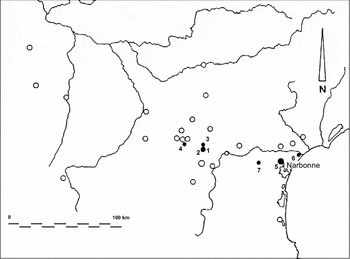
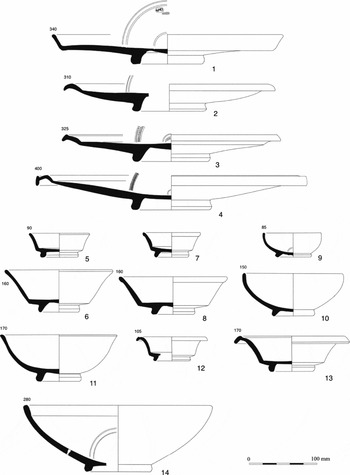
The term ‘southern Gaulish pre-sigillata’ (translated from the French présigillées sud-gauloises) denotes a number of fine wares dated to the last decades of the 1st century B.C., whose production sites were scattered across south-west Mediterranean France (Passelac Reference Passelac, Sabrié, Sabrié, Bémont and Jacob1986a; Reference Passelac, Bémont and Jacob1986b; Reference Passelac1992; Reference Passelac, Ournac, Passelac and Rancoule2009), in the hinterland of the Roman colony of Narbonne (figure 1). As the term itself implies, these ‘pre-sigillata’ pots have been characterized by their visual resemblance – especially with respect to form (figure 2) – to contemporary Italian red-gloss wares or terra sigillata, a series of table wares which had emerged in Italy a few decades earlier and which were being imported in the area under study. Hence vessel form, chronology and location all anchor the phenomenon of the pre-sigillata in the colonial encounter instigated by Roman commercial and political expansion in the 2nd and 1st centuries B.C. across Mediterranean France. Let us thus start with a brief introduction to the events taking place before and during the 1st century B.C. (Goudineau Reference Goudineau and Nicolet1978; Reference Goudineau, Bowman, Champlin and Lintott1996).
Southwest Mediterranean France. Known pre-sigillata production sites (black circles: 1, 2 and 3, Bram; 4, Villeneuve-la-Comptal, Le Cammazou; 5, Narbonne; 6, Fleury d'Aude, l'Oustalet; 7, Luc-sur-Orbieu, Le Jouncas) and their main attested distribution sites (white circles) (adapted from Passelac Reference Passelac1992, 219, figure 1).

Main pre-sigillata forms, from Bram 9 workshop, phase 2 (original drawings by M. Passelac, as published in Passelac Reference Passelac, Roca Roumens and Principal2007, 43, figure 12).

The region in question had a long history of commercial contact with Etruscan, Massaliote, Punic and Iberian traders (Dietler Reference Dietler1997; Reference Dietler2010; Garcia Reference Garcia2004; and Py Reference Py1993 for a longer-term history of the local societies). These multifarious contacts crystallized around one key driving mechanism: the import of wine, accompanied by sets of table wares for consumption. From around the 3rd century B.C., Rome sporadically mingled with these heterogeneous interest groups and their commercial relations. Imports of so-called ‘Greco-Italic’ amphorae (wine containers) and black-gloss ‘Campanian’ wares (table ware of various origins but generally Italian (Morel Reference Morel1978)) started to show up at sites in southern Gaul, especially during the 2nd century B.C. (Dietler Reference Dietler2010, 200; Tchernia Reference Tchernia, Garnsey, Hopkins and Whittaker1983; Reference Tchernia, Carlsen and Lo Cascio2010).
By the later 2nd century B.C. Rome's interests in the southern Gaulish region were firmly established (Goudineau Reference Goudineau and Nicolet1978; Reference Goudineau, Bowman, Champlin and Lintott1996). In 118 B.C. Rome's activities became explicitly political and territorial through the foundation of Narbonne as the first Roman colony in Gaul. The extent and nature of Rome's control in this period is subject to debate. On the one hand a case can be made for continuity and the relative autonomy of the region (e.g. continuity of the main settlement of the region, the oppidum of Montlaurès) (Dietler Reference Dietler1997, 292; Sanchez Reference Sanchez and Dellong2002b, 83). In contrast, others have interpreted the same patterns as a pragmatic strategy of Rome (Provost Reference Provost and Dellong2002, 79). In any case, Rome's commercial interests soon expanded to cover the entire area of present-day France, as evidenced by the rapid spread of the Dressel I wine amphorae imported from Italy during the period from 125 to 25 B.C. (Dietler Reference Dietler2010, 202; Tchernia Reference Tchernia, Garnsey, Hopkins and Whittaker1983; Reference Tchernia, Carlsen and Lo Cascio2010).
In 46/45 B.C., Caesar proceeded to a second colonial foundation at Narbonne, installing legionary veterans (Gayraud Reference Gayraud1981, 175–86). Around the same time, Montlaurès was abandoned, the distinctly Italian influence in Narbonne increased (admittedly the presently available toolbox for identifying Italian practices tends to be limited to the identification of highly visible architectural traces), and – crucial for the purpose of this paper – the production of the southern Gaulish pre-sigillata took off (Garcia Reference Garcia2004, 133). By then southern Gaul had only recently been witnessing the fairly limited quantities of the first imports of red-gloss Italian sigillata (ca 40 B.C.–A.D. 15), the production and distribution of which followed in the footsteps of the black-gloss wares, but were still in the process of developing by the time the pre-sigillata took off. The separation between black-gloss ‘Campanian’ wares and ‘sigillata’ is another instance of the creation of analytical boundaries and their impact on interpretive narratives (Goudineau Reference Goudineau1968, 63; Morel Reference Morel1978), but lies beyond the scope of this study.
Terra sigillata scholarship: pinning down boundaries
Current debates in sigillata studies are a natural reflection of the questions that face all people who have ever been involved in processing ceramics: which types of pot fall into the area of study of (sigillata) specialists? Which sherds do we need to quantify within our category of (terra sigillata)? The fear of being confronted with a table full of unknown, potentially unclassifiable potsherds translates into a pragmatic attitude towards the ‘pre-sigillata’: how can we make them knowable? How can we define them?
Two generic models can be recognized, each with their own answer to the question how to separate out the category ‘sigillata’, and, consequently, to the question which heading southern Gaulish pre-sigillata should be ranged under. The first solution is to emphasize the technology of the respective production sequences. The general conclusion, then, is that the southern Gaulish pre-sigillata is differentiated from Italian sigillata by a less developed technology (Bémont Reference Bémont, Duval, Morel and Roman1990, 81; Desbat Reference Desbat2001, 19; Hoffmann Reference Hoffmann1995, 391). The explanation runs as follows: Italian craftsmen were involved in the southern Gaulish initiatives (Dannell Reference Dannell, Genin and Vernhet2002, 218; cf. Passelac Reference Passelac1992; Reference Passelac, Roca Roumens and Principal2007) at a time when sigillata in Italy itself had not yet reached its technological optimum. The concept of sigillata was thus transferred in an immature state, and never developed further (at least for the centres under discussion here). On closer inspection, however, this argument is problematic because the standard against which pre-sigillata technology is judged as ‘inferior’ is precisely the fully developed, clearly defined Italian sigillata with which it is said to have no relation. It is as if because the initial transfer of know-how and skills for pre-sigillata production came from Italy, their lineage can be reasonably inserted into and compared with what happened in Italy afterwards (for a more general critique of linear views of technology, see Pfaffenberger Reference Pfaffenberger1992).
The second solution takes the difference in technology as a starting point too. But instead of arguing that this is indicative of different stages of development, it is linked to calculations of economic opportunities (Picon Reference Picon2002a). Fully developed sigillata technology only counted as the ‘optimum’ if long-distance export could render higher investments in production viable. Although this model does away with all lingering evolutionary ties between pre-sigillata and sigillata, it replaces this with a largely neoclassical scheme of costs, markets and formalist rationality, the validity of which is heavily debated for the Roman Empire (Bang Reference Bang2008; North Reference North2005).
Calls for an appreciation of the intricacy and contingency of the process of technological transfer characterizing the earliest sigillata phenomena are being heard (Poblome and Brulet Reference Poblome, Brulet, Berg Briese and Vaag2005, 34; various contributions in Poblome et al. Reference Poblome, Talloen, Brulet and Waelkens2004; similar call for Campanian wares by Cibecchini and Principal Reference Cibecchini, Principal, De Sena and Dessales2004), and indeed, most practitioners’ views are rather more complex than either of these options. The problem, however, is that these nuanced views are almost never explicitly linked to the practice of sorting potsherds. This reifies the divide between observation and interpretation, between the world of artefact specialists on the one hand and social or cultural narratives on the other. Creating order in the tables or crates of potsherds has priority over dealing with their complexities, for understandable reasons of negotiating time, money and scientific return. It is not just that this ordering exercise gets confused with an internal order in the potsherds (the well-rehearsed etic/emic issue), but that order is taken to equal ‘pinning down boundaries’. Bémont (Reference Bémont, Duval, Morel and Roman1990, 78–80), for instance, describes two possible kinds of pre-sigillata or imitation sigillata: either they are ordered among themselves and show internal regularity (as a separate category), or they are ordered by reference to sigillata (as a sub-category). While in the case of southern Gaulish pre-sigillata the latter scenario tends to be argued for, both options assume that pre-sigillata are ordered as a coherent, bounded category to which a potsherd can either belong or not.
This type of ordering is not inherently wrong: it could, for instance, be a useful way of dealing with questions of chronology. Similarly, it allows for easy labelling and hence facilitates communication. But it is not the only possible kind of ordering, and this paper seeks to explore its limits and hint at possible alternatives – in particular alternatives suited to the principles of post-colonial thought.
Post-colonial scholarship: challenging boundaries – or not?
But, so the reader might frown, maybe sigillata scholarship is but a straw man amidst state-of-the-art studies on colonial encounters. Surely the idea of permeable boundaries, variable interfaces of contact, and modes of ordering other than either/or categories has been taken up in current post-colonial analyses? The answer is a ‘yes, but . . .’. Let us start with the ‘yes’. During the last couple of decades, post-colonial critique (Young Reference Young2001) has matured from a radical inversion of the poles of domination and resistance (Bénabou Reference Bénabou1976; Senghor Reference Senghor and Senghor1970) to studies questioning the possibility of neatly delineating the different actors entangled in a colonial encounter. An important source of inspiration for this move was the writings of Homi Bhabha, who argued that it is precisely the interplay between the claim of such neat, delineated categorizations and their failure to be consistently met in everyday life that characterizes the colonial third space, exposes ‘the limits of any claim to a singular or autonomous sign of difference’ (Bhabha Reference Bhabha1994, 313) and drives a creative process of cultural creation rather than a passive one of cultural adoption. The articulation of categories is always partial, and this ‘“partial” representation rearticulates the whole notion of identity and alienates it from essence’ (Bhabha Reference Bhabha1994, 127, original emphasis). Building on Bhabha's insights, post-colonial archaeology has convincingly moved beyond static boundaries, rigid categorizations and universal essences.
It is worth browsing through some recent examples – without claiming to present a comprehensive review. Jiménez's (Reference Jiménez, van Dommelen and Knapp2010) work on the role of mimesis and imitation in the colonial context of Roman Spain exemplifies the most sophisticated kind of post-colonial analysis in classical archaeology today. Jiménez joins ancient philosophers’ thoughts with Bhabha's aforementioned emphasis on ambivalence to tackle ‘preconceived ideas of the supremacy of a true original over the copy’ (ibid., 56). Analysing a range of architectural and visual culture in the provinces or in the private sphere as ambivalent references to public models associated with the city of Rome, Jiménez highlights the slippery nature of the imitation, between desire and mockery, between adoption and reworking, but always with a twist in meaning. Van Dommelen (Reference Van Dommelen, Lyons and Papadopoulos2002; Reference Van Dommelen, Riva and Vella2006; Reference Van Dommelen, van Dommelen and Terrenato2007) has long been an advocate of the utility of post-colonial concepts for interpreting past colonial encounters – in particular Punic colonialism in Sardinia, while also making use of fitting analytical tools emphasizing local practices (2002; 2006, 139 and 150) rather than a priori categories. Dietler (Reference Dietler2010) in turn talks about ‘entanglement’ (after Thomas Reference Thomas1991) to signal the abandonment of boundaries and categorizations, but is cautious not to flatten out power relations. Gosden's (Reference Gosden2004; Reference Gosden, Meskell and Preucel2007) framework for the study of colonialism, challenging boundaries between people and things, is a praiseworthy attempt at theorizing the role of ‘things’ – despite criticism of ‘[fetishizing] material culture in such a way that relations between people become mystified as relations between objects and people’ (Dietler Reference Dietler2010, 20–21).
So far, for the ‘yes’, the possibility of fickle and permeable boundaries and modes of ordering other than yes/no categories has become part and parcel of archaeological studies on colonial interactions. Where does our hesitation – the ‘but’ – reside, then? Post-colonial scholarship has indeed set out to challenge a priori boundaries and categories. But, arguably, the extent to which this has led to setting new standards for research practice has been limited because of an exclusive focus on ‘meaning’ – whether of material culture or of the practices in which it was involved. This is at least in part due to the literary legacy of post-colonial theory, where discourse is both the object and the means of analysis (Bhabha Reference Bhabha1994; Said Reference Said1978; Spivak Reference Spivak, Nelson and Grossberg1988).
As a result of this concern with meaning and discourse, the specificity of dealing with things has fallen into oblivion – or, rather, has been taken for granted. This specificity is simply taken to be the physical matter which is observed and described in artefact analysis, with further interpretation needed to access the corresponding meanings. This is true even in an age of ‘material agency’ (Ingold Reference Ingold2007; Reference Ingold, Knappett and Malafouris2008; Knappett Reference Knappett2005): as yet these most recent debates in material-culture studies have not really entered the realm of artefact analysis and threaten to get stuck in an interpretive register (from a different angle, some ethnographic studies have considered the relation between labelling and pottery production: Hodder Reference Hodder1982; Miller Reference Miller1985). While post-colonial critique has been successful in contesting the boundaries of ‘meanings’, it has left those boundaries in place when talking about things, objects or artefacts, about the archaeological record. In other words, whereas it would now be acknowledged that the production or use of a pot that falls under the heading of ‘pre-sigillata’ may not imply aspiration to a circumscribed set of meanings of Roman-ness (to put it very bluntly), in terms of analytical descriptions this pre-sigillata pot would still be characterized as a single, bounded thing, referring to sigillata.
This problematic dichotomy between a single ‘world of things’ and its multiple, fluid ‘meanings’ (see also Hodder Reference Hodder2011) also lingers behind the traditional preference of post-colonial studies for consumption practices, which are implicitly equated with the ‘meaning’ side of things. Dietler (Reference Dietler2010, 185) even claimed that it is ‘the cultural construction of proper consumption, with its symbolic prohibitions and valuations, that determines production, not vice versa’. But not only does the Roman economy now tend to be seen as a complex patchwork of variable feedback loops between production and consumption (Bang Reference Bang2008; Scheidel, Morris and Saller Reference Scheidel, Morris and Saller2007; see e.g. Willis Reference Willis2005 for terra sigillata), also there is no reason why ‘cultural construction’ should be restricted to instances of consumption. A notable exception to this general emphasis on consumption promises to be Van Dommelen and Roppa's contribution to the Tracing Networks project, in which they examine the interactions between Nuragic, Phoenician and Punic traditions on Sardinia through study of the production of ceramic coarse wares (www.tracingnetworks.ac.uk). Moreover, some contributions by ceramic specialists have taken the complexity of cultural encounters beyond narratives of cultural origins, but have as yet been limited to studies of functionality, cooking and eating practices, or, in short, consumption (some examples of broadly similar time and place as the subject of this paper are Bats (Reference Bats1988) on consumption practices in Provence and Principal (Reference Principal, Malfitana, Poblome and Lund2006) on black-gloss wares in north-east Iberia). And the same holds true for some ground-breaking syntheses on cultural processes (Woolf Reference Woolf1998).
This almost exclusive focus on consumption implicitly relegates production to the ‘physical things’ side of the equation, where neutral descriptions and bounded categories still hold exclusive sway – and wrongly so, this paper argues. It has to be noted that this is at least in part a function of the organization of archaeological practice, with material specialists offering ‘neutral’ descriptions and categorizations for interpretive archaeologists to start with. It is this presumed starting point that we need to reconceive.
An ontological critique
Other scholars have touched upon the inadequacy of conventional artefact categories for analysing similarity and difference, or continuity and change, in situations of cultural encounter (Ross Reference Ross2012; Silliman Reference Silliman2001; Reference Silliman2009; Reference Silliman2010; Stahl Reference Stahl, Hicks and Beaudry2010). Within anthropology, more than two decades ago Stoler (Reference Stoler1989, 135) already critiqued how ‘the objects of our study, if not the units of our analysis, have remained much the same’, despite the post-colonial deconstruction of bounded, homogeneous cultural or social categories. The work of Silliman (Reference Silliman2009) within archaeology has questioned the standards for diachronic comparison, the ‘baseline’ against which change and continuity are plotted. Not only are change and continuity always intertwined and relative; they are not ‘two different outcomes that are recognizable, if not measurable, through material remains’ (Silliman Reference Silliman2009, 211). His work also casts doubt on the ontological claims of analytical categories, which ‘are always already there before analysis begins’ (ibid., 213). Indeed, it is difficult to imagine digging a Roman site without any preconceived notion of sigillata as the bright red shiny sherds, the Roman pots par excellence: chronology, identity and origin are all implied by that label. As a consequence, an argument has been made for a consideration of the practices in which artefacts were used instead of an exclusive focus on their cultural origins or production.
But because these studies have not identified the roots of the problem, they have struggled to articulate what is at stake and what the consequences are for archaeological practice. This is evident in continued narratives of objects or material activities that ‘maintain their essential characteristics [i.e. physical characteristics] but whose cultural affiliations [i.e. meaning] shift over time’ (Ross Reference Ross2012, 39). Similarly, Silliman's claim for a privileging of practices concerning use risks simply reifying the consumption/production imbalance discussed before. By equating practice with use, production is excluded from the field of ‘negotiated meaning’, and seen as a static, external resource, something which is always ‘already produced’ (Silliman Reference Silliman2010, 42, original emphasis). So-called standardized products like terra sigillata (with pre-sigillata traditionally following in its wake) are especially prone to such a hollowing-out of the ‘meaning’ of production practices.
In order to question the impermeability of boundaries and the rigidity of categories effectively, we need to bypass the distinction between a single, stable, external world of things ‘out there’ and its multiple, fluid, ambiguous, but disconnected meanings. By separating material culture from its multiple possible meanings, we (among whom post-colonial scholars) have created a gap to be bridged by archaeology. In other words, archaeologists have argued about epistemology: how can we identify the tools that will allow us to say which meanings really corresponded to the things we unearth? This gap, however, disappears when we realize that the world is not a compound of things and meanings. Things do exist ‘out there’ (Harman Reference Harman2009) – this is not a relativist paper – but they are not stable, definite and a priori (Law Reference Law2004). Once this move is made, we can shift from epistemology to ontology.
The ontological state or mode of being of a certain thing does not refer to a general world view but is enmeshed in the worldly practices in which the thing is tied up. It refers both to how things relate to other things (in a similar vein as semantics), and to how things themselves are defined (for instance as bounded entities, in opposition to something else, as variable and changing, etc.). Hence ontology describes the world as it is understood and the possibilities for action in that world (comparable to Gibson's affordances: Gibson Reference Gibson1979; Knappett Reference Knappett2005). Consider the example of the ontological position of the horse. Some time ago, it would have afforded travelling from Paris to Rome, fighting battles, showing off in parades, letting a meadow be grazed, etc. Today the horse's relations to other things have changed, and as a consequence its possible affordances have too. Given the appearance of the steam engine, the railway, the car, the motorway, petroleum, etc., the horse is no longer considered a suitable means of transport for long distances. Other actors such as tanks, long-range missiles and aeroplanes have altered the field of possibilities of battles, leaving no place for the horse. And so on. But not only is the horse defined by different characteristics in different settings of practice (e.g. aesthetics instead of strength), it is also a different kind of thing depending on the practice it is involved in. For instance, in some contexts the horse can trigger affectionate human–animal relations that are defining of the horse's ontology in that context, while in other situations it might function as a commodity exchanged for money and defined by a limited set of parameters (e.g. size, speed, age). And this way in which the horse is understood is not reducible to the story of missiles and aeroplanes: the horse could feature both as an entangled, fuzzily and relationally defined human companion, and as a clearly defined, bounded commodity either in the Middle Ages or today.
The lesson here is that reality and the way in which it is understood cannot be separated from practice (Mol Reference Mol2002; Wenger Reference Wenger1998). This practice is always both material and social: steam engines and leisure go hand in hand changing the horse. And this practice negotiates not just what things are (how they relate to other things), but also how they are (whether they act as categories, networks, oppositions, etc.). It is the latter question that concerns us in this paper: can we analyse whether or not pre-sigillata was defined and understood as a bounded category through its production practices?
Note that similar ontological critiques have been made in recent years in the field of anthropology (Holbraad Reference Holbraad, Henare, Holbraad and Wastell2007; Strathern Reference Strathern1988; Viveiros de Castro Reference Viveiros de Castro1998). Archaeology, however, has a real contribution to make in terms of what such an ontological rethinking does to material culture. Instead of a constructivist ‘thing equals concept’ (Henare, Holbraad and Wastell Reference Henare, Holbraad, Wastell, Henare, Holbraad and Wastell2007; Holbraad Reference Holbraad, Henare, Holbraad and Wastell2007), a proclaimed ontological turn should do more justice to the possible material qualities of the world (Ingold Reference Ingold2007; in line with recent developments in science and technology studies: Law Reference Law2004; Latour Reference Latour1999; Mol Reference Mol, Law and Hassard1999; Reference Mol2002), and to the implications this has for the way we do archaeology. If we do not take these implications seriously, we threaten to reduce ontology to a history of interpretive ‘categories’.
To sum up the argument so far: there is a need to rethink the presence and rigidity of boundaries in situations of colonial encounter. Whereas this need has been acknowledged but not fully implemented in artefact analysis (including sigillata scholarship), post-colonial studies have taken it seriously – but only so far as interpretation, or, ‘meaning’, is concerned. Taking the lead from recent ontological critiques in the fields of philosophy, anthropology and, especially, science and technology studies, we cannot maintain the distinction between multiple, fluid meanings on the one hand and a bounded, single world of things, artefacts or potsherds on the other. Instead, we need to grasp the ontological state of pre-sigillata, its defining relations, and how that definition took shape.
Focusing on assemblages seems to be the most evident way of implementing such a programme within archaeology. As to (pre-sigillata) production sites, however, excavations are fragmentary and closed-context assemblages are rare, as they largely rely on rescue archaeology and cannot generally expect to draw publicity with spectacular finds. This might be part of the reason why post-colonial studies have been drawn towards the detail available in consumption contexts. Nevertheless, archaeological and anthropological studies on production and technology, based to a greater or lesser degree on chaîne opératoire research, have made great advances in linking detailed observations on production sequences to social and relational frameworks of human–thing interactions (the literature is ample, and an extensive bibliography can be found in Dobres Reference Dobres2000 and Lemonnier Reference Lemonnier and Lemonnier1993).
The practices of the production of southern Gaulish pre-sigillata
At the start of our inquiry into the southern Gaulish pre-sigillata, it is necessary to be clear on the status of this case study, which serves to illustrate the methodological point of this article, not to present a new orthodoxy on the pre-sigillata as such or to critique the work that has been done and is in the pipeline. It follows that we need to gloss over some elements that are crucial to interpreting the sociocultural impact of the pre-sigillata, but that do not make a difference to the argument presented here. For example, focus will be on the pre-sigillata in order to challenge the theoretical notion of a clean-cut category, while any comprehensive study of the phenomenon will have to take into account the very minor share of those pre-sigillata within the total production output of the workshops in question. Similarly, we will solely examine the practices of production of the pre-sigillata – and not its distribution or consumption. This is an arbitrary but conscious choice in order to redress the imbalance described above: if we no longer assume that ‘things that look the same’ (or any other basis of category making) were consumed in the same way, there is still an implicit assumption that they were produced as a bounded, well-defined product. Crucial in this regard is the latitude of variation: whether the pathways of different steps in the practice of producing these pots converged or diverged, whether they circumscribed a bounded category or something else (Latour Reference Latour1999; Reference Latour2005).
Before proceeding to this analysis we need to establish the baseline of comparison (Silliman Reference Silliman2009), based on practices instead of categories – although for reasons of communication described above, some well-established labels (e.g. villa) will inevitably be maintained. First, there are those kinds of pottery produced within the same area but preceding the pre-sigillata. Two sites (Sanchez Reference Sanchez2009, 403 ff.) in particular can be considered: La Lagaste (Rancoule Reference Rancoule1970; Reference Rancoule and Laubenheimer2001) and Bouriège (Séjalon Reference Séjalon1998). At both sites, a number of kilns of different dates were unearthed, all of a similar type with a central pillar but lacking a perforated floor. The production output of La Lagaste (Rancoule Reference Rancoule and Laubenheimer2001), starting around 150 B.C. and continuing along with the later pre-sigillata (M. Passelac, personal communication), included urns (wheel-turned or not), and fine wares of different forms, among which were some inspired by black-gloss fine ware imports from Italy. The range of the latter is restrained to a limited number of forms which shared fabric and firing mode with some of the other products of the same site. Fabrics were micaceous, while firing seemed to have been unstable, with different fluctuations between a reducing and an oxidizing cooling atmosphere. Compositional analyses of fabrics and clay types of these vessels are lacking; only two sherds of La Lagaste have been examined, as well as one fragment of a kiln wall. All were non-calcareous, with respective values of CaO of 1.79 per cent, 1.84 per cent and 1.18 per cent (M. Passelac, personal communication). Second, there are those contemporaneous pottery productions with which possible craft interaction could have occurred, in particular the various Italian sigillata productions (Ettlinger Reference Ettlinger1990). Of course, the production sequences of other products at the same sites as the pre-sigillata provide another important touchstone for comparison.
Five production sites of southern Gaulish pre-sigillata have so far been identified; emphasis in this paper will be on the most thoroughly investigated, that of Bram, published in a series of papers by Passelac (Reference Passelac1992; Reference Passelac and Bats1996a; Reference Passelac1996b; Reference Passelac and Laubenheimer2001; Reference Passelac, Roca Roumens and Principal2007; Reference Passelac, Ournac, Passelac and Rancoule2009; monograph in preparation). All known production sites were situated in relation to the new interfaces of communication that were being established in the region: villae, crossroads of roads and river valleys, and the colony of Narbonne itself. If this observation renders their taking part in the colonial encounter evident, this should not in itself warrant the attribution of a cultural origin (‘Italian’ – Passelac Reference Passelac, Roca Roumens and Principal2007) to the products (Silliman Reference Silliman2009). Four workshops are known around the road settlement of Bram: les ateliers du point 9, l'atelier du point 93, l'atelier du point 144 and l'atelier de Villarzens. Only Bram 9 and Bram 144 have been excavated. No traces pre-dating the 2nd century B.C. have as yet been unearthed, and ceramic production has not been attested before the third quarter of the 1st century B.C.
The overall image based on the current state of research is one of dispersed small workshops. The workshop at Villarzens was linked to a villa site, about two kilometres away from Bram, and yielded fragments of kilns and production waste, as well as deposits dominated by coarse wares with a clear, well-fired fabric (Passelac Reference Passelac1992, 210; Reference Passelac, Ournac, Passelac and Rancoule2009, 110). A number of pre-sigillata pots have been attested, but the few specimens make it hard to decide whether or not they had been produced locally. The three other sites – dated to the last quarter of the 1st century B.C. – offer more scope for study (Passelac Reference Passelac, Ournac, Passelac and Rancoule2009, 109 and 184–89). All three were multifunctional workshops: they produced not only pre-sigillata but also thin-walled beakers, lamps, common wares with fine fabric, cooking wares with tempered fabric, storage wares (dolia), domestic objects (chandeliers, incense burners), mortaria and construction material (tiles) (Passelac Reference Passelac1992, 208–9; Reference Passelac, Ournac, Passelac and Rancoule2009). This diversified nature of the products can be deduced from mixed assemblages in kiln remains and ash layers (M. Passelac, personal communication). Colonial influence is clearly notable in the range of products of the workshops, which included new types and functions introduced from Italy: building materials, ritual and domestic implements, etc. (Passelac Reference Passelac, Roca Roumens and Principal2007). Interestingly, this fits in nicely with a change in building techniques attested at Narbonne, from dry masonry constructions to ‘Italian’-style architecture (Sabrié, Sabrié and Ginouvez 1998; Sanchez Reference Sanchez and Dellong2002b, 83). This can be interpreted as change relative to the immediately preceding baseline. Change is key in the current orthodox reading of the evidence: pre-sigillata was the product of a complex colonial encounter with a dominant Italian strand of influence (cf. Passelac Reference Passelac, Roca Roumens and Principal2007). Although we cannot but agree with this, rather more is to be said – in relation to the methodological argument of this paper – beyond the identification of origins, influences and investment (Ross Reference Ross2012; Silliman Reference Silliman2009).
What, for instance, can we say about the how – or, in other words, about the practice – with regard to the multi-product output of these sites? Given the rather modest scale of the production sites surveyed so far (Passelac Reference Passelac and Laubenheimer2001; Reference Passelac, Ournac, Passelac and Rancoule2009), it is very likely that all these different products were being made by the same potters and along similar lines. If we change the baseline of comparison from the a priori categories of ‘Italian’/‘local’ to the preceding practices of pottery production in the area, the picture starts to change. Whereas previously the production of ‘Italian’ forms alongside ‘local’ products was interpreted as change, this becomes continuity when compared to previous regional practices of producing ‘Italian’ (or more generally ‘imported’) black-gloss forms alongside other products, attested for instance at La Lagaste and Bouriège. Again, the form changes (inspired respectively by imports of black-gloss wares and terra sigillata), but the kind of practice persists: the insertion of ‘non-local’ forms in the repertoire was long-established.
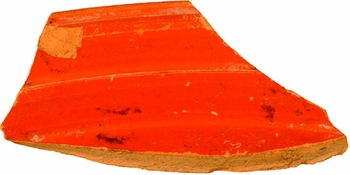
So continuity after all? Not quite, as the practices at Bram differ from those of La Lagaste and Bouriège by their adjustments of the type and preparation of clays for different products. The fabric (figure 3) of the pre-sigillata is generally relatively soft, very bright brown, sometimes yellowish red (if insufficiently fired), with no inclusions visible without microscope. X-ray spectrometry by Maurice Picon has shown the use of different types of clay for different products, namely calcareous (generally containing more than 6 per cent CaO) and non-calcareous (generally containing less than 4 per cent CaO) clays (Passelac Reference Passelac, Bémont and Jacob1986b). The pre-sigillata makes up the ‘calcareous’ group, with an average CaO content between 9.7 and 17.8 per cent. This active selection of clay was in all likelihood inspired by the well-attested correspondence between Italian sigillata and calcareous clays (Picon Reference Picon, Genin and Vernhet2002b). Nevertheless, it is unlikely that this choice was dictated by technological necessity, as attestations of non-calcareous ‘pre-sigillata’ with similar visual characteristics elsewhere indicate (Bénévent, Dausse and Picon Reference Bénévent, Dausse, Picon, Genin and Vernhet2002). If we reconceive ‘Italian’ sigillata as a learned, embodied way of doing rather than a normative cultural marker, then we can reconstruct a process of mediation between craftsmen with different norms, standards and bodily skills. Such mediation is necessary to create a shared frame of reference within a community of practice (Wenger Reference Wenger1998). ‘Calcareous’ clays (which would have been easily differentiated (Picon Reference Picon, Genin and Vernhet2002b, 144–45)) were part of that new frame of reference constituting the ‘right’ type of clay for this product (pre-sigillata). But they were not just a catalogue entry – they were intertwined with skills (how to recognize this clay) and bodily gestures (how to prepare them – with the first attestation of levigation ditches in Gaul (Passelac Reference Passelac, Ournac, Passelac and Rancoule2009, 109)). The need for consideration of the practices that constitute such frames of reference becomes all the more evident given the large variation of CaO contents of the pre-sigillata as compared to the (Italian) ‘sigillata’ way of doing, where stricter limits existed on the latitude of CaO contents. Moreover, the Italian frames of reference would have been varied, too, with several workshops producing similar forms with different technical parameters (see the different contributions in Poblome et al. Reference Poblome, Talloen, Brulet and Waelkens2004). So there was change, yes, but not the straightforward implementation of a default way of doing, not a ‘box’ that could be ticked.
Pre-sigillata sherd, from a ditch infill at Bram. Photo M. Passelac – CNRS.

Only Bram 144 has yielded structural evidence of kilns, two of which have been excavated (Passelac Reference Passelac and Laubenheimer2001; Reference Passelac, Ournac, Passelac and Rancoule2009). Both were circular with variable floor constructions with radiating elements consisting of either daub bricks or tiles (Passelac Reference Passelac1996b, 14–16; Reference Passelac, Roca Roumens and Principal2007, 25), but lacking a perforated floor. Only one of them allowed measurement of the firing chamber, with modest dimensions of 1.75 metres in diameter and 0.6 metre in height. As far as the description of these structures is concerned, they seem to be of the same general type as the kilns previously in use at La Lagaste and Bouriège. Passelac (Reference Passelac1996b, 15; Reference Passelac and Laubenheimer2001, 156–58) links changes in construction techniques (square instead of circular central pillar, use of tiles and refractory bricks, etc.) to increasing Mediterranean input. It is beyond the scope of this paper to confirm or invalidate this observation; of importance here is that this kind of observation privileges cultural origins over practices (Silliman Reference Silliman2009; Reference Silliman2010). Regardless of the likely involvement of Italian know-how it can be argued on the basis of the maintenance of the basic principles of ‘what a kiln should look like and how to use it’ that any changes that did occur (e.g. different construction materials) did not introduce a rupture with respect to the way in which firing was being performed and how its possibilities and limits would have been understood.
Two firing modes were in use, both characterized by a reducing firing atmosphere, followed either by a reducing or by an oxidizing cooling phase (Passelac Reference Passelac1992; Picon Reference Picon, Genin and Vernhet2002b). The potters’ understanding of what the firing technique could and should do would have in turn guided the results of slip and colour, which show significant variability. The two firing modes in use allowed for an output of vessels with either a black or a red (figure 3) exterior colour. Whereas black can be seen to refer back to previous imports and copies of black-gloss wares, red must have stood out as a novelty against a background of products with a black to greyish visible exterior surface, both wheel-thrown and other (Sanchez Reference Sanchez2009). Again, similarity to sigillata practices did not preclude continued similarity to previously anchored frames of reference. Rather, the link with sigillata production was articulated as a new possibility (red colour) explored through the practices of already embodied techniques (firing in reducing atmosphere). The observation that crushed hematite was added to the liquid emulsion for the slips in order to obtain a red end result (Passelac, Léon and Sciau Reference Passelac, Léon and Sciau2008; Passelac Reference Passelac, Ournac, Passelac and Rancoule2009, 109) illustrates the appropriation of this new possibility (red colour) by developing new, local solutions to new, local problems (low FeO contents of the available clays).
Such an exploration of possibilities within a negotiated frame of reference is also exemplified by the so-called triangular kiln spacers, so far discovered exclusively at sites associated with southern Gaulish pre-sigillata production. These are thought to have aided the separation and support of plates both during the drying stage and during firing. This tool's role in firing is especially interesting: it shows an attempt to generate an optimal circulation of the hot gasses within the kiln, which marks an increased concern with the process of firing, its possibilities and its problems. Passelac (Reference Passelac1992; Reference Passelac, Bémont and Jacob1996b; Reference Passelac, Ournac, Passelac and Rancoule2009) has suggested the presumed Italian origin of these kiln spacers as an indication of the Italian origin of the potters. Few attestations have been reported for Italy (Mauné and Sanchez Reference Mauné and Sanchez1999, 138; M. Passelac, personal communication; Cuomo di Caprio Reference Cuomo di Caprio2007, 531 for a similar tool used in the medieval period), and in any case this practice seems to have been a minor one in Italy itself. Hence these tools too have to be inserted in a process of exploring the possibilities within a negotiated frame of reference, where different craftsmen brought different elements of know-how, some of which – like the kiln spacers – caught on. In this case, a marginal original practice (in Italy) became an identifying marker of a new set of practices (the pre-sigillata). The kiln spacers attest to the introduction of new techniques, but the extent to which these could be developed was dependent on the space for manoeuvre or latitude allowed by the frame of reference.
The most striking similarity between southern Gaulish pre-sigillata and Italian sigillata – which accounts for the terminology of ‘pre-sigillata’ – is the overlap in forms (figure 2). Forms from the Italian table ware (black-gloss and sigillata) repertoires were being produced at these local sites in southern Gaul. The observations that almost all forms – regardless of the kind of product – produced at Bram originated in Italy, and that some of these forms could not have been known through imports, further confirm the involvement of ‘foreign’ know-how. But again, the involvement of potters trained in (most likely) Italian workshops – which this article does not contest – does not tell us much about how pre-sigillata production was defined. That pre-sigillata production was not understood as a transposition of the ‘sigillata’ way of doing is evident from a conservatism in forms as compared with these Italian products. Furthermore, the repertoire also included forms with a long history of production in the area, such as the askos Bram 310 (Martin Reference Martin2005b, 438, 441) and the convex bowl Bram 230 (Passelac Reference Passelac, Bémont and Jacob1986b; figure 2, number 14), even though these remained very minor. All the while, these two forms were recognized to be somewhat ‘different’, as many more specimens were produced in different fabrics (so-called pâtes claires and engobe rouge) (Passelac Reference Passelac and Bats1996a, 367; Sanchez Reference Sanchez2009, 377). For Narbonne, it has even been suggested that those bowls Bram 230 were preferentially fired according to a fully reducing process (Sanchez Reference Sanchez2001, 206), not making use of the new possibility of obtaining a red exterior colour. Again, links of similarity were established with sigillata production without giving up on the links back to previous production practices and outputs. Various boundaries were continually established and erased, confirmed and contested, and it is impossible to maintain a single category boundary spanning both formal repertoire and technical characteristics.
A final practice to be considered in our analysis is that of stamping. This has traditionally been one of the boxes to be ticked for the identification of ‘sigillata’ production. And a certain number of epigraphic name stamps of the kind in contemporary use in Italy (Ettlinger Reference Ettlinger1990) have indeed been attested on the pre-sigillata. But not only is this number very small (17 stamps), it was complemented by a number of anepigraphic stamps (eight stamps) reminiscent of stamps already occasionally used on various sorts of locally produced pottery before (e.g. Mauné and Sanchez Reference Mauné and Sanchez1999, 133; Sireix Reference Sireix1994, 107; Solier Reference Solier and Barruol1980). But again, this pre-existing practice caught on and was expanded, while the graphics of the anepigraphic examples at Bram echo Italian specimens. Onomastic studies of the few epigraphic stamps have attested the multiple linguistic origins of the potters’ names (Martin Reference Martin2005b). Instead of reifying these cultural affiliations, we can confirm the likelihood of encounters between potters – some of whom no doubt were Italian – with different embodied skills, different understandings of their craft and different ways of doing. A shared social space as provided by the small-sized production sites at Bram would have framed the exploration of these similarities and differences in a process of aligning them towards a shared frame of reference (Wenger Reference Wenger1998). This is a story of how to make sense of the world, and how to conceive of possibilities of action in that world – a story about ontology.
A fluid ontology
How can we pull these different observations together for them to make sense – both for us, archaeologists, and for the potters in the past? The multiple, complex intersections between cultural origins, actual practices, forms, technologies, etc. defy any attempt at drawing firm, all-inclusive boundaries around this phenomenon. The convergences and divergences between different sets of practices did not run parallel. During some parts of the production process, pre-sigillata pots were differentiated from other products (e.g. choice of clay), but this differentiation was always gradual, never abrupt. Combined with the large latitude of variation within individual steps in the process which precluded internal homogeneity, this means that pots could differ ‘a little bit’, or ‘in some ways’, but still be the same, ‘pre-sigillata’. Hence pre-sigillata production did not exist as a bounded category, with a clearly defined ‘inside’ and ‘outside’. Moreover, its understanding did not simply hinge on a referential relation towards sigillata production. Instead, in producing a pre-sigillata pot, multiple links of similarity and difference to multiple anchor points were being made and undone.
Annemarie Mol and John Law introduced what they call a fluid social topology to describe ‘variation without boundaries and transformation without discontinuity’ (Reference Mol and Law1994, 658, original emphasis; Mol Reference Mol2002). This means that links of similarity and difference are not mutually exclusive, but constantly changing and multidirectional (using different points of reference). A single practice can be both similar to and different from another practice, but it is impossible to pinpoint a precise boundary or rupture where similarity ends and difference begins. Imagine observing a fluid in which differences can be seen, but are never delineated, are constantly moving, cannot be pinpointed, and do not threaten the coherence of the fluid as a whole. Different steps in the production process at Bram were always connected, but also always different, impossible to delineate and fit into an ‘either–or’ category. There was no set of fixed parameters by which ‘pre-sigillata’ pots were defined in the context of production. This does not mean that ‘pre-sigillata’ did not exist in a meaningful way, but that it had a different mode of existence than allowed by our current analytical tools.
In the case of southern Gaulish pre-sigillata production (with an emphasis on the situatedness of this enactment), boundaries not only are irrelevant with respect to cultural origins and meanings; they also did not pertain to how it was understood as a thing either. This makes a difference to post-colonial narratives. The match between thing, label and meaning that is challenged by post-colonial theory is no longer a given to be deconstructed. A traditional post-colonial analysis of pre-sigillata production as ‘not sigillata’ first creates a fixed object in order to then erase it by invoking multiple meanings. But the measurement of similarity and difference, or continuity and change, would still be based upon the pre-sigillata as a bounded category, as a physical trace from the past within the present. But these physical traces that happen to be the starting point of archaeological analysis are themselves the results of a particular way of understanding the world, that of production. As a consequence, the directionality and relevance of similarity and difference, or continuity and change, needs to be reinserted in contingent practices – in this case the practices of production. How the world was understood and shaped in those practices – in the past – will decide whether it makes sense to measure similarity and difference – in the present – in an either–or way or not (sigillata or not sigillata), to compare it to x or y (sigillata as touchstone for ‘pre-sigillata’), to define it by certain traits (bright red colour, calcareous clays), etc.
The lack of agreement of what defines pre-sigillata within scholarship is a direct consequence of the prior and well-established definition of the category of sigillata: this has created the ‘mess’ that is pre-sigillata today (‘like the plants that are turned into weeds by virtue of the invention of gardening’: Law and Singleton Reference Law and Singleton2005, 340). The very attempt to study pre-sigillata on the same conditions – as a bounded, well-defined thing characterized by a limited, stable package of traits – makes it look ‘messy’. If we instead analyse the latitude of variation between and within different production practices, this mess turns into an order, but a different kind of order: a fluid. Hence a switch to ontology entails the performativity of method: whether we ‘find’ ‘mess’ or ‘order’ in the past, for instance.
Arguably, the foregoing examination of production practices did not entirely escape the frame of well-established methods (typology, chemical analysis, etc.), but could nevertheless lead to a ‘fluidly’ defined thing in the past. So do we actually need new methods? We need to acknowledge the reality-making role of method, and be reflexive about what inevitably escapes the picture and how we could capture this in another picture (Law Reference Law2004; Law and Singleton Reference Law and Singleton2005). In other words, this is not to say that all analyses should model the pre-sigillata as a fluid – and in some cases, with regard to some questions, there might be good reasons for not doing so – or that fluid and bounded categories are the only ones we can imagine. It is a claim for a greater awareness of the consequences of ways of ordering our evidence, in particular in post-colonial narratives.
Finally, how to relate this discussion to the colonial encounter in 1st-century B.C. southern Gaul with which we started? The fragmentary conclusions with regard to pre-sigillata production discussed here cannot be extrapolated to the local colonial experience as a whole. But they do make us attentive to the possibility of tracing similar ‘fluid’ constellations in other practices. It is very likely that the way in which various new possibilities and skills were being negotiated within a largely unchanged frame of reference will have been reiterated in other practices within the same spatial and temporal context. Finally, different ontological modes do not imply a value judgement: bounded ‘categories’ are not by definition ‘bad’; ‘fluid’ practices are not always ‘good’ (e.g. Law and Singleton Reference Law and Singleton2005 on alcoholic liver disease). They do, however, entail different possibilities for action and generate different sets of relations (including power differentials): while ‘categories’ stabilize flows of information and lend themselves to the construction of centralized networks, fluids increase the space for manoeuvre and adaptation (Law and Singleton Reference Law and Singleton2005). This is an important area for further study.
What this article has shown is that material culture could be even more foregrounded in post-colonial archaeology. But that move requires us to complement the post-colonial analyses derived from literature studies with a more complex approach to things. Instead of taking material culture as a base line to explain social or cultural processes, or as an illustration of those processes, we need to ask which kinds of process a specific kind of material culture enabled. Did pre-sigillata production allow clear statements about identity, about ‘localness’ or ‘Roman-ness’ (again, to put it very bluntly)? No, because it did not itself exist as a clearly bounded category in the context of production, with singular or unidirectional ties of reference. It did not lend itself to plain, transparent statements and associations. As a fluid thing, it facilitated the kinds of ‘fluid’ relations that post-colonial archaeology has tracked in the social and cultural spheres. It triggered multiple ties, ambivalent references and overlapping identities for the people making it. It is up to post-colonial archaeology to illustrate how other things, different kinds of things, led to different kinds of constellations. It would be interesting, for instance, to trace ‘pre-sigillata's’ trajectory from production to consumption and examine whether it stayed a fluid, whether it became a different kind of thing along the way, and how this happened.
Finally, this requires the rehabilitation of production, which can no longer be seen as determined by consumption, or as offering a blank repertoire of things to be inscribed with meanings in other practices. These recommendations feature as a complement to, rather than an alternative for, the detailed analyses of consumption practices in a colonial context (for the period and area under study see e.g. Bats Reference Bats1988; Dietler Reference Dietler1997; Reference Dietler2010), as well as the much more elaborate analyses of the phenomenon of pre-sigillata and its context (Passelac, monograph in preparation).
Conclusion
The application of post-colonial theory to archaeology has engendered a paradoxical situation in which the most sophisticated of interpretive tools are coupled with the most basic of analytical tools. While the a priori validity of boundaries and circumscribed categories has been rejected on a social and cultural level, such boundaries and categories continue to populate the world of material analysis. Pots are labelled x or y, dishes are squeezed into numbered typologies, and variability is tamed. Others have critiqued the equation of artefact categories with cultural origins before (Ross Reference Ross2012; Silliman Reference Silliman2009; Reference Silliman2010), but this paper has tried to push their criticism by tracing it back to its roots: the separation between a single, static world of things out there and its multiple, fluid, negotiated meanings. An ontological perspective has been introduced to mediate this initial separation and to argue that things do not always exist in the focused, delineated way of a category.
This ontological critique also serves to rectify the general distrust for production as offering a static artefact as a resource for the negotiation of meaning through consumption practices. Tracing the pathways of southern Gaulish pre-sigillata production, we could observe no all-encompassing external delineation or internal homogeneity as to how pre-sigillata was defined and understood. This led us to suggest the ‘fluid’ as an apt description, which posits similarity and difference as multidirectional and not mutually exclusive. This does not mean that boundaries can never exist, nor that they are never a valid tool for analysis, but that they did not have any ontological leverage within pre-sigillata production.
This has consequences for the way we do archaeology – whether in colonial spaces or not. We can insert the issues we tackled with regard to post-colonial archaeology in the broader debates on epistemology and archaeological practice raised in the introduction. An ontological approach could help operationalize the theoretically acknowledged inseparability of observation and interpretation (e.g. Hodder Reference Hodder1997) by conceptualizing things as created rather than enrolled in practices, past and present (including practices of study). Hence practices of various kinds create things of various kinds, which in turn enable various possibilities for action. In order to make this work, we need to stop thinking about bounded material things functioning in fluid fields of meaningful practice. We need to rethink our tools for measuring similarity and difference, or continuity and change. We need to allow for kinds of things and ways of ordering the world that do not run parallel to our a priori analytical categories (Law Reference Law2004; see also Vander Linden Reference Vander Linden2007). Needless to say that this article is only a first attempt at articulating and exploring these issues. But if we do not take up this challenge, we risk forcing a great variety of ways of relating to the world into predefined artefact categories, only to ‘save’ this variety later on by invoking the fluidity of meaning.
Acknowledgements
I would like to thank John Robb, Martin Millett, Robin Osborne and Martin Pitts for reading previous drafts. Comments by the editors and the anonymous referees have improved the structure of the argument, while Michel Passelac has generously shared his expertise on the pottery. He and Corinne Sanchez kindly provided me with original vessel drawings and photographs. This paper stems from research funded by the AHRC and the Faculty of Classics, University of Cambridge.