Introduction
People with schizophrenia are impaired on executive function tasks, as demonstrated classically on the Wisconsin Card Sorting Test (WCST; Goldberg & Weinberger, Reference Goldberg and Weinberger1994). Performance on the WCST requires several skills, including working memory-dependent abstraction, concept formation, set switching and response inhibition. Further research has examined these more specific aspects of executive function and found evidence for impairments in working memory (Park & Holzman, Reference Park and Holzman1992), task switching (Meiran et al. Reference Meiran, Levine and Henik2000) and set shifting (Leeson et al. Reference Leeson, Robbins, Matheson, Hutton, Ron, Barnes and Joyce2009). A further domain, response inhibition, has attracted particular interest recently, with numerous reports emerging in the past few years (Dervaux et al. Reference Dervaux, Bayle, Laqueille, Bourdel, Le Borgne, Olie and Krebs2001; Rubia et al. Reference Rubia, Russell, Bullmore, Soni, Brammer, Simmons, Taylor, Andrew, Giampietro and Sharma2001; Badcock et al. Reference Badcock, Michie, Johnson and Combrinck2002; Bellgrove et al. Reference Bellgrove, Chambers, Vance, Hall, Karamitsios and Bradshaw2006; Kaladjian et al. Reference Kaladjian, Jeanningros, Azorin, Grimault, Anton and Mazzola-Pomietto2007, Reference Kaladjian, Jeanningros, Azorin, Anton and Mazzola-Pomietto2011; Enticott et al. Reference Enticott, Ogloff and Bradshaw2008; Huddy et al. Reference Huddy, Aron, Harrison, Barnes, Robbins and Joyce2009; Nolan et al. Reference Nolan, D'Angelo and Hoptman2010; Dumais et al. Reference Dumais, Potvin, Joyal, Allaire, Stip, Lesage, Gobbi and Cote2011; Duva et al. Reference Duva, Silverstein and Spiga2011). Response inhibition, that is the ability to withhold or suppress behaviours according to task demands, has been classified by Evenden (Reference Evenden1999) as one aspect of a wider multi-factorial phenomenon of impulsivity. In the current study we sought to determine if abnormalities in response inhibition in schizophrenia generalized to reflection impulsivity, which refers to the tendency to gather and evaluate information when coming to a decision. This aspect of impulsivity is of interest in psychosis because studies have reported associations with substance use, including cannabis (Clark et al. Reference Clark, Robbins, Ersche and Sahakian2006, Reference Clark, Roiser, Robbins and Sahakian2009; Solowij et al. Reference Solowij, Jones, Rozman, Davis, Ciarrochi, Heaven, Pesa, Lubman and Yuecel2012), and cannabis use is an important factor in psychosis outcomes (Zammit et al. Reference Zammit, Moore, Lingford-Hughes, Barnes, Jones, Burke and Lewis2008).
Reflection impulsivity was initially assessed (in children) using the Matching Familiar Figures Test (MFFT; Kagan, Reference Kagan1966). This task requires participants to identify a template picture from an array of similar variants. Reflection impulsivity is observed in the speed–accuracy trade-off: impulsive participants do not take sufficient time to analyse the variant array, and commit more errors as a result. However, the complexity of the task materials raises an interpretative difficulty because increased errors can also result from deficient visual working memory or strategy use (e.g. iterative searching between the template and variants). This is a particular concern for research in schizophrenia, where such executive impairments are a prominent aspect of the cognitive profile (Barch et al. Reference Barch, Berman, Engle, Jones, Jonides, MacDonald, Nee, Redick and Sponheim2009). The Information Sampling Test (IST; Clark et al. Reference Clark, Robbins, Ersche and Sahakian2006) was designed to circumvent these difficulties. In this task, participants are presented with an array of grey squares arranged into a grid. The boxes conceal an unequal number of coloured squares that are revealed, one by one, as each grey box is touched. The task is to open as many boxes as needed to decide which colour is in the majority. The main indicator of impulsivity is the tolerance of a lower probability of being correct at the time of decision. The IST offers several advantages for studying the clinical populations in the current project. First, the task clearly displays the already sampled information and also the information available for sampling, avoiding demands on working memory. Second, the task's explicit cost structure allows an assessment of how participants’ pre-decisional reflection relates to the cost of gathering information.
Lack of reflection on the IST is similar to the ‘jumping to conclusions’ (JTC) tendency observed in patients with delusions, measured by using a probabilistic reasoning scenario known as the Beads Task (Garety & Freeman, Reference Garety and Freeman1999; Dudley & Over, Reference Dudley and Over2003; Fine et al. Reference Fine, Gardner, Craigie and Gold2007). However, some evidence indicates that JTC is not specific to patients with delusions, and that people with schizophrenia with or without delusions display limited information sampling on the Beads Task compared to healthy controls (Moritz & Woodward, Reference Moritz and Woodward2005; Van Dael et al. Reference Van Dael, Versmissen, Janssen, Myin-Germeys, van Os and Krabbendam2006). No studies to date have reported performance on the IST in psychosis. Based on the JTC findings, we expected that patients with psychosis would show reduced data gathering on the IST compared to a healthy control group. Taken together with our previous finding in the current sample (Huddy et al. Reference Huddy, Aron, Harrison, Barnes, Robbins and Joyce2009), this would indicate more widespread impairments of inhibition in people with first-episode psychosis (FEP).
Increased reflection impulsivity on the IST has been reported in recreational cannabis users (Clark et al. Reference Clark, Roiser, Robbins and Sahakian2009; Solowij et al. Reference Solowij, Jones, Rozman, Davis, Ciarrochi, Heaven, Pesa, Lubman and Yuecel2012), and in individuals with opiate or amphetamine dependence (Clark et al. Reference Clark, Robbins, Ersche and Sahakian2006). Research has demonstrated higher rates of substance use in people with schizophrenia compared to the general population (Green et al. Reference Green, Young and Kavanagh2005; Barnett et al. Reference Barnett, Werners, Secher, Hill, Brazil, Masson, Pernet, Kirkbride, Murray, Bullmore and Jones2007) and increased impulsivity is suggested as a contributory factor in substance use in people with psychosis (Blanchard et al. Reference Blanchard, Brown, Horan and Sherwood2000). This has been supported by several reports of heightened impulsivity in substance using compared to non-using patients with schizophrenia that have used both self-report (Dervaux et al. Reference Dervaux, Bayle, Laqueille, Bourdel, Le Borgne, Olie and Krebs2001; Gut-Fayand et al. Reference Gut-Fayand, Dervaux, Olie, Loo, Poirier and Krebs2001; Duva et al. Reference Duva, Silverstein and Spiga2011) and laboratory measures of impulsivity (Duva et al. Reference Duva, Silverstein and Spiga2011). There have been no studies examining impulsivity in cannabis users versus non-users in psychotic samples to date despite the potential importance of cannabis in psychosis. Based on existing findings on the IST (Clark et al. Reference Clark, Roiser, Robbins and Sahakian2009; Solowij et al. Reference Solowij, Jones, Rozman, Davis, Ciarrochi, Heaven, Pesa, Lubman and Yuecel2012), we expected that continuing cannabis users in the psychosis sample would show reduced data gathering in comparison to those who had never used cannabis.
In this study we tested whether the domains indexed by the IST and the Stop Signal Task (SST) were differentially affected by FEP and, within the psychosis group, cannabis use. We examined correlations between IST and SST measures to determine the overlap between these two forms of impulsivity. We examined associations between impulsivity and estimated IQ as there are established differences between patients with FEP and healthy controls in current IQ (Mesholam-Gately et al. Reference Mesholam-Gately, Giuliano, Goff, Faraone and Seidman2009) that could act as a confound. To do this we ran a sensitivity analysis in patients with intact IQ scores. Finally, we carried out sensitivity analyses of patients with FEP who had a confirmed diagnosis of schizophrenia at a 1-year follow-up to establish whether effects were robust in the more specific diagnostic category.
Method
Participants
Forty-nine patients were recruited as part of a prospective, longitudinal study of FEP in West London. Patients were screened using the World Health Organization (WHO) Psychosis Screen (Jablensky et al. Reference Jablensky, Sartorius, Ernberg, Anker, Korten, Cooper, Day and Bertelsen1992) and were considered eligible if aged between 16 and 50 years, presenting with a psychotic illness for the first time and had received no more than 12 weeks of antipsychotic medication. The diagnosis was ascertained using a structured interview, the diagnostic module of the Diagnostic Interview for Psychosis – Diagnostic Module (DIP-DM; Jablensky et al. Reference Jablensky, McGrath, Herrman, Castle, Gureje, Evans, Carr, Morgan, Korten and Harvey2000), which includes items from the Operational Criteria Checklist for Psychosis (OPCRIT; McGuffin et al. Reference McGuffin, Farmer and Harvey1991) and the WHO Schedules for Clinical Assessment in Neuropsychiatry (SCAN; Wing et al. Reference Wing, Babor, Brugha, Burke, Cooper, Giel, Jablenski, Regier and Sartorius1990). Patients with a diagnosis of mental and behavioural disorders due to psycho-active substance abuse or organic disorders were excluded from the study. As part of the longitudinal study, all assessments were conducted at entry to the study and all participants were routinely contacted 1 year later, at which time the diagnosis was reviewed, either using a repeat diagnostic interview or from clinical records if they were not available for interview. The diagnostic outcome was established by two psychiatrists (T.R.E.B. and E.M.J.) using the OPCRIT to compile information from the responsible psychiatrists and community psychiatric nurses and the clinical notes. The final DSM-IV diagnoses at follow-up were schizophrenia in 30 patients, schizo-affective disorder in nine patients and other psychosis in 10 patients.
These patients were compared to 30 healthy volunteers recruited from the same catchment area as the patients by advertising in local colleges and hospitals. Exclusion criteria were a history of psychiatric illness in themselves or their first-degree relatives, previous head injury or other neurological illness or endocrine disorder affecting brain function, such as epilepsy and thyroid disease, and drug or alcohol abuse.
Permission to conduct the study was obtained from Merton, Sutton and Wandsworth, Riverside, and Ealing Research Ethics Committees. All participants gave written informed consent and were paid an honorarium for their time.
Following recruitment, cognitive assessments were performed a median of 9 (s.d. = 16) days after clinical assessment. All patients were being prescribed antipsychotic medication at the time of testing: 46 patients were receiving second-generation antipsychotics (30 olanzapine, 12 risperidone, three amisulpride) and three were receiving a first-generation antipsychotic.
Substance use assessment
Information on substance use was obtained using the semi-structured interview within the DIP-DM. For each substance used, information was gathered on the age of first use and then the maximum frequency of use within three time periods: lifetime, previous 12 months, and previous 3 months. The latter was defined as current use. The DIP-DM records frequency of use on a five-point scale from ‘not used’, ‘daily or almost daily’, ‘1–2 days per week’, ‘2–4 times a month’ and finally to ‘less than monthly’. The patients were divided into three groups with respect to their cannabis use: never used (those who reported no cannabis use in any time period), discontinued users (those who reported cannabis use in the past 12 months and/or lifetime but not in the past 3 months) and continuing users (those who reported cannabis use in the past 3 months). The latter group had therefore persisted with cannabis use even though the symptoms of psychosis had developed.
IQ assessments
Pre-morbid IQ was assessed using the Wechsler Test of Adult Reading (WTAR; Wechsler, Reference Wechsler2001). Current IQ was estimated from the four-subtest form of the Wechsler Adult Intelligence Scale III (WAIS-III; Wechsler, Reference Wechsler1999), validated for use in schizophrenia (Blyler et al. Reference Blyler, Gold, Iannone and Buchanan2000).
Assessment of psychotic symptoms
Patients were assessed using the Scales for the Assessment of Positive (SAPS) and Negative Symptoms (SANS; Andreasen, Reference Andreasen and Andreasen1990) and scores for the three symptom-derived syndromes of negative, positive and disorganization were calculated in accordance with the factors described by Liddle & Barnes (Reference Liddle and Barnes1990).
Reflection impulsivity task
The task was programmed in Microsoft Visual Basic 6.0 and administered on a touch-sensitive monitor. On each trial, subjects were presented with a 5 × 5 matrix of grey boxes, with two larger coloured panels at the foot of the screen. Touching a grey box caused the box to open (immediately) to reveal one of the two colours. The task was to decide the box colour in the majority on the board. Opened boxes remained open for the duration of the trial. Subjects were able to open the boxes at their own rate, and the instructions emphasized that the subject could open as many boxes as they wished before making their decision. Participants made their decision by touching one of two coloured panels that matched the boxes in the grid. Upon touching one of the coloured panels, the remaining boxes were uncovered, and the feedback message ‘Correct! You have won [x] points’ or ‘Wrong! You have lost 100 points’ was presented for 2 s. There was a variable delay of at least 1 s before the onset of the next trial, to establish a minimum overall trial length of 30 s. This feature was inserted to counteract delay-averse responding (i.e. responding rapidly simply to progress through the task faster). During this delay, the current points total was presented centrally.
The sequence of colours opened followed one of two predetermined sets of 10 sequences, such that the locations opened had no impact on the colours revealed. The two sequences were assigned to either the fixed win (FW) or decreasing win (DW) condition in a counterbalanced manner. The range of colour proportions revealed varied from 13:12 (52% majority) to 17:8 (68% majority), and the pseudo-randomized sequence ensured that participants did not see a large excess of the same colour consecutively. Subjects completed a practice trial, followed by 10 trials in each of the two conditions. In the FW condition, the subject won or lost 100 points upon making their decision, irrespective of the number of boxes opened. In the DW condition, the available win decreased from 250 points in 10-point steps with every box opened (e.g. responding correctly after opening 12 boxes would yield 130 points). In the DW condition, an incorrect decision lost 100 points, regardless of the boxes opened. No monetary or other material reward was associated with the points awarded.
Performance on the IST was indexed by calculating a coefficient that represents the probability of the subject being correct at the point of decision (P correct) (see Clark et al. Reference Clark, Robbins, Ersche and Sahakian2006). Under some circumstances, the number of boxes opened provides a limited index of the information available. For example, if the subject opens 20 boxes, these might be distributed 10 yellow and 10 blue (P yellow = 0.5) or 15 yellow and five blue (P yellow = 1.0). The P correct equation quantifies the extent of information revealed on a trial-by-trial basis (in fact, this variable is highly correlated with the number of boxes opened). We report the coefficient measure as the primary outcome variable, and report the boxes opened variable for information. We also determined the number of errors made, where the subject chose the colour that was in the minority after the remaining boxes were revealed.
SST
The subjects were seated approximately 80 cm in front of the monitor with responses made on a custom-made button box. Subjects used the index and middle fingers of their dominant hand. Subjects were first familiarized with the task by performing 16 trials with no stop signal tone. Each trial began with a centrally presented pale blue circle; after this period a black directional arrow would appear within the circle and the subjects' task was to make a left/right button press consistent with the arrow. Incorrect responses were indicated to subjects by the word ‘WRONG!’ presented centrally for 2000 ms. Following the practice phase, in the main task stop signals were presented on 25% of trials; the stop signal was a 100-ms, 300-Hz tone. Subjects were instructed to withhold responding whenever they heard the stop signal, while responding as fast as possible to the arrow on all other trials. They were told that stopping and responding as fast as possible were equally important. A tracking algorithm was used to titrate the difficulty of stopping by varying the delay between the Go stimulus, the stop signal delay (SSD) and the stop signal across trials. This procedure yields the stop signal reaction time (SSRT) from the median Go reaction time minus the titrated SSD. Thirty-one patients and 16 of the healthy control sample were included in the previous report of the SST data (Huddy et al. Reference Huddy, Aron, Harrison, Barnes, Robbins and Joyce2009).
Analyses
The initial analyses compared patient and healthy control groups. The second analysis was conducted on the psychosis group only based on cannabis use, comparing the continuing, discontinued or non-using groups defined earlier. Both analyses were carried out using ANOVAs, t tests and χ2 tests, implemented in SPSS version 15.0 (SPSS Inc., USA). We then tested for correlations between the IST and SST measures. Correlation coefficients were calculated separately for the patient and control groups for the impulsivity measures: P correct and SSRT. The SSRT variable on the SST was found to be skewed so log10 transformation was used to normalize this variable. The error variable on the IST was also found to be skewed and scores were square root transformed in this case.
Finally, we carried out sensitivity analyses. First, participants from the patient and healthy control groups with an IQ >90 (i.e. the average range) on the WAIS-III were selected to allow for a comparison of patients with preserved IQ with a comparable group of healthy controls. The participants who met this criterion were 19 patients with psychosis and 23 healthy controls. There was no significant difference in full-scale IQ (FSIQ) between the preserved IQ (mean = 101.3, s.d. = 7.9) and healthy controls (mean = 98.7, s.d. = 12.9) (t 47 = 0.7, p = 0.5). A further sensitivity analysis was run on patients with a confirmed schizophrenia or schizo-affective diagnosis at the 1-year follow-up to determine whether there were differences with the larger group of participants with FEP only. There were 39 patients and, given the demographic differences (patients with schizophrenia were slightly younger and were more likely to be a male), a smaller group of 24 healthy controls who more closely matched the patients was selected for this analysis.
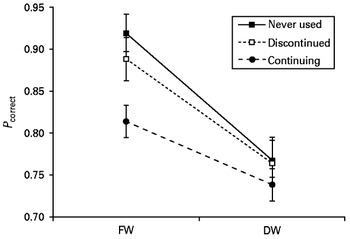
Quality of information at the point of decision (P correct) for current cannabis users, abstinent non-users and never-used groups in the Fixed Win (FW) and Decreasing Win (DW) conditions.

Results
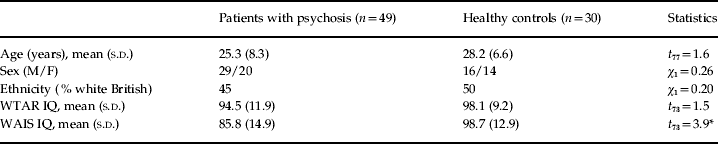
Table 1 shows demographic, symptom data (for patients) and IQ. The patients did not differ from the healthy controls on estimated pre-morbid IQ measured by the WTAR (t 77 = 1.5, p = 0.13) but there was a significant difference on the WAIS-III, with the psychosis group demonstrating a significantly lower FSIQ than the healthy controls (t 77 = 3.9, p < 0.001).
Demographic, clinical and IQ profiles for the healthy controls and patients with psychosis
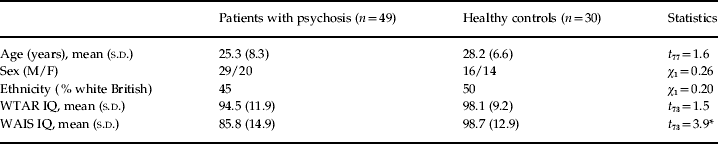
IQ, Intelligence quotient; M, male; F, female; WTAR, Wechsler Test of Adult Reading; WAIS, Wechsler Adult Intelligence Scale; s.d., standard deviation.
* p <0.01.
Differences between people with psychosis and healthy controls
IST
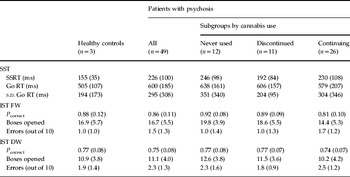
Performance measures on the IST are displayed in Table 2. Mixed-model ANOVAs for each variable (P correct and total errors) were carried out with condition (FW or DW) as a within-subjects variable and group as a between-subjects variable.
Performance on the Stop Signal Task (SST) and the Information Sampling Test (IST) for healthy controls, patients with psychosis and patients with psychosis divided into cannabis use groups

SSRT, Stop signal reaction time; s.d., standard deviation; FW, fixed win; DW, decreasing win.
Values given as mean (standard deviation).
P correct
There was a significant main effect of condition (F 1,77 = 84.5, p < 0.001) that resulted from lower information sampling in the DW condition, consistent with participants adapting their behaviour to the change in reinforcement contingency. There was no significant main effect of group (F 1,77 = 0.98, p = 0.33) or group × condition interaction (F 1,77 = 0.1, p = 0.75).
Total errors
Error rates were significantly higher in the DW than the FW condition (F 1,77 = 28.1, p < 0.001), consistent with the reduced information sampling on the P correct variable. However, the main effect of group was not significant (F 1,77 = 2.4, p = 0.13) and there was also no group × condition interaction (F 1,77 = 0.01, p = 0.97).
SST
The SST indices (SSRT, mean Go RT and standard deviation of the Go RT) are given in Table 2. An independent-samples t test demonstrated that participants with FEP had significantly longer SSRT than healthy controls (t 69 = 3.6, p < 0.001). The Go RT was also slower in the patient group than in the healthy controls (t 69 = 2.7, p = 0.008), but Go RT and SSRT were not significantly correlated in either the patient group (r 43 = 0.04, p=0.78) or the control group (r 28 = –0.11, p = 0.58). There was no significant difference between patients and healthy controls on the variability (s.d.) of the Go RT (t 69 = 1.5, p = 0.12).
Effect of cannabis use on impulsivity in FEP
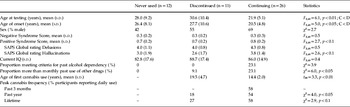
Twenty-six patients were in the category of continuing cannabis users, 11 were discontinued users and the remaining 12 reported never using cannabis. The characteristics of the three groups, in terms of age, gender, psychotic symptoms, past cannabis use, other drug use and number meeting criteria for alcohol dependency, are given in Table 3. Compared to discontinued users, continuing users were younger with regard to age at testing, age of first cannabis use and age at psychosis onset and more likely to be daily users; they consumed other drugs more frequently and tended to show more positive symptoms. We took account of age, SAPS hallucinations and frequency of other drug abuse by entering these variables as covariates in subsequent analyses.
Characteristics of cannabis use in never used (N), continuing (C) and discontinued (D) cannabis-using groups. For analyses where three groups are compared, Bonferroni-corrected significant differences (p < 0.05) are indicated to the right

SAPS, Scale for the Assessment of Positive Symptoms; IQ, intelligence quotient; s.d., standard deviation.
* p < 0.05.
IST
Fig. 1 shows the quality of information at the point of decision for each condition.
P correct
There was a main effect of condition (F 1,43 = 8.7, p = 0.005), a main effect of group (F 2,43 = 4.4, p = 0.02) and their interaction was not significant (F 2,43 = 1.8, p = 0.19). None of the variables entered as covariates reached significance. Bonferroni-corrected post-hoc t tests comparing P correct in the FW condition revealed that continuing users showed reduced data gathering compared to those who never used (p = 0.02). The other between-groups comparisons were not significant.
Total errors
There was a trend towards a main effect of condition (F 2,46 = 3.6, p = 0.06) but no significant effect of group (F 2,46 = 0.5, p = 0.62) or the interaction of group × condition (F 1,48 = 0.3, p = 0.77). None of the variables entered as covariates reached significance.
SST
There were no significant differences between the three groups (F 2,37 = 0.79, p = 0.46) for SSRT or Go RT (F 2,37 = 0.52, p = 0.6). In the former analysis, lifetime more than monthly use of other drugs tended towards being a significant covariate in the model (F 1,37 = 3.8, p = 0.06), whereas age and SAPS hallucinations were not significant.
Associations between IST measures and SSRT
There were no significant correlations between SSRT and the IST P correct in either the FW condition (patient group: r 43 = 0.12, p = 0.42; control group: r 28 = –0.12, p = 0.54) or the DW condition (patient group: r 43 = –0.11, p = 0.50; control group: r 28 = –0.08, p = 0.68).
Associations between current IQ and impulsivity measures
The correlation between current IQ and SSRT was not significant in the patient group (r 43 = –0.23, p = 0.13) or healthy control group (r 30 = –0.10, p = 0.62). On the IST, there was a positive association between FW P correct and current IQ in the healthy control group (r 30 = 0.41, p = 0.02) but not in patients with psychosis (r 49 = –0.11, p = 0.46); there no significant associations between IQ and DW P correct (patient group: r 49 = –0.22, p = 0.13; control group: r 30 = 0.33, p = 0.08).
Sensitivity analyses
An independent-samples t test was carried out comparing the subgroup of patients who were confirmed at the 1-year follow-up to have diagnoses of schizophrenia with the healthy comparison group. This analysis demonstrated that participants with first-episode schizophrenia had significantly longer SSRT than healthy controls (t 33 = 4.3, p < 0.001), which corresponded to a large effect size (Cohen's d = 1.1). The subgroup of patients with schizophrenia did not differ from healthy controls on the IST measures. There was no significant group effect or group × condition interaction on any of the IST task measures. The next analysis examined the subgroup of patients with current IQ in the average range (>90). An independent-samples t test demonstrated significantly longer SSRT compared to the healthy controls (t 33 = 2.6, p = 0.01, Cohen's d = 1.2). There were no significant differences between the groups on the IST measures.
Discussion
We previously reported impairment in response inhibition in people with FEP, as indexed by the SSRT (Huddy et al. Reference Huddy, Aron, Harrison, Barnes, Robbins and Joyce2009). In the current study we found that this was not accompanied by heightened reflection impulsivity, as indexed by the quality of information sampled. This apparent dissociation in task performance was supported by the absence of a correlation between SSRT and the data-gathering measures from the IST. The pattern of results on the two tasks was reversed in the comparison within the psychosis group, between patients who were current cannabis users versus never users. Here, the current cannabis users showed abnormal reflection impulsivity but no differences on response inhibition. The finding of heightened impulsivity in the cannabis-using group is consistent with previous studies using self-report scales of impulsivity in substance use in psychosis (Dervaux et al. Reference Dervaux, Bayle, Laqueille, Bourdel, Le Borgne, Olie and Krebs2001; Gut-Fayand et al. Reference Gut-Fayand, Dervaux, Olie, Loo, Poirier and Krebs2001; Duva et al. Reference Duva, Silverstein and Spiga2011). Similar to the current findings, one of these studies (Duva et al. Reference Duva, Silverstein and Spiga2011) reported an inconsistent profile of group differences across a range of laboratory measures of impulsivity. In particular, current cocaine-using patients with schizophrenia did not differ from non-using patients on a go/no go response inhibition task. These data may be integrated within a framework where inhibition is recognized as a multifaceted trait (Evenden, Reference Evenden1999) rather than a unitary phenomenon and suggest that abnormal response inhibition is associated with schizophrenia but that changes in reflection impulsivity are not.
The absence of a difference on the SSRT measure between the cannabis-using groups was somewhat surprising given evidence that SSRT is slowed following acute administration of tetrahydrocannabinol (THC; Ramaekers et al. Reference Ramaekers, Kauert, van Ruitenbeek, Theunissen, Schneider and Moeller2006). A similar slowing of SSRT is also found in alcohol abuse (Lawrence et al. Reference Lawrence, Luty, Bogdan, Sahakian and Clark2009) and following problematic cocaine use (Li et al. Reference Li, Milivojevic, Kemp, Hong and Sinha2006). The sample size in the subgroups of cannabis use was small, which may increase the chance of a type II error. Although the effect size for the comparison between those who had never used and the continuing users on SSRT was very small (d = 0.16) and in the opposite direction (slower SSRT for those that had never used cannabis compared to cannabis users), these data require replication. There are also no reported studies of SSRT in cannabis users in non-psychotic samples, so the relationship of response inhibition to cannabis use is underspecified at the current time.
There was no evidence of an overall change in information sampling behaviour when comparing patients with psychosis against healthy controls. The change in information sampling between the FW and DW conditions was also similar in the two groups. This suggests that the clinical sample understood the task demands, were adequately motivated by the abstract points reinforcement, and could adjust their behaviour to a coarse change in reinforcement contingencies. This is also consistent with previous research from our group on the Cambridge Gambling Task, where people with schizophrenia adjusted their betting behaviour according to changing probabilities of winning (Hutton et al. Reference Hutton, Murphy, Joyce, Rogers, Cuthbert, Barnes, McKenna, Sahakian and Robbins2002). There was also no evidence of lower overall intellectual ability in continuing cannabis users compared to the other groups.
The difference in reflection impulsivity between cannabis using and non-using subgroups of the clinical sample are highly congruent with those previously reported in previous studies of regular cannabis users (Clark et al. Reference Clark, Roiser, Robbins and Sahakian2009; Solowij et al. Reference Solowij, Jones, Rozman, Davis, Ciarrochi, Heaven, Pesa, Lubman and Yuecel2012). This study reported a similar pattern of increased impulsivity on the same measures reported here. The design of the current study and the preceding studies in non-psychotic samples do not allow for a causal relationship between cannabis use and performance on the IST to be determined. It may be that reflection impulsivity is a trait that predisposes people to start using cannabis and then go on to use it for a more prolonged period. It is also possible, as suggested by Solowij et al. (Reference Solowij, Jones, Rozman, Davis, Ciarrochi, Heaven, Pesa, Lubman and Yuecel2012), that exposure to cannabis leads to abnormalities in neurotransmitter function that regulate behavioural inhibition and effective decision making.
There has been some debate about the reasons why people with schizophrenia continue to use cannabis following psychosis onset. It has been suggested that cannabis may have a self-medicating effect (Spencer et al. Reference Spencer, Castle and Michie2002; Schofield et al. Reference Schofield, Tennant, Nash, Degenhardt, Cornish, Hobbs and Brennan2006) and this may be a factor in continued use. However, a recent review of self-report studies (Kolliakou et al. Reference Kolliakou, Joseph, Ismail, Atakan and Murray2011) suggests that people with schizophrenia use cannabis for similar reasons as the general population: to enhance mood or to ‘get high’. The evidence for the self-medication hypothesis has also been questioned (Blanchard et al. Reference Blanchard, Brown, Horan and Sherwood2000). In terms of continued use, inadequate reflection may be one reason for increased substance use behaviour because it may disrupt appropriate decision making in the context of rewards. A similar suggestion was made by Blanchard et al. (Reference Blanchard, Squires, Henry, Horan, Bogenschutz, Lauriello and Bustillo1999) on the basis of the finding that disinhibition was associated with greater maladaptive skills, such as avoidance coping, in people with schizophrenia. Reduced coping skills may then be expected to lead to poorer outcomes in this group. This is consistent with a previous report from the current sample where discontinued cannabis users demonstrated fewer days in hospital in the first 2 years following onset than those who continued to use cannabis (Leeson et al. Reference Leeson, Harrison, Ron, Barnes and Joyce2012). Furthermore, Grech et al. (Reference Grech, van Os, Jones, Lewis and Murray2005) found that continued cannabis use in people with FEP was related to higher levels of psychotic symptoms at follow-up. Systematic reviews report a range of findings from cross-sectional studies of people with established psychosis that show cannabis use is associated with poorer outcomes in key outcomes such as psychotic symptoms, frequency of relapse, duration of admissions and social exclusion (Zammit et al. Reference Zammit, Moore, Lingford-Hughes, Barnes, Jones, Burke and Lewis2008; Kolliakou et al. Reference Kolliakou, Joseph, Ismail, Atakan and Murray2011).
Increased reflection impulsivity may also impact on treatment outcomes. Indeed, a large-scale study of cognitive behavioural therapy (CBT) combined with motivational interviewing in people with psychosis and substance use problems did not find improvements in key outcomes (Barrowclough et al. Reference Barrowclough, Haddock, Wykes, Beardmore, Conrod, Craig, Davies, Dunn, Eisner, Lewis, Moring, Steel and Tarrier2010). It is possible that verbal therapies, such as CBT, that rely on reflection on the cognitions and behaviours that maintain substance use may be disrupted in individuals where reflective thinking is limited, as we found here. A cognitive treatment for psychosis reported by Moritz & Woodward (Reference Moritz and Woodward2007) focuses on reasoning biases that lead to delusional thinking. Providing such an intervention as a precursor to conventional psychological therapies for substance use may increase the effectiveness of treatments that have, so far, shown limited efficacy.
The similarity in reflection impulsivity between the people with psychosis and the comparison group was surprising in the light of the well-known data-gathering bias found in psychotic samples on the Beads Task (JTC). Both tasks index a related tendency to gather data prior to decision making. The majority of the current sample were presenting with at least moderate levels of delusional symptoms, so the overall level of delusional symptomology does not seem to explain the absence of an effect, particularly considering that delusions may not necessarily be required to observe a data-gathering bias (Moritz & Woodward, Reference Moritz and Woodward2005). Another explanation may lie in procedural differences between the Beads Task and the IST: for example, the IST presents information in a more transparent way, in a grid where both outcome of information sampled and the quantity of information to be sampled are represented explicitly. This may provide a scaffold for participants with working memory problems, which one study has shown to be a factor in Beads Task performance (Menon et al. Reference Menon, Pomarol-Clotet, McKenna and McCarthy2006). Recent studies of the Beads Task have also reported associations with performance IQ (Lincoln et al. Reference Lincoln, Ziegler, Mehl and Rief2010). Given the loading working memory has on performance IQ, working memory could drive the association between IQ and data gathering on the Beads Task.
In conclusion, these data extend the previous finding that patients with psychosis, across substance-using groups, display response inhibition impairment by additionally showing that this tendency does not generalize to reflection impulsivity. This latter form of impulsivity has been found to be heightened in non-psychotic cannabis users and we confirmed this finding also in the current sample of people with FEP. This may have consequences for treatment engagement and the ability to maintain long-term abstinence in substance-using patients with psychosis.
Acknowledgements
This study was supported by Wellcome Trust programme grant 064607 to E.M.J., M.R. and T.R.E.B. We are grateful to the consultants and nurses of West London and South West London and St George's Mental Health National Health Service (NHS) Trusts for greatly facilitating the study.
Declaration of Interest
T.R.E.B. has acted as a consultant for Servier, Johnson & Johnson and Bristol-Myers Squibb. L.C. is a Principal Consultant for Cambridge Cognition, who distribute the IST as part of the CANTAB assessment. The other authors have no biomedical financial interests or potential conflicts of interest.