The absence of subject pronouns cross-linguistically has been the subject of a great deal of empirical and theoretical work, especially within the principles and parameters approach to syntactic variation (see Holmberg & Roberts, Reference Holmberg, Roberts, Biberauer, Holmberg, Roberts and Sheehan2010, for an overview). Despite this, however, the availability of null subjects in Old English has been little investigated compared to other properties such as clausal constituent order. Perhaps because of this state of affairs, conflicting claims have been made in the literature. Hulk and van Kemenade (Reference Hulk, van Kemenade, Battye and Roberts1995:245) stated that “the phenomenon of referential pro-drop does not exist in Old English,” but van Gelderen (Reference van Gelderen2000:137) claimed that “Old English has pro-drop.” Mitchell (Reference Mitchell1985:633) suggested that the possibility of leaving arguments unexpressed “occurs (or survives) only spasmodically” in Old English. Despite the seeming contradiction, we shall see that all three suggestions appear to be right. The availability of the York-Toronto-Helsinki Parsed Corpus of Old English Prose (YCOE; Taylor, Warner, Pintzuk, & Beths, Reference Taylor, Warner, Pintzuk and Beths2003) makes it possible to conduct a quantitative investigation of null subjects on a larger scale than has been carried out before. The results show that, in the majority of classical Old English texts, examples of null referential subjects are so rare as to be potentially considered entirely ungrammatical. However, as we will see, in certain other texts, the phenomenon occurs with a frequency and distribution that cannot be attributed entirely to performance errors.
In this paper, I focus entirely on referential null subjects. Nonreferential null subjects, such as null “expletives” with weather verbs, are robustly attested in Old English (see Fischer, van Kemenade, Koopman, & van der Wurff, Reference Fischer, van Kemenade, Koopman and van der Wurff2000:39), but will be left out of consideration here.
The existence of examples of subject omission in Old English has been known for at least a century. Pogatscher (Reference Pogatscher1901) gave an extensive list of examples, some of which were mentioned by Visser (Reference Visser1963–1973) and Mitchell (Reference Mitchell1985) in their general works on the history of English syntax. Although Pogatscher (Reference Pogatscher1901) treated cases of coordination reduction, as found in Modern English examples such as (1), as examples of subject omission (van Gelderen, Reference van Gelderen2000:124), there are also genuine cases of null referential subjects, as in (2).
(1) The king went to Normandy and met the bishop.
(2) Nu scylun hergan hefaenricaes uard.
now must praise heavenly-kingdom.gen guard
‘Now we must praise the lord of the heavenly kingdom’
(Caedmon's Hymn, Cambridge University Library MS. M, line 1; van Gelderen, Reference van Gelderen2000:126, her (16))
Example (2) is from the Northumbrian version of Caedmon's Hymn, dated to the eighth century. Multiple manuscripts exist, and in some, such as Bodleian Library MS. T1, as in (3), the pronoun is present.
(3) Nu we sculan herian heofonrices Weard.
now we must praise heavenly-kingdom.gen guard
‘Now we must praise the lord of the heavenly kingdom’
(Bodleian Library MS. T1, line 1; van Gelderen, Reference van Gelderen2000:126, her (17))
Tellingly, the scribe of Corpus Christi Oxford MS 279 (MS. O) initially copied Nu sculan ‘Now must’, but then corrected his copy to Nu we sculan ‘Now we must’ (cf. Kiernan, Reference Kiernan1990:164, for discussion of the variation across manuscripts). This raises an important point, also mentioned by Pogatscher (Reference Pogatscher1901:277): If, as seems to be the case, null subjects became progressively rarer through the history of English, scribes may have made “intelligent revisions” (Kiernan, Reference Kiernan1990:164) of what they perceived to be errors, resulting in transmitted texts retaining a lower proportion of null subjects. Likewise, editors have frequently adopted a policy of silently inserting the missing overt pronouns in their editions of Old English texts (Pogatscher, Reference Pogatscher1901:275–276). Both these factors are relevant for our purposes, as quantitative investigations of null subjects in Old English may therefore lead to an underestimation of their actual prevalence, especially because the YCOE (Taylor et al., Reference Taylor, Warner, Pintzuk and Beths2003) is based on critical editions rather than manuscript sources.
In this paper, I present such a quantitative investigation; methods are described in the following section. The results are divided into three subsections discussing differences between texts, between clause types, and between persons. A syntactic analysis is then developed, loosely based on the approach to partial null subject languages taken by Holmberg (Reference Holmberg, Biberauer, Holmberg, Roberts and Sheehan2010). The final section summarizes and concludes.
METHODS
I conducted a search of all texts in the YCOE (Taylor et al., Reference Taylor, Warner, Pintzuk and Beths2003) and York-Helsinki Parsed Corpus of Old English Poetry (YCOEP; Pintzuk & Plug, Reference Pintzuk and Plug2001) that are longer than 15,000 words in order to investigate only texts large enough to make quantitatively reliable generalizations. The object of the search was to find and count (i) overt personal pronoun subjects and (ii) referential null subjects; these two categories together will be referred to as pronominal (as opposed to full determiner phrase [DP] subjects) in what follows. The search was carried out automatically using the program CorpusSearch 2 (Randall, Reference Randall2005–2007).Footnote 1 In the interests of replicability, the queries used to perform the search can be found online.Footnote 2 Citations of Old English examples in the paper, where possible, are given from YCOE/YCOEP corpus token identifications. Because the corpora are also publicly available, this paper contributes more generally to the increasing number of replicable studies in historical syntax.
The YCOE tags referential null subjects (*pro*) distinctly from subjects elided under coordination (*con*) and null expletives (*exp*), using *pro* only when an analysis in terms of one of the other two is impossible. This makes the search for relevant examples relatively simple. However, a preliminary search for all instances of *pro* uncovered two classes of examples that should not be taken to support a prototypical referential null subject analysis. First, there are numerous cases where the verb is in the subjunctive and the context is that of an instruction, as in (4).Footnote 3
(4) gemenge wið buteran
mix.SUB with butter
‘Mix with butter’
(colaece,Lch_II_[1]:3.8.2.406)
Although the sense is imperative, the verb form is clearly subjunctive; because (ge)mengan is a class Ib weak verb, the imperative singular would be (ge)meng. These jussive clauses have therefore been tagged in the YCOE as including a null referential pronoun (*pro*). For simplicity's sake, the figures have been calculated on the basis of indicative clauses only, because this “jussive *pro*” is extremely frequent. In the YCOE Benedictine Rule, 29 of 30 examples of *pro* in main clauses are of this type, and in the Heptateuch, 48 of 52. They are also frequent in instructional texts such as the Herbarium and Bald's Leechbook.
The second category of *pro* that occurs with unexpected frequency is the type illustrated in (5), involving the verb hatan ‘to be called’. Such examples could be analyzed as involving a special type of asyndetic (subject-gap) contact relative clause rather than a true null referential subject; see Mitchell (Reference Mitchell1985:186), Dekeyser (Reference Dekeyser1986:108), and Poppe (Reference Poppe and Tristram2006:197–201).Footnote 4
(5) Ualens wæs gelæred from anum Arrianiscan biscepe, Eudoxius wæs
Valens was taught from an Arian bishop Eudoxius was
haten
called
‘Valens was taught by an Arian bishop called Euxodius.’
(coorosiu,Or_6:33.151.22.3215)
In the preliminary search, Orosius appeared to contain a larger proportion of null subjects in main clauses than did other texts, at 6 percent (34 of 531 examples). However, 27 of these 34 examples involve the verb hatan, and 6 of the remaining 7 are cases of jussive *pro* of the type already discussed. Such examples are also common in the translation of Bede's Historia. Therefore, these cases were excluded from the figures by means of a refinement of the search to rule out forms of the verb hatan.Footnote 5
In distinguishing clause types, in addition to main and subordinate clauses, second and subsequent conjoined main clauses—those introduced by a coordinating conjunction—were treated as a separate category (conjunct); this is because it has often been observed (e.g., Andrew, Reference Andrew1940:1; Bech, Reference Bech2001:86–93; Campbell, Reference Campbell and Rosier1970:93; Mitchell, Reference Mitchell1985:694) that these clauses exhibit different syntactic behavior from other main clauses. I will not have much to say about their behavior here, though data for them are presented for the sake of completeness.
RESULTS
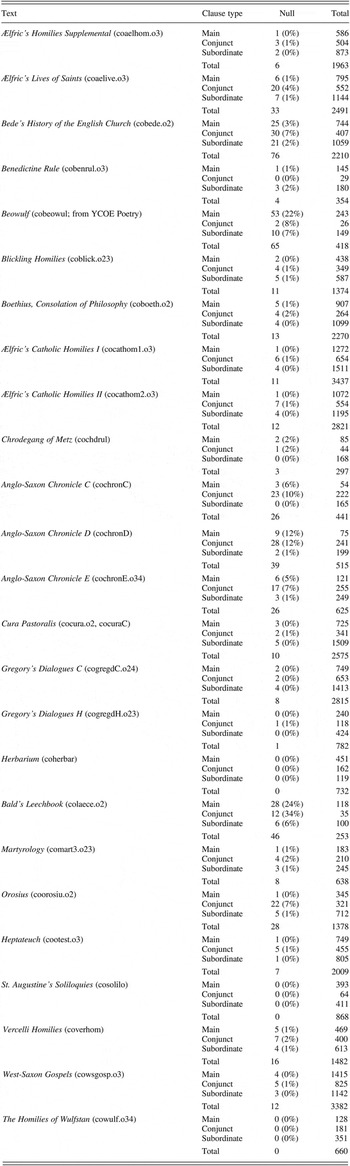
The results of the search are presented in Table 1.
Referential pronominal subjects in Old English finite indicative clauses in the YCOE and YCOEP, by text and clause type

A great deal of variation is visible in Table 1, between texts (some texts do not exhibit referential null subjects at all; others exhibit them at different frequencies) and between clause types (null subjects tend to occur more often in main clauses than in subordinate clauses).Footnote 6 The rest of this section goes into this variation in more detail.
On what I take to be the null hypothesis—that Old English behaved like Modern English in disallowing null subjects—it is not necessarily to be expected that the frequency of *pro* in the YCOE would be 0, as this category may also represent scribal errors. Any corpus of naturally occurring linguistic data is likely to contain violations of even the strongest generalizations at a rate of approximately 1 percent (Bies, Reference Bies1996:5; Santorini, Reference Santorini1989).Footnote 7 Texts that include only very small numbers of instances of *pro* are not necessarily evidence for the grammaticality of referential null subjects in these varieties. However, there exist a number of texts in which the frequency of *pro* is higher, and these will be the focus of the following sections. The aim of the rest of the results section is to demonstrate that null subjects could indeed occur with some frequency in certain contexts, unlike in present-day English.Footnote 8
Differences between texts
Some examples of referential null subjects are given in (6) and (7).
(6) þa lædde mon forð sumne blinde mon.
then led man.nom forth some.acc blind.acc man.acc
Wæs Ø ærest læded to Bretta biscopum
was first led to Britons.gen bishops.dat
‘Then someone led forth a blind man. He was first led to the priests of the Britons’
(cobede,Bede_2:2.100.2.925–cobede,Bede_2:2.100.3.926)
(7) þonne se weard swefeð, sawele hyrde; bið se
then the.nom warder.nom sleeps soul.gen keeper is the.nom
slæp to fæst, bisgum gebunden, bona swiðe neah,
sleep.nom too fast troubles.dat bound killer.nom very near
se þe of flanbogan fyrenum scéoteð.
who that of shaft-bow crime.dat shoots
þonne bið Ø on hreþre under helm drepen biteran stræle
then is in heart.dat under helm.acc hit bitter.dat dart.dat
‘Then the warder sleeps, the soul's keeper. The sleep is too sound, tied to troubles; the killer who shoots sinfully with his bow is too near.
Then he is hit in the heart, under the helmet, by the bitter dart’
(cobeowul,53.1741.1440–cobeowul,54.1745.1443)
In (6), the understood subject is a blind man, who was introduced as the direct object of the previous clause. In (7) it is an unspecified king, the “warder” mentioned several clauses earlier. For more examples of Old English null subjects, particularly from Beowulf, see van Gelderen (Reference van Gelderen2000:126–129) and Visser (Reference Visser1963–1973:4ff).
Many of the texts investigated, including Ælfric's Catholic Homilies and Homilies Supplemental, as well as the Benedictine Rule, Blickling Homilies, Chrodegang of Metz, the translation of Boethius's Consolation of Philosophy, the Cura Pastoralis, both manuscripts of Gregory's Dialogues, the Martyrology, the Heptateuch, St. Augustine's Soliloquies, the West-Saxon Gospels, and Wulfstan's Homilies, show a frequency of overt subjects of 98 to 100 percent in all clause types. This arguably lends weight to Hulk and van Kemenade's (Reference Hulk, van Kemenade, Battye and Roberts1995) claim, because one approach to such low figures is to consider these examples ungrammatical; at any rate, it is easy to see why such a claim would have been made.
In Ælfric's Lives of Saints and Orosius, null subjects are found at a substantial frequency only in conjunct clauses. Why this should be the case is unclear, especially for Ælfric, in whose other writings null subjects in general are extremely rare. Perhaps the systems underlying these texts are characterized by a rule of conjunction reduction in which arguments can be shared across conjuncts “regardless of case or grammatical function,” as suggested by Faarlund (Reference Faarlund1990:104) for Old Norse. A relevant example from Lives of Saints is given in (8), where the dative experiencer in the main clause is the understood subject of the conjunct clause.Footnote 9
(8) Þa gelicode þam gedwolenum þæs bisceopes dom
then liked the.dat heathens.dat the bishop's ruling
and wacodon þa þreo niht
and watched there three nights
‘Then the heathens liked the bishop's ruling, and watched there three nights’
(coaelive, + ALS_[Basil]:338.675–676)
I will leave these two texts out of consideration in what follows.
The remaining texts are Bede's History of the English Church, Beowulf, Bald's Leechbook, and the C, D, and E manuscripts of the Anglo-Saxon Chronicle. All of these texts exhibit null subjects to a greater extent.
Was Old English a null subject language, then? The answer appears to be that there is variation. The texts I have investigated that display null subjects robustly have in common with those investigated by Berndt (Reference Berndt1956) that they are Anglian (Northumbrian or Mercian) or exhibit Anglian features. Berndt (Reference Berndt1956:59–60) demonstrated this for the Northumbrian Lindisfarne Gospels and the Rushworth Glosses, in the process noting that they display a much higher rate of null subjects than do the West Saxon Corpus MS of the gospels (ibid.:78–82). Fulk (Reference Fulk, Fitzmaurice and Minkova2009:96) noted that the Old English Bede and Bald's Leechbook and the D and E manuscripts of the Anglo-Saxon Chronicle, though traditionally assigned to West Saxon, display Anglian features.Footnote 10 Though it is agreed that Bald's Leechbook in its transmitted form was composed in Winchester (Meaney, Reference Meaney1984:36), Wenisch (Reference Wenisch1979:54) argued on a lexical basis that an Anglian (probably Mercian) original must have existed. As for Beowulf, Fulk (Reference Fulk1992:309–325) noted a number of Anglian lexical and morphological features. If null subjects can be considered an Anglian feature on the basis of their distribution across texts, it seems fair to suggest, tentatively, that both van Gelderen (Reference van Gelderen2000) and Hulk and van Kemenade (Reference Hulk, van Kemenade, Battye and Roberts1995) are correct. Referential null subjects were not grammatical in classical Old English (West Saxon), as exemplified, for example, by the works of Ælfric, but they were available, subject to certain restrictions, in Anglian dialects. The key to resolving the apparent contradiction lies in dispelling the illusion of Old English as a monolithic entity. Though it is often treated as such for the purposes of syntactic generalizations—for instance by Fischer et al. (Reference Fischer, van Kemenade, Koopman and van der Wurff2000:37)—the texts provide evidence for diatopic and diachronic variation even within syntax; see, for example, Ingham (Reference Ingham2006) for a demonstration of dialectal variation in negative concord configurations and Suárez-Gómez (Reference Suárez-Gómez2009) on variation in relative clauses.Footnote 11
This result can be underscored by collapsing the figures in Table 1 according to whether the text is listed in the YCOE as purely West Saxon (the works of Ælfric, the Benedictine Rule, the translation of Boethius's Consolation of Philosophy, the Cura Pastoralis, the H manuscript of Gregory's Dialogues, the Heptateuch, St. Augustine's Soliloquies, the West-Saxon Gospels, and Wulfstan's Homilies). Table 2 presents the results: the two dialect groups are clearly distinct (χ2 with Yates's correction, 301.018, 1 df; p < .0001).
Referential pronominal subjects in finite indicative clauses in West Saxon and non–West Saxon

Assuming that earlier stages of Northwest Germanic did allow referential null arguments (Axel, Reference Axel, Kepser and Reis2005, Reference Axel2007, on Old High German; Håkansson, Reference Håkansson2008, on Old Swedish; Sigurðsson, Reference Sigurðsson1993, on Old Icelandic; and Rosenkvist, Reference Rosenkvist2009, and Walkden, Reference Walkden2012, for a broad overview of null subjects in Germanic languages), this property must have been lost in West Saxon during and before the time that our very earliest texts were being produced. I do not here address the issue of how or why this property was lost; though see Walkden (Reference Walkden2012) for some suggestions.
Differences between clause types
In all of the texts that robustly exhibit referential null subjects, including Beowulf, null variants are more common in main clauses than in subordinate clauses. The effect of clause type in Beowulf (main vs. subordinate), for instance, is clearly significant (p < .0001).Footnote 12 This result is similar to that found by Håkansson (Reference Håkansson2008) for Old Swedish, and by Eggenberger (Reference Eggenberger1961) and Axel (Reference Axel2007) for Old High German. Examples (9) and (10) are of null subjects in subordinate clauses.
(9) Forðon in þas tid seo halige cirice sumu
because in these times the.nom holy.nom church.nom some.acc
þing þurh welm receð, sumu þurh monþwærnesse
things.acc through zeal chastises some.acc through meekness
aræfneð, sumu þurh sceawunge ældeð, & swa abireð &
tolerates some.acc through discretion connives and so endures and
ældeð, þætte Ø oft þæt wiðerworde yfel abeorende & ældend
connives that often that noxious evil enduring and concealing
bewereð
prevents
‘Because in these times the Holy Church chastises some things through zeal, tolerates some through meekness, connives some through discretion, and endures and connives, so that she (the Church) often suppresses that noxious evil through endurance and connivance’
(cobede,Bede_1:16.70.33.663–cobede,Bede_1:16.70.33.666)
(10) godfremmendra swylcum gifeþe bið þæt þone hilderæs hæl
good-doers.gen such.dat given is that the.acc battle-charge.acc hale
gedigeð
endure
‘To such performers of noble deeds it will be granted that they survive the assault unharmed’
(cobeowul,11.293.236)
Null subjects in Old English were sensitive to clausal status as in Old High German and Old Swedish, though not in any absolute way, a fact already recognized by Pogatscher (Reference Pogatscher1901:261). In the analysis section, the theoretical implications of this are discussed.
Differences between persons
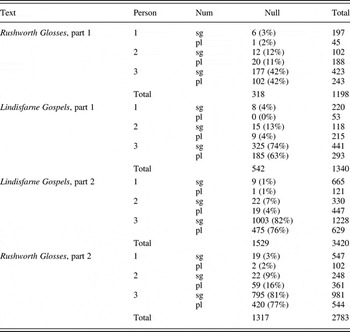
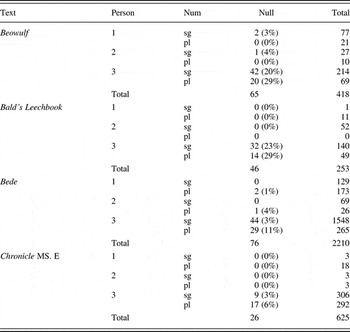
In all of the texts that robustly exhibit referential null subjects, person has a statistically significant effect on the expression versus nonexpression of subjects. Table 2 presents data taken from a study by Berndt (Reference Berndt1956). This table bears some resemblance to van Gelderen's (Reference van Gelderen2000:133) Table 3.1. Though in his own tables, Berndt (Reference Berndt1956:65–68, 75n1) distinguished between subjects elided under coordination and other null referential subjects, van Gelderen (Reference van Gelderen2000) conflated the two categories in the figures for null subjects in her Table 3.1. In Table 3, I have excluded Berndt's (Reference Berndt1956) cases of subjects elided under coordination in order to ensure comparability with Tables 1 and 4.
Referential pronominal subjects in finite indicative clauses in the Lindisfarne Gospels and Rushworth Glosses, by person and number

Source: Based on Berndt (Reference Berndt1956:65–68).
Referential pronominal subjects in finite indicative clauses in Beowulf, Bald's Leechbook, Bede, and MS. E of the Chronicle, by person and number

Berndt (Reference Berndt1956) investigated two texts, the Lindisfarne Gospels (Northumbrian) and the Rushworth Glosses (of which the first part is Mercian and the second Northumbrian). The effect of third versus nonthird person in both parts of each text (cf. also van Gelderen, Reference van Gelderen2000:132n6) proves to be significant at the p < .0001 level. Within the third person, number also has an effect, with overt subjects being preferred for plurals, although the effect is only statistically significant in the Lindisfarne Gospels (part 1: p = .0025, part 2: p = .0023), not in the Rushworth Glosses (part 1: p = 1, part 2: p = .0841). Number has no effect in the first person (Lindisfarne part 1: p = .3612, part 2: p = .6570; Rushworth part 1: p = 1, part 2: p = .5558) and no consistent effect in the second person (Lindisfarne part 1: p = .0067, part 2: p = .1464; Rushworth part 1: p = .8449, part 2: p = .0076). Similar facts hold for four of the texts exhibiting null subjects that I investigated, as shown in Table 4, though the proportions of null subjects in general in these texts is much lower.
In Beowulf, Bald's Leechbook, and Bede, the effect of third versus nonthird person is statistically significant (p < .0001 for the first two; p = .0004 for Bede).Footnote 13 In the Chronicle MS. E, though there are no first- or second-person null subjects, there is no statistically significant effect of number (p = .6206), perhaps because of the low frequency of first and second person overall. The effect of number in the third person is only statistically significant for Bede (p < .0001) and not for the other three texts (Beowulf: p = .1311; Bald's Leechbook: p = .4427; Chronicle MS. E: p = .1080); the number of tokens of first and second person is too small to yield meaningful results as to the effect of number, and there is no obvious trend.
Among other things, van Gelderen (Reference van Gelderen2000) took this systematicity to show that the null argument property of at least some Old English texts cannot be attributed solely to Latin influence. In Latin, overt pronouns are almost never present, so if the absence of pronouns in Old English resulted entirely from isolated instances of overliteral translation, we would expect a random distribution of null subjects across persons and numbers, which is not the case (van Gelderen, Reference van Gelderen2000:133). Instead we find null subjects only very rarely in the first and second person, and only very rarely in subordinate clauses. I concur; furthermore, such a hypothesis would be problematic when dealing with autochthonous texts such as Beowulf that display many null arguments despite being universally acknowledged as having no Latin original and displaying little Latin influence.
Likewise, the null argument property of Old English cannot be attributed solely to metrical considerations in texts such as Beowulf, because this would not account for the greater frequency of null subjects in the third person than in the first and second. All three types of personal pronoun are unstressed monosyllables in Old English. Furthermore, such a hypothesis would be problematic when dealing with prose texts such as Bald's Leechbook, for which no metrical explanation is available. If translation from Latin and/or metrical considerations played a role in favoring null subjects at all in Old English texts, then, it could only have led to a slight general quantitative preference, as neither of these factors is able to account for the person and clause-type asymmetries in Old English or the range of texts in which null subjects are found.
Summary of results
Although many texts appear to reflect grammars that do not permit referential null subjects as a grammatical option, some Old English texts, including Beowulf, Bald's Leechbook, the Lindisfarne Gospels, and the Rushworth Glosses, exhibit a nontrivial proportion of null subjects with a distribution that is unlikely to be due solely to Latin or metrical influence. I suggested that the null subject property was a feature of Anglian dialects of Old English. In those texts that robustly exhibit referential null subjects, such subjects are heavily dispreferred, though not impossible, in subordinate clauses, with overt pronominals being favored. Furthermore, third-person pronominal subjects are much more likely to be null than first- or second-person pronominal subjects.
For completeness, it should be mentioned that referential null objects can also be found in Old English; Ohlander (Reference Ohlander1943), van der Wurff (Reference van der Wurff and Fisiak1997), and van Gelderen (Reference van Gelderen2000) provided a number of examples, including (11) and (12).
(11) se here . . . gesæt þæt lond and gedælde
the army invaded the land and divided
‘The army . . . invaded the country and divided it up’
(cochronC,ChronC_[Rositzke]:881.1.762)
(12) hie . . . leton holm beran / geafon on garsecg
they let sea bear gave on ocean
‘They let the sea bear him, gave him to the ocean’
(cobeowul,4.47.41–42)
I have not attempted a quantitative investigation of null objects here, due to the difficulty of deciding what constitutes a true referential null object as opposed to a verb that is optionally intransitive (e.g., Modern English I have eaten).
ANALYSIS
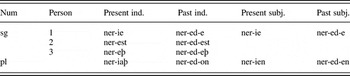
The traditional account of the null subject parameter, following Taraldsen (Reference Taraldsen1978), associated the possibility of null subject properties with rich verbal subject agreement, an intuition with a much longer pedigree in Indo-European philology. Though the intuition has proven difficult to formalize, it seems too valuable to reject entirely. Van Gelderen (Reference van Gelderen2000:125) explicitly adopted “a Taraldsen/Platzack [account]” of pro-licensing for Old English, in which third-person verbal features are more specified than first- and second-person verbal features are. However, it can be seen that such an analysis cannot account for the Old English facts. A sample weak verb paradigm of Old English is given in Table 5.
Verb paradigm for the simple present and past tenses in Old English: nerian (‘to save’)

Source: Mitchell and Robinson (Reference Mitchell and Robinson2007:46).
As can be seen, no person distinctions at all are made in the plural of either tense; the same holds in all dialects of Old English, including the strong verb paradigms. This situation cannot be reconciled with any of the proposals as to what constitutes rich agreement. For instance, according to Müller (Reference Müller, Brandt and Fuß2005), the relevant property disallowing agreement-conditioned null subjects is the occurrence of system-wide syncretisms. Such syncretisms are clearly present in the plural. Furthermore, the differences between texts (and, by hypothesis, between dialects) are mysterious under an agreement-driven account, as are the differences between clause types.
It therefore seems unlikely that the proposal of van Gelderen (Reference van Gelderen2000:125), based on the Taraldsen (Reference Taraldsen1978) intuition, is correct. A further problem is presented by referential null objects such as those in (11) and (12). There is no object agreement on the verb in Old English, so an agreement-driven account would predict that these should be impossible. In classic agreement-conditioned null subject languages such as Italian, null objects are permitted only with arbitrary interpretation and may not be referential (Rizzi, Reference Rizzi1986).
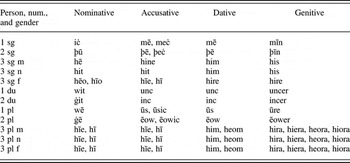
It also seems unlikely that Old English can be likened to the other major subclass of null subject languages, the radical null argument languages such as Japanese, Hindi/Urdu, and Imbabura Quechua. In these languages, arguments (including objects) can be dropped relatively freely without being constrained by verbal morphology, subject only to certain discourse conditions (e.g., see Huang, Reference Huang1984). Such an account for Old English would explain the occurrence of referential null objects. However, a recent and influential proposal by Neeleman and Szendrői (Reference Neeleman and Szendrői2007, Reference Neeleman, Szendrői and Biberauer2008) suggested that languages require agglutinating morphology on pronouns if they are to have radical null arguments; Japanese, for instance, has agglutinative case morphology (Neeleman & Szendrői, Reference Neeleman and Szendrői2007:679). The Old English personal pronoun system is given in Table 6.
Old English pronouns

Source: Mitchell and Robinson (Reference Mitchell and Robinson2007:18–19).
Numerous portmanteau fusional forms can be observed, especially in the nominative case, and none of these fusional patterns stretches across the full paradigm in any of these languages. That is, there is no feature value or combination of feature values such that they define a nonsingleton set of forms in which all members share phonetic material (cf. Neeleman & Szendrői, Reference Neeleman and Szendrői2007:706). Assuming Neeleman and Szendrői's (Reference Neeleman and Szendrői2007) proposal was along the right lines as a characterization of radical null argument languages, then, Old English does not qualify.
In addition, example (7) and others like it preclude a “pronoun zap” or “topic drop” analysis of Old English null arguments as often assumed for modern Northwest Germanic languages (e.g., Huang, Reference Huang1984:546–549; Ross, Reference Ross1982). This is because þonne ‘then’ is in initial preverbal position, and topic drop is not possible in the modern languages precisely when an overt element precedes the verb. A further argument against a pure topic drop analysis is that, in modern Germanic, topic drop is unavailable in subordinate clauses, whereas in Old English, null subjects are available in this context (though dispreferred).
The null subject variety of Old English does not seem to fit very well into any of the traditional categories of null argument language, then. However, it is not alone in this. Finnish and Hebrew both allow referential null arguments under certain conditions (Borer, Reference Borer, Jaeggli and Safir1989; Holmberg, Reference Holmberg2005, Reference Holmberg, Biberauer, Holmberg, Roberts and Sheehan2010; Vainikka & Levy, Reference Vainikka and Levy1999). It has been argued that these languages, as well as others such as Icelandic, Russian, Marathi, and Brazilian Portuguese, should be classed as a separate type of null argument language, the “partial” null argument languages (Holmberg & Roberts, Reference Holmberg, Roberts, Biberauer, Holmberg, Roberts and Sheehan2010:10–11). In formal and written Finnish, for example, first- and second-person pronouns can always be left unexpressed in finite contexts, and third-person pronouns can be left unexpressed when “bound by a higher argument, under conditions that are rather poorly understood” (Holmberg, Reference Holmberg2005:539). Referential objects may also be unexpressed in similar contexts. Hebrew has a similar pattern in the past and future tenses, which have person marking; in the present tense, which does not, subject pronouns are obligatory (Vainikka & Levy, Reference Vainikka and Levy1999:615). The analytic tools developed for these languages will be useful in analyzing Old English. In particular, I here follow an approach based on Holmberg (Reference Holmberg, Biberauer, Holmberg, Roberts and Sheehan2010), arguing that Old English was in a sense the mirror image of languages such as modern formal Finnish.Footnote 14
In Holmberg's (Reference Holmberg, Biberauer, Holmberg, Roberts and Sheehan2010) analysis, referential null subjects in partial null subject languages are DPs that bear a full set of φ-features but whose D-feature is uninterpretable ([uD]). T0, which bears [uφ]-features associated with an EPP, or extended projection principle, feature, agrees with the subject and attracts it to be second-merged in SpecTP, or specifier of TP, thereby valuing T0's [uφ]-features as well as the [uCase] feature of the subject DP. In consistent null subject languages, T0 has a [uD] feature that can be valued by agreement with a null aboutness topic in the C-domain (“what the sentence is about”; Reinhart, Reference Reinhart1981). Because T0 bears a [uD] feature, the subject itself is not required to bear one, and thus a pronoun smaller than a DP—a φP in Holmberg's (Reference Holmberg, Biberauer, Holmberg, Roberts and Sheehan2010) proposal—can serve as the subject. When the uninterpretable φ-features of T0 probe, and subject-verb agreement is established, this φP subject incorporates into the verb rather than moving to SpecTP.Footnote 15
In partial null subject languages, this strategy is not available: because T0 does not bear a [uD] feature, the subject must bear one instead, and hence must be a DP.Footnote 16 Finnish then has two ways of valuing the [uD] feature on the subject DP. In the case of first- and second-person null subjects, it is valued by agreement with elements in the speaker or addressee projections in the left periphery (local logophoric agent or patient, ΛA or ΛP, in the sense of Sigurðsson, Reference Sigurðsson2004:227). In the case of third-person referential null subjects, it is valued through a structurally defined control relation with a DP antecedent (Holmberg, Reference Holmberg, Biberauer, Holmberg, Roberts and Sheehan2010:101–104). The nullness of the pronoun is then due to an extended version of chain reduction.
One immediate question arising from this system is why a null aboutness topic cannot control a null subject in SpecTP directly. Holmberg (Reference Holmberg, Biberauer, Holmberg, Roberts and Sheehan2010:103n11) speculates on this point, but it is clear that it cannot straightforwardly be the case for Finnish main clauses, as null referential third-person subjects are not allowed in this context (e.g., Vainikka & Levy, Reference Vainikka and Levy1999:614). An analysis involving a null aboutness topic would make the prediction that this topic could be present in main clauses in Finnish as it is in consistent null subject languages such as Italian and could thus value the [uD] feature of the null subject pronoun.
A related question is how the agreement relation between left-peripheral speech features, or aboutness topics in the case of consistent null subject languages, and T0 or the subject pronoun in SpecTP comes to hold. The purpose of this agreement relation in Holmberg's (Reference Holmberg, Biberauer, Holmberg, Roberts and Sheehan2010) system is to value the [uD] feature of T0 or the subject pronoun. To achieve this, the left-peripheral category must bear a valued D-feature. In Chomsky's (Reference Chomsky, Martin, Michaels and Uriagereka2000, Reference Chomsky and Kenstowicz2001) agreement system, however, it is the higher category that probes, and it can only do so if it bears an uninterpretable feature itself.
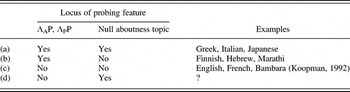
Both problems can be solved at once if it is hypothesized that the ability of these left-peripheral categories to probe is itself parameterized. Specifically, in a given language, ΛAP and ΛPP operators and null aboutness topics in ShiftP (the left-peripheral phrase containing the aboutness topic; see Frascarelli & Hinterhölzl, Reference Frascarelli, Hinterhölzl, Schwabe and Winkler2007) may each independently bear a probing feature alongside their valued D-features, and it is this that gives them the ability to probe and thus enter into an agreement relation with SpecTP or T0, valuing the latter's [uD] feature as a by-product of this. Assuming for the moment that the logophoric operators ΛA and ΛP pattern together in whether they bear probing features, this gives us a four-way typology, as illustrated in Table 7, that crosscuts previous typologies of null argument languages. Table 7 does not present an implicational hierarchy: merely a presentation of the logical (and attested) possibilities.
Typology of null argument context-linking

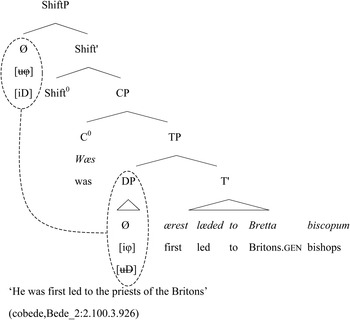
I would like to propose that option (d) in Table 7 is the one instantiated by Old English. As observed by Berndt (Reference Berndt1956) and van Gelderen (Reference van Gelderen2000) as well as earlier in this paper, first- and second-person null arguments are comparatively rare. As Sigurðsson (Reference Sigurðsson1993:254) pointed out for Old Icelandic, this is expected if null arguments are required to have discourse topicality. Although it is not impossible for first- and second-person arguments to be aboutness topics, this type of topicality is not easily established in direct speech, in which most of the attested cases of first- and second-person null arguments are found. I therefore assume that ΛA and ΛP operators lacked the ability to probe in Old English, and that the [uD] feature of a null argument could therefore only be valued by agreement with a null aboutness topic. The relevant derivational configuration for agreement is as illustrated in Figure 1, abstracting away from irrelevant movements and layers of structure; the dotted line indicates agreement.Footnote 17 (On the licensing of verb movement to the C position, see Walkden, Reference Walkden2012:87–101.)
Licensing of null subjects in Old English.

As was additionally established earlier, Old English furthermore shows an asymmetry between main and subordinate clauses with regard to the frequency of null arguments. Null arguments are substantially rarer in subordinate clauses, once again displaying the mirror image of the behavior of Finnish. This can be captured if subordinate finite clauses in Old English are islands with respect to agreement and do not always project their own ShiftP. If ShiftP is present in a subordinate clause, a null aboutness topic probes for and may identify a null argument. If it is not present, null arguments may not be identified, because a null aboutness topic in a higher finite clause may not probe into the lower clause.Footnote 18
I thus propose that null subjects in Old English belong to the set of main clause phenomena (Green, Reference Green1976; Haegeman & Ürögdi, Reference Haegeman and Ürögdi2010; Hooper & Thompson, Reference Hooper and Thompson1973). As such, they should be available in subordinate clauses only under certain conditions. The formalization of these conditions has remained elusive. The key properties have been argued to be assertion (Hooper & Thompson, Reference Hooper and Thompson1973; Wiklund, Reference Wiklund2010), the speaker's commitment to the truth of the clause (Green, Reference Green1976), and most recently clausal (non)referentiality (Haegeman & Ürögdi, Reference Haegeman and Ürögdi2010). All accounts of main clause phenomena, however, predict that they should be available only in “rootlike” contexts, and unavailable in other specific contexts, such as the complements of nonbridge verbs and “central” (Haegeman, Reference Haegeman2004) adverbial clauses. These are precisely the contexts for which Bianchi and Frascarelli (Reference Bianchi and Frascarelli2010) argued that aboutness topics are unavailable. The prediction seems to be largely correct as far as Old English null subjects are concerned: overt forms are required in the complements of nonbridge verbs, as in (13), and in central conditional clauses, as in (14).Footnote 19
(13) wite þu þonne þæt þu hie ne meaht gehælan
know.sbjv you then that you it neg may heal.inf
‘Then you know that you cannot heal it’
(colaece,Lch_II_[1]:1.15.5.104)
(14) gif hio of cealdum intingan cymð
if she of cold.dat cause.dat comes
þonne sceal mon mid hatum læcedomum lacnian
then shall one with hot.dat leechdom.dat heal.inf
‘If it comes of cold causes, one should treat it with hot leechdoms’
(colaece,Lch_II_[1]:1.13.4.85)
A final important feature of partial null subject languages, according to Holmberg (Reference Holmberg2005:540), is that they permit generic null subjects. This is so because φP pronouns, lacking [uD], may not incorporate into T0 in these languages and receive a referential interpretation as T0 also lacks [uD]; hence, if they are incorporated into T0, they may only be interpreted as generic null subjects. Generic null subjects are certainly possible in Old English, as illustrated by (15), though the use of man/mon in this role is more common (see also Rusten, Reference Rusten2010:83–84). As a reviewer notes, instances of jussive *pro*, such as (4), could be analyzed as involving a generic null subject.
(15) Wiþ þæs magan springe þonne þurh muð bitere hræcð
for the maw.gen sore.dat when through mouth bitterly retches
oþþe bealcet
or belches
‘For sores of the mouth when (the patient) retches or belches bitterly through the mouth’
(colaece,Lch_II_[2]:15.1.1.2296)
It thus seems that there is a plausible case to be made for Old English as a partial null argument language.
SUMMARY AND CONCLUSION
The aim of this paper was to investigate the possibility of referential null subjects in Old English. Drawing on a search of the larger texts in the YCOE and YCOEP, as well as an earlier investigation of two northern texts by Berndt (Reference Berndt1956), it was established that some texts reflected a null-subject-permitting grammar to a certain extent, but others did not. It was tentatively proposed that the null subject property might have been a feature of Anglian, but not of West Saxon.Footnote 20
In those texts that robustly exhibit referential null subjects, clear patterns were observed. First, null subjects were proportionally rarer in subordinate clauses than in main clauses. Second, null subjects were proportionally rarer in the first and second persons than in the third. Examples of referential null objects can also be found.
It was argued that the null argument facts of Old English are not compatible with an account based on rich verbal agreement, or with a “radical null argument” account. Instead, it was proposed that Old English was a partial null argument language in the sense of Holmberg (Reference Holmberg, Biberauer, Holmberg, Roberts and Sheehan2010), and an analysis was given in these terms. If the account in this paper is along the right lines, it provides a small contribution to ongoing comparative work on null arguments in early Germanic (Rosenkvist, Reference Rosenkvist2009; Walkden, Reference Walkden2012) and to our understanding of the typology of null argument languages, in addition to shedding some light on the syntax of Old English itself.