Introduction
Although there is evidence for neurocognitive heterogeneity in patients with schizophrenia (MacCabe et al. Reference McGurk and Mueser2002; Joyce & Roiser, Reference Kay, Fiszbein and Opler2007), comprehensive meta-analyses confirm that these patients, as a group, show substantial neuropsychological impairments (Heinrichs & Zakzanis, Reference Hoff, Svetina, Shields, Stewart and deLisi1998; Fioravanti et al. Reference Fioravanti, Carlone, Vitale, Cinti and Clare2005; Dickinson et al. Reference Dickinson, Ramsey and Gold2007). Deficits range between 1.5 and 2.0 s.d. below healthy controls on key dimensions such as attention, working memory, psychomotor speed, verbal and non-verbal memory and executive functions including verbal fluency (Barch, Reference Barch2005; Keefe et al. Reference Kern, Nuechterlein, Green, Baade, Fenton, Gold, Keefe, Mesholam-Gately, Mintz, Seidman, Stover and Marder2006). Although many of these impairments do remain fairly stable over the first years of the illness (Townsend & Norman, Reference Zakzanis, Leach and Kaplan2004; Hoff et al. Reference Jacobson, Truax and Kazdin2005), there might be fluctuations with more difficulties during the acute phase. Since cognitive impairments characterize, however, to a lesser extent, many first-degree relatives of the patients (Snitz et al. Reference Streiner2006), they are discussed as candidate endophenotypes that may be useful in genetic studies of schizophrenia (Gur et al. Reference Gur, Calkins, Gur, Horan, Nuechterlein, Seidman and Stone2007; Allen et al. Reference Allen, Griss, Folley, Hawkins and Pearlson2009).
Cognitive deficits in schizophrenia are clinically important in that they play a crucial role in case management (challenging clinicians' and other professionals' communication skills; McGurk & Mueser, Reference McGurk, Twamley, Sitzer, McHugo and Mueser2006; Priebe & McCabe, Reference Roder, Mueller, Mueser and Brenner2008) and may limit rehabilitation efforts. For example, an increasing number of studies have observed poor insight, which itself is essential for treatment adherence, to be a reflection of neurocognitive dysfunctions, mainly of those mediated by the frontal and the parietal cortex (Shad et al. Reference Simon, de Hert, Wampers, Peuskens and van Winkel2006; although a number of studies did not find these connections; for example, Collins et al. Reference Collins, Remington, Coulter and Birkett1997; Simon et al. Reference Snitz, MacDonald and Carter2009). Similarly, psychosocial rehabilitation outcome is associated primarily with both the amount and pattern of neurocognitive deficits (Green et al. Reference Green, Kern, Braff and Mintz2000; Brekke et al. Reference Brekke, Hoe, Long and Green2007). Considering this background, the assumption that neurocognitive deficits can limit therapeutical use and the effects of psychosocial interventions for patients with schizophrenia appears mandatory.
One such intervention is psychoeducation, which has been defined as ‘systematic, didactic psychotherapeutic interventions, which are capable of informing patients and their relatives about the illness and the treatment options available and of fostering the understanding of and coping with the illness’ (Bäuml & Pitschel-Walz, Reference Bäuml and Pitschel-Walz2008, p. 13). Studies have shown that patients with schizophrenia who receive psychoeducation know more about their illness, are more compliant and experience fewer relapses or rehospitalizations (Barbato & d'Avanzo, Reference Barbato and d'Avanzo2000; Pitschel-Walz et al. Reference Priebe and McCabe2001; Pekkala & Merinder, Reference Pitschel-Walz2002; Lincoln et al. Reference Lineweaver, Bondi, Thomas and Salmon2007; Rummel-Kluge & Kissling, Reference Rummel-Kluge, Pitschel-Walz, Bäuml and Kissling2008). The positive effects of the relatively short interventions are retained over several years (Tarrier et al. Reference Townsend and Norman1994; Bäuml et al. Reference Bäuml, Pitschel-Walz, Volz, Engel and Kissling2007).
Although psychoeducation is now considered a state-of-the-art intervention in treatment guidelines for schizophrenia (APA, 2004; DGPPN, 2006), it is still unknown how much its short- and long-term effects may depend on the neurocognitive status of the patients at the time they enter the treatment, which neurocognitive domains have the strongest influence on the outcome and whether even patients with severe deficits can derive any profit from psychoeducational interventions [as was, for example, shown for the integrated psychological therapy (IPT), which works well even in post acute patients with large attentional impairments; Roder et al. Reference Rummel-Kluge and Kissling2006].
To shed some light on these and related questions, we undertook the Munich Cognitive Determinants of Psychoeducation and Information in Schizophrenic Psychoses (COGPIP) study, supported by the German Research Foundation. This longitudinal study combined a neurocognitive training or control condition with a subsequent psychoeducational group programme and a 9-month follow-up, evaluating the two interventions and their short- and long-term effects by means of sociodemographic, anamnestic, psychopathological, pharmacological, neurological and neuropsychological data. In this paper, we try to answer the following research questions on the most important short-term effect measure of psychoeducation, the level of illness knowledge achieved:
(Q1) Does the neurocognitive or the psychopathological status of patients shortly before they enter a psychoeducational treatment programme better predict the level of illness knowledge after psychoeducation?
(Q2) If neurocognition predicts a significant amount of variance of the patients' illness knowledge after psychoeducation, which cognitive domains are most relevant for such a prediction?
Our hypotheses were:
(H1) The neurocognitive status prior to psychoeducation is a significant and at least just as important predictor of illness knowledge after psychoeducation as is the psychopathological status.
(H2) The most relevant cognitive domains for this prediction are attention and verbal memory.
Methods
Study design
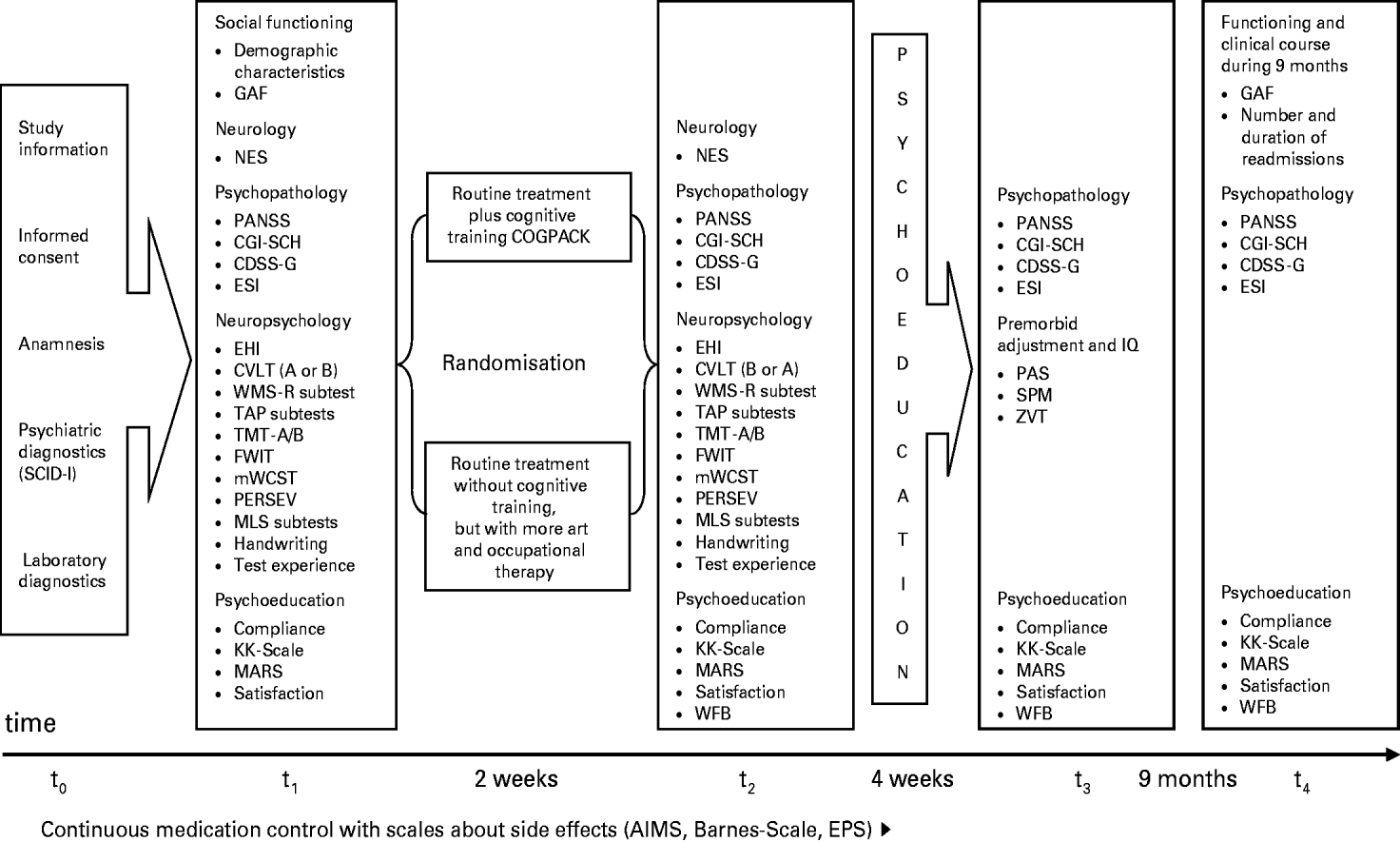
The design of the COGPIP study is shown in Fig. 1.
Design of the Cognitive Determinants of Psychoeducation and Information in Schizophrenia Psychoses (COGPIP) study: procedures, assessment points and measures. Abbreviations of tests, scales and questionnaires are from English or German names of the measurement instruments (see text).

After the patients had given informed consent, basic sociodemographic and anamnestic information was collected and the ICD-10 diagnoses provided by the patients' attending physicians were independently confirmed by means of the Structured Clinical Interview for the DSM-IV. As soon as at least six patients formed a ‘recruitment group’, the baseline assessment (t1) was conducted. Patients were then randomly allocated to either a computerized cognitive training or to routine occupational therapy. After repeating most of the t1 assessments at t2, study patients were motivated to attend a psychoeducational group intervention. This was followed by t3 assessments (without neuropsychological tests). Approximately 9 months later, the study participants were assessed again (t4) on their functional and psychopathological status, psychoeducational outcome variables and on the number of intermediate rehospitalizations and days in hospital. In addition to the study procedures mentioned above, all participants received the routine treatment of our hospital including non-restricted, individualized antipsychotic medication (mainly second generation antipsychotics), supporting psychotherapy sessions, art, music and occupational therapy, relaxation training and supplementary psychosocial group activities according to the rules of evidence-based medicine and good clinical practice following the schizophrenia treatment guidelines of the German Society for Psychiatry, Psychotherapy and Neurology (DGPPN, 2006).
Subjects
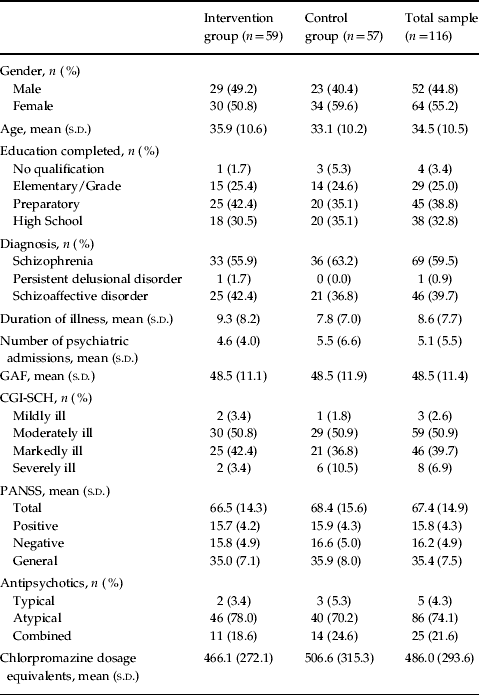
Patients were recruited from three wards of the psychiatric hospital of the Technical University of Munich, Germany, between February 2006 and March 2008. Follow-up assessments were finished in April 2009. In total, 242 patients with schizophrenia spectrum disorders (ICD-10: F20–F29) were screened during the 25-month recruitment period. Patients who met the following inclusion criteria were informed about the study and asked to participate: (1) age between 18 and 60 years; (2) absence of any serious somatic illness or mental retardation; (3) German as first language or a satisfactory command of the German language. Of the 122 patients (50.4%) who fulfilled the inclusion criteria and agreed to participate, six dropped out before the t1 assessments could be completed, due to withdrawal of informed consent or transfer to another hospital. Descriptive data on the remaining 116 study patients are reported in Table 1.
Sociodemographic and clinical characteristics of the study patients at t1

GAF, global assessment of functioning; CGI-SCH, Clinical Global Impression Scale – Schizophrenia Version; PANSS, Positive and Negative Syndrome Scale.
There were no significant differences between the intervention and the control group on the variables shown in Table 1 (χ2-tests for categorical variables: 0.34⩽p⩽0.65; t tests for continuous variables: 0.15⩽p⩽1.00). Between t1 and t3 assessments, another 19 patients dropped out (eight of the intervention group and 11 of the control group) because of withdrawal of informed consent (n=7), attendance at fewer than four psychoeducational sessions (n=5), early discharge (n=5) or sudden need for electroconvulsive treatment (n=1) or chemotherapy (n=1). Drop-out reasons were similar for both subgroups. From the remaining 97 subjects, one refused to fill in the knowledge questionnaire at t2; leaving 96 subjects for data analyses.
Computerized cognitive training
The intervention group attended a maximum of 10 daily training sessions of 60 min each over a 2-week period using the COGPACK software package (Marker, Reference Nelson2003). Each session consisted of a sequence of computerized exercises designed to improve five cognitive domains: attention; verbal and non-verbal memory; psychomotor speed; language processing; visuomotor skills. The training was supervised by a trained psychologist (A.G.), who explained the tasks to the patients and helped them to overcome difficulties. Task difficulty varied depending on the individual performance and was gradually increased. This part of the study will be reported in detail elsewhere.
Psychoeducational groups
Psychoeducation was performed in accordance with the APES manual (Bäuml et al. Reference Bäuml, Pitschel-Walz, Berger, Gunia, Heinz and Juckel2005). Interactive delivery of information and emotional relief are the basic elements of this psychoeducational concept (Bäuml et al. Reference Bäuml, Froböse, Kraemer, Rentrop and Pitschel-Walz2006). Eight 1-h group sessions were held, with two sessions per week. Information was given about symptoms, aetiology, acute treatment, relapse prevention and psychosocial treatment of schizophrenia. Adequate coping strategies were discussed and individual crisis plans were drawn up. Furthermore, patients had the opportunity to discuss current questions or day-to-day problems concerning the illness. In total, 14 psychoeducational groups were run for the study patients. Their relatives were invited to separate psychoeducational groups, which were designed similarly, according to the APES manual, in order to assist the family ‘in speaking the same language’ as the patient. In addition, separate but complementary crisis plans were worked out, both with the patients and their relatives.
Clinical measures
From the various measures applied within the COGPIP study (Fig. 1), only those relevant to this paper will be described.
Illness severity was rated with the Clinical Global Impression Scale – Schizophrenia Version (Haro et al. Reference Haro, Kamath, Ochoa, Novick, Rele, Fargas, Rodriguez, Rele, Orta, Kharbeng, Araya, Gervin, Alonso, Mavreas, Lavrentzou, Liontos, Gregor and Jones2003), ranging from 0 (normal, not ill) to 7 (among the most severely ill). Functional level was determined by the global assessment of functioning (GAF), with possible values between 1 and 100. Psychiatric symptoms were assessed with the Positive and Negative Syndrome Scale (PANSS; Kay et al. Reference Keefe, Bilder, Harvey, Davis, Palmer, Gold, Meltzer, Green, Miller, Canive, Adler, Manschreck, Swartz, Rosenheck, Perkins, Walker, Stroup, McEvoy and Lieberman1987), which contains 30 items rated on a 7-point severity scale. All interviews were carried out by a clinically experienced PANSS rater (T.F.), repeatedly trained and certified within several international multi-centre-studies on the pharmacological treatment of schizophrenia.
The Knowledge of Illness Questionnaire [‘Wissensfragebogen’ (WFB-52); Pitschel-Walz, Reference Pitschel-Walz, Bäuml, Bender, Engel, Wagner and Kissling1997] was originally created for the German Psychoses Information Project (PIP) study (Pitschel-Walz et al. Reference Pitschel-Walz, Leucht, Bäuml, Kissling and Engel2006; Bäuml et al. Reference Bäuml, Pitschel-Walz, Volz, Engel and Kissling2007). Its 107 questions (yes/no answers required) are related to those topics discussed in the psychoeducational groups, concerning symptoms, causes, treatment and warning signs. Examples are: ‘While suffering from schizophrenia, one might experience “reality” quite different from how other people do’; ‘For an effective treatment of schizophrenia, regular intake of antipsychotic medications is crucial’; ‘Nervousness is a frequent warning sign that indicates danger of illness relapse’. Having completed the COGPIP study we calculated an item analysis on the pooled PIP-II/COGPIP WFB data (n=187) and excluded questions with item difficulties >0.80 or item test correlations <0.20. With the resulting 52-item version of the knowledge questionnaire (Cronbach's α=0.94; test–retest reliability r tt=0.74; Kaiser–Meyer–Olkin=0.87) a maximum knowledge total score of 52 could be achieved.
Neuropsychological assessment
Subjects were assessed twice with a comprehensive neuropsychological test battery. The 11 psychometric tests took between 2.5 and 3.0 h to complete. Paper–pencil tests were the California Verbal Learning Test (German version; Niemann et al. Reference Nuechterlein, Barch, Gold, Goldberg, Green and Heaton2008), subtest Digit Span (forward and backward) from the Wechsler Memory Scale – Revised (German version; Härting et al. Reference Heaton, Miller, Taylor and Grant2000), Trail Making Tests A and B from the Halstead–Reitan Neuropsychological Test Battery (HRNTB; Heaton et al. Reference Heinrichs and Zakzanis2004), the modified Wisconsin Card Sorting Test (mWCST, Nelson, Reference Niemann, Sturm, Thöne-Otto and Willmes1976) and the Stroop-Paradigm as measured by the Colour Word Interference Test (‘Farbwort-Interferenztest’; Bäumler, Reference Bäumler1985). Computer-based tests were subtests Alertness and Divided Attention from the Test for Attentional Performance [‘Testbatterie zur Aufmerksamkeitsprüfung’ (TAP), version 1.7c; Zimmermann & Fimm, Reference Zimmermann and Fimm2002] and from the Vienna Test System (Schuhfried, Reference Shad, Tamminga, Cullum, Haas and Keshavan2005) the Perseveration Test (PERSEV, version 21.00) as well as the subtests Tapping, Steadiness and Placing Long Sticks of the Motor Performance Series (‘Motorische Leistungsserie’, version 24.00).
Raw scores were transformed into age, sex and/or education corrected standard scores according to the normative data published in the test manuals. Age-corrected normative data for the mWCST (Nelson, Reference Niemann, Sturm, Thöne-Otto and Willmes1976) was drawn from literature (de Zubicaray & Ashton, Reference de Zubicaray and Ashton1996; Lineweaver et al. Reference MacCabe, Aldouri, Fahy, Sham and Murray1999). For the trail-making test, norms were used, provided by Engel (Reference Engel2007), who combined data from 17 studies, and the latest HRNTB handbook (Heaton et al. Reference Heinrichs and Zakzanis2004) by meta-analytic techniques. In order to express all test variables in a common metric, T scores (mean=50, s.d.=10) were used as standard scores. Where T scores were not the primary outcome format of a test variable, percentiles (or some other scores) were transformed into T scores using the standard normal distribution.
A global neurocognitive performance index (GNPI) was calculated as the average T score from 40 out of 60 test variables. Variables that could not be classified into meaningful cognitive subdomains (see below) or showed reduced variance or insufficient item-scale correlations were excluded. Five domain-specific neurocognitive composite scores were calculated following Zakzanis et al. (Reference Zimmermann and Fimm1999; pp. 24–31), who defined seven neurocognitive domains within their comprehensive meta-analyses of neurocognitive deficits in various neuropsychiatric disorders. While our battery included no variables for two of their domains (verbal skill and performance skill), we had to sort some of our variables not mentioned by Zakzanis and co-workers into the remaining five domains, namely, the TAP variables (sorted into the attention/concentration composite score) and the second order redundancy score from the PERSEV (sorted into cognitive flexibility/abstraction). Internal consistencies (Cronbach's α) of the GNPI and the five composite scores (attention/concentration, memory acquisition, delayed recall, cognitive flexibility/abstraction, manual dexterity) ranged from 0.74 to 0.92. Test–retest reliabilities were 0.72⩽r tt⩽0.87.
Data analyses
A series of 2 (treatment groups)×2 (time points) repeated measurement analyses of variance indicated significant main effects of time on neurocognitive performance (improvement from t1 to t2 in the GNPI and in four of the five domain-specific composite scores), as well as on illness knowledge (improvement in WFB-52 total scores from t2 to t3), but not any significant main or interaction effects of patient subgroup (preceding cognitive training versus no training). While these somewhat disappointing results of the COGPIP study are relevant for another set of hypotheses, in the context of the present paper they justify our pooling of data from both patient subgroups in order to test H1 and H2 within the total sample by calculating blockwise and stepwise multiple linear regression analyses. According to our hypotheses, the criterion variable was ‘knowledge outcome’ (WFB-52 total scores at t3) and the pre-selected predictor variables were neurocognition (GNPI or, for more fine-grained analyses, domain-specific composite scores at t2) and psychopathology (PANSS total scores at t2). We also included ‘baseline knowledge’ (WFB-52 scores at t2) as a predictor variable, since illness knowledge was highly correlated between t2 and t3 (which means good test–retest reliability of the WFB-52 questionnaire: r tt=0.81). Stepwise (forward/backward) analysis was used for the determination of the predictive power of the domain-specific neurocognitive composite scores, as this approach is more appropriate for inter-correlated predictors to avoid misinterpretation due to multi-collinearity (Streiner, Reference Tarrier, Barrowclough, Porceddu and Fitzpatrick1994). Both regression analyses were then repeated using reliable change indices (RCI; Jacobson & Truax, Reference Joyce and Roiser1992) as a measure of ‘knowledge gain’ (intra-individual change in WFB-52 total score from t2 to t3) as criterion variables. RCI were also used to define a subsample of patients with significant knowledge gain (one-directional RCI⩾1.645; Hafkenscheid, Reference Hafkenscheid2000), whose clinical and neuropsychological characteristics were compared with patients without such gain. For all regression analyses, α levels for variable inclusion or exclusion were set at <0.05 and ⩾0.10, respectively. For all other tests, the level of statistical significance was α⩽0.05 (two-tailed). SPSS versions 15.0.1 and 18.0.1 for Windows were used (SPSS Inc., USA).
Results
Within the total sample, the global level of psychopathology as measured by the PANSS total score diminished from mean=67.8 (s.d.=14.0, range 38–101) at t1 to mean=51.1 (s.d.=13.9, range 31–88) at t3, demonstrating a clear symptomatic improvement [t=13.95, degrees of freedom (df)=95, p<0.001]. Mean illness knowledge (WFB-52 total score) increased from 36.7 (s.d.=11.4, range 8–51) at t2 to 40.1 (s.d.=11.4, range 6–52) at t3. Although the corresponding mean difference of 3.5 (s.d.=6.9) was clearly significant (paired t test: t=4.92, df=95, p<0.001), this is only a small to medium effect (Cohen's d=0.31).
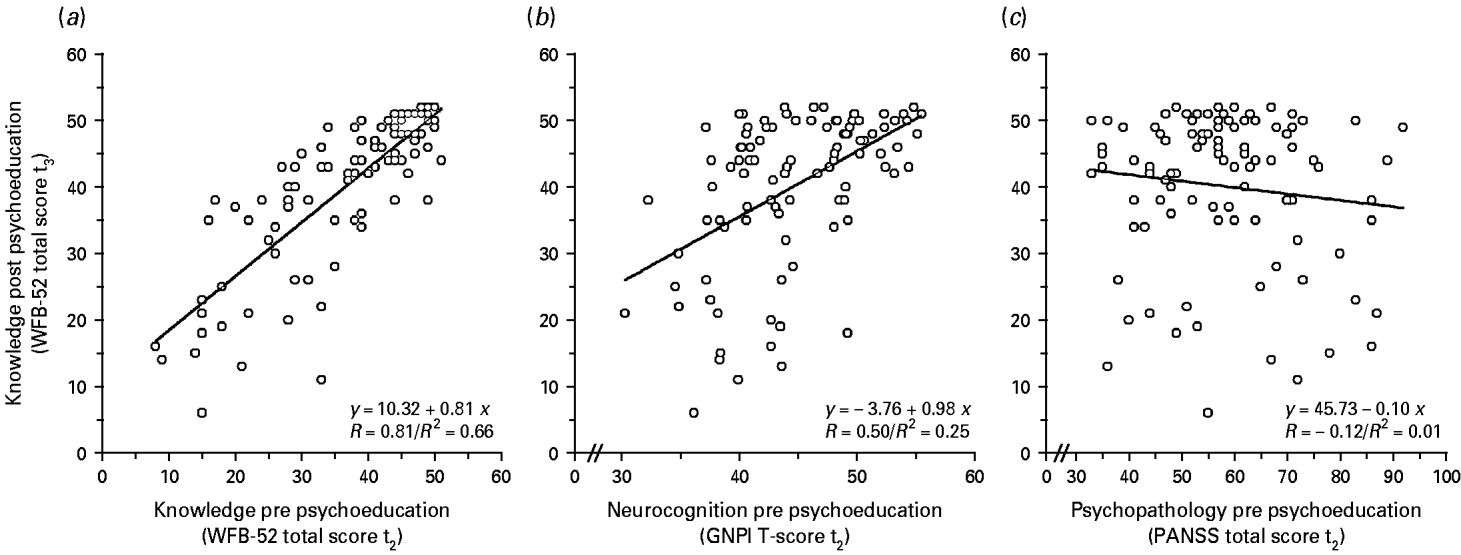
Figure 2 shows the bivariate zero-order correlations of illness knowledge after psychoeducation with illness knowledge, neurocognition and psychopathology before psychoeducation. There was a strong relationship between illness knowledge at both measurement points (Fig. 2 a), a medium correlation between knowledge and global neurocognitive performance (Fig. 2 b) and a very small, close to zero correlation between knowledge and level of psychopathology (Fig. 2 c).
Bivariate scatter plots with zero-order correlations and linear fits between illness knowledge after psychoeducation at t3 (y-axes) as the criterion variable and three potential predictor variables before psychoeducation at t2 (x-axes): baseline illness knowledge (a), neurocognition (b) and psychopathology (c). Note the x-axis breaks in plots (b) and (c). WFB-52 (The Knowledge of Illness Questionnaire; ‘Wissensfragebogen’); GNPI, global neurocognitive performance index; PANSS, Positive and Negative Syndrome Scale.

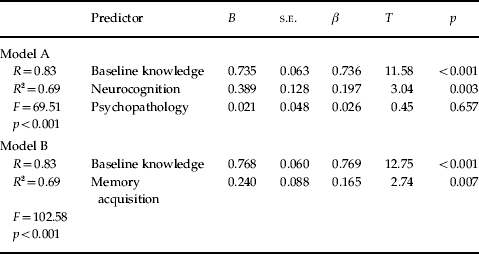
Results of the blockwise and stepwise multiple linear regression analyses for knowledge outcome at t3 are shown in Table 2.
Results of a blockwise (model A) and stepwise (model B) multiple linear regression analysis with illness knowledge (WFB-52) after psychoeducation (t3) as the criterion variable (n=96)

WFB-52, The Knowledge of Illness Questionnaire (‘Wissensfragebogen’).
Corrected R 2: 0.68 (model A); 0.68 (model B).
In model A, predictor variables were baseline illness knowledge (WFB-52), neurocognition (Global Neurocognitive Performance Index) and psychopathology (Positive and Negative Syndrome Scale total score). In model B, predictor variables were baseline illness knowledge and five domain-specific neurocognitive composite scores. All predictor variables were measured before psychoeducation (t2).
The multiple correlation from the blockwise regression analysis (model A) was substantial, indicating that 69% of the variance in the criterion variable could be explained. While baseline knowledge and neurocognitive performance (GNPI) were both significant predictors, the global level of psychopathology (PANSS total score) had no predictive value. The multiple correlation from the stepwise regression analysis (model B) was equally high. From the five domain-specific neurocognitive composite scores, only memory acquisition was selected as a significant predictor variable together with baseline knowledge.
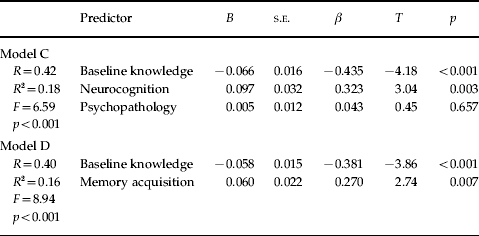
Mean knowledge gain (RCI) from pre- to post-psychoeducation was 0.87 (s.d.=1.73, range −5.49 to 5.24). Blockwise and stepwise regression analyses with RCI as the dependent variable revealed the results given in Table 3.
Results of a blockwise (model C) and stepwise (model D) multiple linear regression analysis with reliable change indices of illness knowledge (WFB-52) change from pre- (t2) to post- (t3) psychoeducation as the criterion variable (n=96)

WFB-52, The Knowledge of Illness Questionnaire (‘Wissensfragebogen’).
Corrected R 2: 0.15 (model C); 0.14 (model D).
In model C, predictor variables were baseline illness knowledge (WFB-52), neurocognition (Global Neurocognitive Performance Index), and psychopathology (Positive and Negative Syndrome Scale total score). In model D, predictor variables were baseline illness knowledge and five domain specific neurocognitive composite scores. All predictor variables were measured before psychoeducation (t2).
In spite of much lower multiple correlations, R 2 was significant in both models (C and D), which replicated findings from Table 2. Apart from baseline knowledge, neurocognition, not psychopathology, was a significant predictor of knowledge gain and among the five domain-specific neurocognitive composite scores only memory acquisition was selected.
According to the RCI⩾1.645 criterion, 28 patients (29.2%) significantly improved their illness knowledge from t2 to t3, while 68 patients (70.8%) remained more or less stable (n=60) or even deteriorated (n=8). Comparing both patient subgroups, no significant differences were found with regard to age, duration of illness, number of hospitalizations, GAF at t1, PANSS summary or subscale scores at t2 or t3, level of intelligence (SPM; Schuhfried, Reference Shad, Tamminga, Cullum, Haas and Keshavan2005) at t3 and neurocognitive global and domain-specific composite scores at t1 or t2, except that patients with significant individual knowledge gain had somewhat better memory acquisition at t1 (mean T scores=45.0, s.d.=8.0) as compared with patients without such gain (mean=41.7, s.d.=7.5, t=1.96, df=94, p=0.053).
Discussion
In recent years, psychoeducation has become an integral part of the non-pharmacological treatment of schizophrenia and related psychoses (Rummel-Kluge et al. Reference Schuhfried2006; Getachew et al. Reference Getachew, Dimic and Priebe2009), yet little is known about factors that might influence the outcome of psychoeducational interventions.
Findings reported here confirmed H1, that in a heterogeneous sample of patients with schizophrenic disorders the neurocognitive performance before psychoeducation predicts illness knowledge after psychoeducation. In fact, in addition to baseline knowledge, neurocognition was the only significant predictor, while the level of psychopathology was insignificant. H2, speculating that the most relevant neurocognitive domains for such a prediction would be attention and verbal memory, was only partially confirmed. Within a stepwise regression approach with baseline illness knowledge and five domain-specific neurocognitive composite scores as independent variables, only memory acquisition was selected as an additional predictor apart from baseline knowledge. This appears reasonable as, beyond the knowledge already acquired by a patient, his or her ability to encode new information should determine the final level of knowledge.
Findings were similar for knowledge gain, using RCI (Jacobson & Truax, Reference Joyce and Roiser1992) as a measure of individual change in illness knowledge from pre- to post psychoeducation, yet the amount of variance explained was far smaller in these analyses, probably due to the ceiling effect in the knowledge questionnaire (Fig. 2 a). Baseline knowledge had a negative effect on knowledge gain, meaning that the higher the baseline knowledge, the smaller the gain.
Thus, it may be concluded that among various neuropsychological performance measures, memory acquisition significantly predicts knowledge outcome after psychoeducation as well as knowledge gain during psychoeducation, even if baseline illness knowledge (the most important predictor) is taken into account. It should be mentioned that among the other neurocognitive composite scores, flexibility/abstraction and attention/concentration had even higher zero order correlations than memory acquisition with knowledge outcome. But since they were also closer correlated to baseline knowledge, they were outperformed by memory acquisition in the stepwise regression analyses due to redundancy effects.
We would like to discuss these findings in relation to other studies on the role of neurocognition for psychoeducation, but we are not aware of any such study. Therefore, our results must be treated with caution and as preliminary for as long as they have not been replicated.
Since the mean pre–post difference of illness knowledge was – although highly significant – rather small in our study sample (Cohen's d=0.31), one could ask whether being able to answer three or four more questions of the illness questionnaire correctly after the intervention could be meaningful for a single patient. As was shown by means of the RCI analyses, nearly one-third of our patients showed an increase in illness knowledge greater than random change and this alone might be worth the effort. In fact, the amount of knowledge gain was quite considerable in some cases (up to a maximum of +21 WFB-52 points), but these cases were counterbalanced by others who showed a substantial drop (up to −22 points). While we do not know which amount of increase in illness knowledge might be clinically significant in any single patient (i.e. making a difference in the short- or even long-term outcome of the illness itself), the within-group variance of the knowledge scale was large enough to search for possible predictors of knowledge outcome after psychoeducation, which was our focus here.
With regard to sample size, the COGPIP study is not underpowered, but it could be questioned whether the study design was ideal in order to identify neurocognitive predictors of illness knowledge following psychoeducation, as a preceding neurocognitive training aimed at increasing neurocognition before psychoeducation. The inclusion of a preceding neurocognitive training was motivated by our hope that trained patients with increased neurocognitive performance might profit more from psychoeducation than untrained patients. Obviously, this was not the case. One could speculate that the training period was too short. Yet, there is evidence that the nature of a neurocognitive training intervention is much more important than its length, with interventions that aim at compensation rather than restitution (such as COGPACK) yielding higher effects (Krabbendam & Aleman, Reference Leucht, Kane, Kissling, Hamann, Etschel and Engel2003; McGurk et al. Reference Marker2007). Without differential effects of COGPACK training, pooling of the data from trained and untrained patients seemed adequate for the purposes of this report. To be sure about that point, we tried subgroup membership as an additional predictor variable within the regression analyses, which led to nearly identical results with those described above.
In therapy studies, outcome measures are of great importance. As our measure of illness knowledge might have lost discriminative power since it was introduced in the early 1990s and successfully used in several studies (see references cited in Pitschel-Walz et al. Reference Pitschel-Walz, Leucht, Bäuml, Kissling and Engel2006; Bäuml et al. Reference Bäuml, Pitschel-Walz, Volz, Engel and Kissling2007), we modified the original WFB to a shortened version with enhanced psychometric properties (see Method). Nevertheless, a ceiling effect remained obvious in the WFB-52 total scores (Fig. 2). We are currently occupied with further modifications to the WFB-52 in order to solve this problem.
In recent years, considerable efforts have been made to identify the factorial structure of neurocognitive deficits in schizophrenia by employing comprehensive neuropsychological test batteries to large patient samples (Gladsjo et al. Reference Gladsjo, McAdams, Palmer, Moore, Jeste and Heaton2004; Nuechterlein et al. Reference Nuechterlein, Green, Kern, Baade, Barch, Cohen, Essock, Fenton, Frese, Gold, Goldberg, Heaton, Keefe, Kraemer, Mesholam-Gately, Seidman, Stover, Weinberger, Young, Zalcman and Marder2004; Dickinson et al. Reference Dickinson, Ragland, Calkins, Gold and Gur2006; Keefe et al. Reference Kern, Nuechterlein, Green, Baade, Fenton, Gold, Keefe, Mesholam-Gately, Mintz, Seidman, Stover and Marder2006; Genderson et al. Reference Genderson, Dickinson, Diaz-Asper, Egan, Weinberger and Goldberg2007). The question remains as to which tests should be used for which research purposes. We have not been able to simply adopt recently recommended test batteries, for instance, those of the CATIE and MATRICS initiatives (Keefe et al. Reference Kern, Nuechterlein, Green, Baade, Fenton, Gold, Keefe, Mesholam-Gately, Mintz, Seidman, Stover and Marder2006; Kern et al. Reference Krabbendam and Aleman2008; Nuechterlein et al. Reference Pekkala and Merinder2008), since several of their components are not yet adapted to German conditions. Furthermore, the CATIE and the MATRICS batteries differ in that they have been optimized for several purposes (pharmacological treatment versus neurocognitive rehabilitation research, respectively) and it is likely that an optimal battery for psychoeducation research may differ from each of them. Our calculation of composite scores according to the classification of neuropsychological test variables, as suggested by Zakzanis et al. (Reference Zimmermann and Fimm1999), is based on empirical evidence as well as on neuropsychological expertise. Factor analysing our own data (unpublished) underpinned this approach as suitable for our purposes.
A clinician who wants his or her patient to attend a psychoeducational treatment group will very likely focus on the patient's current psychopathological status in order to decide if and when the patient is ready for such an intervention and able to profit from it. Results of our study demonstrate that the patient's neurocognitive status, as measured by standardized neuropsychological tests, might be a more important predictor of psychoeducation outcome than is psychopathology, at least with regard to illness knowledge, which has been our focus here. Of course, a patient with extreme psychomotor excitement or strong preoccupation caused by hearing voices will probably be unable to attend a psychoeducational treatment group, let alone take advantage of it. But, except for such conditions, it is our clinical experience that even patients with acute symptoms can successfully participate in such groups. Even after the psychoeducational programme, 25% of our patient sample could be qualified as still moderate to markedly ill (PANSS total scores ⩾62; Leucht et al. Reference Lincoln, Wilhelm and Nestoriuc2005), due to persisting positive and negative symptoms. Thus, dispersion of PANSS total scores would have been sufficient to uncover a substantial correlation with knowledge outcome or gain, if such a correlation had existed.
In conclusion, we found evidence that neurocognition (particularly memory acquisition) is a significant predictor of illness knowledge after psychoeducation, while the level of psychopathology is not. This finding, if replicable, might be somewhat counterintuitive, but it would have important clinical implications. If neurocognitive deficits limit the benefit of psychoeducation, it would be reasonable to shape existing treatment programmes for neurocognitively more impaired patients in order to be able to target their needs better and enable them to profit from such an intervention as much as possible. The critical role of deficits in memory acquisition, which might be an indicator of the patient's general learning capacity, points to the necessity to start the psychoeducation programme not too early, to provide not too much information at once and to present all facts as clearly as possible, to use graphical presentations of the learning material in addition to spoken words and to repeat all material as often as possible.
If, for a given treatment programme, distinct versions are developed for the neurocognitively more intact vs. more handicapped patients, neuropsychological data could then serve as a tool for the assignment of certain patients to specific treatments.
Acknowledgements
The COGPIP study (ClinicalTrials.gov identifier: NCT00646256) was supported by the German Research Foundation (Deutsche Forschungsgemeinschaft: DFG Ja 680/4–2, 4–3). We are grateful to all participants, patients as well as relatives, and to Zasu Keller, Tanja Sonnfeld, and Andreas Ulitsch for their temporary assistance in the data collection and preparation.
Declaration of Interest
None.