Introduction
Ongoing improvement of undergraduate medical education is required in order to keep pace with the changing demands of twenty-first century medical practice. Medical education should have equal priority with medical research and clinical patient care. However, despite the great advances in medical care over the last century, medical teaching methods have changed little.Reference Nandi, Chan, Chan, Chan and Chan1 In this context, the adoption of problem-based learning in medical education is potentially valuable.
Problem-based learning is a student-centred, independent, self-directed learning style guided by a facilitator. Since its introduction in 1969 at McMaster University, Hamilton, Ontario, Canada, increasing enthusiasm has been expressed for incorporating problem-based learning within undergraduate medical education.Reference Kaufman, Mennis, Waterman, Duban, Hansbarger and Silverblatt2 The benefits of the approach include self-motivated acquisition of knowledge and better communication skills, team-work, problem-solving and information sharing.Reference Wood3 Within the basic and clinical sciences, the focus of life-long learning must shift from fact memorisation to problem-solving, through the introduction of methods focussing on self-directed learning and independent study.Reference Al-Gindan, Al-Sulaiman and Al-Faraidy4 Studies comparing problem-based learning with conventional educational methods have reported an increase in students' intellectual satisfaction, an improvement in their clinical performance, and knowledge accumulation equal to that for traditional methods.Reference Maudsley5
Problem-based learning takes place in small groups usually comprising six to eight students plus a facilitator. The process begins with the discussion of an individual case which includes important curriculum topics. Group analysis of this case identifies gaps in the students' knowledge, stimulating them to independently research their learning objectives. After a period of self-directed learning, the students meet to share and discuss their new knowledge, supervised by the facilitator.Reference Thurley and Dennick6 When engaged in problem-based learning, the students follow the seven-step process developed in Maastricht, the Netherlands.Reference Thurley and Dennick6 These steps are: (1) problem clarification; (2) problem definition; (3) problem analysis; (4) sifting and sorting information; (5) identification of learning objectives; (6) self-directed learning; and (7) reconvening as a group for further discussion.
Modern, applied problem-based learning has four key principles: constructivism, self-directed learning, collaboration and contextual learning.Reference Thurley and Dennick6
Constructivism refers to activating and building knowledge on the basis of prior learning. Its three key components are: (1) activation of prior knowledge; (2) encoding specificity (i.e. new knowledge will be retained if what is learned resembles what is applied); and (3) elaboration (i.e. discussion of a topic and questioning, facilitating comprehension and easy recall of information).
Collaboration involves cooperation of individuals to work as a team, facilitating the development of effective problem-solving skills. Learning in context may aid information retention and recall, because information learned at a similar time as desired facts is easier to recall at a later date.
Problem-based learning has both advantages and disadvantages.
Students undertaking problem-based learning use self-selected reading material to obtain information, including journals and on-line databases; as a result, they show greater confidence in information-seeking and have a more in-depth approach to learning.Reference Nandi, Chan, Chan, Chan and Chan1 They also show improved interpersonal skills and psychosocial knowledge and have a better attitude toward patients. Problem-based learning increases students' motivation and enjoyment in learning.Reference Nandi, Chan, Chan, Chan and Chan1
The disadvantages of problem-based learning are its increased financial cost, increased demand for library and computer resources, and the limited number of medical students who can be trained. In addition, students taught using problem-based learning place more emphasis on meaning than on memorisation, and score lower in basic science examinations, indicating a gap in cognitive knowledge which may potentially affect clinical outcomes.Reference Corrigan, Reardon, Shields and Redmond7 Therefore, a combination of problem-based learning and conventional teaching methods may provide the most effective training for undergraduate medical students.Reference Nandi, Chan, Chan, Chan and Chan1
Teaching ENT to undergraduate medical students is essential, as ENT problems account for up to one-quarter of primary care consultations and half of paediatric consultations.Reference Doshi and Carrie8–Reference Donnelly, Quraishi and McShane10 Over 50 per cent of medical school graduates who stay in medicine will become general practitioners.Reference Mace and Narula11 In the UK, ENT is the fourth largest surgical specialty.Reference Mace and Narula11 Although there are no published statistics on the popularity of ENT as a specialty amongst Egyptian and Saudi Arabian medical graduates, we believe that considerably more of these graduates specialise in ENT compared with other surgical specialities. Undergraduates in medical schools which use problem-based learning show greater interest in ENT as their future medical specialty, compared with conventionally taught medical students.Reference Matsui, Ishihara, Suganuma, Sato, Tang and Furiko12 However, some authors have declared problem-based learning to be insufficient in undergraduate clinical courses of a short duration, such as otolaryngology.Reference Dunne, Zapf, Hamer, Folz, Kauser and Fischer13, Reference McParland, Noble and Livingston14
Otolaryngology course teaching at Al-Ahsa College of Medicine
In response to medical education changes elsewhere, we introduced problem-based learning within the ENT course for fifth-year medical students at Al-Ahsa College of Medicine, King Faisal University, Saudi Arabia. Here, undergraduate ENT teaching was a three credit-hour course. Fifth-year medical students comprised 60 individuals divided into two semester groups, with each semester group divided into six subgroups of five or six students each. The ENT course was run over three weeks, for three hours per day, five days per week, and required two facilitators. Table I shows the clinical rounds schedule.
Clinical rounds schedule

OPD = out-patient department
In addition, traditional ENT teaching was also given, in the form of 16 didactic, theoretical lectures each semester (one hour per week), and further applied in a three-hour audiology teaching session, a three-hour ENT radiology teaching session, and instruction in ENT history and examination at the beginning of clinical rounds.
Problem-based learning completed the remaining clinical sessions. Six days were allocated for case scenarios and discussions, one day for work in the simulation laboratory, and one day for student presentations (each day comprised a three-hour clinical session).
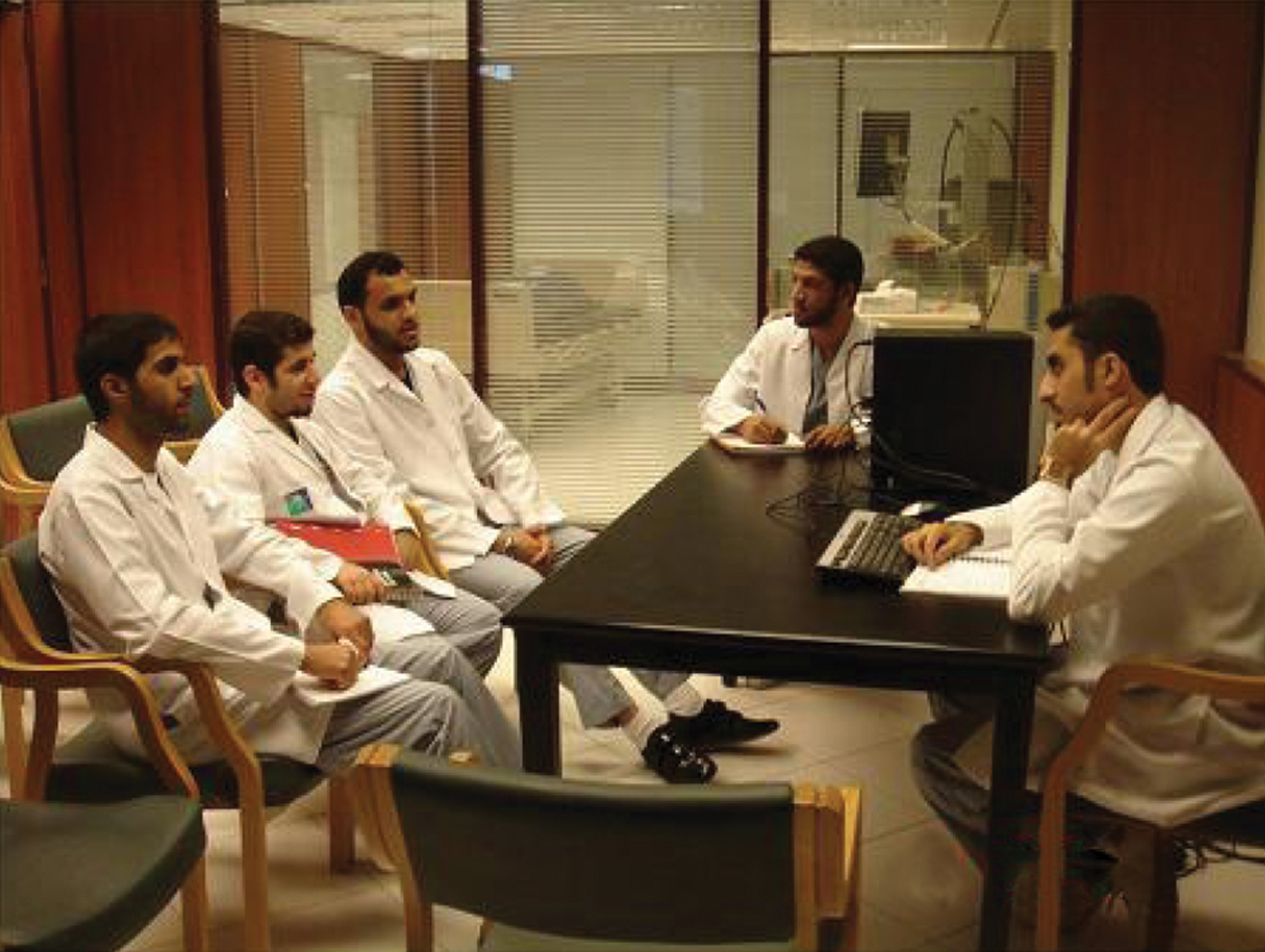
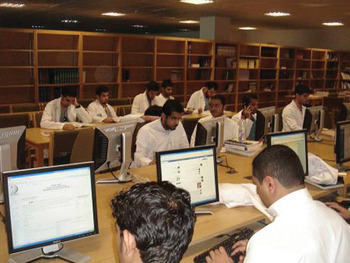
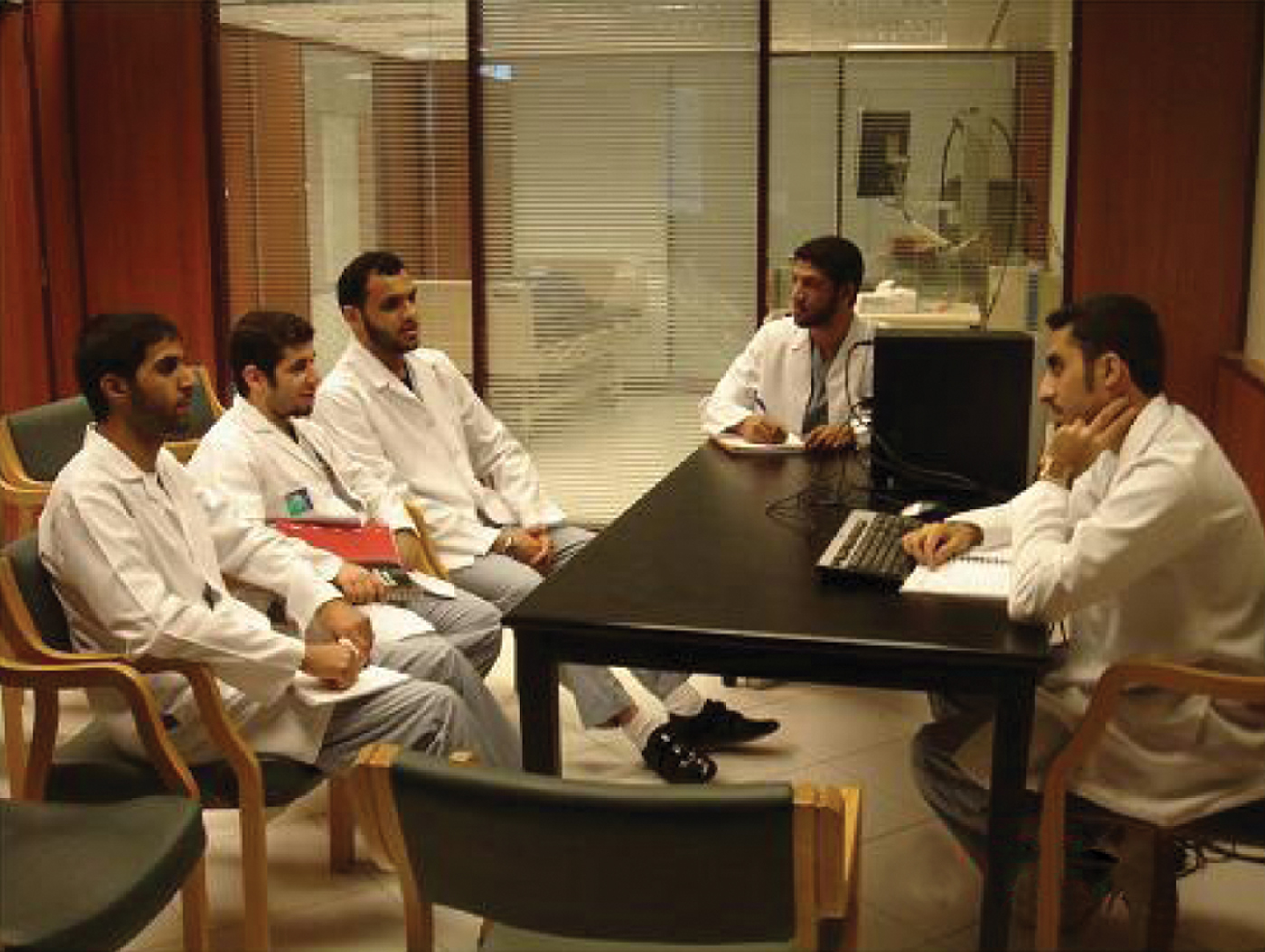
During case discussions, one student in each subgroup acted as chair and another as scribe to record the discussion (Figure 1); these roles rotated for each case. Students were allotted one hour to analyse case data, with teaching staff acting as facilitators rather than information sources. Three cases were discussed in each session. The otology session included three cases covering hearing loss, vertigo, aural pain and discharge. The rhinology session covered epistaxis, nasal obstruction and smell disorders. The laryngology cases covered sore throat, dysphagia, stridor and hoarseness. After the clinical session, students reviewed relevant data in the library (Figure 2) and on the Internet. In the following clinical session, they assessed their newly acquired knowledge and presented to the group their final conclusions, based on this knowledge; the whole group then discussed the points raised. After a final decision on the best diagnosis for each case scenario, each student then took a history from an in-patient in the Al-Jabr hospital ENT department, which they subsequently presented at the beginning of the outpatient clinic at the University Health Centre. Over three days in the out-patient clinic, students listened to clinical histories taken by the facilitators (for new out-patients), elicited relevant clinical signs, observed patient management and discussed each case. All proceedings were documented in student logbooks, which were collected at the end of the clinical rounds for assessment.
Case scenario discussion. One student acts as chair and another as scribe.
Students collecting information in the library.

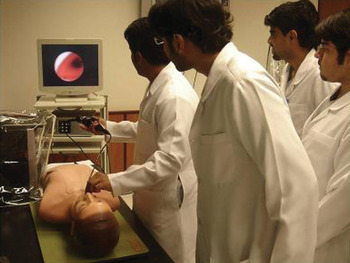
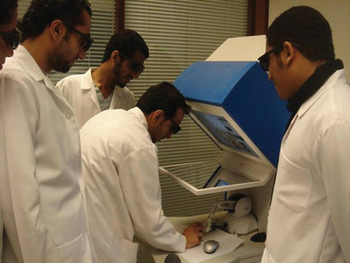
Students also spent a day in the simulation laboratory, during which ENT anatomy and clinical examination skills were reinforced and common ENT surgical procedures introduced. Students were taught ENT anatomy using physical models, and received further instruction on ENT examination and ear diseases via video recordings. The principles of common ENT endoscopic surgical procedures were taught using a computerised mannequin (Figure 3). A haptic temporal bone surgery simulator was used to demonstrate mastoidectomy and functional endoscopic sinus surgery (Figure 4), while a different mannequin was used for cricothyroidotomy and tracheotomy training.Reference Abou-Elhamd, Al-Sultan and Rashad15
Students using the bronchoscopy computerised mannequin.

Students using a haptic temporal bone surgery simulator.

There was also a student presentation day. On the first day of the rotation, every student was allocated a topic (usually drawn from common ENT diseases or surgical procedures) to be reviewed and then presented on the penultimate day of that rotation.
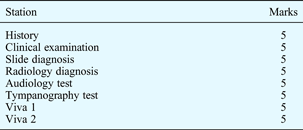
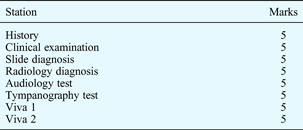
On the last day of the rotation, the final clinical rounds examination constituted 40 per cent of each student's total marks. Table II shows the distribution of marks across the various clinical examination stations.
Final clinical rounds examination stations and possible marks
• Undergraduate medical education requires ongoing improvement in order to keep pace with the changing demands of twenty-first century medical practice
• Problem-based learning is increasingly being adopted by medical schools worldwide
• This paper reviews the application of problem-based learning, combined with more traditional teaching methods, to undergraduate ENT training
In addition, students also underwent continuous assessment reflecting their attendance record and their attitude and level of active participation during sessions; this, together with their logbook and topic presentation, constituted 20 per cent of their overall mark.
The remaining 40 per cent of marks were allocated based on a final written examination for the semester (comprising 60 multiple choice questions plus scenario cases).
Conclusion
Problem-based learning is guided by a facilitator but is student-centred, independent and self-directed. It increases students' intellectual satisfaction and improves their clinical performance. At Al-Ahsa College of Medicine, King Faisal University, Saudi Arabia, we have applied a combination of problem-based learning and conventional teaching methods. From our teaching experience, we believe that this approach has resulted in a substantial increase in our students' ENT knowledge. Furthermore, students' feedback on this approach has been encouraging.