

On May 15, 1930, in the small border town of Naco, Sonora, census enumerator Miguel Robles started to count. When he finished walking his assigned portions of Calle Hidalgo, Avenida Independencia, and Calle Morelos, he had enumerated 143 individuals, each of whom answered the single question regarding religious identity the same way: Catholic. A block over, a carpenter named Ignacio Ledgard left his tools for the day to canvas his own neighborhood, counting 252 individuals, including his own family. They also all identified as Catholic, except for two Chinese men with no religion.Footnote 1
Across the Mexican republic, the aggregate statistical data from the 1930 population census painted the same picture. Of more than 16.5 million individuals counted, 97.7% identified as Catholic.Footnote 2 The strong anticlerical provisions of the 1917 Constitution and the federal government's vigorous, violent enforcement campaigns—particularly against the Cristero Rebellion in the late 1920s and de-Christianization efforts in the 1930s—constructed the postrevolutionary Mexican state as highly secular and antagonistic to religion, especially Catholicism. Nonetheless, at the granular, quotidian level, individuals and families overwhelmingly claimed to be Catholic. In the professed identity of its population, Mexico was a Catholic country.
The two Chinese men with no religion stood out in enumerator Robles's tally. So did 22 individuals without religion in another census taker's count of 239 individuals in a neighborhood nearer to Naco's international border with the United States; of the 22, 18 had emigrated from China.Footnote 3 In contrast to the Mexican population as a whole, Chinese persons in northern Mexico, whether immigrants or native-born, did not identify as Catholic in numbers even approaching 97.7%. The Chinese population was religiously different, much more religiously diverse.
In a burgeoning historiography, scholars have plumbed a wealth of primary data—newspapers, books, music, diplomatic archives, censuses, court cases, private letters, personal interviews—to explicate the prejudice Chinese people in Mexico experienced and resisted in the early twentieth century. For example, Gerardo Rénique has argued that anti-Chinese prejudice provided “a safe outlet for the otherwise denied or muted racialism inscribed in the official indigenista racial orthodoxy” of postrevolutionary Mexican nationalism.Footnote 4 Julia Maria Schiavone Camacho identified Catholicism as a source of significant comfort and identity for Chinese Mexican families in transpacific migration.Footnote 5 Jason Oliver Chang connected constructions of the state and religion when, in 1926, officials in Colima saw in Chinese-Mexican miscegenation “a compelling secular rationale for claiming the government's exclusive authority to regulate marriage” as “[a]nticlerical and antimiscegenation discourse became intertwined with the fear of the sacramental union of degenerates.”Footnote 6 Fredy González's work on Chinese communities in Mexico after 1931, the height of anti-Chinese discrimination, pays sustained attention to religion—Catholicism and devotion to the Virgin of Guadalupe specifically—in the lives of Chinese Mexicans in the mid twentieth century.Footnote 7 Their careful research and explication deepen our understanding of the complex factors that interacted to construct postrevolutionary Mexico: race, nationalism, economic competition, class, geography, gender, and religion, among others.
With the extant historiography as foundation, I argue that religious prejudice intertwined with racism and economic nationalism to justify violence and discrimination, culminating in the state-sponsored expulsion of Chinese people and their families from Sonora in 1931 and 1932.Footnote 8 The Chinese population's religious difference, including those who professed no religion, compounded and magnified racial discrimination against it, even as that same racial discrimination obviated essential contributions Chinese people made to the vitality of the Mexican nation. First, with religion as the analytic lens, I explicate the 1930 census as an act of governance. While the US-mediated end to the Cristero War in 1929 formally concluded the most brutal enforcement of the anticlerical Mexican state, intermittent violence continued until 1941. Moreover, the federal government engaged in vigorous de-Christianization campaigns into the late 1930s.Footnote 9
Nonetheless, even the formally anticlerical Mexican state and the violence it employed to that end conceded a question on the population census to the religious identity of its population. Not surprisingly, the official census struggled conceptually with a definition of religion and, practically, with a multiplicity of Chinese faith-traditions and lived experience. Chinese people did not tally cleanly. Nonetheless, through the religious identity question and its limited statistical analysis, a state-sponsored conception of religion—and of Mexico as a Catholic country—emerged from the census. Meanwhile, the aggregate census data created a demographic picture of the Chinese population in Sonora in 1930 as both more Catholic and less religious than others imagined it to be. In its religious demography, the Chinese population looked much more like the rationalist non-believers of Mexico's educated elite than like the rest of the Mexican population.
Second, the religious diversity of the Chinese population provides context for the pernicious discrimination Chinese people faced in northern Mexico in the 1920s and 1930s. Whatever their actual religious identity, and however they practiced their beliefs, popular perception differed. Newspapers and books presented Chinese as religiously Other—Confucian, Buddhist, non-religious, non-Catholic—an otherness that fueled prejudice against them, even in the officially anticlerical Mexican state. Religious and racial prejudice reflected and reinforced each other in virulent fashion.
Counting by Religion
Antonio Peñafiel, in 1883 the first director of Mexico's new federal agency, the General Directorate of Statistics, saw in statistics and their creation of a national demography the basis for Mexico's independence.Footnote 10 Statistics broke Mexico free from its colonial past, moving it into the realm of civilized nations.Footnote 11 In his understanding of the inherent power of categorizing and gathering data, Peñafiel presaged Michel Foucault's theoretical analysis of governmentality and the emergence of the administrative state.Footnote 12 In Peñafiel's view, moreover, statistics went beyond “the simple and arithmetic collection of moral, intellectual, and physical data” to produce “the deductions and consequences applicable in public administration.”Footnote 13 As a concrete matter, Mexico's first national population census in 1895 served as such an explicit act of governance that Porfirio Diaz, the president of the Republic, personally enumerated his own section, setting a “noble and elevated example by fulfilling this humble labor.”Footnote 14 Statistics enacted governance.
In that project of governance, the Mexican federal government chose to include religion as a category by which to count its population in the 1930 census. By doing so, the government recognized the practical phenomenology of religion, even as the revolutionary nation's foundational document, the still-new 1917 Constitution, imagined a secular, anticlerical state. While Article 24 of the 1917 Constitution proclaimed freedom of individual religious belief in Mexico, other articles severely limited religious organizations and personnel. Article 3 required education, whether public or private, to be entirely secular and excluded religious organizations completely from establishing primary schools. Article 5 disallowed, among others contracts, irrevocable commitments to the priesthood or offices in religious orders that would impair or limit a person's freedom. Article 27 forbade churches and other religious organizations from owning, possessing, or administering real estate. The lengthy Article 130, among others, separated church and state but denied legal status to religious entities, allowed state and local authorities to control the number of religious ministers present in their jurisdictions, forbade ministers from participating in political activities, and required ministers to be Mexican by birth.Footnote 15
The anticlerical provisions of the 1917 Constitution remained largely aspirational, concrete in constitutional word but not implemented in statute or government action, until Plutarco Elías Calles assumed Mexico's presidency in 1924. Calles facilitated the enactment of an implementing statute in June 1926, and then closed churches, monasteries, and schools; confiscated property; and expelled foreign Catholic priests.Footnote 16 The resulting three-year long violent conflict between Catholics and the government, known as the Cristero Rebellion, left tens of thousands dead and more exiled in the United States, particularly in and from Mexico's west-central states.Footnote 17 Even after the US-influenced end to the Cristero Rebellion, the Mexican government engaged in pointed de-Christanization campaigns.Footnote 18
Historians have debated whether postrevolutionary Mexico was anti-religious as well as anticlerical. Adrian Bantjes claimed that, between 1914 and 1938, a significant majority of anarchists and radical Constitutionalists went well beyond anticlericalism to attack religion itself.Footnote 19 In response, Roberto Blancarte complicated the absoluteness of the anti-religion claim by noting that Mexico received significant Jewish immigration during the height of anticlerical persecution (1925–35): “Hence the Mexican state cannot be accused of being systematically anti-religious in a time in which it was receiving a large migration caused by the existence of religious persecution in other parts of the world…. [T]here was not a systematic attempt to drive God out of Mexico.”Footnote 20 Like the admission of religiously persecuted refugees, the religious identity question in the 1930 census complicates the idea of an anti-religious Mexican state. The inclusion of the question admitted God's continued place in Mexico, even as the census itself worked to govern and constrain individual religiosity.
Mexico has always asked its population about their religious identity in its national censuses, although the preliminary studies before the first census in 1895 reveal an ambivalence regarding its inclusion.Footnote 21 Some of the foreign censuses that Antonio Peñafiel suggested as practical examples for Mexico's first national population count included a question about religious identity, among them those of Germany, Spain, Belgium, and Guatemala. Others did not: England, Denmark, Bavaria, the United States, Nicaragua, and El Salvador. In fact, Peñafiel and his colleague Francisco Ramírez y Rojas recommended that for Mexico's first census, the questionnaire (boleta) ask for name, sex, age, occupation, civil status, place of birth, language spoken, relationship with the head of household, literacy, residency, and physical or intellectual disabilities, emphasizing that the boleta should be limited to these only.Footnote 22 In the end, however, religious identity and nationality were added, although the motivating reasons remain unclear.Footnote 23 In its quest for the modernity that statistical governance would provide, Mexico may have decided to follow the best-practices guide from the International Congress of Statisticians.Footnote 24 At its meeting in St. Petersburg in 1872, the International Congress recommended including a question on individual religious identity in state-sponsored censuses, a recommendation which Peñafiel referenced in his 1883 preliminary studies for the first census.Footnote 25
Although asking about religious identity was not new, Mexico could have broken from the practice in the four previous censuses conducted in 1895, 1900, 1910, and 1921; it could have refused to do so in the 1930 census. Such a break could have reified the secular, anticlerical imagination of the 1917 Constitution in the population count, a change in census questions for which recent precedent existed. The 1921 census included a question regarding an individual's race; the 1930 census did not.Footnote 26 In the lead-up to the 1930 census, and after significant debate, the National Statistics Office judged Mexico a postracial society, stratified by class and perhaps by first language, but no longer by race. The office, thus, eliminated the question on race.Footnote 27 In contrast, religion remained.
A census count demands at least relatively impermeable categories and a general consensus as to the substantive content of each. But, what religion is, or alternatively what counts as religion, is highly contested, both as a scholarly and practical matter.Footnote 28 Likewise, distinguishing between concepts like religion and nationality, another category by which the 1930 Mexican population census counted, is a comparatively recent phenomenon, a concept of modernity. As religious studies scholar Catherine Bell has argued, “‘Religion’ is a historical term like all other terms and phenomena,” a term that emerged “when it became useful in naming something that previously did not exist or did not need a name.” At the same time, the historical context in which the concept of religion emerged is important and has led, also in Bell's words, to the (problematic) treatment of Christianity as the prototype of all religion.Footnote 29 Mexico's effort to count by religion in the 1930 census, particularly for the Chinese population in Sonora, demonstrates the concrete reality of Bell's theoretical analysis. The census both exemplified the conceptual challenges of defining religion and, at various points, relied on Christianity as the prototype for religious identity.
The 1930 Mexican census employed direct individual inquiry when counting the population. With respect to religion, the official census instruction pamphlets advised census takers simply: “In Column 33, write the name of the religion that the individual claims. For children, write the name of the religion that the parents or guardian indicate.”Footnote 30 The instructions made no suggestion that the census taker substantiate the individual's religious identity by checking parochial records, or verifying participation in religious practices, or following up with religious leaders, if they existed, to make sure individuals were indeed what they claimed to be. The census instruction pamphlets treated religious identity as an individual choice, determined by self-identification, in contrast to other categories like nationality or civil status that were defined by law.
At the top of Column 33 on the 1930 census boleta itself, however, the instructions to census takers changed, limiting the options for self-identification. In place of the advice to the census taker to write the religion the interviewee claimed, a list appeared: “Is the individual Catholic? Protestant? Buddhist? Jewish? Another religion? Of no religion?” None of the other formal census instructions for religion dictated that these, and only these, be the categories available to describe an individual's religious identity. In contrast, for the population censuses conducted in 1895, 1900, and 1910, the boleta asked census takers to write in longhand the religion an individual identified as her own: “Catholic, Protestant, or of another religion.”Footnote 31 The aggregate tabulations for different states reflected the religions represented in each one. For example, in the 1910 census, in addition to Catholics, Protestants, and those without religion (sin culto), Sonora tabulated Greek Orthodox, Muslims, Buddhists, Jews, and Mormons, while Tabasco added Spiritualists but had no Jews or Mormons.Footnote 32 Likewise, in 1910, Nuevo León numbered Deists, while Chiapas gave atheists their own count separate from those without religion.Footnote 33
Limiting the number of categories by which to tabulate religious affiliation may have appeared to be a practical necessity to the drafters of the 1930 census, particularly the “Other” category which could serve as a catch-all, but it also imposed governmental constraints on individual religious claims in ways the three prerevolutionary censuses had not. The Census Management Office, the governmental entity charged with reviewing the individual boletas, governed by the list as did the National Statistics Department that published the official census results. The Census Management Office “corrected” numerous census boletas to reflect one of the six official categories and counted by them when tabulating the data. The census instructions allowed individual determination regarding religious identity, but the governmental act of aggregating data meant that an individual's choice was not necessarily how her religious identity counted in the end. In the eight population censuses from 1921 through 1990, Mexico limited official answers to the religious identity question to six: Catholic, Protestant, Buddhist, Jewish, Other, and None.Footnote 34
The census requirement that an individual declare a single religion treated Christianity as the prototype of religion, thus considering religious identity to be unitary and exclusive rather than potentially multiple and inclusive.Footnote 35 The census boleta divided Christianity into just two categories, Catholic and Protestant, without recognizing various denominations within Protestantism, the Orthodox-Roman split, or nondenominational Christianity. At the same time, the boleta did not explicitly recognize the possibility of religious conversion, in contrast to its recognition of legal nationality change. The boleta allowed the possibility of naturalization, of a formal conversion to Mexican nationality, in columns 23 and 25. The census taker was to check column 23 if the individual was Mexican and then, in column 25, write in longhand the individual's former nationality, if he had one. With respect to religion, however, the individual could only declare what he was, not what he had been if his religion had changed. In this sense, the boleta treated religion and nationality differently, although, as the American theologian John Cobb has pointed out, historically both religion and nationality were usually ascriptive: “[M]ost people's religious orientation has been determined for them by the communities into which they were born…. Most people have no more chosen their religion than their ethnicity or nationality.”Footnote 36
What Counts as Religion?
To count by religion, in a census or otherwise, requires knowledge of what counts as religion. At first recording, the Mexican census boleta and instructions made that knowledge again an individual decision. Each individual decided what religion meant when answering the question. At the data reporting and publication stage in the 1930 Mexican population census, however, that knowledge was governmental, made by the Census Management Office and the National Statistics Department. The census categories themselves reflected a fairly conventional, if under-inclusive, Western knowledge and conception of religion: Catholic, Protestant, Buddhist, Jewish, Other, None. As would be expected, however, the answers census takers originally recorded on the boleta were much broader, both numerically and ontologically. In addition to the six formal categories for religion, 1930 census enumerators in Sonora recorded members of the Chinese population in at least eight other ways: as atheists, Confucians, Masons, Muslims, and Nationalists, plus two as Methodists and one each as a Free Thinker (Pensador Libre) and Coolie (Couhi). As a practical matter, Chinese people in Sonora and the census takers who encountered them conceptualized religion much more broadly than did the official boleta.
What sort of conversation ensued between census taker Isidro Carrasco and the six Chinese men on Liberty Street in Naco whose religion Carrasco recorded as Nationalist?Footnote 37 In China, Chiang Kai-shek's Nationalists (Kuomingtang) had overthrown the Beiyang Army's government of the Republic of China.Footnote 38 Tong wars and violence between political factions likewise plagued the Chinese population in Sonora.Footnote 39 Perhaps religion was the only category on the census that allowed these individuals to differentiate themselves from their political rivals. Perhaps, they understood their politics as their religion, or found religion irrelevant to their identity. Similarly, did the Free Thinker, a 35-year-old shoemaker by the name of Manuel Juan, engage in a rationalist discussion with the census taker about the category of religion itself?Footnote 40 Did Jose Hoo actually identify himself as a “Couhi” or coolie?Footnote 41 If so, did he mean that his labor status defined his philosophical approach to the world, even though his occupation was merchant? And what about those identified as Masons?Footnote 42 Did they say, “This is my religion,” even though the religious identity of Masons is diverse and Masonry itself does not claim to be a religion?Footnote 43 Or was calling oneself a Mason a culturally recognizable way of identifying membership in a secret society, even though other Masons in Mexico rejected Chinese members and organizations?
On occasions both before and after the census, leaders of Masonry in Mexico publicly spurned the professed association of Chinese secret societies. In 1924, a “distinguished mason of the Grand Lodge of the Pacific,” Juan L. Paliza, published an open letter in a local newspaper rejecting any association between Masonry and a Chinese tong: “I say one more time” that the Chee Kung Tong “is not masonic, nor could it be.”Footnote 44 In 1931, the Grand Master and Secretary of the Grand Lodge, Valley of Mexico, José María Tapia and Marino Soní respectively, emphatically reiterated that point in the influential national paper El Universal. Citing their official authority, they declared the “Chinese lodges Chee Kung Tong and Lung Sing Tong to have no connection or any other relationship with Masonry in Mexico.”Footnote 45 However clearly Mexicans rejected Chinese Masons, some Chinese men nonetheless claimed Masonry when required to identify their religion on the original census boletas.
Which Religions Count?
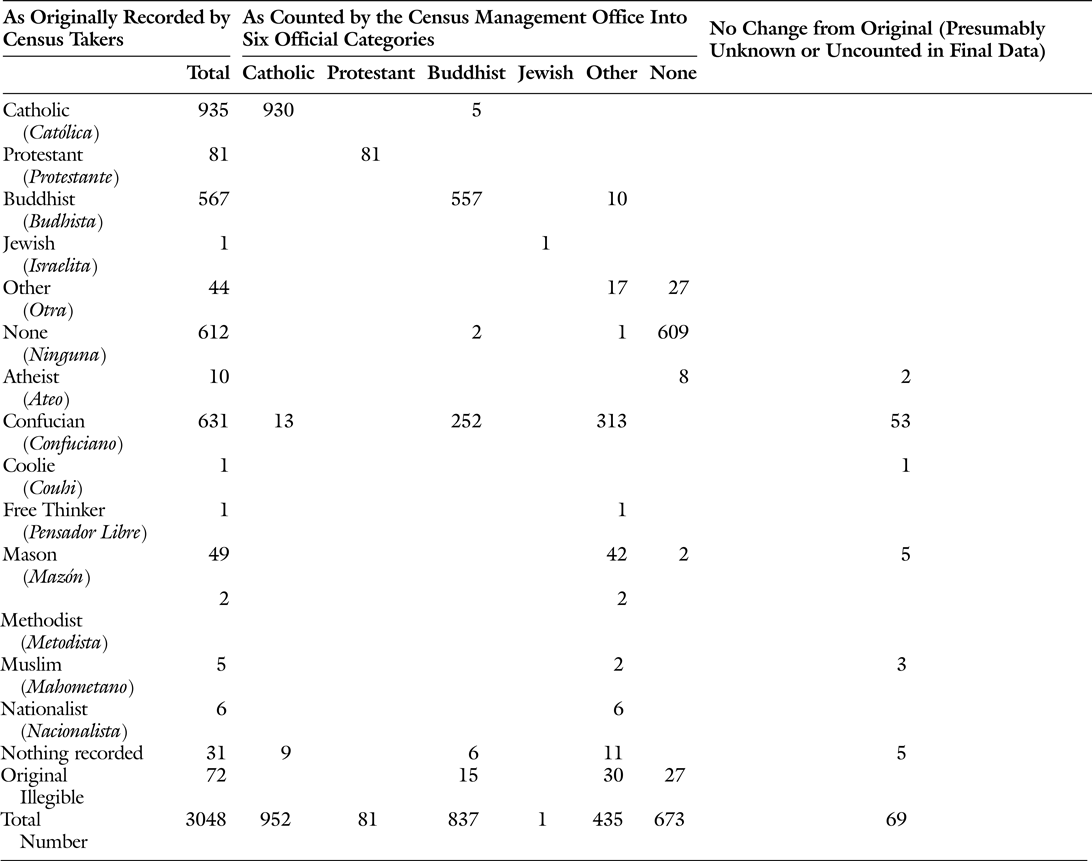
Even within the six official religious categories defined by the boleta, census takers and the Census Management Office struggled to count Chinese people. The count reflects uncertainty. The census takers recorded a wide variety of religious beliefs for individual Chinese, rather than using the category “Other” (see Table 1).Footnote 46 Of the Chinese population, only 44 (1.4%) were originally recorded as “Other.” But, when the boletas arrived at the Census Management Office for review, the office governed individual religious identity by counting people as something other than atheists, Confucians, Free Thinkers, Masons, Muslims, Methodists, Nationalists, and Coolies. The office converted the vast majority to one of the six official categories. The handful of Chinese individuals (69 or 2%) that the office did not convert, presumably remained uncounted or were listed as unknown.
Chinese Population by Religion 1930 Mexican Census, State of Sonora
Source: Data drawn from individual census forms, 1930 Mexican Census, State of Sonora.
As Table 1 demonstrates, most of the Chinese people originally recorded as atheists became None, as did several Masons and a third of the individuals whose original religious identity was illegible. Most of the rest of the government-converted—the Free Thinker, the Masons, the Methodists, the Muslims, the Nationalists, those with nothing recorded—became Other. The Methodists could have easily counted as Protestant rather than Other, but with only two Methodists the difference in the overall count was slight.
Confucians were a different story. After Catholic (935), Confucianism was the religious identity originally claimed by the largest number of Chinese people, although it was not a category by which they could be officially counted. Of the 631 Confucians, the Census Management Office converted 13 to Catholic (2%), 252 to Buddhist (40%), and 313 to Other (50%). Fifty-three (8%) remained unchanged.
Moving half of the Confucians to the catch-all Other category is a reasonable approach to religious identity; making Confucians into Buddhists, less so. What potential explanations exist for changing Confucians into Buddhists? Whoever in the Census Management Office counted Confucians as Buddhists may not have known enough about either to differentiate between the two, or may have considered Confucianism and Buddhism to be essentially the same. Alternatively and more optimistically, perhaps the Census Management Office employees who reviewed the boletas were particularly religiously sophisticated and rejected Christianity as the prototype religion, understanding instead the possibility in Eastern belief systems for multiple and inclusive identities and attempting to respect that potential multiplicity given the constraints of a census form that required a single religious identity. The boletas themselves provide no insight into the reviewers’ motivation. With the change of Confucians to Buddhists in the final count, Buddhism became the second largest religious identity for Chinese in Sonora at 837, a fairly close second to the 935 Catholics. Without detailed information, not present in the boletas themselves, counting Confucians as Catholics makes even less sense than counting them as Buddhists. In the small Hacienda de Matuticachi, in the municipality of Bacoachi, nine unmarried men who initially identified as Confucian became Catholic, the only ones so converted and counted in Sonora.Footnote 47 There is no explanation for the change.
What happened to Chinese people who identified with no religion, claiming None as their official category? Both before and after the Census Management Office's forced conversions, None identified the religious convictions of the third largest group of Chinese people: 591 before the conversions, and 652 after. Perhaps because of the official anticlerical, anti-religious policies of the government, “no religion” may have seemed a less problematic identity for the Census Management Office than other categories. Only three nonbeliever Chinese individuals were converted to something else, two to Buddhism and one to Other. Ironically though, 27 individuals originally counted as Other lost their religious identity and became None. On evidence from the boletas themselves, the Census Management Office appears to have understood lack of religious belief more fully than the diversity of religious belief that the six official categories suppressed.
When the National Statistics Department compiled data for the 1930 census, it cross-tabulated by sex and age, and occasionally by municipality, for civil status, literacy, occupation, place of birth, nationality, language, real-estate ownership, mental and physical defects, religion, and time spent unemployed. For every locality, from large cities like Hermosillo to small towns like Naco to rural enclaves with one or two persons, the National Statistics Office published a population breakdown by gender. Likewise, the office broke down literacy rates by municipality, gender, and age.Footnote 48
In the massive compilation of data and its detailed publication for each state in a multiplicity of tables and charts cross-tabulated by a variety of categories, religion received very little attention. While the federal government included religion as a countable category, it was relatively indifferent to its statistical analysis. Of the 195 pages of data and charts and dozens of tables that represent Sonora's censal demography in 1930, only one table on half a page tabulated religion: Table 37, Population Classified by Religious Creed.Footnote 49
Table 37 breaks the population down by gender and provides both absolute numbers and relative numbers per 100,000 inhabitants. It also compares the absolute numbers for the 1930 census with three previous population censuses taken in 1921, 1910, and 1900. What Table 37 does not do, however, is cross-tabulate religion with any category other than gender. In other contexts, the National Statistics Department cross-tabulated occupations by Mexican nationals and foreigners. Among owners of real estate, it distinguished between Mexican heads of household and foreign heads of household, and even identified the countries from which the foreign heads of household derived and the type of property they owned. It did nothing of the sort with religion, as if conceding the relevance of religious identity in Mexico just enough to count it but not analyze it. Although the census counted by religion, the lack of statistical analysis of the collected data reinforced the anticlerical, secular imagination of the official Mexican state.
Given the lack of statistical analysis or cross-tabulation, there is no specific recorded data in the official census reports on what percentage of Mexican nationals as compared to foreigners identified as Catholic. Nor is there a cross-tabulation of religion with naturalization or expatriation that would show whether individuals whose nationality changed were more or less likely to be religiously diverse than the population as a whole. Although the question of Mexican citizenship itself was highly contested in the postrevolutionary period, the census reports do not separate native-born Mexicans from naturalized Mexicans with respect to any other category. Thus, there is no separation for religion.Footnote 50
Despite the lack of official statistical analysis and the six official religious identities whose governance limited how an individual could be counted, the census imagined Mexicans as Catholic and Mexico as a Catholic country. In addition to the official instruction pamphlets, the Census Management Office developed a sample boleta sheet filled out with imaginary data as an example to guide census enumerators.Footnote 51 In the sample form, native-born Mexicans are all envisioned as Catholic. Forty-two-year old Manuela Díaz de González, her four children, her maid, and her maid's infant son—all born in Mexico, all of Mexican nationality—enumerate as Catholic. The same is true for Pedra Flores, Dolores Martínez, Ernest Guillén, and others.Footnote 52
The sample boleta imagined naturalized Mexicans as more religiously diverse than native-born Mexicans. Each of three naturalized Mexicans has a different religion. Manuela Diaz de Gonzalez's Spanish-born husband is Catholic, an Argentine-born man of Italian extraction has no religion, and a former Venezuelan is Protestant. Foreigners were imagined even more decidedly as religiously diverse and other than Catholic. The Americans Sam Green, his divorced daughter Laura Smith, and infant grandson Charles Smith are Protestant. Chinese Samuel Chin Fu and Wan Goo are Buddhist. Of the foreigners on the sample boleta, only a Guatemalan doctor is Catholic.Footnote 53 In sum, the instructional boleta imagined as Catholics all native-born Mexicans and one third of naturalized Mexicans, but only one sixth of foreigners. With 97.7% of the population of Mexico identifying as Catholic in the actual census, reality bore out the religious imagination of the sample census boleta. Mexicans were Catholic.
And yet, the Chinese population in Sonora was decidedly more Catholic than the sample boleta anticipated, as well as substantially more diverse. The sample described 100% of the Chinese-born individuals as Buddhist—admittedly, the sample included only two Chinese people—when in the actual census only 27% counted as Buddhist and 31% counted as Catholic (see Table 2). Likewise, Chinese persons who naturalized as Mexicans were even more likely to be Catholic, at 41%, than either those who retained their Chinese nationality or the 33% Catholic that the sample boleta anticipated for naturalized Mexicans as a whole.
Population of Sonora Compared with Chinese Population and Chinese Naturalized as Mexican by Religion (as counted) 1930 Mexican Census, State of Sonora

Source: Data drawn from individual census forms and Quinto censo… Sonora, Cuadro XXXVII, Población Clasificada según el Credo Religioso, 123.
However Catholic the Chinese populace in Sonora may have been, it was not nearly so Catholic as the general population. In comparison with the general population, Chinese people were nearly three times as likely to be Protestant, 68 times as likely to be Buddhist, 47 times as likely to be of another religion, and 17 times as likely to have no religion. The Chinese population was religiously diverse, both within itself and with respect to the general population of Sonora. Adult men born in China, particularly those who were single or only married civilly and not by religious sacrament, differed the most from the general Sonoran population. As Table 3 shows, only 21% and 17%, respectively, identified as Catholic.
Population of Sonora Compared with Adult Men Born in China by Religion (as counted) and Civil Status 1930 Mexican Census, State of Sonora

Source: Data drawn from individual census forms and Quinto censo… Sonora, Cuadro XXXVII, Población Clasificada según el Credo Religioso,” 123.
As a group including 22% that claimed no religion, the Chinese population looked much more like the rationalist nonbelievers of Sonora's intellectual and professional elite than the rest of the population. Several of the men who served as federal judges in Sonora in the 1920s and 1930s, among them Arsenio Espinosa and Joaquín Silva, claimed no religion. Neither did federal employees Gelasio Cejudo y Carbajal, Pedro Soto, and Octavio Duplat; private security guard Francisco Cuevas; and engineers Gontran Noble and Casimiro Benard.Footnote 54 While there were certainly miners and ranch hands and other manual laborers without religion, the nonbelievers among Sonora's educated classes represented a significant portion of the 1.2% of Sonora's population that disclaimed religious identity.
Outside of the 1930 census, it is difficult to get a reliable or comprehensive sense of how Chinese people identified religiously in Mexico in the early twentieth century. Sonora's civil registration system for births, marriages, and deaths did not record religion. Even if it had, a 1923 anti-miscegenation law and executive branch circulars largely excluded Chinese immigrants and persons of Chinese descent from registering their marriages and children's births.Footnote 55 At the same time, Catholic parish records for the sacraments of baptism and marriage did not record nationality or race. The digital version of Mexico's federal Register of Foreigners does not provide the registrants’ religion. Moreover, in contrast to the 1930 census, only aggregate data is available for the 1940 census, not the individual census boletas. Because of the lack of data, any discussion about the religious identity of Chinese people in Sonora after the 1931–32 expulsion is highly speculative.
The data does demonstrate, however, the brutal effectiveness of the state-sponsored expulsion. The Register of Foreigners identifies fewer than 60 Chinese nationals living in Sonora in the mid 1930s. The 1940 Census counts only 93 Chinese nationals and 63 former Chinese nationals who had naturalized as Mexican. The 1930 census had counted 3571 individuals as Chinese in Sonora.Footnote 56
What difference did Chinese religious diversity make in Sonora in the 1920s and 1930s? The reification of that difference in the census count and its clear identification in boleta after boleta came at an inauspicious moment for Chinese people in Sonora. While the actual data was not published until four years later, 1930 marked a time when the Sonoran state legislature and executive branch refocused a virulent gaze on Chinese people, particularly with respect to legislation that limited their employment and ostensible public health laws that targeted their businesses and living arrangements.Footnote 57 Moreover, the expulsion of Chinese people and their families from Sonora in 1931 and 1932, arguably under secret orders from governor Rodolfo Elías Calles, happened in relatively close temporal proximity to the census enumeration.Footnote 58 Although census information was supposed to be private, it is easy to imagine a census taker in Sonora mentally registering the religious difference of the Chinese population, particularly given that census takers throughout Sonora, like those in Naco, tended to live in or near the neighborhoods they counted. Counting Chinese people by religion required thought, decision, and evaluation, a level of engagement largely absent for the 97.8% of the population of Sonora who professed Catholicism.Footnote 59 Chinese religious diversity demanded attention during the census count.
Although scholars have identified racial prejudice, economic competition, and challenges to gender constructs as contributing factors in discrimination against Chinese people in Sonora in the early twentieth century, religious difference is a missing strand in the historiography and our understanding of the religious complexities of postrevolutionary Mexico. Disentangling the religious prejudice manifest in newspapers and books demonstrates the power of religious prejudice to interact with and magnify the discrimination Chinese people faced due to racism, economic competition, and gender constructs.
Religious Contumely in the Newspaper El Intruso
During a time of slowly increasing literacy in Mexico, print media, sometimes with accompanying graphics, played an important role in anti-Chinese crusades. Of the various Sonoran newspapers that began with or developed an anti-Chinese editorial stance, El Intruso, founded in the mining town of Cananea on January 23, 1921, by Santiago Rivas and Basilio Zepeda y Vidal, stands out for its longevity and the consistency of its attack on Chinese people. Issue after issue urged boycotts of Chinese businesses, mocked Chinese speakers of Spanish, defended anti-Chinese discrimination as legal, and challenged the masculinity of Chinese men while defaming the chastity and patriotism of Mexican women who interacted with them. Beginning in mid April 1924 and continuing at least through July 1931, the front page of El Intruso contained a box of text with a decorative outline that set it apart from ordinary columns.Footnote 60 In the text, El Intruso addressed the national press, asking it to permanently include the same anti-Chinese message in their newspapers as well. The box itself urged Mexico's president to abrogate the 1899 treaty of commerce and friendship between China and Mexico and to promulgate laws, first, to forbid marriage and sexual intimacy between Chinese men and Mexican women to protect the Mexican race against the painful decay the newspaper associated with “yellow, Asian blood,” and, second, to prevent Chinese people from handling or dealing in foodstuffs, to limit supposed infectious disease and conserve public health.Footnote 61 For at least seven years, every time a reader picked up a copy of El Intruso, the front page niggled its anti-Chinese invective. El Intruso’s virulent speech against Chinese people depended explicitly on warped constructions of religiosity and belief systems.
El Intruso commonly labeled persons of Chinese descent “Sons of Confucius” (hijos de Confucio) or Confucians, thus differentiating them from other Mexicans by belief rather than race. Among the many examples, a headline in late 1925 identified as “sons of Confucius” three men who died “mysteriously,” likely murdered.Footnote 62 Likewise, certain unnamed “Sons of Sonora” explicitly distanced themselves from and ranted against Chinese people by decrying “the hour in which the first son of Confucius” entered the state of Sonora.Footnote 63 When a Chinese banker organized a gala event, he was both “a son of Great China” and one of the “Confucians” whose wee-hours partying with several young women the newspaper chastized.Footnote 64 Further, the near-perfect homonyms in Spanish of Confucio (Confucius) and confuso (confused or confusing) allowed word play that belittled Confucianism as a belief system and Chinese people as a whole. In November 1925, El Intruso published a mocking speech ostensibly given by the fictional “Chan Hui Lay, a special envoy from the land of rice” on his arrival in Cananea. According to El Intruso, “the Immortal Chan Hui Lay” pronounced his speech in “Idioma ‘Confuso,’” translating as the “confused and confusing Confucian language” of Chinese speakers.Footnote 65
With apparent delight, El Intruso reported in December 1925 the linguistic and political jab governors of Sonora, Sinaloa, and the Territory of Baja California took against Chinese diplomats who had complained to the federal government about the rock-throwers and club-swingers who attacked Chinese men accompanying Mexican women in public. The governors called the diplomats “consuls of the ex-Celestial Empire,” deriding the downfall of the Qing Dynasty and the emperor as Son of Heaven.Footnote 66 Labeling Chinese men “celestials” (celestiales), as El Intruso allowed on other occasions, mocked that belief system.Footnote 67
Within El Intruso’s pages, a sacrilegious catechism deployed a biting satire of the Catholic Lord's Prayer and Creed in anti-Chinese invective. In the parodic Lord's Prayer, the reciter addressed the Father and praised his name, but prayed that the anti-Chinese “will of the people in Sonora and in the whole Republic” be done, rather than invoking God's will on earth and in heaven. The prayer did not seek daily bread from God, but demanded immediate return of Sonora's economy from “the hands of Chinese vampire bats (chinacates).” Rather than reciprocal forgiveness—forgive us our debts as we forgive our debtors—the recitation recognized no sin on the Sonoran side, but conditioned exculpation for the “complete ruin” in which Chinese businesses allegedly left the economy, on the subjunctive will of the ruined Mexicans. The recitation sought rescue not from sin, but from the tentacles of the Chinese “octopus.”Footnote 68
Similarly, the satiric Creed expressed belief not in God but in law, specifically Law 27, “creator of Chinese Ghettos and the wrath of Chinamen,” and Law 31 “that prohibits marriage between Mexican women and Chinese men.” The port of Guaymas, the geographic location where Chinese people had first arrived in Sonora, was “virgin and martyr who suffered beneath the power of the yellow octopus.” Chinese people were purportedly that octopus, their alleged tentacles suffocating commerce so disastrously as to leave the economy like Christ: “crucified, dead, and buried.” Furthering the image of commercial activity as a salvific Christ that Pontius-Pilatean Chinese businessmen had destroyed, the parodic Creed portrayed the economy arriving in hell but resurrecting itself from the debris of industry on the third day, then going up to the state congress to dictate laws to condemn Chinese people for their pecuniary and hygienic sins. Rather than confessing belief in one holy Catholic and apostolic Church, the recitant again professed faith in Law 27 and Law 31, which would serve to “restore commerce and its long-lasting life”—not salvation for all—but solely “for the benefit of Mexican nationals.”Footnote 69
While the satiric Lord's Prayer and Creed identified Chinese businessmen with Pontius Pilate, El Intruso and its authors named Mexicans who supported Chinese people the ultimate traitor in the Christian narrative, Judas Iscariot. Writing under the single-name pseudonym Zaratiel, one anti-Chinese author described “the gleam of joy in the eyes of men with yellow faces” as they contemplated the derogation of anti-Chinese public hygiene laws under the pretext that the laws violated their “sacred rights.” In Zaratiel's cosmos, “bad Mexicans, those that we can call traitors to the race” filled the role of “Judases to their brothers” as they sold their “middling intellect for a handful of silver” by supporting Chinese-run businesses. In Zaratiel's book fragment, a multiplicity of gods and heroes emoted at Chinese success in Sonora, positively or negatively depending on their perspective and place in the Mexican pantheon. On the Chinese side, “Confucius laughs . . . . his semblance no longer sad … his revolting mouth with gingivitic gums set in a mocking smile.”
Similarly, Chinese gold triumphed against truth, implying subornation of Mexican judges, and perjury, while “[f]riends of Buddha have their stomachs full.” In contrast, the first indigenous president of Mexico, Benito Juárez—“the undefeated, the glorious whose success inscribed in gold his name in Mexican history”—cried in sorrow at the alleged Chinese perfidy. In the end, Mexico would triumph in its religious and economic crusade against Chinese people because “[t]he anti-vice gladiators are in the breach, on foot, with their eyes fixed on the sacred ideal … To he who fights will go the victory.”Footnote 70
On the same day, in a letter to the newspaper, J. M. Abril of Cananea accused supporters of Chinese people of acting “with marked bad faith” because they sold out their “most sacred duties for the thirty pieces of silver of which the Biblical Legend speaks.”Footnote 71 Many others invoked silver coins and Judas Iscariot to shame “chineros”—Chinese lovers—away from the alleged race treason they committed when buying from Chinese businesses. P. C. González of Naco argued for a boycott of Chinese businesses, characterizing those who patronized them as betraying the national interest “for a few pieces of money, like Judas in the Bible.”Footnote 72 In a tirade spanning four newspaper columns, an anonymous “Observer” railed against Mexican men and women who entered Chinese stores, spoke in familiar forms (tuteando) with the proprietors, and risked noxious disease by consuming Chinese comestibles. They were “the Judases of the country.”Footnote 73 Similarly, native-born Mexicans who patronized Chinese businesses “should be considered absolute Judases to their race, who like the favored disciple sold Christ in exchange for the 30 coins he received from the Pharisees” because they thus delivered a handcuffed Sonora to a monstrous Chinese fate.Footnote 74
On Easter Sunday, 1924, E. S. Romero from Nacozari de García made support of Chinese a question of racialized blood: “By expelling the yellow dragon, we manifest that the blood of Iscariot has never run through our veins; rather, our veins reverberate with hot and patriotic Aztec blood.”Footnote 75 Shortly after Holy Week ended, a commentary highlighted the week's purpose—creating “religious memory in which all the parishes that serve the Apostolic Roman Religion work day and night to remind their congregants of the life, Passion, and Death of the Savior of Mankind.” The commentary then conflated Mexicans who favored Chinese, “the common enemy of the race,” with Herod, Judas, and Pontius Pilate, enemies and betrayers of Christ. The commentary urged state legislators to derogate some laws and implement new ones that would allow “for the extermination of these new Iscariots … enemies of our race, whomever they may be.”Footnote 76 In a comparison between contemporary Judases and the biblical counterpart, others saw the modern sin as more blameworthy than a betrayal of Christ, because the biblical Judas “understood his crime and hung himself,” while the modern traitors “fatten themselves daily with the blood that they slurp, like leeches and through the acts of Chinese, from their race brothers.”Footnote 77
Religious Misconjecture in the Book El ejemplo de Sonora
In his vitriolic book-length screed against Chinese people, El ejemplo de Sonora (The Example of Sonora) published in 1932, José Ángel Espinoza grounded his animosity in religion as well as race.Footnote 78 With prejudice rather than accuracy foremost in his criticism, he displayed little actual knowledge of Buddhism, Confucianism, or other belief systems Chinese immigrants might profess, and instead attributed to all Chinese individuals core values of violence, bloodlust, and excessive racial loyalty, regardless of their official census identity as Catholic, Protestant, Buddhist, Jewish, Other, or None, or their original recording in the census as atheist, Confucian, Mason, Muslim, Nationalist, Methodist, Free Thinker, or Coolie. Espinoza homogenized Chinese religious diversity and ignored the nearly one-third who, in the census, professed the dominant Mexican religion of Catholicism.
The sources for Espinoza's purported religious knowledge remain unclear. He did not suggest that he had personally experienced or discussed systems of beliefs with followers of Buddha or Confucius in Sonora or anywhere else. He did not pretend to have traveled to Asia himself. He did not seem aware of the few Asian travelogues published by Mexicans and Central Americans that did touch on Buddhism or Confucianism—Francisco Bulnes's 1875 book 11,000 Leagues over the Northern Hemisphere, Enrique Gómez Carrillo's 1906 From Marseille to Tokyo, Sensations of Egypt, India, China and Japan, or the later Caricature of a Tour of India published by Miguel Alonzo Romero in 1937 about his earlier travels.Footnote 79 Espinoza's portrayals of Buddhism and Confucianism in no way approximate these authors’ representations of actual encounters.
Despite Buddhism's rejection of blood sacrifice, Espinoza depicted the Buddha as bloodthirsty and vindictive, motivated by gory lust (see Figure 1).Footnote 80 Espinoza's portrayal stood in diametrical opposition to the nonviolence, non-resistance, and respect for all life that typically defined Buddhism.Footnote 81 Rather than Buddhism, the aural imagery of a furious and vengeful god resonates with Old Testament scripture while the visual imagery Espinoza employed mirrors human sacrifice as depicted in Aztec cosmology, almost as if Espinoza sought to impose on Buddhism the darkest religious violence in Mexico's own traditions.Footnote 82
Buddha, as Depicted in José Ángel Espinoza's El ejemplo de Sonora

In Espinoza's words, the Buddha was “furious and vengeful,” a jealous god who demanded, in an act of “divine justice,” the blood of “the bad Chinese whose loyalty shifts from a brother of the same race to a foreigner,” and thus becomes an enemy. The Buddha felt “supreme joy” when “bloody victims” fell at his golden feet. Jehovah is similarly furious and vengeful, seeking blood as satisfaction in several Old Testament scriptures including Deuteronomy 32:42, wherein Moses sings of Jehovah's lust for blood: “I will make mine arrows drunk with blood, and my sword shall devour flesh; and that with the blood of the slain and of the captives, from the beginning of revenge upon the enemy.”Footnote 83 As the violent language in Espinoza's caption echoes Old Testament scripture, the visual imagery in the accompanying cartoon mirrors depictions of Aztec cosmology.
In an image from the Codex Tudela, Micatlantecuhtli, a lord of the land of the dead, sits—like Buddha in Espinoza's cartoon—atop a pyramid, greedy mouth open, clawed talons seeking the blood and heart of the sacrificial victim (Figure 2). Similarly, Espinoza's cartoon recalls an image of human sacrifice from the Codex Magliabechiano (Figure 3). Blood runs down pyramid stairs and a victim lies contorted at the bottom, like the victim in Espinoza's image. Here, however, an altar rather than a god stands on the top of the pyramid while other individuals actively participate in the ritual by holding a victim's legs and pulling another's arm, rather than sitting to the sides. Blood cascades down the pyramid in each image, although the victim's location differs. Likewise, in both images, two men with weapons close at hand relish the spectacle, smiling grotesquely or eating part of the sacrifice. In both visual and aural imagery, Espinoza's cartoon resonates more deeply with violence and bloodshed in the Old Testament and Aztec cosmology than with the Buddhism he purported to depict.
Codex Tudela, Mexico, Sixteenth Century

Codex Magliabechiano, Mid Sixteenth Century, Mexico

With the same disregard, Espinoza attributed the blessing of protection that the “venerated goddess Guanyin” (venerada diosa Koanine) offered, not to her compassionate nature but to jealous violence done on her behalf. She “protects and supports good people, as long as they don't fail to make bloody sacrifices in her honor.” Espinoza simplified the rich and nuanced worship of Guanyin, and the multiplicities of her historical manifestations, to a single black rooster: “Chinese seafarers who want protection from hurricanes and shipwrecks and the vagaries of pirates and bandits, do no more than sacrifice a black rooster on the day of departure, sprinkle its hot blood on the boat and hang the poor headless chicken on the mast, after which the crew sets sail without fear.”Footnote 84
Even putting aside the inapt description of animal sacrifice, Guanyin was not the only venerated goddess in Chinese belief systems who provided protection to seafarers. In the South China area from which most of the Sonoran immigrants originated, T'ien Hou, a Taoist diety, was “revered primarily for her ability to tame the sea” and “suppress pirates and other ‘opportunists.’”Footnote 85 Likewise, given the fragmentation and multiplicity of belief traditions in China in the early twentieth century, the goddess and ritual to which Espinoza referred could have been part of a folk religion specific to a particular region rather than one associated with Buddhism or Taoism.Footnote 86 In any event, Espinoza provided no source for his professed knowledge of a venerated goddess, the bloody ritual he associated with her, or Buddhism more generally.
Espinoza's complaints against Confucianism are less animated than those he levels against Buddhism, but no less bloody. Although he describes the maxims of Confucius as “inspired by an acceptable moral ethic” and “the strongest spiritual tradition in the Orient,” Espinoza immediately criticizes Confucian practice in China. There, “more than anywhere else on earth,” vengeance “is considered a legitimate and noble sentiment of the soul” and human life receives no respect. Within the Confucian tradition, Espinoza attributed “a voracious appetite for vengeance” to ancient Chinese gods, who could be satisfied only with the “shedding of blood and burnt sacrifices.”Footnote 87 While sacrifice was an important part of Confucian ritual, Espinoza grossly oversimplified both practice and belief.Footnote 88 As with Buddhism, Espinoza also failed to identify the source of his ostensible knowledge of Confucianism.
Espinoza further complained against Chinese people for their perceived resistance to Christianity, disregarding the reality of Chinese religious practice in Sonora itself and the number of Chinese people who identified as Catholic. From an unnamed book, Espinoza recounted the story of a long-term Christian missionary who found the Chinese singularly unreceptive: “The round rocks of the mountains and the dry cedars of the pathway were more moved by my fervent sermons, delivered in not-half-bad Chinese, than the silent, heretical, and hostile coolies, from whom in 19 years of faithful Christian sowing, I was barely able to harvest even a single mocking smile.”Footnote 89 Thus, in favor of a single distant tale, Espinoza ignored the hundreds of Chinese Catholics in his own state—men like Luis Chin and Rafael Chon, Espinoza's own neighbors in Agua Prieta—who embraced Christianity sufficiently to participate in the sacrament of marriage with Mexican women, to raise Catholic children, and to identify themselves and their families as Catholic in the census.Footnote 90
Even as he perceived Chinese resistance to Catholic missionaries, Espinoza considered Chinese people to be traitors to Christ and, therefore, to Mexico. Twice, he used Christ as a symbol for Mexico, for the New World, in contrast to the allegedly turncoat Chinese. First, Espinoza subtly associated Mexico with Christ in a scene set near Guaymas, Sonora, during the Revolution (see Figure 4).
“¿Quién vive?” Three Soldiers Stop Chinese Man in Cart at Gunpoint

After stopping a Chinese man on a road, three soldiers tested his partisan loyalty at gunpoint by demanding “Who lives?” (¿Quién vive?). Unable to ascertain to what faction the soldiers belonged and thus whether the safe answer was “Huerta lives!” (¡Viva Huerta!) or “Obregón lives!” (¡Viva Obregón!”), the Chinese traveler stumbled in broken Spanish, “You tell me who.” He would profess loyalty to whomever safety and his cart load of commercial goods required. Espinoza remarked: “A Chinese has only one party: the same that Judas embraced before the glitter of gold.”Footnote 91 In other words, as Judas Iscariot betrayed Christ, Chinese people betrayed Mexico's revolutionary cause for money. In Espinoza's estimation, Chinese belonged to the party of avarice rather than principle.
In another cartoon, one with a diseased portrayal of a Chinese man, Espinoza identified the man as a Chinese “ambassador,” and directly equated immigrant-friendly Mexico with Christ (see Figure 5). As if the open sores, eyes blinded by trachoma or syphilis, and drool did not sufficiently convey Espinoza's perception of disease, he warned in subtly sexual language, “The ambassador of ancient China plants agony and suffering in the young America that, like Christ, opens its arms to immigration from the whole world.”Footnote 92 Lecherous Chinese people infected Christ, the Americas, Mexico. In Espinoza's cosmos, ungodly Chinese people threatened to destroy the Christian, Catholic nation of Mexico.
Caricature of Chinese ‘Ambassador’: “Planting Disease and Agony in Mexico”

Espinoza's consistent misrepresentation and gross caricature of Chinese faith traditions would have been apparent only to readers with independent knowledge. Given the extremely limited number of Spanish-language books in early twentieth century Mexico with information about Eastern religions and belief systems, that number was presumably small. It seems probable that Espinoza's readership was primarily composed of those who already believed in the crusade against Chinese people, individuals who would not question the inaccuracy of his portrayal of Chinese religion and belief systems as violent and vengeful.
Even in the unlikely event that a skeptical reader wanted to verify or challenge his assertions, it would have been difficult to do so. Espinoza offered no relevant citations regarding religion, nor even a general bibliography. Whatever his sources, Espinoza neither appreciated nor understood the complexity and multiplicity of religious traditions and worship in China. Nor was that his goal. Rather he used religious misunderstanding and caricature to reinforce the racial prejudice and discrimination Chinese people already faced in Mexico. He ignored the reality of both religious diversity and the significant Catholic commitment of Chinese people in Sonora in order to vilify the entire Chinese population, to undergird hate as religiously permissible and justified.
Conclusion
The religious identity question in the 1930 population census revealed Mexico to be a deeply Catholic country, despite the official anticlerical constitution of 1917 and its violent enforcement during the Cristero Rebellion and in de-Christanization campaigns. Counting Chinese people by religion in a Catholic country afforded a specific exclusionary act of governance in the postrevolutionary state, one that both identified religious difference from the population as a whole and erased diversity of belief within the Chinese population itself. Religious prejudice, exemplified by the contumely and misconjecture in Santiago Rivas's newspaper El Intruso and José Ángel Espinoza's book El ejemplo de Sonora, built on that religious difference to justify vicious discrimination and violence against Chinese people and their families in the state of Sonora in the 1920s and 1930s. Espinoza invoked religious discrimination through his gross misconstructions of Buddhist and Confucian traditions and ignorance of the lived experiences of Chinese Mexicans. El Intruso likewise provoked anti-Chinese invective through its repeated publication of articles and letters that deployed biblical narratives and imagery to mock and discredit Chinese belief systems. Religious discrimination compounded racism and economic nationalism to the detriment of Chinese nonbelievers and believers alike, in the Catholic country that was an officially anticlerical state.





