Floods are one of the most common natural disasters in Thailand causing damage to the economy, properties, social structures, and most importantly, human health. The consequences of flooding on human health have been reviewed in the past few years.Reference Ahern, Kovats and Wilkinson 1 , Reference Torti 2 Floods could be a direct cause of death, ie, drowning, and also an indirect cause of death such as electrical shock and other injuries. Several health problems including communicable and noncommunicable diseases increasingly occur before, during, and after flooding. However, information regarding the health effects of floods, particularly in relation to morbidity, is limited.
From July 2011 to January 2012, Thailand encountered the worst flooding situation in decades causing many losses. Several areas of central Thailand including Bangkok were under water for a few months. As a consequence, exposure to floodwater inevitably led to contracting water-related diseases such as leptospirosis, gastroenteritis, and skin diseases. Skin is a vital external barrier of the human body protecting the body from toxic substances, injuries, and infections. Development of skin diseases will compromise the protective function leading to other diseases. A few studies have reported on the skin problems associated with floods.Reference Lee, Choi and Eun 3 - Reference Vachiramon, Busaracome and Chongtrakool 6 However, evidence of factors determining the development of skin diseases is still limited. During the flood crisis, humanitarian assistance from government and private sectors was actively provided throughout the affected areas, in which the main support was from military forces. Therefore, these personnel were also prone to water-related diseases. In the present study, we aimed to determine the prevalence of and risk factors for skin problems among army personnel who provided humanitarian assistance and flood victims who lived in the flooded areas of Bangkok.
Methods
Study Population
Army personnel providing humanitarian aid and flood victims living in suburban areas of Northwestern Bangkok, Thailand, were enrolled in this study. These areas were flooded for a total of 12 weeks from October to December 2011 over an area of 50 km2. The areas were mainly orchards and housing developments and encompassed a total of 30,000 households. Approximately 77,000 people lived in these areas. Our survey was conducted in the 6th week after the flooding started. Nonprobability sampling was performed to enroll civilian participants who came to seek help or receive relief goods at the points of care. In addition, a total survey was conducted among army personnel residing at the army camp when they were off duty. This study was reviewed and approved by the Institutional Review Board of The Royal Thai Army Medical Department. Written informed consent was obtained from each subject.
Detecting Skin Diseases and Determining Prevalence of and Risk Factors for Skin Symptoms
A certified dermatologist evaluated those who presented with skin lesions and performed diagnoses. To determine the prevalence of and risk factors for acquiring skin symptoms, standardized questionnaires were created covering demographic data, the skin symptoms presented, history of water exposure, and sanitary behaviors. A face-to-face interview of each participant was performed by the investigators.
Microbiological Investigations
Skin sampling and culturing of microorganisms were also performed. Samples were transferred into Amies transport media and sent to the Department of Microbiology, Phramongkutklao College of Medicine, Bangkok, Thailand. The samples were then cultured on blood and Sabouraud-dextrose agar. Growing bacterial colonies were then biochemically tested to determine specific bacterial species.
Statistical Analysis
All statistical analyses were performed by using STATA/SE for Windows version 9.2 (StataCorp LP, College Station, TX). Prevalences of skin diseases, percentages, means, and standard deviations of demographic data were presented for descriptive statistics. The associations between associated factors and skin symptoms were measured by using Pearson’s chi-square for categorized variables. Risk factors were reported as odds ratios (ORs). The crude OR was calculated by univariate analysis. From the univariate analysis, the factors with a P value less than 0.2 were included in the bivariate logistic regression model. Multivariate analysis was performed for adjusted ORs by using the saturated model. To identify the exposure duration as the risk of acquiring skin symptoms, medians and quartiles of the exposure duration per month were used for stratification. All statistical parameters were calculated with a P value of 0.05.
Results
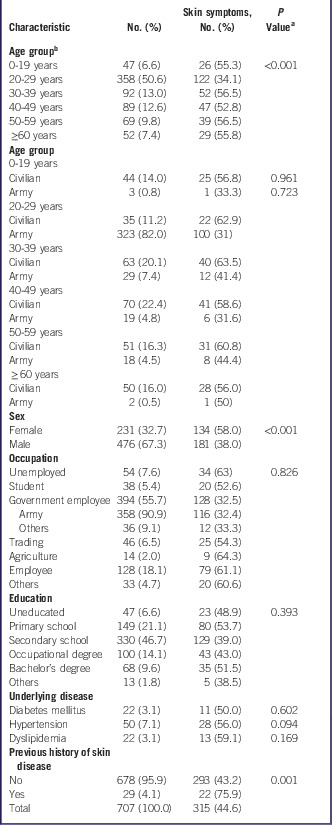
A total of 707 participants were enrolled in this study. Table 1 shows the demographic data of the enrolled participants. Approximately half of the population consisted of army personnel. The mean age of the army personnel was 26.2±8.8 years (range, 19-60 years). In contrast, the mean age of the flood victims was higher (mean, 40.6±17.8 years; range, 2-100 years). Approximately 70% of the population was male. Only 4% of the population had a history of skin diseases.
Demographic Data of the Enrolled Participants

a Significant differences in the prevalence of skin symptoms among groups were determined by chi-square test.
b Mean age was 32.5±15.3 years (range, 2-100 years).
The flood victims and army personnel described the patterns of flooding where they were usually exposed, ie, stagnant type (62.4%, n=441) and flow type of floodwater (37.6%, n=266). The majority of floodwater contained refuse materials (90.8%, n=642) and had an offensive odor (85.0%, n=601). A total of 77% of the participants reported floodwater that was black or dark-colored, whereas the rest reported a normal color.
Regarding exposure time, 91.5% (647) of the population was exposed to floodwater for 1 month. The water depth to which they were exposed varied among the individuals in this study, ie, at the waistline (32%), at the torso level (25.7%), at the neck level (14.5%), at the thigh level (9.9%), at the knee level (8.7%), at the shin level (5.1%), at the ankle level (3.1%), and at unspecified levels (0.3%).
Median exposure time to floodwater during the past 1 month was 50±79.2 hours. During the exposure to floodwater, 18.5% wore no protective footwear. Sandals were the most common footwear (53.9%), whereas 37.6% wore covered shoes. Participants wearing long boots, short boots, and combat boots constituted 4.4%, 3.4%, and 0.8% of the population, respectively. Approximately 88.9% of the population did not wear socks during water exposure. Approximately three-fourths of the population (75.5%) did not wear protective gear such as plastic thigh or chest waders. Only 44.0% of the participants cleaned themselves immediately after exposure. Cleaning themselves after 60 min, within 30 to 60 min, and in <30 min was reported by 14.4%, 12.8%, and 21.8% of the participants, respectively. A total of 7% did not clean themselves after water exposure.
Skin symptoms were recorded among 315 participants (44.6%), including itching (57.6%), rash (25.5%), blisters (7.2%), wounds (4.6%), and other nonspecific symptoms (0.9%), such as a burning sensation, scaling skin, or macerated skin. The age group of 20 to 29 years and male, for which the majority were army personnel, showed a lower percentage of skin symptoms compared with other groups. No association was found between skin symptoms and underlying diseases including diabetes mellitus, hypertension, and dyslipidemia.
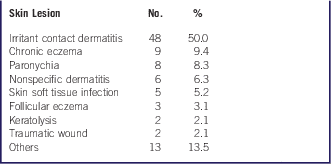
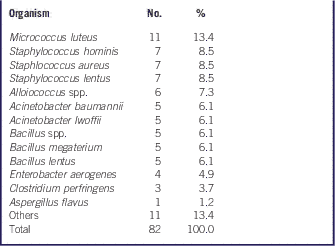
Of all 707 participants, skin lesions were detected among 96 participants (13.6%; Table 2). In all, 50% of the presented skin lesions were diagnosed as irritant contact dermatitis. The lesions were mostly located on the feet (n=71, 74.0%), followed by the thighs/leg (n=9, 9.4%), the arms/hands (n=8, 8.3%), the trunk (n=6, 6.2%), and the face (n=2, 2.1%). Table 3 shows the microbiological results of 82 specimens collected from skin lesions. Most specimens were identified as environmental or normal skin flora.
Diagnosis of Dermatological Lesions Detected in 96 Participants During the 2011 Floods in Thailand

Microbiological Identification of Specimens Collected From Skin Lesions

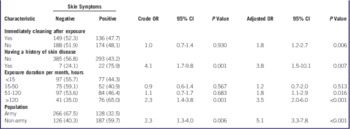
Table 4 shows the results of the univariate and multivariate analyses conducted to determine the risk factors for acquiring skin symptoms among 707 participants. Delayed cleaning after exposure to floodwater, having a history of skin diseases, and exposure to floodwater for more than 50 hours per month were independent risk factors for acquiring skin lesions. In addition, civilian participants were 5.1 times as likely to acquire skin symptoms as were army personnel.
Results of Univariate and Multivariate Analyses to Determine Risk Factors for Acquiring Skin Symptoms Among 707 ParticipantsFootnote a

a Abbreviations: CI, confidence interval; OR, odds ratio. Data were adjusted for time of cleaning after exposure, exposure duration per month, population, and previous history of skin disease.
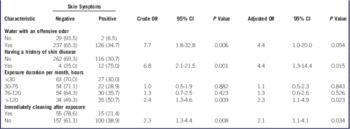
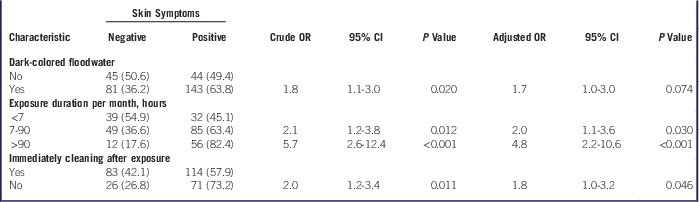
The results of the univariate and multivariate analyses to identify risk factors for skin symptoms among army personnel are shown in Table 5. Among army personnel, having a history of skin diseases, not immediately cleaning their feet after exposure, and exposure to floodwater for more than 120 hours per month were independently associated with developing skin symptoms. Table 6 shows the results of the univariate and multivariate analyses to identify risk factors for skin symptoms in the civilian population. Exposure to floodwater for more than 7 hours per month and delayed cleaning after exposure were independent risk factors for skin symptoms.
Results of Univariate and Multivariate Analyses to Determine Risk Factors for Acquiring Skin Symptoms Among the Army Populationa

aAbbreviations: CI, confidence interval; OR, odds ratio. Data were adjusted for time of cleaning after exposure, exposure duration per month, previous history of skin disease, and foul-smelling water.
Results of Univariate and Multivariate Analyses to Determine Risk Factors for Acquiring Skin Symptoms Among the Civilian Flood Victimsa

aAbbreviations: CI, confidence interval; OR, odds ratio. Data were adjusted for time of cleaning after exposure, exposure duration per month, and dark-colored floodwater.
Discussion
In the 707 enrolled participants, the prevalence of skin symptoms was 44.6%. The prevalence of skin conditions in the present study was similar to that reported in the study of the 1998 flood in Bangladesh.Reference Kunii, Nakamura and Abdur 7 The high prevalence of skin diseases might be explained by the fact that the disaster that recently occurred in Thailand happened unexpectedly. As a result, the flood victims did not properly prepare themselves for the situation. Among these participants, 96 had skin lesions during the survey. The most common skin lesion identified in this study was irritant contact dermatitis, similar to previous studies reported from Asian countries. In 2006, flood victims in Thailand, who developed inflammatory skin diseases, showed a predominant incidence of irritant contact dermatitis.Reference Vachiramon, Busaracome and Chongtrakool 6 Furthermore, Lee and colleaguesReference Lee, Choi and Eun 3 determined skin lesions among the victims of the 2004 tsunami in Indonesia and revealed a high prevalence of inflammatory skin diseases. Infectious skin diseases were also predominant in these 2 studies. Both fungal and bacterial skin infections were identified in nearly 40% of the enrolled victims who presented with skin symptoms during the 2006 floods in Thailand.Reference Vachiramon, Busaracome and Chongtrakool 6 The most common skin problems in the 2004 tsunami in Indonesia were also infectious skin diseases (32.5%).Reference Lee, Choi and Eun 3 In contrast, our information showed a lower percentage of skin infection that corresponded with the result of bacterial cultures of samples from skin lesions. Most bacteria identified from these samples were environmental or normal skin flora. Because we conducted this cross-sectional survey 6 weeks after the flood started, some participants with acute skin problems such as mild forms of skin infection, eczema, and irritant contact dermatitis might have already been treated.
In both studied groups, delayed cleaning after exposure to floodwater was significantly associated with acquiring skin symptoms. One of the most common skin irritants is water.Reference Slodownik, Lee and Nixon 8 However, dirt and chemical substances in the floodwater could constitute irritants. Civilian flood victims had a greater risk of acquiring skin symptoms compared with the army population. This might be due to the intensity and duration of the exposure. Because the civilian population mostly stayed in the flooded areas, they might have been constantly exposed to floodwater. In contrast, the army population moved into the flooded areas for humanitarian assistance and stayed in camps outside the flooded areas. The flood victims had a higher risk of acquiring skin symptoms when they were exposed to floodwater for more than 7 hours per month. A longer exposure time, ie, more than 120 hours per month, was identified as a risk factor for acquiring skin symptoms in the army group. This could be explained by the nature of humanitarian assistance missions. The army personnel were on duty mostly during the day and employed a shift system. Thus, exposure to floodwater among the army personnel was intermittent and might not have been as great as among the flood victims. Recovery of the skin could occur during the off-duty period in the army group. The development of some skin diseases such as irritant contact dermatitis is usually cumulative owing to the stepwise progression of damage to the barrier functions of the skin.Reference English 9 Intermittent exposure in the army group probably allowed the skin to recover and remain subclinical. In addition, the army group would be better prepared before deployment for this humanitarian assistance, including being provided with foot powder, protective uniforms, and boots. The possibility of being better provisioned for hygiene during deployment was also enhanced by daily front-row health education and health care services by the army medical teams. On the other hand, a higher prevalence of skin symptoms among flood victims might also have been due to how the participants were enrolled. Flood victims were asked to participate when they came to the points of care. Although no formal announcement of the project was made in the flooded areas and no serviced skin clinic was set up at the point of care, it is possible that those who had more problems were selected. In contrast, a total survey was conducted among the army personnel in the camp when they were off duty.
Among the endogenous factors influencing the susceptibility to skin diseases, particularly irritant contact dermatitis, having a history of skin diseases was associated with acquiring skin symptoms. Multivariate analysis showed the association among the army group. A few previous reports indicated that the barrier function of the skin can be compromised in those with existing skin diseases, making the skin more susceptible to irritants and infections.Reference Tupker, Coenraads and Fidler 10 - Reference Nassif, Chan and Storrs 12 However, other endogenous factors including age and sex showed no association with skin symptoms. Although other studies indicated that the younger age group is more susceptible to irritants,Reference Cua, Wilhelm and Maibach 13 , Reference Schwindt, Wilhelm and Miller 14 our study showed a similarly high prevalence of skin symptoms in all age groups except the ages of 20 to 29 years. This could be explained by the fact that the majority of this age group were army personnel (82.0%). When a stratified analysis was performed for civilian and army groups, no association was observed between skin symptoms and age group. In addition, multivariate analysis showed no association between sex and the development of skin symptoms among civilians and army personnel.
Conclusions
Our results indicated that flood victims showed a higher prevalence of skin symptoms compared with army personnel who rendered humanitarian assistance. This may be due to being better provisioned for hygiene before and during deployment and also having less prolonged exposure to floodwater. The most presented skin lesion was irritant contact dermatitis. The significant risk factors for the development of skin symptoms included having a history of skin diseases and delayed cleaning after exposure to floodwater. Our study also provided duration of exposure time to floodwater for the development of skin symptoms after exposure. Our information suggests that immediate cleaning after exposure to floodwater is recommended. Education campaigns should provide this important information to the public before and during flooding. The public and responders should be reminded to (1) wear boots if possible, (2) wear and change socks frequently, (3) use powder to help keep the feet dry, and (4) make sure the feet are washed with soap and water after contact with standing water. In addition, accessible stations with clean water and soap should be provided for washing when people leave the flooded areas. The information is also useful for humanitarian teams in terms of preparing in the predeployment stage and taking care of their hygiene during deployment in flooded areas.
Acknowledgment
We thank the army and civilian participants. This study was financially supported by the Phramongkutklao Research Fund.