Implications
In jennies, the dietary supplementation of verbascoside (VB), a natural extract from leaves of Verbenaceae, could be a strategy to modify the fat composition and vitamins A and E contents of milk, improving its nutritional quality. Moreover, the oxidative status of the animals can be positively affected by VB supplementation, resulting in a general improvement of the donkey’s milk production system.
Introduction
The nutritional characteristics and the in vitro and in vivo effects of donkey’s milk in humans has received scientific interest in recent years. The first potential use of donkey’s milk in human feeding has concerned infants affected by cow milk protein allergy (Monti et al., Reference Monti, Viola, Baro, Cresi, Tovo, Moro, Ferrero, Conti and Bertino2012) due to its similarity to human milk (D’Auria et al., Reference D’Auria, Agostoni, Giovannini, Riva, Zetterström, Fortin, Greppi, Bonizzi and Roncada2005), low allergenicity (Vita et al., Reference Vita, Passalacqua, Di Pasquale, Caminiti, Crisafulli, Rulli and Pajno2007) and good palatability (D’Alessandro and Martemucci, Reference D’Alessandro and Martemucci2012). Donkey’s milk has also been proposed as a functional food able to induce the release of anti-inflammatory interleukins, tumour necrosis factors-α and nitric oxide (Tafaro et al., Reference Tafaro, Magrone, Jirillo, Martemucci, D’Alessandro, Amati and Jirillo2007).
Donkey’s milk is characterized by a low milk fat content (Martemucci and D’Alessandro, Reference Martemucci and D’Alessandro2012). Its consequent low energetic value may suggest a potential use in hypocaloric human diets (Martemucci and D’Alessandro, Reference Martemucci and D’Alessandro2012). Moreover, the fatty acid profile shows a low content of saturated fatty acids (SFA), a high polyunsaturated fatty acids (PUFA) content, a low n-6 to n-3 fatty acid ratio and advantageous values of atherogenic and thrombogenic indices, which have been linked to potential health benefits in humans (Martemucci and D’Alessandro, Reference Martemucci and D’Alessandro2012).
In humans, diet therapy is recognized as an important tool to reduce serum cholesterol levels (Malhotra et al., Reference Malhotra, Shafiq, Arora, Singh, Kumar and Malhotra2014). The concentration of serum lipoproteins is mainly determined by the lipid present in the foods as SFA, monounsaturated fatty acids (MUFA) and PUFA, with the balance between lipid types more relevant than the total quantity of fat (Ascherio, Reference Ascherio2002). High dietary intakes of SFA is a risk factor for the development of atherosclerosis and cardiovascular disease. In contrast, the reduction of SFA and the increase of unsaturated fatty acids improve human health (Simopoulos, Reference Simopoulos2008).
Moreover, dietary intake of fat-soluble antioxidants/vitamins (A and E) have beneficial effects on human health reducing oxidative stress, which is considered to be a risk factor for chronic conditions (Willcox et al., Reference Willcox, Ash and Catignani2004). To improve the long-term health of consumers, there is considerable interest in reducing the harmful components of milk (SFA) and increasing those with beneficial effects (PUFA and PUFA/SFA ratio) by interventions in animal feeding (Martemucci and D’Alessandro, Reference Martemucci and D’Alessandro2013). Dietary supplementation of phenolic compounds has been shown to have positive effects on the production and quality of milk, and dairy products (O’Connell and Fox, Reference O’Connell and Fox2001) as well as on health status of the animals (Martemucci and D’Alessandro, Reference Martemucci and D’Alessandro2013).
In a study by D’Alessandro et al. (Reference D’Alessandro, Casamassima, Jirillo and Martemucci2014), a short period of dietary supplementation with VB in lactating jennies resulted in influencing the serum lipidic and hepatic profiles, and the oxidative status of dams and of their suckling foals. The aim of this study was to determine whether the long-term dietary supplementation of jennies with VB affects the fatty acid composition and vitamins A and E contents of the milk during a whole lactation. The effects of the dietary supplementation on selected serum biochemical parameters and markers of oxidative status of the animals were also assessed.
Material and methods
The animals were handled following the recommendations of European Union directive 86/609/EEC and Italian law 116/92 regarding animal care.
The trial was carried out in southern Italy on a total of 12 adult lactating jennies of Martina Franca breed kept on the same farm and routinely milked twice a day (D’Alessandro and Martemucci, Reference D’Alessandro and Martemucci2012). The trial lasted the whole lactation of 6 months. The animals were healthy and in good condition (body condition score (BCS): 3.0 to 3.5 of a scale 0 to 5; D’Alessandro and Martemucci, Reference D’Alessandro and Martemucci2012) at the beginning and throughout the study period. The jennies were bred following a semi-extensive breeding system which is based on the use of natural scrub pasture (7 to 10 h of grazing) with supplementation of meadow hay (3 to 4 kg /day per jenny), wheat straw (2 kg/day per jenny) and concentrate (mixture of oats, corn flakes and bran; 2.0 to 2.5 kg of grain/day per jenny), and water ad libitum.
At foaling, the jennies were subdivided into two experimental groups (n 6) corresponding to control group, receiving no antioxidant supplement; and VB group, receiving antioxidant supplement containing a lipid-encapsulated VB (5 mg VB/g supplement, corresponding to 10 to 12.5 g VB/jenny). The two groups were matched for age (6 to 10 years), weight (310±20 kg) and BCS (D’Alessandro and Martemucci, Reference D’Alessandro and Martemucci2012; 3.0 to 3.5 of a scale 0 to 5).
The antioxidant supplement contained a water-soluble extract from leaves of Verbenaceae (Lippia spp.), titrated in phenyl propanoid glycosides expressed as verbascoside (Sintal Zootecnica, Isola Vicentina, Vicenza, Italy). The composition of the antioxidant feed supplement as phenolic compounds was as follows: gallic acid, 1.75±0.07; 3,4-dihydroxybenzoic acid, 0.45±0.04; methyl gallate, 1.91±0.09; iso-VB, 0.43±0.04; and VB, 4.47±0.08 g/kg (Rastrelli L., Personal communication).
Milk sampling and analyses
Individual milk samples were collected monthly over the lactation period (6 months). Each sample was split into different aliquots for the analyses of the chemical gross composition, fatty acid profile, and vitamins A and E concentrations. The samples were then preserved (−20°C) until analysis.
The contents of fat, protein, casein and lactose of milk were analysed using an IR milk analyser (Milkoscan 6000; FOSS Italia S.r.l., Padova, Italy) previously calibrated for donkey’s milk according to Federation Internationale dé Laiterie (International Dairy Federation) (2000).
The fatty acid composition was determined on milk fat according to Folch et al. (Reference Folch, Lees and Sloane Stanley1957). The fatty acid composition was estimated using methyl esters prepared by direct transesterification, according to IUPAC (International Union of Pure and Applied Chemistry, 1987). The analyses were performed by a gas chromatograph Trace model 2000 series (ThermoQuest, CE, Instruments, Italy) features an open-flame ionizing detector to 270°C. The fatty acids were separated using a CP-Sil 88 fused-silica capillary column (100 m×0.25 mm i.d.×0.2 μm film thickness; Chrompack, Middleburg, the Netherlands). The injector temperature was 250°C and the detector temperature was 270°C. The separation was carried out at pre-programmed temperatures according to Casamassima et al. (Reference Casamassima, Nardoia, Palazzo, Vizzarri, D’Alessandro and Corino2014b). The total race time was 102 min. Identification of fatty acids was performed using an external standard (Supelco TM 28 Hunger components mix; Sigma Chemical Co., St. Louis, MO, USA). Fatty acid peaks were identified by a comparative analysis with the retention times of pure standard of known concentration. Their content has been expressed as percentages of total identified fatty acids, and the atherogenicity index and the trombogenic index were calculated (Ulbricht and Southgate, Reference Ulbricht and Southgate1991).
Vitamins A and E were extracted from milk samples with ethanol and chloroform (Zhao et al., Reference Zhao, Tham, Lu, Lai, Lee and Moochhala2004) and analysed on an HPLC system (Kontron Instruments, Milano, Italy) consisting of an autosampler (HPLC Autosampler 360; Kontron Instruments) with a 20 μl loop, two mixed pumps (HPLC Pump 422; Kontron Instruments, Milano, Italy) and a 5 μm, 250×4.60 mm C18 column (Phenomenex, Torrance, CA, USA). The mobile phase was 75% nitrile acid and 25% methanol (75 : 25 v/v) at a flow rate of 1.0 ml/min. A fluorimeter detector (Kontron model FMS 25) and computer with Kroma System 2000 software were used. Vitamins A and E were identified by comparing the retention time of the pure (>97%) standards (Sigma Aldrich, St. Louis, MO, USA). The concentrations were determined using Kroma System 2000 (version 1.8.1) comparing peak area with standard reference curves.
Blood sampling and analyses
The blood samples were collected from five jennies for each of the two experimental groups 8 days after foaling (D0) and then at D90, D105 and D120 of lactation.
Blood samples were taken before the morning feeding in Vacutainer tubes (Venoject, Terumo, Europe N.V., Leuven, Belgium) with gel separator (for serum collection) or with ethylenediamine tetraacetic acid (for plasma collection). The tubes for serum collection were allowed to clot at room temperature for 3 h before centrifugation at 3000 r.p.m. for 15 min; the serum was frozen at −20°C until analysis. The tubes for plasma collection were immediately placed on ice, and within 2 h of bleeding were centrifuged at 2500 g for 10 min and then stored at −20°C until analysis.
The levels of total cholesterol, high-density lipoproteins cholesterol (HDL-C) and low-density lipoproteins cholesterol (LDL-C), tryglicerides, bilirubin, alanine aminotransferase (ALT) and aspartate aminotransferase were determined on serum using an automated clinical chemistry analyser (model ARCO; Biotecnica Instruments S.p.a., Rome, Italy). The non-esterified fatty acid concentrations were determined using a spectrophotometer (550 nm wavelength) with a commercially available kit (Randox Laboratories, Crumlin, UK). Plasma reactive oxygen metabolites (ROMs) were measured by the analytical method patented by Diacron (Cesarone et al., Reference Cesarone, Belcaro and Caratelli1999). The results were expressed in Carr units (1 Carr unit equals 0.024 mmol/l of H2O2).
Thiobarbituric acid reactive substances (TBARs) in plasma were measured by the method of Esterbauer and Zollner (Reference Esterbauer and Zollner1989). The results are expressed as millimoles of thiobarbituric acid per litre of plasma.
Vitamins A and E were extracted from plasma samples and determined according to the procedures previously described for the analyses of vitamins A and E in milk.
Statistical analysis
All data were analysed using the GLM procedure for repeated measures (SPSS, 2010) and the animal entered the model as repeated factor. For the data on chemical composition, fatty acids profile and vitamins A and E contents of the milk analysis included the fixed effects of dietary supplement, the month of lactation, their interaction (dietary supplement×month of lactation) and an error term. The data were presented as mean values of each group and with the relative standard error; differences were tested by Scheffé test and considered significant for at least P<0.05. For the blood biochemical parameters analysis included the fixed effects of dietary supplement, the day of blood sampling, their interaction (dietary supplement×day of sampling) and residual error (SPSS, 2010). Pre-treatment values were used as covariate for blood parameters.
Results
Milk composition
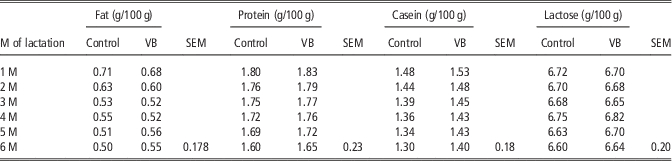
There was no consistent difference in the content of fat, total protein, casein and lactose contents between milks from jennies supplemented with VB and that of the control group (Table 1).
Effect of dietary verbascoside (VB) supplementation on gross composition of donkeys’ milk during 6 months (M) of lactation

Control=diet without VB; VB=diet supplemented with verbascoside.
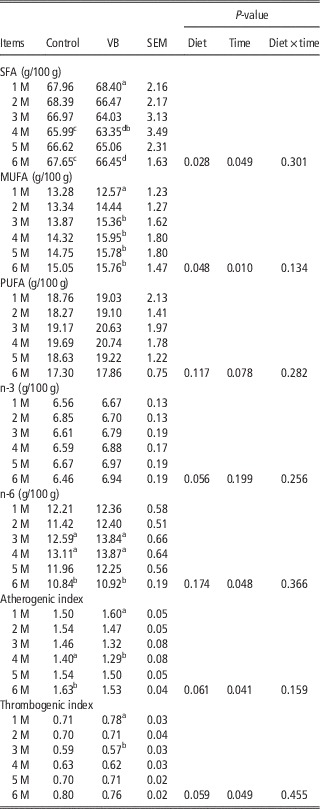
The proportion of the total SFA was affected (P<0.05) by the VB supplementation and lactation stage of the jennies (Table 2). The addition of VB to the diet led to lower (P<0.05) values of total SFA. The SFA values in the VB group were lower (P<0.05) at 4th and 6th months in comparison with those of the control group. No significant variations were observed in the control during the lactation period.
Effect of dietary verbascoside (VB) supplementation on summarized fatty acid classes and indices of nutritional quality of fatty acids in donkey’s milk during 6 months (M) of lactation

Control=diet without VB; VB=diet supplemented with verbascoside; SFA=saturated fatty acids; MUFA=monounsaturated fatty acids; PUFA=polyunsaturated fatty acids.
a,b,c,dValues with different superscripts letters differ significantly at P<0.05.
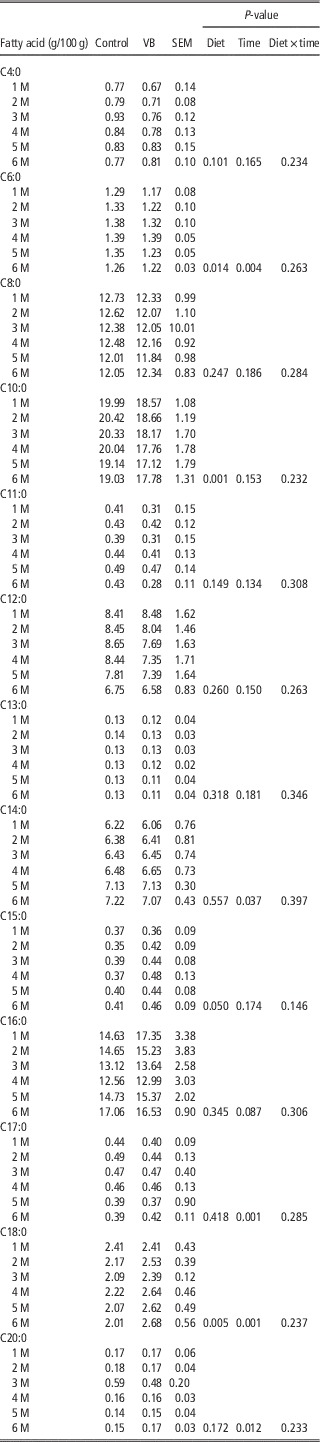
Among the individual SFA, the dietary VB supplementation affected lower concentrations of C6:0 (P<0.01) and C10:0 (P<0.01) acids, and greater levels for C15:0 (P<0.05) and C18:0 (P<0.01) acids (Table 3) in comparison with the control. Lactation stage affected the proportions of C14:0 (P<0.05), C17:0 (P<0.01), C18:0 (P<0.01) and C20:0 (P<0.01) acids (Table 3).
Effect of dietary verbascoside (VB) supplementation on the profile of saturated fatty acids in donkey’s milk during 6 months (M) of lactation

Control=diet without VB; VB=diet supplemented with verbascoside.
The total MUFA content of milk was affected by the VB supplementation (P<0.05) and lactation stage (P<0.01) (Table 2). In the VB group, the MUFA values at the 3rd, 4th, 5th and 6th months were greater (P<0.05) in comparison with that of the 1st month.
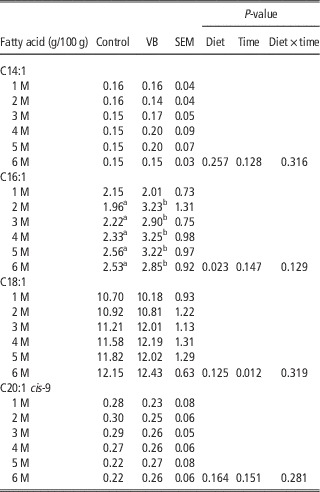
The profile of MUFA is reported in Table 4. The main effect (P<0.05) of VB supplementation was obtained for C16:1 acid, which showed higher levels (P<0.05) from the 2nd to the 6th months of lactation, in comparison with the control group. The concentration of oleic acid was influenced (P<0.01) by the lactation stage increasing with the increase of lactation time in both the control and VB groups (Table 4).
Effect of dietary verbascoside (VB) supplementation on the profile of monounsaturated fatty acids in donkey’s milk during 6 months (M) of lactation

Control=diet without VB; VB=diet supplemented with verbascoside.
a,bValues with different superscripts letters differ significantly at P<0.05.
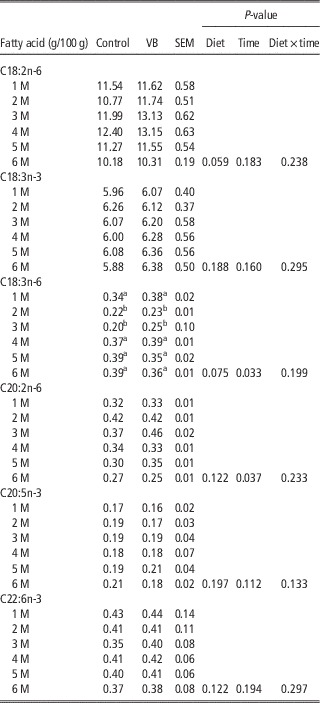
The total PUFA content of milk was not affected by the VB supplementation (Table 2). Among the PUFA, linoleic acid level was improved (P=0.06) by the VB supplementation throughout the lactation period (Table 5). The lactation stage influenced (P<0.05) the levels of γ-linoleic and C20:2n-6 acids.
Effect of dietary verbascoside (VB) supplementation on the profile of polyunsaturated fatty acids in milk during 6 months (M) of lactation

Control=diet without VB; VB=diet supplemented with verbascoside.
a,bValues with different superscripts letters differ significantly at P<0.05.
The nutritional quality indices of milk were improved (P=0.06) by the VB supplementation showing greater contents of total PUFA n-3 and lower values of atherogenic and thrombogenic indices in comparison with the control diet (Table 2). Lactation stage also affected (P<0.05) total PUFA n-6 content of milk, and the atherogenic and thrombogenic indexes (Table 2).
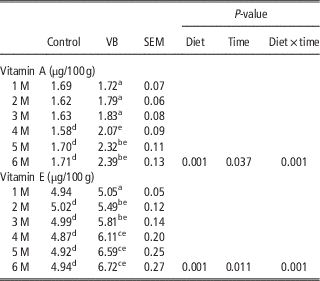
The VB supplementation affected nutritional quality of milk increasing significantly (P<0.01) the vitamins A and E contents (Table 6). In particular, greater levels of vitamin A were observed during the last 3 months of lactation (4th to 6th months), and from the 2nd to 6th months for vitamin E. Lactation stage also affected (P<0.05) vitamin A (P<0.05) and vitamin E (P>0.01) levels.
Effect of dietary verbascoside (VB) supplementation on the vitamins A and E contents in donkey’s milk during 6 months (M) of lactation

Control=diet without VB; VB=diet supplemented with verbascoside.
a,b,c,d,eValues with different superscripts letters differ significantly at P<0.05.
Blood biochemical parameters and oxidative status of jennies
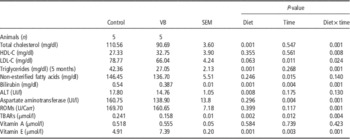
The VB supplementation resulted in a decrease (P<0.01) in serum levels of total cholesterol, tryglicerides, bilirubin and ALT, and although not significant, to a decrease in LDL-C levels (P>0.05) (Table 7). The HDL-C, non-esterified fatty acid and aspartate aminotransferase levels were unaffected by the dietary treatment (Table 7).
Effect of dietary verbascoside (VB) supplementation on the blood biochemical parameters in lactating jennies

Control=diet without VB; VB=diet supplemented with verbascoside; HDL-C=high-density lipoproteins cholesterol; LDL-C=low-density lipoproteins cholesterol; ALT=alanine aminotransferase; ROMs=reactive oxygen metabolites; TBARs=thiobarbituric acid reactive substances.
Plasma concentrations of TBARs and vitamin E were higher (P<0.01) in the VB group than the control, whereas no differences were observed in relation to ROMs and vitamin E levels (Table 7).
Discussion
Interventions in animal feeding are considered strategic ways to modify milk fatty acid composition and to improve the nutritional and health qualities of milk (Martemucci and D’Alessandro, Reference Martemucci and D’Alessandro2013). In this study, although the dietary VB supplementation did not influence the fat content of milk, it had a clear effect on the fatty acid profile of milk resulting in a decrease of SFA (−2.4%) and an increase of MUFA (+6.0%). The positive effects of VB supplementation on the quality of donkey milk are in agreement with the findings of Casamassima et al. (Reference Casamassima, Nardoia, Palazzo, Vizzarri, D’Alessandro and Corino2014b) in ewes where VB decreased SFA and increased MUFA, PUFA and vitamins A and E contents in milk.
In humans, the amount of dietary fat influences the concentration of plasma lipoproteins but the quality of lipid consumed (SFA, MUFA, PUFA) and their balance assume a major importance in terms of health (Weech et al., Reference Weech, Vafeiadou, Hasaj, Todd, Yaqoob, Jackson and Lovegrove2014). Some speculations can be made concerning the potential implications of the changes in the fatty acid profile of donkey’s milk as food for human consumption.
In general, fat of donkey milk may be considered more favourable for human health in comparison with other milks from ruminant species (cow, buffalo, ewes and goats) due to its lower percentage of SFA (Blasi et al., Reference Blasi, Montesano, De Angelis, Maurizi, Ventura, Cossignani, Simonetti and Damiani2008). The further reduction of SFA in favour of MUFA and PUFA, induced by the VB dietary supplementation of jennies, may be considered worthy of attention. Current recommendations include decreasing dietary intake of SFA and an increased intake of PUFA as part of a heart-healthy diet (Simopoulos, Reference Simopoulos2008; Livingstone et al., Reference Livingstone, Lovegrove and Givens2012).
Considering the individual SFA of milk, in the present study VB administration induced a decrease of the short-chain (C4 to C8:0) and some medium (C9 to C13:0) fatty acids, and an increase of C15:0 and C18:0 acids. The exact mechanisms by which the VB acts on the lipid profile are not known. Two pathways on the biosynthesis of fatty acids at the level of mammary epithelial cells have been reported. The first is related to the primary way by which palmitic acid, stearic, oleic and all 18 carbon and longer-chain fatty acids are obtained. The source of fatty acids is through direct uptake of preformed fatty acids from blood lipoproteins derived from the intestinal absorption and mobilization of adipose tissue (Lock and Shingfield, Reference Lock and Shingfield2004). Exogenous fatty acids are supplied to mammary epithelial cells from the plasma non-esterified fatty acids pool that primarily originate by lipolytic release from adipose tissue triacylglycerol stores. In ruminants, the fatty acids in these stores are elaborated using acetate (C2) and β-hydroxybutyrate as principal precursor, whereas glucose is the principal lipogenic precursor in monogastric animals (Clegg et al., Reference Clegg, Barber, Pooley, Ernens, Larondelle and Travers2001), such as donkeys. However, in the present study the serum levels of non-esterified fatty acids of the jennies were unaffected by the VB dietary supplementation, confirming the results of a previous study (D’Alessandro et al., Reference D’Alessandro, Casamassima, Jirillo and Martemucci2014). The second pathway for the biosynthesis of fatty acids is the so-called de novo synthesis by which the mammary gland produces all 4:0 to 12:0, most 14:0 and half the 16:0 fatty acids. Palmitic acid (16:0) is derived from both de novo synthesis and circulating blood lipids (Lock and Shingfield, Reference Lock and Shingfield2004).
Among the total MUFA, the VB supplementation induced an increase only in C16:1 acid content, thus demonstrating a selective action on the substrate or on the activity or expression of enzyme Δ9-desaturase, which is responsible in the udder for the desaturation of C16:0 in C16:1.
From a general nutritional point of view, the reduction in the short- and medium-chain (C4:0 to C13:0) fatty acid levels of milk induced by the VB supplementation does not seem beneficial. No nutritional relevance assume the increase of C15:0 and stearic acids in milk from the VB group. Stearic acid is considered a ‘neutral’ fatty acid because it has been shown to have no net impact on the plasmatic level of either LDL-C or HDL-C in humans (Bonamone and Grundy, Reference Bonamone and Grundy1988), and is not atherogenic (Mensink et al., Reference Mensink, Zock, Kester and Katan2003). This lack of negative effect of stearic acid has been attributed to its reduced digestibility and easy desaturation into oleic acid (Bonamone and Grundy, Reference Bonamone and Grundy1988).
Among the MUFA in milk, oleic (C18:1) is the most prevalent acid in milk from donkey (Martemucci and D’Alessandro, Reference Martemucci and D’Alessandro2012). In this study, the proportion of oleic acid was unaffected by the VB dietary supplementation and it varied in relation to the lactation stage of the jennies.
Considering the PUFA content, a slight improvement was induced by the dietary supplementation of VB on the contents of the total PUFA and linoleic (C18:2n-6) acid, and on atherogenic and thrombogenic indices, which indicate the healthfulness with respect to the milk fatty acid content.
Taking together the findings on the milk fatty acid profile, we can consider that the nutritional and health qualities of donkey milk were not completely improved by the dietary treatment with the VB. However, it is to consider that the VB supplementation induced more favourable SFA and MUFA contents and tended to improve atherogenic and thrombogenic indices.
In this study, the VB administration affected the serum parameters, confirming the results of a study carried out in ewes (Casamassima et al., Reference Casamassima, Nardoia, Palazzo, Vizzarri and Corino2014a) and those of a recent study on lactacting jennies (D’Alessandro et al., Reference D’Alessandro, Casamassima, Jirillo and Martemucci2014). In the latter, the same effects on the serum lipid profile were observed in the suckling foals, probably induced through the mediated milk way. Therefore, in humans an indirect health effect on lipid metabolism through a mediated action of VB ‘enriched’ milk might be hypothesized.
Interestingly, greater levels of vitamins A and E in milk was observed in VB group in comparison with the control. This improves the quality of milk for the consumers as both of the two vitamins are involved in physiological functions, and thus play important roles on health and wellness (Jacobs et al., Reference Jacobs, Henion, Briggs, Connell, McCullough, Jonas, Rodriguez, Calle and Thun2002; Ross, Reference Ross2004; Meydani et al., Reference Meydani, Han and Wu2005).
In the present study, the VB group also showed a greater blood concentration of vitamin E leading to suppose that the improvement of milk in these components is due to a greater availability for the milk synthesis at the mammary gland level. In a previous study in donkeys (D’Alessandro et al., Reference D’Alessandro, Casamassima, Jirillo and Martemucci2014) the maternal VB treatment improved also the serum levels of vitamins A and E in the suckling foals.
Evidence of VB effects on oxidative status of the jennies were observed in this study, confirming some studies on donkeys (D’Alessandro et al., Reference D’Alessandro, Casamassima, Jirillo and Martemucci2014) and ewes (Casamassima et al., Reference Casamassima, Nardoia, Palazzo, Vizzarri and Corino2014a), and leading to suppose a beneficial effect on animal conditions.
Conclusions
The results provide evidence that the dietary supplementation of VB to lactating jennies changes fatty acid profile of milk, and improves its nutritional characteristics in terms of SFA, MUFA, and vitamins A and E contents. In addition, the study confirmed the VB effects on serum lipidic profile and oxidative status of the animals. Considering these novel findings, the present study suggests a potential application to modify the quality of donkey’s milk. Further studies are required to assess the use of donkeys as producers of ‘pharma food’, as well as to validate the potential clinical utility of human consumption of donkey’s milk that has been ‘enriched’ through the supplementation with VB in the animal diet.
Acknowledgement
The study was supported by the University of Bari.