INTRODUCTION
There is growing interest among ecologists to explore the influence of regional pool diversity and environmental factors on local species diversity (Gronroos & Heino Reference GRONROOS and HEINO2012, Heino et al. Reference HEINO, MUOTKA and PAAVOLA2003, Leibold et al. Reference LEIBOLD, HOLYOAK, MOUQUET, AMARASEKARE, CHASE, HOOPES, HOLT, SHURIN, LAW and TILMAN2004, Poff Reference POFF1997, Soininen et al. Reference SOININEN, HEINO, KOKOCINSKI and MUOTKA2009, Vinson & Hawkins Reference VINSON and HAWKINS1998, Reference VINSON and HAWKINS2003). Results obtained from both practical and theoretical data have demonstrated a linear relationship between regional species richness (RSR) and local species richness (LSR) for aquatic invertebrates and vertebrates (Caley & Schluter Reference CALEY and SCHLUTER1997, Cornell & Lawton Reference CORNELL and LAWTON1992, Griffiths Reference GRIFFITHS1997, Shurin et al. Reference SHURIN, HAVEL, LEIBOLD and PINEL-ALLOUL2000). However, very few studies have involved aquatic macro-invertebrates in forested streams (but see Gronroos & Heino Reference GRONROOS and HEINO2012, Heino et al. Reference HEINO, MUOTKA and PAAVOLA2003, Soininen et al. Reference SOININEN, HEINO, KOKOCINSKI and MUOTKA2009).
There are two types of RSR–LSR relationships: linear and curvilinear. Linear relationships indicate that local communities are unsaturated and that local control is minimal or non-existent. In these cases, the local communities are mainly regulated by regional processes (e.g. dispersal, topographic, speciation and extinction; Huston Reference HUSTON1994, Rosenzweig Reference ROSENZWEIG1995). However, curvilinear relationships indicate that local communities are saturated and profoundly controlled by local processes (Cornell Reference CORNELL1999, Cornell et al. Reference CORNELL, KARLSON and HUGHES2008). Therefore, the local-scale variation in diversity can be the result of local processes including biotic (Hillebrand Reference HILLEBRAND2005) and abiotic factors (Field et al. Reference FIELD, HAWKINS, CORNELL, CURRIE, DINIZ‐FILHO, GUÉGAN, KAUFMAN, KERR, MITTELBACH and OBERDORFF2009, Gronroos & Heino Reference GRONROOS and HEINO2012). Most studies to date have found linear LSR–RSR relationships (Cornell et al. Reference CORNELL, KARLSON and HUGHES2008, Gronroos & Heino Reference GRONROOS and HEINO2012, Witman et al. Reference WITMAN, ETTER and SMITH2004), although curvilinear relationships have also been demonstrated (Krasnov et al. Reference KRASNOV, STANKO, KHOKHLOVA, MIKLISOVA, MORAND, SHENBROT and POULIN2006, Ricklefs Reference RICKLEFS2000, Stendera & Johnson Reference STENDERA and JOHNSON2005).
Defining ‘region’ and ‘locality’ is crucial for biogeographical studies. Thus, the ideal region should be environmentally homogeneous with ecologically meaningful boundaries (Angermeier & Winston Reference ANGERMEIER and WINSTON1998, Cornell & Karlson Reference CORNELL, KARLSON, Tilman and Kareiva1997). Studies examining the effect of regional and local processes on LSR for aquatic macro-invertebrates have usually used environmental parameters to reflect local processes, and regional diversity pools to indicate the effect of regional processes (Gronroos & Heino Reference GRONROOS and HEINO2012, Heino et al. Reference HEINO, MUOTKA and PAAVOLA2003, Soininen et al. Reference SOININEN, HEINO, KOKOCINSKI and MUOTKA2009). However, the inclusion of biotic interactions as descriptors has rarely been applied (Hillebrand Reference HILLEBRAND2005, Peres-Neto Reference PERES-NETO2004, Shurin & Allen Reference SHURIN and ALLEN2001), because biotic interactions are always difficult to measure (Hillebrand Reference HILLEBRAND2005).
Although the amount of research in tropical South-East Asian streams including Malaysia has increased over the last two decades (Al-Shami et al. Reference AL-SHAMI, MD RAWI, AHMAD, ABDUL HAMID and MOHD NOR2011, Reference AL-SHAMI, CHE SALMAH, ABU HASSAN and MADRUS2013a,Reference AL‐SHAMI, HEINO, CHE SALMAH, ABU HASSAN, SUHAILA and MADRUSb; Che Salmah et al. Reference CHE SALMAH, ABU HASSAN and JONGKAR2004, Reference CHE SALMAH, AL-SHAMI, MADRUS and AHMAD2013, Reference CHE SALMAH, AL-SHAMI, MADRUS and AHMAD2014a, Reference CHE SALMAH, AL-SHAMI, AHMAD, MADRUS and NURL HUDAb; Dudgeon Reference DUDGEON2008), drivers of local diversity are not fully understood. To our knowledge, this study is the first effort to report the RSR–LSR relationship and the relative importance of regional diversity and environmental conditions to the local diversity in South-East Asian streams. Here, we used data on stream invertebrates previously collected from seven catchments covering almost the entire Peninsular Malaysia (Al-Shami et al. Reference AL-SHAMI, CHE SALMAH, ABU HASSAN and MADRUS2013a) to: (1) explore the relationship between RSR and LSR; (2) determine the relative importance of RSR and environmental parameters on LSR for aquatic macro-invertebrates in tropical forested streams. We hypothesized that stream invertebrates from Malaysian streams would show a linear relationship between regional and local species richness following the general pattern found in temperate streams. We also expect strong effect of regional factors in shaping the local diversity of stream invertebrates in Peninsular Malaysia compared with the effect of environmental conditions.
MATERIALS AND METHODS
Location
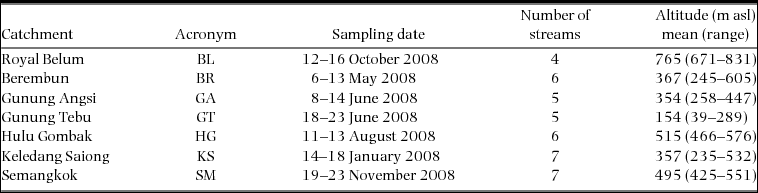
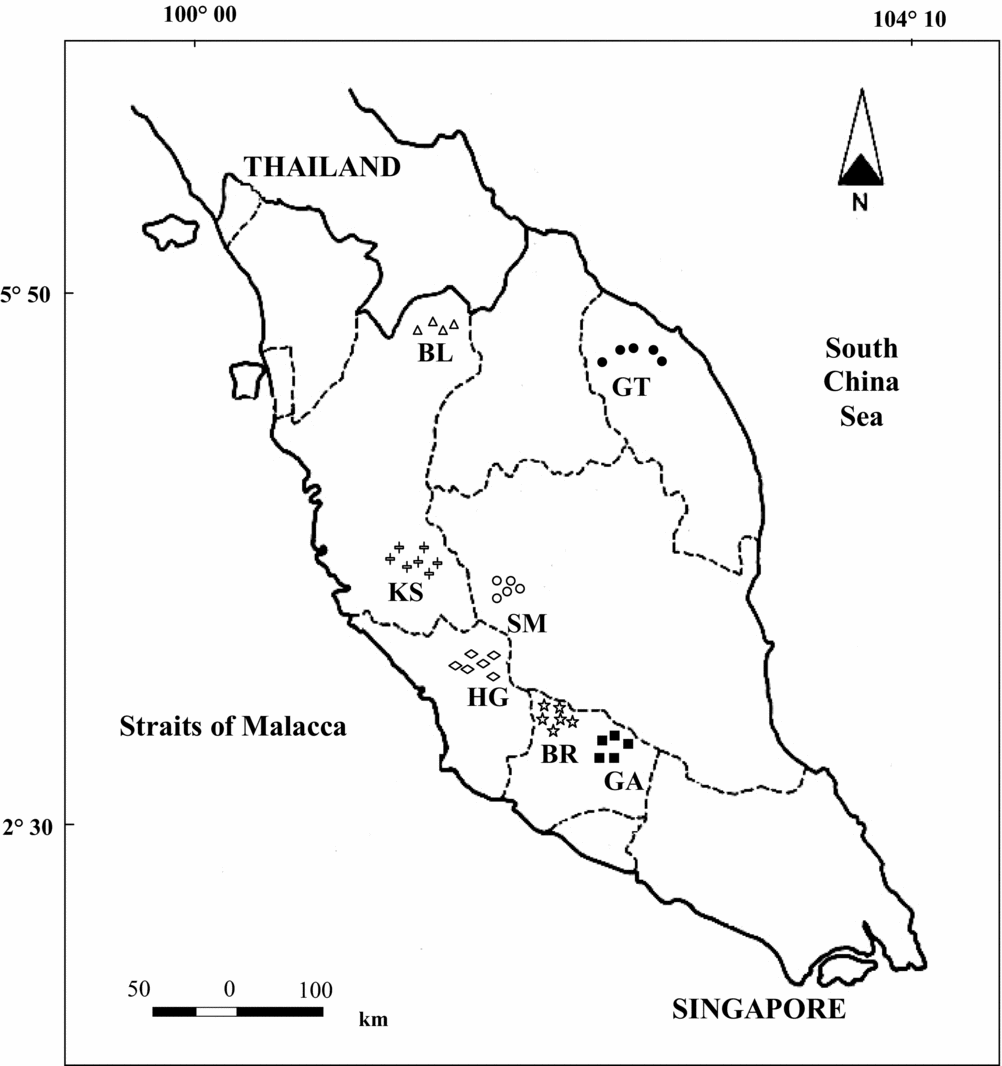
A total of 38 streams (i.e. local) located in seven catchments (i.e. region) were sampled, covering the latitudinal range 2°38′–5°47′ and longitude 101°01′–102°38′. The study streams were located in tropical dipterocarp forests (Figure 1, Table 1): Gunung Tebu (GT), Royal Belum (BL); Semangkok (SK), Keledang Saiong (KS), Hulu Gombak (HG), Gunung Angsi (GA) and Berembun (BR), as described in our previous study (Al-Shami et al. Reference AL-SHAMI, CHE SALMAH, ABU HASSAN and MADRUS2013a). Streams were also selected based on their accessibility and their order ranged from first to third. The investigated forests are covered by thick and dense vegetation, thus accessibility was the main concern. The sampling dates varied over the year because of large distances among forests and due to selecting the most suitable times (i.e. usually periods of little rainfall) to enter the forests. Thus, it was extremely difficult to sample all sites at the same time. Most of the sampling sites in this study are pristine as they are located in protected forest reserves. However, some logging activities were reported in some forests more than 30 y ago. Other forests have been recently disturbed by oil palm plantation and highway construction (GA and HG). Further details of the study sites and their geographical locations and characteristics are described in Al-Shami et al. (Reference AL-SHAMI, CHE SALMAH, ABU HASSAN and MADRUS2013a).
Details of names, date, streams number, altitude and geographical coordinates of forested catchments in Peninsular Malaysia where benthic invertebrates were collected.

Map of Peninsular Malaysia showing approximate location of investigated regions.
Aquatic macro-invertebrates
The datasets used in this paper are based on stream-invertebrate collections from our previous study (Al-Shami et al. Reference AL-SHAMI, CHE SALMAH, ABU HASSAN and MADRUS2013a). In each stream, the benthic macro-invertebrates were sampled (10 samples from each stream) using a D-frame 300-μm-mesh aquatic net of 0.3 m width when it contacts the substrate. Further details on the stream macro-invertebrates sampling procedures and techniques are provided in Al-Shami et al. (Reference AL-SHAMI, CHE SALMAH, ABU HASSAN and MADRUS2013a). The aquatic macro-invertebrates were identified using keys of Morse et al. (Reference MORSE, YANG and TIAN1994) and Yule & Yong (Reference YULE and YONG2004). It was difficult to identify most of the specimens to species level due to a lack of taxonomic keys for Malaysian stream macro-invertebrates. In such cases, we identified most specimens to genus, which still provides useful data for biodiversity studies (Heino & Soininen Reference HEINO and SOININEN2007).
Environmental data
Description of measuring and analysing the physico-chemical parameters of the studied streams in Peninsular Malaysia is provided in our previous study (Al-Shami et al. Reference AL-SHAMI, CHE SALMAH, ABU HASSAN and MADRUS2013a). These environmental parameters include water depth, stream width, water pH, water temperature, velocity, dissolved oxygen (DO), biochemical oxygen demand (BOD), chemical oxygen demand (COD), ammonia-N and total suspended solids (TSS).
Canopy cover was estimated visually as a percentage (%). The substratum was classified based on the description by Platts et al. (Reference PLATTS, MEGAHAN and MINSHALL1983) and the substrate index mean was calculated following the method of Baltz et al. (Reference BALTZ, VONDRACEK, BROWN and MOYLE1991). However, the total habitat score was calculated based on the composite scores of habitat assessments following the method of Barbour et al. (Reference BARBOUR, GERRITSEN, SNYDER and STRIBLING1999).
Statistical analysis
Non-metric multidimensional scaling (NMDS) based on Euclidean similarity distance was used to examine the variation in environmental parameters among the investigated regions using PAST.
In this study, a stream was considered as the local scale and a catchment as the regional scale. Thus, LSR was expressed as mean species richness for each stream to avoid pseudoreplication (Srivastava Reference SRIVASTAVA1999). Meanwhile, RSR was reported as the cumulative species richness of a catchment. To examine the nature of the LSR–RSR relationship (i.e. linear or curvilinear), the decision tree approach of Griffiths (Reference GRIFFITHS1999) was applied on log-transformed data. First, regression analysis was conducted for log(x+1)-transformed data to examine whether the regression line passed through the origin (intercept not different from 0). Then, if the intercept was significantly higher than 1, the shape was assumed to be curvilinear. However, if the intercept was not different from 1, another regression was fitted for log-transformed data. Therefore, one-sample t-test was employed to check if the slope for log-transformed regression differed significantly from 1. If so, the LSR–RSR relationship was interpreted to be curvilinear. If the slope did not differ from 1 the LSR–RSR relationship was assumed to be linear. This approach to examine the shape of the LSR–RSR relationship has been used in several studies (Canning-Clode et al. Reference CANNING-CLODE, BELLOU, KAUFMANN and WAHL2009, Gronroos & Heino Reference GRONROOS and HEINO2012, Soininen et al. Reference SOININEN, HEINO, KOKOCINSKI and MUOTKA2009).
All statistical analyses were performed using R version 2.14.1. A simple linear model was also employed to examine the influence of RSR on LSR. Meanwhile, a multiple regression model was conducted using the package of MASS (Venables & Ripley Reference VENABLES and RIPLEY2002) to determine the effects of environmental parameters on local species richness. Variation partitioning (functions varpart) and significance of fractions (using 999 permutations) were carried out using the vegan package to estimate the relative importance of RSR and environmental parameters on LSR.
RESULTS
The relationship between LSR and RSR
Variability in the environmental conditions was relatively low as illustrated in the NMDS graph (Figure 2). Environmental variables of Royal Belum (BL) and Gunung Tebu (GT) showed high variation compared with those in the other catchments.
NMDS based on Euclidean distance of physical and chemical parameters (pH, DO, velocity, temperature, width, depth, TSS, BOD, COD, ammonia and canopy cover) showing low amount of variation among the investigated catchments. BL: Belum, BR: Berembun, GA: Gunung Angsi, GT: Gunung Tebu, HG: Hulu Gombak, KS: Keledang Saiong, SM: Semangkok.
A total of 151 taxa and morphospecies of aquatic macro-invertebrate were found in forested streams of Peninsular Malaysia (Appendix 1). The mean LSR at the local scale (stream) varied from 3.1 to 15.9. However, RSR at the regional scale ranged from 20 to 54.
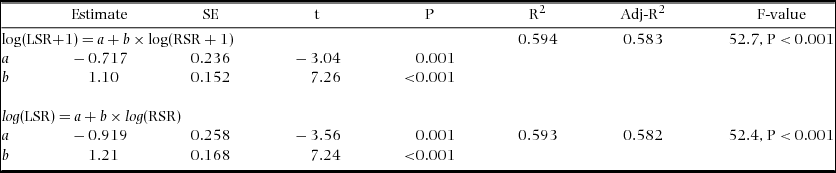
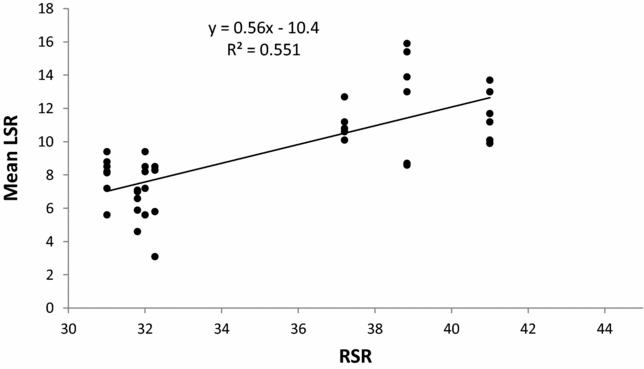
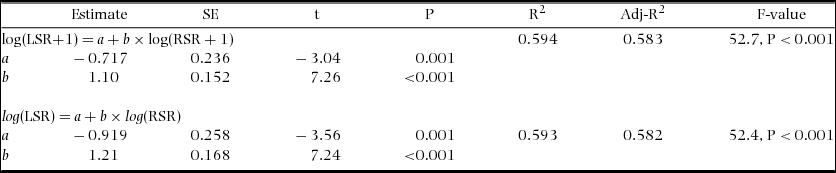
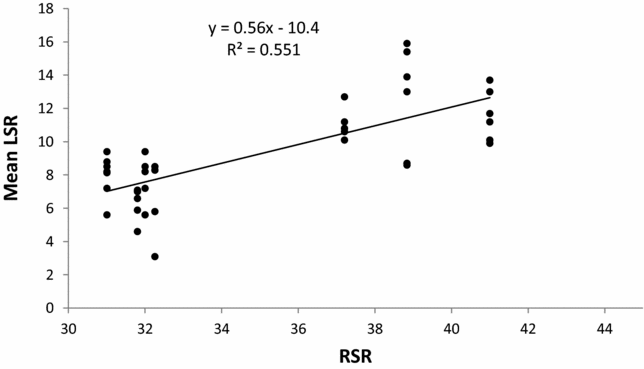
The aquatic macro-invertebrate community showed a linear relationship between RSR and LSR. In the log(x+1)-transformed regression model (Adj-R2 = 0.583, F = 52.7, P < 0.001), the intercept (a) was −0.717 and did not differ significantly from 0. Meanwhile, the slope in the log-transformed regression model (Adj-R2 = 0.582, F = 52.4, P < 0.001) did not differ from 1 (b = 1.21) indicating a linear relationship of LSR–RSR (Table 2). For comparison, the regression model based on untransformed data was always significant between RSR and LSR (mean), as illustrated in Figure 3 (R2 = 0.551, P < 0.01).
Summaries of the two regression models (log-transformed and log (x+1)-transformed for local species richness (LSR) and regional species richness (RSR) of stream invertebrates in Peninsular Malaysia. a: intercept, b: slope.
Regression plots of mean local species richness (LSR) versus regional species richness (RSR) of stream invertebrates in Peninsular Malaysia. The linear regression equation is based on untransformed data.
Influence of RSR and environmental conditions on LSR
As expected, RSR showed a strong and significant relationship with LSR (Adj-R2 = 0.596, F1,36 = 55.6, P < 0.001). On the other hand, the multiple regression model of environmental parameters versus LSR was not significant (Adj-R2 = 0.189, F12,25 = 1.72, P = 0.122). In this model, only total suspended solids (TSS; Adj-R2 = 0.118, P = 0.023) and DO (Adj-R2 = 0.100, P = 0.024) showed significant influence on LSR (P < 0.05).
The variation partitioning results revealed that a high and significant fraction (F = 28.7, P = 0.005) of the variation in LSR was explained solely by RSR (43%). However, the variation in LSR explained by pure environmental parameters was not significant (F = 1.15, P = 0.350), and was as low as 2%. The shared fraction of variation of LSR for RSR+ENV was 17% and the amount of unexplained variance in this model was 38%.
DISCUSSION
Shape of the LSR–RSR relationship for aquatic macro-invertebrates in Peninsular Malaysia
The present study revealed that local macro-invertebrate richness in forested streams of Peninsular Malaysia showed a linear relationship with RSR. Aquatic macro-invertebrates display substantial and varied rates of dispersal, as they inhabit different environments with different histories and evolution, thus promoting the regional processes to control the local diversity (Gronroos & Heino Reference GRONROOS and HEINO2012, Palmer et al. Reference PALMER, ALLAN and BUTMAN1996). This concurred with earlier studies (Cornell et al. Reference CORNELL, KARLSON and HUGHES2008, Griffiths Reference GRIFFITHS1999, Heino et al. Reference HEINO, MUOTKA and PAAVOLA2003), demonstrating a sound influence of regional diversity on LSR (Gronroos & Heino Reference GRONROOS and HEINO2012).
The present study can be considered to be the first report examining specifically the LSR–RSR relationship and the effects of environmental factors on local diversity of aquatic macro-invertebrates in forested headwater streams of Peninsular Malaysia. Essentially, our results revealed a strong effect of RSR on LSR. The R2 values reported in this study (R2 = 0.607, Adj-R2 = 0.596) fall within the ranges recorded for other aquatic animals: 0.10–0.57 for stream fishes (Angermeier & Winston Reference ANGERMEIER and WINSTON1998), up to 0.69 for stream macro-invertebrates (Heino et al. Reference HEINO, MUOTKA and PAAVOLA2003, Soininen et al. Reference SOININEN, HEINO, KOKOCINSKI and MUOTKA2009) and 0.76 for marine benthic macro-invertebrates (Witman et al. Reference WITMAN, ETTER and SMITH2004). However, value from this study was higher than that from a similar study of temperate streams in Finland, which reported an Adj-R2 value of 0.13 (Gronroos & Heino Reference GRONROOS and HEINO2012). Although our findings might be surprising because of high Adj-R2 values, they are still in the line of several studies involving both aquatic invertebrates and vertebrates (Cornell Reference CORNELL1999, Heino et al. Reference HEINO, MUOTKA and PAAVOLA2003, Shurin et al. Reference SHURIN, HAVEL, LEIBOLD and PINEL-ALLOUL2000).
Although many researchers may consider environmental parameters to be the major determinants of species diversity at local scales (Gronroos & Heino Reference GRONROOS and HEINO2012), we could not detect a clear influence of environmental parameters on local diversity. This was in disagreement with results of Gronroos & Heino (Reference GRONROOS and HEINO2012), who found a significant relationship between environmental parameters and local species richness. Hence, there is a discrepancy in the findings about the drivers of local species richness as several authors have demonstrated that a strong RSR–LSR relationship indicates the superiority of regional control over local diversity for lentic and lotic communities (Al-Shami et al. Reference AL‐SHAMI, HEINO, CHE SALMAH, ABU HASSAN, SUHAILA and MADRUS2013b, Griffiths Reference GRIFFITHS1997, Hugueny & Paugy Reference HUGUENY and PAUGY1995, Oberdorff et al. Reference OBERDORFF, HUGUENY, COMPIN and BELKESSAM1998). Others, however, have highlighted the prevalence of local processes in shaping the patterns of local richness for aquatic communities (Jackson & Harvey Reference JACKSON and HARVEY1989, Tonn et al. Reference TONN, MAGNUSON, RASK and TOIVONEN1990).
Relative importance of RSR and environmental conditions on LSR
Although several studies suggested that both species richness of the regional pool and environmental conditions were important in determining local macro-invertebrate species richness, we found the regional species pool was the only significant and strong driver of local species richness. The amount of variance explained by RSR was less than 50% of the total variation in LSR. This indicates absence of pseudoreplication when mean LSR was used in exploring the LSR–RSR relationship to evade the within-region variability in LSR, which may result in overestimation of the importance of RSR (Gronroos & Heino Reference GRONROOS and HEINO2012, White & Hurlbert Reference WHITE and HURLBERT2010). By comparison, the regional diversity pool explained the highest fraction of variation in LSR, which is much higher compared with the fraction percentage reported for aquatic macro-invertebrates from boreal streams (Gronroos & Heino Reference GRONROOS and HEINO2012). Despite that, the richness of the regional species pool explained 73–76% of local species richness for marine benthic communities (Witman et al. Reference WITMAN, ETTER and SMITH2004). On the other hand, it is an accepted fact that stream species richness is low at small spatial scale (i.e. local scale) and high at large spatial scale (i.e. regional scale) in the tropics compared with temperate streams (Dudgeon Reference DUDGEON2008) due to higher rarity of most taxa in the tropics (Stout & Vandermeer Reference STOUT and VANDERMEER1975).
It was expected that RSR would be more important in explaining the variation of LSR compared with environmental conditions. We also found that environmental variables showed weak (2%) relative importance in controlling the LSR for macro-invertebrates in forested streams of Peninsular Malaysia. However, Gronroos & Heino (Reference GRONROOS and HEINO2012) found extremely high importance of local environmental conditions for local species richness in forested streams of Finland, probably because of high variation of environmental conditions among the investigated regions. Although the regression model of LSR against environmental parameters was not significant in this study, some variables such as TSS and DO were the only significant factors influencing local richness. We suggest that low variation in physical and chemical features in the studied regions may weaken the effects on local diversity. This also was supported by our earlier reports as the effect of selected environmental parameters on beta diversity of stream invertebrate communities was clearly suppressed by the presence of a regional factor (Al-Shami et al. Reference AL‐SHAMI, HEINO, CHE SALMAH, ABU HASSAN, SUHAILA and MADRUS2013b). In addition, the importance of RSR for benthic invertebrates at large regional scales has been inconsistently reported, with either high (Heino et al. Reference HEINO, MUOTKA and PAAVOLA2003) or low (Stendera & Johnson Reference STENDERA and JOHNSON2005) values cited. Therefore, it is assumed that regional processes exert a stronger influence in streams of Peninsular Malaysia than in temperate forested streams (Gronroos & Heino Reference GRONROOS and HEINO2012). Despite the fact that the investigated streams are not currently managed and, to a degree, are protected by state governments from anthropogenic disturbance, logging activities in some adjacent forests near to the studied sites were reported about 40 y ago (i.e. between 1963 and 1977; S. K. Yap unpublished data). Thus, this previous land-use may result in a profound effect of the region on the local diversity. According to Harding et al. (Reference HARDING, BENFIELD, BOLSTAD, HELFMAN and JONES1998), past land-use and deforestation may lead to strong alterations in the diversity of stream macro-invertebrates seen in the present day.
CONCLUSIONS
We found that RSR had a linear relationship with LSR, indicating unsaturated diversity of aquatic macro-invertebrates in streams of Peninsular Malaysia. The strong effect of RSR reflects the importance of regional processes (e.g. dispersal constraints, topographic factors, past land-uses) in shaping the local diversity in tropical forested streams of Malaysia. Thus, RSR explained the highest fraction of variation in local diversity. However, the effect of environmental parameters on LSR was absent, probably because of low variation in physical and chemical conditions among the studied regions. Further studies encompassing a larger scale would be useful in drawing general conclusions about the relationship between the regional diversity pool and local species richness in tropical streams of South-East Asia. Consequently, such future studies may help explain both the ecological and biological mechanisms controlling diversity of aquatic macro-invertebrate communities in tropical streams of Asia.
ACKNOWLEDGEMENTS
Thanks to Jani Heino for kind help and constructive comments which improved the paper significantly. We also express our heartfelt gratitude to various people involved in this study; Hazdri Abdullah, Mohd Shukri, Hamzah, Siti Khatijah, Yahya Tahir, Wan Zaki, Kalimuthu for their tireless help in the field. To many others who directly or indirectly helped us during this study, we are indebted. We are grateful to the Dean, School of Biological Sciences, Universiti Sains Malaysia in Penang for providing field and laboratory facilities to conduct this research. To Forest Research Institute Malaysia counterparts headed by Dr Christine Fletcher and Dr Abdul Rahman Kassim, we thank them for their financial support, help and understanding. The Conservation of Biodiversity (CBioD) Project is a national project executed by the Ministry of Natural Resources and the Environment, and implemented by the Forest Research Institute Malaysia. The CBioD Project is co-funded by the UNDP-GEF (MAL/04/G3) and ITTO [PD 165 02 Rev.3 (F)]. Key partners to the CBioD Project are: Perak ITC S/B, Perak SEDC, Forestry Headquarters State Forestry Departments of Peninsular Malaysia and Fundamental Research Grant (203/PBIOLOGI/6711224) of Ministry of Education Malaysia. The Project is a joint effort with the University of Miami, Duke University and Harvard University. Thanks also go to two anonymous reviewers as well the associate editor for their constructive comments.
Abundance of aquatic macro-invertebrates taxa collected from forested streams. Taxonomic composition of the forested catchments in the Peninsular Malaysia. BL: Belum, BR: Berembun, GA: Gunung Angsi, GT: Gunung Tebu, HG: Hulu Gombak, KS: Keledang Saiong, SM: Semangkok.