One of the most effective strategies to reduce intramammary infections is antibiotic dry therapy. This practice is widely used in dairy cows and has proven effective in keeping them healthy and enhancing milk production (Robert et al. Reference Robert, Seegers and Bareille2006). Antibiotic dry therapy has also shown good results in meat sheep breeds, helping to increase weight gain in lambs relative to untreated animals (Watson & Buswell, Reference Watson and Buswell1984). The therapy has worked well in several breeds of dairy sheep (reviewed by Petridis & Fthenakis, Reference Petridis and Fthenakis2014), including Israeli-Assaf sheep under intensive management (Chaffer et al. Reference Chaffer, Leitner, Zamir, Winkler, Glickman, Ziv and Saran2003), cross-bred dairy sheep in a semi-intensive system (Spanu et al. Reference Spanu, Berger, Thomas and Ruegg2011), Churra sheep under traditional management (Gonzalo et al. Reference Gonzalo, Tardaguila, De la Fuente and San Primitivo2004) or Spanish-Assaf sheep in mixed production systems (Gonzalo et al. Reference Gonzalo, Linage, Carriedo, Juarez, Beneitez, Martinez and De la Fuente2009, Reference Gonzalo, Carriedo, Garcia-Jimeno, Perez-Bilbao and De la Fuente2010).
In addition, previous studies of this therapy in dairy sheep have not examined in detail the various factors that may influence its success, such as dry period length, which can be crucial for subsequent milk yield (Hernandez et al. Reference Hernandez, Elvira, Gonzalez-Martin and Astiz2012). These investigations are particularly important for optimising production while minimising antibiotic use. Therefore, the present study investigated the effects of intramammary cephapirin dry therapy on the performance and health of Lacaune sheep under intensive management.
Material and methods
Flock and management
This study included data on milk production from complete lactation periods of 4345 Lacaune sheep on a single farm between March 2009 and January 2012. Since June 2010, intramammary cephalosporin (cephapirin benzathine; CEFA-SAFE®, MSD Animal Health, Boxmeer, Netherlands) was administered to all sheep (300 mg/ewe) at the beginning of the dry period. Ewes belonged to a flock of approximately 4000 sheep on the Cerromonte Farm in Avila, Spain (continental climate, latitude 40.90°N, altitude 900 m). The original flock had been imported from the French Lacaune Association in the Upra Lacaune Region of Aveyron.
The environmental conditions of the animals remained approximately the same over the entire study period. Flock management, described in detail by Elvira et al. (Reference Elvira, Hernandez, Cuesta, Cano, Gonzalez-Martin and Astiz2013a, Reference Elvira, Hernandez, Cuesta, Cano, Gonzalez-Martin and Astizb), can be summarised as follows. Animals were housed indoors, and food was rationed according to the sheep's production level. Reproductive management included five mating periods per year; different groups of ewes were kept with males for 25 d to allow natural mating. Ewe lambs were mated for the first time between 8 and 10 months of age. Mean age at first lambing was 432±77·4 d (14·4 months). Ewes were mated again approximately 100–140 d after lambing. From the day after lambing, ewes were milked twice a day, with no suckling period for lambs, and milking continued until production dropped below 0·5 l/d or until 30 d before the subsequent lambing, when they were dried off.
Experimental groups and endpoints
Data available from ewe lactation periods were analysed in two different ways, depending on the question we wanted to examine. In Experiment 1, we wanted to determine the effects of antibiotic dry therapy on on-farm milk yield and on ewe performance during 5981 lactation periods. All lactation periods included in our analysis were complete: they included a previous initial dry period as well as subsequent lambing. A total of 2152 lactation periods were second lactation periods; 1681, third; 1015, fourth; 667, fifth; 316, sixth; and 150, seventh or later lactation periods.
A total of 2402 lactation periods followed an initial dry period with antibiotic therapy (antibiotic group), while 3579 followed an initial dry period with no therapy (control group). Data on potential confounding factors known to influence performance, such as lactation period number (LN), length of initial dry period (I-DPL) and initial interlambing interval (I-ILI) were collected. ILI was defined as the time interval between two consecutive lambings.
To control for effects of antibiotic dry therapy at the level of individual ewes, we analysed a subset of 1951 animals for which data for two consecutive lactation periods were available. For these animals, data were compared for a lactation period after an initial dry period with no antibiotic treatment (control group) and for a subsequent lactation period after antibiotic dry therapy (antibiotic group).
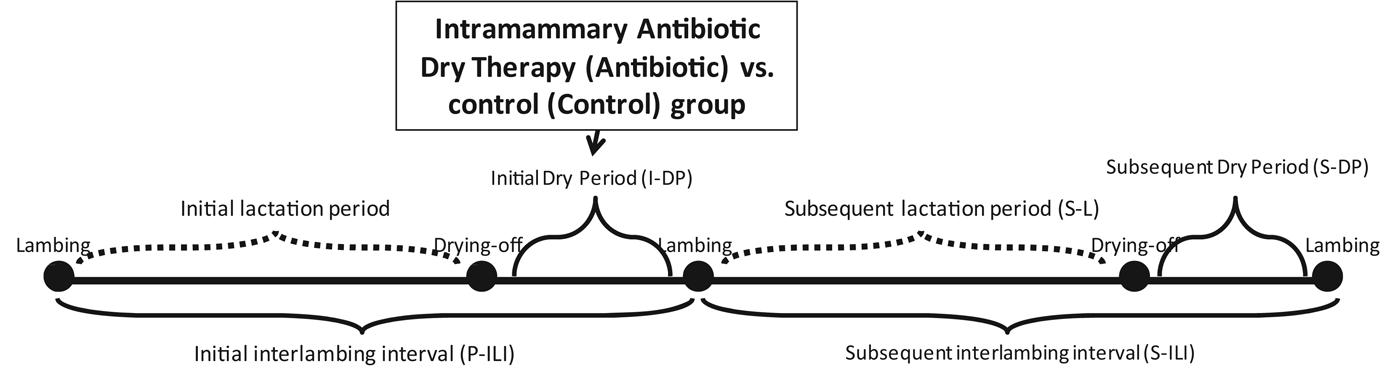
The following on-farm yield data were collected for individual lactation periods: individual ewe; the initial interlambing interval (I-ILI), defined as the interval between the previous lambing and the lambing that gave rise to the lactation period under study; the number of the lactation period under study (LN); the length of the initial dry period before the lactation period under study (I-DP); the length of the lactation period under study (S-LL); total milk yield of the lactation period under study (TY), daily milk yield in ml during the lactation period under study (Y/DIM); the length of the subsequent dry period (S-DPL); and the length of the subsequent interlambing interval (S-ILI) (Fig. 1).
Study design and nomenclature of lactation periods and relevant performance parameters.

In Experiment 2, we wanted to study the effects of antibiotic dry therapy on milk quality parameters, i.e. somatic cell count (SCC) and content of fat and protein. Data on milk quality were taken from the Spanish National Official Milk Yield Recording System for Sheep Dairy Production Control Programme (http://www.uagcyl.es/). This part of the study included 3727 complete lactation periods with a previous dry period, of which 1620 followed a dry period with no antibiotic therapy (control group) and 2107 followed antibiotic dry therapy (antibiotic group). Ewe-level analysis was conducted on data from 1390 animals for which two consecutive lactation periods were compared, one after an untreated initial dry period (control group) and a subsequent lactation period after antibiotic dry therapy (antibiotic group). Data from the National Official Milk Yield Recording System were extracted on the following parameters of milk yield and quality during subsequent lactation periods: SCC (cells/ml×10−3), Y/DIM, total protein yield (TP, %) and total fat yield (TF, %). Sampling was performed once a month by farm workers, who tested every sheep that was lactating on the day of sampling.
During the study period, antibiotic residues in the milk of each bulk tank were assayed daily before collection. These legally mandated assays are designed to detect down to 4 parts per billion by volume (ppb) of amoxicillin, 4 ppb of ampicillin and 10 ppb of oxytetracycline. The assays were performed using an Eclipse 100ov screening test according to the manufacturer's instructions (ZEU-Inmunotec, Zaragoza, Spain). This test is based on the ability of samples to inhibit the growth of spores of Bacillus stearothermophilus var. calidolactis C953. Milk in bulk tanks was also sampled monthly for the 12 months preceding this study in order to identify pathogens present on the farm. The pathogens most frequently isolated were coagulase-negative Staphylococcus, followed by Staph. aureus and least often Streptococcus agalactiae. These results were used to select the appropriate drug for antibiotic dry therapy during the present study. SCC was determined by spectrophotometry and flow cytometry.
Statistics
Performance records were collected at the farm, stored and validated on-farm using Alpro Windows software (DeLaval, Tumba, Sweden). Records from the National Official Milk Yield Recording System were collected from the publicly available database (www.uagcyl.es). Data were analysed using SPSS® 19.0 (IBM, NY, USA). Statistical significance of differences in continuous parameters was assessed using Student's t test. Relationships between continuous variables were assessed using Pearson correlation analysis. When data did not show a normal distribution, the significance of differences was assessed using the Kruskal-Wallis test. Only differences with P<0·001 were considered significant; this restrictive threshold was chosen in light of the large size of the animal groups in this study.
Results
Experiment 1: on-farm parameters of yield and performance
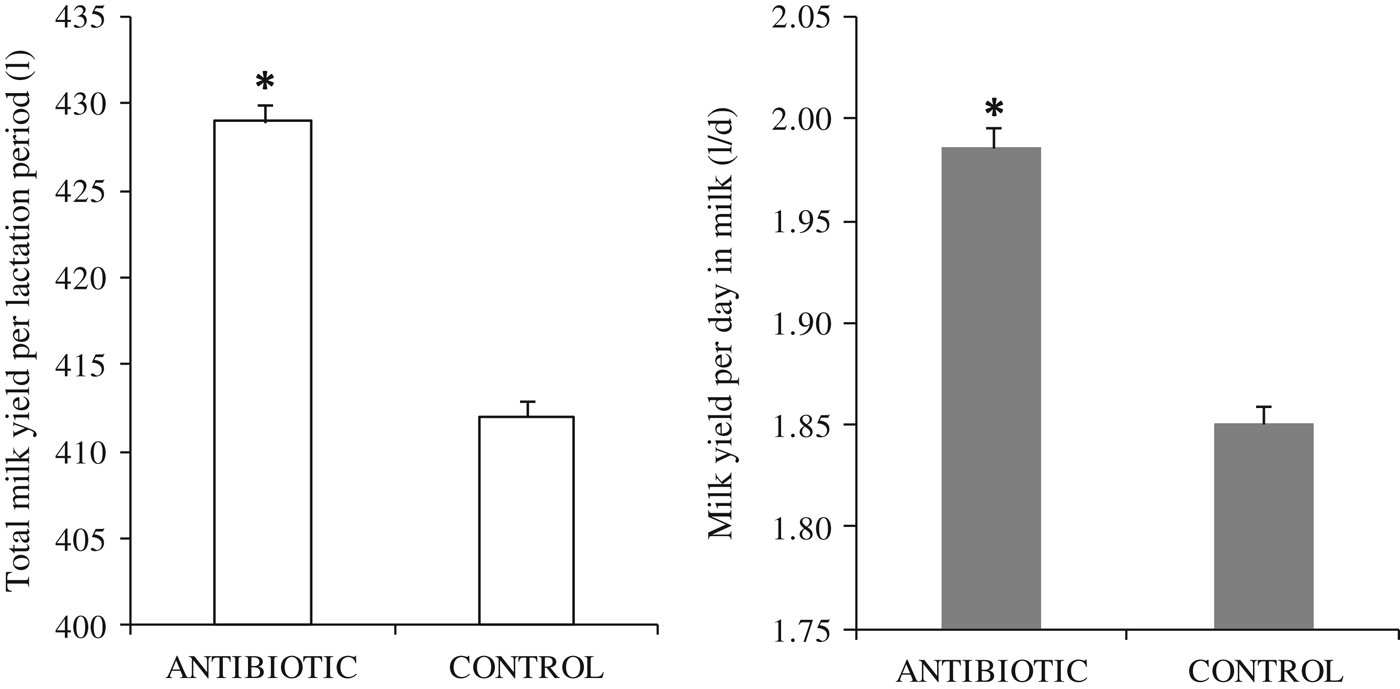
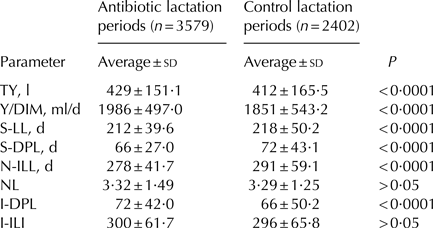
Antibiotic dry therapy with cephalosporin significantly improved daily milk yield and total yield per lactation period in Lacaune dairy sheep under intensive conditions, based on analysis of 5981 complete lactation periods (Table 1, Fig. 2).
Total yield per lactation period (left) and daily milk yield (right) of Lacaune dairy sheep under intensive management. Lactation periods were preceded either by cephapirin dry therapy (n=3579 lactation periods; Antibiotic) or by a dry period with no therapy (n=2402 lactation periods; Control). Asterisks show statistically significant differences between groups (P<0·001).
Performance and yield parameters associated with lactation periods of 1951 Lacaune dairy sheep under intensive management following an initial dry period with cephapirin therapy (Antibiotic) or no therapy (Control)
TY, total yield of subsequent lactation periods; Y/DIM, daily milk yield; S-LL, length of the subsequent lactation period; S-DPL, length of the subsequent dry period; N-ILL, subsequent interlambing interval; NL, number of lactation periods; I-DPL, length of the initial dry period; I-ILI, length of the initial interlambing interval
To verify that these results were likely to reflect the effects of antibiotic dry therapy, we compared the antibiotic and control groups in terms of several potential confounding factors. As expected, we found that the antibiotic group showed a similar number of lactation periods, similar initial interlambing interval but larger initial dry period length (Table 1).
Analysis of variations in performance variables within and between the antibiotic and control groups revealed that initial dry period length correlated inversely with yield variables such us total yield (r=−0·055, P<0·0001), daily milk yield (r=−0·039, P<0·0001), and length of the subsequent lactation period (r=−0·048, P<0·0001). Initial dry period length correlated directly with subsequent dry period length (r=0·141) and subsequent interlambing interval (r=0·058; both P<0·0001).
In order to identify which factors exerted the strongest influence on the length of subsequent lactation periods and therefore productivity, we simultaneously analysed all yield and performance variables for a possible relationship with the length of the subsequent lactation period. This decision-tree analysis, conducted simultaneously on data from both the antibiotic group and control group, revealed that the length of the initial dry period was the strongest determinant of the length of the subsequent lactation period (P<0·0001). Initial dry periods lasting 48–52 d were associated with longer lactation periods (mean, 226 d) than were initial dry periods outside this range. Antibiotic therapy affected the length of the lactation period only when the initial dry period was shorter than 48 d; in this case, antibiotic therapy during the dry period was associated with a shorter lactation period (mean, 210 d) than was a dry period without therapy (mean, 219 d; P<0·001).
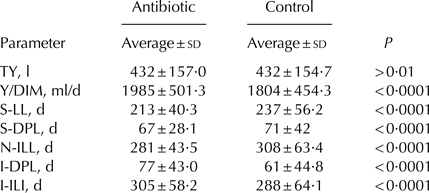
In order to analyse the effects of antibiotic dry therapy at the level of individual ewes, yield parameters were analysed for 1951 sheep with two consecutive complete lactation periods, the first following an initial dry period without antibiotic therapy, and the second following an initial dry period with antibiotic therapy. Antibiotic dry therapy was associated with greater milk production per lactation period (1985±501·3 vs. 1804±454·3 l; P<0·0001) as well as shorter lactation periods (213±40·3 vs. 237±56·2 d; P<0·0001; Table 2).
Comparison of milk yield parameters between a lactation period preceded by an untreated dry period (Control), followed by a lactation period after cephapirin dry therapy (Antibiotic) in the same in the same group of sheep as in Table 1
TY, total yield of subsequent lactation periods; Y/DIM, daily milk yield; S-LL, length of the subsequent lactation period; S-DPL, length of the subsequent dry period; N-ILL, subsequent interlambing interval; NL, number of lactation periods; I-DPL, length of the initial dry period; I-ILI, length of the initial interlambing interval
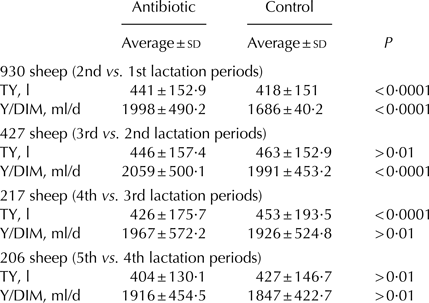
To extend this individual-level analysis, we compared, for the same ewe, one lactation period after an untreated dry period with a lactation period after a treated dry period as a function of lactation order (Table 3). The results indicate that the positive effect of antibiotic treatment on yield is greater during earlier lactation periods.
Comparison of milk yield parameters between a lactation period preceded by an untreated dry period (Control), followed by a lactation period after antibiotic dry therapy (Antibiotic) in Lacaune dairy sheep under intensive management, stratified by lactation order
TY, total yield of subsequent lactation periods; Y/DIM, daily milk yield
Experiment 2: milk quality parameters
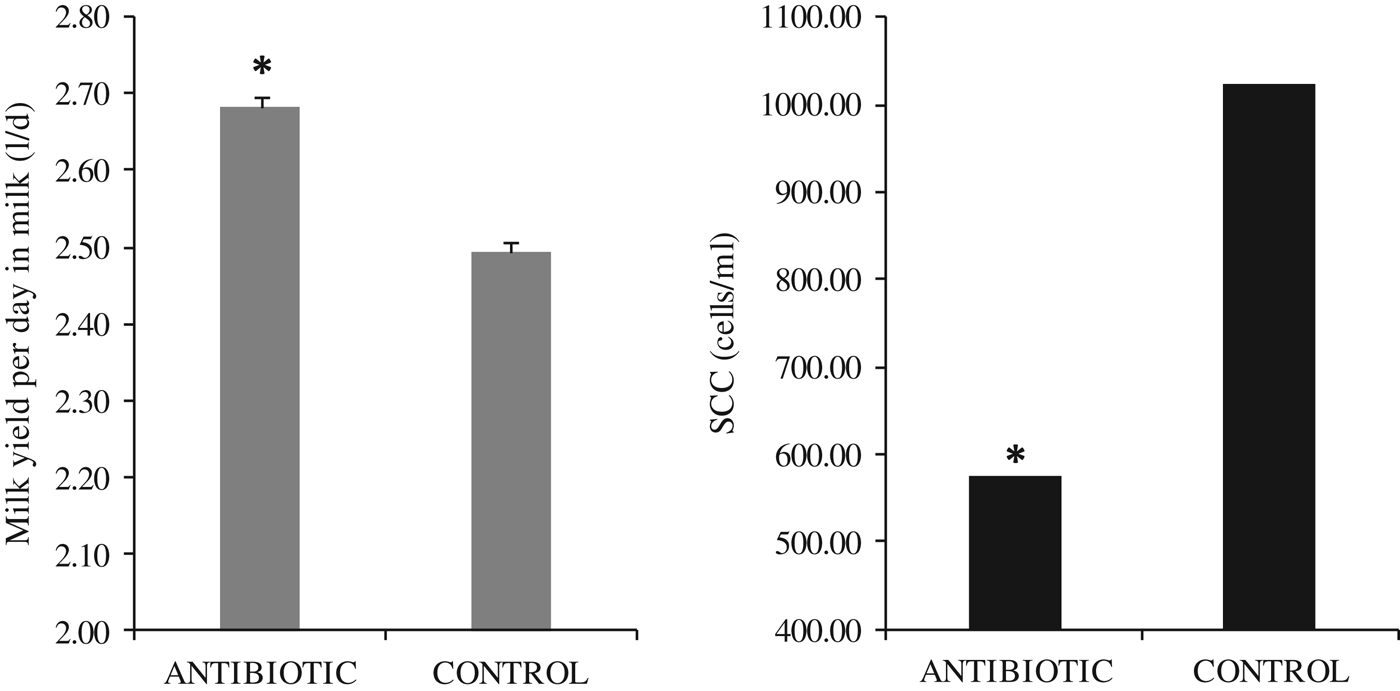
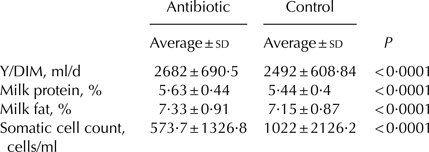
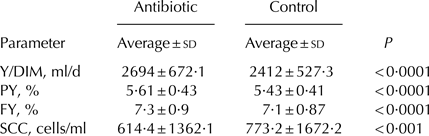
Antibiotic dry therapy significantly improved both the daily milk yield and milk quality during the subsequent lactation period. SCC was significantly lower, and fat and protein content slightly higher, in milk produced following antibiotic dry therapy than in milk produced after a control dry period (Fig. 3, Table 4).
Daily milk yield (left) and somatic cell count (SCC) of milk (right) produced by Lacaune dairy sheep under intensive management during lactation periods preceded either by cephapirin dry therapy (n=2107 lactation periods; Antibiotic) or by a dry period with no therapy (n=1620 lactation periods; Control). Asterisks show statistically significant differences between groups (P<0·001).
Daily milk yield (Y/DIM) and milk quality associated with lactation periods of Lacaune dairy sheep under intensive management following an initial dry period with cephapirin therapy (Antibiotic) or no therapy (Control)
Source: Spanish National Official Milk Yield Recording System for Sheep Dairy Production Control Programme
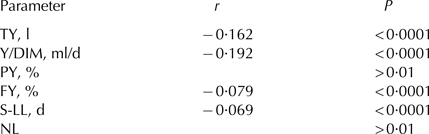
Given the importance of SCC as an index of milk quality, we examined whether SCC correlated with milk yield or quality parameters in our study. The results indicated that SCC correlated inversely with nearly all yield and quality parameters (Table 5). The exceptions were protein content in the milk and number of lactation periods, neither of which showed an association with SCC.
Analysis of correlations between somatic cell count (cells/ml) and milk production and quality parameters of Lacaune dairy sheep under intensive management
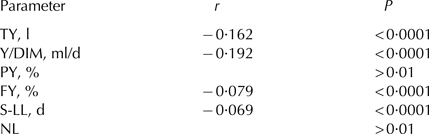
TY, total yield of subsequent lactation periods; Y/DIM, daily milk yield; PY, protein yield in %; FY, fat yield in %; SCC, somatic cell count; S-LL, length of the subsequent lactation period; NL, number of lactation periods; I-DPL, length of the initial dry period
Just as we did for milk yield parameters, we wanted to examine the effects of antibiotic dry therapy on milk quality at the level of individual ewes. Therefore, we analysed quality data for 1390 sheep with two consecutive complete lactation periods, the first following an initial dry period without antibiotic therapy, and the second following an initial dry period with antibiotic therapy. The results confirmed that antibiotic therapy improved yield per day in milk (2694±672·1 vs. 2412±527·3 ml/d; P<0·0001) and reduced the SCC (614·4±1362·1 vs. 773·2±1672·2 cells/ml; P<0·001) (Table 6).
Comparison of milk quality parameters between a lactation period preceded by an untreated dry period (Control) and a subsequent lactation period preceded by antibiotic dry therapy (Antibiotic) in the same group of 1390 Lacaune dairy sheep under intensive management
Y/DIM, daily milk yield; PY, protein yield in %; FY, fat yield in %; SCC, somatic cell count
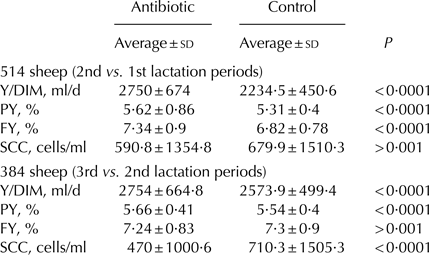
To extend this individual-level analysis, we compared, for the same ewe, one lactation period after an untreated dry period with a lactation period after a treated dry period as a function of lactation order (Table 7). The results indicate that the positive effect of antibiotic treatment on yield was greater during earlier lactation periods, but that the reduction in SCC was more notable in the third lactation period than in the second one.
Comparison of milk quality parameters between a lactation period preceded by an untreated dry period (Control) and a subsequent lactation period preceded by antibiotic dry therapy (Antibiotic) in Lacaune dairy sheep under intensive management, stratified by lactation order
Y/DIM, daily milk yield; PY, protein yield in %; FY, fat yield in %; SCC, somatic cell count
Discussion
The present study provides the first detailed insights into how antibiotic dry therapy affects the productive and milk quality parameters of Lacaune sheep under intensive management. Total yield per lactation period as well as daily milk yield were significantly greater during lactation periods following antibiotic dry therapy than during lactation periods without such therapy. In addition, milk produced after antibiotic dry therapy showed significantly lower SCC and slightly higher protein and fat content than milk in control lactations. These results suggest that antibiotic dry therapy with 300 mg intramammary cephapirin benzathine per ewe can increase the profitability and health of Lacaune dairy sheep under intensive management.
Analysis of yield in individual ewes showed that during the second lactation period, antibiotic dry therapy was associated with enhancement in daily milk yield relative to lactation without antibiotic therapy, while during the third and subsequent lactation periods, yield was similar with or without antibiotic therapy. In contrast, Lacaune ewes under intensive management normally show the highest yield during the first lactation period and then gradually smaller yields during subsequent lactation periods despite a constant daily yield, as a result of the fact that lactation periods gradually shorten with age (Hernandez et al. Reference Hernandez, Elvira, Gonzalez-Martin, Gonzalez-Bulnes and Astiz2011; Elvira et al. Reference Elvira, Hernandez, Cuesta, Cano, Gonzalez-Martin and Astiz2013a, Reference Elvira, Hernandez, Cuesta, Cano, Gonzalez-Martin and Astizb). This suggests that antibiotic dry therapy, by increasing daily yield, can substantially increase total yield per lactation period.
Antibiotic dry therapy was also associated with significantly higher milk quality, reflected in a 50% lower SCC than milk from untreated lactation periods (1022±2126 vs. 573±1326 cells/ml). In fact, SCC in milk from treated lactation periods remained lower than SCC in untreated milk through at least the third lactation period. This is despite the fact that ewes are more likely to suffer intramammary infection and therefore higher SCC with increasing lactation order (Gonzalo et al. Reference Gonzalo, Ariznabarreta, Carriedo and San Primitivo2002, Reference Gonzalo, Tardaguila, De la Fuente and San Primitivo2004). We found that lower SCC correlated with higher yield per day in milk, as reported for dairy cows (Hand et al. Reference Hand, Godkin and Kelton2012) and for Churra and crossbreed dairy sheep (Gonzalo et al. Reference Gonzalo, Tardaguila, De la Fuente and San Primitivo2004; Spanu et al. Reference Spanu, Berger, Thomas and Ruegg2011). Presumably antibiotic dry therapy prevents and eliminates intramammary infections, maximising the number of healthy, milk-producing cells in the udder.
The association between antibiotic dry therapy and both higher daily yield and higher total yield per lactation period is slightly surprising given that the therapy was associated with a significantly longer initial dry period. Longer initial dry periods have been shown to reduce yield and length of subsequent lactation periods as well as leading to poor health in cows, Chilean sheep and Lacaune sheep (Natzke et al. Reference Natzke, Everett and Bray1975; Pinedo et al. Reference Pinedo, Risco and Melendez2011; Hernandez et al. Reference Hernandez, Elvira, Gonzalez-Martin and Astiz2012). However, we did not observe such effects in the present study, suggesting that the positive effects of antibiotic dry therapy can outweigh the potential negative effects due to longer initial dry periods. Such extended dry periods are necessary to ensure adequate time for the antibiotic to clear from the animals and not enter the milk. Indeed, daily testing of milk batches on the study farm failed to detect antibiotic levels in excess of legal limits for Spain (data not shown). This is consistent with previous results suggesting that antibiotic contamination of milk depends more on general farm conditions than on the use of antibiotic dry therapy (Gonzalo et al. Reference Gonzalo, Carriedo, Garcia-Jimeno, Perez-Bilbao and De la Fuente2010).
Antibiotic dry therapy was associated with one negative effect in our study: lactations following therapy were shorter than lactations following control dry periods. Our decision-tree analysis of all performance variables suggests that this negative effect was due not to the therapy itself but to the longer length of the initial dry period. This is similar to the conclusions of a study of antibiotic dry therapy in Lacaune sheep without antibiotic dry therapy (Hernandez et al. Reference Hernandez, Elvira, Gonzalez-Martin and Astiz2012). All these studies are consistent with similar work in dairy cows (Bernier-Dodier et al. Reference Bernier-Dodier, Girard, Talbot and Lacasse2011).
The fact that antibiotic dry therapy was associated with minimal problems in the present study probably reflects the rigorously controlled hygienic conditions on the study farm. Less rigorous control may help explain why such therapy by itself was found to be insufficient for reducing SCC in milk and therefore for enhancing yield in Israeli-Assaf dairy sheep after procaine-benzylpenicillin-nafcillin-dihydrostreptomycin dry therapy; additional measures were needed to prevent intramammary infections and maintain healthy udders in the herd (Chaffer et al. Reference Chaffer, Leitner, Zamir, Winkler, Glickman, Ziv and Saran2003). Failure to ensure adequate hygiene control may also help explain why antibiotic dry therapy failed to improve milk yield in Spanish Assaf milk ewes (Gonzalo et al. Reference Gonzalo, Linage, Carriedo, Juarez, Beneitez, Martinez and De la Fuente2009).
We observed an inverse relationship between fat content in milk and SCC, as reported for dairy goats (Revilla et al. Reference Revilla, Lurueña-Martínez and Vivar-Quintana2009; Rupp et al. Reference Rupp, Clément, Piacere, Robert-Granié and Manfredi2011). In contrast, we observed no association between protein content of milk and SCC.
Management practices on the study farm can be considered representative of other Lacaune farms outside the Roquefort Designation of Origin and they are similar to management practices for many other dairy sheep breeds under intensive management. Therefore, we expect our results to be relevant to most intensive dairy sheep farms around the world.
Conclusion
This study indicates that antibiotic dry therapy with cephapirin is associated with both greater total milk yield and daily milk yield during subsequent lactation periods in Lacaune dairy sheep under intensive conditions. It is also associated with significantly lower SCC and slightly higher protein and fat content of milk produced in subsequent lactation periods. These findings suggest that antibiotic dry therapy may be effective for improving the health and productivity of Lacaune sheep as well as potentially other dairy sheep breeds under intensive management.
The authors would like to thank Frank Wallner for assistance with data collection, the flock managers for their collaboration, and Pedro Cuesta and Iagoba Cano (Department of Research Support, Complutense University of Madrid) for statistical analyses.