

In a Washington Post column, editor Marc Fisher (Reference Fisher2021) argues that the COVID-19 pandemic created ideal conditions for the spread of extremist views in the United States. In particular, he notes that pandemics increase distrust in traditional institutions; the “economic wallop and the disease’s lethal punch” contribute to radicalization, especially among “white supremacist and neo-Nazi groups” that, by “offering a unified belief system that blames others … proposes to resolve anxieties by attacking the existing power structure.” Fisher’s column is not unique; other stories in major media outlets have presented similar arguments (e.g., Ainsley, Reference Ainsley2021; Clarke, Reference Clarke2022).
Academic papers, too, have explored the relationship between pandemics and extremism. Terrorism scholars, for example, argue that COVID-19 might lead to radicalism around the world (Ackerman & Peterson, Reference Ackerman and Peterson2020; Marone, Reference Marone2021), and a Brookings Institution article suggests that far-right populist political parties in Italy may benefit from the pandemic’s effects (De Maio, Reference De Maio2020). Research focused on the effects of the last major pandemic—the Spanish influenza of 1918–1919—further fuels these concerns. The rise of both the Nazi Party in Germany (Blickle, Reference Blickle2020) and the Fascist Party in Italy (Acemoglu et al., Reference Acemoglu, De Feo, De Luca and Russo2020; Galofré-Vilà et al., Reference Galofré-Vilà, Gómez-León and Stuckler2021) have been connected to higher influenza death rates in European cities.
Taken together, these popular and scholarly accounts raise the question of how radical attitudes manifested in the United States after the 1918–1919 influenza pandemic. While the early 1920s United States is not directly comparable to the social and economic strife in Germany and Italy that led to the rise of the Nazi and Fascist parties, the United States witnessed its own manifestation of right-wing populism in the rapid ascendance of the Ku Klux Klan (see Gordon, Reference Gordon2017). In the aftermath of the pandemic, Klan membership grew rapidly in the early 1920s, peaking around 1924 and enrolling over 1% of the U.S. population (Skocpol et al., Reference Skocpol, Ganz and Munson2000).
Thus, we ask, did the deaths that resulted from the influenza epidemic of 1918–1919 affect the strength of Klan membership in the early 1920s? The answer to this question has critical implications both for our understanding of this specific episode in American politics and for what scholars and activists might expect from post-COVID-19 pandemic mobilization in the United States.
The Ku Klux Klan of the 1920s
The Ku Klux Klan of the 1920s was formed by Colonel William Joseph Simmons in 1915. The new Klan was inspired by D. W. Griffith’s film Birth of a Nation. The Klan struggled in its early years, but in June 1920, Simmons met with two members of the Southern Publicity Association who had worked on public relations campaigns for other major groups. Together, they devised a new approach to build the organization. Klan representatives were well compensated for attracting new dues-paying members using a pitch centered on a “100% American” message that portrayed immigrants, Jews, Blacks, and Catholics as threats to the American order (MacLean, Reference MacLean1994; Madison, Reference Madison2020; Pegram, Reference Pegram2011). The group’s nationalistic, nativist, and racist messaging have led many Klan historians to note its similarities to early twentieth-century right-wing populist movements in Europe (Gordon, Reference Gordon2017, pp. 199–209). Most scholars, however, stop short of directly comparing the Klan to fascism (but see MacLean, Reference MacLean1994, pp. 179–184, as noted by Pegram, Reference Pegram2011, p. 223).
The reborn Klan’s message was particularly attractive to native-born White Protestants in the wake of World War I, and the Klan’s popularity grew so quickly that by 1921, Congress was investigating its activities. This surge of attention, coupled with that garnered by members’ robes, hoods, and cross burnings, drew detractors—but also attracted more members. With a significant, rapidly growing membership base, the Klan then moved to build alliances with politicians and political party leaders who supported its message. The foremost example is the Klan’s strong presence in Indiana’s Republican Party and the city of Indianapolis (Moore, Reference Moore1991), but the group also became involved in politics in other states, particularly Colorado (Goldberg, Reference Goldberg1981).Footnote 1
The Klan’s success, however, was short-lived. Its growth was fueled by clever marketing and a confrontational message. As Fryer and Levitt (Reference Fryer and Levitt2012) state, “the 1920s Klan is best described as an enormously successful marketing ploy: a classic pyramid scheme, officials at the top getting rich off of the individuals at the bottom, energized by sales agents with enormous financial incentives to sell hatred” (p. 1924). Money flowed to the leadership, but it split into two camps when Simmons was replaced as Imperial Wizard by Hiram Wesley Evans. The membership took sides, too. Then, the Klan faced backlash from politicians, newspaper editors, the public, and former members who exposed its secrets. Finally, in Indiana—the Klan’s base of power—the leader behind the order’s success in the state was tried and found guilty of abduction, rape, and murder (Madison, Reference Madison2020, pp. 127–137), after which he exposed politicians who had accepted Klan bribes. That was the final nail in the Klan’s coffin, and membership in the organization dropped significantly by the late 1920s.
Largely as a result of data limitations, social scientific work on the Klan is limited. However, McVeigh (Reference McVeigh1999; see also McVeigh, Reference McVeigh2009) found that the Klan was stronger in states with growing manufacturing sectors and increasing populations that were also suffering from agricultural downturns. In urban areas, skilled native-born White industrial workers were concerned about the increasing centralization and mechanization of industry and its greater reliance on unskilled immigrant and Black labor (McVeigh, Reference McVeigh1999, pp. 1475–1476; McVeigh, Reference McVeigh2009). In rural areas, falling farm prices and increasing tenancy drove native-born White Protestants toward the Klan (McVeigh, Reference McVeigh1999). Overall, native-born White Protestants felt a “power devaluation” as society changed, leading to a rapid rise in Klan membership.
The pandemic and the Klan?
Given previous work suggesting that pandemic deaths can radicalize citizens, we examine whether deaths from the 1918–1919 Spanish influenza pandemic also affected the growth of the Klan in the early 1920s. The disruptions created by pandemic deaths were potentially just as important to making the Klan appealing to potential members as the changes wrought by agricultural struggles, urbanization, industrialization, and immigration.
Alternatively, it is possible that the pandemic and the rise of the Klan were not directly related. Perhaps the Klan found an audience among citizens frustrated by growing immigrant, Catholic, Jewish, and Black populations and related concerns about employment and quality of life—conditions that predated the pandemic (and the end of World War I) and had a history of mobilizing White Protestant opposition. Such a finding would support the power devaluation thesis (McVeigh, Reference McVeigh1999), while also adding complexity to recent scholarly findings and popular discourse contending that pandemics give rise to radicalism.
In either case, understanding the degree to which the Klan was a product of the pandemic or a product of selling intolerance more broadly allows future researchers—particularly those who study American politics—to better anticipate the degree to which the COVID-19 pandemic may affect the growth and appeal of extremist political parties and candidates, as well as groups such as the Proud Boys and QAnon. Pandemic-induced extremism is the product of exceptional circumstances; extremism arising around the time of a pandemic but caused by other societal changes must be evaluated through a different lens.
Data
We use several data sources to examine the relationship between the 1918–1919 influenza pandemic and the strength of the Ku Klux Klan in the 1920s. To measure Klan membership, we use estimates of male and female Klan membership in states and major cities, as well as male Klan membership in Indiana counties and the state’s 15 largest cities. The former estimates were created from an analysis of available Klan records, newspaper reports, interviews, and other sources (Jackson, Reference Jackson1967, pp. 237, 239). Jackson (Reference Jackson1967) states that these membership estimates were from 1915 to 1944, but since membership was really only present in the early 1920s, it has been treated elsewhere as reflective of a much shorter period (McVeigh, Reference McVeigh1999, p. 1477). Because group records were largely destroyed, these estimates are the best available nationwide data on Klan membership and have been used in previous empirical research (McVeigh, Reference McVeigh1999). The latter estimates were created from reports of Indiana Klan officers in 1925; they estimate total members and percentages of the native-born White male population in the Klan for all but three Indiana counties (Moore, Reference Moore1991, pp. 48–50, 58). These data, too, have been used in previous empirical work (McVeigh, Reference McVeigh1999; McVeigh et al., Reference McVeigh, Myers and Sikkink2004).
To measure pandemic severity, we use state-level death rates (influenza and pneumonia) from 1918 (the pandemic’s peak year) as presented in the U.S. Bureau of the Census’s (1922) Mortality Statistics, 1920 (p. 30). Influenza deaths were often attributed to pneumonia, which attacked people with weakened immune systems. Records often present them in the same table—hence their combination in our state-level death rates measure. While deaths are but one measure of pandemic severity (see the Online Appendix for a discussion of pandemic restrictions, along with World War I troop deployments), it is the only measure for this particular pandemic for which data are consistently available in the United States. Mortality was also used by Blickle (Reference Blickle2020) and Galofré-Vilà et al. (2021) in their studies of the pandemic’s effect on the rise of Nazism in Germany and the Fascist Party in Italy, respectively.
Only 30 states kept health records on the causes of deaths, meaning that 18 states are excluded. The states for which data are not available are Alabama, Arizona, Arkansas, Delaware, Florida, Georgia, Idaho, Iowa, Mississippi, Nebraska, Nevada, New Mexico, North Dakota, Oklahoma, South Dakota, Texas, West Virginia, and Wyoming. On average, these states represented 29.7% of estimated Klan membership and had fewer estimated Klan members (47,300 on average for those included, 33,400 for those excluded). Thus, our sample captures most Klan membership.
The Bureau of the Census (1923) also reported city-level data for jurisdictions over 100,000 residents, which matches 60 of the 85 cities in Jackson’s (Reference Jackson1967) data. Several cities were listed with a neighboring community (or communities) that had a Klan presence. Any major cities of over 100,000 residents in 1920 were averaged. If one city did not provide data, we relied on the core city’s data to test our propositions. This underrepresents small- and medium-sized urban areas, which typically had greater per capita organizing than major cities (Gamm & Putnam, Reference Gamm and Putnam1999). However, the Klan was quite strong in major urban areas (Jackson, Reference Jackson1967).
To study pandemic effects in Indiana, we rely on two sources. For urban areas, we combine Klan data from Moore (Reference Moore1991, p. 58) with influenza and pneumonia deaths per 100,000 for the 15 largest cities, as published in the Yearbook of the State of Indiana, 1919 (Indiana Legislative Reference Bureau, 1920, p. 554). For rural areas, we draw on a Bureau of the Census (1920) special health report detailing influenza and pneumonia deaths in Indiana and Kansas by region (geographically proximate groups of counties) from September to December 1918. For correspondence with this format, we aggregate Klan county data from Moore (Reference Moore1991, pp. 48–50) into the regions used by the Census Bureau (see the Online Appendix, Table A, for counties listed by region).
Since we are interested in the direct effects of the pandemic on Klan membership, we compare death rates attributed to the pandemic (per 100,000) to membership percentages per native White population, for the Jackson estimates (which include female members), and per native-born White men, for the Moore data (which exclude female members) for U.S. states, cities over 100,000 residents, rural Indiana regions, and the 15 largest Indiana cities. We supplement these correlative approaches with univariate and multivariate models using predictors derived from or related to previous studies of Klan membership. These include the percentage of tenant farmers in 1920, the percentage of Black population in 1920, and the percentage of Catholics in 1916, along with variables calculating percentage point changes in tenants and the Black population (1910–1920) and Catholics (1916–1926). The first two are derived from the decennial U.S. Census, and the third is derived from the U.S. Census of Religious Bodies. As with pandemic death rates, pairs of cities with over 100,000 residents in 1920 were averaged. Considering the Klan’s membership overwhelmingly joined between 1921 and 1924, these Census data are the most proximate demographic measures to Klan membership figures.
Results
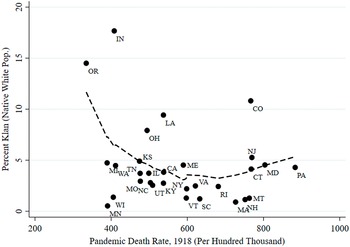
Figure 1 presents the relationship between state pandemic deaths rates and Klan membership per capita. Based solely on this visual, we observe no discernable relationship between pandemic deaths and Klan membership.
1918 pandemic deaths and Klan membership by state.

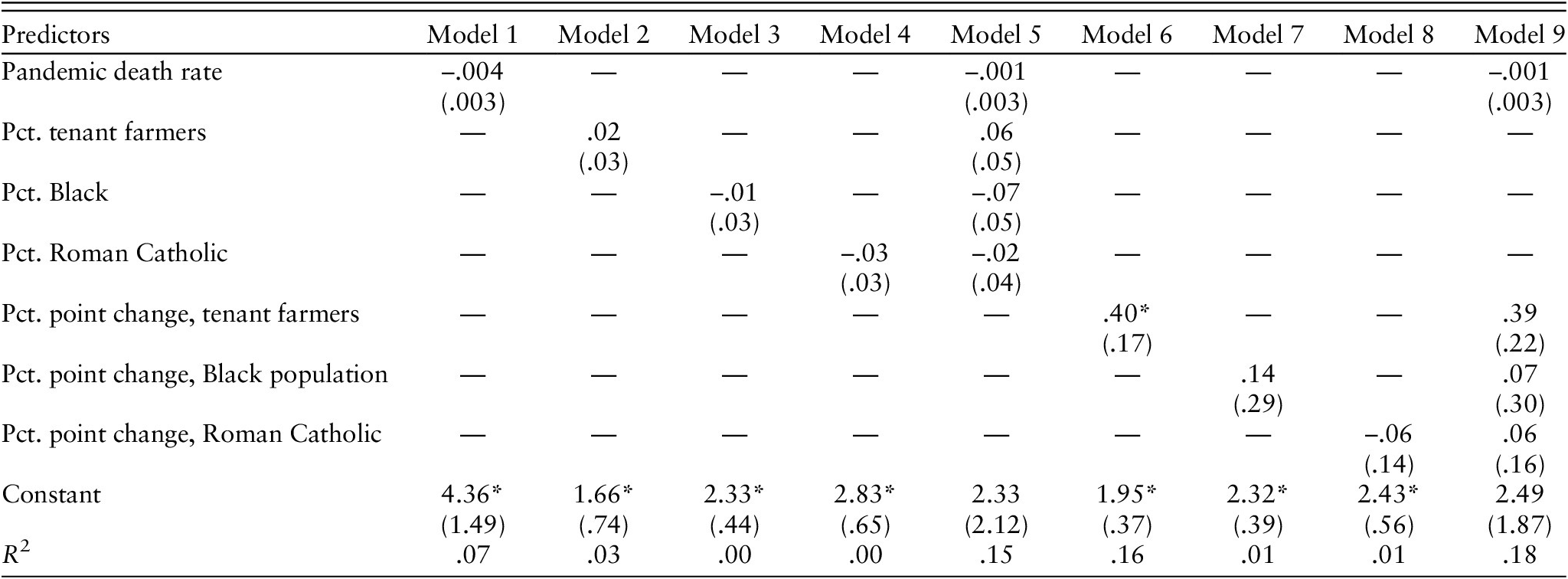
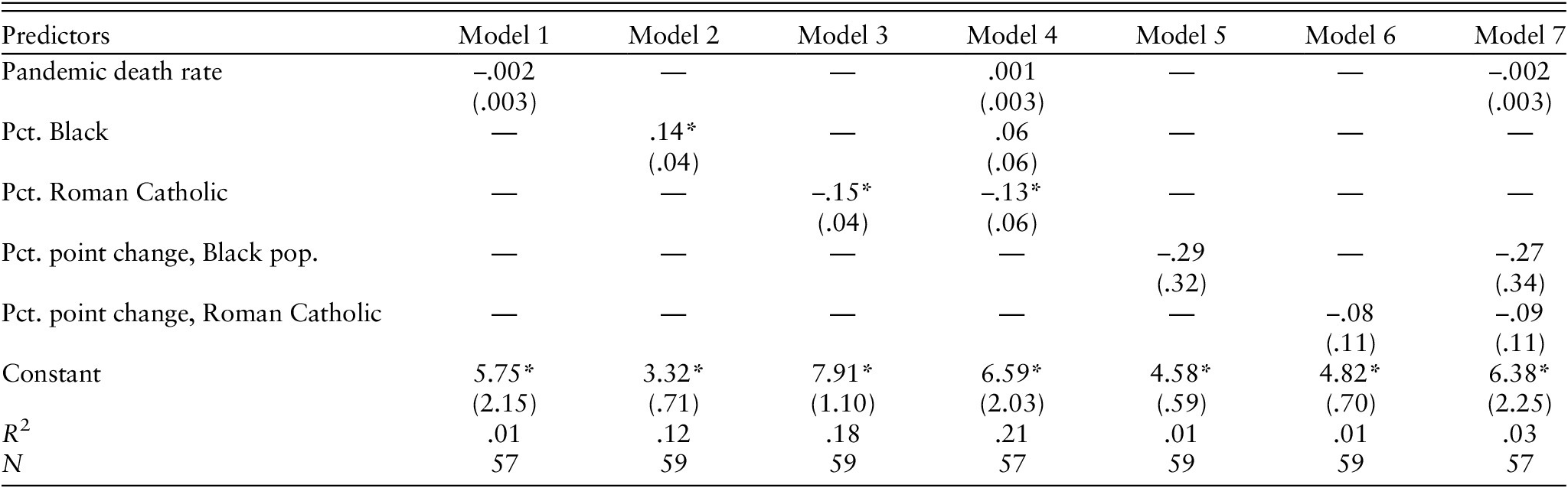
To explore this relationship more carefully, linear regression models predicting Klan membership based on pandemic death rate, controlling for tenant farmers and Black and Catholic populations (percentage and percentage point changes), are presented in Table 1. In the 30 states reporting pandemic data, we, like McVeigh (Reference McVeigh1999), found evidence of a positive relationship between Klan membership and a rise in tenant farming from 1910 to 1920, but only at the p < .05 level in a univariate model; here, a move from one standard deviation below to one standard deviation above the mean change in tenant farming leads to a 1.63 percentage point increase in the percentage of Klan membership. Since the mean percentage of Klan membership is 2.27, with a standard deviation of 2.03, this change is substantively important. No other variables were significant.
Predicting percentage of Klan membership by state.

Notes: * p <.05, two-tailed test. Ordinary least squares regression. N = 30 for all models.
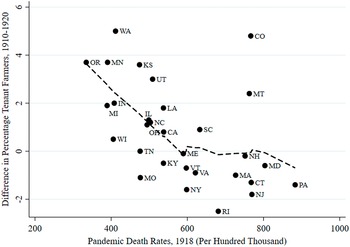
This finding does not rule out the possibility of an indirect pandemic effect on Klan membership. Specifically, if pandemic deaths increased tenancy rates, the pandemic may have indirectly fueled the growth of the Klan. However, further investigation reveals a relatively strong negative relationship between tenant farming and pandemic death rates (–.50), as displayed in Figure 2. This correlation appears to reflect increasing tenancy in rural states, where pandemic death rates were typically lower.
Pandemic death rates in 1918 and changes in the percentage of tenant farmers, 1910–1920, by state.

Thus, in the 30 states that reported pandemic death rates (representing 70% of all Klan members), there is no observable evidence that pandemic deaths led to greater Klan membership. And, even though the statistical power of state-level models with an n of 30 is modest, it seems unlikely that the pandemic death rate would become a substantively significant and positive predictor of Klan membership even with data from the other 18 states. The variable was not close to achieving statistical significance in any model specification in Table 1. The additional evidence in Figure 2 also suggests a potential relationship with tenancy whereby fewer pandemic deaths may have indirectly led to more Klan membership.
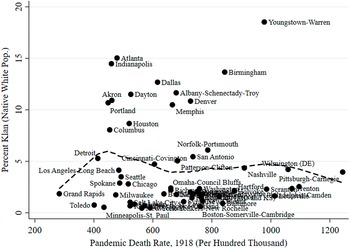
Furthermore, no significant relationship between pandemic deaths and Klan membership emerges when we consider data from all major cities (Jackson, Reference Jackson1967), as shown in Figure 3. This is confirmed in Table 2, which shows city models predicting Klan membership using pandemic death rates and percentages of Catholic and Black population. In the univariate and bivariate models, percentage of Catholic is negative and significant, and percentage of Black is positive and significant; in the multivariate models, only the percentage of Catholic findings persist. In practical terms (using Model 4’s results), moving from one standard deviation below to one standard deviation above the mean percentage of Catholics leads to a 3.29 percentage point decrease in the percentage of native-born White males in the Klan (
 $ \overline{x} $
= 4.53%; SD = 4.54). Thus, a larger per capita Catholic population limited Klan organizing in a significant and relatively sizeable way.
1918 pandemic deaths and Klan membership by city.

Predicting percentage of Klan membership by city.

Notes: *p <.05, two-tailed test. Ordinary least squares regression.
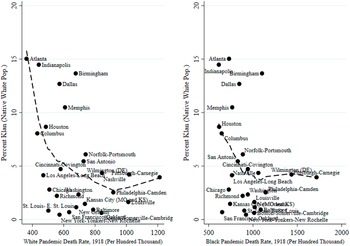
Moreover, in the 26 cities for which White and Black citizens’ death rates were recorded separately, pandemic death rates are never significant predictors of Klan membership. In fact, once again, Klan membership is higher in cities with lower pandemic death rates, especially among White citizens, as shown in Figure 4. While based only on a sample of the largest cities, these findings, like those connecting lower pandemic death rates to increases in tenant farming and then greater Klan membership at the state level, indicate that Klan membership is, if anything, related to lower pandemic death rates.
1918 pandemic deaths and percentage of Klan membership, by city and race.

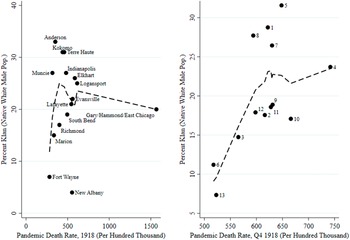
Finally, the left panel of Figure 5 illustrates the results for the 15 largest cities in Indiana. This analysis again reveals no direct connection between pandemic deaths and Klan membership. The right panel of Figure 5 shows the relationship between pandemic deaths and Klan membership in the 13 Indiana regions without a city over 10,000 residents. In this analysis, for the first time, we see evidence of a positive relationship (.59) between pandemic deaths and Klan membership. But because of the small sample size, the correlation overstates the relationship. There is no correlative relationship between Klan membership and pandemic death rates for the 10 cases above approximately 17% Klan membership (.03). In light of this information and the findings of the three previous analyses, and without more precise county-level estimates of pandemic deaths, we encourage readers to approach these regional findings with caution.
1918 pandemic deaths and percentage of Klan membership, Indiana cities (left) and rural regions (right). See the Online Appendix, Table A, for a list of counties included in each of the numbered regions shown in the right panel.

Discussion and conclusion
Ultimately, the results show no consistent positive relationship between deaths caused by the 1918–1919 Spanish influenza pandemic and Ku Klux Klan membership in the 1920s. State- and city-level findings, in fact, suggest that the Klan was stronger where the pandemic was less severe. These findings contrast sharply with recent findings that pandemic-related deaths increased support for the Nazi Party in Germany (Blickle, Reference Blickle2020) and for the Fascist Party in Italy (Acemoglu et al., Reference Acemoglu, De Feo, De Luca and Russo2020; Galofré-Vilà et al., 2021). Granted, the American social, cultural, and institutional environment was different than post–World War I Europe, but the Klan was the United States’ fullest expression of early 1920s right-wing populism (Gordon, Reference Gordon2017). The findings here, then, serve as a cautionary tale when attempting to broadly link oppositional political movements to pandemics.
These findings are especially pertinent for scholars considering the effects of pandemics on American politics. The studies on Nazism and Fascism in Germany and Italy cited earlier focus on the formation of parties in multiparty electoral systems. During periods of severe economic and social strife, a new party may successfully mobilize dispossessed citizens to show up at the polls. But in the United States, the two-party dominant electoral system generally leads not to the creation of new political parties that run candidates for office, but to the formation of organizations—in this case, a voluntary membership association—in which citizens pay significant initiation fees and dues and commit time to group activities. When compared with voting, association membership comes at a much greater cost to those struggling financially in the wake of a pandemic. Compounding this, Klan recruiters were given financial incentives to increase membership, so focusing on areas hit hard by the pandemic may not have been wise. Instead, cities relatively unscathed by the pandemic with a strong Protestant middle class were likely better targets for recruiting citizens willing and able to pay to hate. This later allowed the Klan to enter politics through collaboration with willing politicians in both major parties.
Future American politics research on pandemic effects needs, first, to explore the Spanish flu’s effect on other politically minded associations, particularly those for which membership and organizational data are available not just for states and large cities, but also for small- to medium-sized urban areas (see Gamm & Putnam, Reference Gamm and Putnam1999). Likewise, scholars should further explore the relationship between pandemic deaths and organizing in rural areas; with fewer organizations to join relative to urban areas, perhaps pandemic deaths stimulated interest in society and made joining an association with extreme viewpoints more attractive. Furthermore, as the 2022 and 2024 elections approach, scholars should prepare to study how the COVID-19 pandemic affects voting for extremist candidates and political parties, both within the United States and abroad. Finally, scholars should also monitor radical groups such as QAnon and the Proud Boys to see whether they expand in the wake of the pandemic and, if so, how. Though these are not mass movements on the scale of the Klan, there are similarities between them (e.g., loss of status, economic grievances, views on corruption in government, and a nationalistic perspective); findings related to the Klan may help scholars frame how to study these groups.
In total, the severity of a pandemic does not necessarily ignite citizens’ latent propensity to hate. As the findings here for the 1920s Ku Klux Klan in the United States underscore, pandemic effects must be considered within the broader environmental context, particularly citizens’ perceptions of power devaluation created by changes to society and culture.
Supplementary Materials
To view supplementary material for this article, please visit http://doi.org/10.1017/pls.2022.14.
Open Scientific Practices Statement
This article earned the Open Data badge for open scientific practices. The data that support the findings of this study and the award of this badge are openly available at: https://doi.org/10.7910/DVN/PEKNA6.