In the recent Truth and Reconciliation Committee of Canada report (TRCC, 2015a; 2015b) that included the state of learning for Indigenous learners and posed clear recommendations for the educational needs of these learners, it is clear that the educational system needs to make changes for how Indigenous students are taught. Most notably, TRCC (2015a) indicated that governments need to be involved in ‘building capacity for intercultural understanding, empathy, and mutual respect’ (p. 7). In British Columbia, the First Nations Education Steering Committee (FNESC) presented seven key learning principles of learning for Indigenous learners (FNESC, 2015); however, to date, little research has been conducted on how these principles are applied in the school system. It should also be noted that the term, Aboriginal, is inclusive of First Nations, Métis and Inuit peoples in Canada; however, outside of direct quotes, Indigenous will be used throughout this research project.
Learning and Indigenous Students
The professional literature is somewhat divided on learning and Indigenous students. Some argue that these learners acquire information better through certain delivery methods (Hughes & More, Reference Hughes and More1997; Swisher, Reference Swisher1994; Toulouse, Reference Toulouse2008), while others purport that ‘learning styles’ are a way of labelling Indigenous students (More, Reference More1987; Rasmussen, Baydala, & Sherman, Reference Rasmussen, Baydala and Sherman2004) or that teachers use very narrow approaches to teaching that do not engage the students (Cooper, Warren, & Doig, Reference Cooper, Warren and Doig2004; Maher, Reference Maher2012). This brief literature review will outline these arguments but will conclude with a summary of one researcher's tenet that interactive technologies work particularly well with Indigenous students.
In his seminal study, More (Reference More1987) investigated the ‘learning styles’ research available to him at the time and his work has been often cited and replicated over the last 30 years. He found that meaning of ‘learning styles’ varied but a major contributor to the definition was cultural differences. Additionally, he reported that research defining the concept was varied but included internal cognitive processes, a type of sensory input and the effectiveness of learning through senses, perceptual abilities and some on physical characteristics of the learning setting. He further emphasised that there is a preferential selection of learning style by students, as each student holds a variety of learning styles and that a learning style is a characteristic or usual way of learning and is not directly related to the effectiveness of learning. He adopted this definition for the purposes of his discussion: ‘The characteristic or usual strategies of acquiring knowledge, skills and understanding by an individual’ (p. 2).
Similarly, Rasmussen et al. (Reference Rasmussen, Baydala and Sherman2004) reviewed the professional literature on the learning and cognitive patterns of Canadian Indigenous students and on pedagogical strategies for teaching Indigenous learners. Their review revealed several interesting findings. First, the visual-spatial abilities of Indigenous students are well developed and they tend to have higher visual-spatial abilities than verbal abilities. Second, they argued that Indigenous students utilise holistic and observational learning as they tend to be observational, experiential and holistic learners who focus on visual elements and perceive that the whole determines the meaning of the pieces (i.e., global learners). Lastly, they reported that Indigenous learners prefer a kinesthetic modality, favour interactivity, use the visual modality, thrive in group work and collaborative activities and enjoy creativity and flexibility of thought in assignments and tasks.
The researchers also reported there were specific teaching methods that were conducive to the success of Indigenous children. For instance, the teacher should adopt community- and family-oriented approaches (e.g., use of elders in the classroom, group focussed activities). They should also use interactive teaching styles that would include allowing for observational learning, flexibility where teachers account for individual strengths and needs of all children, contextualised instruction and an emphasis on students’ experiences and knowledge in a collaborative approach. Additionally, teachers should use visual aids to support visual-spatial learning and should engage children using activities like arts, crafts, drumming, singing, cooking and other traditional (Indigenous) methods. Lastly, they emphasised that teachers should use multi-method and multi-modality instruction which could incorporate experiential learning techniques and focus on process rather than product.
Cooper et al. (Reference Cooper, Warren and Doig2004) explored ‘White’ teachers’ perceptions of Indigenous math learners in Australia and compared their results to Green's (1982) similar study on the impact of teacher perceptions of Indigenous learners on student performance. They interviewed 12 teachers at three schools in remote Northwest Queensland in classrooms with 50–100% Indigenous populations of Indigenous and non-Indigenous students as math learners. The teachers were interviewed at the beginning of the school year and at the end and focussed on their perceptions of mathematics teaching and learning, what math curriculum should be taught and what teachers should do to improve math classroom teaching. In the second interview, teachers identified the math learning differences between Indigenous and non- Indigenous students. The teachers reported differences between Indigenous and non-Indigenous math learners’ progress in understanding since Green's original study. Most notably, the teachers reported that Indigenous students: (a) were hands on (tactile–kinesthetic) learners who worked well with tactile materials or learned by doing; (b) were visual learners and preferred discussion and visual (vs. auditory) language and (c) preferred structured and supportive learning environments and requested more guidance and support. In short, these teachers’ perceptions indicated that Indigenous learners have distinct learning preferences that include hands-on learning, less emphasis on written work and more on discussion and a structured and supportive learning environment.
El Sayed, Soar and Wang's (Reference El Sayed, Soar and Wang2012) study sought to identify key factors that need to be considered when developing a CD-ROM-based training programme for Australian Indigenous Health Workers. This study was the second part of a four-phase study that examined educational gaps with Indigenous Health workers and included the development of a professional development model after completing an initial needs assessment. The authors conducted an extensive literature review of online electronic and library resources to investigate learning styles, Indigenous and Torres Strait Islander health, interactive media, computer-based education and media and Indigenous and Torres Strait Islander culture. Using semistructured interviews, they questioned 10 stakeholders who had worked extensively in the area of Indigenous health and education and training and included educators, general managers, programme managers and developers, coordinators and healthcare workers.
Pertinent to the present study, the researchers’ literature analysis revealed that cultural principles should take into consideration when designing a programme. Specifically, it should take into account Indigenous learning styles (e.g., self-paced, graphics emphasised), incorporate audio and visual tools instead of just text-based tools, include Indigenous Australian concepts of illness and health, ensure an emphasis on a social and collaborative focus of learning, and should begin with a discussion of realistic health problem in story telling fashion to honour previous knowledge.
The interview findings were broken down into three thematic categories: cultural factors, information technology availability, and literacy, learning aspects; however, for the purposes of discussion, only the first will be reviewed here. The interviewees emphasised the need for cultural factors to be considered in the design of the programme. In particular, the programme should be designed with the diversity of Indigenous culture in mind; there should be a simplification of medical terminology with support of graphics and simple word choice; they should use Indigenous sound and accent in audio tools; they should include case studies using Indigenous peoples and focus on the Indigenous patient; they should ensure that knowledge sharing is integrated into story modules; and should incorporate Indigenous medicinal practices such as a localised bush medicine component.
As part of his research with Haida-language learners, White (Reference White2008) performed a meta-analysis of over 100 books, reports and articles on Indigenous learning preferences. His analysis on ‘students’ participatory preferences’ (p. 18) revealed 14 characteristics of Indigenous students when they were learning in the classroom: (1) participate at their own discretion; (2) enjoy group-oriented tasks; (3) favour one-on-one interaction with the teacher for clarification or for permission; (4) prefer to participate out loud when comfortable enough with the subject matter; (5) learn from repeated and silent observation; (6) are spatially and holistically oriented; (7) prefer holistic approaches to learning; (8) are interested in what other learners are doing; (9) need time to answer teacher questions; (10) remain silent when being reproached; (11) spurn displaying knowledge that others might possess; (12) prefer not to be singled out or called upon by the teacher; (13) prefer collaborative learning over competitive learning and (14) like to wander around the room without permission (see pp. 18–21). In a later work, White (Reference White2014) provided specific examples of using technology with Indigenous learners and argued that ‘in combining all of these aspects-textual, audio, visual and recordings-the computer adds a most significant contribution to the technological impact [on learning]’ (p. 143). Clearly, there is much potential for technology and Indigenous learners (White, Reference White2008; Reference White2014).
Considering the extant literature on Indigenous student learning preferences (Cooper et al., Reference Cooper, Warren and Doig2004; Hughes & More, Reference Hughes and More1997; Maher, Reference Maher2012; More, Reference More1987; Rasmussen et al., Reference Rasmussen, Baydala and Sherman2004; Swisher, Reference Swisher1994; Toulouse, Reference Toulouse2008), Kitchenham (Reference Kitchenham2013) argued that there is a strong relationship between interactive technologies and the way Indigenous students learn. He examined the effect of educational technology on the preservation of Indigenous language and culture in his pursuit to answer the research question (To what degree do Aboriginal Language and Culture (ALC) teachers use educational technology in teaching Indigenous languages?). In particular, using an online questionnaire, he surveyed ALC teachers in British Columbia public schools and received a 58.3% return rate. Pertinent to the present study, 71.4% of the respondents indicated that using an interactive whiteboard was ‘very effective to highly effective’ and 75.0% reported that using a digital video camera was ‘very effective to highly effective’; these two percentages presented strong support for using interactive technologies with Indigenous students.
Research Methods
Methodologically, I adopted a mixed-methods approach in this longitudinal study with Indigenous learners in the public school system in Canada. The clear benefit of combining quantitative and qualitative research methods is that the quantitative data can be used to demonstrate growth in an objective manner while the qualitative data answer the questions that arise from those quantitative results (Kitchenham, Reference Kitchenham, Mills, Durepos and Wiebe2009; Teddlie & Tashakkori, Reference Teddlie and Tashakkori2003). The central research question was: What are the experiences and opinions of teachers in technology-equipped classrooms as they teach mathematics to Indigenous students?
The quantitative part of the study was simple as the administrator of the school was interested in viewing whole-class, between differences (Indigenous and non-Indigenous students), and average mathematics performance. To this end, I used descriptive statistics. The qualitative part of the study was based on hermeneutic phenomenology as I was interested in the lived experiences of the participants (van Manen, Reference van Manen1990; Reference van Manen1991; Reference van Manen2014). This type of phenomenology is as follows:
a method of abstemious reflection on the basic structures of the lived experience of human existence. The term method refers to the way or attitude of approaching a phenomenon. Abstemious means that reflecting on experience aims to abstain from theoretical, polemical, suppositional, and emotional intoxications. . . . Lived experience means that phenomenology reflects on the prereflective or repredicative life of human experience as living through it. (van Manen, Reference van Manen2014, p. 26, original emphasis)
That is, I wanted to capture the experiences and opinions of each teacher and to represent their views in text so that others could understand better their own experiences with Indigenous students.
Specifically, the quantitative phase of this three-year study began with four teachers collecting mathematic results in the Fall and Spring of each school year based on the students’ performance on the Vancouver Island Net Diagnostic Mathematics Assessment (DMA) (Vancouver IslandNet, 2008), a locally developed math assessment used by the majority of school districts in British Columbia. Additionally, teachers were asked to complete a brief survey on Indigenous students’ learning preferences in the second year of the study. The qualitative phase of the study involved semistructured interviews. The four teachers were interviewed in the first year of the study, three teachers in the second year and two teachers in the last year.
The public school site was chosen because over 50% of the students are of Indigenous descent and the school and I had worked together on previous projects. The principal asked any interested teachers to identify themselves to take part in the study that would examine the effectiveness of interactive technology on student achievement and related student characteristics such as attendance, punctuality and engagement. The school was focussed on math achievement as part of its goal for the district so it conducted pre tests at the beginning of the school year (September or October) and post tests at the end of the year (May or June). Since the school conducted pre and post tests across all grades to investigate if certain teaching practices improved student achievement, I was able to use those data to measure if interactive technologies were effective in the years (grade levels) in my study.
The principal was supportive of the teachers’ technology integration and provided software and hardware support when it was demonstrated that the teachers would use the technology. I was able to provide some hardware through my own research funds and the principal of the school tried to match anything that I provided. Give the focus of my research, by the end of the study, the teachers had access to the following interactive technologies:
-
• SMARTBoard in one classroom;
-
• Epson interactive projectors in two classrooms;
-
• Mimeo interactive projector;
-
• Elmo document camera in each of the four classrooms.
It is important to note that all four teachers had technology-equipped classrooms and met with each other to discuss the use of those technologies on a weekly basis (as did all teachers in the school but the focus topic differed from group to group). What differed was both the use of the technology and the type of technology in the classrooms. The Year 4 teacher had the most technology-rich classroom since he had a Mimeo interactive whiteboard, a document camera, a sound system and a student response system; however, the students themselves rarely interacted with the technology and usually only under his supervision. The Year 5 teacher used a document camera in the first year and received and used an Epson interactive projector in the second year (and was not in the study for the last year as she left the school). The Year 6 teacher had a technology-rich classroom as he had an Epson interactive projector, a student response system, and a document camera; however, the students in his class often used the technology and were encouraged to use the hardware and software whenever he was not conducting a whole-class lesson. The Year 7 teacher used a document camera in her classroom but did not want an interactive whiteboard for all three years of the study.
The four teachers (identified by pseudonyms for the purpose of discussion here) taught Year 4, Year 5, Year 6 and Year 7; however, only one teacher from the first year was still in the study by the end of the third year but the grade-level representation remained the same. After the first year, the Year 6 teacher transferred to another school and was replaced by another teacher who became part of the study. At the end of the second year, the Year 5 teacher transferred to another school but the replacement teacher chose not to participate in the study and one (Year 4) teacher from the first year dropped out of the study and was not replaced. In the last year of the study, only two teachers remained in the study.
The interviews were conducted in May or June in each of the three years of the study. The teachers were asked to report on their observations of the Indigenous students in terms of attendance, punctuality and engagement in the first year of the study, and in small- and large-group discussions in the second year, and were asked to reflect on the three years of using interactive technologies with the Indigenous students, in particular, in the final year of the study.
Results
For clarity of results presentation, I will outline the achievement findings for the years of the study and discuss any patterns that emerged throughout the three years since detailed findings are to be presented elsewhere and a thorough discussion of these results is beyond the scope of this article. Then, I will discuss the survey findings in which the four teachers rated the learning preferences of their Indigenous students in the second year of the study. Finally, the coding and theming of the interviews conducted in all three years of the study will be presented and discussed.
Math Achievement
Across the four grades, all students improved in their math achievement in one of the six assessment subtests. Number Sense is a measure of basic understanding of numbers and their functions in addition, subtraction, multiplication and division. Statistics and Probability tests a student's understanding of concepts such as many-to-one correspondence and constructing and interpreting graphic representations of many-to-one correspondences. Patterns and Relations measure the student's ability to use patterns to describe the world and solve problems as well as how to present algebraic expressions in multiple ways. Shape and Space asks the student to demonstrate an understanding of how to use direct and indirect measurement to solve problems which includes describing 2-D and 3-D object characteristics and their relationships and describing and analysing position and motion. Problem solving is an assessment to see how a student can use the other four strands to solve word problems. (An example of the entire assessment Grade/Year 4 can be found at http://www.testonline.ca/pdf/end_of_grade3-beginning_of_grade4.pdf).
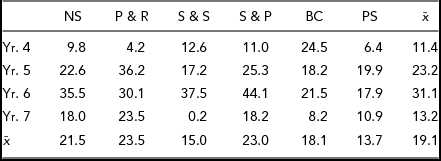
Table 1 presents the mathematics achievement by subtest for the Indigenous students in Years 4, 5, 6 and 7 over the course of the three-year study as well as the overall average. Since the subtests had different totals for possible correct answers from Fall to Spring assessments, all results are reported in percentages rather than raw scores.
Average Percentage Increase between Fall and Spring Assessment for All Years (Grades) for Indigenous Students Across the Three Years of the Study (with Overall Average by Subtest)

NS = Number Sense; P & R = Patterns and Relations; S & S = Shape and Space; S & P = Statistics and Probability; BC = Basic Computation; PS = Problem Solving.
As can be seen from Table 1, there were increases across all six subtests: Number Sense, Patterns and Relations, Shape and Space, Statistics and Probability, Basic Computation and Problem Solving. In particular, students had an increase of 20% or more in each of the six subtests in all four grades (levels) across the three years of the study and an increase of 30% or more in Patterns and Relations (Year 5: 36.2%; Year 6: 30.1%), Number Sense (Year 6: 35.5%), Shape and Space (Year 6: 37.5%) and Statistics and Probability (Year 6: 44.2%). It should also be noted that the students in Year 6 at the end of the three years study achieved the greatest gain as they increased 20% or more in five of the six subtests with a mean gain of 31.1% across the six subtests compared to an overall mean gain of 19.1% for all levels and subtests in the three years of the study. Comparatively, this average is approximately three times the gain of the Year 4 teacher (11.4% compared to 31.1%). This teacher also used interactive technologies more frequently and more efficiently, as observed by the researcher, than the other teachers in the study. Lastly, it is interesting to note that Problem Solving was the lowest achieving subtest; however, since the nature of the subtest is for students to read problems and solve them mathematically, it can be argued that it is a reading test more than a math test.
Surveys
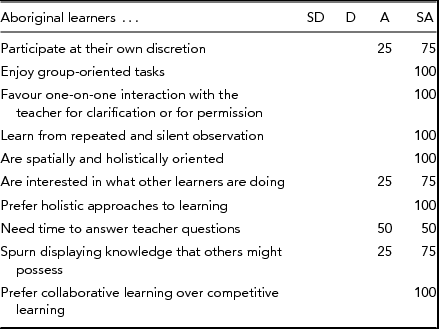
Near the end of the second year, each of the teachers from the first year was asked to complete a brief survey on the learning preferences of their Indigenous students (see Table 2). The primary purpose of the survey was to set the stage for the third year interviews; however, the statements were taken from the interviews with the teachers in the first and second years of the study and from the professional literature. As can be seen, the four teachers either agreed or strongly agreed to each of the 10 statements. In particular, all four teachers strongly agreed that Indigenous learners enjoy group-oriented tasks, favour one-on-one time with teacher, learn best from repeated and silent observations, are ‘big picture’ learners, and thrive in a collaborative learning environment. These results formed the basis of the interviews in the third year and allowed me to focus the statements so that they became questions specifically related to the students’ math achievement.
Aboriginal Learning Preferences Survey Results (in Percentages)

SD = Strongly Disagree; D = Disagree; A = Agree; SA = Strongly Agree.
Interviews
As indicated earlier, the teachers were interviewed in each year of the three-year study. Sample questions included:
-
• Tell me about a typical mathematics lesson in your Grade X classroom;
-
• Tell me about how you use technology to teach mathematics in your Grade X classroom;
-
• If I were a fly on the wall in your Grade X classroom, what would I see and hear from the children as they worked on their mathematic in a technology-based class? What about in a lesson without technology?;
-
• Tell me about a typical math lesson in your Grade X classroom;
-
• Tell me about how you use technology to teach math in your Grade X classroom;
-
• What differences have you noticed in your Aboriginal students’ math achievement since using, integrating, or teaching technology? What about non-Aboriginal students?
-
• As you reflect look back on the years of the study, what can you say about student math achievement in general? What about since introducing interactive technologies in your math lessons?
In the first year, the focus was on their observations of the Indigenous students in terms of attendance, punctuality and engagement and on small- and large-group discussions in the second year while, in the third year, they were interviewed on their three years of using interactive technologies with the Indigenous students, in particular. In the first year, all four of the original teachers were interviewed but in the second year of the study, one teacher was replaced in the study so that only three original teachers were interviewed. Only two teachers were interviewed in the third year since two teachers left and one teacher from the first year opted out of study in the second year of the study. In other words, there were 10 interviews in total and only one teacher was interviewed all three years.
Each interview lasted 45–75 minutes and all interviews were conducted in the teachers’ classrooms. The interviews in the first year concentrated on the teachers’ general perceptions of Indigenous students’ math achievement, their goals for the year and their comfort levels with technology use and integration. The interviews in the second year were specific to Indigenous learning preferences and, in the third year, the teachers’ technology use and integration in math classes.
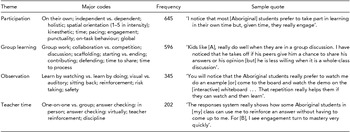
After each interview was transcribed, the teachers examined the transcriptions and declared their respective interviews to be accurate and a fair representation of the discussion. These interviews were then coded and themed (see Table 3). Following Saldaña (Reference Saldaña2013) and Schreier (Reference Schreier2012), I used a variety of coding methods. In the first cycle coding, I began with a coding frame (Schreier, Reference Schreier2012) since it was evident that certain concepts would be present in the interviews and then I moved to second-cycle coding to look for concepts and ideas that were not as evident in the previous coding sequence. In particular, I used attribute coding (e.g., name of school; teacher names), magnitude coding (e.g., depth of the expression from very strong to very weak), versus coding (e.g., comparing one concept with another as a juxtaposition), structural coding (e.g., akin to a coding frame in that the research applies a specific phrase to the comments) and values coding (e.g., use of expressive language to portray a value or emotion) (Saldaña, Reference Saldaña2013).
Transcribed Interviews by Theme, Major Code, Frequency and Sample Quote

In total, there were 1788 coded statements that resulted in the 33 major codes and four overall themes. Participation accounted for 36.1% of the overall coded statements and Group Learning for 33.3% of the overall statements. Both of these themes occurred three times more frequently than the Teacher Time theme and close to two times as frequently as the Observation theme.
Comments related to the Participation theme were related to how the Indigenous students took part in school, in general, and in mathematics class, in particular. As one teacher mentioned:
I notice how the Aboriginal students really do well in math when they can manipulate objects or use manipulatives. For instance, when I introduced the document camera to the students, I saw how effective it was with [three Indigenous students] since they could come up and move the objects. . . . I also noticed how they got the idea of 3-D by not only feeling the object but feeling the object under the document camera and seeing it on the [interactive] whiteboard. . . . Later on, other [Indigenous] students took risks and tried working out some of the problems we used the document camera for on the whiteboard. Before we got the tech[nology] in the class, those students wouldn't have even tried (Teacher A).
Teacher B added her thoughts on the participation of the Indigenous students as she pointed out that ‘since we started the technology project three years ago, I have seen the Aboriginal students attend more often, be less late, engage in lessons, and try harder. Really try harder. It's like a light went off. I think that whole technology thing appeals to their best way of learning’. Another teacher echoed that sentiment in the response:
I really notice that the Aboriginal students are excellent at spatial orientation and seeing the big picture much more than the non-Aboriginal students. I see it all the time now in math class as they see the answer before many of the other students get it if the problem is related to shapes or even everyday uses of math. . . . I also notice how quickly they respond with the clickers [student response system] now that they have gotten the hang of them. Before I would have to wait for [Student B] and so would the whole class. Now he responds just as fast as all the other students and can explain how he got the answer afterwards. Before he would just shrug.
Another teacher commented on the Indigenous students and their ability to work dependently now when they were very dependent on others for concept understanding. She pointed out that ‘I know the Aboriginal students were always checking with each other or with their [non-Aboriginal] peers but they work on their own now and are really independent. I mean, really independent’ (Teacher C). In fact, all teachers pointed out that the Indigenous students had become more independent in their work habits since the classrooms had introduced interactive technologies in the mathematics classes.
The Group Learning theme was also well populated with comments from the teachers. All teachers pointed out that the Indigenous students thrived in group work activities: ‘they don't always take charge but do participate in the discussion whenever they are grouped’ (Teacher D); ‘the Aboriginal students often don't contribute as much in the big class discussions but they often do well in the small groups’ (Teacher E); ‘they are excellent in group activities and not just in math class’ (Teacher A) and ‘the [Indigenous] students are really good if we work in smaller groups and on group-oriented tasks’ (Teacher C).
When the teachers presented comments related to the Observation theme, they used mostly the traditional ‘learning styles’ language. For instance, Teacher A said that ‘the Aboriginal students do learn by watching and learning by doing . . . in other words, they can watch something being modelled like using triangulation to solve a problem and then they get it [but] they also learn by doing the work’. Another commented ‘I see that they are not auditory learners as much as visual learners like most kids at this age. [The Indigenous students] like to digest what is said and then, when they are ready, say the answer’ (Teacher E) and another echoed that ‘I wish I had just thought of giving them time to answer rather than expecting the [Indigenous] students to answer right away’. Teacher B stressed that
The Aboriginal students aren't really risk takers and need to feel really safe in the classrooms. I mean, I get it. They have had years of believing that they can't learn and now they see a way in the technology to equal the playing field. The technology gives them time to think, to practice, and when ready, to take that risk. Too bad more teachers can't see how these kids are thriving in my classroom and [in the other] classrooms.
Similar comments were presented using language like ‘need reinforcement’, ‘observations help a lot for them’, and ‘learning styles’.
Teacher Time was not as well represented as the first two themes but it still garnered over 10% of the comments from the teachers. The teachers concentrated mostly on the evolution of the Indigenous students from being resistant to one-on-one working (e.g., seatwork) to using one-on-one time with the teacher to check on understanding or ask clarifying questions. For instance, ‘[Student C] used to ask me “is this right” and if I said “not quite”, he would sit and wait until I came back again. Now he checks on whether he is on the right track . . . concentrates on process and not product’ (Teacher A) and ‘I find that the Aboriginal students really just need me for clarification and they used to want me to spend too much time with them when I have 24 other students’ (Teacher D). One common theme among all the teachers was that ‘checking the answer’ now became a virtual operation since the teachers could use the interactive whiteboard to create a repeating movie that re-did a sample question over and over. ‘I really enjoy using that feature that you taught me because now I can write the sample after teaching the lesson and then let the kids work on problems while I circulate. I notice the Aboriginal students will watch the movie or come up and copy the steps’ (Teacher D); this approach allowed the teachers to use their time much more wisely.
Discussion
The majority of the students in this three-year study increased dramatically in their math achievement when they were immersed in interactive technologies as evidenced by the increases in math scores in the final year of the study (see Table 1). Both the teachers’ ratings on the informal survey and their comments in the first-, second- and third-year interviews demonstrated that they saw Indigenous learning preferences being addressed by the interactive technologies in their respective classrooms. For the purposes of discussion, I have grouped the overall trends into three topics in relation to interactive technologies: Holistic, Multimodal and Collaboration.
Holistic
As demonstrated in the literature review, Indigenous learners tend to learn better when they see the larger view of a concept rather than the finite details and the students and teachers in this study exemplified this statement. For instance, teachers in this study used graphic organisers (e.g., mind mapping; Venn diagram; learning web) in their math (and other subject) classes either on the interactive whiteboard or using the document camera. All the students, but particularly the Indigenous students, were able to understand concepts much better as they saw the ‘big picture’ of a math exercise rather than concentrating on the finer details.
In More's (Reference More1987) original research on Indigenous learning styles, he proposed that teachers should utilise holistic teaching methods as Indigenous students demonstrate a ‘higher frequency and relative strength in global processing on both verbal and non-verbal tasks [and] a higher frequency and relative strength in processing visual/spatial information’ (p. 5). That is, Indigenous students tend to perform at a higher level when they are taught in a holistic approach. These findings are also echoed by Rasmussen et al. (Reference Rasmussen, Baydala and Sherman2004) as they argued that Indigenous students tend to learn best when approaches include a focus on the visual elements of a lesson and incorporate an approach that stresses the whole determines the meaning of the pieces.
According to Alberta Education, Aboriginal Services Branch (2005), ‘(g)raphic organizers reflect a holistic learning by revealing not only what students are thinking but also how they are thinking as they work through learning tasks’ (p. 81, original emphasis). The Vancouver Island Net DMA (Vancouver IslandNet, 2008) results did demonstrate an increase over the three years; specifically, in the areas of number sense and patterns and relations which both require seeing the answers in a more global sense and graphic organisers would assist in practising the principles related to using numbers to represent relationships (i.e., number sense) and using patterns to describe the world and solve problems (i.e., patterns and relations).
Multimodal
The teachers reported in both the survey and semistructured interviews that they saw definite strengths in tactile–kinesthetic learning with the Indigenous students. They repeatedly described how all the students learned better and quicker whenever the teachers used multimodal instruction that included visual, auditory, tactile and kinesthetic learning. Specifically, the teachers discussed how the Indigenous students mastered the math material when they could manipulate the material — either physically or virtually — and their math achievement scores over the three years demonstrated that observation.
Rasmussen et al. (Reference Rasmussen, Baydala and Sherman2004) argued that Indigenous children have more well-developed or higher visual-spatial abilities than non-Indigenous children and they have a preference for the kinesthetic modality. The students in the present study also thrived in class when opportunities were presented that necessitated using their visual-spatial abilities such as using numbers to represent patterns.
Similar to the results of this study, Cooper et al. (Reference Cooper, Warren and Doig2004) found that teachers in their study reported that Indigenous students in math classes were definite hands-on, tactile–kinesthetic learners. Additionally, they argued that Indigenous students perform better in math when there is less emphasis on reading material (i.e., visual modality) and more on discussing the material (i.e., auditory modality) after manipulating the material (i.e., tactile–kinesthetic modality). Although specific to Indigenous Australian health workers, El Sayed et al. (Reference El Sayed, Soar and Wang2012) study reinforced the notion that Indigenous students work well with technology, when it is graphic rich and there is less reliance on written material.
Collaboration
The data in this study revealed a strong preference for collaborative activities in the math classroom. Particularly, the interview responses highlighted both the Indigenous students’ thriving in a discussion-rich environment and the need to incorporate more discussion in the classrooms to engage the Indigenous students. Many teachers brought up the fact that they saw Indigenous students contribute in a group environment much more readily than in a whole-class activity. They pointed out the Indigenous students were much more engaged and contribute more deeply and more frequently when in small-group settings. The math achievement data and the survey responses also reinforce this sense of collaboration.
White (Reference White2008) presented 14 Indigenous learning preferences based on his analysis of the professional literature. Several of his findings were reinforced in this study and work well with interactive technologies. In particular, he argued that Indigenous students succeed in classrooms in which they can participate when they feel ready, use group-oriented tasks, promote participating verbally as long as they feel comfortable with the subject material, emphasis collaborative over competitive learning and allow interest in what other students are doing and saying. The findings in this study reinforce all of these Indigenous ‘students’ participatory preferences’ (p. 18) as put forth by White.
Conclusion
In Canada, Indigenous students are not completing high school at the same rate as non-Indigenous students and they tend to score lower on national and international assessments. The recent Truth and Reconciliation Committee of Canada report (TRCC, 2015a; 2015b) has presented recommendations for the educational needs of Indigenous learners in Canada and has held the Canadian educational system accountable for making changes to the system to ensure that Indigenous students succeed from preschool to adult education.
This study has presented an argument that Indigenous students could succeed more if teachers acknowledged that they learn differently than they are presently taught. It is apparent from this small study that the impact of interactive technologies could be immense in improving the math achievement of Indigenous learners if the educational school system incorporates strategies that encompass holistic, multimodal and collaborative learning.
On the one hand, this study was not large in scale but, on the other hand, it did collect data over a three-year period in four classrooms that contained the same interactive technologies as most classrooms in British Columbia. The study limited in that it was one school in a rural setting in Northern British Columbia. To test the robustness of these findings, more studies need to examine the influence of interactive technologies on Indigenous learning preferences and more studies should investigate that influence over more than three years.
About the Author
Dr Andrew Kitchenham began his teaching career in rural Alberta, Canada and has never lost his rural roots. He has been interested in and intrigued by educational technology for over 20 years. Most recently, he has been conducting research on effective technology-based pedagogies with Aboriginal learners. He holds degrees from three universities, including two doctorates. Presently, he is the Univrsity of Northern British Columbia School of Education Chair.