Introduction
Impaired communication is a well-established consequence of traumatic brain injury (TBI) (Douglas, Reference Douglas, Reilly, Douglas and Oates2004). As many as 70% of those with TBI report difficulties with word finding (Ponsford, Olver, & Curran, Reference Ponsford, Olver and Curran1995), while 35% are reported to experience comprehension difficulties (Olver, Ponsford, & Curran, Reference Olver, Ponsford and Curran1996) and 26% exhibit inappropriate social communication (Ponsford et al., Reference Ponsford, Olver and Curran1995). Although detailed longitudinal studies of communication outcome are rare, evidence suggests that communication deficits after TBI persist into the long term and result in substantial ongoing demands on therapy resources (Snow, Douglas, & Ponsford, Reference Snow, Douglas and Ponsford1998, Reference Snow, Douglas and Ponsford1999). Further, impaired communication skills have been found to correlate significantly and substantially with long-term quality of life, employment and social integration (Dahlberg et al., Reference Dahlberg, Hawley, Morey, Newman, Cusick and Harrison-Felix2006; Galski, Tomkins, & Johnston, Reference Galski, Tompkins and Johnston1998; Knox & Douglas, Reference Knox and Douglas2009; Snow et al., Reference Snow, Douglas and Ponsford1998; Struchen et al., Reference Struchen, Clark, Sander, Mills, Evans and Kurtz2008a; Struchen, Pappadis, Sander, Burrows, & Myszka, Reference Struchen, Pappadis, Sander, Burrows and Myszka2011). A significant relationship between communication and social participation is not surprising, given that communication is the means by which we negotiate daily activities and maintain relationships.
As communication deficits are not only common but also persistent, people with TBI frequently continue to experience communication breakdown. Everyday communicative interactions become stressful (Bracy & Douglas, Reference Bracy and Douglas2005; Douglas & Spellacy, Reference Douglas and Spellacy2000) and relatives, teachers, employers and friends often judge social communication problems as one of the most problematic consequences of the injury (Bootes & Chapparo, Reference Bootes and Chapparo2010; Brooks, Campsie, Symington, Beattie, & McKinlay, Reference Brooks, Campsie, Symington, Beattie and McKinlay1987; Douglas & Spellacy, Reference Douglas and Spellacy2000; Galski et al., Reference Galski, Tompkins and Johnston1998; O’Flaherty & Douglas, Reference O’Flaherty and Douglas1997; Rietdjik, Simpson, Togher, Power, & Gillett, Reference Rietdjik, Simpson, Togher, Power and Gillett2013; Shorland & Douglas, Reference Shorland and Douglas2010). Stress and anxiety are associated with difficulty expressing and comprehending a message. Typically, we use communication-specific coping strategies in situations characterised by communication breakdown. Productive strategies enhance message transfer, reduce stress and facilitate participation. In contrast, non-productive strategies do little to resolve problems, frequently exacerbate stress and promote social isolation. In a series of studies, we have shown that people with TBI exhibit a pattern of communication-specific coping that deviates markedly from the norm (Friedman & Douglas, Reference Friedman and Douglas2005; Mitchell & Douglas, Reference Mitchell and Douglas2011; Muir & Douglas, Reference Muir and Douglas2007). We found that TBI participants used significantly more non-productive coping strategies and significantly fewer productive strategies than control participants matched for age, gender and education. We also found that the ability to cope with communication breakdown was significantly associated with social outcome (r = .51, p < .05). These findings support the functional importance of communication-specific coping. Indeed, it is not only the communication deficits themselves that play a role in outcome following TBI, but so too do communication-specific coping strategies. Our findings also suggest that communication-specific coping may account for more variance in social outcome (25%) (Friedman & Douglas, Reference Friedman and Douglas2005) than communication ability alone (13%) (Snow et al., Reference Snow, Douglas and Ponsford1998). Given these results, we developed a treatment which specifically targets coping in the context of communication breakdown. The intervention is designed to facilitate the use of productive, and reduce the use of non-productive, communication-specific coping strategies. In this project, we evaluated communication-specific coping intervention (CommCope-I) using a single-case experimental design (SCED) and hypothesised that the intervention would impact substantially and measurably on functional communication in two adults with chronic social communication problems as a result of TBI.
Method
Participants
Two adults, Samantha and Thomas, participated in the study (pseudonyms have been used to protect the identity of the participants).
Samantha
Samantha had sustained a very severe TBI (loss of consciousness >4 weeks) 8 years prior to participating in the study. At the time of her injury, Samantha was working full time. She had completed high school and some tertiary-level education. At the time of participating, Samantha was 30 years old and living at home with her family. She was not working and received attendant care support to enable her to access community activities several times per week.
Samantha liked singing, dancing, going to the movies and attending the gym. She reported that her goals for the future included getting a full-time job, getting back to driving and travelling overseas. The important people in her life were her family.
Prior to participating in the programme, Samantha rated her confidence with communication as 6/10. She reported that her confidence with communication was generally high. However, when she was unsure of the topic being discussed, her communication confidence was low and would result in her withdrawal from the conversation. Samantha identified that she would like to be able to communicate more assertively and to be better able to tailor her communication to her communication partners.
Thomas
Thomas had completed a university degree and was working full time when he sustained a very severe TBI (loss of consciousness >4 weeks). At the time of the study, Thomas was 34 years old and almost 6 years had elapsed since his injury. Thomas reported that he liked fitness, especially running, snowboarding and barracking for his football club. Many of his rehabilitation goals related to improvement of his physical impairments that posed a barrier to his participation in these activities. He also held a number of volunteer positions, and relied heavily on communication in these roles.
Prior to participating in the programme, Thomas rated his confidence with communication as 6/10. He reported:
I still know I have improvement to make . . . I think I am better than obviously when I first started seeing a speech pathologist. Well, I’m a lot better than that. And people have commented lately a few times that my voice is a lot better. Yeah, looking good. I’d like to get to 9 or 10. And I think that can be done.
Measures
The Discourse Coping Scale – Clinician Rating (DCS–CR) was developed and tested specifically to measure the target behaviour for the project. The scale uses a 10-cm visual analogue scale with anchor points 0 and 10 defined (0 = person shows little or no appropriate use of communication-specific coping strategies and 10 = person shows full appropriate use of communication-specific coping strategies). The assessor is required to view a video recording of a participant interaction and rate the extent to which the specified individual demonstrates full and appropriate use of communication-specific coping strategies within the interaction. To assist with the rating, the assessor is provided with a list of 35 communication-specific coping strategies used in situations where people are struggling to understand the message being conveyed by a communication partner (i.e., comprehension strategies from CommSpeCS-research version) and 35 communication-specific coping strategies used in situations where people are struggling to get their message across to a communication partner (i.e., expression strategies from the CommSpeCS-research version).
The Communication-specific Coping Scale – research version (CommSpeCS) (Douglas & Mitchell, Reference Douglas and Mitchell2012) was developed to measure communication-specific coping strategies. It consists of two subscales (comprehension and expression) and has two versions (self-report and close other). Each subscale has 35 items with space for the respondent to identify additional strategies used. Strategies on both subscales load into two domains: productive communication coping strategies which facilitate interaction (message transfer) and non-productive which act as a barrier to the interaction. To date, evaluation of the CommSpeCS has involved two studies. First, internal consistency and temporal stability were evaluated on a normative control sample of 182 (101 males, 81 females; mean age 38.2 ± 13.5 years) healthy adults and close others recruited from community and sporting groups across four states in Australia (Victoria, Tasmania, South Australia and Queensland). Respondents with a self-reported history of hearing impairment, psychiatric illness, neurological conditions, head injury or severe concussion were excluded. Second, the ability of the CommSpeCS to distinguish between a group of 26 adults with TBI and a control group of 26 neurologically normal adults matched on gender, age and education was then evaluated.
Internal consistency and test–retest reliability coefficients exceeded 0.80 (0.80–0.84) in the normative sample for self and close other versions of the scale measuring message expression and message comprehension. Results of the clinical comparison also supported the clinical utility of the CommSpeCS. The scale was able to distinguish between the TBI group and the control group, and significant differences between the groups emerged from both the perspectives of the injured adults and the perspectives of their close others.
The La Trobe Communication Questionnaire (LCQ) (Douglas, O’Flaherty, & Snow, Reference Douglas, O’Flaherty and Snow2000) was used to measure the frequency of functional communication problems. The LCQ has two forms, a self-report form and a close other/relative form. There are 30 items on the LCQ. Item content reflects the four domains of Grice's (Reference Grice, Cole and Morgan1975) Cooperative Principle of conversation: Quantity, Quality, Relation and Manner supplemented by items reflecting social communication deficits reported in the TBI literature (for a detailed description of item content, see Douglas, Bracy, & Snow, Reference Douglas, Bracy and Snow2007a, Reference Douglas, Bracy and Snow2007b; Douglas et al., Reference Douglas, O’Flaherty and Snow2000).
There are four possible levels of response for each of the 30 items: (1) never or rarely; (2) sometimes; (3) often; and (4) usually or always. The frequency response format yields individual item scores ranging from 1 to 4, and a total score ranging from 30 to 120. High scores are consistent with a perception of frequent difficulties and low scores indicate less frequent difficulties.
The LCQ has been evaluated psychometrically on young healthy adults (Douglas et al., Reference Douglas, O’Flaherty and Snow2000) and adults with TBI (Douglas et al., Reference Douglas, Bracy and Snow2007b). It has high internal consistency (Cronbach's Alpha: self-report = .85, close others = .86), and acceptable stability over time for self-report (test–retest reliability-8 weeks: r = .76), in the healthy adult population. Similarly, internal consistency of the questionnaire is high for TBI participants (Cronbach's Alpha = .91) and their close others (Cronbach's Alpha = .92). Test–retest coefficients across a 2-week interval for TBI participants (r = .81) and their close others (r = .87) are also acceptable. Principal component factor analysis supports the construct validity of the LCQ and indicates that it can also be used to measure dimensions within TBI-related communication breakdown (Douglas et al., Reference Douglas, Bracy and Snow2007a; Douglas et al., Reference Douglas, O’Flaherty and Snow2000; Struchen et al., Reference Struchen, Pappadis, Mazzei, Clark, Davis and Sander2008b). The clinical utility and sensitivity of the LCQ within the TBI adult population has been supported by the results of several published studies (Bracy & Douglas, Reference Bracy and Douglas2005; Douglas, Reference Douglas2010; Struchen et al., Reference Struchen, Clark, Sander, Mills, Evans and Kurtz2008a; Tu, Togher, & Power, Reference Tu, Togher and Power2011; Watts & Douglas, Reference Watts and Douglas2006).
The Depression Anxiety Stress Scales-21 (DASS-21) was used to index general psychological distress. The DASS-21 is a short form of Lovibond and Lovibond's (Reference Lovibond and Lovibond1995) 42-item self-report measure of depression, anxiety and stress (DASS). Henry and Crawford (Reference Henry and Crawford2005) tested the construct validity of the DASS-21 and provided normative data for the general adult population. The subscales and the total score of the measure were found to have acceptable to high internal consistency (Cronbach's Alpha: Depression = .88, Anxiety = .82, Stress = .90, Total = .93). The DASS-21 was also shown to have adequate construct, discriminant and convergent validity. Confirmatory factor analysis modelling indicated that the three scales indexed a substantial common factor (general psychological distress) but also accounted for significant variance specific to each scale.
The Craig Handicap Assessment and Reporting Technique – Short Form (CHART-SF) (Whiteneck, Charlifue, Gerhart, Overhosler, & Richardson, Reference Whiteneck, Charlifue, Gerhart, Overhosler and Richardson1992) was used to describe the participants’ current level of handicap. The CHART-SF has six subscales (physical independence, cognitive independence, mobility, occupation, social integration and economic self-sufficiency) that quantify the extent to which an individual functions in a particular domain. Five subscales (physical independence, cognitive independence, mobility, occupation and social integration) were used in this study. Each of the domains or subscales of the CHART-SF have a maximum score of 100 points. Higher scores for each of the CHART subscales reflect higher levels of functioning and participation, with a score of 100 considered the level of performance typical of the average non-disabled person. Achieving the maximum score indicates no handicap and that the roles within that domain are fulfilled at a level equivalent to that of the norm (Mellick, Reference Mellick2000). CHART scores have been normed on a non-disabled population and Rasch analysis has verified its scaling and scoring procedures (Whiteneck et al., Reference Whiteneck, Charlifue, Gerhart, Overhosler and Richardson1992). Test–retest and participant–proxy reliability have both been shown to be high, with correlation coefficients ranging from .80 to .95 (Zhang et al., Reference Zhang, Abreu, Gonzales, Seale, Masel and Ottenbacher2002).
Treatment
Communication-specific Coping Intervention (CommCope-I) is a structured intervention programme that targets communication-specific coping strategies. Communication-specific coping strategies are defined as the behavioural strategies employed by an individual engaged in an interpersonal communicative interaction when there is breakdown in the transmission of the intended message, either conveying the message (expression strategies) or understanding the message (comprehension strategies). The intervention was developed to incorporate the procedures and principles utilised in cognitive behavioural therapy and context-sensitive social communication therapy. The aim of CommCope-I is to facilitate the client's use of productive communication coping strategies by shaping the strategies that are already evident in the client's behavioural repertoire. Additional productive strategies broadly consistent with the client's natural response profile can be introduced. Productive strategies are then used to replace non-productive strategies in the client's behavioural repertoire.
CommCope-I is comprised of three components:
1. Facilitate awareness: During this component, clients identify and rank (according to impact on activity and participation) personally relevant situations/scenarios characterised by communication breakdown. With the clinician, the client identifies productive and non-productive strategies from self- and close-other reports on the CommSpeCS (research version). This component concludes with an exploration of the consequences of productive and non-productive strategies in personally relevant situations/scenarios from the client's everyday experiences.
2. Develop skill: This component begins with the client working with the clinician to develop a Personally-relevant Coping Strategy Hierarchy. This hierarchy defines a small set of productive communication coping strategies relevant to that individual, which can be used to address communication breakdown in the community. Productive Coping Scripts and Reminder Scripts are then developed and practised through a series of graded scenarios: (i) with the clinician – structured environment and unstructured environments (Home and Community); (ii) with everyday communication partners (ECPs), including family members and support workers – structured environment and unstructured environments (Home and Community); and (iii) self-managed – Home and Community.
3. Evaluate performance: Outcomes of individual communication scenarios are evaluated with the aid of video recording from multiple perspectives, including self-rating, the ratings of ECPs (family and carers) and the clinician.
The core procedural methods employed in CommCope-I reflect the principal concepts of self-coaching, a treatment method developed for people with TBI by Ylvisaker (Reference Ylvisaker2006). These methods and the associated functions are listed below.
• Development of personally relevant scripts – maximises ecological validity.
• Use of personally compelling imagery and concrete reminder strategies (e.g., visual aids, cue cards) – reduces reliance on memory.
• Repeated rehearsal – maximises procedural learning.
• Use of video learning trials – facilitates self-evaluation.
• Use of reminder scripts by ECPs – supports procedural learning and reduces reliance on memory.
• Supported use in the real-world environment – maximises likelihood of skill use.
• Self-managed use in the real-world environment – maximises maintenance.
• Self-evaluation of performance – supports generalisation and maintenance of behaviour change.
The CommCope-I programme delivered in this project required 12 × 1-hour intervention sessions preceded by baseline assessment and followed by post-treatment assessment at 1 week and follow-up at 1 month and 3 months. The intervention phase is delivered at a rate of twice-weekly sessions over a six-week period.
Clinician Training
Two clinicians were trained to deliver the intervention. Both clinicians were qualified, practising speech pathologists and both had worked with clients with neurogenic communication disorders. One had less than 5 years’ experience and the other more than 5 years’ experience. Training involved a 3-hour group interactive workshop where the treatment, with associated written support materials, was described and demonstrated.
Procedure
Approval to conduct the study was obtained from university and health institution ethics committees. Data collection took place in the participants’ homes and in their local community. The first visit commenced with completion of informed consent procedures and collection of demographic information. The CHART-SF procedure was completed with information from the participants and their nominated close others. Participants then completed the DASS-21, the self-report versions of the LCQ and the CommSpeCS. Close others completed close-other versions of the LCQ and the CommSpeCS. These assessments were repeated at three follow-up intervals (1 week, 1 month and 3 months).
Design and Data Analysis
In order to produce a high-quality study we used the SCED Scale (Tate et al., Reference Tate, McDonald, Perdices, Togher, Schultz and Savage2008; now revised as Tate et al., Reference Tate, Perdices, Rosenkoetter, Wakim, Godbee, Togher and McDonald2013) to guide design-related decisions. We used an A–B–A design with follow-up using multiple probes and one replication.
Samantha's and Thomas's performance in weekly sessions was evaluated by an independent assessor (speech pathologist not involved in the individual's treatment) using the Discourse Coping Scale – Clinician Rating (DCS–CR). The clinician assessor rated assessment recordings during baseline sessions (Samantha: sessions 1, 2 and 3; Thomas: sessions 1, 2, 3 and 4), intervention recordings in sessions 3, 5, 7 and 9 and sessions 10 and 11 (which included novel tasks) and follow-up sessions at 1 week, 1 month and 3 months. Session recordings were presented in random order. Data were analysed using the percentage of non-overlapping corrected data (PNCD) procedure (Manolov & Solanas, Reference Manolov and Solanas2009). The PNCD procedure is a conservative single-case analysis technique, which involves completing a data-correction procedure to remove the baseline trend from the data series prior to calculating the change produced as a result of intervention. The trend correction factor is calculated and applied to the data series, then used to identify the highest baseline point and the percentage of corrected data that exceeds this baseline point (Manolov & Solanas, Reference Manolov and Solanas2009). Effectiveness was indexed using Scruggs and Mastropieri's (Reference Scruggs and Mastropieri1998) method for assessing the significance of results between phases of the single-case trial. In this method, effect size is based on the percentage of non-overlapping data between baseline, treatment and follow-up phases of the single-case intervention trial: highly effective ≥90%, moderately effective 70–90%, minimally effective 50–70%, ineffective <50%.
Results
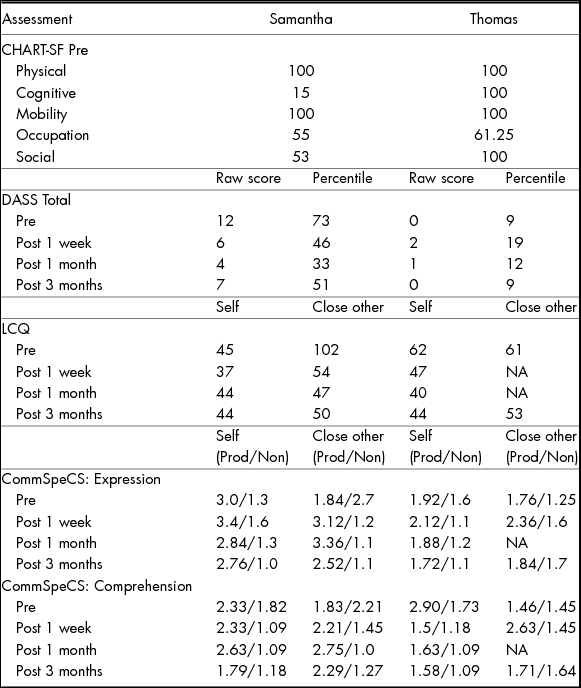
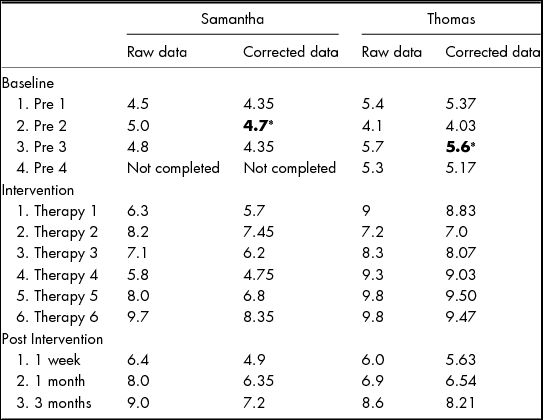
Table 1 summarises the results on the CHART-SF, DASS-21, LCQ and CommSpeCS for Samantha and Thomas. Table 2 outlines results for both participants on the primary outcome measure, the Discourse Coping Scale – Clinician Rating (DCS–CR), across baseline, treatment and follow-up phases. Raw data scores on the DCS-CR and corrected data scores using the data-correction procedure to remove the baseline trend from the data series are shown.
Pre- and Post-intervention Assessment Results

NA, not available; Prod, productive strategies; Non, non-productive strategies.
Raw Data Scores and Corrected Data Scores on the DCS-CR
*Corrected highest baseline rating.
Inter-rater reliability on the DCS-CR was evaluated through calculation of intraclass correlation coefficients (ICC) using the two-way random effects model. Two clinicians independently rated 18 discourse samples (58% of recordings) from the two participants using the DCS procedure. ICC analysis revealed excellent inter-rater reliability. The average of the scores of the two raters was highly reliable (ICC = .996; 95% confidence interval .990 to .999) and the single-measure ICC showed excellent single-rater reliability (ICC = .992; 95% confidence interval .980 to .997).
Samantha
Samantha's CHART-SF results show she is able to function well physically and her mobility is not compromised. In contrast, her cognitive independence is well below the level of performance typical of the average non-disabled person and she also shows substantial handicap in the social and occupational domains.
Pre- versus post-intervention assessments (DASS-21, LCQ and CommSpeCS)
At the commencement of the intervention Samantha's total score on the DASS-21 was equivalent to the 73rd percentile of the general adult population. At the end of the intervention her general psychological distress had reduced to a level commensurate with the 46th percentile, increasing marginally to the 51st percentile at the 3-month follow-up assessment.
Prior to intervention Samantha's and her mother's perception of her communication difficulties differed markedly. Samantha's self-report total score on the LCQ indicated she perceived few communication problems (Samantha's score = 45; normative mean = 52.47, standard deviation = 9.62). In contrast, her mother perceived her to have a large number and a high frequency of problems more than three standard deviations above the normative close-other mean (close-other total score for Samantha = 102; normative close-other mean = 47.17, standard deviation = 9.93). This pattern of results, with a large discrepancy (close-other score greater than self-report score), is typically reflective of impaired awareness on the part of the person with TBI. In Samantha's case it was consistent with generally impaired executive function. At the end of treatment, Samantha's mother perceived substantial improvement in her daughter's communication difficulties and reported her performance to be within one standard deviation of the normative mean. This improved score was maintained at 1 month and 3 months post-intervention.
Prior to intervention, Samantha perceived herself to use productive communication-specific coping strategies more frequently than non-productive strategies. This result was not the case from the perspective of her mother, who reported Samantha to use non-productive strategies substantially more frequently than productive strategies. At the end of treatment, and at both follow-up assessments, this pattern had reversed, with Samantha's mother reporting a substantial reduction in the frequency of non-productive strategies and an increase in the use of productive strategies. Samantha herself reported marginally decreased use of non-productive strategies at the end of intervention and at follow-up.
Treatment for Samantha
Samantha identified four scenarios to focus on during the treatment programme: (1) speaking with family and friends on the telephone; (2) gaining required information on the telephone from customer service representatives; (3) speaking with friends and relatives at social gatherings; and (4) speaking with customer sales and service representatives in retail outlets.
In situations where Samantha had difficulty getting her message across, she learned to use or increase the use of the following productive communication-specific coping strategies: prepare in advance by making a list (e.g., questions she wanted to ask, or things she wanted to purchase); move closer to and look at her communication partners while gaining their attention; describe or show physical examples; use gesture and pointing; say the information in a different way; check what the listener had not understood; and have someone to help when necessary.
During treatment sessions Samantha focused strongly on productive strategies to use when she had difficulty understanding or remembering someone else's message. Samantha learned to ask for the information to be repeated or for an example to be provided, to ask for more detail, and ask for the message to be explained in different words. She also learned to tell the communication partner what she could not understand, asked for the message to be explained in easier words, and clarified the information she had been given. Recording the information (e.g., pen and paper) was a further strategy developed in the programme.
Baseline, intervention, post-treatment and follow-up data series (DCS-CR)
The PNCD was determined by calculating the trend correction factor (Manolov & Solanas, Reference Manolov and Solanas2009), which in this case was .15 (i.e., the mean of the difference between the baseline points). After applying this trend correction factor to the data series, the highest baseline point (4.7) was used to calculate the percentage of non-overlapping corrected data. The intervention demonstrated a highly clinically significant effect, both at the end of intervention (PNCD 100%) and at follow-up assessments up to 3 months after the completion of intervention (PNCD 100%) (Figure 1).
Samantha: percentage of non-overlapping corrected data.
Feedback
Samantha's rating of her confidence with communication had risen from 6 to between 7 and 8 out of 10 at the conclusion of the treatment programme, depending on her familiarity with the topic of conversation. She reported that a key change in her behaviour was that she would now ask questions or for an explanation, if she found herself in a communication interaction where she was having difficulty understanding the message.
I definitely benefited [from participation in the programme]. If I don't understand something now, I’ll ask questions to make sure I understand it. (Samantha)
Towards the end of the programme, Samantha's mother began reporting that the use of the strategies targeted in the treatment sessions had led to changes in Samantha's confidence when speaking with family and friends, and these communication partners were providing feedback that they were enjoying longer and more fulfilling conversations with Samantha.
Both Samantha's mother and support worker participated in the final evaluation session of the treatment and provided feedback about the programme. Both described the positive impact that participation had on Samantha's communication. Samantha's support worker also described a feeling of being better equipped to support Samantha's communication and engagement.
[There has been] a vast improvement from the beginning to now. (Samantha's support worker)
It's a really, really good program and I’ve noticed a lot of changes, considering the way she talks, she's more descriptive, she asks more questions now, where before she was not. It's a very, very good program and I would recommend it to other people. (Samantha's mother)
[It's been] really helpful, [Samantha] has been given some great tools to use, as we have too . . .thinking of different ways to help [her] along and different tools to help get her started and motivated. (Samantha's support worker)
Thomas
The CHART-SF results for Thomas showed he was able to function well in all domains of participation with the exception of the occupational domain, which was reflected in his substantially restricted work-related functioning.
Pre- versus post-intervention assessments (DASS-21, LCQ and CommSpeCS)
The DASS-21 total score for Thomas was indicative of low psychological distress (<20th percentile of the general adult population) from the beginning to the end of treatment and at both follow-up points.
Prior to intervention, Thomas and his father agreed closely on their perceptions of the frequency with which Thomas experienced communication problems. Thomas's self-report total score on the LCQ (62) was 1 standard deviation above the normative mean; his father's total score on the LCQ close-other version (61) was 1.4 standard deviations above the normative mean for close others. At the 3-month follow-up, both Thomas and his father perceived a reduction in the frequency of his communication difficulties. Thomas reported reduced frequency of use of non-productive communication-specific coping strategies, from pre-treatment assessment to 3-month follow-up assessment. His father reported an increase in Thomas’ use of productive strategies at the end of treatment, but the magnitude of this increase was reduced at 3 months.
Treatment for Thomas
Thomas identified four scenarios to focus on during the treatment programme: (1) participating in Board Meetings; (2) speaking with a young man with acquired brain injury whom he was mentoring; (3) responding to question and answer time after delivering an oral presentation to school students; and (4) speaking with his father.
Thomas worked with his clinician to identify a number of coping strategies relating to different types of communication breakdown. In situations where Thomas had difficulty getting his message across, he practised giving more detail, checking with the person to see whether they had understood, increasing his volume and slowing his rate, giving small chunks of information and writing down dot points of what he would like to discuss. Thomas also practised several strategies when he had difficulty understanding someone else's message, including listening for key words, looking at facial expressions, asking the person to rephrase their question, and saying ‘I don't understand’.
Throughout the programme, Thomas was enthusiastic and motivated to participate in all tasks. He consistently attempted to use the strategies targeted in sessions with his clinician during a range of interactions in-between treatment sessions.
Baseline, intervention, post-treatment and follow-up data series (DCS-CR)
Table 2 outlines results on the Discourse Coping Scale – Clinician Rating (DCS–CR) across baseline, treatment and follow-up phases. These data are also presented visually in Figure 2. The intervention demonstrated a highly clinically significant effect, both at the end of intervention (PNCD 100%) and at follow-up assessments up to 3 months after the completion of intervention (PNCD 100%).
Thomas: percentage of non-overlapping corrected data.
Feedback
Thomas reported that using the strategies he had practised with his clinician in treatment had ‘improved the way I talked . . . improved my speech with other people so much more’. At the conclusion of the programme, he reported a substantial increase in his overall confidence in communicating in a variety of settings and with a variety of people, rating his confidence in communication as 9.5/10. Thomas reported that he would give the programme a ‘ten out of ten’, and particularly enjoyed having the opportunity to practise his skills within real-life scenarios that were important to him.
[I] got more out of it when I was with them, with the actual person I was talking with, it was allowing them to understand my difficulties as well as me trying to get better at talking with them.
Discussion
People with TBI have ongoing cognitive and communication difficulties, resulting in frequent interpersonal communication breakdown. Communication-specific coping strategies are used to resolve communication breakdown. The results of this study provide sound proof-of-concept support for the CommCope-I programme. The programme elicited clinically significant improvements on expression and comprehension discourse tasks in participants, and improvements were maintained up to 3 months post-treatment.
Positive changes in interpersonal communication were also evident in the participants’ reports of their own functioning. Both participants reported reduced use of non-productive communication-specific coping strategies at the end of treatment and at 1 and 3 months following treatment. One participant also reported a reduction in general psychological distress at the end of treatment, and this reduction was maintained at 1 and 3 months post-treatment.
Positive intervention-related changes were also perceived by close others who interacted regularly with the participants. Close others reported reduced functional communication problems at the end of treatment and at 1 and 3 months following treatment. They also reported an increase in the observed use of productive communication-specific coping strategies, which was maintained 1 and 3 months following treatment.
Qualitative feedback from clients and close others highlighted important strengths of the intervention, including its focus on strategy development, use of video feedback and community practice. Overall, these results indicate that this novel intervention, focused on communication-specific coping, can produce improvement in the functional communication skills of adults who have substantial communication problems as a consequence of very severe TBI. Not only was improvement evident, but it was elicited in two adults who sustained their injuries more than 5 years previously and presented with stable profiles of post-injury performance. Further, the intervention was found to be highly effective at the end of treatment and 3 months later, using a relatively conservative SCED data analysis method. While the data analysis method was conservative, the design itself could have been improved by applying a multiple baseline across participants, rather than a withdrawal design. The withdrawal design is somewhat limited in the case of skill-based interventions like CommCope-I which are designed to facilitate lasting change in behaviour and are thus not strictly amenable to evaluation using return to baseline single-case designs. Nevertheless, this novel intervention has been shown to elicit positive changes in primary and secondary outcome measures, which provide clear support for further evaluation of the intervention, using single-case systematic experimental replication and group trials using randomised controlled designs. In addition, this single-case evaluation with replication has enabled further fine-tuning of the intervention manual and the development of treatment-fidelity guidelines to apply in future evaluation trials.
These results are particularly promising when considered in the context of the scope and consequences of communication problems after TBI. The majority of those with moderate to severe TBI report difficulties with communication that can persist for several years (Snow et al., Reference Snow, Douglas and Ponsford1998), impacting negatively on social outcome. CommCope-I provides an effective and efficient (12 hours) means of improving communication-specific coping, by reducing non-productive strategies and increasing productive strategies. In addition, reduced overall communication dysfunction was reported not only by those who participated in the treatment but also by those close to them. It is encouraging to see that this study joins a growing number of studies showing positive results for treatments targeting communication following TBI (Cicerone et al., Reference Cicerone, Langenbahn, Braden, Malec, Kalmar, Fraas and Ashman2011; Dahlberg et al., Reference Dahlberg, Cusick, Hawley, Newman, Morey, Harrison-Felix and Whiteneck2007; McDonald et al., Reference McDonald, Tate, Togher, Bornhofen, Long, Gertler and Bowen2008; Togher, McDonald, Tate, Power, & Rietdijk, Reference Togher, McDonald, Tate, Power and Rietdijk2013; Togher et al., Reference Togher, Wiseman-Hakes, Douglas, Stergiou-Kita, Ponsford and Teasell2014).
Acknowledgement
This research was funded by the Victoria Neurotrauma Initiative of the Transport Accident Commission, Victoria, Australia (grant no. D071).