Sexism
Sexism is a form of complex prejudice, which has become increasingly scientifically relevant over the last decade. Traditionally, it has been defined as a reflection of hostility toward women (Expósito, Moya, & Glick, Reference Expósito, Moya and Glick1998). However, the theory of ambivalent sexism suggests two opposite evaluative orientations toward women: hostile sexism (traditional sexism based on prejudice and sexist antipathy against women) and benevolent sexism (stereotypical attitudes towards women which are subjectively positive and tend to elicit behaviors that are categorized as prosocial) (Glick & Fiske, Reference Glick and Fiske1996). Both hostile (HS) and benevolent sexism (BS) are used to justify men’s structural power and to maintain the gender inequalities. The two types of sexism coexist within the same individual and share the assumption that women inhabit restricted domestic roles and are the “weaker” sex.
Ambivalent Sexism Inventory (ASI, Glick & Fiske, Reference Glick and Fiske1996) is one of the most widely used tools for assessing sexism both on a national (e.g., Ferragut, Blanca, & Ortiz-Tallo, Reference Ferragut, Blanca and Ortiz-Tallo2013; Garaigordobil & Aliri, Reference Garaigordobil and Aliri2013) and an international context (e.g., Christopher, Zabel, & Miller, Reference Christopher, Zabel and Miller2013; Gonçalves, Orgambídez-Ramos, Giger, Santos, & Gomes, Reference Gonçalves, Orgambídez-Ramos, Giger, Santos and Gomes2015; Roets, van Hiel, & Dhont, Reference Roets, van Hiel and Dhont2012). Empirical evidence suggests that the HS and BS differentiation is clear, strong and generalizable (Glick et al., Reference Glick, Fiske, Mladinic, Saiz, Abrams, Masser and López2000) while the most fine-grained distinctions are not (e.g., León-Ramírez & Ferrando, Reference León-Ramírez and Ferrando2014). For example, original studies showed certain evidence in favour of a factorial structure of the full model with hostile sexism and benevolent sexism, consisting of three sub-factors (protective paternalism Footnote 1 , heterosexual intimacy Footnote 2 and complementary gender differentiation Footnote 3 ). However, more recent studies on the Portuguese adaptation of ASI have also shown a four-factor structure (hostile sexism and three sub-factors involving benevolent sexism) with similar adjustment rates to those obtained with the two-factor structure (e.g., Gonçalves et al., Reference Gonçalves, Orgambídez-Ramos, Giger, Santos and Gomes2015). The four-factor structure fits in with the theoretical model proposed by Glick and Fiske (Reference Glick and Fiske1996) and it has the empirical advantage of allowing a complete analysis of the kinds of beliefs associated with ambivalent sexism in people in relation with victimization or perpetration of intimate partner violence.
One of the advantages of the ASI is its currently accepted theoretical foundation in relation to sexism and the broad range of empirical evidence in terms of psychometric properties. Hostile and benevolent sexism are positively co-related according to the results of the majority of studies that have taken place (Glick et al., Reference Glick, Fiske, Mladinic, Saiz, Abrams, Masser and López2000), as well as hostile sexism, related with other gender ideology scales (Glick & Fiske, Reference Glick and Fiske1996; Moya, Expósito, & Padilla, Reference Moya, Expósito and Padilla2006). There is also strong evidence that males show more sexist beliefs and minimised perceptions of the seriousness of interpersonal violence than women (Expósito et al., Reference Expósito, Moya and Glick1998).
Sexism and intimate partner violence
Traditionally, interpersonal violence in couples has focused on the marital context or on adult consolidated couples. However, dating violence has elicited a growing interest in recent years (Ureña, Romera, Casas, Viejo, & Ortega-Ruiz, Reference Ureña, Romera, Casas, Viejo and Ortega-Ruiz2015). This type of relationship has certain differential characteristics such as the absence of children, absence of economic independence or a different dynamic of violence (bidirectional and reciprocal) (Viejo, Reference Viejo2014). The majority of literature deals with the relationship between sexism and ideologies/beliefs/myths that legitimize gender-based violence. There is a consensus that sexist beliefs lead to potentially violent behaviours when couples are in situations of conflict or disagreement (Bascón, Saavedra, & Arias, Reference Bascón, Saavedra and Arias2013), due to the “balance of power” between the male and female being unequal. However, there is a lack of empirical data concerning the link between sexism and gender-based violence or intimate partner violence.
Certain studies indicate that there is a relationship between hostile sexism and different aspects of gender-based violence (Valor-Segura, Expósito, & Moya, Reference Valor-Segura, Expósito and Moya2008). However, this actually involves an association between hostile sexism and the justification and legitimisation of violence against women. To be more precise, the different forms of sexism have been related to the legitimisation of intimate partner violence (Durán, Moya, Megías, & Viki, Reference Durán, Moya, Megías and Viki2010; Glick, Sakalli-Ugurlu, Ferreira, & Souza, Reference Glick, Sakalli-Ugurlu, Ferreira and Souza2002; Megías & Montañés, Reference Megías and Montañés2012). Hostile sexism is associated with the justification of rape, a lower level of positive attitudes toward these victims (Durán et al., Reference Durán, Moya, Megías and Viki2010; Sakalli-Ugurlu,Yalcin, & Glick, Reference Sakalli-Ugurlu, Yalcin and Glick2007) and justification of violence in a dating relationship following an act of betrayal (Forbes, Jobe, White, Bloesch, & Adams-Curtis, Reference Forbes, Jobe, White, Bloesch and Adams-Curtis2005). Men present more sexist beliefs and minimised perceptions of the seriousness of interpersonal violence than women (Arnoso, Ibabe, & Elgorriaga, Reference Arnoso, Ibabe and Elgorriaga2014; Expósito et al., Reference Expósito, Moya and Glick1998). Stith, Smith, Penn, Ward, and Tritt (Reference Stith, Smith, Penn, Ward and Tritt2004) conducted a meta-analysis with 85 studies on adult population, and they concluded that in males the attitudes and traditional gender ideology had a moderate effect size (r = .29) in relation to the perpetration of physical violence against their partner. From the perspective of intimate partner violence in the review by Capaldi, Knoble, Shortt, and Kim (Reference Capaldi, Knoble, Shortt and Kim2012) found that hostile attitudes or acceptance of violence against women (e.g., patriarchal domination) in intimate relationships predict weakly or moderately the perpetration of violence against their partner in both men and women. When it comes to mild levels of violence, a low association has been found between sexist beliefs (e.g., hostile sexism) and perpetration of intimate partner violence in a multicultural context (Arnoso et al., Reference Arnoso, Ibabe and Elgorriaga2014). Moreover, in a recent study of León-Ramírez and Ferrando (Reference León-Ramírez and Ferrando2014) focused on dating violence victimization, the predictive power of ambivalent sexism regarding dating violence victimization seems to be relatively low. However, the best prediction found was for physical violence from hostile sexism.
Finally, it is necessary to consider the desirability of maintaining gender-based violence term, used in a general way in Spain, to refer to all assaults occurring within an intimate relationship, due to the fact that it can lead to more confusion than clarity when trying to prevent dating violence (Rodríguez-Franco et al., Reference Rodríguez-Franco, López-Cepero, Rodríguez-Díaz, Bringas, Antuña and Estrada2010).
Objectives
One of the objectives of this study was the adaptation of the ASI into Basque, and its subsequent validation. It was specifically intended to verify the internal consistency, the factor structure of the instrument (two-factor, full or four-factor model), configural, measurement and structural invariance depending on the version (-Spanish and Basque-). Another objective involved the study of the prevalence of violence in dating relationships, and if ambivalent sexism was a valid predictor of such violence in both men and women.
Method
Participants
This study involved 1378 college students (66% of whom were women) from the Basque Autonomous Community (Spain), with an average age of 19.81 (ranging from 17 to 30 years old) with a standard deviation of 2.12. 53% of the participants were doing degrees in social sciences, 33% in health sciences and 14% in scientific and technical fields. There were a Spanish sample (n = 751) and a Basque sample (n = 627). Two samples were equivalent due to being from the same university (University of the Basque Country), where no significant differences were found in relation to gender χ2(1, N = 1353) = 2.35; p = .13, family income t(1347) = 1.38, p = .168, education level of parents t(1343) = 1.28, p = .20 or type of university studies of participants (health sciences, social sciences and science-technologies χ2(2, N = 1353) = 2.66; p = .27. 90% born outside of Spain belonged to the Spanish sample (n = 65) versus 10% from the Basque sample (n = 7) [χ2(1, N = 1378) = 45.52; p < .001].
Instruments
Ambivalent Sexism Inventory (ASI, Glick & Fiske, Reference Glick and Fiske1996; Spanish version by Expósito et al., Reference Expósito, Moya and Glick1998)
This scale is composed of 22 items with 5 response options (1 = Strongly disagree, to 5 = Strongly agree) that measures hostile sexism (e.g., Women exaggerate the problems that they have at work) and benevolent sexism (e.g., Women should be cherished and protected by men). There was an excellent average internal consistency of Spanish ASI according to two studies by Expósito et al. (Reference Expósito, Moya and Glick1998): hostile sexism (α = .88), benevolent sexism (α = .85) and overall (α = .89).
Dating Relationship Questionnaire (Cuestionario de Violencia entre Novios, CUVINO, Rodríguez-Franco et al., Reference Rodríguez-Franco, López-Cepero, Rodríguez-Díaz, Bringas, Antuña and Estrada2010)
This instrument assesses eight forms of victimization in dating relationships, which is composed of 42 behavioural indicators (e.g., My partner humiliates me in public) answered according to a 5-point Likert scale (1 = Never, to 5 = Almost always). These indicators are grouped into eight dimensions of violence: detachment, humiliation, sexual, coercion, physical, gender, emotional punishment and instrumental. Technical abuse is considered to exist when the response “sometimes” or more in terms of frequency is received in response to any indicator (García-Díaz et al., Reference García-Díaz, Fernández-Feito, Rodríguez-Díaz, López-González, Mosterio-Díaz and Lana-Pérez2013). The overall internal consistency in this study (α = .92) was excellent.
Perpetration of Dating Violence Scale
A questionnaire of six items was elaborated in order to validate information about victimization experience in dating relationships without repeating the same items as CUVINO (Rodríguez-Franco et al., Reference Rodríguez-Franco, López-Cepero, Rodríguez-Díaz, Bringas, Antuña and Estrada2010). This scale is composed of three items on physical violence (e.g., When my partner and I get angry, we are usually abusive and physically assault each other) in dating and other three on psychological violence (e.g., I usually initiate an argument by yelling, insulting or threatening my partner) according to a 5-point Likert scale (1 = Never, to 5 = Almost always). The internal consistency was acceptable (α = .73). The principal components analysis yielded a one-factor structure with an eigen value greater than 1 (2.75), and this factor accounted 46% for of the total variation.
Procedure
A favourable report has been issued by the Ethics Committee of the University of the Basque Country for this research. Selection of the sample of participants was performed using non-random sampling method from the University of the Basque Country. However, we tried to obtain a representative sample of the population taking into account gender, grade and university colleges. There were different class groups depending on language (Spanish or Basque) in each university college. All students of this university can choose the language that they study through in each academic year. The criteria for considering a Spanish group or a Basque group was if participants studied their courses through Basque or Spanish. The instructions for data collection were standardised and described in a step by step manner. The collection of data took place during the 2014–15 academic year, with the presence of the staff assigned to this research, for approximately 45 minutes. Once the data was analysed, a report was issued containing the general findings to the corresponding lectures to inform the students of their respective class groups. In order to produce the Basque version of ASI a process of reverse translation was followed according to the recommendation of Hambleton and Patsula (Reference Hambleton and Patsula1999) in the adaptation of a measuring instrument from one culture to another.
Data analysis
The first step involved confirmatory factor analysis using the Maximum Likelihood method. As the multivariate distribution was not normal (standardised Mardia coefficient = 43.31), fit indices were based on the robust method. A study of the reliability of the ASI also took place in terms of its internal consistency. The analysis was carried out with full information maximum likelihood estimation (e.g., Arbuckle, Reference Arbuckle, Marcoulides and Schumacker1996). This was followed by the acquisition of the data related to the prevalence of violence in dating relationships (technical abuse) and gender differences in heterosexual relationships. An 8 (Victimization in dating relationships) x 2 (Gender: male vs. female) MANOVA was conducted. Victimization in dating of heterosexual relationships was a repeated measures factor with eight forms of victimization of CUVINO. Subsequently, the correlational analysis between the dating violence scores and different sexist beliefs were calculated. All participants were included in these data analyses. Additional analyses carried out to know the patterns of correlations as a function of gender. Moreover, a stepwise linear regression analysis was conducted, with age as a control variable and components of ASI and gender (female) as predictors of victimization violence. We also explored one full model of victimization violence, adding perpetration of dating violence as a predictor variable to the previous regression model. Moreover, two parallel regression analyses were conducted for perpetration of dating violence. The data analysis was performed using the SPSS, version 23, with the exception of the confirmatory factor analyses, which was conducted with the EQS program version 6.2. Some researchers have suggested an adequate fit if RMSEA is less than or equal to .06 (e.g., Hu & Bentler, Reference Hu and Bentler1999).
Results
Psychometric properties of the Ambivalent Sexism Inventory in its Basque version
Preliminary analyses
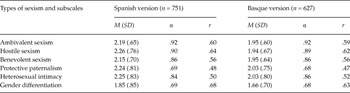
Table 1 presents the descriptive analysis and internal consistency depending on the sub-samples. The asymmetry index of an item was above 2, and another item had also a kurtosis index above 2. The Basque version of ASI presented excellent psychometric properties, making it unnecessary to remove or add any item. According to Table 1, the internal consistency coefficients ranged from .92 to .68. Two sub-scales are slightly below the criteria of α ≥ .70 to consider that there is an acceptable level of reliability. The discrimination index of all items on this scale is acceptable (corrected correlation item-test corrected ID < .30), and the alpha coefficient does not improve if any item in the scale is removed.
Means and standard deviation in parenthesis of subscales as a function of version

Note: M = Mean; SD = Standard Deviation; α = Cronbach’s Alpha coefficient; r = Average inter-item correlation.
Factorial validity of the Basque version of the ASI
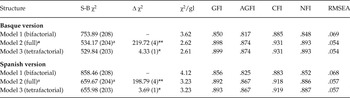
The confirmatory factor analysis (CFA) applied to the Basque sample showed that the model of four first-order interrelated factors presented more improved adjustment than the other two models (see Table 2). The greatest support for the Model 3 is based on the significant difference of the chi-square compared with Model 2, the fact that the ratio between the chi-square and the degrees of freedom is 2.56, the GFI, AGFI and CFI indices come in above 90 and the RMSEA value is close, at .05. A check can also take place in Table 2 to see if the results of the corresponding analyses for the Spanish version are similar. In the tetrafactorial model, the chi-square varied between 520.48 and 614.14, the RMSEA index of the Basque version was .054 and the Spanish version .057. However, there was very little variation between the GFI, AGFI, CFI and NFI indices. It can be concluded that the tetrafactorial model adjusts well to the data in the Spanish version.
Fit indices comparison of three models as a function of ASI version

Note: **p < .001; *p < .05. a This model has an additional parameter refer to correlated residuals between Heterosexual intimacy and Protective paternalism.
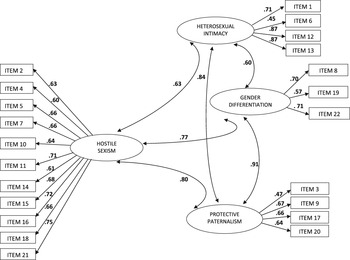
The CFA results of the tetrafactorial model of the Basque version are shown in Figure 1. The factorial loads are acceptable as the lowest comes in at .45, and are generally over .60. In response to the results of this model, we can say that there are significant correlations between the four latent factors and the intensity of the relationship is moderate to high, with the correlations varying from between .60 and .91.
Tetrafactorial model of the Basque version of the Ambivalent Sexism Inventory. S-B χ Footnote 2 (203, N = 627) = 529.84, CFI = .931, RMSEA = .054. All factor loadings and correlations are significant, p < .001.

Invariance of the ASI tetrafactorial model
According to Table 3, after establishing the configural invariance through the samples (baseline of the multi-group model), the invariance of the parameters was supported by the corresponding analyses for the measurement and structural invariance. The changes were less than .01 in the CFI and RMSEA indices in terms of measurement invariability, indicating that the factor loads in the constitution of each factor were invariant in terms of language. Furthermore, the minor changes to the goodness of fit indices are compatible with the structural invariance through the two samples.
Invariance of tetrafactorial model of ASI

Note: **p < .001.
Prevalence of violence in dating relationships
42% of university students had suffered technical abuse (with a response of Sometimes or more for certain items) from their partners. If we look exclusively at participants in heterosexual relationships, there were not any gender significant differences. If we take into account the “zero tolerance” criterion (García-Díaz et al., Reference García-Díaz, Fernández-Feito, Rodríguez-Díaz, López-González, Mosterio-Díaz and Lana-Pérez2013) in dating relationships (including Rarely), the overall percentage amounted to 58%, where the rate of victimization for males and females was similar in heterosexual relationships. 43% of participants who had been victimized applying “zero tolerance” stated that they had perpetrated violent behaviour toward their partner.
In an 8 (Victimization in dating relationships) x 2 (Gender: male vs. female) MANOVA, a multivariate significant interaction effect Victimization x Gender was found [Pillai’s trace = .03, multivariate F(7, 912) = 3.97, p = .001, η2 = .03]. Univariate effects of this interaction were significant, Greenhouse-Geisse (assumption of sphericity is violated) F(3,43 3140177) = 2.99, p = .024. Post hoc analyses revealed that men stated slightly higher levels of victimization than women in terms of physical violence (p = .013) and emotional punishment (p = .019) while there were not gender differences in the rest of victimization form.
Violence in dating relationships and sexism
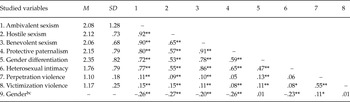
Table 4 contains the correlation coefficients between different sexist beliefs and violence in dating relationships. Sexist beliefs are positively related with victimization in dating relationships as well as with the perpetration of violence, with the exception of protective paternalism and heterosexual intimacy that did not correlate with the perpetration of violence. The highest correlations correspond to the association between victimization in dating relationships and ambivalent sexism (r = .15, p < .01) and hostile sexism (r = .15, p < .01).
Mean, standard deviation and correlation matrix between sexism and dating violence (N = 1054)a

* p < .05; **p < .01. aThe number of participants has decreased, because some of them have not had dating relationships longer than three months; bGender coding 1 = female; 0 = male. CPoint-biserial correlation was applied between gender and the other variables.
In the male group all ASI components were significantly correlated to the perpetration of violence and victimization violence in dating relationships. The higher correlations found were between ambivalent sexism and perpetration of violence (r = .16, p < .001) and victimization violence (r = .15, p < .001). Conversely, in the female group, only hostile sexism was correlated significantly to the perpetration (r = .13, p < .01) and victimization violence in dating relationships (r = .23, p < .001).
In the first regression analysis focused on victimization of dating violence, hostile sexism was just a significant predictor of victimization violence (β = .18, p < .001), F(1, 815) = 5.24, p < .001; R 2 = .03. This model only explained 3% of the variance of dating violence victimization. However, in the full model regression analysis significant predictors of dating violence victimization were perpetration of violence (β = .46, p < .001) and hostile sexism (β = .12, p < .001), F(2, 808) = 130.71, p < .001; R 2 = .24. This model explained 24% of the variance of dating violence victimization.
The first regression analysis focused on perpetration of dating violence and showed that gender (female) (β = .13, p < .001), hostile sexism (β = .11, p = .012), and gender differentiation (β = .08, p = .052) were significant predictors, F(3, 840) = 11.04, p < .001; R 2 = .03. Nevertheless, in the full model regression analysis significant predictors of dating violence perpetrator were victimization of dating violence (β = .47, p < .001), gender (β = .11, p < .001), and gender differentiation, (β = .08, p = .008), F(3, 807) = 89.20, p < .001; R 2 = .25.
Discussion
One objective of this study involved elaborating a Basque version of ASI, providing evidence of the validity of the internal consistency and factor structure of the Basque and Spanish versions, as well as configural, measurement and structural invariance. The results of the confirmatory factorial analysis indicate that the Basque version has a four-factor structure like the Spanish version, one of hostile sexism and three factors relating to benevolent sexism like the original studies in English (Glick & Fiske, Reference Glick and Fiske1996) and more recent studies (e.g., Gonçalves et al., Reference Gonçalves, Orgambídez-Ramos, Giger, Santos and Gomes2015). The model of the four interrelated factors of first order showed significantly better fit for the two versions than the bifactorial model and the full model. Furthermore, a positive relationship was found between hostile sexism and benevolent sexist beliefs. Evidence of the equality of the two versions was also provided, through the analysis of configural, measurement and structural invariance.
The overall dimensions of the ASI (hostile sexism and benevolent sexism) presented a good level of internal consistency in terms of the reliability of the instrument, consistent with those obtained in its initial construction (Glick & Fiske, Reference Glick and Fiske1996) and with the subsequent adaptations such as that of Expósito et al. (Reference Expósito, Moya and Glick1998) or Formiga, Gouveia, and Santos (Reference Formiga, Gouveia and Santos2002). Reliability of protective paternalism protector and gender differentiation scored slightly lower than desirable (α < .70) in the two versions. The Basque version of the ASI ultimately presents similar psychometric characteristics to those of the Spanish version, providing sufficient guarantees to be used as an instrument for measuring ambivalent sexism in adult Basque speakers. It has therefore been a very useful instrument to explore the complex phenomenon of sexism, evaluating a number of sexism dimensions with theoretical and empirical soundness for a variety of languages and cultures. This study enables the use of the ASI instrument to be expanded to the Basque-speaking population, which will facilitate the identification of sexist beliefs at an early age, as well as the planning, implementation, and evaluation of early intervention in this population.
One aspect worth noting is that the Spanish sample consistently scored above the Basque sample in all types of subscales and these differences were significant. It may be due to real differences between two groups (impact bias) (Camilli & Shepard, Reference Camilli and Shepard1994). Helms (Reference Helms2006) noted that cultural experiences and environmental socialization can impact on test performance. This point should be analyzed in depth in future studies. On the other hand, the mean value of ambivalent sexism found in the study could be compared with other studies that evaluated similar samples. In the present study, the Spanish version mean of ambivalent sexism was 2.19 (Likert scale ranging from 1 to 5). In a similar study by Garaigordobil and Aliri (Reference Garaigordobil and Aliri2013) using a sample of the Basque Country, taking into account the same age interval, using a Likert scale from 0 to 5, the ambivalent sexism mean was 1.77 while original studies based on U.S. undergraduate students conducted by Glick and Fiske (Reference Glick and Fiske1996) get a mean of 2.37. In order to compare the results of these three studies, proportions were calculated with this procedure (M/5) or (M+1)/6, depending on the study: the present study = .44, Garaigordobil and Aliri (Reference Garaigordobil and Aliri2013) = .46; Glick and Fiske (Reference Glick and Fiske1996) = .56. It can be concluded that sexist beliefs have not decreased very significantly over the last 20 years (around 10%) when taking into account the major effort made during this period to prevent sexism in Western countries.
The second objective involved the analysis of the prevalence of violence in dating relationships on the basis of gender. 42% of university students had suffered some kind of technical abuse by their heterosexual partner, without any gender differences. The results of the scope of studies conducted in the context of the general population show similar rates of dating violence in men and women, where the majority of prevalent pattern involves mutual violence (Desmarais, Reeves, Nicholls, Telford, & Fiebert, Reference Desmarais, Reeves, Nicholls, Telford and Fiebert2012; Graña & Cuenca, Reference Graña Gómez and Cuenca Montesino2014). This type of dating violence generally involves situational Footnote 4 or episodic violence, entailing minor levels of violence and generally arising from conflicts and arguments of the couple without the presence of the desire to control or dominate the other member (Graña & Cuenca, Reference Graña Gómez and Cuenca Montesino2014). This study provides data on the perception of victimization among men, something barely discussed in previous literature (López-Cepero, Lana, Rodríguez-Franco, Paíno, & Rodríguez-Díaz, Reference López-Cepero, Lana, Rodríguez-Franco, Paíno and Rodríguez-Díaz2015). Taking into account different types of dating violence in heterosexual relationships, men stated slightly higher level of victimization than women in physical violence, emotional punishment. Similar patterns of results were found with the same instrument to measure dating violence victimization with a Spanish sample (López-Cepero et al., Reference López-Cepero, Lana, Rodríguez-Franco, Paíno and Rodríguez-Díaz2015) and a Mexican sample (Cortés-Ayala et al., Reference Cortés-Ayala, Flores Galaz, Bringas Molleda, Rodríguez-Franco, López-Cepero Borrego and Rodríguez Díaz2015).
The third objective was to ascertain whether sexism was a valid predictor of violence in dating relationships in both women and men. The results indicate that the victimization involving minor levels of violence in dating relationships is slightly associated with ambivalent sexism of the victims. However, it is not possible to indicate that ambivalent sexism is a valid predictor of dating violence, due to only accounting for 3% of the variance in victimization, where hostile sexism is the only significant predictor. Some studies show evidence of a certain relationship between hostile or benevolent sexism and violence in intimate partner violence (e.g., Arnoso et al., Reference Arnoso, Ibabe and Elgorriaga2014; Capaldi et al., Reference Capaldi, Knoble, Shortt and Kim2012) or in dating violence (León-Ramírez & Ferrando, Reference León-Ramírez and Ferrando2014; Rojas-Solís & Carpintero, Reference Rojas-Solís and Carpintero2011), whereas other studies found different effects depending on the type of sexist belief (hostile vs. benevolent) (Allen, Swan, & Raghavan, Reference Allen, Swan and Raghavan2009). Although sexism is a set of negative beliefs related to women that would be eradicated, this is perhaps not a precursor of dating violence in men or women.
There has been almost no explanation of how female sexism may impact on their experiences of intimate partner violence. Studies based on community samples include both men and women where victimization in intimate partner violence was predicted by ambivalent sexism (Arnoso et al., Reference Arnoso, Ibabe and Elgorriaga2014; Capaldi et al., Reference Capaldi, Knoble, Shortt and Kim2012; León-Ramírez & Ferrando, Reference León-Ramírez and Ferrando2014) or by adversarial sexual beliefs (Bookwala, Freize, Smith, & Ryan, Reference Bookwala, Frieze, Smith and Ryan1992). Although there is also some evidence to the contrary, benevolent sexism of women is associated with less victimization from their male partners based on an undergraduate student population (Allen et al., Reference Allen, Swan and Raghavan2009). While literature on gender-based violence assumes a close association between hostile sexism of the perpetrators and the violence perpetrated in intimate relationships, the empirical demonstration of this relationship has not been very convincing (Rojas-Solís & Carpintero, Reference Rojas-Solís and Carpintero2011). On the other hand, as it was expected, the perpetration of violence was a valid predictor of victimization. This result is consistent with the bidirectionality of dating violence indicated by different authors (e.g., Desmarais et al., Reference Desmarais, Reeves, Nicholls, Telford and Fiebert2012; Graña & Cuenca, Reference Graña Gómez and Cuenca Montesino2014). Certain authors suggest that violence perpetrated by women against men is more defensive than reactive (Allen et al., Reference Allen, Swan and Raghavan2009; Bookwala et al., Reference Bookwala, Frieze, Smith and Ryan1992), due to finding in their studies that female violence tends to be in reaction to male violence, whereas men tend to initiate violence then their partners respond with violence.
To conclude, the ASI presents acceptable psychometric properties in the Basque version, whereas ambivalent sexism does not seem to be an important risk factor for dating violence. As the main limitation of this study is that the sample comes from a convenience sample of college students, it would be worthwhile replicating the ambivalent sexism study in non-university contexts and using other instruments to measure sexism. Future research should consider possible moderator variables such as cultural context, stressful events or mental health. Prevention and intervention measures should bear in mind the relationship between perpetration and victimization in dating violence, and work with perpetrators or potential perpetrators and victims, be they men or women (Rojas-Solís & Carpintero, Reference Rojas-Solís and Carpintero2011).