Implications
The excellent meat quality of the Mangalitza pig breed has favoured its expansion in Hungary and several other countries. Here, we have analysed the population structure and genome-wide diversity of Mangalitza pigs. When compared with cosmopolitan breeds, Red Mangalitza pigs show a high genomic coverage of very long (>30 Mb) ROH (runs of homozygosity). These results indicate the occurrence of recent and strong inbreeding. In order to avoid the detrimental consequences of inbreeding depression, Mangalitza breeder associations should implement reproductive strategies aiming to minimize inbreeding.
Introduction
Many European local pig breeds have experienced a sustained demographic recession due to indiscriminate crossbreeding, competition with more productive breeds, decline of traditional production systems, progressive abandonment of rural activities and loss of grazing land (Food and Agriculture Organization of the United Nations, 2015). In Europe and the Caucasus, at least 90 breeds have disappeared and many others are endangered or face extinction (Food and Agriculture Organization of the United Nations, 2015). The progressive loss of local porcine breeds may have a negative impact on the production of highly specialized traditional fresh and cured meat products.
One appropriate model to investigate the consequences of strong demographic contractions on genetic diversity is the Mangalitza breed, which is distributed in Hungary and, with a much lower population census, in Romania, Germany, Austria and Switzerland (Egerszegi et al., Reference Egerszegi, Rátky, Solti and Brüssow2003). In 1927–30, there were 1000–1920 Mangalitza pigs in Hungary, and this number peaked to 17 691 individuals in 1955. However, this breed experienced a very serious demographic decline during the two subsequent decades, mainly due to competition with more productive breeds. Noteworthy, only 34 breeding sows were registered in the herd-book in 1975 (Egerszegi et al., Reference Egerszegi, Rátky, Solti and Brüssow2003). Fortunately, the establishment of conservation genetic plans allowed the demographic recovery of this breed (Egerszegi et al., Reference Egerszegi, Rátky, Solti and Brüssow2003). In Romania, the Red Mangalitza breed accounted for 500 individuals in 1983, but only 34 pigs remained in 1996, and nowadays this population faces extinction (Egerszegi et al., Reference Egerszegi, Rátky, Solti and Brüssow2003) and it has a low diversity (Manunza et al., Reference Manunza, Amills, Noce, Cabrera, Zidi, Eghbalsaied, de Albornoz, Portell, Mercadé, Sànchez and Balteanu2016). In principle, this sustained demographic decline is expected to reduce genetic variation and to increase the levels of inbreeding of Mangalitza pigs, two features that might threaten the genetic conservation of this ancient traditional breed.
In the current work, we aimed to characterize the genome-wide diversity of the Hungarian and Romanian Mangalitza breeds, other porcine and wild boar populations in order to assess if the strong population reduction that the Mangalitza breed has experienced during the second half of the 20th century has resulted in a substantial increase of whole-genome homozygosity. Such results would be relevant to ascertain if Mangalitza breeder associations need to implement reproductive and genetic strategies aiming to minimize inbreeding.
Material and methods
Sample collection, DNA extraction and genotyping
Blood samples from Blond (number of samples; n=37) and Swallow-belly (n=26) Mangalitza pigs as well as from Red Mangalitza pigs from Hungary (n=20) and Romania (n=25) were collected in ethylenediamine tetraacetic acid-coated vacutainer tubes. For comparative purposes, several reference populations were included in this study: Blond Mangalitza × Duroc crossed pigs (n=48), Bazna (n=5), Duroc (n=56), Hampshire (n=11), Landrace (n=29), Large White (n=27), Pietrain (n=20) and wild boar from Hungary (n=28) and Romania (n=18, reported in Manunza et al., Reference Manunza, Amills, Noce, Cabrera, Zidi, Eghbalsaied, de Albornoz, Portell, Mercadé, Sànchez and Balteanu2016). Bazna is a local breed native to Romania with a black coat and white belt reminiscent of Hampshire pigs (Draganescu et al., Reference Draganescu, Ghita and Nagi2008). The Bazna breed is famous because of its hardiness and high-quality marbled meat.
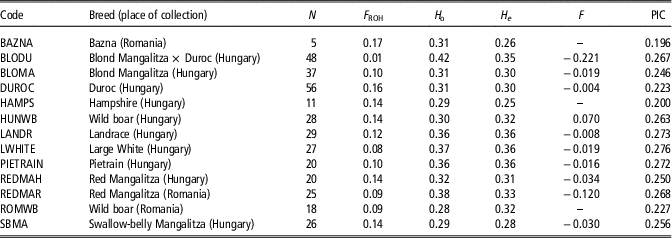
Total DNA was isolated from the samples using a simple protocol (Zsolnai et al., Reference Zsolnai, Szántó-Egész, Anton, Tóth, Micsinai and Rátky2013). Single nucleotide polymorphisms (SNPs) were genotyped with the Porcine SNP60 BeadChip (Illumina, San Diego, CA, USA) or GeneSeek Genomic Profiler 50K Porcine SNP chip (Neogen, Scotland, UK). A series of quality control procedures were conducted on the raw data using the SNP & Variation Suite software v.8.8.1 (Golden Helix, Bozeman, MT, USA). Linkage disequilibrium pruning (genotype correlation coefficient; r 2>0.5) was applied to the whole data set. Linkage disequilibrium between adjacent SNPs was measured with r 2 calculated with the SNP & Variation Suite software v.8.8.1. In addition, monomorphic markers and unmapped SNPs, as well as those with a call rate <95%, were eliminated from the data set. In addition, we removed SNPs with a minor allele frequency lower than 0.05. Duplicated samples (identical by descent value >0.95) and individuals with a genotype call rate <95% were removed. After filtering steps, the final data set included 350 animals and 30 121 SNPs (Table 1).
Diversity statistics calculated over the whole set of pig and wild boar populations

N= number of sampled individuals; F ROH= proportion of the autosomal genome covered by runs of homozygosity; H o= observed heterozygosities; H e = expected heterozygosities; F=method-of-moments relatedness F coefficient; PIC= polymorphism information content.
Population genetics analyses
The proportion of mixed ancestry and population structure were evaluated with the ADMIXTURE software v.1.3 (Alexander et al., Reference Alexander, Novembre and Lange2009), by using default parameters, and with FastStructure (Raj et al., Reference Raj, Stephens and Pritchard2014) by performing five test sets for cross-validation and with Structure software (Evanno et al., Reference Evanno, Regnaut and Goudet2005), considering burnin periods of 10 000 steps followed by 100 000 additional Markov Chain Monte Carlo iterations. ADMIXTURE calculates maximum likelihood estimates of individual ancestries based on data provided by multiple loci (Alexander et al., Reference Alexander, Novembre and Lange2009). FastStructure is an algorithm for inferring population structure from SNP genotype data based on a variational Bayesian framework for posterior inference (Raj et al., Reference Raj, Stephens and Pritchard2014). We evaluated different numbers of clusters (K-value, from 1 to 30) by considering the mixed ancestry model in each software. The optimal K-value was determined by taking into account (a) the estimates of the cross-validation errors (Alexander and Lange, Reference Alexander and Lange2011) for ADMIXTURE outputs, (b) the highest probability for FastStructure (Raj et al., Reference Raj, Stephens and Pritchard2014) and (c) the highest deltaK for Structure results (Evanno et al., Reference Evanno, Regnaut and Goudet2005) estimated with the STRUCTURE HARVESTER software v.0.6.94 (Dent and VonHoldt, Reference Dent and VonHoldt2011) as implemented in the Web server http://taylor0.biology.ucla.edu/structureHarvester. Generation of phylogenetic trees and bootstrap analysis were performed with the TreeMix software (Pickrell and Pritchard, Reference Pickrell and Pritchard2012). A neighbour-joining tree including all analysed individuals was built with MEGA7 (Kumar et al., Reference Kumar, Stecher and Tamura2016). The PLINK software v.1.9 (Purcell et al., Reference Purcell, Neale, Todd-Brown, Thomas, Ferreira, Bender, Maller, Sklar, de Bakker, Daly and Sham2007) was used to calculate observed (H o) and expected (H e ) heterozygosities as well as to build a multidimensional scaling (MDS) plot by using a genome-wide identity-by-state pairwise distances matrix (--mds-plot 2 and --cluster options). The -het command of the PLINK software v.1.9 (Purcell et al., Reference Purcell, Neale, Todd-Brown, Thomas, Ferreira, Bender, Maller, Sklar, de Bakker, Daly and Sham2007) was used to compute the method-of-moments relatedness F coefficient. The polymorphism information content (PIC) within each population was computed with the Botstein’s (Reference Botstein, White, Skolnick and Davis1980) method. The PIC parameter for any given SNP i is defined as:
 $$PIC_{i} {\equals}1{\minus}\left( {a_{i}^{2} {\plus}(1{\minus}{\rm }a_{i} )} \right)^{2} {\minus}{\rm }2{\times}{\rm }a_{i}^{{2{\rm }}} {\times}{\rm }\left( {1{\minus}{\rm }a_{i} } \right)^{2} $$
where a i represents the minor allele frequency of SNP i.
The detection of ROH was carried out with the PLINK v.1.9 software (Purcell et al., Reference Purcell, Neale, Todd-Brown, Thomas, Ferreira, Bender, Maller, Sklar, de Bakker, Daly and Sham2007). The minimum length of a ROH was set to 1 Mb in order to minimize the detection of spurious ROH. To make sure that ROH length is not affected by low SNP density, the minimum number of SNPs that constituted a ROH (
 $l$
) was set to 50, considering the calculation method proposed by Lencz et al. (2007):
 $$l{\equals}{{log_{{e{\rm }{\alpha \over {n_{{s{\rm }\,x\,{\rm }n_{i} }} }}}} } \over {log_{e} {\rm }(1{\minus}het)}}$$
where n s is the number of SNPs per individual, n i the number of individuals, α the percentage of false positive ROH (set to 0.05 in the present study) and het the mean SNP heterozygosity across all SNPs. The density of SNPs was set to one SNP for each 100 Kb and a maximum distance of 1000 Kb was allowed between two consecutive SNPs. The scanning window contained 50 SNPs, and the maximum number of missing SNPs per window was set to five with allowance for one heterozygous SNP.
Each ROH was classified based on its physical length into four size categories: 1 to ⩽5 Mb, 5 to ⩽15 Mb, 15 to ⩽30 Mb and >30 Mb. For each ROH category, the mean sum of ROH per breed was calculated by summing the lengths of all ROH in a given individual for each one of the categories under consideration. The inbreeding coefficient derived from ROH genomic coverage (F ROH) was calculated by dividing total ROH length per individual by total genome length across all 18 autosomes (2444 Mb) for each individual. The effective population number in the recent past was calculated with the SNeP software (Barbato et al., Reference Barbato, Orozco-terWengel, Tapio and Bruford2015).
Results
Autosomal diversity and population structure
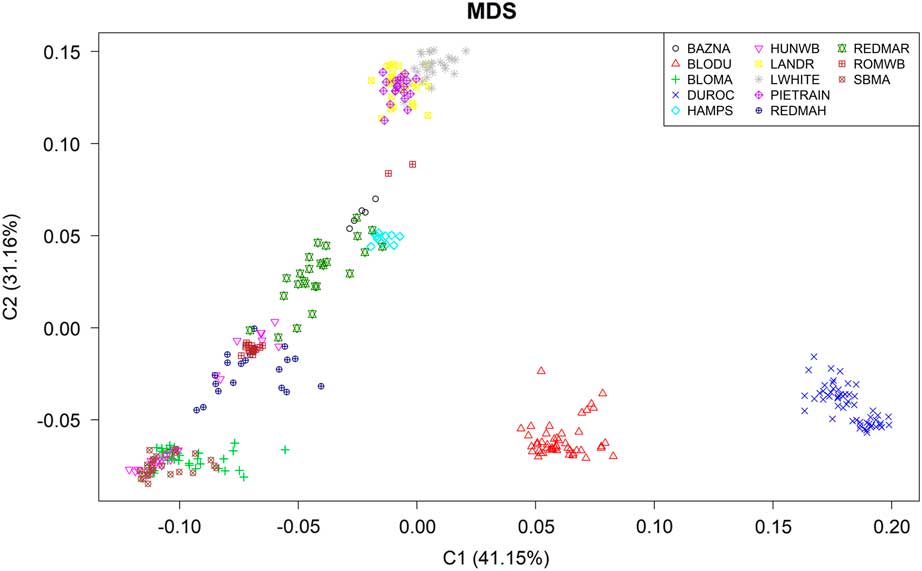
To investigate the genetic relationships between Red, Swallow-belly and Blond Mangalitza swine and other pig and wild boar populations, we built an MDS plot based on genome-wide identity-by-state pairwise distances calculated with PLINK (Figure 1). The first principal component separated Duroc pigs from the remaining breeds (Figure 1). As expected, Blond Mangalitza × Duroc crossed pigs occupied an intermediate position between both parental populations. In the second component, the cosmopolitan breeds Landrace, Large White and Pietrain clustered independently from Mangalitza pigs and Romanian and Hungarian wild boars. The Hampshire and Bazna pigs occupied an intermediate position between these two clusters. We detected a close relationship between Mangalitza pigs and Hungarian wild boars. By making a three-dimensional rotation of the MDS plot, we noted that Romanian wild boar is clearly separated from Mangalitza pigs and, on the other hand, it shows a close relationship with the Bazna breed (Supplementary Figure S1). Descriptive statistics of genetic diversity are shown in Table 1. In purebred populations, both observed and expected heterozygosities ranged between 0.28 and 0.38, whilst Blond Mangalitza × Duroc swine showed high levels of heterozygosity because of their hybrid origin (H o=0.42, H e =0.35).
Multidimensional scaling plot (MDS) depicting the relationships between Mangalitza pigs and other wild boar and pig populations. The following codes are used: C1=1st component; C2=2nd component; DUROC=Duroc; BLODU=Blond Mangalitza × Duroc; HAMPS=Hampshire; BAZNA=Bazna; LANDR=Landrace; LWHITE=Large White; PIETRAIN=Pietrain; REDMAH=Red Mangalitza (Hungary); REDMAR=Red Mangalitza (Romania); BLOMA=Blond Mangalitza; SBMA=Swallow-belly Mangalitza; HUNWB=Wild boar (Hungary); ROMWB=Wild boar (Romania).

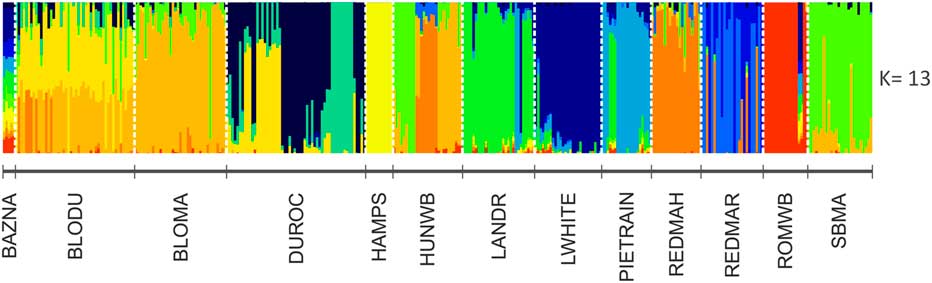
The Admixture, fastStructure and Structure analyses showed that the most probable K-value is K=13 (Figure 2). Indeed, this was the K-value with the lowest cross-validation error (Admixture), the highest probability (fastStructure) and also the highest DeltaK value (Structure). Population structure analyses provided evidence of genetic admixture for Blond Mangalitza × Duroc crossbreds, a result that could be anticipated due to their hybrid origin, and also for Bazna pigs. Indeed, the Bazna breed has a composite origin, that is, it was created in 1872 by crossing Mangalitza and Berkshire pigs and, subsequently, it was introgressed with blood from Angler Sattelschwein, Large White and Berkshire pigs (Ciobanu et al., Reference Ciobanu, Day, Nagy, Wales, Rothschild and Plastow2001). We also observed that Romanian Red Mangalitza, Hungarian Red Mangalitza and Blond and Swallow-belly Mangalitza pigs have distinct genetic backgrounds. At K⩾ 6, they split up into three groups with different genetic background representing the Red, Swallow-belly and Blond Mangalitza varieties (Supplementary Figure S2). Population structure analyses also evidenced that Hungarian wild boar share part of their genetic background with Hungarian Red, Swallow-belly and Blond Mangalitza pigs, but not with the four cosmopolitan breeds (Duroc, Large White, Landrace and Pietrain). As previously published by Manunza et al. (Reference Manunza, Amills, Noce, Cabrera, Zidi, Eghbalsaied, de Albornoz, Portell, Mercadé, Sànchez and Balteanu2016), we identified two Romanian wild boars that had been clearly introgressed with cosmopolitan breeds (probably Large White). At K=4, we observed four genetic backgrounds in domestic pigs: (a) Duroc, (b) Large White, Landrace and Pietrain, (c) Red Mangalitza from Hungary and Romania and (d) Blond and Swallow-belly Mangalitza, while Bazna and Blond Mangalitza × Duroc crossed pigs showed evidence of admixture b (Supplementary Figure S2). These results were consistently found at K=4 to 9 and reflect the common ancestry of Red Mangalitza pigs as well as the fact that Hungarian Red Mangalitza swine were imported into Romania to ‘refresh the blood’ (i.e. reduce endogamy) of the local Red Mangalitza populations recently. The analysis of Supplementary Figure S2 also shows that at K⩾10, Hungarian and Romanian Red Mangalitza pigs display signs of genetic differentiation. The phylogenetic tree depicted in Supplementary Figure S3 support the population structure results reported above. Red Romanian and Hungarian populations are genetically divergent. Moreover, the Hungarian wild boar population shows a close relationship with Mangalitza pigs, while Romanian wild boar is genetically differentiated from Mangalitza pigs and Hungarian wild boar. The coefficients of genetic differentiation (F ST) (Supplementary Figure S4) also evidence that cosmopolitan breeds form a tightly related group and that Hungarian wild boar is closely related to Mangalitza pigs. Moreover, a relevant genetic affinity between Romanian and Hungarian wild boar can be also appreciated.
Admixture analysis of Mangalitza pigs and additional wild boar and pig populations for the K-value with the lowest cross-validation error (K = 13). Each individual is represented by a single column divided into K coloured segments, where K is the number of assumed clusters. Populations are separated by black lines. The following codes are used: DUROC=Duroc; BLODU=Blond Mangalitza × Duroc; HAMPS=Hampshire; BAZNA=Bazna; LANDR=Landrace; LWHITE=Large White; PIETRAIN=Pietrain; REDMAH=Red Mangalitza (Hungary); REDMAR=Red Mangalitza (Romania); BLOMA=Blond Mangalitza; SBMA=Swallow-belly Mangalitza; HUNWB=Wild boar (Hungary); ROMWB=Wild boar (Romania).

In the neighbour-joining tree shown in Supplementary Figure S5, Romanian wild boars form a distinctive clade, with the only exception of two individuals (identified as hybrid animals) which group with the cosmopolitan porcine breeds. Duroc and Duroc × Blond F1 individuals are also distributed in independent clusters. Romanian and Hungarian Red Mangalitza pigs display a close relationship though there is some level of genetic divergence (they are located in different branches of the tree). Hungarian wild boars are distributed in the three clades corresponding to Blond, Swallow-belly and Red Hungarian Mangalitza pigs, highlighting the close relatedness between these domestic and wild populations.
Estimation of the effective size showed that Red Romanian and Blond Mangalitza pigs have the lowest and the highest values of effective population size (N e ), respectively (Supplementary Figure S6), while N e values of Swallow-belly and Red Hungarian are in between. Such results are quite consistent with the current census of Blond (n=6267), Swallow-belly (n=1298), Red Hungarian (n=2106) and Red Romanian (n=120) Mangalitza pigs.
Analysis of runs of homozygosity
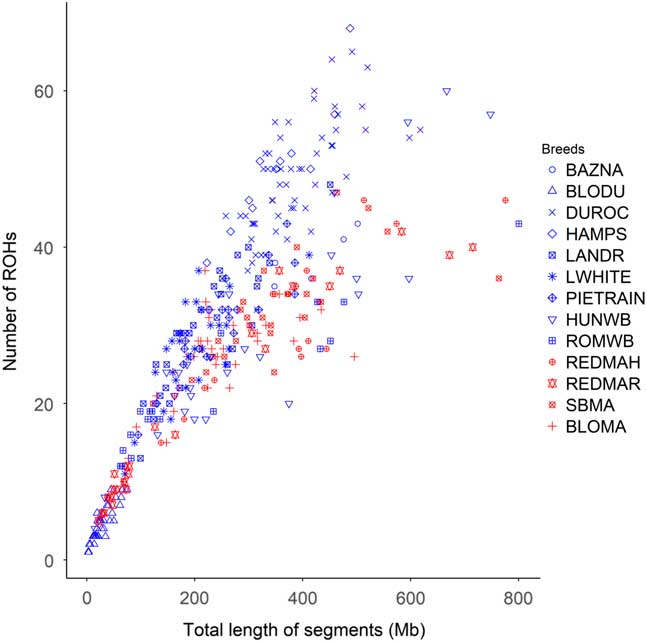
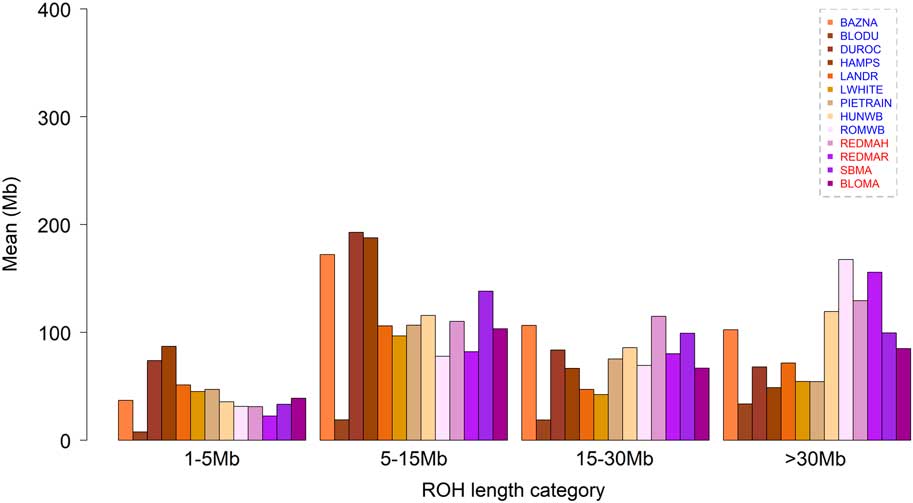
We have characterized the length, distribution and frequency of ROH in the 13 pig and wild boar populations under analysis. The number and coverage of ROH (Figure 3) as well as F ROH coefficients (Table 1) of Romanian Red and Blond Mangalitza pigs were lower than those recorded in Duroc, Hampshire and Bazna pigs, but similar to those measured in Large White, Landrace and Piétrain pigs. Indeed, the analysis of Figure 3 does not show major departures between Mangalitza pigs and cosmopolitan breeds with regard to the distribution of individuals according to ROH number and genomic coverage. On the other hand, we have observed that the majority of ROH were short (<5 Mb) and medium ROH (5 to 15 Mb), that is, 3902 and 4651 ROH measured 0 to 5 Mb and 5 to 15 Mb, respectively, in contrast only 13,62% of the ROH displayed larger sizes, that is, 1,007 ROH from 15 to 30 Mb and 342 ROH larger than 30 Mb. Importantly, a comparative analysis of ROH classes evidenced that Red Mangalitza pigs from Romania and Hungary (together with Romanian wild boars) have a higher average proportion of their autosomal genomes, 155.7 Mb (Romanian Red) and 129.4 Mb (Hungarian Red), covered by very long ROH (>30 Mb). In strong contrast, in the remaining populations only 33 (Blond Mangalitza × Duroc) to 102.4 Mb (Bazna) were covered by very long ROH (Figure 4). Finally, the levels of homozygosity in Blond Mangalitza × Duroc crossbred pigs were negligible because of their hybrid nature.
Number and total length of runs of homozygosity (ROH) in Mangalitza pigs and additional wild boar and pig reference populations. The number of ROH estimated in each individual genome (y-axis) is plotted against total ROH total size (i.e. the number of Mb covered by ROH in each genome, x-axis). The following codes are used: DUROC=Duroc; BLODU=Blond Mangalitza × Duroc; HAMPS=Hampshire; BAZNA=Bazna; LANDR=Landrace; LWHITE=Large White; PIETRAIN=Pietrain; REDMAH=Red Mangalitza (Hungary); REDMAR=Red Mangalitza (Romania); BLOMA=Blond Mangalitza; SBMA=Swallow-belly Mangalitza; HUNWB=Wild boar (Hungary); ROMWB=Wild boar (Romania).

Classification of the runs of homozygosity (ROH) identified in Mangalitza pigs and additional wild boar and pig populations based on their size (x-axis) and mean sum of ROH (y-axis, measured in megabases) within each ROH category and averaged per breed. The following codes are used: DUROC=Duroc; BLODU=Blond Mangalitza × Duroc; HAMPS=Hampshire; BAZNA=Bazna; LANDR=Landrace; LWHITE=Large White; PIETRAIN=Pietrain; REDMAH=Red Mangalitza (Hungary); REDMAR=Red Mangalitza (Romania); BLOMA=Blond Mangalitza; SBMA=Swallow-belly Mangalitza; HUNWB=Wild boar (Hungary); ROMWB=Wild boar (Romania).

Discussion
One of the main goals of our study was to investigate whether the strong population recession experienced by Mangalitza pigs has resulted in a severe contraction of their genetic diversity. In general, the observation of Figure 3 and Table 1 does not show a convincing pattern of significantly increased homozygosity in Mangalitza pigs. Indeed, ROH number and coverage and F ROH coefficients recorded in Mangalitza pigs are comparable to those measured in the majority of cosmopolitan breeds (with the exception of Duroc). In a previous study, Yang et al. (Reference Yang, Cui, Perez-Enciso, Traspov, Crooijmans, Zinovieva, Schook, Archibald, Gatphayak, Knorr, Triantafyllidis, Alexandri, Semiadi, Hanotte, Dias, Dovč, Uimari, Iacolina, Scandura, Groenen, Huang and Megens2017) showed that Mangalitza pigs display higher average F ROH values than a broad array of European and Chinese breeds, however, the dispersion of the F ROH data in Mangalitza pigs was also very high making difficult to predict if such difference would be statistically significant. Moreover, Yang et al. (Reference Yang, Cui, Perez-Enciso, Traspov, Crooijmans, Zinovieva, Schook, Archibald, Gatphayak, Knorr, Triantafyllidis, Alexandri, Semiadi, Hanotte, Dias, Dovč, Uimari, Iacolina, Scandura, Groenen, Huang and Megens2017) only analysed 20 individuals, while in the current work we have sampled 108 Mangalitza pigs.
The moderate homozygosity of cosmopolitan breeds, which have been subjected to a strong artificial selection, could be due to the fact that they carry Asian alleles at variable frequencies since they were introgressed with Chinese sows during the 18th to 19th centuries. In contrast, the origin of Mangalitza pigs is exclusively European (Manunza et al., Reference Manunza, Amills, Noce, Cabrera, Zidi, Eghbalsaied, de Albornoz, Portell, Mercadé, Sànchez and Balteanu2016). Although Chen et al. (Reference Chen, Gomes, Costa, Santos, Charneca, Zhang, Liu, Wang, Bento, Nunes, Buzgó, Varga, Anton, Zsolnai and Beja-Pereira2013) indicated that Hungarian Mangalitza pigs might have been weakly introgressed with Asian blood, a worldwide analysis of porcine genetic diversity showed clear evidence that Chinese introgression into Hungarian Mangalitza, Iberian, Cinta Senese and Nero Siciliano pigs is negligible (Yang et al., Reference Yang, Cui, Perez-Enciso, Traspov, Crooijmans, Zinovieva, Schook, Archibald, Gatphayak, Knorr, Triantafyllidis, Alexandri, Semiadi, Hanotte, Dias, Dovč, Uimari, Iacolina, Scandura, Groenen, Huang and Megens2017). We can conclude that the Mangalitza breed was mostly spared from the introgression of Asian genes into European pig breeds that took place during the 18th to 19th centuries (Giuffra et al., Reference Giuffra, Kijas, Amarger, Carlborg, Jeon and Andersson2000).
One of the most relevant results of our study is that the genomic coverage of very long ROH (>30 Mb) is particularly high in Romanian (155.7 Mb, 6.3% autosomal genome) and Hungarian Red (129.4 Mb, 5.3% autosomal genome) Mangalitza pigs. This finding is a clear indication of strong and recent inbreeding. The dramatic reduction in population size combined with matings between related individuals might be the main cause of the relatively high genomic coverage of very long ROH in Red Mangalitza swine. In contrast, such pattern was not obvious in Blond Mangalitza, evidencing that the three Mangalitza populations analysed in the current work underwent different demographic histories. Indeed, the MDS plot (Figure 1), the Admixture results (Figure 2) and the neighbour-joining tree (Supplementary Figure S5) indicated the existence of genetic differentiation between Blond, Swallow-belly and Red Mangalitza pigs. As previously explained, the Red Mangalitza breed was produced by crossing, about one century ago, Blond Mangalitza with Szalontai pigs, a high, bulky, robust and red-coated Hungarian aboriginal race devoted to produce meat (Hankó, Reference Hankó1940).
One of the potential sources of genetic variability in Mangalitza pigs could be gene flow with wild boars. Indeed, the genome-wide analysis of the diversity of Mangalitza pigs indicated the existence of a close genetic affinity between this breed and wild boars (Figure 1). In the Admixture analysis (Figure 2), Hungarian Red and Blond Mangalitza pigs shared a common genetic background with Hungarian wild boars. Similar results have been obtained when comparing Iberian pigs and Spanish wild boars (Manunza et al., Reference Manunza, Amills, Noce, Cabrera, Zidi, Eghbalsaied, de Albornoz, Portell, Mercadé, Sànchez and Balteanu2016), a finding that might be explained by the occurrence of ancient and recent genetic exchanges between wild and domestic pigs. Indeed, it is well known that Szalontai sows, which intervened in the formation of the Red Mangalitza variety, produce stripped piglets, a strong indication of their ancient and extensive introgression with local wild boars (Egerszegi et al., Reference Egerszegi, Rátky, Solti and Brüssow2003). Moreover, as many as 25% pigs of the commune of Bârzava (Arad County, Romania) have been introgressed with wild boars (Matiuti et al., Reference Matiuti, Bogdan, Crainiceanu and Matiuti2010). This high level of introgression could be due to the extensive regime of pastoral management that has been traditionally performed in certain areas of Romania, where pigs are allowed to roam free providing a window of opportunity for the occurrence of unintentional mattings with wild boars (Matiuti et al., Reference Matiuti, Bogdan, Crainiceanu and Matiuti2010). As reported by Manunza et al. (Reference Manunza, Amills, Noce, Cabrera, Zidi, Eghbalsaied, de Albornoz, Portell, Mercadé, Sànchez and Balteanu2016), two Romanian wild boars showed clear evidence of introgression with domestic pigs, being the Large White breed the most likely source (Supplementary Figure S2, K⩾4). Recently, Iacolina et al. (Reference Iacolina, Pertoldi, Amills, Kusza, Megens, Bâlteanu, Bakan, Cubric-Curic, Oja, Saarma, Scandura, Šprem and Stronen2018) reported a relatively high abundance of hybrid wild boars in Austria, Bosnia and Herzegovina, Bulgaria and Serbia. Moreover, a genome-wide analysis of the diversity of North European wild boars revealed that about 10% of the individuals showed some evidence of introgression from domestic pigs (Goedbloed et al., Reference Goedbloed, Megens, Van Hooft, Herrero-Medrano, Lutz, Alexandri, Crooijmans, Groenen, Van Wieren, Ydenberg and Prins2013), thus revealing that the hybridization of pigs and wild boars is relatively frequent even in countries where pig management is essentially intensive.
We have demonstrated that Red Mangalitza pigs have a relatively high genomic coverage of very long ROH (>30 Mb), a clear indication that this breed has been subject to a strong and recent inbreeding. It is well known that inbreeding can have negative consequences on both production (Silió et al., Reference Silió, Rodríguez, Fernández, Barragán, Benítez, Óvilo and Fernández2013) and reproduction (Saura et al., Reference Saura, Fernández, Varona, Fernández, de Cara, Barragán and Villanueva2015) performance, a phenomenon known as inbreeding depression (Charlesworth and Willis, Reference Charlesworth and Willis2009). In order to avoid the detrimental consequences of inbreeding depression, Mangalitza breeder associations should devise reproduction and genetic strategies aiming to increase breeding values for production goals and at the same time keeping inbreeding to a minimum.
Acknowledgements
Part of the research presented in this publication was funded by grant AGL2013–48742-C2–1-R awarded by the Spanish Ministry of Economy as well as by projects TKISSE and TGENRE supported by the Hungarian Ministry of Agriculture. The authors also acknowledge the support of the Spanish Ministry of Economy and Competitivity for the Center of Excellence Severo Ochoa 2016-2019 (SEV-2015-0533) grant awarded to the Centre for Research in Agricultural Genomics (CRAG). Tainã Figueiredo Cardoso was funded with a fellowship from the CAPES Foundation-Coordination of Improvement of Higher Education, Ministry of Education of the Federal Government of Brazil. Thanks also to the CERCA Programme of the Generalitat de Catalunya.
Declaration of interest
The authors declare that they have no competing interests.
Ethics statement
Sampling was performed by trained veterinarians following standard procedures and relevant national guidelines to ensure appropriate animal care.
Software and data repository resources
None of the data were deposited in an official repository.
Supplementary material
To view supplementary material for this article, please visit https://doi.org/10.1017/S1751731119000582