Introduction
The value of forage has considerably increased in recent years because of the increasing demand for livestock products and a realization of the impact of livestock on improving rural livelihoods. Sorghum is a high water-use-efficient crop with high photosynthetic efficiency and dry matter accumulation rates. The importance of sorghum as a forage crop is growing in many regions of the world because of its high fodder productivity and ability to utilize water efficiently even under drought conditions (Reddy et al., Reference Reddy, Ramesh and Reddy2004).
Utilization of sorghum exclusively for forage purpose is common in several parts of the semi-arid tropics. While single-cut forage sorghum caters to the fodder need of rainfed dryland areas and small farmers, multi-cut types are preferred for areas with irrigation and large dairy enterprises. About 20–60% of dry fodder supply in semi-arid areas is dependent on sorghum. It is estimated that sorghum fodder constitutes 20–45% of the total dry weight of feed of dairy animals during the normal seasons and up to 60% during the lean summer and winter seasons (Anonymous, 2007).
Multi-cut sorghum types play a major role in meeting the fodder demand. A popular multi-cut variety, SSG 59-3, was released in 1974 (Paroda and Lodhi, Reference Paroda and Lodhi1978) in India. It was obtained from an advanced-generation selection of a cross between non-sweet Sudan grass and the sweet sorghum variety JS 263. It has high tillering capacity and gives three cuts. To date, it has been used as a check variety in All India Coordinated Sorghum Improvement Project forage sorghum trials, since a multi-cut variety that could yield better than SSG 59-3 was not released at the national level (Anonymous, 2011). To realize the improvement in multi-cut varieties over SSG 59-3, we need to introduce genetic variability. With the existing variability, plant breeders have successfully recombined the desired genes from cultivated crop germplasm and related wild species by sexual hybridization, and have developed new cultivars with desirable traits (Jain et al., Reference Jain, Brar and Ahloowalia1998). Occasionally, the desired variation is unavailable in the right combination, or simply does not exist at all. In such cases, alternative technologies are required, which could create more genetic variability and reduce the time in developing new cultivars with improved economic traits.
Mutation induction is an established tool in plant breeding to supplement existing germplasm and to improve cultivars in certain traits. Ever since the epoch-making discoveries made by Muller (Reference Muller1927) and Stadler (Reference Stadler1928), a large amount of genetic variability has been induced by various mutagens and contributed to modern plant breeding. Radiation sources, such as X-rays, γ-rays and fast neutrons, and chemical mutagens have been widely used to induce mutations. Hundreds of improved varieties in different crops have been released to farmers, demonstrating the economic value of the technology (Micke et al., Reference Micke, Donini and Maluszynski1987; Kharkwal and Shu, Reference Kharkwal, Shu and Shu2009). Keeping in mind the advantage of mutations, efforts were made to create variability in SSG 59-3 through mutagenesis. Fifteen such mutants of SSG 59-3 were evaluated in different locations for important fodder yield and quality traits.
Materials and methods
The popular multi-cut variety, SSG 59-3 was used for this study to create variability using mutation breeding. The variety SSG 59-3 was planted after treating with a combined treatment of γ-ray doses, i.e. 30, 40 and 50 kR, and 0.2% Ethyl Methane Sulfonate (EMS) treatment at CCSHAU, Hisar. No single plant germinated at 40 and 50 kR+0.2% EMS treatment. Forty-nine plants that were germinated after the treatment with 30 kR+0.2% EMS in the M1 generation were raised during Kharif 2003 and selfed to produce the M2 generation. The M2 generation was evaluated for the variation in Kharif 2004. These plants have been selfed since then and selections were made. Fifteen such mutagenic derivatives of SSG 59-3 were advanced further until they become uniform. These 15 lines were evaluated extensively for morphological and quality traits at three locations (CCSHAU Hisar, GBPUAT Pantnagar and DSR Hyderabad) during 2009 and at five locations (CCSHAU Hisar, GBPUAT Pantnagar, MPUAT Udaipur, PAU Ludhiana and DSR Hyderabad) during the year 2010. At each location, these lines were arranged in a randomized complete block design with three replications. Each experimental unit was composed of two rows of 5 m long with a row spacing of 0.45 m.
Observations recorded
In each location, observations were recorded on the following fodder yield and quality parameters: days to 50% flowering were recorded on a plot basis, while other parameters were recorded on ten individual plants/plot.
Field observations
Days to 50% flowering were recorded as the number of days required from planting for 50% of the plants in a plot to reach mid-anthesis. Plant height was recorded as the height of the plant from the ground level to the tip of the main tiller at flowering. The number of leaves per plant was counted at flowering, and the length and breadth of the fourth leaf from the ground level was recorded. The plants were harvested at 50% flowering to estimate fodder yield and to recover samples for quality analysis (see below). Green fodder yield (GFY) was recorded immediately after harvest to avoid moisture loss.
Observations on fodder quality
Hydrocyanic acid (HCN) is an important anti-nutritional factor in forage sorghum, and HCN content less than 200 ppm on a dry weight basis is safe for animal consumption. HCN content was estimated by using green plant samples (0.20 g minced tissue) sampled at 35 d after sowing. The estimation of HCN was performed according to the procedure by Gilchrist et al. (Reference Gilchrist, Lueschen and Hittle1967). Protein percentage was estimated by determining total nitrogen in the sample by the modified micro-Kjeldahl method (Jackson, Reference Jackson1973). In vitro dry matter digestibility (IVDMD) was determined according to Mechrez and Orskov (Reference Mechrez and Orskov1977).
Statistical analysis
Data from eight environments were analysed using multiple Randomized complete block design (RCBD) analysis in the software Windostat (Indostat, 2004). Stability analysis was performed using the model of Eberhart and Russell (Reference Eberhart and Russell1966).
Results
The data from different locations over 2 years showed the presence of variability in the lines for almost all the traits studied.
Variability in fodder yield traits
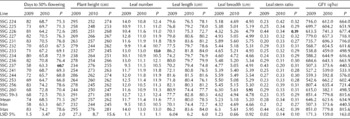
Days to 50% flowering varied from 61 to 79 d among the lines studied. The line SSG 237 was the earliest to flower in both years and was found to be 10 d earlier than SSG 59-3 (Table 1). Leaf parameters, such as greater number of leaves, leaf length, leaf breadth and leaf:stem ratio, are important and contribute to a high fodder yield. Little variation was observed for leaf number among the mutants. However, SSG 233 with 13 leaves in both years had a high leaf number. Longer leaves were also observed in SSG 233 (84 cm) compared with SSG 59-3 (Table 1). Twelve mutants were found to have broad leaves, among which SSG 260 was the best with a leaf breadth of 5.95 cm compared with 4.78 cm for SSG 59-3. A high leaf:stem ratio was observed for SSG 226. For GFY, none of the mutants was promising compared with SSG 59-3.
Performance of SSG 59-3 mutants for fodder yield and associated traits over 2 years (2009, 2010 and pooled-P)

GFY, green fodder yield; LSD, least significant difference.
Variability in fodder quality traits
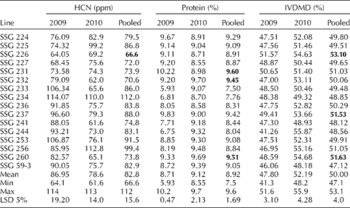
Six mutants recorded low levels of HCN compared with SSG 59-3. The mutant SSG 226 was the best with the lowest HCN level (Table 2). High protein and high IVDMD are desirable quality traits for forage sorghum. In the mutant lines studied, the protein percentage ranged on average from 7.5 to 9.6% in both years (Table 2). The mutant SSG 231 had high protein followed by SSG 260 and SSG 232. Digestibility of fodder is the most important forage quality parameter that helps in the optimal absorption of the feed consumed by animals. The IVDMD values in the mutants ranged from 47.1 to 53.1%, the highest being in SSG 226, followed by SSG 260 and SSG 237.
Performance of SSG 59-3 mutants for fodder quality traits over 2 years (2009 and 2010)

HCN, hydrocyanic acid; IVDMD, in vitro dry matter digestibility; LSD, least significant difference.
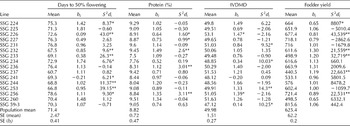
Stability of these genotypes for the important traits was estimated using the Eberhart and Russell model (Table 3), which indicated that stable lines are available over environments for fodder yield and important quality traits. For earliness, SSG 237 was the most stable genotype, while for protein percentage, SSG 231 and SSG 260 were stable across the locations. For IVDMD, SSG 226, SSG 260 and SSG 237 were promising. For fodder yield, SSG 227 and SSG 231 were stable.
Individual regression analysis and estimates of stability parameters of SSG 59-3 mutants for fodder yield and quality

IVDMD, in vitro dry matter digestibility; b i, linear component; S 2d i, non-linear component.
P* < 0.05, ** P< 0.01.
Discussion
The data on fodder yield and quality from different locations over 2 years showed that the lines evaluated had variability for most of the traits studied. Days to 50% flowering is an important trait in forage sorghum improvement because early flowering is a desirable trait, especially in multi-cut forage sorghums, so that more number of cuts can be taken. The line SSG 237 was found to be 10 d earlier than the control line SSG 59-3. Leafiness of the forage lines is very important since it increases the intake potential by animals. Hence, leaf parameters such as greater number of leaves, leaf length, leaf breadth and leaf:stem ratio are important. Considering all the leaf parameters, SSG 233 with a greater number of longer leaves, and SSG 231 and SSG 244 with longer and broader leaves were promising.
HCN is an anti-nutritional factor in forage sorghum that is potentially toxic to animals when fed on 30–35-d-old sorghum crops (Wheeler et al., Reference Wheeler, Mulcahy, Walcott and Rapp1990; Cheeke, Reference Cheeke1998). Usually, maximum HCN content is observed at the early stage of 30–35 d of crop growth and thereafter gradually decreases. HCN is readily absorbed into the bloodstream of grazing ruminants, causing cellular asphyxiation and eventually death (Hoveland and Monson, Reference Hoveland and Monson1980). Hence, it is essential to develop varieties/hybrids with high fodder yields and low HCN content in sorghum. SSG 226 with the lowest level of HCN was the best line. Besides low HCN, high protein and high IVDMD are desirable quality traits for forage sorghum. Digestibility of fodder is the most important forage quality parameter that helps in the better absorption of the feed consumed by animals. The mutant SSG 260 had high protein and IVDMD values, and thus is a promising line as far as forage quality is concerned.
Stable performance over different environments is a prerequisite for the development of any variety. For judging the stability of a genotype, it was emphasized that both linear (b i) and non-linear (S 2d i) components of the genotype × environment interaction are necessary. According to the Eberhart and Russell model, a variety is considered to be stable if it shows high mean performance with a regression coefficient of unity (b i= 1) and minimum deviation (non-significant) from the regression line (S 2d i= 0). Studies on the genotype × environment interaction and stability parameters of the mutant derivatives indicated the availability of mutant lines that were stable in their performance over environments for fodder yield and important quality traits. For days to 50% flowering, SSG 237, which flowered earlier than all the other lines, was the most stable genotype for earliness with a b i value close to unity and non-significant deviation from regression (Table 3). For protein percentage, SSG 231 and SSG 260 were very stable across the locations. For IVDMD, the best line SSG 226, with a b i value significantly greater than unity, is suitable for more favourable conditions. The lines SSG 260 and SSG 237, with IVDMD higher than the population mean, b i values close to unity and non-significant deviation from regression, were promising and stable across the locations. For fodder yield, SSG 227 and SSG 231, which yielded more than the population mean, were stable.
This study indicates that, since the variation available in multi-cut forage sorghums is less, mutations provide an opportunity for creating variability. Evaluation of mutants derived from SSG 59-3 over 2 years indicated that even though there were no lines with better fodder yield over SSG 59-3, much variation was observed for earliness, leaf parameters and fodder quality (Tables 1 and 2). The lines with a combination of improved traits may be of interest to forage sorghum breeders. For example, in the present study, SSG 260 with low HCN, high protein percentage, high IVDMD and high leaf:stem ratio compared with SSG 59-3 is a potentially useful line for improving fodder quality. SSG 237, which was 10 d earlier than SSG 59-3, had high digestibility compared with SSG 59-3. Similarly, SSG 226 had low HCN, high digestibility and high leaf:stem ratio. SSG 232, which flowered 5 d earlier than SSG 59-3, had high protein percentage and low HCN compared with SSG 59-3. All these lines can be utilized in the breeding programme for improving multi-cut forage sorghum for these specific traits.