INTRODUCTION
In the United States, undocumented immigrants are more likely to win immigration legal claims when they have legal representation (Eagly and Shafer Reference Eagly and Shafer2015; Ryo Reference Ryo2018; Chand et al. Reference Chand, Apolonia Calderon, Hawes and O’Keeffe2021). Yet immigrants seeking legal representation face major obstacles. Unlike defendants in the criminal legal system, immigrants are not guaranteed a right to government-provided counsel in either affirmative or defensive legal claims in the immigration system. Expensive private representation is often unaffordable for undocumented immigrants, the majority of whom belong to low-income families (Migration Policy Institute 2018). And despite the increased efforts of local jurisdictions and nonprofits to expand the availability of free or low-cost legal representation for immigrants (see, for example, Robbins Reference Robbins2017; Swan Reference Swan2018; Despart Reference Despart2020), the demand for affordable representation still far exceeds the supply of immigration attorneys (Lakhani Reference Lakhani2019). Therefore, like the unequal distribution of access to other civil legal institutions (Sandefur Reference Sandefur2008), legal services providers unintentionally play a stratifying role: in choosing who to represent, they shape the broader distribution of immigrant legal status.
To make such difficult and consequential representation decisions within conditions of severe constraint, immigration legal services providers try to select cases they think will win their claims. Applying to the immigration bureaucracy with an unwinnable case is not only an inefficient use of scarce resources but also may put clients in danger of deportation. Scholars have offered a key insight to what makes a winnable case: cultural legibility. Legal services providers choose clients who best fit the cultural expectations of a “deserving” immigrant (Lakhani Reference Lakhani2013, Reference Lakhani2014; Galli Reference Galli2019). Because humanitarian statuses based on experiencing crime victimization and abuse are one of the only avenues to permanent legal status available to undocumented immigrants, the culturally legible “deserving” immigrant victim is typically a woman, who has suffered clear violence and trauma, has reported her experiences to the proper authorities, and, motivated by her desire for safety not only for herself but also for the public, has assisted in the identification, investigation, and punishment of her abuser (Bhuyan Reference Bhuyan2008; Berger Reference Berger2009; Lakhani Reference Lakhani2019).
My interviews with legal aid providers from thirty-eight nonprofit organizations illuminate an additional requirement for what makes a winnable case and, therefore, a case that attorneys select for representation. By recounting the key decisions that they have made across four stages in the representation process (case selection, attorney assignment, relief pursual, and application production), attorneys confirmed that legibility as a deserving immigrant victim is a necessary but insufficient condition for gaining and determining legal representation. Attorneys also spoke at length about how they strived to minimize the burden of representing each case and their overall caseload. Attorneys assessed not only whether a potential client’s case could realistically navigate the complex, highly variable, ever-changing bureaucracy of local civil and criminal legal systems and the federal immigration system but also how much work it would take for them to shepherd this case through this process. Minimizing this burden was as important as emphasizing a client’s legibility as the deserving immigrant: attorneys could reject a culturally legible client whose case was too burdensome to represent.
Legal providers make two key case assessments when determining if a client is likely to receive favorable adjudication by the US Citizenship and Immigration Services (USCIS): legibility and burden. Culturally legible cases fit the “deserving immigrant victim” ideal. Simultaneously, cases are low burden when attorneys predict that they can successfully assemble all the appropriate paperwork required to check all the boxes required by local and federal government bureaucracies at each stage of the process. If attorneys anticipate not meeting even one requirement, the case is not “winnable,” no matter how deserving the client’s narrative may be. Likewise, “low burden” clients are those whose cases are less complex and require fewer labor hours to build. Attorneys prefer low-burden cases because they allow attorneys to maximize the total number of clients they can represent. Attorneys predict a case’s representation burden in terms of how much time, effort, and investigation would be required to check the many boxes required by local and federal government bureaucracies at each stage of representation. As demonstrated below, the representation burden of each case varies over time and across numerous factors, including political geography (city, county, state, federal), overlapping civil and criminal legal processes, funding sources, and the possible humanitarian legal avenues for relief. While attorneys regularly expend extensive time, resources, and energy learning new legal changes and jumping administrative hoops to build a winnable case, sometimes attorneys recognize that the bureaucratic obstacles—although potentially surmountable—would be too time consuming to justify taking on a particular client.
By documenting the importance of both cultural legibility and case burden to attorneys representing immigrant humanitarian status seekers, this article advances socio-legal scholarship on immigrants and the law in three directions. First, the findings extend past scholarship on case winnability by describing attorneys’ pressures to minimize representation burden. Second, the findings help scholars understand immigration representation and, ultimately, access to legal status as a stratifying process that begins with client selection. Attorneys exclude perceived “unwinnable” and “hard-to-win” cases from representation to protect these potential clients from deportation as well as to safeguard their own capacity and caseloads. This stratifying process occurs well before an application for legal status is filed with the immigration bureaucracy. This processual approach also provides an explanation for existing scholarship that finds a positive relationship between legal representation and winning legal status. Third, my findings demonstrate that, unless the immigration system can lessen both the cultural demands it makes of immigrants seeking to regularize their status and the bureaucratic requirements that increase representation burden for attorneys who shepherd this process, stratification amongst immigrants will be an inherent feature of free and low-cost representation regardless of how much legal aid is available. Case burden and cultural legibility are not inherent characteristics of immigrant clients and their cases but, rather, state-imposed and state-codified requirements.
LITERATURE REVIEW
The Increasing Significance of Legal Status
Scholars have long established the importance of legal status for immigrants in the United States. Legal status is a “master status” that overwhelms other social and political identities (Gonzales Reference Gonzales2016) and accentuates social disadvantages (Waters and Pineau Reference Waters and Gerstein Pineau2015). Undocumented and liminally documentedFootnote 1 immigrants and their children face barriers to institutional access and challenges to social integration (Waters and Pineau Reference Waters and Gerstein Pineau2015). This results in poorer outcomes compared to their permanently documented or US-born peers across multiple dimensions, including work (see, for example, Hall, Greenman, and Farkas Reference Hall, Greenman and Farkas2010), family (see, for example, Hook and Glick Reference Hook and Glick2020), and education (see, for example, Bean et al. Reference Bean, Leach, Brown, Bachmeier and Hipp2011). Importantly, legal status is also tied to immigrants’ deportability (Asad Reference Asad2020). The presidential administration of Donald Trump exacerbated this issue by implementing over four hundred Executive Branch changes to immigration law and policy (Pierce and Bolter Reference Pierce and Bolter2020), including the undoing of Obama-era enforcement priorities that deprioritized immigrants with humanitarian claims or victimization status. These changes broadened deportability to all undocumented immigrants (Moinester Reference Moinester2019).
In response to this broadened risk and changing political climate, many state and local governments instituted or reaffirmed policies to protect their immigrant residents (Immigrant Legal Resource Center 2019). One strategy was new or continued funding to local nonprofits providing free and low-cost legal representation for immigrants in removal proceedings and/or seeking to affirmatively regularize their status (Farmer Reference Farmer2017). These efforts were often motivated by, among other factors, empirical findings that immigrants with representation have much higher success rates in removal proceedings compared to unrepresented immigrants (Ryo and Peacock Reference Ryo and Peacock2019; Chand et al. Reference Chand, Apolonia Calderon, Hawes and O’Keeffe2021). Yet as socio-legal scholars have long noted, there always will be more clients seeking free and low-cost representation than there are organizations and attorneys providing it in legal contexts where there is no right to counsel (Sandefur Reference Sandefur2007). Immigrants in the United States have no right to legal representation for issues under immigration law. Even with increased local legal services funding, there is not enough to meet demand. As a result, attorneys providing legal aid make difficult choices as to which clients they will represent and how much effort they will expend.
The Humanitarian Path through Multiple Legal Contexts
Even with representation, undocumented immigrants have very few pathways to long-term, permanent legal status under US immigration law. One of these pathways is humanitarian status based on experiencing interpersonal victimization, which allows a recipient to later apply for legal permanent residency and ultimately citizenship. These statuses are limited due to their narrow eligibility (for example, qualifying harm) and numerical availability (for example, statutory limits on the number of visas available annually). These statuses include the U visa for crime victims; the T visa for human trafficking victims; self-petitions under the Violence against Women Act (VAWA) for victims of domestic violence perpetrated by a US citizen or legal permanent resident;Footnote 2 special immigrant juvenile status (SIJS) for youth who have experienced abandonment, abuse, or neglect by a parent; and asylum for female domestic violence victims from certain countries. Several statuses also allow recipients to access social welfare programs from which they would otherwise be barred. To receive one of these legal statuses, immigrant applicants must apply to USCIS, the Department of Homeland Security agency responsible for managing and adjudicating immigration visas.
Although immigration policy is national, local and state policies can mitigate some of its effects, leading to immigrant outcomes that can vary based on political geography (Portes and Zhou Reference Portes and Zhou1993). This is also true in the case of victimization-based legal status. Before applying to USCIS, applicants must ask local government agencies to provide third-party documentation of their credibility, victimization, and suffering. Some statuses require applicants to report their victimization to law enforcement. Others (for example, the U visa) require a law enforcement or prosecuting agency to certify that the applicant was helpful in investigating their perpetrator and suffered substantial harm (Orloff, Isom, and Saballos Reference Orloff, Isom and Saballos2010). The calculus to ask local government agencies is complicated by the fact that many state and local governments participate formally or informally in the enforcement of immigration laws. This makes seeking certification from some agencies riskier than others due to the threat of removal for the applicant and/or their family, community, or perpetrator if their perpetrator is also an immigrant and the applicant does not want them to face immigration system consequences such as removal (Armenta and Alvarez Reference Armenta and Alvarez2017). Therefore, whether and how someone can successfully apply for humanitarian status at the federal level is thus mediated by how accessible local and state actors might be.
The Role of Burden in Legal Representation
The literature discussed above demonstrates both the complexity of the existing immigration system and the importance of legal representation for individuals hoping to navigate this system for a successful outcome. But given the high demand for legal services and the limited supply of legal aid, how do attorneys decide which clients to represent and which statuses to pursue? To answer this question, I pair existing research that shows how attorneys guide immigrant survivors to be culturally legible victims during the application process with the literature on how street-level bureaucrats respond to increased burdens in their work. The literature on street-level bureaucrats engaged in last-mile policy implementation has explored how professional ideologies, organizational processes, and institutional logics influence how public servants interface with everyday citizens seeking help and benefits (Lipsky Reference Lipsky1983; Maynard-Moody and Musheno Reference Maynard-Moody and Musheno2003). A key theme is how actors who serve poor clients struggle with morally fraught professional decisions in moments of tension, including how to distribute scarce resources when client demand and the burdens of work are simultaneously high. For instance, public defenders and welfare workers spend disproportionate time and effort on some clients versus others based on their professional ideologies and moral judgments of defendants and welfare seekers (Watkins-Hayes Reference Watkins-Hayes2009; Clair Reference Clair2020). Health-care workers may shift burdensome clients onto other medical professionals (Seim Reference Seim2017), triage medical care in emergency rooms (Lara-Millán Reference Lara-Millán2014), or change the services to less onerous (and less holistic) forms (Horton Reference Horton2006). All of these burden-reducing decisions result in disproportionate access to, and experiences of, services for the poor.
Immigration lawyers, however, differ from many other cases of street-level bureaucrats in that universal care is rare due to immigrants’ lack of a right to counsel. This results in otherwise eligible applicants being turned away from representation without the likely opportunity to try again with the same organization. In past scholarship, attorneys who broker immigrants’ access to the legal status application process triage representation based on how clients will be perceived by the benefits-providing government or how legible they are to adjudicators. According to Paige Sweet (Reference Sweet2018, 2), legibility is “the ability [of individuals] to be recognized as legitimate and worthy of resources within institutions.” In the case of immigration legal status, scholars to date have understood institutional legibility as being primarily a cultural phenomenon, arguing that applicants only receive recognition from the immigration bureaucracy if they first become legible (Asad Reference Asad2020).
To be categorized as culturally “deserving,” immigrant victims must demonstrate an adequate amount of suffering, credibility as a victim of crime, a willingness to punish their perpetrators (who may be immigrants themselves), and good moral character (Lakhani Reference Lakhani2013, Reference Lakhani2014; Galli Reference Galli2019). Scholars further document how attorneys help clients claim legal status during a period of legal uncertainty by scripting two key narratives (Lakhani Reference Lakhani2013): a “clean” narrative of victimhood (which requires smoothing over story discrepancies that may alert adjudicators to a client’s lack of credibility or deservingness) and a narrative of a “good moral character” (which focuses on the client’s positive civic engagement). More specifically, Chiara Galli (Reference Galli2019) demonstrates how legal services providers assess clients’ cultural legibility—including how their clients fit into narrow legal categories of victimhood and the likelihood of success based on their possession of “humanitarian capital” vis-à-vis concrete, documented, quantifiable suffering—when determining their clients’ legalization strategies.
When deciding how to represent humanitarian claims, I find, like Sarah Lakhani (Reference Lakhani2013) and Galli (Reference Galli2019), that immigration attorneys consider the cultural legibility of a potential client and whether they can meet the expectations of a “deserving” immigrant victim. However, I also find that immigration attorneys expend significant effort predicting, evaluating, and navigating the bureaucratic and administrative burden of representing each case. They assess whether they can realistically expect to navigate a client’s case through the complex network of multi-jurisdictional government agencies, system adjudicators, and patchwork legal frameworks that make up immigration law. For example, while previous studies have discussed how clients must report their abuse to the police to demonstrate cultural legibility, my findings show that a client’s willingness to do so is not enough: attorneys also try to predict how many phone calls they need to make to the agency, how many emails they must send to other legal advocates for information gathering, and how many appeals it may take to the law enforcement agency’s leadership to assess their willingness and, if they are willing, whether they can convince them to do so in a timely manner. Assessing which local law enforcement agencies are supportive and which may be risky to approach is just one illustration of how attorneys consider a chaotic landscape of bureaucratic practices to determine the burden of representing a case and, ultimately, whether and how they can feasibly move the case forward.Footnote 3 Attorneys can screen out cases that they predict will have too high a burden, even if the applicant is technically eligible for relief.
The case of attorneys representing affirmative, humanitarian status seekers demonstrates how their predictions of winnability and the minimization of burden clarifies our understanding of who gets representation and how and expands our understanding of representation as a multi-stage process instead of an event. Only when we understand both the legibility of a case and the attorney’s anticipated burden of lawyering that case can we clearly see the implications for legal status inequality vis-à-vis access to representation. In the conclusion, I highlight the limits of depending on legal aid as a protective and regularization strategy for undocumented immigrants given these findings.
Methods
Data
This study draws on interviews with forty-one nonprofit legal aid providers, who represent thirty-eight organizations, regarding their experiences representing immigrants affirmatively seeking to regularize their immigration status via humanitarian means.Footnote 4 Immigrants affirmatively claim legal status when they are not undergoing removal proceedings and defending their ability to stay in the United States via immigration court. These are immigrants who might otherwise be “under the radar” from the immigration system (Asad Reference Asad2020). Instead, they affirmatively apply for status by submitting an application to the USCIS agency. Attorneys represent clients seeking relief under the following humanitarian immigration pathways: T visa for human trafficking victims, U visa for victims of qualifying crimes, SIJS for minors who have experienced abuse and neglect from at least one parent, VAWA self-petitions for victims of domestic violence perpetrated by a US citizen or lawful permanent resident, and asylum for victims of gender-based violence from certain countries. Each of these pathways has its own statutory history, legal debates, and specific eligibility and application requirements.Footnote 5
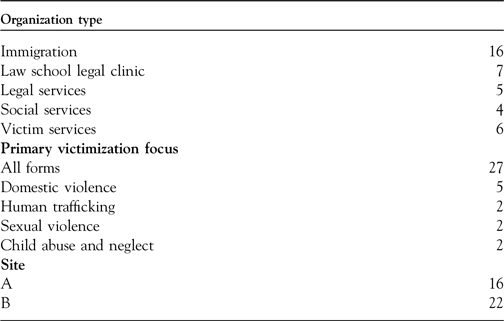
The study respondents represent the range of nonprofit organizations currently providing free or low-cost legal representation for immigrant victims of crime. These organizations vary in size, focus, and mission, ranging from immigration-specific legal organizations to victim service organizations that have a department specializing in immigration law. Most do not carry an extensive removal defense caseload, instead focusing on screening clients for affirmative relief and providing advice and counsel to potential clients who do not qualify for status. All providers typically screened for financial eligibility up to an income threshold, commonly 200 percent of the poverty line. Table 1 provides an overview of the attorneys’ organizational types and their focus on victimization.
Legal services organization characteristics (N = 38)

The providers and their respective organizations were working in two similar geographic sites. Each site is a large urban metropolitan area on the East Coast of the United States that leans politically liberal and espouses pro-immigrant sentiments and policies at the local government level. If undocumented immigrants are in, or have entered, deportation proceedings in either of these metropolitan areas, they benefit from favorable federal immigration court circuits. Both sites were also comprised of a multitude of governmental jurisdictions, including various cities, counties, and state courts that all play a role in humanitarian status claims. And both sites included a metropolitan core surrounded by counties and jurisdictions that were less friendly to immigrants and lean more politically conservative, including at least one outlying county per site with a 287(g) agreement with the Department of Homeland Security, a federal program that deputizes local law enforcement to perform federal immigration enforcement activities (Congressional Research Service 2021). The providers’ organizations generally have support from the public as well as from local government leaders and the local criminal legal system agencies, and they acknowledge that they practice immigration law in areas where services and legal aid providers are more plentiful and financially supported compared to those in other metropolitan areas. Their clients come from communities with a long history of immigration to the area.
Data Collection and Analysis
I conducted qualitative, semi-structured, in-depth interviews from March 2019 through February 2021. I initially used online resources focused on immigration and victimization legal services to compile a list of relevant organizations and then examined organization websites to identify individuals who appeared to be primarily responsible for representing immigrant victims of crime or humanitarian status seekers. I recruited providers via email. At the end of each interview, I asked respondents to recommend additional providers. The purpose was twofold: to conduct snowball sampling for additional respondents and to confirm that my initial provider list was accurate. The interviews consisted of seventeen in person, twenty over the phone, and one via video conference call, which ranged from roughly thirty minutes to three hours long. All but three were recorded. I transcribed the first thirteen interviews with assistance from speech recognition software and used professional transcription services for the rest. I took electronic notes for the three interviews I did not record. I also wrote post-interview notes to capture immediate reactions, theoretical and empirical insights, and other reflections.
My findings emerged from iterative rounds of coding using the qualitative data analysis software NVivo and memo writing. My first two rounds of analysis inductively focused on respondents’ descriptions of the immigration legal environment as ever-changing. I noticed that attorneys frequently emphasized the impact of bureaucratic and administrative barriers on their work, as opposed to solely focusing on client characteristics that made them deserving or undeserving of legal status. In the subsequent two rounds of coding, I focused on how respondents made decisions throughout the legal representation process based on clients’ legibility as the deserving immigrant victim and the many procedural demands of overlapping government bureaucracies.
FINDINGS: THE CALCULUS AND PROCESS OF LEGAL REPRESENTATION
In recounting how they represent low-income, undocumented immigrant clients affirmatively seeking humanitarian relief, providers regularly discussed the “calculus” of legal decision making. Legal aid organizations are unable to represent every immigrant who seeks their services, in part, because not everyone has a viable claim to status and, in part, because the organizations themselves operate with limited financial resources and capacities. When asked to describe how they select a case for representation, attorneys often mentioned selecting cases that were “winnable,” which were cases that had “viability” or “merit.” Determining case winnability was especially important given the consequences of filing an unsuccessful claim, which was recognized as a referral to deportation proceedings.Footnote 6 As one attorney explained, for example,
a client who has been here for twenty years, [who has] the non-frivolous but very weak asylum case, we provide them advice but probably decline representation because of the risk to the client of submitting their application. Especially with asylum cases brings a risk of being placed into removal proceedings. (Attorney B17)
Attorneys assessed winnability according to two factors: a case’s legibility (adherence to the adjudicators’ expectations of culturally deserving immigrant victims) and a case’s representation burden (the amount of time, resources, labor, and knowledge the case would take to represent). Attorneys’ assessment of a case’s representation burden is significant given the high client demand and limited resources: spending too much effort with any one client will reduce the total number of people that the organization can support. Thus, an attorney’s perception of an ideal “fit” for representation is a winnable case that has high legibility to adjudicators and will be low burden to represent. Footnote 7
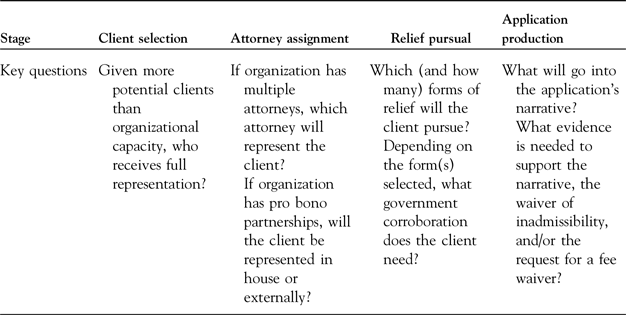
I also found that legal aid providers evaluate a case’s legibility and representation burden across four key stages in the representation process. In the first stage, providers select who will receive full representation from within their potential client pool. In the second stage, they assign the client to either an in-house attorney or an external pro bono attorney from a large corporate law firm. In the third stage, the attorney determines the humanitarian form (or forms) of relief for which the client will apply. And in the fourth stage, attorneys produce the application documents for submission to USCIS, including the client’s narratives and the supplementary forms. Table 2 summarizes the decisions attorneys make at each stage. These stages do not always occur sequentially; for instance, several stages, particularly stages one through three, may occur at once.
Attorneys’ key decisions at each stage of legal representation

Case Burden’s Role in Winnability
I argue that an attorney’s prediction of case winnability involves two key assessments. First, providers assess whether their client and the client’s claims meet the cultural expectations of the “deserving” immigrant, as established by the institutions from which they are asking for corroboration and legal status. These cultural expectations must be met in two arenas: the immigration system, which evaluates whether the client is eligible for, and deserving of, legal status, and the justice or family court system, which evaluates whether the client is a credible victim of crime or abuse who deserves state support. Second, attorneys assess the case’s representation burden by anticipating whether they can navigate their client and their client’s claims through the multiple, overlapping, and changing requirements of the US immigration system and the criminal legal system or family court bureaucracies. They predict how much work a case’s claims will take to win, including how much expertise they already possess and need to develop, how many peer attorneys to contact for help or to train, how many non-lawyer actors to involve, how much paperwork and documentation they need to collect, how much evidence they need to produce, and how many meetings will be needed to produce affidavits. Attorneys assess and attempt to minimize case burden not only at each stage of the representation process but also longitudinally as policies and procedures change over time and cross-sectionally as policies and procedures change based on geography-based legal jurisdictions.
The attorneys who I interviewed repeatedly emphasized the complexity, difficulty, and sheer amount of labor and time required to navigate a claim through the immigration system’s complicated procedural and bureaucratic demands. Some of these tasks, while perhaps trivial to the public, had especially devastating effects on their day-to-day capacity to represent clients. And because the administration of immigration law is outside of federal statutes, attorneys respond to how the federal immigration bureaucracy makes burdensome rules, processes, and policies. As one attorney put it,
all of these other little [law and policy changes] are just administrative ticky tack bullshit. But it’s hard to make someone who’s not an advocate feel like it’s unfair. … You have to explain the whole system first. And I think those things are tougher to handle, to explain to people generally and explain to clients. Because they’re facially neutral bureaucratic rules, even though their whole purpose is to make life harder for survivors. (Attorney A10)
As I demonstrate below, these increasing procedural demands directly affect assessments of both case winnability and case burden: the more “facially neutral” bureaucratic hoops to jump, the more likely a case is to fail to clear the banal procedural requirements necessary for winning and the more likely a case is to supersede a legal aid attorney’s burden limits.
But attorneys attempting to minimize a case’s representation burden also exacerbate demands for cultural legibility. To illustrate, providers frequently discussed how to approach clients with criminal backgrounds. Respondents clarified that they screen clients for representation based on criminal background not because they think these clients are unworthy of representation or even because they think criminal background cases are precluded from winning. For instance, as one attorney explained,
the hypo[thetical] I gave with the [client with] four drug convictions in recent past, that case is going to take significantly more amount of work than someone with a clean record. And so my capacity constraint might not allow me to take that case on, whereas I would be able to take on the case for a crime victim perhaps with a quote-unquote “lesser crime.” (Attorney B17)
This attorney and others explained that the burden of representing these cases makes clients with an extensive criminal background not a good fit for representation: the effort to understand the legal implications of a criminal background, determine if the potential applicant is eligible for a waiver, gather the evidence needed to secure a waiver, and develop the expertise in criminal law or “crimmigration” (Stumpf Reference Stumpf2006) are just a few of the required steps that make these clients difficult to represent. Lawyers were often confident that, if they had the time, resources, and expertise to do so, they could render such a client culturally legible as a deserving immigrant victim. But the high cost to represent these clients, coupled with the demand from other potential clients without these challenges, made it difficult to justify taking on such a client, especially if it meant excluding several other clients with winnable, less burdensome cases.
Maximizing Cultural Legibility and Minimizing Representation Burden
Stage 1: Client Selection
Attorneys prioritize high legibility, low burden clients and cases for representation. Clients with winnable cases have not only experienced qualifying victimization, but they have also clearly suffered trauma as a result of that victimization and have access to, or are willing to seek out, the evidence needed to document their suffering. Clients also must have reported their victimization to law enforcement or be willing to do so going forward, which demonstrates that they are willing to help punish their abusers. Providers also select clients based on their prediction of how burdensome representation will be. At the client selection stage, an attorney’s prediction of a case’s winnability and burden is heavily influenced by several factors: how much paperwork is ultimately needed, whether required forms can be secured and how much effort it will take to secure them, how complex the subarea of immigration law is, and how federal, state, and local policies that directly or indirectly influence immigration law are administered. For example, several respondents brought up how the difficulty of asylum cases made gender-based violence claims not ideal for representation due to a 2018 ruling by then Attorney General Jeff Sessions. The added work to make a compelling asylum case raised questions concerning whether the client’s case would be a good use of their limited resources. As one provider explained,
I feel like the way that Jeff Sessions wrote that decision didn’t completely preclude people on the basis of DV [domestic violence] at all. I think that you could really clearly articulate a reason why, especially if you’ve sought protection and stuff, and the state itself hasn’t been effective. And in protecting someone, I think there are ways that you could craft a “particular social group” or craft it in terms of political opinion or something else that would fit. But I just don’t know enough right now to see what have people been using to try and get that done. (Attorney B04)
Other providers echoed this sentiment, including one law school clinic director discussing how they selected easier cases for their students: “I tend to take the ‘beginning’ or sort of ‘beginning-intermediate’ cases, and that pretty much rules out domestic violence and gang-related cases from Central America” (Attorney B15). Another attorney explained his organization’s broad policy: “We don’t do asylum work, because then it becomes all-consuming and then it makes it very difficult to do other kinds of cases” (Attorney A15). While these clients are still culturally legible as victims of domestic violence, no amount of suffering would make them a good fit for these providers because the administration of asylum law made these claims too difficult to represent.
Stage 2: Attorney Assignment
At this stage, organizations with multiple attorneys on staff will match a potential client with an attorney in a way that minimizes representation burden. Even clients who were deemed legible to the immigration system in the first stage might be excluded at the second stage if the organization did not have a suitable attorney on staff to represent them. Respondents reported making attorney assignments based on staff members’ expertise and capacity. If an attorney speaks a certain language or is experienced in representing one type of claim, they will be able to represent a claim better than another attorney. One attorney stated:
I’ve never done a T [visa] before, so if a T comes in, I’ll ask [another staff member] if she wants to do it. I do a lot of asylum and SIJS mainly, just because that’s what I have the most experience in doing. So yeah, I would say it’s driven a lot by what’s coming in and what we have capacity to take, but then ultimately, it’s based on people’s specialty and what they feel comfortable doing. (Attorney B21)
These considerations illustrate how assigning cases based on attorneys’ own preferences and expertise help to minimize representation burden, whether that is because one attorney can represent a claim more quickly or more knowledgeably than another.
Several respondents work for organizations that have extensive, formal partnerships with large corporate law firms providing pro bono representation for their clients. These organizations build their caseloads around determinations of which cases will be represented in-house by the organization’s staff attorneys versus which cases will be outsourced to a corporate law firm. In these partnerships, nonprofit organizations typically provide significant amounts of training, mentorship, and communication to corporate law firm partners. According to the providers, the benefit of pro bono partner representation is not only increased caseload coverage but also more resource-intensive representation for outsourced clients because big law firms have larger attorney-to-client ratios with greater capacity: “[Pro bono programs] have a ton of resources which is awesome … they’re flying out country conditions experts, things we can never do, and clients can never afford to and they’re just billing the firm” (Attorney B14).
When determining which cases are a good fit for pro bono versus in-house representation, these providers typically refer high winnability cases externally. This preference is based on their pro bono partner’s typical lack of expertise in immigration law and in working with vulnerable immigrant clients. As one provider explained,
a mentored case has to be a mentored case. That is to say, I think you will generally see the end point of the case in some specific way and it should be a case that a pro bono team, potentially without a ton of experience in immigration law, can handle and be successful. We want to be mindful of the skill set that our pro bono teams bring to the table. (Attorney B12)
Other providers with pro bono partners echo this sentiment, emphasizing the balance between a client’s cultural legibility as an immigrant victim and the burden of working with a client who may have experienced a high level of trauma: “There are some circumstances where the severity of harm favors pro bono placement because the case is a much clearer cut case. There’s other times where, because of the severity of the harm, there are challenges in working with the client” (Attorney B17).
Attorneys also reveal assessments of case burden when considering relief-specific bureaucratic timelines. According to respondents, cases assigned to pro bono partners need to have balanced timelines due to this work being a secondary responsibility to their primary, paying clients. Cases cannot have any immediate upcoming deadlines (for example, a client seeking asylum right before they pass the one-year eligibility mark of entering the country), but they also cannot take too long to adjudicate (as one attorney explained, “a ball and chain eight-year case that I’m never going to see decided” [Attorney B14] is not emotionally or professionally satisfying for pro bono attorneys to represent). In short, no matter how culturally legible a case may be, attorneys are less likely to assign a case for pro bono representation if such a case is too burdensome and, therefore, a poor fit for the activities and expertise of private firms.
Stage 3: Relief Pursual
At the relief pursual stage, legal aid providers determine for which forms of relief the client is eligible. If clients are eligible for more than one form, attorneys determine how many forms to pursue and in what sequence. For example, attorneys discussed advising clients who were eligible for both the SIJS and asylum to apply for SIJS first because it was an easier standard of suffering to meet (as one attorney explained, “the level of trauma that most clients suffer, to make someone eligible for asylum, is really high” [Attorney A10]). Attorneys also recommend that a client pursue avenues that minimize representation burden, even if the client is less culturally legible for one form of relief and vice versa. One common example of minimizing a case’s burden at this stage is how attorneys advise their clients to report their victimization to, or to seek corroboration from, law enforcement or other government agencies—a requirement for U visa, T visa, and SIJS applicants. Clients who are fully culturally legible as victims of crime, abuse, and neglect nevertheless may be stopped by their inability to secure corroboration to certifying institutions, most commonly local, state, and federal law enforcement, prosecutors, and family courts. For example, U visa certification policies vary by local and state jurisdictions as well as by individual agencies. Certification is also entirely discretionary. At the time, lawyers did not work in states with a law that mandated a response to certification requests in a certain number of days. If a client's victimization occurred in a jurisdiction that would not provide U visa certification, or that had an onerous certification process, then attorneys could recommend a different pathway of relief:
There’s a huge range in terms of how helpful [police departments] are willing to be. Do they have a dedicated person? Do they have somebody who is willing to fill out the form that you need to get a U visa done? It’s so hard to say. In [county], I’ve tried repeatedly to get my client a U visa certification. I’ve never even come close. And I can’t do it because they’re not willing to do it for me. And it’s little things. You can’t get the person on the phone, the person’s out of the office. There’s so many little bureaucratic ways just to be like, “I’m not going to do this for you.” (Attorney B12)
The decision to pursue certification was also important when a relevant agency was in a county known to have informal and/or formal participation with federal immigration enforcement or was a federal law enforcement agency themselves. Attorneys described being especially cautious when recommending clients report to these agencies due to the potential risk of removal for the client or their families. Some reported no longer turning to Homeland Security Investigations, the investigative agency of the US Department of Homeland Security, at all in order to satisfy reporting or certification requirements, which created extra burdens if there was no alternate reporting agency or if the alternate agency had its own burdensome policies.
However, providers also brought up instances where a client who was not culturally legible was still able to pursue relief due to an easier, less burdensome relief form. For example, attorneys discussed how a victim of domestic violence may be eligible for either a U visa, a T visa, or VAWA self-petition but may not want to report the abuse to law enforcement for myriad reasons (for example, they did not want their partner punished and potentially deported, or they and their family depended financially on their partner). These clients were culturally illegible as a deserving immigrant victim because they are unwilling to participate in the punishment of their abuser. But, as one respondent explained, they still have workable options at this stage:
And so [reporting] a calculus the client has to make for him or herself. Doing a VAWA case, at least there’s no requirement to report, so that’s an option. In T visa cases, there’s exceptions to the reporting requirement or there are ways of reporting so they’re less likely to trigger an investigation and arrest than other ways of reporting. So that might be a decision that the client makes. So if there is a factual basis for pursuing a T visa for a domestic violence survivor, that could be the better option for her. (Attorney B17)
However, there are potential consequences to using a pathway that provides less cultural legibility, even if it is procedurally less burdensome for the attorney and their client. As several attorneys articulated, there are potential benefits to getting law enforcement involved in a meaningful way, such as investigating a report and providing certification. These strategies provide additional corroboration of the client’s claims, as I discuss in the next section. In sum, attorneys’ assessments of case burden at the relief pursual stage foregrounds relief-specific features, requirements, and options, highlighting how attorneys consider concerns other than the client’s cultural legibility as an immigrant victim to determine which relief form to pursue. Although I have highlighted only a few examples above, my respondents offered a large number of varied situations when predictions of case burden—not cultural legibility—took precedence in determining how a case would be pursued. Some of the additional procedural factors considered include: clients’ desires to sponsor family members as derivatives for relief; clients’ willingness and capacity to participate in onerous relief requirements, such as whether they were emotionally prepared to participate in a prosecution in return for certification; any legal statuses that clients already might hold and that might provide a legal backup in case they face removal; and clients’ personal needs (for example, work authorization) that emphasize the urgency of their relief seeking.
Stage 4: Application Production
At the application production stage, attorneys decide what to put in the application itself before it is submitted for USCIS’s adjudication. Respondents consider three key components when creating an application: the client’s narrative of their story and how their narrative fits into a relief-specific category; how adjudicators will evaluate the client’s story; and any supplemental forms that go along with the application, such as a waiver of inadmissibility and its associated fee waiver. In producing application narratives, the attorneys emphasized the importance of the client’s cultural legibility:
I do think certainly from an adjudication’s perspective and the way that we’ve seen Vermont Service Center Footnote 8 switch and shift in the past year and a half, two years, it’s been towards prioritizing quote-unquote “perfect victim[s].” So prioritizing survivors’ [without] criminal histories of their own, or survivors [without] substance abuse history. (Attorney A07)
Through application narratives, attorneys aim to communicate that the client was a credible victim of interpersonal violence who suffered severe trauma as a result of that victimization and was in need of the protection offered by long-term legal status. In telling their client’s story, attorneys seek to highlight not only the client’s experiences of victimization and suffering but also the characteristics that demonstrate “good moral character” while de-emphasizing any characteristics that may cast doubt on their client’s moral worth. One attorney referred to the adjudicator’s expectation of “good moral character” as a “squishy” (Attorney A04) discretionary requirement that could be met by supplemental narratives, such as letters of support from community leaders. Additionally, clients must also demonstrate that they deserve relief because they are seeking to improve public safety by reporting their victimization. Their reporting actions must be demonstrated by supplementary evidence, such as police reports and/or certification from law enforcement or another eligible agency. As one respondent explained, the most useful U visa certifications include additional narratives about how helpful their client was:
The other benefit to that, if we can get involved early enough, is that then I end up getting certifications where either the prosecutor or the police will actually write specific information about how helpful the client was. … I expect that those ones I won’t really have a problem with because it’s very clear that the complaining witness or the victim was really cooperative. (Attorney B04)
The possibility of securing this kind of favorable, corroborative narrative from a law enforcement agency, however, is dependent on the jurisdiction in which the client was victimized and how onerous it is for the attorney and client to secure this corroboration.
Attorneys also commonly have clients with “messy” backgrounds, which attorneys “clean up” by justifying client behaviors that may raise adjudicators’ suspicions (Lakhani Reference Lakhani2013). Attorneys create narratives that emphasize the relationship between a client’s trauma, victimization, and criminal acts, emphasizing how criminal acts were collateral consequences of victimization, or how the client was compelled to commit criminal acts because of an abuser. Even non-criminal behaviors may raise an adjudicator’s suspicion, such as the amount of time passing between an applicant’s victimization and the application, due to an assumption that clients who apply for victimization-based relief years after experiencing the qualifying crime are only doing so for immigration status. One provider explained how to justify the gap in behavior:
If there has been a long period of time between when they escaped [trafficking] and when they apply, we’ll get a lot more evidence to show what explains that gap. Like maybe a psychological evaluation saying they weren’t ready to talk about it. Try to get them hooked up with a lot more services now to show why it’s important for them to stay. (Attorney B01)
To support these cultural narratives of deserving victimhood, attorneys worked with their clients, peer attorneys, service providers, and certifiers to produce evidence and documentation. For instance, service providers produce expert statements on diagnoses of post-traumatic stress disorders, which provide evidence to satisfy the extreme suffering requirement of humanitarian relief and also justification for any past actions that potentially jeopardize the client’s credibility and ability to evoke adjudicator sympathy. One attorney discussed how a mental health professional can provide supportive documentation of trauma: “There’s certain psychological symptoms that are going to arise that validate the fact that this did happen to them, like startle reflex or intrusive thoughts, flashbacks, nightmares, things like that, that a professional can document in a way that a lawyer has no training for” (Attorney A04). And attorneys craft narratives, test and confirm the effectiveness of certain types of claims and educate local law enforcement and other certifying agencies about victimization-based immigration programs to convince them of how their clients have met the legibility requirements for legal status.
To create these cultural narratives of deserving immigrant victimhood, however, attorneys must also navigate onerous bureaucratic adjudication mechanisms that cast suspicion on their efforts. First, they perceive the standards of adjudication to be very high, meaning that they are ever vigilant in how they include evidence and prove their clients’ claims. They describe the Request for Evidence—a response from USCIS asking for more evidence after an application’s submission—as a bureaucratic tool that often creates nonsensical, unfair demands for more paperwork. Restrictions on what types of documentation could prove a client was poor enough to deserve a fee waiver (for example, requiring formal tax returns instead of an employer’s affidavit of earnings for immigrants not legally authorized to work) for their waiver of inadmissibility are also frustrating.
Second, attorneys were much more apt to talk about the bureaucratic filing strategies that they use to try to maximize the chances of applicant claims being read and not returned than they were to discuss the construction of narrative credibility. The legal aid providers who I interviewed discussed ensuring that they used the right color of ink, writing “NA” in otherwise empty form boxes, including specific forms of evidence such as W-2s for fee waivers, and labelling applications with dividers, headers, and post-it notes to bypass adjudicators asking for information that was already provided.Footnote 9 As one attorney explained, putting together an application that appeared clear and organized was one tactic that his organization used:
If it looked like an attorney put it together, that’s the first phase. They’re like, ‘Okay,’ they’ll just hand it to the people to, like, look at the internal stuff. If it looks like it wasn’t well put together, someone who didn’t have an attorney, they’ll a lot of times just blanket deny it just because it didn’t look good. (Attorney B16)
His explanation for doing so was based on a perception that USCIS would deny a sloppy application due to its signal that the applicant did not have an attorney and, therefore, did not know how to navigate bureaucratic expectations from what constituted a quality application.
DISCUSSION AND CONCLUSION
When legal aid providers represent immigrant clients’ humanitarian claims to the US immigration bureaucracy, they often try to maximize a case’s winnability and minimize its burden. Their goal is to maximize the number of clients they can effectively represent and minimize the risk to clients themselves. This was especially evident from the attorneys practicing in a legal context in which clients’ risk of removal due to an unsuccessful application was higher than ever. Consistent with existing scholarship, I have found that lawyers try to maximize winnability by optimizing clients’ cultural legibility to institutions as deserving and credible immigrant victims (Lakhani Reference Lakhani2014; Sweet Reference Sweet2018; Galli Reference Galli2019). Yet by asking legal aid providers to recount the entire legal decision-making process (client selection, attorney assignment, relief pursual, and application production), this article has also detailed how attorneys constantly assess, predict, and ultimately attempt to minimize the complex and laborious procedures that constitute case burden. Attorneys understand the compounding nature of burden to unfold over any given case’s timeline, underscoring their desire to minimize burden for not only one case but also their entire caseload.
Attorneys deem cases less burdensome when they anticipate being able to navigate their clients’ cases through complex and often-changing federal immigration policies and administrative procedures as well as through local and state bureaucracies whose cooperation is essential for validating their clients’ claims. Attorneys determine a client’s case burden, therefore, by predicting how numerous factors—including the local jurisdiction in which one’s victimization occurred, what government agency will corroborate their victimization, which of the many bureaucratic timelines they meet, and the many complicated administrative requirements they either meet or have already missed—coalesce in a single case. A client may be culturally legible as the deserving, ideal immigrant victim, but their victimization may have occurred in a jurisdiction where law enforcement is unfriendly to certifying their U visa application or they may have aged out of their state’s definition of a “juvenile” for SIJS applications. If an attorney considers their client and their client’s claims to be too resource intensive for their organization to represent and, therefore, too procedurally complicated to win, they are unlikely to offer the client full representation. The client is then either unlikely to file an application for legal status at all, must try again with another similarly constrained nonprofit organization, or try to pay for costly private counsel.
Case burden is therefore a key mechanism for legal stratification: it creates an additional institutional demand that is capriciously higher for some clients than for others, while also reinforcing the narrow inclusion of so-called “deserving” immigrants. And case burden also exacerbates other existing social inequalities, such as clients with criminal backgrounds (for example, too legally complicated), clients who do not speak English or are “too traumatized” to undergo legal proceedings (for example, harder to place with pro bono attorneys), or clients who have migrated from certain regions of the world (for example, it is harder to prove gender-based persecution from Central America). Future scholarship can examine how other dimensions of social inequality, including racialization and ethnic origin, gender, sexuality, age, and countries of origin, interact with legal stratification.
Documenting the importance of case burden to attorneys who represent immigrants seeking to regularize their legal status extends socio-legal scholarship in the areas of immigration law, institutions, and inequality. To begin, by comparing legal providers across various organizational types and geographic spaces, I have captured how federal, state, and local bureaucracies and regulations overlap to create highly varied procedural expectations for any one case. Administratively and bureaucratically complicated and onerous legal processes exacerbate legal stratification, especially during moments of heightened legal uncertainty for immigrants. Risk-averse legal aid providers, battling their own organizational and resource constraints, often screen clients out of the representation process based on their predictions of whether the case will meet the complex, changing, and often capricious bureaucratic demands of the immigration system. Importantly, whereas attorneys often reported confidence in their ability to shape a client’s narrative to meet the “deserving immigrant victim” ideal that is required for cultural legibility, they expressed extreme frustration at their inability to change or control the banal administrative and bureaucratic pitfalls that dictate how much work representing a particular case will take and, therefore, the number and composition of cases they can represent. These constraints unintentionally exacerbate immigrants’ legal stratification and perpetuates unequal access to civil legal justice (Sandefur Reference Sandefur2008).
Second, my findings demonstrate the benefits of examining immigration representation as a process rather than as a binary variable at one point in time. In contrast to a binary approach, I have shown how representation begins—and sometimes ends—well before an individual submits their claims for evaluators to adjudicate. Specifically, the attorneys who I interviewed described representation as a four-stage process that includes deciding whether to represent a client, which attorney to assign to the client, which relief statuses to pursue, and how to produce a winning application narrative, given high procedural demands and limited resources. This examination extends past qualitative scholarship on legal representation as a process in nonprofit settings (Lakhani Reference Lakhani2013; Galli Reference Galli2019) and reveals potential client attrition: attorneys can select clients to represent or not to represent, depending on their analysis of the client’s cultural legibility and prediction of representation burden at any one of these stages.
By examining the process explicitly, I have also shown how attorneys’ decisions can also result in differential representation outcomes: whether a client receives representation at all, who their attorney is (for example, in-house or external and corporate pro bono), what forms of relief they ultimately apply (for example, a slightly more onerous form or a form with more benefits), and how their applications are constructed, narrated, and supported with what evidence. This implies that not all legal representation is equal and, therefore, not a binary variable and that legal status applications could have different outcomes based on these decisions. Future scholarship on the representation effect could examine the relationship between case outcomes and variation in legal representation decisions. My findings complicate the positive relationship between representation and legal status by highlighting how attorneys screen out the “unwinnable” or “hard-to-win” cases well before an application for status is made. Unlike removal defense cases, most filed affirmative humanitarian cases have legal representation: in recent years, over 90 percent of U visa applications and affirmative asylum applications have an attorney involved (US Citizenship and Immigration Services 2020; Transactional Records Access Clearinghouse 2021). This study has shown how these high rates of representation for affirmative humanitarian applications come to be: the attorneys that I interviewed explain that not representing a client with an unwinnable or hard-to-win case lowers the risk that the client might be removed. Studies comparing represented and non-represented removal cases in immigration court have shown how immigrants with attorneys have more favorable outcomes than those without (Ryo Reference Ryo2018; Chand et al. Reference Chand, Apolonia Calderon, Hawes and O’Keeffe2021). Yet I anticipate a similar study of victimization-based visa applications affirmatively filed with USCIS would be difficult due to these pre-application selection processes. Understanding the early stage of client selection in a range of immigrant legal proceedings deepens our understanding of the selection role that attorneys play, which ultimately leads to legal outcomes.
Third, while my findings confirm that attorneys play an important role in brokering immigrants’ claims to the state, they also raise questions about the efficacy of relying on increased legal representation to protect immigrants without corresponding changes to the state’s demands on immigrants. Providing legal representation for immigrants to achieve long-term well-being through political incorporation and protection against removal is an important and urgent goal. Advocates for immigrant legal universal representation argue that a public defender-type model guards against these early demands for selecting culturally legible clients (Berberich et al. Reference Berberich, Chen, Lazar and Tucker2018). As this study implies, an increase in the number of talented immigration attorneys at legal services organizations can also potentially alleviate the pressure to select less burdensome cases. Yet this solution is insufficient without corresponding long-term institutional reforms aimed at creating accessible, standardized procedural pathways through the immigration system that make cases less burdensome in the first place. What makes a case “burdensome” is not an inherent quality of help-seeking clients and the circumstances of their lives but, rather, the onerous requirements imposed by the federal immigration system.
And even in cases where an attorney can successfully and efficiently navigate the administrative burdens required before helping a client file for status, my findings show how these existing legal status categories continue to force legal providers to ultimately reflect “back to the state” the kinds of immigrants who meet the cultural expectation of deservingness (Abarca and Coutin Reference Abarca and Bibler Coutin2018). Increasing representation may decrease case burden throughout the representation stage and decrease the pressure of cultural legibility at the case selection stage, but it does not inherently decrease the demands of cultural legibility at all stages. This is because federal and local governments impose the requirements for humanitarian relief that manifest at the relief pursual and application production stages. These problems highlight the necessity for macro-level, long-term solutions that not only change cultural perceptions of immigrant worthiness but also provide the bureaucratic and administrative avenues to facilitate doing so. Solutions at the federal level would require a simultaneous increase in legal categories, specifically ones that are not based on narrow definitions of victimization or deservingness, a less onerous bureaucratic process for applying to these categories, and an increase in the immigration bureaucracy’s capacity to adjudicate applications in a timely and efficient manner. Motivations for these long-term solutions remain out of reach if we do not change cultural narratives about which immigrants belong while simultaneously making it easier to actually claim belonging. Only when we reduce the demand for culturally legible immigrants and lessen the burden of their pathways to inclusion will opportunities for immigrants to achieve political belonging via long-term legal status come to fruition.