The teat canal is the first barrier that microorganisms face when invading the bovine udder (Jain, Reference Jain1979; Paulrud, Reference Paulrud2005). Despite several non-specific defence mechanisms of the bovine teat canal in lactating cattle (Williams & Mein, Reference Williams and Mein1985; Paulrud, Reference Paulrud2005) the presence of free amino acids and intercellular lipids can support the microbial colonization of the teat canal's keratin layer (Nickerson, Reference Nickerson1987; Paulrud, Reference Paulrud2005).
The important mastitis-causing pathogens that have been isolated from the teat canals of lactating cattle include coagulase-negative staphylococci, Staphylococcus aureus, Streptococcus uberis and coliform bacteria (Du Preez, Reference Du Preez1985; Zecconi et al. Reference Zecconi, Hamann, Bronzo and Ruffo1992; Paduch et al. Reference Paduch, Mohr and Krömker2012; Quirk et al. Reference Quirk, Fox, Hancock, Capper, Wenz and Park2012). Du Preez (Reference Du Preez1985), Zecconi et al. (Reference Zecconi, Hamann, Bronzo and Ruffo1992) and Haveri et al. (Reference Haveri, Hovinen, Roslöf and Pyörälä2008) have speculated that the microbial colonization of the teat canal may be associated with the development of intramammary infections.
New infection rates and mastitis rates may relate to the environmental bacteria counts in bedding materials (Bramley & Neave, Reference Bramley and Neave1975; Smith et al. Reference Smith, Todhunter and Schoenberger1985; Hogan et al. Reference Hogan, Smith, Hoblet, Todhunter, Schoenberger, Hueston, Pritchard, Bowman, Heider, Brockett and Conrad1989). As postulated by Zadoks et al. (Reference Zadoks, Allore, Barkema, Sampimon, Gröhn and Schukken2001) and Munoz et al. (Reference Munoz, Welcome, Schukken and Zadoks2007), bedding material and bedding management may play roles in the outbreaks of Str. uberis mastitis and Klebsiella pneumoniae mastitis. Rendos et al. (Reference Rendos, Eberhart and Kesler1975) noted that the bacterial populations in bedding may affect the teat skin populations in lactating cattle. In several studies, positive correlations between the bacterial counts in bedding materials and bacterial counts on teat skin have been found for Gram-negative bacteria, coliforms, Klebsiella spp., and streptococci (Hogan & Smith, Reference Hogan and Smith1997; Hogan et al. Reference Hogan, Bogacz, Thompson, Romig, Schoenberger, Weiss and Smith1999; Zdanowicz et al. Reference Zdanowicz, Shelford, Tucker, Weary and von Keyserlingk2004). Currently, there is a lack of knowledge about associations between bedding material and bacterial populations on bovine teat skin and in bovine teat canals. The objective of the present study was to investigate whether the treatment of sawdust bedding with an alkaline conditioner is associated with the teat skin and teat canal bacterial counts of mastitis-causing pathogens in lactating dairy cattle.
Materials and Methods
Herd and animals
This field study was conducted on one commercial dairy farm in northern Germany with 145 German Holstein black pied cows. The average milk yield was 9620 kg (3·7% fat-corrected milk), and the mean bulk milk somatic cell count was 220 000 cells/ml. The cattle were housed in free-stall barns with sawdust-bedded cubicles and were milked twice a day. The farm was equipped with a rotary parlour.
Cows in the middle (100–200 days in milk) of their second lactation with normal udders, normal teats and round teat ends (Grunert, Reference Grunert, Rosenberger, Dirksen, Gründer and Stöber1990) were included in this study. Further criteria included: four functional quarters without udder infections or signs of clinical mastitis (i.e. no detection of microorganisms in 0·01 ml milk, a somatic cell count <100 000 cells/ml per quarter, no clotting or discolouration of milk, no swelling or udder redness and no heat upon udder palpation), clean udders (teat skin without splashing or plaques of manure), no visible udder lesions or trauma, teat tissue and skin that appeared normal, no excessively rough callous rings around the teat orifices of all four teats (Mein et al. Reference Mein, Neijenhuis, Morgan, Reinemann, Hillerton, Baines, Ohnstad, Rasmussen, Timms, Britt, Farnsworth, Cook and Hemling2001), and similar sizes of the four teats. These criteria were evaluated by one trained researcher immediately before the trial period. During the trial period, clinical signs of mastitis in animals that were included in the study were recorded by the farmer, who was trained by the researcher.
Experimental design
The present study used a crossover design with two groups of lactating dairy cattle (each consisting of 5 cows) to reduce confounding (Wellek & Blettner, Reference Wellek and Blettner2012). The total duration of the trial period was 6 weeks. After 3 weeks, the animals rotated between the two bedding material groups [sawdust + alkaline conditioner (pH 9·8) vs. untreated sawdust (pH 6·6)]. The same diet was fed to all cows included in the study for the entire experimental period.
In both bedding material groups, the animals were kept in identical stalls with deep-bedded cubicles. The animal : cubicle ratio was 1 : 1. The height of the bedding was approximately 10 cm. At the beginning of the study, the stalls were filled with fresh bedding material. In one bedding material group, a commercial hydrated lime-based alkaline conditioner (pH 12) (Desical®, Hufgard GmbH, Rottenberg, Germany) was mixed with industrial sawdust from conifers (weight ratio 1 : 1). In the second group, the bedding material consisted of pure sawdust. The total mesophilic aerobic bacterial count of the fresh sawdust was 2800 cfu/g; the counts of coliform bacteria and aesculin-positive streptococci were below 10 cfu/g. Before filling the stalls, 800 l water was added to the bedding material of the 150 cubicles. Once a day during morning milking, the stalls were cleaned manually and 300 g of fresh bedding material [sawdust + alkaline conditioner (weight ratio 1 : 1) or untreated sawdust] was added per m2. This bedding system is common in many European countries with deep bedded cubicles. After 3 weeks, the bedding material was removed from all stalls and the stalls were filled with fresh bedding material.
Sample collection
Immediately before the trial period, the udder health status of 20 animals complying with the inclusion criteria were evaluated on the basis of quarter foremilk samples. From the animals that were free of udder infections, 10 cows were randomly selected for the study. To evaluate the udder health status during the trial period, quarter foremilk samples were taken from all quarters of the animals included in the study at the end of weeks 3 and 6. After cleaning the teat ends with paper towels and disinfecting them with ethanol (70%), the first three streams of milk were discarded. From each quarter, approximately 10 ml of milk were collected aseptically into a sterile tube.
Teat skin and teat canal swab samples were collected and analysed microbiologically, as described by Paduch & Krömker (Reference Paduch and Krömker2011) and Paduch et al. (Reference Paduch, Mohr and Krömker2012). The teat skin and teat canals of the right front teat and the left rear teat were sampled using the modified wet and dry swab technique at the end of weeks 1, 2, 3, 4, 5 and 6. The teat skin was sampled after pre-milking and pre-cleaning with dry paper towels, which was conducted by the dairy farmer. The first swab (ultrafine, Dry Swab, Check Diagnostics, Westerau, Germany) was moistened with ¼ Ringer's solution (Merck, Darmstadt, Germany) and rotated 360° around the teat canal orifice at a distance of 1 cm. The same procedure was carried out with the dry swab. Immediately after sampling, the tips of both swabs were transferred into one tube with 2 ml of sterile Ringer's solution.
The teat canals were sampled immediately after cluster detachment and before post-milking teat disinfection. Both swabs were inserted 5 mm into the teat canal and rotated 360 °C. The tips were transferred into one tube, as described for the teat skin swabs.
The quarter foremilk and swab samples were transported at 5 °C to the microbiology laboratory of the University of Applied Sciences and Arts Hannover (Germany) within 8 h. One trained researcher conducted all of the sampling.
Laboratory analysis
A subsample of 0·01 ml of each quarter foremilk sample was streaked onto a quadrant of an aesculin blood agar plate (Oxoid, Wesel, Germany). The plates were incubated aerobically at 37 °C and examined after 24 and 48 h. Colonies were identified by Gram staining, cell morphology, haemolysis patterns, and aesculin hydrolysis. Gram-positive cocci were differentiated by a catalase test. Presumptive Staph. aureus was identified with a tube test using Bactident® Coagulase EDTA rabbit plasma (Merck, Darmstadt, Germany) after subcultivation in a brain heart infusion broth (Merck, Darmstadt, Germany) at 37 °C for 24 h. Aesculin-positive streptococci were subcultivated on modified Rambach agar (Watts et al. Reference Watts, Salmon and Yancey1993) at 37 °C for 24 h. Gram-positive, aesculin-positive, catalase-negative and β-d-galactosidase-positive cocci were identified as presumptive Str. uberis. Gram-negative and oxidase-negative (Bactident® Oxidase; Merck, Darmstadt, Germany) isolates were subcultivated on ChromoCult® coliform agar plates (Merck, Darmstadt, Germany). Escherichia coli produces blue to violet-coloured colonies, whereas other coliform bacteria produce salmon-coloured colonies. A sample was defined as contaminated if more than two different colony types of environmental mastitis-causing pathogens were observed. The somatic cell count was determined using a SomaScope Smart flow cytometer (Delta Instruments B.V., Drachten, The Netherlands). The udder health status was evaluated according to the recommendations of the German Veterinary Medical Society (2002) based on the results of the cyto-bacteriological investigation of the foremilk samples. Mastitis was diagnosed if the somatic cell count exceeded 100 000 cells/ml. If mastitis-causing micro-organisms were isolated from a quarter foremilk sample and the somatic cell count was below 100 000 cells/ml, a latent infection was inferred.
The swab sample material was vortexed with a mixer (type REAX 1 R, Heidolph, Schwabach, Germany) for 20 s before removing the swab tips from the tubes. The agar plates were inoculated in duplicate with either 0·1 ml of a swab solution or a dilution (−2, −3, −4 or −5) prepared with ¼ Ringer's solution. The inoculum was spread with a sterile Drigalski spatula onto the agar surface. Staph. aureus counts in the swab samples were determined with Baird-Parker agar plates (Merck, Darmstadt, Germany) with an egg yolk-tellurite emulsion (Oxoid, Wesel, Germany), and Str. uberis counts were evaluated with modified Rambach agar plates. ChromoCult® coliform agar plates (Merck, Darmstadt, Germany) were used for the detection of Esch. coli and other coliform bacteria. Baird-Parker agar plates were incubated aerobically at 37 °C for 48 h. The coagulase activity of isolates producing black colonies with clearing and precipitate zones on the Baird-Parker agar was determined by a coagulase tube test. The coagulase-positive isolates were defined as presumptive Staph. aureus. The inoculated modified Rambach agar plates and ChromoCult® coliform agar plates were incubated aerobically at 37 °C for 24 h. From the modified Rambach agar, one colony of each colony type of β-d-galactosidase-positive cocci was isolated and subcultivated on aesculin blood agar (Oxoid, Wesel, Germany) at 37 °C for 24 h to identify presumptive Str. uberis. The results from plates with 1–300 colonies were used to calculate bacterial counts in teat skin and teat canal swab solutions. The weighted arithmetic means were calculated for each of the pathogen groups included in the investigation (Staph. aureus, Str. uberis, Esch. coli, and other coliforms). Results were reported as cfu/ml of swab solution.
Statistical analysis
The data were recorded with Microsoft Excel 2003 software (Microsoft, USA). Bacterial counts were normalized by adding 1, followed by the log10-transformation (log10 cfu/ml). SPSS 19.0 software (IBM, USA) was applied for data analysis. Descriptive statistics were calculated, and linear mixed regression models for repeated measurements were used to determine associations between the bedding material and the log10-transformed bacterial counts (including Staph. aureus, Str. uberis, Esch. coli, and other coliforms) in the teat skin and teat canal swab samples. The subject was the teat. The bedding material (sawdust + alkaline conditioner vs. untreated sawdust), sampling week (1, 2, 3, 4, 5, or 6) and the interaction between these variables were treated as fixed factors, and the animal was considered a random factor. Pearson correlation coefficients between log10-transformed bacterial counts in teat skin and teat canal samples were calculated. Statistical significance was defined at P < 0·05.
Results
In total, 120 teat skin swab samples and 120 teat canal swab samples from 20 quarters of 10 cows were taken.
During the trial period, all animals included in the study were free of clinical mastitis; no changes in teat skin condition (e.g. irritation, dryness, chapping) were observed. Furthermore, all animals were free of intramammary infections and mastitis at the end of weeks 3 and 6.
Staphylococcus aureus
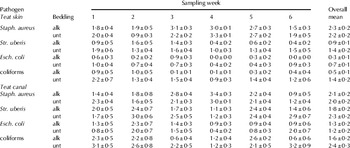
Overall, for the teat skin swab samples from the animals that were bedded on sawdust treated with the alkaline conditioner, the mean Staph. aureus count was 0·1 log units higher than in samples from animals bedded on untreated sawdust (Table 1). For the teat canal swab samples from the cows housed on sawdust treated with the conditioner, the mean Staph. aureus count was 2·1 ± 0·2 log10 cfu/ml. Similarly, in the untreated sawdust group, the mean bacterial count was 2·0 ± 0·2 log10 cfu/ml.
Means (±sem) (log10 cfu/ml) of bacterial counts (Staphylococcus aureus, Streptococcus uberis, Escherichia coli, coliforms other than Esch. coli) in teat skin swab samples (n = 60 per bedding material group) and teat canal swab samples (n = 60 per bedding material group). After week 3, the animals (n = 5 per bedding material group) rotated between the bedding material groups [sawdust + alkaline conditioner (alk), untreated sawdust (unt)]

Streptococcus uberis
In the teat skin swab samples the mean Str. uberis counts were 0·9 ± 0·1 log10 cfu/ml (sawdust + alkaline conditioner) and 1·4 ± 0·2 log10 cfu/ml (untreated sawdust) (Table 1). For the teat canal swab samples from the cows housed on sawdust treated with the conditioner, the mean Str. uberis count was 0·5 log units lower than in the samples from animals that were housed on untreated sawdust.
Escherichia coli
For cows that were housed on sawdust treated with the alkaline conditioner, a mean bacterial count of 0·3± 0·1 log10 cfu/ml was found for the teat skin swab samples (Table 1). In contrast, in the untreated sawdust group, the mean Esch. coli count was 0·4 log units higher. Esch. coli was not isolated from the teat skin of cows that were bedded on the sawdust treated with the conditioner at the end of weeks 4 or 6. Mean Esch. coli counts for the teat canal swab samples were 1·3 ± 0·2 log10 cfu/ml (sawdust + alkaline conditioner) and 1·2 ± 0·2 log10 cfu/ml (untreated sawdust).
Coliform bacteria other than Esch. coli
For the teat skin swab samples, the mean counts of coliform bacteria other than Esch. coli were 0·5 ± 0·1 log10 cfu/ml (sawdust + alkaline conditioner) and 1·4 ± 0·2 log10 cfu/ml (untreated sawdust) (Table 1). For the teat canal swab samples, the mean bacterial counts of 1·6 ± 0·2 log10 cfu/ml (sawdust + alkaline conditioner) and 2·4 ± 0·3 log10 cfu/ml (untreated sawdust) were recorded.
Mixed models
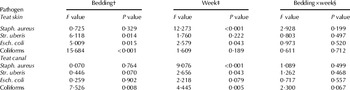
The bedding material was associated with the teat skin bacterial counts of Str. uberis, Esch. coli and other coliform bacteria and with the teat canal bacterial counts of coliform bacteria other than Esch. coli (Table 2). The week was associated with the teat skin and teat canal bacterial counts of Staph. aureus, the teat skin bacterial counts of Esch. coli and the teat canal bacterial counts of Str. uberis and coliforms other than Esch. coli. Teat skin and teat canal bacterial counts were not associated with the animal (P > 0·05).
P values of the linear mixed models (dependent variables: log10-transformed teat skin and teat canal bacterial counts, fixed factors: bedding material, sampling week, interaction between bedding material and week). The subject was the teat

† Bedding material: sawdust + alkaline conditioner, untreated sawdust
‡ Sampling week: 1, 2, 3, 4, 5, 6
§ Interaction between bedding material and sampling week
Pearson correlations between teat skin and teat canal bacterial counts
For cows housed on sawdust bedding treated with the alkaline conditioner, the teat skin bacterial counts were significantly correlated with teat canal bacterial counts for Staph. aureus (r = 0·43, P < 0·001), for Str. uberis (r = 0·32, P = 0·007), and for coliforms other than Esch. coli (r = 0·60, P < 0·001), but not for Esch. coli (r=0·16, P = 0·106). For cows housed on untreated sawdust, correlation coefficients were r = 0·20 (P = 0·064) for Staph. aureus; r = 0·49 (P < 0·001) for Str. uberis; r = 0·33 (P = 0·005) for Esch. coli; and r = 0·54 (P < 0·001) for other coliform bacteria.
Discussion
In the present study, the mastitis-causing pathogens Staph. aureus, Str. uberis, Esch. coli and other coliform bacteria were isolated from teat skin and teat canal swab samples obtained from lactating dairy cattle. The bovine teat skin can act as a reservoir of Staph. aureus, Str. uberis and coliform bacteria (Bramley, Reference Bramley1984; Kagkli et al. Reference Kagkli, Vancanneyt, Vandamme, Hill and Cogan2007; Piccinini et al. Reference Piccinini, Cesaris, Daprà, Borromeo, Picozzi, Sechhi and Zecconi2009). As demonstrated by Du Preez (Reference Du Preez1985), Staph. aureus is able to persist in teat canals for more than 3 months. However, it remains unclear whether the environmental mastitis-causing pathogens Str. uberis and Esch. coli colonize the bovine teat canal epithelium (Bramley et al. Reference Bramley, King, Higgs and Neave1979; Bramley, Reference Bramley1984; Pryor, Reference Pryor2008).
All of the animals included in this study were free of mastitis at the beginning of the trial period and remained free of clinical signs of mastitis throughout the trial. At the end of weeks 3 and 6, no intramammary infections were observed. However, it was not investigated whether the detection of mastitis-causing pathogens in the teat skin and teat canal swab samples could result from transient populations or long-term colonization of teat epithelia (Paduch et al. Reference Paduch, Mohr and Krömker2012).
In the present study, the bedding material was associated with the teat skin bacterial counts of the environmental mastitis-causing pathogens Str. uberis, Esch. coli and other coliform bacteria (P < 0·05). Teat canal bacterial counts of coliform bacteria other than Esch. coli were associated with both the bedding material and the week (P < 0·05). To our knowledge, the present study is the first work indicating that associations between bedding material and teat canal bacterial counts exist.
Bacterial growth in bedding materials is promoted by moisture and the availability of organic nutrients (Fairchild et al. Reference Fairchild, McArthur, Moore and Hylton1982; Bey et al. Reference Bey, Reneau and Farnsworth2002). In general, bacterial counts are higher in organic bedding materials than in inorganic materials (Hogan et al. Reference Hogan, Smith, Hoblet, Todhunter, Schoenberger, Hueston, Pritchard, Bowman, Heider, Brockett and Conrad1989). As observed by Hogan & Smith (Reference Hogan and Smith1997) the bacterial populations of environmental mastitis-causing pathogens in sawdust and on teat skin are affected by the addition of hydrated lime for 1 d. In contrast to the present study, the authors did not add fresh sawdust treated with an alkaline material once a day. Hogan & Smith (Reference Hogan and Smith1997) and Hogan et al. (Reference Hogan, Bogacz, Thompson, Romig, Schoenberger, Weiss and Smith1999) attributed the reduction of bacterial growth to the addition of lime or commercial conditioners to bedding materials, as well as the resulting change in the pH value. As suggested by the authors, the reduction of bacterial populations in bedding materials may be associated with the reduction of the teat skin bacterial counts. The implications of this finding suggest that the teat skin and teat canal loads of environmental mastitis-causing pathogens may be decreased by the addition of an alkaline conditioner to sawdust. In this study, the pH value of unused sawdust treated with the alkaline conditioner was 9·8. As stated by Hughes (Reference Hughes1999), both Esch. coli and Str. uberis are able to grow at pH values up to 9·5. It can be concluded that the addition of a hydrated lime-based conditioner to sawdust bedding may decrease the growth of bacteria in the bedding, the contamination of teat skin and teat canal with environmental pathogens and the risk of environmental mastitis. Smith et al. (Reference Smith, Todhunter and Schoenberger1985) recommended reducing the environmental pathogen contamination of the teat end as a method for controlling environmental mastitis.
It is feasible that the trial period was too short to reveal longer term effects of bedding material on the Str. uberis and Esch. coli populations in teat canals, given that an association between bedding material and teat canal microbial bacterial counts was found only for coliform bacteria other than Esch. coli. Interestingly, the teat skin and teat canal bacterial counts did not vary by animal. This could be explained by the selective inclusion of animals that had normal teat skin, a lack of excessively callous rings around the teat orifices, clean udders and teat skin without traces of manure.
Teat canal swab samples were taken after detachment of the milking cluster. By this sampling procedure the risk of damage to the teat canal epithelium is reduced, because milk residues and teat canal laxity facilitate the insertion of swabs into teat canals (Paduch & Krömker 2011; Paduch et al. Reference Paduch, Mohr and Krömker2012). However, during milk flow part of the teat canal keratin with adhered microorganisms is removed from the teat canal (Capuco et al. Reference Capuco, Mein, Nickerson, Jack, Wood, Bright, Aschenbrenner, Miller and Bitman1994; Paulrud, Reference Paulrud2005), which may affect teat canal bacterial counts.
Associations between the bedding material and the teat skin and teat canal bacterial counts of Staph. aureus were not observed. Both the teat skin counts and the teat canal counts of Staph. aureus were associated with the week (P < 0·001). Important reservoirs of Staph. aureus – in contrast with environmental pathogens – include the milk from infected quarters, skin lesions, milking liners and milkers’ hands (Smith et al. Reference Smith, Todhunter and Schoenberger1985; Haveri et al. Reference Haveri, Hovinen, Roslöf and Pyörälä2008). The rationale underlying the relationship between the length of bedding exposure (in weeks) and the teat skin and teat canal bacterial counts of Staph. aureus could not be ascertained in this study. However, the present study indicates that, for the contagious pathogen Staph. aureus and the environmental pathogens Str. uberis, Esch. coli and other coliform bacteria, different risk factors affecting the teat skin and teat canal bacterial counts may exist. Paduch et al. (Reference Paduch, Mohr and Krömker2012) found that teat-end hyperkeratosis scores are associated with the environmental pathogen loads of teat canals, but not with teat canal Staph. aureus loads.
In general, the teat skin bacterial counts of environmental pathogens and the teat canal bacterial counts of coliform bacteria other than Esch. coli are affected by the treatment of the bedding material with an alkaline conditioner. This may result in a lower number of intramammary infections caused by the mentioned pathogens while using the treatment of bedding materials. Further research is needed to characterize the long-term effects of the bedding material on microbial populations in bovine teat canals, the stability and dynamics of microbial populations on the teat epithelia of lactating dairy cattle, as well as methods that can be used to estimate the risk of mastitis.
We thank the staff and students at the University of Applied Sciences and Arts Hannover. The present study was supported by the Chamber of Agriculture of Lower Saxony, Germany. We thank the company Kalkwerk Hufgard GmbH (Germany) for providing the alkaline conditioner Desical®. We are grateful to the dairy farmer who supported this study.