

1. Introduction
Air pollution has emerged as a critical global public health threat, prompting heightened attention from both researchers and policymakers. According to the World Health Organization (WHO, 2021), approximately 99 per cent of the global population is exposed to ambient air pollution levels that exceed the WHO's recommended air quality guidelines, contributing to a substantial and growing burden of disease worldwide. Among various airborne pollutants, particulate matter (PM) – specifically PM2.5 and PM10 – has been identified as particularly harmful due to its ability to penetrate deep into the lungs, enter the circulatory system and reach critical organs such as the heart and brain. These PMs have been strongly associated with a range of adverse health outcomes, including cardiovascular and respiratory diseases, lung cancer, stroke and premature mortality (EPA, 2009; Rückerl et al., Reference Rückerl, Schneider, Breitner, Cyrys and Peters2011). Reflecting the severity of these risks, the International Agency for Research on Cancer officially classified PM as a Group 1 carcinogen in 2013 (WHO, 2021).
Importantly, the health impacts of air pollution are not evenly distributed across populations but vary depending on socioeconomic and demographic conditions (Hajat et al., Reference Hajat, Hsia and O'Neill2015; Dominski et al., Reference Dominski, Branco, Buonanno, Stabile, Da Silva and Andrade2021). Among these outcomes, those arising from exposure during pregnancy have drawn particular attention, because the developing fetus is highly sensitive to environmental insults and because adverse birth outcomes can have lasting consequences over the life course.
A substantial body of empirical research has explored the health effects of air pollution on neonates over the past decades (Chay and Greenstone, Reference Chay and Greenstone2003; Currie and Neidell, Reference Currie and Neidell2005; Currie et al., Reference Currie, Neidell and Schmieder2009; Jayachandran, Reference Jayachandran2009; Coneus and Spiess, Reference Coneus and Spiess2012). Most studies have focused on in utero exposure, examining its effects on neonatal health indicators such as low birth weight (defined as <2.5 kg) and preterm birth (defined as delivery before 37 weeks of gestation). The findings generally indicate that air pollution significantly increases the probability of both low birth weight and preterm delivery. Moreover, these adverse birth outcomes have been linked to longer-term consequences for human capital development, including lower educational attainment and poorer labour market performance (Black et al., Reference Black, Devereux and Salvanes2007; Bharadwaj et al., Reference Bharadwaj, Gibson, Zivin and Neilson2017; Chen, Reference Chen2025).
More recently, a growing number of studies have highlighted the critical importance of the first trimester of pregnancy as a window of heightened vulnerability to air pollution exposure (Ritz et al., Reference Ritz, Wilhelm, Hoggatt and Ghosh2007; Lee et al., Reference Lee, Roberts, Catov, Talbott and Ritz2013; Pedersen et al., Reference Pedersen, Giorgis-Allemand, Bernard, Aguilera, Andersen, Ballester, Beelen, Chatzi, Cirach, Danileviciute, Dedele, Van Eijsden, Estarlich, Fernández-Somoano, Fernández, Forastiere, Gehring, Grazuleviciene, Gruzieva, Heude, Hoek, De Hoogh, Van den Hooven, Håberg, Jaddoe, Klümper, Korek, Krämer, Lerchundi, Lepeule, Nafstad, Nystad, Patelarou, Porta, Postma, Raaschou-Nielsen, Rudnai, Sunyer, Stephanou, Sørensen, Thiering, Tuffnell, Varró, Vrijkotte, Wijga, Wilhelm, Wright, Nieuwenhuijsen, Pershagen, Brunekreef, Kogevinas and Slama2013; Iodice et al., Reference Iodice, Hoxha, Ferrari, Carbone, Anceschi, Miragoli, Pesatori, Persico and Bollati2018; Bekkar et al., Reference Bekkar, Pacheco, Basu and DeNicola2020). This period coincides with the organogenesis phase of fetal development, during which the major organ systems are formed, making the fetus particularly sensitive to environmental insults. These findings underscore the importance of the timing of exposure and suggest that temporally targeted interventions – such as pollution mitigation during early pregnancy – may be crucial in designing effective environmental health policies.
This study empirically investigates the impact of ambient PM on neonatal health outcomes in South Korea. While a substantial body of research has examined the relationship between air pollution and infant health, further empirical expansion across diverse socioeconomic contexts and through granular approaches remains necessary to meaningfully contribute to both theoretical discourse and policy formulation (Arceo et al., Reference Arceo, Hanna and Oliva2016). This study contributes to the literature in several ways.
First, the analysis strengthens the external validity by leveraging near-universal administrative birth records for all live births to mothers of reproductive age between January 2016 and June 2019.Footnote 1 Whereas prior studies are often limited to specific regions or selected cohorts (Currie and Neidell, Reference Currie and Neidell2005; Currie et al., Reference Currie, Neidell and Schmieder2009; Lee et al., Reference Lee, Roberts, Catov, Talbott and Ritz2013), this nationwide dataset allows us to identify generalizable policy implications at the national level, thereby offering both academic and practical contributions.
Second, the study contributes methodologically through the granular linkage of gestational timing to spatially matched pollution data. We obtain the residential location of mothers at the time of birth, geocoded at the municipal level (226 cities, counties and districts), which serves as the fundamental unit of residence, and match each newborn to air pollution data from monitoring stations in the corresponding area. Furthermore, using each infant's birth month and gestational age, we reconstruct the in utero exposure period and calculate trimester-specific exposure intensities to PM. This detailed linkage improves interpretability of critical exposure windows while preserving administrative-scale coverage.
Third, to address potential endogeneity in pollution exposure, we adopt an instrumental variable (IV) approach supporting a quasi-experimental interpretation (Brewer et al., Reference Brewer, Dench and Taylor2023). This strategy is particularly well-suited to the Korean context, where a substantial portion of air pollution originates from northwestern China – such as the Gobi Desert and adjacent industrial zones (Jia and Ku, Reference Jia and Ku2019). Given this climatological fact, we use the frequency of westerly winds as a time-varying instrument for local PM concentrations, drawing on wind direction data from the Korea Meteorological Administration (KMA). This approach isolates exogenous variation in PM levels, thereby addressing not only concerns about residential sorting but also the confounding role of local economic activity, which can simultaneously affect ambient air quality and birth outcomes (Rangel and Vogl, Reference Rangel and Vogl2019; Anderson, Reference Anderson2020; Miller et al., Reference Miller, Molitor and Zou2024). Based on this instrument, we implement two-stage least squares (2SLS) estimation to identify the causal effects of PM exposure on neonatal health outcomes.Footnote 2 Our wind-direction IV design is most closely related to Anderson (Reference Anderson2020), which exploits exposure from a known pollution source downwind; we apply the same downwind logic to transboundary inflows from non-local upwind sources.
An important limitation of this design is that west-northwesterly wind events shift multiple components of particulate pollution simultaneously. In our data, first-trimester PM2.5 and PM10 are strongly correlated, with a correlation coefficient of 0.739. The available wind-direction variation therefore does not permit us to identify the independent causal effects of PM2.5 and PM10. Throughout the paper, we accordingly interpret the 2SLS coefficient on PM2.5 as the effect of the broader wind-induced particulate-pollution shock, expressed in units of PM2.5, rather than as the pollutant-specific marginal effect of PM2.5 holding PM10 constant.
To implement this design, we assemble near-universal administrative birth records covering 1,008,142 live births to mothers of reproductive age between January 2016 and June 2019. We then link each newborn to municipality-level (226 districts) air-pollution and meteorological data by reconstructing trimester-specific in utero exposure windows from birth month and gestational age. Our main exposure measure is the average PM2.5 concentration during the first trimester, corresponding to the organogenesis window. Our two outcomes are indicators of low birth weight (below 2.5 kg) and preterm birth (before 37 weeks of gestation). We estimate the effect of first-trimester wind-induced particulate pollution on these outcomes by 2SLS using PM2.5 as the exposure index and instrumenting it with the first-trimester frequency of west-northwesterly (270°–330°) winds that transport transboundary dust into Korea. We cluster standard errors at the municipal level.
Our main findings are as follows. In the 2SLS specification, a wind-induced particulate-pollution increase corresponding to a 1 µg/m3 increase in first-trimester PM2.5 raises the probability of preterm birth by about 0.05 percentage points. Relative to the sample mean of 7.8 per cent, a 10 µg/m3 increase corresponds to a roughly 6.4 per cent increase in preterm-birth risk. This effect is robust. It persists across alternative pollution definitions and an alternative instrument, and it is statistically significant across most subgroups defined by infant sex, region, maternal employment, education and age, although the effect is attenuated in the Seoul Capital Area. By contrast, the estimated effect on low birth weight is small and statistically insignificant once endogeneity is addressed. The instrument is strongly relevant throughout, with first-stage Kleibergen–Paap rk F statistics far exceeding conventional thresholds. Together, these results indicate that early-pregnancy exposure to wind-induced particulate pollution increases the risk of preterm birth in South Korea.Footnote 3 Because the same wind events also shift PM10, this magnitude represents the effect of the joint particulate-pollution variation scaled by the associated change in PM2.5; it should not be interpreted as the effect of PM2.5 alone.
The remainder of the paper is structured as follows. Section 2 introduces the institutional and environmental context in South Korea. Section 3 outlines the empirical strategy. Section 4 describes the data sources and variable construction. Section 5 presents the main results. Section 6 concludes.
2. Korean context
In South Korea, public and policy discussions on air pollution have predominantly focused on PM, which has been confirmed to be at critically high levels by international standards. South Korea's annual average PM2.5 concentration measured 24.6 µg/m3 in 2000, 21.6 µg/m3 in 2010 and 25.3 µg/m3 in 2020, consistently exceeding the Organization for Economic Co-operation and Development Organization for Economic Co-operation and Development (OECD) averages of 17.9, 14.6 and 12.1 µg/m3, respectively, over the same periods. These levels are also four to five times higher than the WHO's recommended annual threshold of 5 µg/m3 (OECD, 2023). According to OECD (2023), South Korea's mortality rate attributable to air pollution stood at 42.7 per 100,000 population in 2019, approximately 1.5 times higher than the OECD average of 28.9. This is particularly striking given that most OECD countries saw an average 32 per cent decline in air pollution-related mortality between 2000 and 2019.
The persistently high levels of PM in South Korea are the result of a complex interplay between domestic and external factors. A key external contributor is the seasonal inflow of air pollutants originating from the Gobi Desert and the industrial zones of northern China, which are carried by prevailing westerly winds during the spring season (Kim et al., Reference Kim, Chung and Cho2017; Jia and Ku, Reference Jia and Ku2019). Historically, yellow dust events have been documented in Korean texts for centuries, underscoring that such inflows are not merely modern industrial byproducts but also reflect the country's underlying geographical and climatic vulnerability. In this sense, Korea's air pollution problem is not only a consequence of industrialization but also deeply rooted in its structural exposure to transboundary environmental risks. Figure 1 illustrates South Korea's geographical position in relation to the path of yellow dust transport and the regional patterns of dust events.
Geographic context and image of dust storm.

These environmental risks are further compounded by Korea's demographic challenges, particularly the simultaneous trends of extremely low fertility and delayed childbearing (Hwang, Reference Hwang2023). According to Statistics Korea, the country's total fertility rate fell to 0.72 in 2023, the lowest among OECD countries. Meanwhile, the average maternal age at childbirth reached 33.6 years, and the average age at first birth rose to 31.9, continuing an upward trajectory. Advanced maternal age is associated with increased risks of pregnancy complications such as preterm birth and low birth weight, and these vulnerabilities may be exacerbated by environmental shocks like PM exposure. In a context like South Korea – where the number of births is declining sharply – adverse health impacts of air pollution on newborns are not merely individual health concerns but broader threats to societal sustainability. If the few children being born are disproportionately exposed to harmful environmental conditions, the implications may include long-term constraints on the formation of health and human capital for future generations.
3. Empirical strategy
To examine the relationship between prenatal PM exposure and neonatal health outcomes, we begin by estimating the following ordinary least squares (OLS) specification:
 \begin{equation*}{Y_{ij}} = \beta {T_{ij}} + {X_{ij}}\Gamma + {R_j}\mu + {\epsilon _{ij}}\end{equation*}
where  $i$ indexes the individual newborn and
 $j$ denotes the municipality of residence at birth. The dependent variable
 ${Y_{ij}}$ is a binary indicator of neonatal health, measured by either low birth weight or preterm birth. The main explanatory variable of interest,
 ${T_{ij}}$, represents the level of PM exposure experienced by newborn
 $i$ during gestation in region
 $j$. Since the gestational period varies across individuals,
 ${T_{ij}}$ is a personalized exposure measure constructed based on gestational age. The vector
 ${X_{ij}}$ includes newborn characteristics (gender, singleton, first-born), maternal characteristics (age, education, employment) and paternal characteristics (age and education) available in the birth records; Section 4 provides the full definition. The vector
 ${R_j}$ captures time-invariant municipality characteristics using a parsimonious set of municipality-type indicators: whether municipality
 $j$ is located in the Seoul Capital Area, whether it is a metropolitan/special city, and whether it is a rural county (‘gun’). We do not include municipality fixed effects in the baseline specification; instead, these indicators flexibly absorb systematic cross-sectional differences associated with broad urbanicity and regional status while preserving the variation exploited by our wind-based design. Standard errors
 ${\epsilon _{ij}}$ are clustered at the municipal level to account for heteroskedasticity and spatial correlation.
However, this OLS model may suffer from potential endogeneity. For instance, if maternal residential choice is correlated with unobserved health preferences or birth planning, the estimated coefficient on  ${ }{T_{ij}}$ may be biased due to omitted variable confounding. To address this concern, we adopt the IV strategy.
As an instrument, we exploit meteorological variation in wind patterns that is exogenous to maternal behaviour. Specifically, we construct an IV  ${Z_{ij}}$, which captures the frequency of westerly winds (originating from the Gobi Desert region) during the trimesters of gestation. These seasonal wind flows have been shown to strongly affect local PM concentrations in Korea but are plausibly orthogonal to other determinants of neonatal health (Deryugina et al., Reference Deryugina, Heutel, Miller, Molitor and Reif2019; Jia and Ku, Reference Jia and Ku2019; Miller et al., Reference Miller, Molitor and Zou2024). Thus,
 ${Z_{ij}}$ satisfies the relevance and exclusion conditions required for a valid instrument.
We implement the 2SLS estimation as follows. The first-stage regression is given by
 \begin{equation*}{T_{ij}} = {\beta _0}{Z_{ij}} + {X_{ij}}\varphi + {R_j}\delta + {\epsilon _{ij}}\end{equation*}
where  ${T_{ij}}$ denotes observed PM exposure; the fitted value
 $\widehat {{T_{ij}}}$ is used in the second stage. In the second stage, we estimate the causal effect of PM exposure on neonatal health by substituting the predicted exposure into the outcome equation:
 \begin{equation*}{Y_{ij}} = {\beta _1}\widehat {{T_{ij}}} + {X_{ij}}\Delta + {R_j}\gamma + {e_{ij}}.\end{equation*}
This IV approach allows us to identify the causal parameter under the assumption that wind direction is a strong predictor of local PM levels while remaining orthogonal to unobserved determinants of infant health. By leveraging exogenous meteorological variation, this strategy isolates plausibly exogenous changes in pollution exposure and mitigates bias arising from endogenous residential sorting. Furthermore, our wind-based instrument addresses endogeneity concerns stemming from the fact that local air quality is jointly determined with local economic activity.Footnote 4 Specifically, it exploits variation in PM driven by non-local inflows associated with westerly winds, rather than by contemporaneous local economic conditions. Thus, a key advantage of our approach is that it isolates exogenous fluctuations in pollution that are less mechanically linked to local socioeconomic factors.
A key feature of our identification strategy is that the relevant variation in the instrument is temporal rather than spatial. Supplementary Appendix Table A1 shows that the mean share of days with 270°–330° winds during the first trimester is nearly identical across the Seoul Capital Area (0.430), non-capital regions (0.429), metropolitan cities (0.430), non-metropolitan areas (0.429) and rural areas (0.429), with similarly uniform standard deviations (SDs) (0.189–0.191). A variance decomposition further indicates that the total variation in the IV (SD = 0.190) is almost entirely accounted for by within-district temporal variation (within-district SD = 0.190), with negligible between-district differences. Together, these patterns show that identification is driven by within-district month-to-month fluctuations in wind direction – variation to which pregnant women cannot plausibly respond through residential sorting.
The exclusion restriction in this setting concerns the effect of west-northwesterly winds on neonatal health through the particulate pollution transported by these winds. It does not imply that the instrument shifts PM2.5 independently of PM10. Because the two pollutants respond jointly to the same transboundary inflows,  $\beta $ identifies the effect of the wind-induced particulate-pollution bundle scaled by the instrument-induced change in PM2.5. It therefore cannot be interpreted as a pollutant-specific effect holding other particulate fractions constant.
Our approach follows the ‘downwind exposure from a known source’ framework of Anderson (Reference Anderson2020) in a transboundary setting. Westerly winds transport PM from upwind deserts and industrial regions into Korea, generating variation in local PM driven primarily by non-local inflows rather than contemporaneous local economic activity. This feature strengthens the exclusion restriction by ensuring that the induced pollution fluctuations are less mechanically linked to local socioeconomic conditions. In contrast to Deryugina et al. (Reference Deryugina, Heutel, Miller, Molitor and Reif2019), which employs a full set of wind-direction indicators without a clearly identified source, our instrument is explicitly anchored to a well-defined upwind origin.
4. Data and variables
This study constructs a comprehensive dataset by integrating administrative birth records with environmental data. Information on births is obtained from the Vital Statistics of Births provided by Statistics Korea. These statistics are based on resident registration and birth reporting systems and include detailed information such as the year and month of birth, gestational age, birth weight and parental socioeconomic characteristics. Using this information, we retrospectively estimate the conception year and month for each newborn, allowing us to match prenatal exposure to PM and wind patterns by gestational trimester.
The analysis focuses on births occurring between January 2016 and June 2019. To enhance the accuracy of the analysis, several sample restrictions are imposed. Specifically, we exclude cases where gestational age is recorded as zero weeks, birth weight is zero, at least one parent holds a non-Korean nationality, residential information is missing, the place of birth is outside a medical institution or the corresponding area and time lack air pollution or meteorological data. After applying these filters, the final sample includes 288,238 births in 2016, 306,846 in 2017, 280,996 in 2018 and 132,062 in the first half of 2019, totalling 1,008,142 observations.Footnote 5
The dependent variables consist of two binary indicators of neonatal health outcomes. The first is a dummy variable for low birth weight, defined as birth weight below 2.5 kg. The second is a dummy variable for preterm birth, defined as gestational age below 37 weeks. Both indicators are standard outcome measures widely used in public health research.
The main explanatory variable is PM concentration measured at the municipal level. These data come from AirKorea, an air quality monitoring programme administered by the Ministry of Environment. Figure 2 illustrates the average PM concentrations across municipalities during the sample period.
Exposure to PM in early pregnancy.

The original data are available at an hourly frequency, which we aggregate into daily means and then into monthly averages. Using the estimated conception month and gestational length of each infant, we match trimester-specific monthly PM exposures. For example, if a mother conceived in September 2017 and gave birth in May 2018, the first trimester PM exposure is calculated as the average concentration over September–November 2017; the second trimester is based on December 2017 through February 2018, and so on.Footnote 6
The main analysis focuses on exposure to PM2.5 during the first trimester of pregnancy, as this period has been found to be particularly critical for fetal development. For robustness checks, we also consider alternative exposure definitions, including PM10 and exposure during the second trimester. First-trimester PM2.5 and PM10 are strongly correlated in the analysis sample (r = 0.739), reflecting their joint response to transboundary dust and pollution events. We therefore use PM2.5 as the primary exposure index but do not interpret it as providing independent variation in fine particles conditional on PM10.
A potential concern with municipality-level PM measurement is that assigning district-average concentrations to all births introduces measurement error relative to true individual exposure. Under the standard assumption of classical measurement error, where the district average is an unbiased but noisy proxy, OLS estimates are attenuated towards zero, while IV estimates remain consistent (Wooldridge, Reference Wooldridge2010).Footnote 7 Because our instrument predicts PM at the same municipality level at which pollution is measured, the 2SLS estimator identifies the causal effect of district-level ambient PM on health outcomes, which is the policy-relevant parameter for environmental regulation.
We provide direct evidence on the extent of within-district measurement error using hourly monitoring-station data. Among 226 municipalities, 115 contain two or more stations. In these districts, the mean within-district SD of monthly average PM2.5 across stations is 2.89 µg/m3, compared to a total SD of 8.68 µg/m3. Thus, within-district spatial variation accounts for roughly one-third of total variation, indicating that most variation in ambient PM occurs across districts and over time rather than within districts. Supplementary Appendix Table A2 reports the full distribution of within-district variation.
The IV is constructed based on wind direction data provided by the KMA.Footnote 8 The KMA collects daily weather observations from 97 monitoring stations nationwide. For each municipality, we identify the geographically closest weather station by calculating the distance from the municipal centroid to each station using the Haversine formula. Wind direction is measured as the direction of the maximum wind frequency observed each day. Based on this, we construct a binary variable indicating whether the wind on a given day came from the west-northwest direction (between 270° and 330°), corresponding to airflows originating from the Gobi Desert region. The variable is coded as 1 if the wind direction falls within this range and 0 otherwise. We then calculate the monthly average of this binary indicator to obtain trimester-specific exposure values for each newborn. For instance, if westerly winds from the specified direction occurred on 15 out of 30 days in a given month, the wind exposure value for that month is 0.5. The average wind exposure during the first trimester, defined as the proportion of days with 270°–330° wind directions, serves as the main IV in our analysis. For robustness, we also construct alternative IVs using a narrower directional band (290°–320°) and wind exposure during the second trimester.
To control for potential confounding factors in the relationship between air pollution and neonatal health, we include a rich set of individual- and household-level covariates available from the birth statistics. These include binary indicators for female child, singleton birth, first-born status and maternal employment status (student, housewife/unemployed), as well as parental education (college degree or higher), and parental age groups (mother aged 20–34, father aged 20–39). We also account for regional characteristics through dummies for capital region, metropolitan city and rural area. These variables are additionally used to assess heterogeneous treatment effects across different subgroups. Table 1 presents summary statistics for all variables used in the analysis.
Descriptive statistics

Table 1 Long description
Descriptive statistics are reported as Mean, SD, Min, and Max for birth outcomes, air pollution exposures, wind direction indicators, and demographic and regional indicators. Low birth weight has mean 0.063, SD 0.244, min 0.000, max 1.000; preterm birth has mean 0.078, SD 0.268, min 0.000, max 1.000. Pm2.5 exposure, first trimester has mean 21.004, SD 8.595, min 0.000, max 47.065; working hours, t1 has mean 20.784, SD 8.418, min 0.000, max 48.930; off hours, T1 has mean 21.224, SD 8.826, min 0.000, max 49.022. Pm10 exposure, first trimester has mean 39.792, SD 11.025, min 11.049, max 85.059; pm2.5 exposure, second trimester has mean 20.870, SD 8.648, min 0.000, max 44.570. Wind direction 270 to 330 degrees, first trimester has mean 0.441, SD 0.188, min 0.011, max 0.879; wind direction 290 to 320 degrees, first trimester has mean 0.259, SD 0.148, min 0.000, max 0.666; wind direction 270 to 330 degrees, second trimester has mean 0.442, SD 0.188, min 0.017, max 0.922. Female infant has mean 0.486, SD 0.500, min 0.000, max 1.000; singleton birth has mean 0.956, SD 0.204, min 0.000, max 1.000; first live birth by mother has mean 0.540, SD 0.498, min 0.000, max 1.000. Maternal status: inactive has mean 0.438, SD 0.496, min 0.000, max 1.000; paternal education: college or higher has mean 0.776, SD 0.417, min 0.000, max 1.000; maternal education: college or higher has mean 0.804, SD 0.397, min 0.000, max 1.000. Paternal age 20 to 39 has mean 0.872, SD 0.335, min 0.000, max 1.000; maternal age 20 to 34 has mean 0.677, SD 0.468, min 0.000, max 1.000. Seoul Capital Area has mean 0.506, SD 0.500, min 0.000, max 1.000; metropolitan or special city has mean 0.422, SD 0.494, min 0.000, max 1.000; rural area has mean 0.072, SD 0.258, min 0.000, max 1.000.
Notes: The total sample size is 1,008,142 across all variables. Low birth weight indicates birth weight below 2,500 grams. Preterm birth refers to births occurring before 37 completed weeks of gestation. The unit of PM is µg/m3. PM2.5 exposure, first trimester and related indicators represent average maternal exposure to fine PM during specific pregnancy periods. Wind direction variables capture the predominant wind flow during pregnancy trimesters, categorized by directional degrees. Maternal status: inactive includes mothers who are students, homemakers or unemployed. Regional indicators (e.g., Seoul Capital Area) are defined based on official administrative classifications.
5. Estimation results
5.1. Main results
Table 2 presents the estimated effects of first-trimester exposure to PM2.5 on neonatal health outcomes. The dependent variables are indicators for low birth weight and preterm birth. The main explanatory variable, PM exposure, refers to the average PM2.5 concentration during the first trimester of pregnancy, measured in micrograms per cubic metre (µg/m3). Columns (1) and (4) report baseline OLS estimates without control variables. Columns (2) and (5) add a rich set of socioeconomic and demographic controls. Columns (3) and (6) present the 2SLS estimates using wind direction as an IV.Footnote 9
Main results

Table 2 Long description
Six regression columns report coefficients for PM exposure with two dependent variables: low birth weight in columns 1 to 3 and preterm birth in columns 4 to 6. For low birth weight, the PM exposure coefficient is 0.0002 in column 1, 0.0001 in column 2, and 0.0000 in column 3, with standard errors shown as 0.0000 in parentheses for all three. For preterm birth, the PM exposure coefficient is 0.0003 in column 4, 0.0003 in column 5, and 0.0005 in column 6, with standard errors 0.0000, 0.0000, and 0.0001 respectively. A first stage section labeled, First-stage estimation with dependent variable PM Exposure, reports a Wind direction coefficient of 24.5805 with standard error 0.0436 in column 3 and again in column 6. The Covariates row shows N in columns 1 and 4, and Y in columns 2, 3, 5, and 6. The F-statistic is listed as 3.20E plus 05 in column 3 and in column 6. The sample size N is 1008142 in every column.
Notes: Columns (1)–(3) use low birth weight as the dependent variable, and columns (4)–(6) use preterm birth as the dependent variable. The key explanatory variable, PM exposure, refers to PM2.5 exposure during the first trimester of pregnancy. Because wind-induced PM2.5 and PM10 concentrations co-move, the IV coefficient represents the effect of the broader particulate-pollution shock indexed by PM2.5, rather than an isolated PM2.5 effect. The instrumental variable employed is the predominant wind direction (270°–330°) during the first trimester. Control variables include dummies for female infant, singleton birth, first live birth by mother, maternal employment status (student, homemaker or unemployed), parental education (college or higher for both mother and father), parental age groups (mother aged 20–34, father aged 20–39), and residential area characteristics (Seoul Capital Area, metropolitan or special city and rural area). The F-statistic reported is the Kleibergen–Paap rk Wald F statistic. Standard errors clustered at the municipal level are reported in parentheses.
The results indicate that a 1 µg/m3 increase in PM2.5 exposure is associated with a 0.01–0.02 percentage point increase in the probability of low birth weight, and the coefficients are statistically significant in the OLS specifications. However, the 2SLS estimates suggest a smaller and statistically insignificant effect on low birth weight.
By contrast, for preterm birth, PM2.5 exposure consistently shows a statistically significant positive effect across all specifications. In the IV model, a wind-induced particulate-pollution increase associated with a 1 µg/m3 increase in PM2.5 during the first trimester leads to a 0.05 percentage point increase in the probability of preterm birth.Footnote 10 Given that the dependent variable is binary, the coefficient can be interpreted as a change in probability. Considering that the mean incidence of preterm birth in the sample is approximately 7.8 per cent, a 10 µg/m3 increase in PM2.5 corresponds to a 0.5 percentage point increase in preterm birth, which represents a relative increase of about 6.4 per cent over the sample average.Footnote 11
As a robustness check, we also estimate the low birth weight model restricting the sample to full-term births only (gestational age ≥37 weeks; N = 929,665). The IV estimate in this restricted sample is −0.0001 (p < 0.01). However, because PM exposure itself causes preterm birth, conditioning on gestational age introduces endogenous sample selection (Angrist and Pischke, Reference Angrist and Pischke2009). We therefore retain the full sample as the primary specification and report the selected term-only results in Supplementary Appendix Table A3.
5.2. Robustness checks
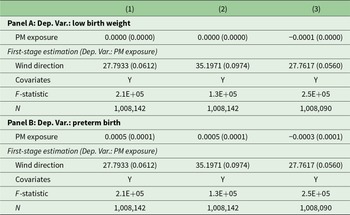
Table 3 presents the results from a series of robustness checks using alternative model specifications. Panel A reports the estimates for low birth weight, and Panel B for preterm birth, with each column reflecting results based on alternative definitions of PM exposure or modifications to the IV.
Robustness checks

Table 3 Long description
Two panels report coefficients for PM exposure on low birth weight in panel A and preterm birth in panel B, each shown for columns 1, 2, and 3 with standard errors in parentheses. Panel A lists PM exposure as 0.0000 in column 1, 0.0000 in column 2, and minus 0.0001 in column 3, with standard errors 0.0000, 0.0000, and 0.0000. Panel B lists PM exposure as 0.0005 in column 1, 0.0005 in column 2, and minus 0.0003 in column 3, with standard errors 0.0001, 0.0001, and 0.0001. Each panel includes a first stage section labeled first stage estimation, dependent variable PM exposure, where wind direction is 27.7933 in column 1, 35.1971 in column 2, and 27.7617 in column 3, with standard errors 0.0612, 0.0974, and 0.0560. Covariates are marked Y in all three columns in both panels. The F statistic is 2.1e plus 05 in column 1, 1.3e plus 05 in column 2, and 2.5e plus 05 in column 3 in both panels. N is 1008142 in columns 1 and 2 and 1008090 in column 3 in both panels.
Notes: Panel A uses low birth weight and panel B uses preterm birth as the dependent variable. The baseline explanatory variable is PM2.5 exposure, first trimester, instrumented by wind direction 270°–330°, first trimester. Column (1) replaces the explanatory variable with PM10 exposure, first trimester. Column (2) replaces the instrument with wind direction 290°–320°, first trimester. Column (3) uses PM2.5 exposure, second trimester (instrumented by wind direction 270°–330°, second trimester); 52 births lack a valid second-trimester exposure value. The PM2.5 and PM10 specifications should be interpreted as alternative measures of the common wind-induced particulate-pollution shock, not as estimates of pollutant-specific effects. Control variables are identical to those in Table 2. The F-statistic reported is the Kleibergen–Paap rk Wald F statistic. Standard errors clustered at the municipal level are reported in parentheses.
Before presenting the robustness results, we briefly motivate each alternative specification. Supplementary Appendix Table A4 reports descriptive statistics and the pairwise correlation between first-trimester PM2.5 and PM10 (r = 0.739). Column (1) of Table 3 replaces PM2.5 with PM10, the broader inhalable fraction, which rises together with PM2.5 during transboundary dust events. Column (2) replaces the instrument with a narrower wind-direction band (290°–320°), testing sensitivity to the precise directional definition. Column (3) uses second-trimester exposure, testing whether the effect is specific to the first-trimester organogenesis window. For low birth weight, the estimated effects are statistically insignificant in the first-trimester specifications. For preterm birth, the effect is positive and statistically significant in both first-trimester specifications. The second-trimester specification is the exception, with a negative estimate. These patterns show that the adverse first-trimester result is robust to using either PM2.5 or PM10 as an index of the underlying transboundary particulate-pollution shock.
Specifically, column (1) replaces PM2.5 with PM10 and yields a positive and significant preterm estimate (0.0005), and column (2) employs the narrower directional band (290°–320°) with a similar estimate (0.0005). A 10 µg/m3 increase in first-trimester exposure thus raises the probability of preterm birth by about 0.5 percentage points, a relative increase of roughly 6.4 per cent at the 7.8 per cent baseline. Column (3) redefines exposure based on the second trimester of pregnancy. Consistent with the organogenesis hypothesis, the adverse effect does not extend to this later window.Footnote 12 These findings reinforce the conclusion that prenatal PM exposure during the first trimester has a robust and adverse effect on preterm birth risk.
Because the same wind events jointly shift PM2.5 and PM10 (r = 0.739), and the available wind-direction bands provide no transparent source of pollutant-specific variation, the PM10 result in column (1) should be read as robustness to an alternative index of the common particulate-pollution shock, not as evidence that the two pollutants can be separately identified. We therefore refrain from attributing the estimated preterm-birth effect specifically to PM2.5.
5.3. Heterogeneities
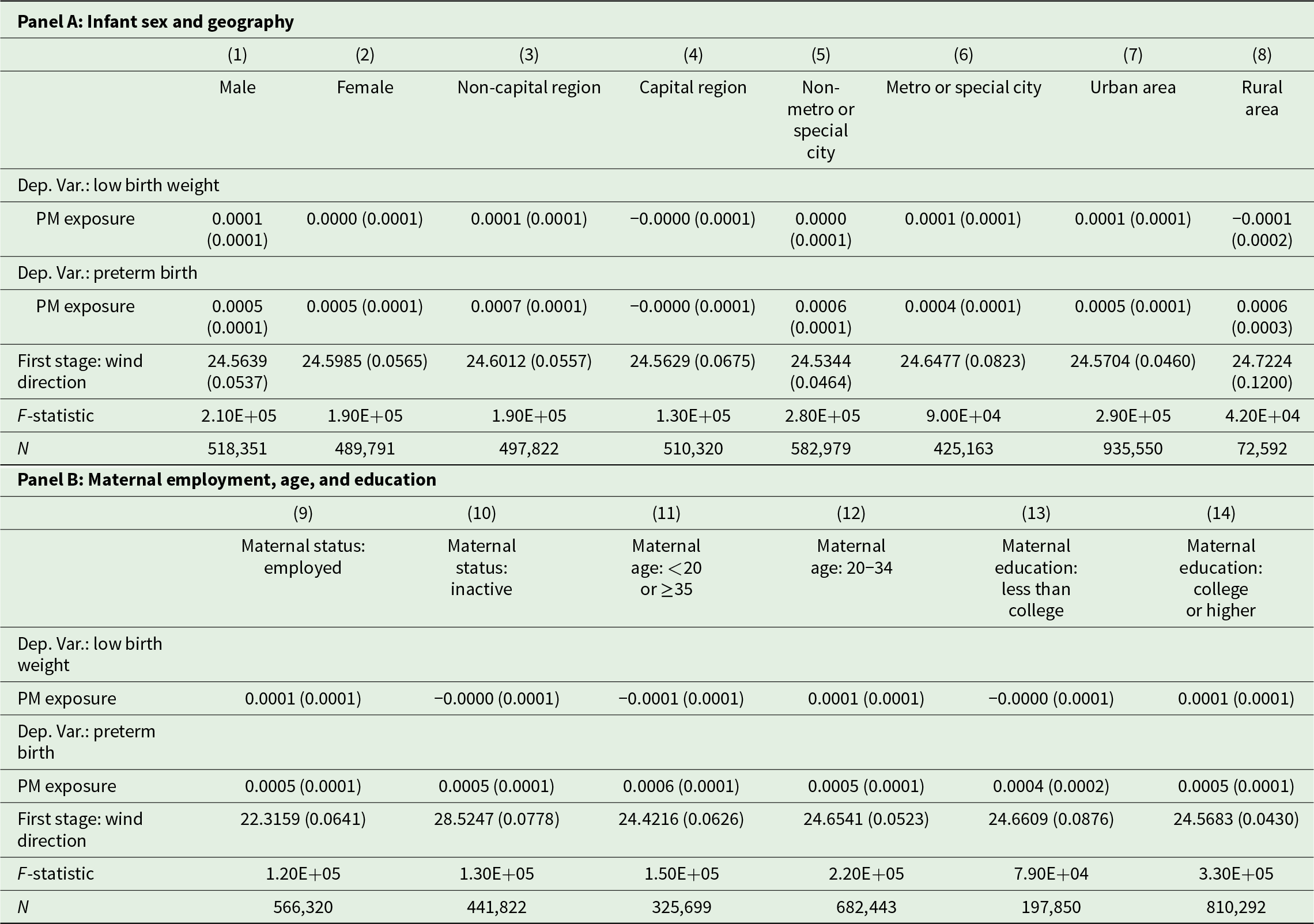
Table 4 presents heterogeneity analyses by estimating the effects of PM2.5 exposure on different population subgroups defined by socioeconomic and demographic characteristics. Panel A covers subgroups defined by infant sex and geography, and panel B covers subgroups defined by maternal employment, age and education; each panel reports estimates for both outcomes. In all specifications, the main explanatory variable is PM2.5 exposure during the first trimester, and the models include the same set of control variables and the IV used in the main analysis.
Heterogeneities

Table 4 Long description
Panel A reports PM exposure coefficients for two dependent variables, low birth weight and preterm birth, split by infant sex and geography, with standard errors in parentheses. For low birth weight, PM exposure is 0.0001 for Male and 0.0000 for Female; by region it is 0.0001 for Non Capital region and negative 0.0000 for Capital region; by city type it is 0.0000 for Non metro or special city and 0.0001 for Metro or special city; by area it is 0.0001 for Urban area and negative 0.0001 for Rural area. For preterm birth, PM exposure is 0.0005 for both Male and Female; by region it is 0.0007 for Non Capital region and negative 0.0000 for Capital region; by city type it is 0.0006 for Non metro or special city and 0.0004 for Metro or special city; by area it is 0.0005 for Urban area and 0.0006 for Rural area. Panel A first stage, Wind direction values range from 24.5344 to 24.7224, with F statistic values from 4.20E plus 04 to 2.90E plus 05, and N from 72592 to 935550 across columns. Panel B reports the same outcomes by maternal status, age, and education. For low birth weight in Panel B, PM Exposure is 0.0001 for Maternal status employed, negative 0.0000 for Maternal status inactive, negative 0.0001 for Maternal age less than 20 or greater than or equal to 35, 0.0001 for Maternal age 20 to 34, negative 0.0000 for Maternal education less than college, and 0.0001 for Maternal education college or higher. For preterm birth in Panel B, PM exposure is 0.0005 for Maternal status employed and inactive, 0.0006 for Maternal age less than 20 or greater than or equal to 35, 0.0005 for Maternal age 20 to 34, 0.0004 for Maternal education less than college, and 0.0005 for Maternal education college or higher; first stage Wind direction ranges from 22.3159 to 28.5247, F statistic from 7.90E plus 04 to 3.30E plus 05, and N from 197850 to 810292.
Notes: All specifications include the Table 2 controls and instrument first-trimester PM2.5 with first-trimester wind direction 270°–330°. Because PM2.5 and PM10 co-move, the coefficients index the broader wind-induced particulate-pollution shock rather than an isolated PM2.5 effect. The F-statistic is the Kleibergen–Paap rk Wald F statistic. Standard errors clustered at the municipal level are in parentheses.
The preterm-birth results show that the adverse effect of wind-induced particulate pollution, indexed by PM2.5, remains statistically significant and positive in nearly all subgroups, with the capital region the sole exception. Notably, the effect is robust across both male and female infants, as well as among residents of non-capital regions, metropolitan cities, urban areas and rural areas. Similarly, the positive and significant impact persists across groups defined by maternal employment (employed vs. non-employed), education (college or higher vs. less than college) and age (20–34 vs. <20 and ≥35). These findings suggest that the adverse impact of wind-induced particulate pollution, indexed by PM2.5, on preterm birth is not confined to specific vulnerable groups but is instead a broadly generalizable phenomenon.
Overall, the results in Table 4 confirm that the main conclusion – early pregnancy exposure to air pollution significantly increases the risk of preterm birth – is robust across diverse socioeconomic and geographic contexts. These findings suggest the importance of implementing universal environmental health interventions for all pregnant individuals, rather than targeting only select subgroups.
The consistency of these effects across socioeconomic groups warrants comment, since avoidance behaviour, such as wearing masks or using indoor air purifiers during dust events, might be expected to vary with socioeconomic status. Several features of the Korean setting account for this uniformity. First, South Korea's universal National Health Insurance equalizes access to prenatal care across socioeconomic strata, so subgroup differences cannot operate through differential medical access. Second, the transboundary dust shock isolated by our instrument is a population-wide ambient event that raises outdoor concentrations roughly uniformly within a district and infiltrates indoors regardless of dwelling type, limiting the scope for socioeconomic gradients in realized exposure. Third, our sample period (2016–2019) predates the COVID-19 normalization of mask use, when routine KF94/N95 wearing and household air-purifier ownership may have been less widespread and less sharply stratified than in the post-COVID period. Finally, yellow-dust forecasts are issued publicly and broadcast nationally, so risk awareness, and whatever avoidance it induced, was broadly diffused rather than concentrated among high-income households. Because our instrument moreover exploits exogenous variation from non-local inflows rather than anticipated local episodes, the exposure it captures is difficult to offset behaviourally. We therefore interpret the uniformity of effects as reflecting limited and weakly socioeconomically-graded avoidance during the sample period.Footnote 13
In response to concerns about combining young and old mothers in a single reference group, we re-estimate the IV model separately for mothers aged under 20 and mothers aged 35 and above. The original specification pooled these two groups into a residual category (maternal age: <20 or ≥35). Supplementary Appendix Table A5 reports the disaggregated results. Mothers under 20 represent only 0.22 per cent of the sample (N = 2,193), while mothers aged 35 and above account for 32.09 per cent (N = 323,502). For the older-mothers subgroup, the IV estimate on preterm birth is 0.0006 (p < 0.01) with a first-stage F-statistic exceeding 150,000, confirming both statistical significance and strong instrument relevance. For the young-mothers subgroup, the point estimate on preterm birth is larger (0.0014) but statistically insignificant, which is expected given the very small sample size. The first-stage F-statistic of 1,039 indicates that weak instruments are not a concern even in this small subgroup.
As a complement to the subgroup-specific regressions, we also estimate interaction specifications following the approach recommended in the literature for comparing treatment effects across groups within a unified framework. Specifically, we interact PM2.5 with subgroup indicator variables and instrument the endogenous interaction term (PM2.5 × subgroup dummy) with the corresponding interaction of the IV and the subgroup dummy. Supplementary Appendix Table A6 reports the interaction estimates for preterm birth, while Supplementary Appendix Table A7 reports the corresponding estimates for low birth weight. For preterm birth, the main effect of wind-induced particulate pollution, indexed by PM2.5, remains statistically significant across all specifications. The only statistically significant interaction is PM2.5 × Seoul Capital Area ( $\beta $ = −0.0003, p < 0.05), suggesting that the PM effect on preterm birth is attenuated in the capital region, which is consistent with better indoor air quality infrastructure or more active avoidance behaviour. All other interaction terms are statistically insignificant, supporting the conclusion from the subgroup analysis that the adverse PM effect on preterm birth is broadly uniform across socioeconomic and demographic groups. For low birth weight, neither the main pollution coefficients nor any of the interaction terms are statistically significant, consistent with the null IV estimate in the full sample.
We also examine whether the effect varies with the seasonal timing of exposure, exploiting each mother's conception month to identify whether the first trimester overlaps the spring yellow-dust season. The results are reported in Supplementary Appendix Table A8. Exposure varies strongly with timing. Average first-trimester PM2.5 ranges from 12.2 µg/m3 for summer conceptions to 31.7 µg/m3 for winter conceptions, and the preterm-birth rate co-moves accordingly. Interacting instrumented PM2.5 with an indicator for a first trimester that overlaps the spring dust season nonetheless yields a small and statistically insignificant interaction term. The marginal effect is positive and significant both within and outside the dust season, indicating that seasonal differences operate through the level of exposure rather than through the dose–response slope. Thus, the seasonality result does not imply a different average dose–response slope by season; rather, the policy-relevant amplification appears concentrated among older mothers. Within first trimesters overlapping the spring dust season, the estimate for mothers aged 35 and above is roughly twice that for younger mothers, whereas outside the dust season the two age groups are indistinguishable. Given South Korea's late-childbearing demography, this amplification among older mothers is of particular policy relevance. We note finally that the west-northwesterly instrument is most cleanly interpreted as a transboundary dust shifter during spring. In deep winter, the same wind direction reflects the cold, dry continental monsoon, so our pooled specification, identified primarily by the dominant spring transboundary signal, remains our preferred design.
6. Conclusion
This study investigates the effects of first-trimester exposure to transboundary particulate pollution on neonatal health outcomes in South Korea, using PM2.5 as the primary exposure index. Leveraging a large-scale, population-level dataset of nationwide birth records, we employ the 2SLS estimation strategy to address the endogeneity of pollution exposure. Specifically, we use wind direction patterns associated with westerly flows from the Gobi Desert – one of the main sources of PM inflow into Korea – as an IV.
The results indicate that wind-induced particulate pollution during early pregnancy significantly and robustly increases the risk of preterm birth. In our preferred specification, an increase in this pollution shock corresponding to a 10 µg/m3 increase in measured PM2.5 raises the probability of preterm birth by 0.5 percentage points – equivalent to a relative increase of approximately 6.4 per cent over the baseline rate. This effect remains robust across most subgroups defined by sex, geography and socioeconomic characteristics. This estimate captures the joint variation in particulate pollution associated with west-northwesterly inflows and should not be interpreted as the effect of PM2.5 independently of PM10.
These findings highlight the critical role of environmental health risks during early gestation, particularly in the prevention of preterm birth. In the context of South Korea's rapidly ageing maternal population and persistently low fertility rate, neonatal health cannot be addressed through maternal health policies alone. Our results point to the need to integrate environmental regulation, including air quality management, into broader population and reproductive health strategies. Policies that jointly target maternal health and environmental conditions may generate important complementarities in improving birth outcomes and, more broadly, demographic outcomes. Our seasonal analysis reinforces this concern, showing that the preterm effect of dust-season exposure is amplified among mothers aged 35 and above. Because South Korea continues to shift towards later childbearing, this group carries growing demographic weight, making the integration of air-quality management into maternal and reproductive health policy all the more salient.
While this study benefits from the external validity afforded by nationwide administrative and meteorological data, it has several limitations. First, PM2.5 and PM10 move closely together during the transboundary pollution events used for identification. Our wind-based design therefore identifies the health effect of the broader particulate-pollution shock but does not separately identify the causal effects of fine and coarse particles. Although PM2.5 is used as the primary exposure measure, its estimated coefficient absorbs the accompanying variation in PM10. Second, PM exposure is measured at the municipal level and may not capture individual-level variations in actual exposure due to behavioural factors. Third, our outcome measures – low birth weight and preterm birth – may result from heterogeneous underlying mechanisms, including medical intervention or genetic predisposition, which we are unable to fully disentangle. Future research would benefit from incorporating more granular data on maternal behaviour or mobility to improve exposure measurement. Linking birth records to additional health data – such as hospital records or prenatal care histories – could enable a deeper analysis of biological pathways. Finally, quasi-experimental designs that exploit variation in the timing or intensity of environmental regulations may offer stronger causal identification of policy effects.
Our estimates are likely to be conservative lower bounds of the true causal effect. If pregnant women engage in avoidance behaviour such as wearing masks, using indoor air purifiers or reducing outdoor activity during high-pollution episodes, actual personal exposure would be lower than measured ambient PM, attenuating the estimated effects. Although we cannot directly observe individual avoidance behaviour, we note that our study period (2016–2019) precedes the COVID-19 pandemic, during which mask-wearing became pervasive in South Korea. Prior to the pandemic, the routine use of KF94/N95 masks among the general population was substantially less prevalent, limiting the scope for systematic avoidance to meaningfully affect our estimates. To the extent that avoidance behaviour is positively correlated with socioeconomic status, the attenuation is likely more pronounced among higher-income subgroups, which may partly explain the null or smaller effects observed in the capital region.
Supplementary material
The supplementary material for this article can be found at https://doi.org/10.1017/S1355770X26100783.
Funding statement
No funding is associated with this study.
Competing interests
The authors declare none.