The American public has overwhelmingly supported the Development, Relief, and Education for Alien Minors (DREAM) Act since 2001. The support is widespread and cuts across race, ethnic, and party lines (Price Reference Price2017).Footnote 1 First introduced in Congress in 2001, the DREAM Act creates a path to legal residency for undocumented youth who entered the United States as minors and meet several requirements. Given the United States’ anti-immigrant sentiment in the wake of the September 11, 2001 terrorist attacks, support for the DREAM Act is perplexing. To that end, scholars across fields have pointed to the exceptional framing of the DREAMers as the primary predictor of support (Druckman, Peterson, and Slothuus Reference Druckman, Peterson and Slothuus2013; Haynes, Merolla and Ramakrishnan Reference Haynes, Merolla and Ramakrishnan2016; Pérez Huber Reference Pérez2016; Wallace and Wallace Reference Wallace and Wallace2020).
However, a significant portion of non-Hispanic white Americans who support the DREAM Act also support restrictive and often punitive immigration policies: policies that take a restrictionist stance and penalize, criminalize, or aid in the criminalization of undocumented immigrants.Footnote 2 For example, in 2012, about 48% of white Americans favored the DREAM Act and a proposal allowing police to check the immigration status of individuals. What predispositions ground white Americans’ support for the DREAM Act and punitive policies? Are white Americans who support both the DREAM Act and punitive immigration policies different than those who support the DREAM Act and oppose punitive immigration policies? If so, what makes them different, how do we explain these differences, and what are the political implications?
I focus exclusively on white Americans for various reasons. First, white Americans, unlike Black and Latino Americans, offer more within-group variation in public opinion on the topic of immigration. Second, immigration is one of the most important issues shaping American politics and it serves as an activating agent of white identity politics (Jardina Reference Jardina2019). Third, and relatedly, white Americans’ predispositions remain underexamined as factors that help complicate and elucidate the politics of white identity. Fourth, examining white Americans’ contradictory attitudes on immigration is essential given that native-born whites still represent the majority of the American population and, most importantly, whites make up 75% of the American electorate. Resultantly, an examination of whites’ attitudes and behavior vis-à-vis immigration are necessary in the larger conversation about how immigration continues to impact U.S. politics. Fifth, immigration has been shown to shape partisan politics and further polarize Democrats and Republicans (Abrajano and Hajnal Reference Abrajano and Hajnal2015). Joining very few scholarly works on the connection between immigration and white partisanship (Abrajano and Hajnal Reference Abrajano and Hajnal2015; Bowler, Nicholson, and Segura Reference Bowler, Nicholson and Segura2006; Craig and Richeson Reference Craig and Richeson2014; Dyck, Johnson, and Wasson Reference Dyck, Johnson and Wasson2012), my work contributes to this scholarship by further complicating white partisanship and immigration policy attitudes. The implications of this paper show that a subset of white Democrats mimic white Republicans on immigration-related legislation.
I pose two questions. First, what influences most white Americans to support DREAM Act legislation? Second, what leads a subset of these same individuals to simultaneously support restrictive immigration policies that hurt DREAMers and their families? The DREAM Act explicitly recognizes that these young immigrants were brought to the United States illegally as minors by someone else, sometimes their parents. I assume that respondents understand that these young people likely have undocumented parents or mixed status households. Subsequently, when asked about a punitive proposal that allows the police to check the immigration status of individuals or punishing sanctuary cities, I assume that respondents understand the plausibility of these young people’s parents being detrimentally stopped by local police and detained because of federal-local ICE enforcement contracts (see Golash-Boza Reference Golash-Boza2019; Gonzales Reference Gonzales and Vargas2016; Valdivia Reference Valdivia2019).
The literature on the DREAM Act argues that the framing of the Act leads most white Americans to support the policy. DREAMers are framed as American in every way, except on paper (Gonzales Reference Gonzales and Vargas2016; Pérez Reference Pérez2012).Footnote 3 The framing of the DREAM Act explains why the majority of Americans support the legislation and legitimizes DREAMers’ “American” actions of attending college or serving in the military (Haynes, Merolla, and Ramakrishnan Reference Haynes, Merolla and Ramakrishnan2016). In some ways, they have earned citizenship (Sullivan Reference Sullivan2019; Wallace and Wallace Reference Wallace and Wallace2020). Whites’ generally harbor more restrictive and punitive immigration policy preferences. The literature does not discuss the leap from whites’ support for the DREAM Act and their simultaneous support for restrictive immigration policies. What is the mechanism that allows for a subset of whites’ simultaneous support? The framing around the DREAM Act has been shown to work on both Republicans and Democrats. However, do white Republicans and Democrats follow the same logic in their support for both the DREAM Act and punitive immigration policies?
I argue that predispositions explain these two contradictory policy preferences. I focus on racial resentment and egalitarianism, predispositions that underscore American values. Simply put, my theory posits that the same values that lead respondents to support restrictive immigration policies also lead them to support the DREAM Act. DREAMers’ legitimacy stems from the meritocratic values Americans place on individual hard work. While previous research finds that the framing of the DREAM Act matters, it does not expose the underlying mechanism that leads a subset of white Americans to support the DREAM Act and restrictive immigration policies, which run counter to supporting DREAMers.
I expect high levels of racial resentment and anti-egalitarianism to explain support for both policies because both predispositions legitimize the framing of DREAMers as hardworking “Americans” who do not expect handouts and embody the values of equal opportunity. Theoretically, high levels of racial resentment and anti-egalitarianism are both negatively associated with DREAM Act support and positively associated with restrictive immigration policy preferences. DREAMers are exemplary individuals because they serve as legitimizing agents for white Americans who believe that Black Americans take more than they deserve, that structural racism does not exist (racial resentment), and that equal opportunity is available to all (egalitarianism).
One normative implication of the findings is that white Americans are using the same values of meritocracy, work ethic, and equality, without regard to structural barriers, to arrive at contradictory conclusions about the DREAM Act. Thus, broader immigration reform will continue to struggle in Congress. I shed light on how laws can end up contradicting and nullifying one another, especially in relation to the welfare of those residing in the United States. Furthermore, this contradiction happens across party lines and among those we least expect.
Data from the 2012 American National Election Studies (ANES) and the 2018 Cooperative Congressional Election Studies (CCES) demonstrates that white Americans use racial resentment and egalitarianism as justifications to support both policies. However, the effects are conditioned on partisanship. The framing of the DREAM Act allows partisanship to mitigate the significance and strength of racial resentment and egalitarianism. Racial resentment is a significant factor for Republicans’ support for both the DREAM Act and other restrictive immigration policies. Republicans’ support for both these policies is not contradictory given past scholarship. Republican support for the DREAM Act is primarily due to the military component of the framing of the DREAM Act (Wallace and Wallace Reference Wallace and Wallace2020). Additionally, Republicans generally support restrictive immigration policies. The inclusion of Republicans in the models further highlights the contradictory and interesting results for Democrats and Independents.
One of my main contributions to the scholarship on immigration and whites’ political behavior shows that predispositions override partisanship for Democrats in determining support for the DREAM Act and restrictive immigration policies. On the whole, given the partisan nature of American politics, we think of Democrats as more strictly progressive and Republicans as less so relating to immigration. However, I show that high levels of racial resentment and anti-egalitarianism condition Democrats’ simultaneous support of restrictive and progressive immigration policies. Hence, even if the majority of Democrats support the DREAM Act, a portion of this constituency supports restrictive immigration policies that undermine the DREAM Act. This finding is not what we would expect from Democrats and warrants future work on the nuances and complexities of self-identified white Democrats.
Furthermore, while racial resentment is not significant in explaining support for local police immigration enforcement among Independents, anti-egalitarianism significantly influences support for these kinds of policies. Anti-egalitarianism is significant in explaining contradictory policy attitudes among some Democrats and Independents. For white Independents, whether pure Independents or leaning Independents, the findings speak to important questions about a political group that political scientists continue to struggle to understand (Miller and Wattenberg Reference Miller and Wattenberg1983; Petrocik Reference Petrocik2009). Independents made up roughly 31% of the electorate in the 2016 presidential election (Huang et al. Reference Huang, Jacoby, Lai and Strickland2016), thus these findings have normative implications for future elections, especially when immigration is a wedge issue. The findings for self-identified Independents contributes to an understanding of the value (anti-egalitarianism) that drives Independents’ contradictory attitudes towards immigration policies, which is aligned with the value that influences Democrats but not Republicans. Normatively, I help us understand the different values undergirding Republicans’, Democrats’, and Independents’ policy attitudes. The differential impact of racial resentment and anti-egalitarianism across and within American political parties is a major contribution to the field as it furthers and complicates our understanding of white public opinion and behavior.
Brief Overview of the DREAM Act
In 2001, Dick Durban (D-IL) and Orrin Hatch (R-UT) introduced the first iteration of the DREAM Act in the U.S. Senate, mimicking the House Bill titled the Student Adjustment Act of 2001. The DREAM Act was introduced many times subsequently, but before 2007, it was included in larger comprehensive immigration legislation that failed to pass in the Senate. In 2007 and 2010, the DREAM Act was introduced as a stand-alone policy. In 2010, the DREAM Act (H.R. 5281) came close to passing in Congress, failing by five votes in the Senate (Olivas Reference Olivas2012). After pressure from DREAM Act activists, President Obama passed a temporary fix through Executive Order, the Deferred Action for Childhood Arrivals (DACA) program. DACA would halt the deportation of those young immigrants who came to the U.S. illegally as minors and had no criminal record. In 2017, different versions of the DREAM Act were introduced in the Senate by Senators Lindsay Graham (R-SC) and Richard Durbin (D-IL) and in the House by Rep. Lucille Roybal-Allard (D-CA) and Rep. Ileana Ros-Lehtinen (R-FL). While the bills drew some support, they failed to pass. The most recent version of the DREAM Act, H.R. 2820, was introduced in May 2019 by Rep. Roybal-Allard, which passed in the House Judiciary Committee and was subsequently combined with H.R. 2821, the American Promise Act of 2019 introduced by Nydia Velázquez (D-NY) and Yvette Clarke (D-NY), to form H.R. 6, the American Dream and Promise Act of 2019.Footnote 4 The American Dream and Promise Act passed the House on June 4, 2019, by a vote of 237 to 187.
After the Obama presidency, Democrats and Republicans started splitting their support of the initially bipartisan legislation. However, public support of the DREAM Act across party lines remained. A June 2014 poll found that 68% of Americans supported a DREAM Act policy with majority support across party lines (Jones et al. Reference Jones, Cox, Navarro-Rivera, Dionne and Galston2014). In 2017, various polls showed majority support among Americans, including among 67% of Trump voters (AV Press Releases Reference Releases2016). In 2017, President Trump rescinded DACA even as polls continued to show wide support for DREAMers. These results are puzzling, especially given the strong anti-immigrant rhetoric connected to the 2016 presidential election. How do we understand white Republican voters in favor of the DREAM Act? And how do we understand some white Democratic voters’ preferences for the DREAM Act and punitive immigration policies?
Framing and Support for the DREAM Act
Scholars have argued for the importance of framing to understand the widespread support of the DREAM Act. Although the framing literature can serve as an alternative explanation, it works in tandem with my argument. The framing literature has thus far failed to adequately specify the underlying mechanism whereby a given frame influences attitudes. While the framing of DREAMers as exceptional young “Americans” helps explain widespread support for the DREAM Act, it cannot explain why some in the public simultaneously support more restrictive immigration policies. I argue that the DREAM Act framing cues individual predispositions to which white Americans already ascribe, predispositions of racial resentment and egalitarianism. The predispositions of racial resentment and egalitarianism explain simultaneous support for these seemingly contradictory policies. Framing around agentless children who have grown up to be hardworking and productive members of society taps into strongly held beliefs of egalitarianism. This framing leads to widespread support for the DREAM Act, given that egalitarianism is part of the American creed, which defines elements of American identity. However, white Americans who perceive that individuals or groups are not following the norms of the American work ethic but expect unearned benefits or who have “cut the line” in some way, are more likely to support punitive immigration legislation. Variation in levels of predispositions will help distinguish between those who support the DREAM Act and restrictive immigration policies from those who support the DREAM Act and oppose restrictive immigration policies.
Media and activist framing of the DREAM Act and DREAMers plays a significant role in influencing public opinion on the policy. Importantly, support for the DREAM Act cuts across party lines. The predominant frame across media sources, liberal- or conservative-leaning, features prototypical young Americans who follow the norms of Americanism by going to school or serving in the military. Permissive frames that include mentions of children elicit support for the DREAM Act across party lines (Haynes, Merolla, and Ramakrishnan Reference Haynes, Merolla and Ramakrishnan2016). From past literature, we know that policies that center children elicit more permissive and progressive policy preferences (Druckman, Peterson, and Slothuus Reference Druckman, Peterson and Slothuus2013; Haynes, Merolla, and Ramakrishnan Reference Haynes, Merolla and Ramakrishnan2016; Wallace and Wallace Reference Wallace and Wallace2020). For Republicans, the exceptional framing of DREAMers is one aspect that drives their support of the DREAM Act. However, the strength of the mention of children differs among partisans depending on the year (Haynes, Merolla, and Ramakrishnan Reference Haynes, Merolla and Ramakrishnan2016) and level of polarization (Druckman, Peterson, and Slothuus Reference Druckman, Peterson and Slothuus2013). The military service component is especially influential among Republicans, moving support of the DREAM Act bill from just over 50% to 65% (Wallace and Wallace Reference Wallace and Wallace2020).
The predispositions that white Americans hold align with the framing of the DREAM Act, but this alignment does not preclude them from simultaneously supporting restrictive immigration policies. The same predispositions used to support the DREAM Act view adults as having more agency, as disobeying the law, and as not following the norms of Americanism. By examining predispositions, we can understand why the frames lead Democrats and Republicans to support the DREAM Act, but do not shift attitudes on other immigration policies.
Why Racial Resentment and Egalitarianism?
Racial attitudes are complex, and predispositions, such as racial resentment and egalitarianism, help make sense of and justify public opinion and attitudes. Embedded within the American Creed are values such as individualism, equality, and egalitarianism, all of which can be found in the predispositions of racial resentment and egalitarianism. White racial attitudes are often contradictory where whites, in theory, believe one thing, but in practice do the opposite. Conflicting racial attitudes, as argued by Katz and Hass, are rooted in American core values (Reference Katz and Hass1988). Values underwrite these predispositions and help make sense of support for both the DREAM Act and punitive immigration policies.
Racial Resentment
Racial attitudes have played a longstanding role in American public opinion (Kinder and Sanders Reference Kinder and Sanders1996; Pérez Reference Pérez2016; Tesler Reference Tesler2016; Valentino, Neuner, and Vandenbrock Reference Valentino, Neuner and Vandenbroek2018). Scholars have found that certain public policies are viewed through a racialized lens by Americans, in particular white Americans. Racial resentment, an implicit and subtle measure of racial attitudes, influences vote choice (Schaffner, Macwilliams, and Nteta Reference Schaffner, Macwilliams and Nteta2018) as well as a variety of public policies such as affirmative action (Feldman and Huddy Reference Feldman and Huddy2005) and welfare (Gilens Reference Gilens1996). It also influences other seemingly non-racialized issues such as healthcare (Tesler Reference Tesler2012), the death penalty (Unnever and Cullen Reference Unnever and Cullen2007), deservingness of government aid (DeSante Reference DeSante2013), and immigration politics and policy (Kinder and Sanders Reference Kinder and Sanders1996; Parker and Barreto Reference Parker and Barreto2013).
In the twenty-first century, racial resentment remains a significant predictor of policy attitudes (Tuch and Hughes Reference Tuch and Hughes2011). Racial resentment in U.S. politics is also independent of the election of the nation’s first Black president or the overtly racialized 2016 presidential elections (Enders and Scott Reference Enders and Scott2019). Finally, racial resentment is not a direct proxy for partisanship or ideology (Henry and Sears Reference Henry and Sears2002) though there is an association between racial resentment and liberal-conservative ideology (Neblo Reference Neblo2009; Rabinowitz et al. Reference Rabinowitz, Sears, Sidanius and Krosnick2009).Footnote 5
Although racial resentment focuses on Black Americans, I argue that it captures whites’ belief in longstanding and entrenched American values of racial individualism and deservingness. Scholars have shown that white Americans who score high on the racial resentment scale tend to explain racial inequality in terms of individual behavior (racial individualism), while white Americans who score lower on the scale focus on structural forces (Kam and Burge Reference Kam and Burge2018). Beliefs about why racial inequality exists are rooted in racial resentment.Footnote 6 Theoretically, racial resentment should be a factor in whites’ attitudes towards immigration policies. If immigration is a racialized issue (Parker and Barreto Reference Parker and Barreto2013) and whites’ racial resentment can spillover to seemingly nonracial policies (Tesler Reference Tesler2012), then racial resentment signals more than just anti-Black sentiments.
Immigration is fundamentally rooted in questions about inequality, deservingness, and whites’ racial position in the United States. Immigrants are presumed to be exclusively Latino in the media (Brader, Valentino, and Suhay Reference Brader, Valentino and Suhay2008; Chavez Reference Chavez2008; Santa Ana Reference Santa Ana2002). Immigration is often framed as economically threatening because immigrants take jobs from Americans (Citrin et al. Reference Citrin, Green, Muste and Wong1997; Hainmueller and Hiscox Reference Hainmueller and Hiscox2010), use undeserved resources (Fox Reference Fox2004), and displace whites (Brader, Valentino, and Suhay Reference Brader, Valentino and Suhay2008; Hood and Morris Reference Hood and Morris1998; Rocha and Espino Reference Rocha and Espino2009). Furthermore, immigration activates whites’ racial attitudes towards their own group (Jardina Reference Jardina2019) and their position in society. Higher levels of racial resentment are significantly correlated with whites’ denial of racial advantages (DeSante and Smith Reference DeSante and Smith2020).
Why would higher levels of racial resentment result in support for the DREAM Act and other punitive immigration policies? Immigration, historically, has been about the maintenance of whites’ racial and social position in the United States (e.g., Naturalization Act of 1790; Ngai Reference Ngai2004; U.S. Congress 1790), a connection highlighted in the 2016 presidential election (Lopez Bunyasi Reference Bunyasi and Tehama2019). Furthermore, discourse on whites’ “minority” status further connects immigration as the culprit of this predicament (Cramer Reference Cramer2016; Gest Reference Gest2016; Hochschild Reference Hochschild2016). Racial resentment underscores perceptions of structural racism and white privilege that are intricately related to immigration policy. Thus, analyzing the values that underlie predispositions is necessary. Support for the DREAM Act serves as doubling down on the values motivating racial resentment—individualism, self-reliance, hard work, obedience, and discipline (Kinder and Sears Reference Kinder and Sears1981)—all of which should be rewarded.
Lower levels of racial resentment should then correlate with support for the DREAM Act and opposition to punitive immigration policies. If lower levels of racial resentment are correlated with an understanding of structural racism and an acknowledgement of white advantage, then punitive immigration policies should elicit opposition from this subset of white Americans, given immigration’s historical and contemporary inherently racialized policies. As such, the first hypothesis follows.
-
Hypothesis 1: Higher levels of racial resentment will positively correlate with whites’ support for restrictive and punitive immigration policies and the DREAM Act, whereas lower levels of racial resentment will correlate with those who support the DREAM Act and oppose restrictive immigration policies.
Egalitarianism
Whites’ support for the DREAM Act and punitive immigration policy preferences comport with their relatively higher levels of anti or inegalitarian beliefs. Egalitarianism is another racialized predisposition about (in)equality that is detached from any explicit out-group, but still frames how whites view race equity in America (Parker and Barreto Reference Parker and Barreto2013). As defined by Feldman (Reference Feldman1988), egalitarianism is an American interpretation of formal or political equality rather than equality of results. At the root of egalitarianism lies the belief that equality of opportunity exists for everyone, and that unequal outcomes are not a byproduct of inequality but instead of individual-level differences. Most white Americans believe in equal opportunity, but do not agree on equality of outcomes (Sears, Henry, and Kosterman Reference Sears, J. Pulizzi, Kosterman, Sears, Sidanius and Bobo2000a).
White Americans generally hold egalitarian beliefs about equal opportunity. High egalitarians believe that the United States should continue to work on equalizing society, whereas high anti-egalitarians wrongly assume that equality of opportunity already exists and are opposed to pushing equal rights because it would lead to preferential treatment. Anti-egalitarians are not necessarily against equal opportunity but believe that America has already achieved equal opportunity.
Generally, egalitarians hold positive feelings toward minorities, including immigrants, and have more pro-immigration attitudes (Espenshade and Calhoun Reference Espenshade and Calhoun1993; Pantoja Reference Pantoja2006). Comporting with past literature, high levels of egalitarianism should be associated with less punitive immigration policies. Anti-egalitarianism levels are usually low since equality is an American norm and most Americans theoretically agree or feel a social obligation to perform egalitarianism. Because equality is part of the American Creed (Lipset Reference Lipset1996) it is difficult to present oneself as anti-equality without any social ramifications. Furthermore, Jack Critin, Beth Reingold, and Donald Green (Reference Citrin, Reingold and Green1990) find that equality is perceived by the American public as the most central attribute of being “a true American,” which comports with how DREAMers are framed. Theoretically, egalitarianism is a factor that influences white Americans’ evaluation of immigration-related legislation.
Egalitarianism is also a racialized concept because the notion wrongly assumes that systemic and structural issues do not play a role in (un)equal opportunities that lead to unequal outcomes for individuals and groups. Furthermore, egalitarians often use their beliefs to blame individuals for their misfortunes. In discussing whites’ understanding of “Black failure,” Gould finds that perceptions of “Black ‘failure’ … is overdetermined by whites who are committed to egalitarian values of equal opportunity, who believe that blacks have equal opportunity, and who conclude … that blacks are lazy and/or dumb” (Reference Gould1999, 173). Even those with high levels of egalitarianism cling to American values of equality and individualism to make sense of inequality in such a way that lays blame on individual behavior rather than structural racism.
One counterhypothesis of the influence of racial resentment is that whites’ opposition to liberal racialized policies is due to conservative nonracial attitudes. Partisanship and ideology serve as prominent nonracial attitudes (Sniderman and Tetlock Reference Sniderman and Tetlock1986; Sniderman and Piazza Reference Sniderman and Piazza1993). However, more recently fairness or egalitarianism have been included (Sniderman and Carmines Reference Sniderman and Carmines1997). Inegalitarian attitudes do not replace racial resentment. Although egalitarianism as a concept is positively associated with racial resentment, inegalitarian attitudes are used as a way to justify racial resentment (Sears, Sidanius, and Bobo Reference Sears, Sidanius and Bobo2000b). For anti-egalitarians, in particular, opposition to policies that appear to privilege a racial or ethnic group, such as progressive immigration, is undergirded by the belief that equal opportunity already exists.
White Americans use egalitarianism to reconcile cognitive dissonance. Anti-egalitarians support the DREAM Act because of its framing. Whites cannot ignore values they laud when it comes to “making sense” of inequality as an individual dilemma, rather than the structural dilemma of which they are part. To appear reasonable, white liberals as well as some moderates and conservatives cannot justify opposing the DREAM Act because its very framing defines American liberal values. The DREAM Act legitimizes what anti-egalitarians already know, that there is equality of opportunity and these young DREAMers are a testament to it due to individual hard work (Schuman et al. Reference Schuman, Steeh, Bobo and Krysan1998). However, their adult guardians are not following American norms, because they are deemed as gaining unearned services, disobeying the rule-of-law, and gaining unequal advantage by “skipping” the line. Support for the DREAM Act among anti-egalitarians further serves the “legitimizing myth” (Sidanius and Pratto Reference Sidanius and Pratto1999) that all is equal and that structural racism does not exist, while simultaneously supporting punitive “hierarchy-enhancing” immigration policies aimed to maintain the racial and social status quo (see Parker and Barreto Reference Parker and Barreto2013; Sidanius et al. Reference Sidanius, Levin, Liu and Pratto2000).
Relatively higher levels of anti-egalitarianism should then lead to support for the DREAM Act, as DREAMers legitimize the myth of equality, and punitive immigration policies, as these policies particularly target adult immigrants. As such, the second hypothesis follows.
-
Hypothesis 2: Higher levels of anti-egalitarianism will positively correlate with whites’ support for restrictive and punitive immigration policies and the DREAM Act, whereas lower levels of anti-egalitarianism (or higher levels of egalitarianism) will correlate with support for the DREAM Act and opposition to restrictive immigration policies.
The Role of Partisanship
Attitudes on immigration have increasingly become polarized along partisan lines (Abrajano and Hajnal Reference Abrajano and Hajnal2015), with Republicans becoming more right-leaning and Democrats more left-leaning. I expect the hypotheses to hold even after controlling for partisanship. Republicans will support punitive immigration policies regardless (ibid.; Casellas and Wallace Reference Casellas and Wallace2020; Collingwood and Gonzalez O’Brien Reference Collingwood and O’Brien2019; Reny, Collingwood, and Valenzuela Reference Reny, Collingwood and Valenzuela2019). Notwithstanding, the DREAM Act has majority support even among Republicans; thus, I expect Republicans to continue to show support for the DREAM Act, albeit at lower rates than Democrats and Independents. Consequently, Republican support for both of these types of policies are not contradictory, given that prior scholarship has extensively shown what drives Republican support for the DREAM Act (Wallace and Wallace Reference Wallace and Wallace2020). For Republicans, supporting both types of policies is not normatively the same as the Democrats’ contradictory support. Nonetheless, I include Republican support for both policies as a way to compare them to Democrats and Independents. The contradiction then is not that Republicans support both policies, but that a subset of Democrats might mimic Republicans and be motivated by the same values as Republicans. I expect high levels of racial resentment and anti-egalitarianism to condition Democrats’ support (similar to Republicans) for punitive immigration policies given that Democrats (following the Party’s more liberal stance) are more likely to oppose punitive immigration policies. Alternative explanations, detailed in the following section, are also taken into account.
Data and Methods
To test the hypotheses, I use the 2012 ANES and the 2018 CCES, focusing on non-Hispanic third-generation whites.Footnote 7 I drop non-Hispanic white Americans who are closer to an immigrant experience, which may taint their immigration attitudes. In the analysis the 2012 ANES and 2018 CCES are used, while the 2016 ANES and other variables in the 2018 CCES can be found in the online appendix, which I use to replicate my findings using varied immigration outcome variables. The ANES surveys (2012 n= 3,102; 2016 n= 2,692) provide a full list of the independent variables. The CCES common content (n=30,406) provides a large number of respondents, although not all of the independent variables are present. The CCES is useful for its size and timeframe. The use of the 2012 ANES serves as a departure point from Haynes and colleagues’ insignificant findings of the effectiveness of the child frame in 2012. If the child frame was not significant, even if it was an important and significant frame for Democrats, then what drove support and opposition to the DREAM Act in 2012? The 2016 and 2018 surveys serve to replicate the models as well as to expand the years of examination of support for the DREAM Act. The 2016 presidential election was highly polarized, thus making it a suitable year to analyze the DREAM Act. The year 2018 serves as a non-presidential year and potentially slightly less polarized year, which might garner different results.
The dependent variables include a selection of immigration policies, including support for the DREAM Act (Dream Act), which is coded for higher numbers to signify support. In the 2012 ANES, the DREAM Act question reads “There is a proposal to allow people who were illegally brought into the U.S. as children to become permanent U.S. residents under some circumstances. Specifically, citizens of other countries who illegally entered the U.S. before age 16, who have lived in the U.S. 5 years or longer, and who graduated from high school would be allowed to stay in the U.S. as permanent residents if they attend college or serve in the military. From what you have heard, do you favor, oppose, or neither favor nor oppose this proposal?” In 2016, the question was worded differently: “What should happen to immigrants who were brought to the U.S. illegally as children and have lived here for at least 10 years and graduated from high school here? Should they be sent back where they came from, or should they be allowed to live and work in the United States?” Finally, the 2018 CCES asks if respondents favor or oppose this statement: “Provide legal status to children of immigrants who are already in the United States and were brought to the United States by their parents. Provide these children the option of citizenship in 10 years if they meet citizenship requirements and commit no crimes.” Coding for the DREAM Act is shown in table 1. This variable is further used in models to divide the respondents by those who support or oppose the DREAM Act.
Distribution of DREAM Act preferences

Note. Percentages shown for all white Americans.
I focus on two measures of punitive immigration policies to gauge support or opposition to federal-local policies that affect immigrants’ everyday life. In the online appendix, I replicate the models using federal-level immigration policies as well. Punitive immigration policies are defined as policies that take a restrictionist stance and that penalize and criminalize or aid in the criminalization of (undocumented) immigrants. First, the police’s ability to check for the immigration status of anyone they deem reasonably suspicious (police checks) is an ordinal measure asking respondents to favor, neither favor or oppose, or oppose.Footnote 8 Second, respondents are asked to favor or oppose withholding federal funds from any local police department that does not comply with the federal government (funds),Footnote 9 which serves as fiscal punishment towards sanctuary city police departments (Collingwood and Gonzalez O’Brien Reference Collingwood and O’Brien2019). These policies are similarly positioned in asking generally about police involvement in enforcing immigration.Footnote 10 All restrictive and punitive immigration policies are coded for higher numbers to signify more punitive responses.
The major independent variables in all of the analyses are coded to run from 0 to 1, unless otherwise binary, with higher values indicating the more conservative view. The core variables include racial resentment as measured by Kinder and Sanders (Reference Kinder and Sanders1996), and egalitarianism as measured by Sears, Henry, and Kosterman (Reference Sears, J. Pulizzi, Kosterman, Sears, Sidanius and Bobo2000a); refer to the online appendix for the question wording.
To control for alternative explanations, well-known variables that influence immigration attitudes are taken into account where possible. Variables include group affect, especially Latino racial attitudes (Brader, Valentino, and Suhay Reference Brader, Valentino and Suhay2008). Personality and predispositional traits like authoritarianism (Craig and Richeson Reference Craig and Richeson2013; Fisher et al. Reference Fisher, Deason, Borgida and Oyamot2011) and moral traditionalism (Kinder and Kam Reference Kinder and Kam2009) have been found to matter for immigration attitudes. Levels of patriotism are also known to influence immigration attitudes (Schildkraut Reference Schildkraut2011). Financial and economic variables including immigration job threat are taken into account (Burns and Gimpel Reference Burns and Gimpel2000; Scheve and Slaughter Reference Scheve and Slaughter2001). A measure of political threat is included and operationalized by perceptions about the number of Latinos in politics. Due to the content of the DREAM Act, the presence of children in the home becomes important, the expectation being that families with children will be more sympathetic. Finally, demographic controls such as gender, age, party identification (Abrajano and Hajnal Reference Abrajano and Hajnal2015), and education (Chandler and Tsai Reference Chandler and Tsai2001; Hainmueller and Hiscox Reference Hainmueller and Hiscox2010) are taken into account. Furthermore, I make use of the measures asking about white racial privileges (DeSante and Smith Reference DeSante and Smith2020) in the 2018 CCES when analyzing this data.
Results
I first provide basic descriptive statistics on support for the DREAM Act and other immigration policies, as well as examine the data by partisanship. Next, I move on to the main results, showing the significance of racial resentment and egalitarianism. The last subsection are results from a robustness check of the theory proposed using support for increased spending for social security and welfare programs.
According to the 2012 ANES, around 52% of white Americans favored the DREAM Act and about 21% opposed the proposal. By partisanship, about 65% of self-identified white Democrats support the DREAM Act and 10% oppose it. Support for the DREAM Act drops to approximately 55% for Independents and 40% for Republicans. About 22% of Independents and 28% of Republicans oppose the policy.
In the same survey, respondents were asked for their policy preferences on various immigration-related policies including whether the state and local police should enforce immigration laws (Police Checks). Approximately 60% of whites supported this law, while about 21% opposed it. By partisanship, white Democrats oppose this law by 40%, while approximately 37% support it. About 62% of white Independents support this law, while 18% oppose it. Finally, almost 80% of white Republicans support this kind of legislation while 6% oppose it.
A little over 48% of whites who support the DREAM Act also support the police enforcing immigration laws. Table 2 depicts the percentage of whites who supported the DREAM Act and punitive immigration policies, while table 3 shows percentages by partisanship. Of these 48%, approximately 19% are Democrats, 40% are Independents, and 41% are Republicans. While Independents and Republicans make up the majority of those who support both pieces of legislation, 19% of Democrats support both, not taking into consideration white Democrats who support police checks and oppose the DREAM Act or those who remain ambivalent in their preferences. These percentages are also interesting for Independents.
Supporters of the DREAM Act and punitive immigration policies

Note. Percentages shown for all white Americans.
Sources: ANES 2012 (Police Checks) and CCES 2018 (Funds).
Supporters of the DREAM Act and punitive immigration policies, by party

Note. Sample size in parentheses.
Sources: ANES 2012 (police checks) and CCES 2018 (funds).
According to the 2018 CCES, about 51% of whites support withholding federal funds from local police departments not complying with the federal government (Funds), while 73% support providing a legal status to DREAMers and DACA recipients. By partisanship, 17% of Democrats, 50% of Independents, and 82% of Republicans support this punitive immigration policy. Meanwhile support for the DREAM Act is high among Democrats at 92%, 74% among Independents, and 55% among Republicans. About 38% of those who support fiscal punishment towards these police departments also support granting legal status to DREAMers. Of these 38%, 15% are Democrats, 31% Independents, and 54% Republicans.
The following section asks what leads the majority of white Americans to support DREAM Act legislation? Who are these individuals? Examining the 2012 and 2016 ANES alongside the 2018 CCES reveals a similar story. A sizeable number of white Americans who favor restrictive immigration policies, which negatively impacts DREAMers and their families, also favor DREAM Act legislation. These numbers are largely driven by Independents and Republicans, raising the question of what underlying mechanisms explain simultaneous support for both policies.
Support for the DREAM Act
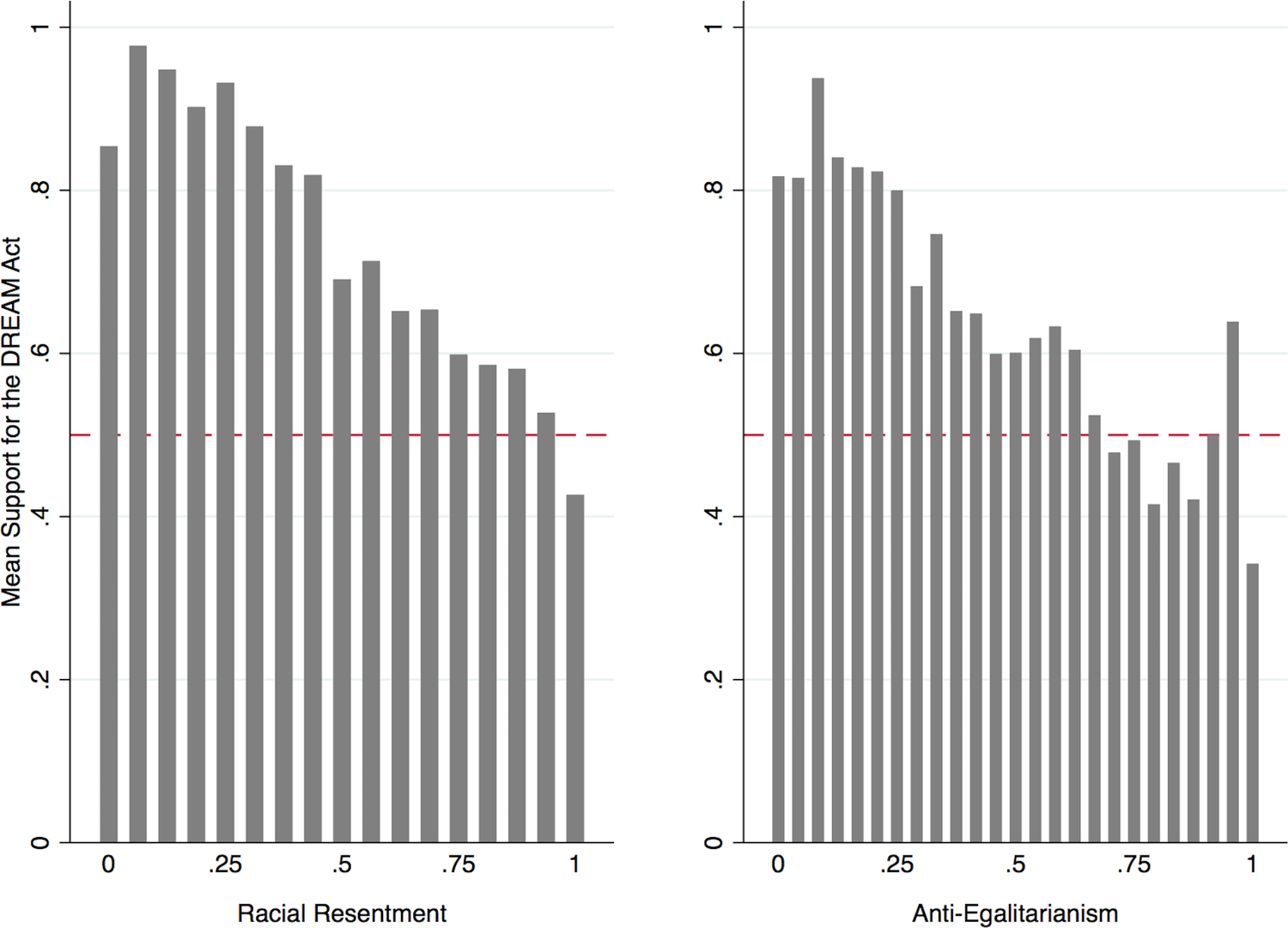
As shown in tables 1 and 2, there is wide support for the DREAM Act and sizeable support for punitive policies that enforce immigration at the local level. An examination of the DREAM Act by racial resentment and egalitarianism is shown in figure 1 and illustrates interesting results.
Average support for the DREAM Act by levels of predispositions
Source: ANES 2012

Although higher levels of racial resentment and anti-egalitarianism decrease support for the DREAM Act among white Americans, opposition to the policy is under 50%. In fact, if we look at the distribution of both racial resentment and egalitarianism (as seen in figure 1A and 2A in the online appendix),Footnote 11 we see that whites who support the DREAM Act do not all have low levels of racial resentment or high levels of egalitarianism. Figure 1 is a descriptive depiction of the average support for the DREAM Act by levels of racial resentment and egalitarianism. Although higher levels of racial resentment and anti-egalitarianism (at levels higher than the neutral 0.5) decrease support for the DREAM Act, support for the DREAM Act continues to be above 50%. There are only ninety-nine individuals with a racial resentment level of 1 and at the tail-end of anti-egalitarianism (refer to figures 1A and 2A).
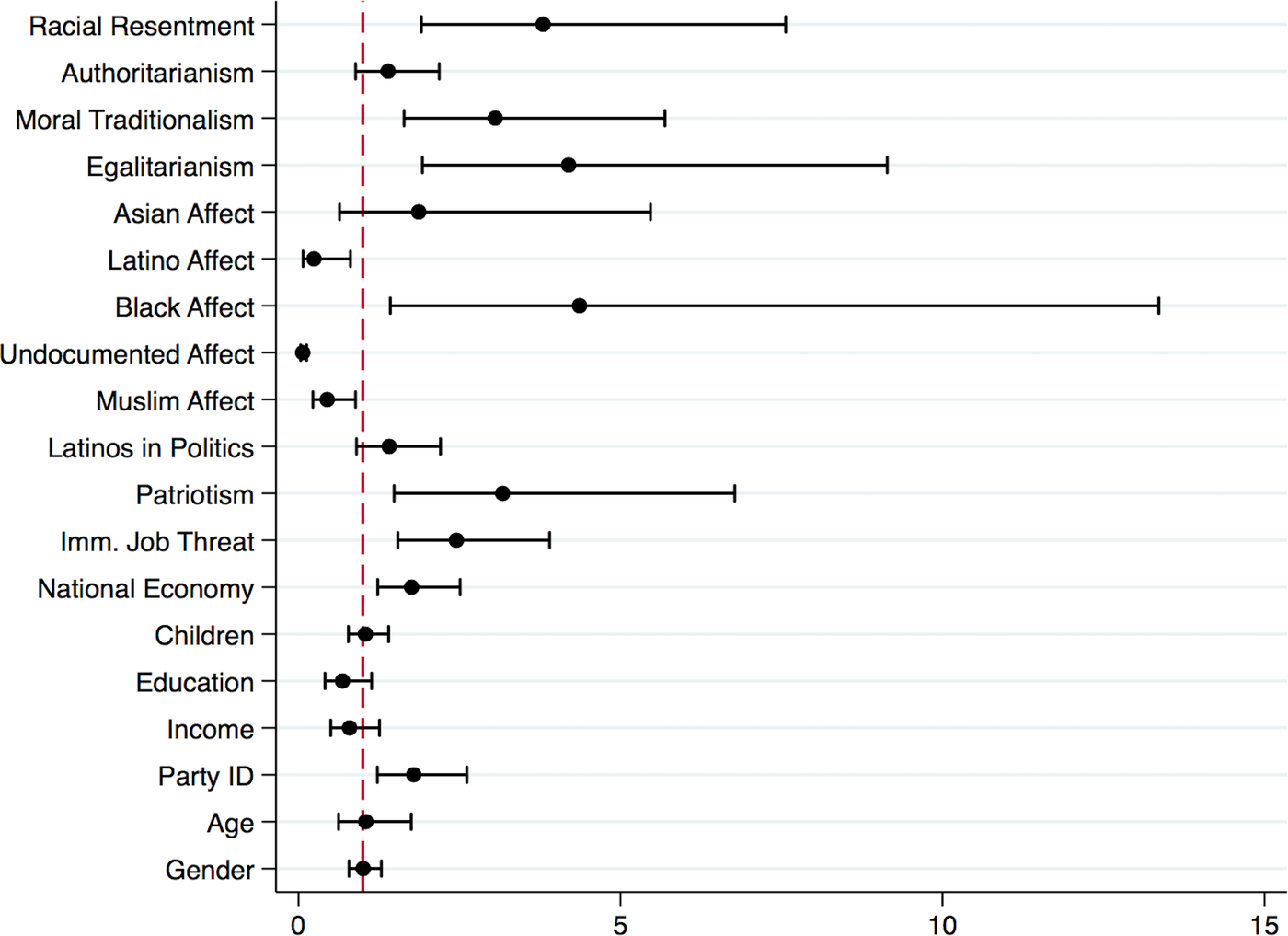
Odds ratio favoring police checks among DREAM Act supporters
Source: 2012 ANES
These findings are not surprising and comport with previous research on the DREAM Act. However, previous research has not focused on how predispositions are cued in the framing of the policy. Moreover, that these predispositions predict support for the DREAM Act raises additional questions about how these predispositions may impact support for other policies that contradict the DREAM Act. How do we understand the complicated nature of support for the DREAM Act, even among the racially resentful and the anti-egalitarians? I argue that it is precisely because support for the DREAM Act exists among this subset of white Americans that explains their support for punitive immigration policies.Footnote 12
The DREAM Act and Police Checks Preferences
Is there anything unique about those who support restrictive immigration policies and the DREAM Act? Table 2A depicts four ordered logistic models predicting support for police checks using the 2012 ANES.Footnote 13 Model 1 shows the full sample, Model 2 examines those who favor the Act and Model 2A replicates Model 2 without partisanship to showcase the difference in magnitude of racial resentment and egalitarianism,Footnote 14 Model 3 shows those who neither favor or oppose, and Model 4 depicts those who oppose the DREAM Act.
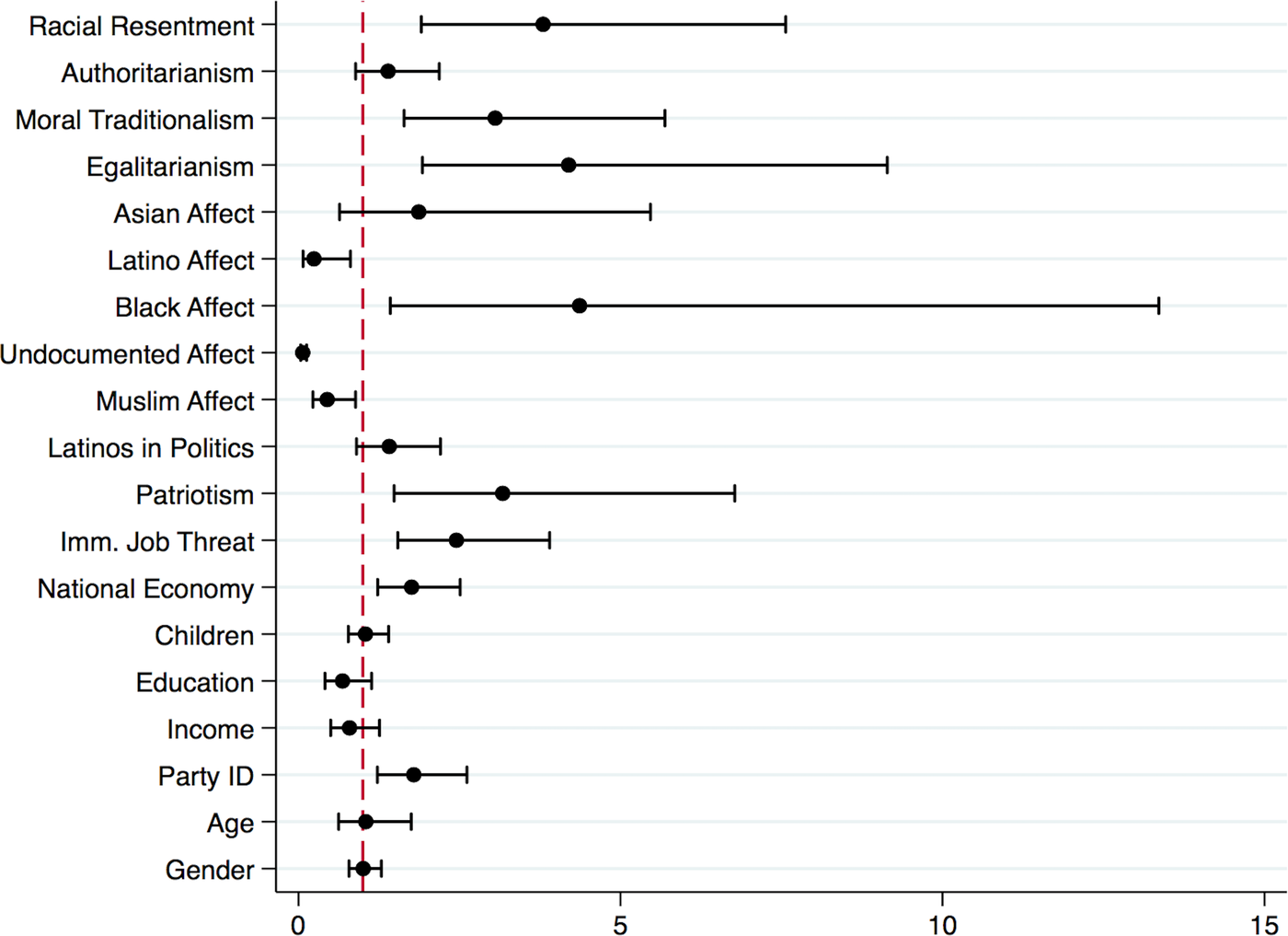
In Model 1, racial resentment and anti-egalitarianism alongside other factors are both positively correlated with supporting police checks. Among those who favor the DREAM Act, higher levels of racial resentment, authoritarianism, moral traditionalism, anti-egalitarianism, patriotism, and Republican partisanship increase support for police checks.Footnote 15 Figure 2 depicts the odds ratio from table 2A, Model 2.
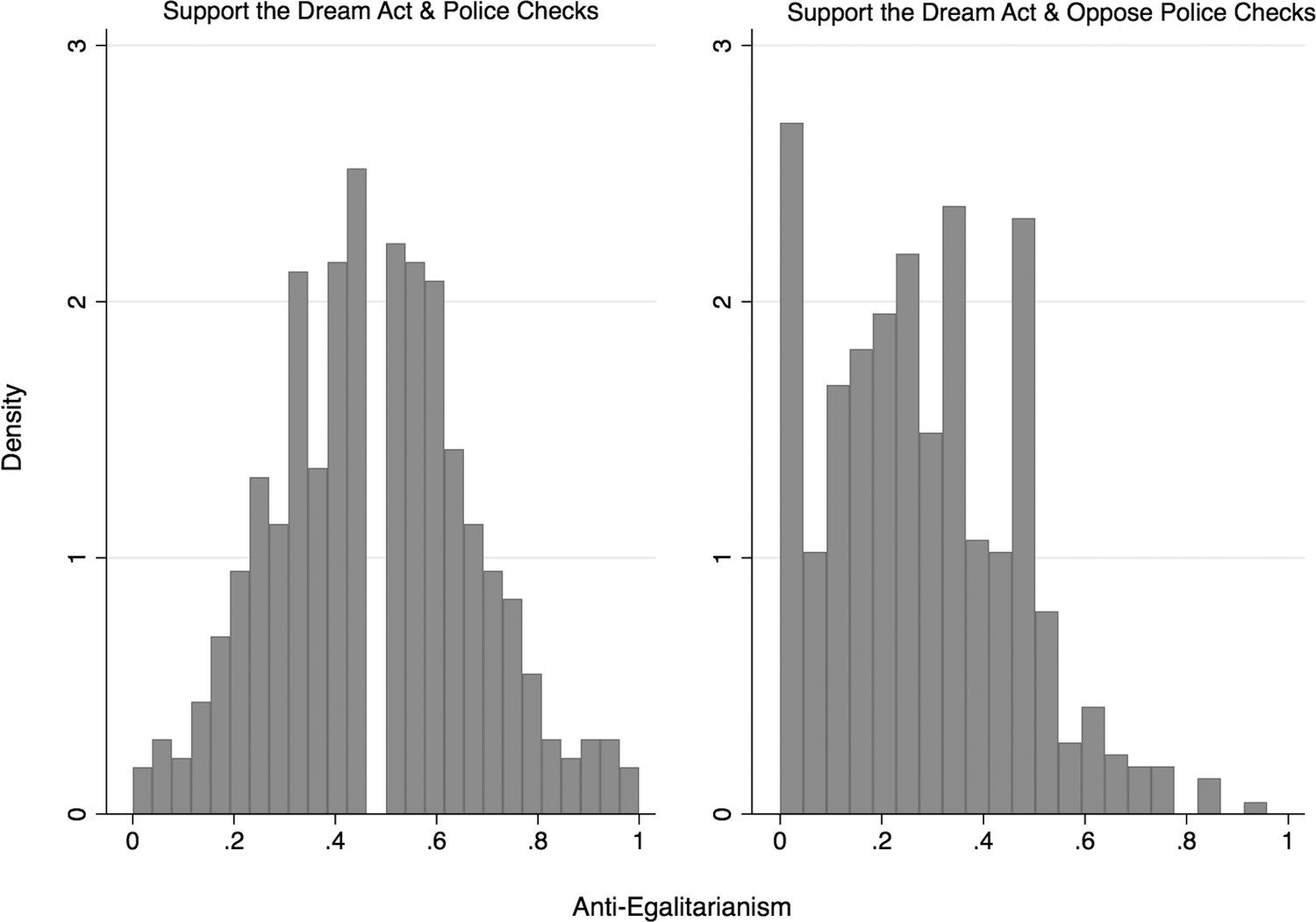
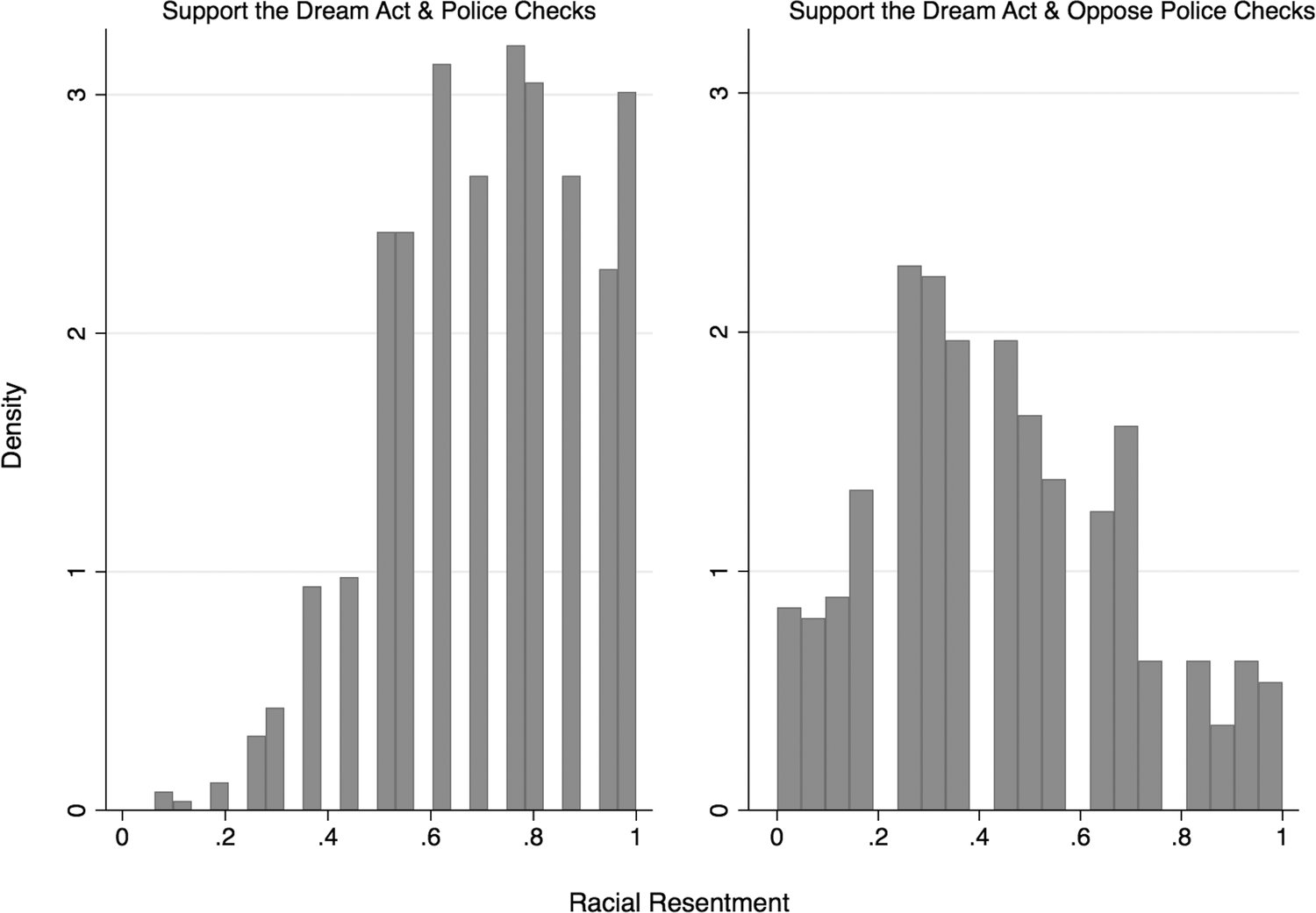
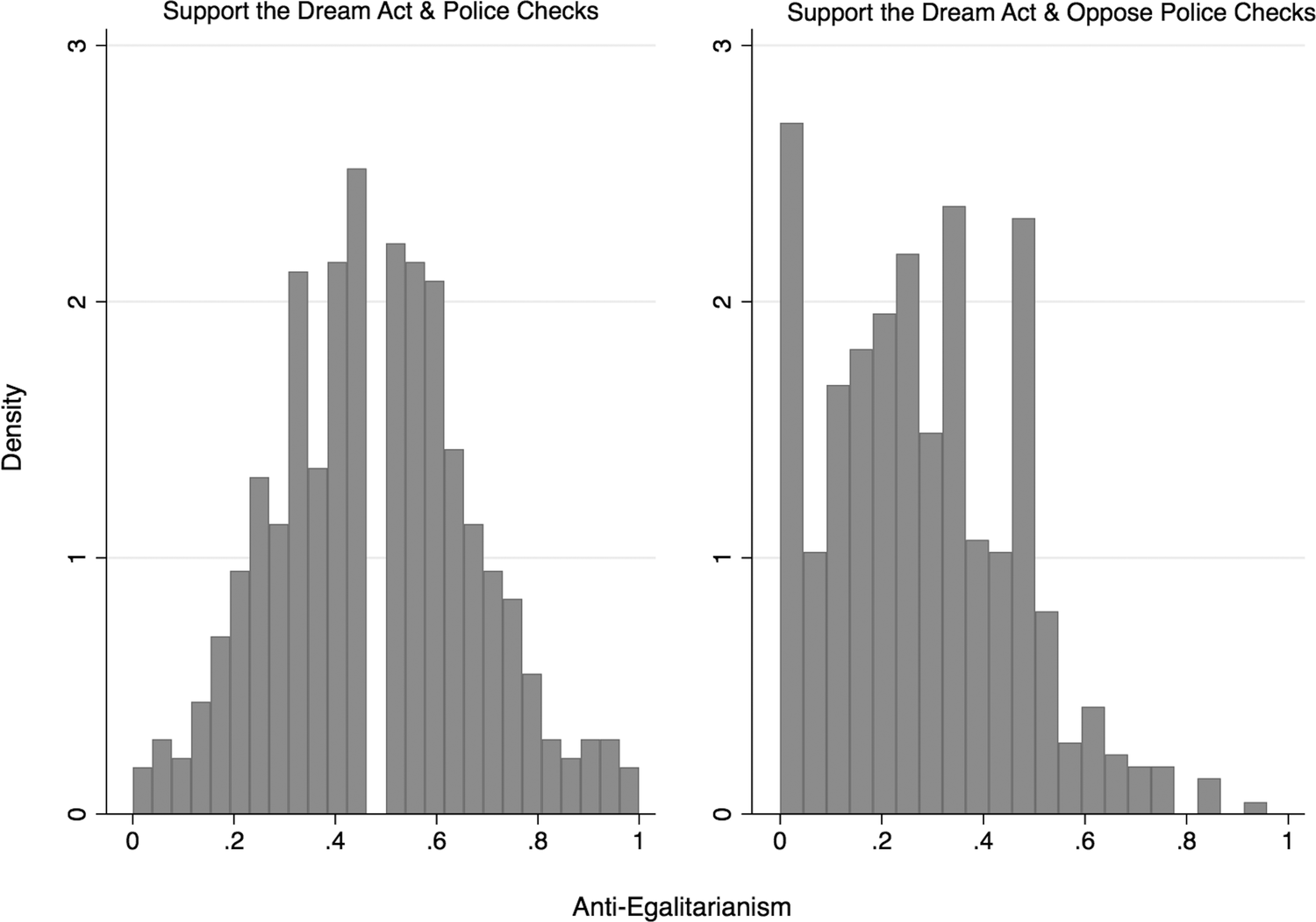
Whites who support the DREAM Act and also support police checks are distinct. The levels of racial resentment and egalitarianism among those who support the DREAM Act and police checks are more spread out than whites who oppose police checks. Figures 3 and 4 show the distribution of egalitarianism and racial resentment, respectively, for whites who support both policies (left figure) and those who support the DREAM Act and oppose police checks (right figure). Whites who support both policies fall both below and above the neutral 0.5 level of egalitarianism; both egalitarians and anti-egalitarians support the two policies. Egalitarians are just as likely to support both the DREAM Act and police checks. However, whites who support the DREAM Act and oppose police checks are more likely to have lower anti-egalitarian levels (0.28), while whites who support both policies have a higher level (0.48). The difference in means are statistically significant (t[1181]= 17.51, p=.000).
Distribution of anti-egalitarianism depending on support for the DREAM Act and police checks
Source: ANES 2012
Distribution of racial resentment by support for the DREAM Act and police checks
Source: ANES 2012
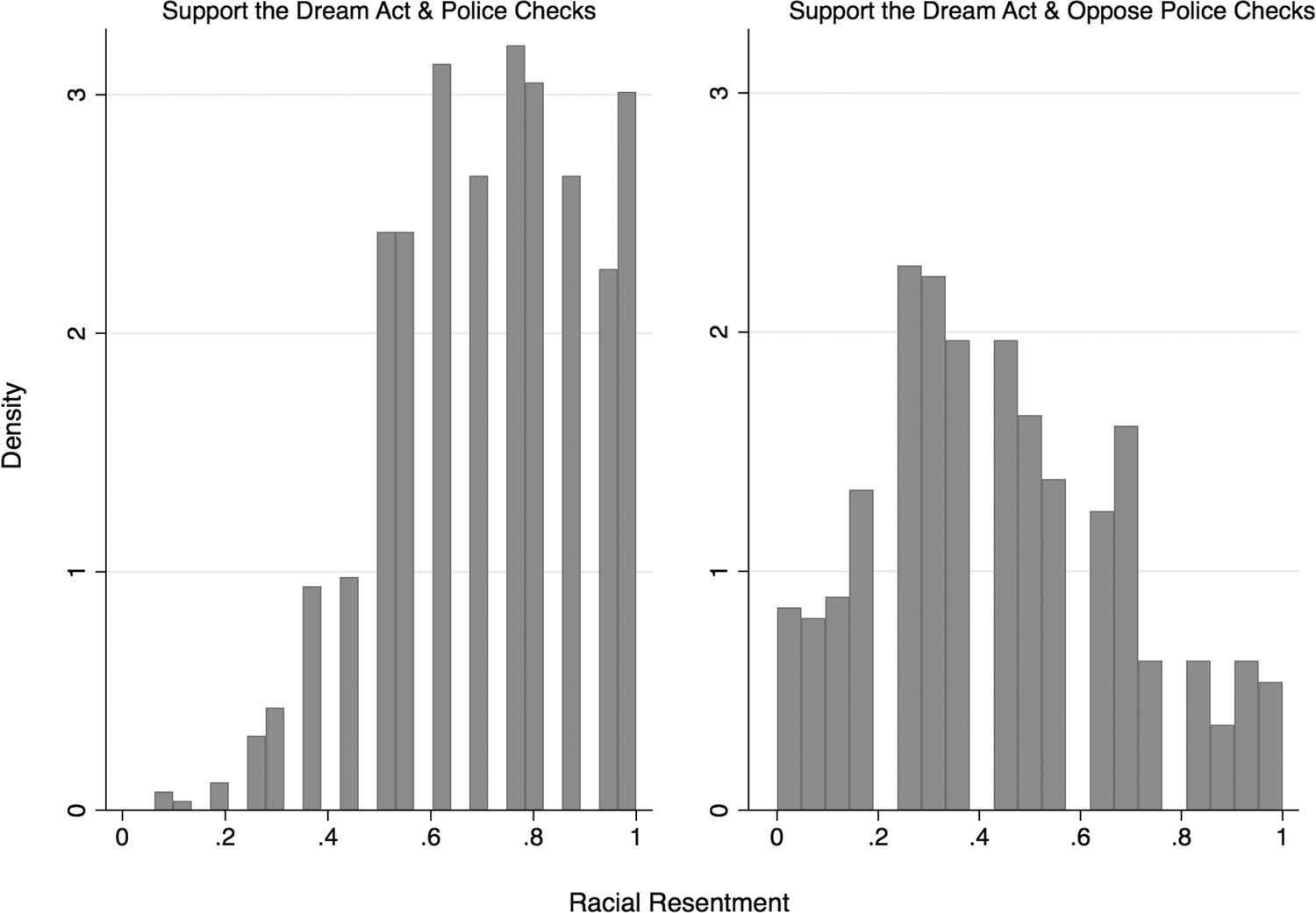
Figure 4 shows even more striking results for racial resentment. Whites who support both policies have higher levels of racial resentment (0.71) compared to whites who support the DREAM Act and oppose police checks (0.44). The difference in means between the two are statistically significant (t[547]=9.12, p=.000). Support for the DREAM Act and police checks is driven by higher levels of racial resentment. Finally, levels of racial resentment and anti-egalitarianism are higher among Democrats, Independents, and Republicans who support both policies compared to those who support the DREAM Act and oppose police checks. Footnote 16
Are the findings being driven by Republicans? Partisanship does not change the substantive impact of racial resentment and egalitarianism; it may be the case that the magnitude of these predispositions are different across partisanship. Table 3A shows support for police checks in 2012, without taking into consideration DREAM Act preferences. Table 3A shows that racial resentment is significantly associated with support for police checks across parties, while egalitarianism is significant for Democrats and Independents, but not Republicans.
Importantly, table 4A replicates table 2A, Model 2 analyzing the factors that predict support for police checks among DREAM Act supporters and modeled by party identification. Table 4 shows the key coefficients and odds ratio of the fully specified table 4A. Among Democrats, racial resentment and egalitarianism are both significant and positively associated with support for police checks. This finding corroborates the theory that support for both the DREAM Act and restrictive and punitive immigration policies are driven, even among Democrats, by the values underpinning racial resentment and egalitarianism. Looking at the proportional odds ratio, the odds of supporting police checks over neither supporting nor opposing are 6.18 higher for a one-unit change in racial resentment. The odds of supporting police checks over neither supporting nor opposing are 7.45 higher per one-unit change in egalitarianism. For Independents, only egalitarianism is significant. The odds of Independents supporting police checks over neither supporting nor opposing are 4.91 higher for a one-unit change in egalitarianism. Finally, for Republicans, racial resentment is significant but not egalitarianism. The odds of Republicans of supporting police checks over neither supporting nor opposing are 5.20 higher for a one-unit change in racial resentment.
Determinants of police checks among DREAM Act supporters, by party identification

Note: + p<.10 * p<.05 ** p<.01 *** p<.001; Full table in the appendix.
Source: ANES 2012; Based on a 3-point PID scale.
As hypothesized, favoring police checks among Democrats who support the DREAM Act is driven by both racial resentment and anti-egalitarianism. The values underlying egalitarianism drive the results for Independents, while for Republicans, racial resentment but not egalitarianism drives the results. For Republicans, restrictive immigration policy preferences and higher levels of racial resentment fall in line with the party’s general attitudes towards immigration. For Democratic DREAM Act supporters, however, higher levels of racial resentment and anti-egalitarianism influence support for punitive immigration policy. Democrats are most susceptible to predispositions beyond what their party identification dictates for their political behavior. The findings for Democrats and Republicans substantiates the theory that I outlined. For Independents, the findings are a bit more nuanced. However, non-leaning Independents are less swayed by underlying predispositions than are Democrats, Republicans, and Independents who lean one way or the other. Footnote 17 Independent leaners’ behavior is more aligned with partisans than non-leaning Independents (LaLoggia Reference LaLoggia2019).
The DREAM Act and Sanctuary City Preferences
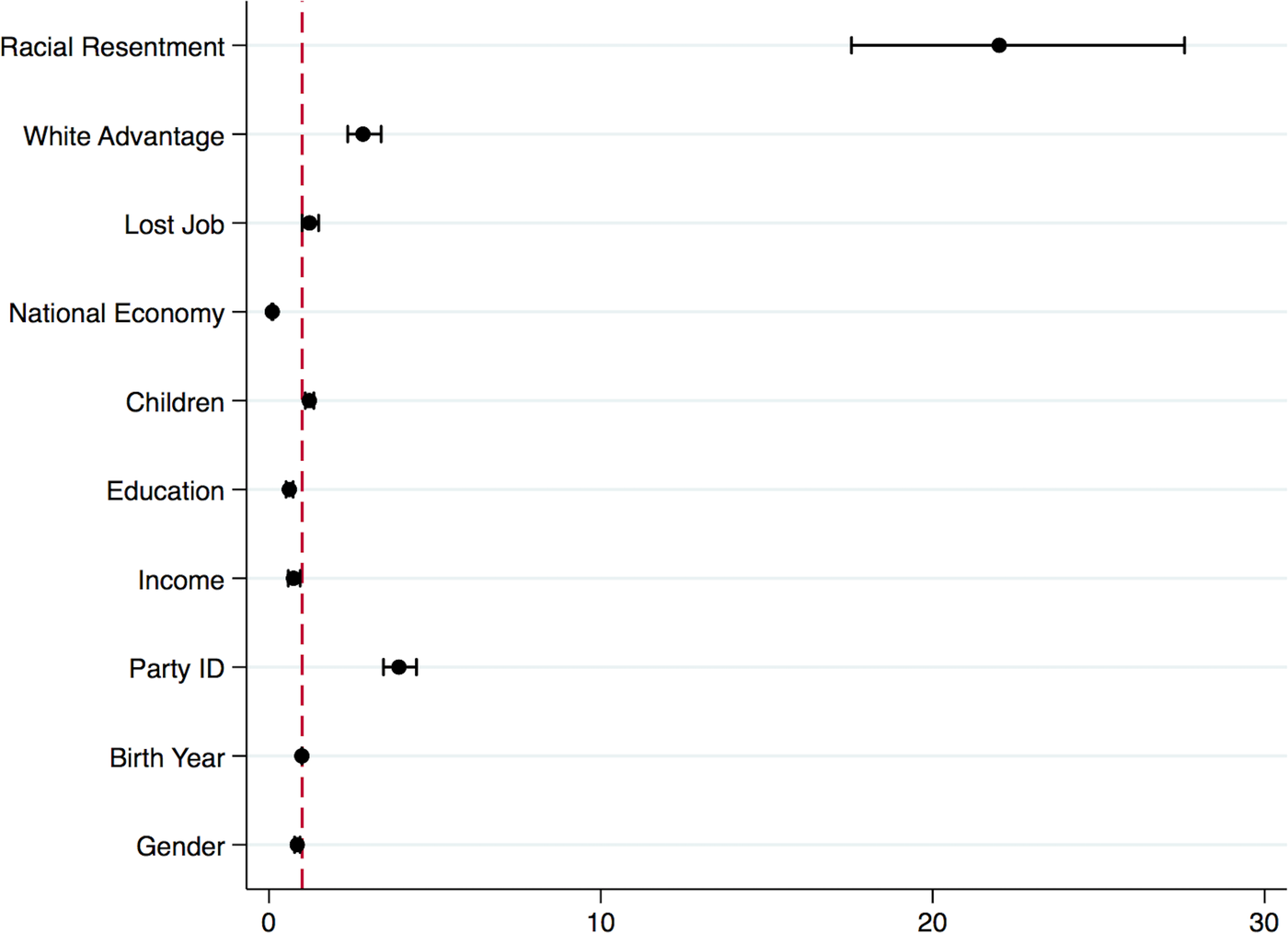
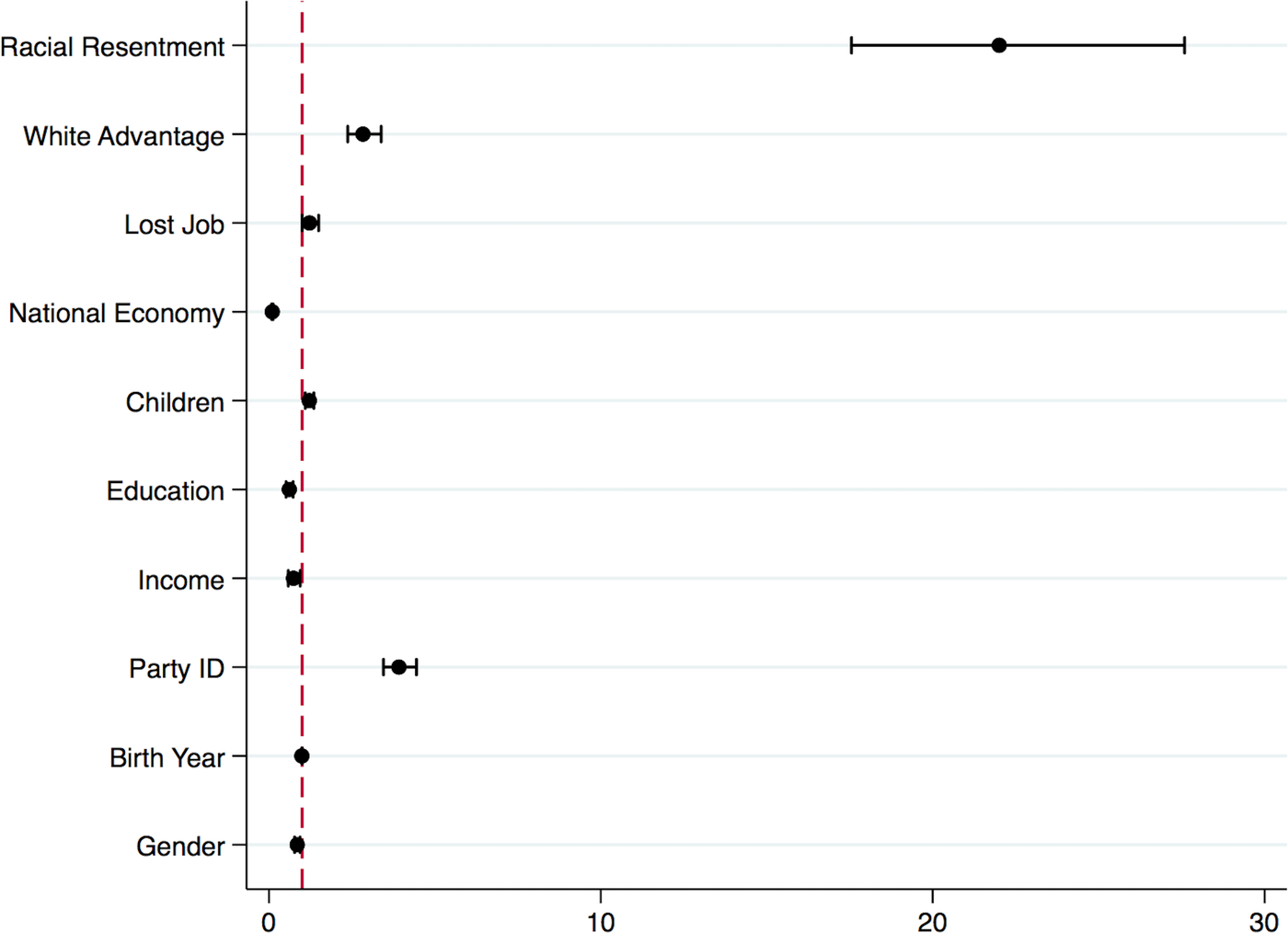
The 2018 CCES also examines preferences for withholding federal funds from police departments unwilling to cooperate with immigration enforcement (Funds), which is akin to opposition to sanctuary cities through fiscal punishment (Collingwood and Gonzalez O’Brien Reference Collingwood and O’Brien2019). In relation to withholding funds, racial resentment is a significant factor. Table 7A shows a logit model predicting support for withholding funds. The first model is the full model, while Model 2 is among DREAM Act supporters and Model 3 among those who oppose the DREAM Act.Footnote 18 Figure 5 shows the odds ratio of DREAM Act supporters who favor withholding funds. Table 8A shows that racial resentment is significantly associated with opposing sanctuary cities and supporting a DREAM Act policy across party identification. Similar to the previous 2012 ANES results, the magnitude for Democrats is highest, followed by Independents and Republicans.
Odds ratio for withholding funds among DREAM Act supporters
Source: 2018 CCES
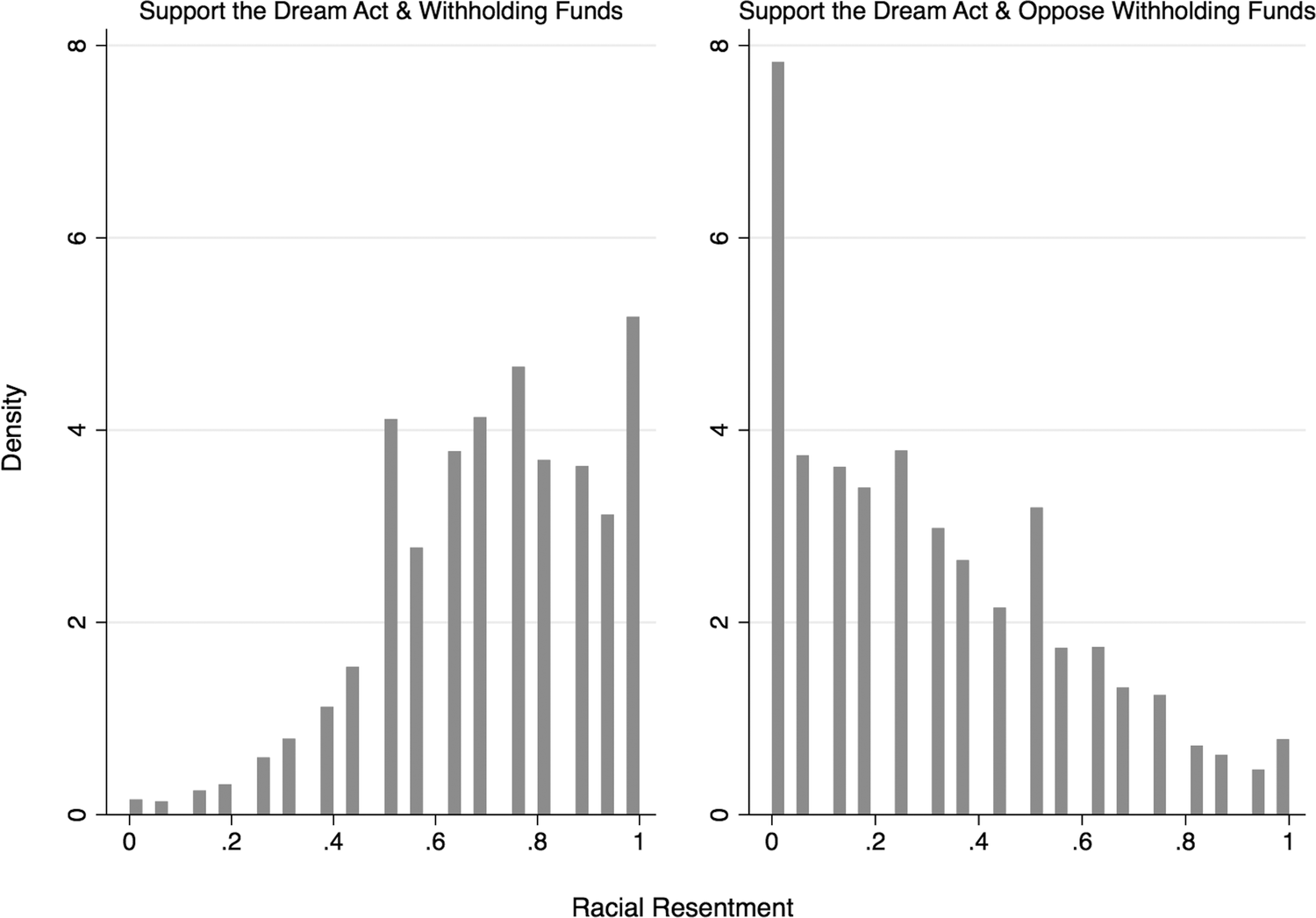
The puzzling category of whites who support withholding funds and the DREAM Act have a racial resentment level of 0.70, while those who support the DREAM Act and oppose withholding funds, the more aligned category, have a racial resentment mean level of 0.31. These two differences are shown in figure 6 and are statistically significant (t[18,791]=103.13, p=.000). Those who support withholding funds and who oppose the DREAM Act⸺the restrictive option⸺have a resentment mean level of 0.81, while those who oppose both have a racial resentment level of 0.64.
Distribution of racial resentment depending on withholding funds and DREAM Act support
Source: CCES 2018
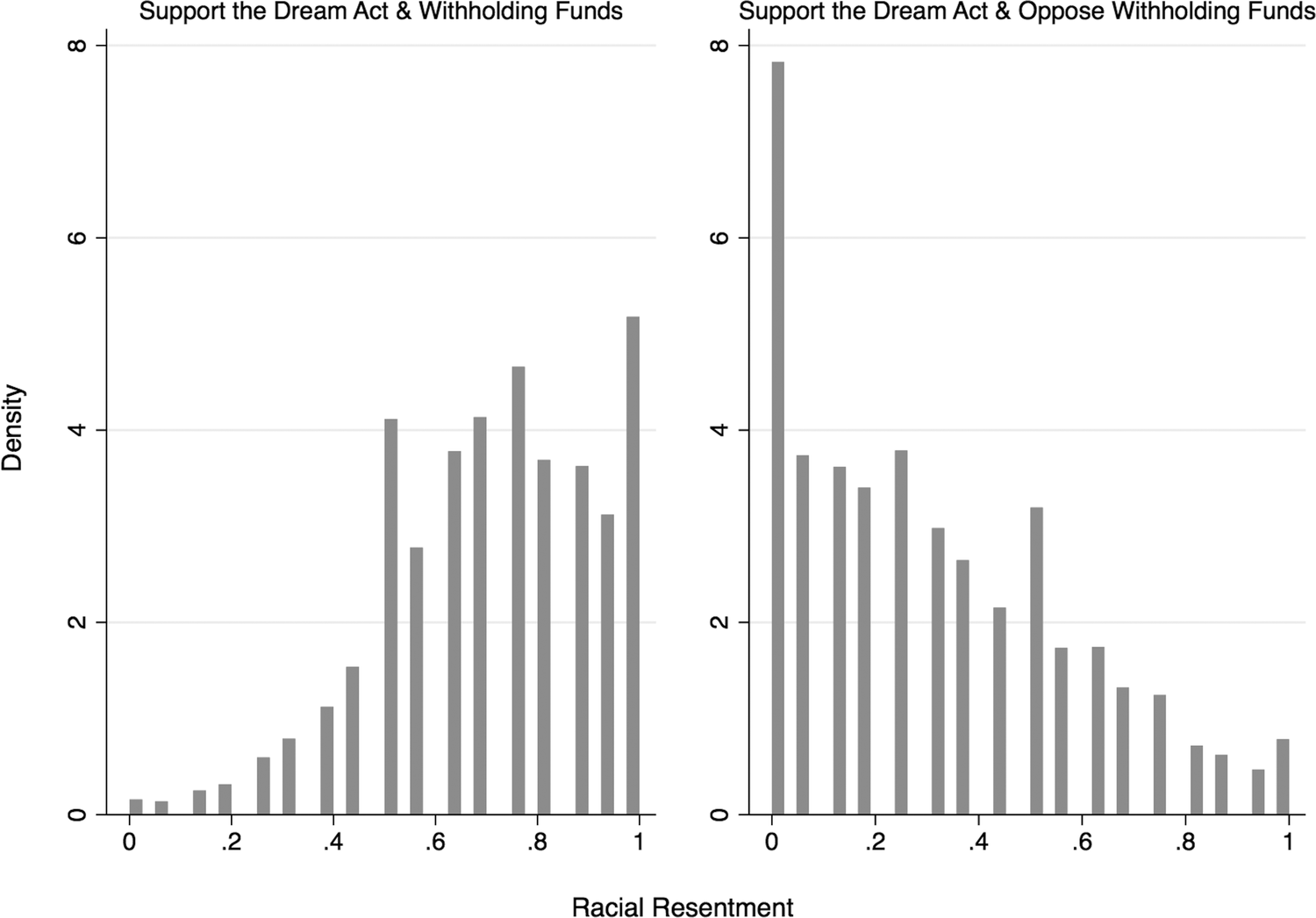
An examination by party follows the same pattern. Democrats (0.58), Independents (0.69), and Republicans (0.75) who support both policies have higher levels of racial resentment than Democrats (0.24), Independents (0.34), and Republicans (0.59) who support the DREAM Act and oppose withholding funds from police departments.Footnote 19 All of the differences in means within each party are statistically significant.
Racial resentment and egalitarianism are significant factors in explaining the subset of whites who support restrictive immigration policies and the DREAM Act. The models were able to control for key alternative explanations, such as partisanship and economic anxiety. Although partisanship and economic variables are significant, these explanations did not nullify racial resentment and egalitarianism as significant predictors of support for the DREAM Act and restrictive immigration policies. Whites who support both policies have much higher levels of racial resentment and anti-egalitarianism than whites who support the DREAM Act and oppose restrictionist immigration policies. These higher levels allow this particular subset of white Americans to support both policies in a way that is not found among those who support the DREAM Act and oppose restrictive policies. By partisanship, racial resentment and anti-egalitarianism were consistent in predicting whites’ preferences to support the DREAM Act as well as more restrictive immigration policy among Democrats, while anti-egalitarianism was consistent among Independents.
Robustness Check
While my focus is on immigration attitudes, my general theory can apply to similarly framed issues. To check whether this argument holds among other policy issues, I examine whites’ preferences on spending for social security and welfare programs. Social security is framed as a policy that largely benefits whites (Lieberman Reference Lieberman2007; Winter Reference Winter2006). Welfare programs, however, are racialized and framed as programs that primarily help “undeserving” people of color (Gilens Reference Gilens1996; Hancock Reference Hancock2004; Quadagno Reference Quadagno1996), including Latinos (Fox Reference Fox2004). If the argument holds, whites who prefer increasing spending towards social security and welfare programs will have lower levels of racial resentment and anti-egalitarianism. In contrast, whites who prefer increasing spending on social security and decreasing spending on welfare programs will have higher levels of racial resentment and anti-egalitarianism.
Whites see beneficiaries of social security as worthy of such benefits, deserving Americans, while simultaneously seeing those who get welfare as unworthy, undeserving, and un-American. This group is parallel to whites who support the DREAM Act and restrictive immigration policies, whereas the former group are parallel to whites who support the DREAM Act and oppose restrictive immigration policies. Figures 8A and 9A are indicative of the same hypothesized pattern. Whites who want to increase both social security and welfare programs have a racial resentment average level of 0.57 and an anti-egalitarian average level of 0.30, while those who want to increase social security but decrease welfare programs have an average racial resentment level of 0.77 and an anti-egalitarian level of 0.47. Both of these differences are statistically significant.
When examined by partisanship, the pattern holds. For racial resentment and egalitarianism, Democrats have lower racial resentment levels than Independents and Republicans. However, among Democrats, those who want to increase spending for both social security and welfare programs have a lower level of racial resentment and anti-egalitarianism. The same is the case for Independents and Republicans. These results are statistically significant and are shown in table 11A and 12A.
Discussion
Despite bipartisan support for the DREAM Act, Congress has not passed any law that would create a pathway to citizenship for DREAMers. Scholars have mainly focused on the framing of the DREAM Act as the main reason for its majority support among Americans. Drawing on the relevant scholarship, I was interested in understanding DREAM Act support in conjunction with support for punitive immigration policies. I aimed to answer who supports both policy types and who supports only one or the other? Furthermore, what role does partisanship play in support of both policies?
The findings indicate that even in the face of alternative explanations, such as economic anxieties and partisanship, racial resentment had a consistent and positive influence on support for both the DREAM Act and more punitive and restrictive immigration policies. First, higher levels of racial resentment lower the likelihood of supporting the DREAM Act but do not negate majority support. Higher levels of racial resentment are also associated with support for punitive immigration policies. This is the case for proposals that call for the police checking the status of individuals and withholding funds from police departments that do not comply with federal immigration enforcement. White Americans who support both policies have higher levels of racial resentment than white Americans who support the DREAM Act and opposed punitive immigration policies. Furthermore, partisanship does not eliminate the substantive impact of racial resentment, with the exception of Independents’ attitudes towards police checks. It is not surprising that Republicans are largely in favor of restrictionist immigration policies, even as they continue to support the DREAM Act. Prior scholarship provides compelling evidence that explains Republicans’ support for the DREAM Act (Wallace and Wallace Reference Wallace and Wallace2020), which is not contradictory to Republicans’ understanding of the model citizen. On the other hand, it is surprising that some Democrats support both types of policies. Higher levels of racial resentment account for that support, whereas Democrats with lower levels of racial resentment support the DREAM Act and oppose police checks, which is the expected outcome. White Democrats and Republicans who hold onto the values underpinning racial resentment support both types of immigration policies.
The 2018 CCES finds that racial resentment is positive and strongly associated with withholding funds from police departments. In that same model, denial of white advantage also has a positive and strong association with the same outcome. Whites who deny white privilege are more likely to prefer withholding funds from uncooperative police departments. Both racial resentment and denial of white privilege show that opposition to sanctuary cities has a racial dimension (Collingwood and Gonzalez O’Brien Reference Collingwood and O’Brien2019). When measured through racial resentment, whites do appear to use race as a predictor for their policy preferences across political parties.
Differing levels of egalitarianism distinguish white Americans who support both types of policies from whites who support the DREAM Act and oppose punitive immigration policies. The former group has higher mean levels of anti-egalitarianism while the latter has a lower mean level. This effect is significant even after controlling for partisanship. However, an examination of the model by party identification reveals that white Democrats and Independents dominate this finding, whereas egalitarianism is insignificant among white Republicans. Thus, the findings point to the differential impact of anti-egalitarianism across party lines in explaining the contradictory policy opinions among white partisans.
This study furthers our understanding of how underlying predispositional values play a significant role in support for the DREAM Act among white Americans who simultaneously support restrictive immigration policies. Furthermore, the robustness check also shows how this theory applies beyond immigration policies.
These findings contribute to the scholarship on immigration and white political behavior. The framing literature as it relates to the DREAM Act suggests that it is the framing of the DREAM Act and DREAMers that explain wide support for the policy (Druckman, Peterson, and Slothuus Reference Druckman, Peterson and Slothuus2013; Haynes, Merolla, and Ramakrishnan Reference Haynes, Merolla and Ramakrishnan2016; Wallace and Wallace Reference Wallace and Wallace2020). I went a step further to understand the mechanism underlying the framing for different partisan groups. Predispositions can be used to examine seemingly contradictory policy preferences. The core values of individualism, work ethic, and equality underlie the predispositions white Americans hold and legitimize their support of the DREAM Act and punitive immigration policies.
Second, political scientists’ understanding of partisanship is complicated by the findings. Predispositions often override partisanship, especially for Democrats and are possibly more important than partisanship in determining attitudes. This finding is not as consistent among Republicans because racial resentment and partisanship push whites toward the same conclusions. Partisan attachments strongly shape American political behavior (Bartels Reference Bartels2000; Campbell et al. Reference Campbell, Converse, Miller and Stokes1960). Partisan Americans consistently vote with their party. However, I showed that Democrats, in particular, are highly susceptible to predispositions (also see Hooghe and Dassonneville Reference Hooghe and Dassonneville2018). The importance of partisan-level conditional modeling and predispositions for partisans is a major contribution of this work.
Finally, our current understanding of white identity politics must be complicated in ways that seriously consider predisposed attitudes vis-à-vis policies that activate in-group attachment. An understanding of racial identity as related to other cultural characteristics such as cultural value orientations is needed (Helms Reference Helms1990). Predispositions lead to these value judgements. Without consideration of values, white racial identity politics is incomplete. Furthermore, the findings shed light on the role of immigration on white Democrats’ political behavior. Past scholarship explains that immigration has the power to move Democrats to the left and Republicans to the right, and that Democratic to Republican defection is also influenced by immigration (Abrajano and Hajnal Reference Abrajano and Hajnal2015). Perhaps Democrats who have higher levels of racial resentment and anti-egalitarianism are those who have defected or are most susceptible to defecting. My findings have broad implications for the welfare of immigrants, the future of immigration politics, and American politics.
Conclusion
White Americans’ support for punitive policies like police checks and punishing sanctuary localities actually hurt the very same group for which they support a pathway to legalization. DREAMers can be easily targeted by federal-local immigration enforcement programs like 287(g) and Secure Communities. Thus, supporting both types of policies is detrimental for DREAMers in many ways. DREAMers’ family members are also at risk of being stopped by local police (Golash-Boza Reference Golash-Boza2019; Gonzales Reference Gonzales and Vargas2016; Valdivia Reference Valdivia2019). This has indirect effects on DREAMers resulting in family separation and lack of financial and emotional support. Scholarship has often focused on majority support for the DREAM Act without also examining what other policies the same people are supporting that may nullify their DREAM Act support.
American support for the DREAM Act is not enough for immigration reform because the DREAM Act is seen as exceptional and it does not run counter to supporting punitive immigration legislation. In fact, support for anti-immigrant legislation is made that much more prevalent because of the moral framing of DREAMers. I shed light on one of the failings of the American public welfare state. The United States government enacts laws all of the time and often these laws nullify one another. I highlight one way that this happens and that it happens across party lines.
As long as the same predispositions drive support for the DREAM Act, passing a version of a DREAM Act remains difficult. If white Americans continue to be driven by the values of meritocracy and work ethic and define equality as equality of opportunity without regard to structural barriers, immigration reform at-large will continue to struggle in Congress. This is especially the case for Democrats and Independents. It is not surprising for Republicans to support punitive policies, but if a subset of Democrats and Independents are supporting these kinds of contradictory policies, the normative implication is the continued difficulty of the DREAM Act bill and immigration reform writ large.
This study is not without data limitations. The 2018 CCES examinations lack key independent variables that would serve as an exact replication of the 2012 data. However, the results of the 2018 data follow the expected pattern. Future research might also replicate the conditions of other racial and ethnic groups.
Supplemental Materials
To view supplementary material for this article, please visit http://dx.doi.org/10.1017/S1537592720002492.