Introduction
Cranberry is a perennial crop grown primarily in North America. The United States and Canada dominate production with 98,000 and 50,000 ha, respectively, in 2017 (Sandler Reference Sandler2018). In South America, approximately 4,200 ha were in production in Chile in the same year, along with minor hectarage distributed across Eastern Europe and the Netherlands. In the United States, more than half the hectarage is in Wisconsin (8,421 ha), followed by Massachusetts (5,292 ha) and New Jersey (1,215 ha). The overall farmgate crop value for the U.S. crop was $291 million in 2020 (USDA-NASS 2021).
Cranberry beds remain in continuous production for many seasons given that berry yield does not tend to decline over the years (as with other perennial crops) coupled with the high cost to renovate a planting (the process by which cranberry beds are modified and replanted). In 2009, it was estimated that the median cost to renovate Massachusetts cranberry farms was $81,000 ha−1 (Gordon Reference Gordon2009). Moreover, newly renovated cranberry plantings do not produce a profitable berry yield until the third or fourth season, when the plants are established and stolons (i.e., runners) have colonized the bed to form continuous canopy cover. The long-term nature of cranberry plantings and dense vine ground cover limit the ability to use rotation or cultivation methods for weed management. Thus, weed control is almost exclusively limited to herbicide application. Common residual herbicides include dichlobenil, napropamide, or sulfentrazone applied prior to weed growth and when cranberry vines are dormant. Mesotrione, quinclorac, and graminicides are applied postemergence during active cranberry growth. Additionally, glyphosate, clopyralid, and 2,4-D can be used in selected applications, such as with a wick wiper, to control late-season weeds that escape previous applications (Guedot et al. Reference Guedot, Colquhoun, Nice and Holland2021).
The weed spectrum in cranberry is unique given the crop’s perennial nature and distinct production habitat. The cultivated American cranberry is native to North America and requires acidic, moist soils in cool climates (Hoekstra et al. Reference Hoekstra, Neill and Kennedy2020). Most weeds commonly found in cranberry are perennials, and many are native wetland species (Colquhoun et al. Reference Colquhoun, Roper and Sulman2009; Sandler et al. Reference Sandler, Dalbec and Ghantous2015). The influence of these weeds on cranberry yield and quality is not well known and cannot be extrapolated from other cropping systems given the unique nature of both cranberry production and the weed species spectrum. In Massachusetts, a weed species prioritization system was developed in 1995 that uses expert and grower input across three categories: rate of spread, potential to cause crop loss, and control difficulty (Else et al. Reference Else, Sandler and Schluter1995). A Canadian group of researchers published a revised priority rating system that attributed point scores to four criteria: impact, biological form or type, invasive or reproductive capacity, and adaptation to cranberry habitat (Neron et al. Reference Neron, Deland, Drolet and Painchaud2013). These systems are used to generate priority ratings ranging from low to very high that growers can use as a general guide for directing management efforts.
To the best of our knowledge, despite more than 200 yr of commercial production in the United States (Sandler Reference Sandler2018), reports of direct quantification of weed impact on cranberry yield and quality is limited to a single paper by Patten and Wang (Reference Patten and Wang1994), in which three perennial weed species were investigated: Pacific silverleaf [Argentina egedii (Wormsk.) Rydb. ssp. Egedii], birdsfoot trefoil (Lotus corniculatus L.), and Douglas aster [Symphyotrichum subspicatum (Nees) G.L. Nesom var. subspicatum]. Regression analysis was used to explore the relationship between weed canopy density and cranberry yield and quality. The authors reported that weed density reduced cranberry yield in a linear relationship and that berry yield was more sensitive to weed interference than berry quality. They further hypothesized that light was the most limiting factor in the competitive relationship and suggested additional research to investigate the long-term impact of established weed populations on cranberry yield components. Although qualitative data support the contention of yield loss due to weed competition including an expert input system (via a survey of weed scientists and outreach specialists) to estimate 25% yield loss across species (Swanton et al. Reference Swanton, Harker and Anderson1993), quantitative data on weed impacts on cranberry yield are lacking.
The work presented here addresses the needs described above with four common weed species across multiple production seasons and systems in Wisconsin, Massachusetts, and New Jersey. Weed species were chosen that represent diverse phenology and growth habits. Carolina redroot is a perennial herbaceous plant with a fibrous root system and is native to the southeastern United States. It has grass-like leaves that extend to about 0.5 m tall and produces cream-colored flowers in early summer that are attractive to pollinators. It frequently colonizes New Jersey cranberry beds, where it often forms monoculture patches (Besançon et al. Reference Besançon2019). Earth loosestrife is another perennial herbaceous species of wetland areas in North America. It is propagated primarily by producing long and deep rhizomes throughout the growing season, and secondarily by bulblets located in the leaf axils in fall. Bristly dewberry is a perennial subshrub native to the eastern half of North America. In spring, emerging from extensive perennial crowns and roots it produces vines that spread across the top of the cranberry canopy. Polytrichum moss, also commonly known as haircap moss, is found in moist habitats across North America, Eurasia, and Australia. It is a perennial spore-producing plant that forms long-living, dense, and deep mats in moist cranberry beds (Sandler et al. Reference Sandler, Dalbec and Ghantous2015; USDA-NRCS 2021).
The primary objective was to use these representative species to quantify the impact of weed density, groundcover, and biomass on several cranberry yield components and related interactions with other cranberry pests. The long-term goal is to build a “library” of objective weed impact information that growers and consultants could use to make weed management decisions such as balancing control costs with the weed species’ economic impact on production. Also, the interaction of weeds with other cranberry pests, such as insects and plant pathogens, can be documented relative to berry yield and quality and in a way that is useful in making integrated pest management decisions if this relationship is consistent over production years.
Materials and Methods
Studies were conducted in 2018 through 2020 at the P.E. Marucci Center for Blueberry and Cranberry Research in Chatsworth, New Jersey (39.82°N, 74.53°W), the UMass Cranberry Experiment Station in East Wareham, Massachusetts (41.76°N, 71.67°W), and in commercial cranberry beds in Warrens, Wisconsin (44.13°N, 90.49°W). All production practices, such as pest management, fertilizer inputs, and irrigation followed regional commercial standards (Besançon et al. Reference Besançon, Oudemans and Rodriguez-Saona2021; Ghantous et al. Reference Ghantous, Sylvia and Gauvin2021; Guedot et al. Reference Guedot, Colquhoun, Nice and Holland2021).
The methodology and analyses used in these studies were based on the work reported by Patten and Wang (Reference Patten and Wang1994). The same methodology was used for Carolina redroot and earth loosestrife studies in New Jersey and bristly dewberry studies in Wisconsin. The Carolina redroot studies were conducted over the course of three seasons, whereas bristly dewberry and earth loosestrife studies were conducted in two seasons. In each study season, 40 0.5-m2 quadrats were located in cranberry beds where the target weed species was the only species present and the cranberry vines visually appeared otherwise healthy and with complete canopy growth. Within each cranberry bed, quadrats were visually placed to include a variety of weed densities ranging from complete absence to the highest level of visually estimated infestation. In Wisconsin, the studies were conducted in cranberry beds planted to the ‘Stevens’ variety, while in New Jersey the varieties were ‘Ben Lear’ for Carolina redroot and ‘Stevens’ for earth loosestrife studies.
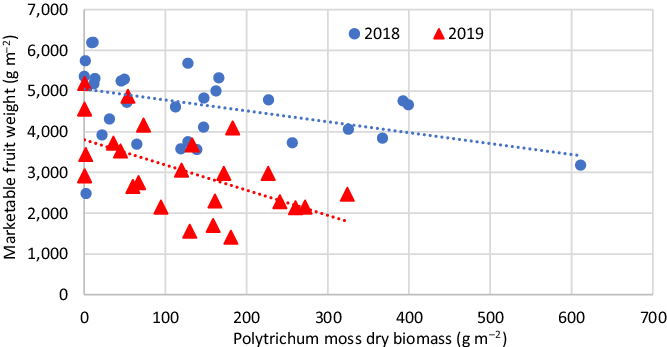
Smaller quadrats and fewer samples (30 in 2018 and 24 in 2019) were used in the polytrichum moss study in Massachusetts since harvesting the moss mat down to the soil level and separating moss plants intertwined among cranberry vines requires significant time for each sample. In this case, individual quadrats measuring 0.09 m2 were randomly placed on Stevens beds with patchy moss infestations to capture a gradient of moss cover from none to 100%. All plant material within the quadrat was harvested to the soil level using hand-held clippers. The samples were placed into individual bags by quadrat and brought to the laboratory for separation of cranberry vines, berries and moss vegetation.
Weed and cranberry sampling was conducted within a few days of cranberry harvest in mid-September through mid-October in each season. Weed species data collection included population density, biomass, and groundcover for Carolina redroot, earth loosestrife and bristly dewberry, and biomass for polytrichum moss in Massachusetts. Weed groundcover was visually estimated in each 0.5-m2 quadrant. Cranberry yield measures included total fresh berry biomass and berry number, which subsequently were used to calculate average berry weight. Additionally, berry quality measures included the percent rotted fruit, berry color rated visually on a scale of 0 (no red color) to 10 (complete red color across the entire berry; in Wisconsin only), total anthocyanin (TAcy; New Jersey only) and percent insect-damaged fruit (in New Jersey only; no insect-damaged fruit was noted in Wisconsin or Massachusetts studies). Total marketable fruit excluded rotted or insect-damaged fruit and fruit <0.95 cm in diameter. Cranberry vine and weed biomass were dried in an oven at 60 C for 3 d, then weighed to determine dry biomass.
Linear regression was used to explore the relationship between weed biomass, groundcover, or density and marketable cranberry yield in each study year as reported by Patten and Wang (Reference Patten and Wang1994). Data were subject to ANOVA to determine the significance level of the regression coefficients. Additionally, two-sided t-tests were used to compare regression slopes among years within a weed species as a measure of the consistency in weed interference impacts across study years. Data were then pooled across study years for each species, and Pearson correlation coefficients were used to determine the significance of the relationships between weed interference (density, groundcover or biomass) and cranberry quality parameters (i.e., color, insect-damaged fruit, vine biomass, etc.).
Results and Discussion
Regression Analysis
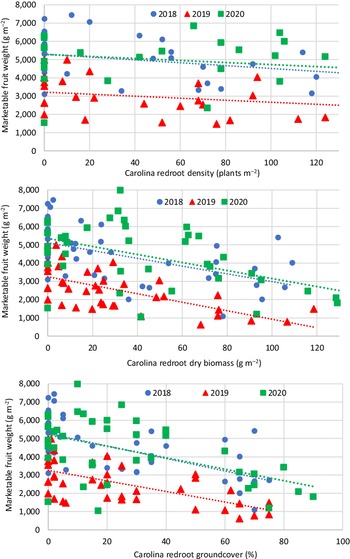
Weed density, groundcover, and dry biomass were regressed against marketable cranberry yield for each study year and weed species. All linear regressions for Carolina redroot, bristly dewberry, and polytrichum moss were significant at the P < 0.05 level, and nine of these 12 regressions were highly significant at P ≤ 0.001 (Table 1). For Carolina redroot, the slope for weed density regressed against marketable berry yield ranged from −5.55 to −7.84 across the three study years, indicating a temporally and spatially consistent relationship where each Carolina redroot plant reduced cranberry yield by an average of 6.3 g m−2. Weed groundcover was also strongly related to marketable berry yield in each year (Table 1).
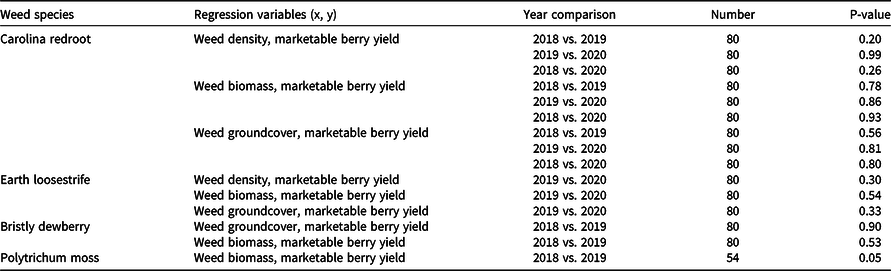
Regression slope and statistical significance among years for Carolina redroot, earth loosestrife, bristly dewberry, and polytrichum moss in cranberry.

Additionally, two-sided t-tests were conducted to compare the regression slopes between study years to further explore whether the results were consistent enough to be reliable indicators of the relationship between weed interference and cranberry yield in a way that is useful to growers, cranberry processors and crop consultants. In this case, there were no differences in the slopes among three study years when Carolina redroot weed density or groundcover were regressed against cranberry yield (Table 2).
Comparison of regression slopes among years in cranberry for Carolina redroot and earth loosestrife in New Jersey, bristly dewberry in Wisconsin, and polytrichum moss in Massachusetts.a

aRegression slopes were compared using two-sided t-tests with a significance level of P ≤ 0.05.
In the relationship between Carolina redroot biomass and cranberry yield, the regression slope was similar in 2018, 2019, and 2020 (−21.26, −23.22, and −21.94, respectively; Tables 1 and 2), indicating that in these three study years, each gram of Carolina redroot dry biomass reduced cranberry yield by an average of 22.1 g. While Carolina redroot density, groundcover, and biomass were very consistently related to cranberry yield across all three study years, from a practical standpoint, weed density or groundcover are good measurement choices in that they require the practitioner to simply count weeds or visually estimate cover in a square meter instead of harvesting the weed, drying, and then weighing biomass at a later date.
In contrast, the relationship between earth loosestrife measurements and marketable cranberry yield was not consistent between years nor statistically significant in any case (Table 1). For example, when earth loosestrife groundcover was regressed against marketable berry yield, regression slope estimates ranged from −25.95 in 2019 to −7.73 in 2020, with P-values of 0.15 and 0.16, respectively.
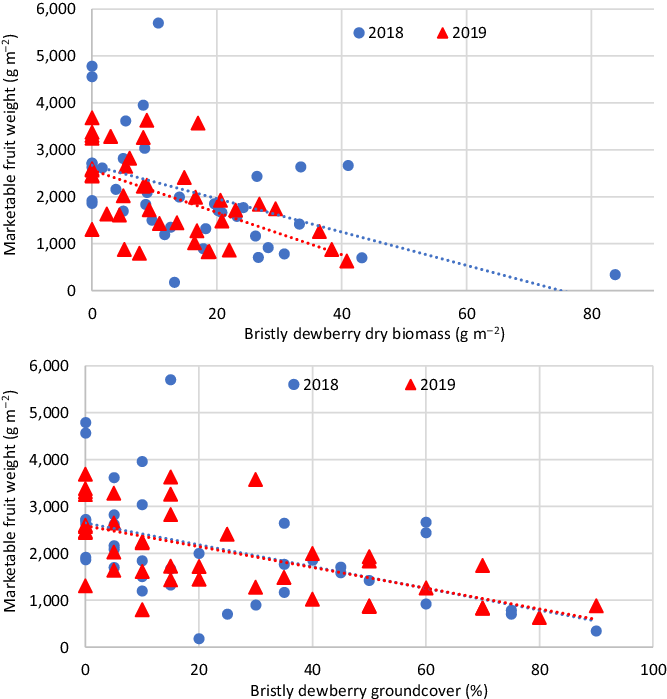
The relationship between visual estimation of bristly dewberry groundcover and cranberry yield was very consistent between the two study years. One percent bristly dewberry groundcover reduced cranberry yield by −23.2 g and −22.2 g in 2018 and 2019, respectively; a remarkably consistent relationship given the subjective nature of visual estimations as well as the viny nature of Rubus species growth (Table 1). The P-value for the two-sided t-test comparing regression slopes between the two study years was 0.9 (Table 2). The relationship between bristly dewberry biomass and cranberry yield was also consistent and indicated a severe impact from weed competition, ranging from a 35.6 g cranberry yield loss from 1 g bristly dewberry biomass in 2018 to a 45.1 g yield loss in 2019 (Table 1). These slopes were statistically similar between years, suggesting a consistent and reliable relationship (Table 2).
The regression relationship between polytrichum moss biomass and marketable cranberry yield was still statistically significant, but less so than the relationships for Carolina redroot and bristly dewberry. Additionally, the regression slope for this relationship differed between the 2018 and 2019 study years (P = 0.05), with more than double the impact on yield in 2019 than in 2018 (Tables 1 and 2).
The authors hypothesize that there could be several reasons for the less significant and consistent relationship observed with the moss species. First, the biological relationship between a dense and deep matting species such as polytrichum moss may be more complex and less predictable than with other weed species. Mosses have complex ecosystem functions, and for coexisting vascular plants, can act both as beneficial (e.g., increase moisture availability) and inhibitory (e.g., reduce nitrogen availability; Gornall et al. Reference Gornall, Woodin, Jónsdóttir and van der Wal2011). Overall cranberry yield for the farm where the moss trial was located was 28,245 kg ha−1 in 2018 and declined to only 20,400 kg ha−1 in 2019. This indicates the crop was experiencing stressors in 2019 not present in 2018 (such as high air temperature, data not shown). It has been documented that biotic and abiotic stressors can significantly impact the competition dynamics between crops and weeds and varies based on plant species (Patterson Reference Patterson1995). We hypothesize that the competition level between moss and cranberry was enhanced by abiotic stressors in 2019, however, more research is needed to understand the details of this relationship.
Additionally, the sample size and number for polytrichum moss was less than for the other studied weed species given the time-consuming nature of harvesting and separating moss plants from cranberry vines deep within the plant community canopy, and this may have reduced the statistical power and consistency of the relationship.
These relationships are presented visually in Figures 1 through 3 for all weed species except earth loosestrife, for which no significant relationships were observed. As noted earlier and in Table 2, all regression slopes compared here (with one exception) were similar between study years, but the intercepts differ quite substantially among years for Carolina redroot and between years for polytrichum moss. For example, the y-intercept for Carolina redroot in 2019 was 3,249 g and 5,347 g in 2020 (Figure 1). This indicates that while cranberry yield was about 40% greater in 2020, the impact of weed competition remained similar. The remarkable consistency between years in using visual estimations of Carolina redroot or bristly dewberry groundcover to estimate cranberry yield are illustrated in Figures 1 and 2. In future research, it would be interesting to explore whether this simple and feasible method could be applied to additional cranberry weed species, particularly with the recent availability of mobile digital imaging applications that could reduce subjectivity.
‘Ben Lear’ cranberry marketable fruit weight relative to Carolina redroot density, dry biomass, and groundcover in 2018, 2019, and 2020 in Chatsworth, New Jersey.

‘Stevens’ cranberry marketable fruit weight relative to bristly dewberry dry biomass and groundcover in 2018 and 2019 in Warrens, Wisconsin.

Relationship between Cranberry Quality and Weed Interference
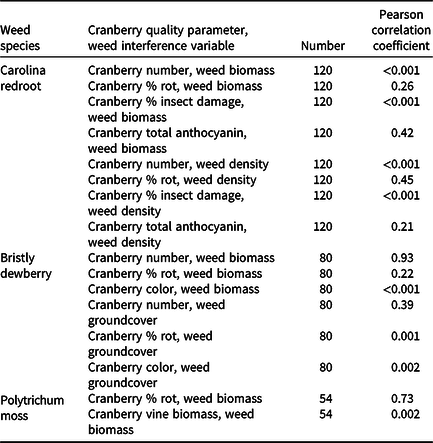
Data were combined across study years to explore the relationship between cranberry quality parameters of local interest and weed interference from these three species. Anecdotally, growers have suggested that weeds harbor damaging insects, increase crop canopy humidity and water retention leading to increased fruit rot and cover the cranberry canopy in a way that shields cool fall air from aiding red berry color development, but those notions had not been studied or objectively documented. In this work, we found that cranberry fruit rot was only correlated with weed interference in one case—with bristly dewberry groundcover, which supports the grower notion mentioned above.
For Carolina redroot, berry number was highly correlated with both weed biomass and density (P < 0.001; Table 3). Interestingly, the percentage of insect-damaged fruit was also strongly positively correlated with Carolina redroot weed biomass and density (Table 3 and Figure 4). Scars at the surface of the fruits associated with the absence of feeding damage on cranberry vines indicated that injuries were caused by sparganothis fruitworm (Sparganothis sulfureana Clemens; L. Wells-Hansen, personal communication). Previous studies carried out in New Jersey and Massachusetts have shown that sparganothis fruitworm can use weeds (such as earth loosestrife) in cranberry beds as a primary host species (Averill and Sylvia Reference Averill and Sylvia1998). No studies have determined whether Carolina redroot could be a possible primary or secondary host species for this pest. Carolina redroot foliage is known to host larva of the mottled duskywing moth (Erynnis martialis Scudder), and Carolina redroot flowers attract many pollinators, including butterflies (Les Reference Les2020). Egg masses of spotted fireworm (Choristoneura parallela Robinson), an important pest of cranberry in New Jersey where larvae feed on fruits and leaves, have also been found on the upper leaf surface or floral stem of Carolina redroot (D. Schiffhauer, personal communication). Future studies should be conducted to determine whether Carolina redroot plants might be a secondary host for sparganothis larvae or whether Carolina redroot blooming from late June to mid-July might attract sparganothis adults that appear during the same period (de Lange and Rodiguez-Saona Reference de Lange and Rodriguez-Saona2015). Carolina redroot leaves usually extend above the cranberry canopy and could intercept air-applied insecticides, thereby reducing insecticide effectiveness and increasing the proportion on insect-damaged berries. Because Carolina redroot cannot be controlled with agricultural practices traditionally associated with cranberry cropping (Besançon Reference Besançon, Oudemans and Rodriguez-Saona2021), it is therefore important to develop management strategies based on early detection and use of effective residual and postemergence herbicides.
Pearson correlation coefficients for the relationship between various cranberry quality parameters and weed interference.a

aData were combined across study years.
‘Stevens’ cranberry marketable fruit weight relative to polytrichum moss dry biomass in 2018 and 2019 in East Wareham, Massachusetts.

Regression of selected cranberry quality and weed parameters. Carolina redroot studies were conducted in ‘Ben Lear’ cranberry in New Jersey (2018 to 2020), bristly dewberry studies were conducted in ‘Stevens’ cranberry in Wisconsin (2018 and 2019), and polytrichum moss studies were conducted in Stevens cranberry in Massachusetts (2018 and 2019). Data were combined across study years.

Wisconsin cranberry growers have often noted observations of substantial cranberry color loss associated with dewberry growth above the cranberry canopy (J. Colquhoun, personal communication). This work strongly supports that notion, where cranberry color loss was significantly correlated with both bristly dewberry biomass and groundcover (Table 3 and Figure 4).
In Massachusetts, it was noted that cranberry vine biomass significantly decreased with increased polytrichum moss biomass (P = 0.002; Figure 4). Although moss competition was not directly tested in this study, research in lowbush blueberry (Vaccinium angustifolium Ait.), a closely related crop with similar growth habit to cranberry, examined polytrichum moss competition dynamics (Percival and Garbary Reference Percival and Garbary2012). Manually removing 0% (control), 33%, 66%, and 100% of moss resulted in blueberry stem densities that were 184%, 248%, and 361% greater than the untreated control in the vegetative stage and 167%, 371%, and 555% greater in the reproductive stage, respectively, indicating that moss was physically competing with blueberry for space rather than growing in areas where blueberry growth was sparse. For cranberry, the relationship between decreased cranberry biomass and increased moss biomass closely resembles the observed trend of decreased fruit yield with increased moss biomass as seen in lowbush blueberry.
Practical Applications and Next Steps
In a practical sense, there are two primary ways that this information can be used to inform cranberry weed management. First, these studies provide objective information that can be used to educate growers, consultants, agrichemical registrants, and regulators about the impacts of weeds on cranberry yield and quality. Prior to this work and in the absence of related studies, anecdotal observations and prognostication were the only data sources. For example, in a 2019 survey of Wisconsin cranberry growers, 15% of respondents indicated that they felt their weed pressure had no impact on cranberry yield and 64% thought their yield loss was 10% or less (Wisconsin State Cranberry Growers Association, unpublished data). In simple calculations using the data presented here, maximum yield loss in the presence of bristly dewberry ranged from 75% to 95% in the two study years, and where Carolina redroot was present maximum yield loss was 79% to 81% across the three study years. This suggests that yield loss from weeds such as these is not only much greater than what growers assume but also quite consistent among production years, particularly with Carolina redroot.
Second, this information can be used to economically prioritize management efforts based on the weed species and extent of infestation. For example, bristly dewberry groundcover was a consistent and reliable observation to use in yield impact estimations as noted in this work. In 2018, the regression presented here would indicate that 20% bristly dewberry groundcover was related to a 4,640 kg ha−1 yield loss. Using an estimate of US$0.78 kg−1 based on the 2020 processed crop value (USDA-NASS 2021), this yield loss would cost the grower US$3,630 ha−1, suggesting a high priority for management. Additionally, the long-term colonizing nature of bristly dewberry is a common driver of cranberry bed renovation, which compounds the financial impact as noted above.
The studies presented here indicate that the relationship between weed interference and cranberry yield can be reasonably estimated with feasible field trials and is consistent among production years. Given these observations, the work presented here would not need repeating over time to remain reliable unless there were significant changes in the production system, such as variety advancements that change crop growth habit or phenology. With that in mind, cranberry growers and related processing industries would benefit from expanding this work to include additional weed species, creating a data library that could be used to prioritize research and management efforts.
Acknowledgments
We thank Baylee Carr and the crew at the P.E. Marucci Center for their help collecting data. We also thank the Wisconsin Cranberry Board, the New Jersey Blueberry and Cranberry Research Council, the Cranberry Institute, and Ocean Spray Cranberries, Inc. for their financial support of this work. No conflicts of interest are declared.