Introduction
Functional decline, increased risk of developing both physical and mental disorders and the experience of one or more negative life events are distinctive features of aging in both men and women. Although there are many similarities between men and women at advanced ages, there are also important differences. In general, women live longer, which increases their risk of experiencing the negative consequences of aging. One consistent finding is that depression is more prevalent among women than among men (Steffens et al., Reference Steffens2000; Blazer, Reference Blazer2003; Chow et al., Reference Chow2004). However, it has been suggested that depression might be under-diagnosed to a greater extent among men (Courtenay, Reference Courtenay2000).
Emotional suffering in old age is largely explained by various psychiatric conditions, of which depression is the most common (Blazer, Reference Blazer2003). Depression in old age presents a different spectrum of symptoms than depression among the young, e.g. increased loss of interest and motivation, sleep disturbances, anorexia and fatigue as well as different risk factors, such as chronic diseases, negative life events, declining health, inappropriate medications (Forsell and Winblad, Reference Forsell and Winblad1999; Forsell, Reference Forsell2000; Chou and Chi, Reference Chou and Chi2003; Schoevers et al., Reference Schoevers, Beekman, Deeg, Hooijer, Jonker and van Tilburg2003) and malnutrition (Gold et al., Reference Gold, Malmberg, McClearn, Pedersen and Berg2002). Psychosocial factors have also been shown to contribute to the development of depression in the elderly: inadequate social networks (Barefoot et al., Reference Barefoot, Mortensen, Helms, Avlund and Schroll2001; Chou and Chi, Reference Chou and Chi2003), feelings of loneliness (Green et al., Reference Green1992; Prince et al., Reference Prince, Harwood, Blizard, Thomas and Mann1997) and a low educational level (Ganguli et al., Reference Ganguli, Dube, Johnston, Pandav, Chandra and Dodge1999). Heredity and previous episodes of depression do not seem to be as important among the old as among younger age groups (Schoevers et al., Reference Schoevers, Beekman, Deeg, Hooijer, Jonker and van Tilburg2003). The loss of a spouse, which is common among the very old, while important among young men and women with depression, seems to be less so among old people (Thompson et al., Reference Thompson, Gallagher-Thompson, Futterman, Gilewski and Peterson1991; Prince et al., Reference Prince, Harwood, Blizard, Thomas and Mann1997), especially among the oldest women (Heikkinen and Kauppinen, Reference Heikkinen and Kauppinen2004). Experiencing the death of an adult child has been shown to be associated with depression, both among the young as well as among old women (Prince et al., Reference Prince, Harwood, Blizard, Thomas and Mann1997).
Depression in old age differs between men and women, both regarding the reporting of symptoms and the investigation of risk factors. Women more often report mood-related symptoms, while men report more motivation-related symptoms and agitation (Forsell et al., Reference Forsell, Jorm and Winblad1994; Kockler and Heun, Reference Kockler and Heun2002). Feelings of loneliness and poor self-perceived health are common among women who are developing depression. Among men, declining health, chronic diseases, becoming a widower and other social factors are known risk factors for depression (Heikkinen and Kauppinen, Reference Heikkinen and Kauppinen2004).
Concerning the very old, numerous studies have shown a high prevalence of depression, but despite such findings, depression is often under-diagnosed and inadequately treated (Beekman et al., Reference Beekman, Copeland and Prince1999; Blazer, Reference Blazer2003; Rinaldi et al., Reference Rinaldi2003; Schoevers et al., Reference Schoevers, Beekman, Deeg, Hooijer, Jonker and van Tilburg2003). Depression in this age group is associated with increased mortality and a poorer outcome for physical comorbidities and it is therefore important to treat it (Blazer, Reference Blazer2003, Bergdahl et al., Reference Bergdahl2005).
The aims of the present study were to investigate the social, medical and psychological factors associated with depression among men and women aged 85 and above, and to investigate possible differences between men and women with depression.
Method
This study focuses on people aged 85 years and older who participated in the larger ‘Umeå 85+ Study’ that took place in Umeå, Sweden between February 2000 and July 2001 (described in detail in von Heideken Wågert et al., Reference von Heideken Wågert2006), and later in five rural communities in the county of Västerbotten during 2002. The information from the participants in the rural municipalities was collected in the same manner as that in the Umeå Study.
Participants
A random sample comprising half the population born in 1915 (85 year olds) and the total population born in 1910 (90 year olds) and 1905 or earlier (range 95–103), living in an expanding, urban municipality in northern Sweden, on 1 January 2000, were selected for participation (n = 348). Similarly, a random sample comprising half the population born in 1917 (85 year olds) and the total population born in 1912 (90 year olds) and 1907 or earlier (range 95–103), living in five depopulated, rural municipalities in northern Sweden, on 1 January 2002, were also selected for participation (n = 179).
The names, addresses and personal identification numbers of the eligible participants were obtained from the National Tax Board. The randomization of 85 year olds was achieved by randomly selecting every second person from the National Tax Board lists, where people are listed in order of date of birth.
Forty-four people out of 527 (8.3%) died before they could be asked to participate. They did not differ from those invited to participate regarding age, sex or living conditions but a greater proportion were married (p = 0.013). Fifty-two out of 483 people (10.8%) declined the invitation to participate. A higher proportion of this group were men (p = 0.018) and married (p = 0.029), but there were no differences concerning age or living conditions. Sixty-eight out of the eligible 431 (15.8%) could not be evaluated for depression. No differences were found regarding age, sex or civil status, but a greater proportion (p = 0.042) were in institutional care. The final sample consisted of 102 men and 261 women, 363 participants in total (75.2%) out of the 483 who were alive at the time of inclusion. The participants’ age distributions were 85 (n = 146), 90 (n = 131) and ≥ 95 (range 95–103 years, n = 86).
Procedure
The participants received an initial letter containing information about the study, and two weeks later they were informed about the home visit procedure and gave their informed consent. If they were suffering from dementia, relatives were informed and decided whether or not their relative could participate. Assessments were carried out during two to three home visits and included structured interviews and measurements. Data were also collected from medical charts, relatives and caregivers. All assessments, questions and scales were interviewer-administered and conducted in the same order for all visits. Each home visit took about two hours. Finally, a specialist in geriatric medicine (YG) evaluated all the documentation concerning the diagnoses, drug treatments and measurements before the final diagnoses were made, according to the same criteria for all participants.
Depression and cognition
Depression was diagnosed according to DSM-IV criteria but, in addition, anyone who had previously diagnosed depression with ongoing treatment with antidepressants, despite a Geriatric Depression Scale (GDS) score <5, was diagnosed as having depression. Depressive symptoms were screened for using the GDS-15, where scores of between five and nine indicate mild depression, and a score of ten or more indicates moderate to severe depression (Sheik and Yesavage, Reference Sheik and Yesavage1986). The GDS-15 has recently been evaluated in a sample of the very old and has been found to have high sensitivity and specificity in diagnosing depression (de Craen et al., Reference de Craen, Heeren and Gussekloo2003). To validate the depression diagnosis, participants with a GDS score of five or more were further assessed using the Montgomery-Åsberg Depression Rating Scale (MADRS) (Montgomery and Åsberg, Reference Montgomery and Åsberg1979), which has scores of 0–30. Depressive and other psychiatric symptoms were also rated according to the Organic Brain Syndrome scale (OBS scale) (Jensen et al., Reference Jensen, Dehlin and Gustafson1993). A person treated for depression with a GDS score <5 was regarded as having responded to the treatment. It should be noted that the only antidepressive treatment method available to the participants investigated was antidepressive medication.
Cognition was screened for using the Mini-mental State Examination (MMSE) which has a maximum score of 30. Any score below 24 indicates impaired cognition (Folstein et al., Reference Folstein, Folstein and McHugh1975). Dementia was diagnosed according to DSM-IV criteria based on assessments including MMSE, OBS scale, and previously diagnosed dementia and, in uncertain cases, a complete dementia assessment was performed at our outpatient clinic.
Experienced symptoms and sociability
For assessment of security and loneliness, we used the questions: “Do you feel safe at home?”, “Do you get the help that you feel you need?”, “Do you feel lonely sometimes?”, “Do you have a good friend/family member to talk to if you need to?”, “Do you have anyone who could help you if necessary?”, “Do you feel loved or do you feel that somebody cares for you?”, “Do you wish that you had more friends?”, “Do you want to see your family more often?” To gain a more objective assessment of actual loneliness, the participants were also asked about how many visits they had received from friends and relatives, how often they had visited somebody else during the preceeding week and how many telephone calls they had received in the previous week. To confirm the number of visits and phone calls received by participants with dementia, their relatives and caregivers were also asked the same question.
Physical measurements
Activities of daily living (ADL) were rated using the Barthel ADL Index (Mahoney and Barthel, Reference Mahoney and Barthel1965), which consists of 10 items concerning personal (p-) ADL. The maximum score is 20, which indicates total independence in p-ADL. The participants answered a question about how often they walked outdoors independently. They were also asked whether they had been outdoors during the preceding week.
Morale
Morale was assessed using the Philadelphia Geriatric Center Morale Scale (PGCMS). The scale consists of 17 questions and, according to its designer, scores of between 17 and 13 indicate high morale, 12 and 10 middle range and 9 and 0 low morale (Lawton, Reference Lawton1975). The British Geriatric Society has recommended the PGCMS for measuring quality of life among older people (Dall and Hopkins, Reference Dall and Hopkins1992).
Ethics
All participants were informed personally about any diseases discovered, and these results were also forwarded to their general practitioner for information and in some cases intervention.
The study was approved by the Ethics Committee of the Medical Faculty of Umeå University (§99–326).
Statistics
All calculations were made using the Statistical Package for Social Sciences (SPSS). The χ2 and Student's t-tests were used to analyze differences between groups. Multicholinearity was controlled for by correlation analyses. Variables with a statistically significant association with depression were included in logistic regression models in order to find independent factors associated with depression. The variables that best explained the differences between people with depression and those without were chosen in the final models, for men and women separately. A p-value of <0.05 was regarded as statistically significant.
Results
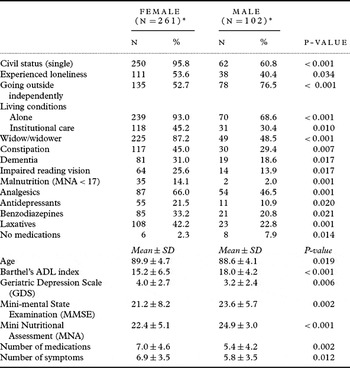
In the final sample of 363 participants, 106 were diagnosed as suffering from depression (29.2%). Of these, 87 were women (33.3%), and 19 were men (18.6%, p = 0.006). Of those treated with antidepressants 55.6% of the men and 41.7% of the women had a GDS score of less than 5, implying that more than half of those being treated for depression were still depressed. Other characteristics of the total population are shown in Table 1.
Characteristics of the total population according to gender (N = 363)

*Statistics measured on number of valid cases (different numbers of cases missing in different variables).
†Every month or more seldom.
‡Friends and family – seldom/never.
Univariate findings
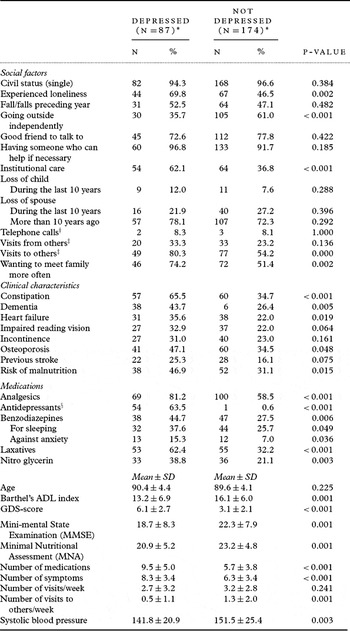
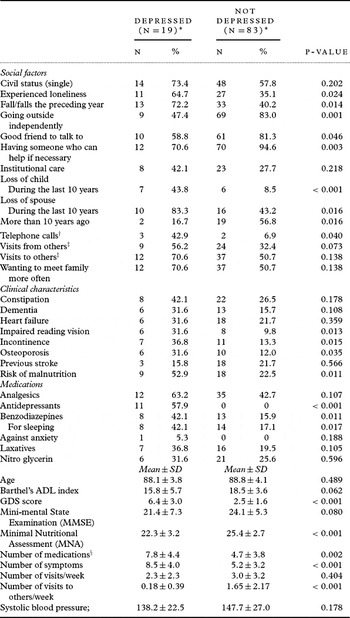
Depression among both men and women was significantly associated with an experienced loneliness, not going outside independently and a low number of visits to others per week. The depressed participants took more medication, even when treatment with antidepressants was excluded, and they took more benzodiazepines. A larger number of symptoms were reported among the depressed, both men and women, and more depressed participants suffered from osteoporosis. A higher proportion of the depressed were at risk of malnutrition, which was also indicated by a lower minimal nutritional assessment (MNA) score.
Among men, depression was associated with not having a good friend to talk to, nor having somebody who could help if necessary, and receiving too few telephone calls from their family and friends. The loss of a child during the preceding 10 years was also associated with depression in men. A history of falls during the previous year was more common among men with depression. Depressed men more often had impaired reading vision and suffered more often from incontinence than men without depression.
Among women, depression was associated with living conditions, e.g. being in institutional care and visiting others seldom or never. Women with depression also wanted to see their family more often than those without depression. Concerning the diagnoses, depression among women was associated with constipation, dementia and heart failure. Depression was also associated with various kinds of medication; analgesics, laxatives, nitro glycerin and benzodiazepines as a group as well as against anxiety. Women with depression scored lower on the Barthel ADL index than those without depression, and on the MMSE. They also had a lower systolic blood pressure (Tables 2 and 3).
Characteristics of the female population according to depression (N = 261)

*Statistics measured on number of valid cases (different numbers of cases missing in different variables).
†Every month or more seldom.
‡Friends and family. Seldom/never.
§Antidepressants are not included in this group.
Characteristics of the male population according to depression (N = 102)

*Statistics measured on number of valid cases (different numbers of cases missing in different variables).
†Every month or more seldom.
‡Friends and family – seldom/never.
§Antidepressants are not included in this group.
Regression
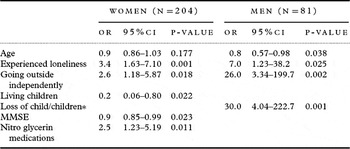
The final regression showed that depression among men was associated with loss of child/children during the last 10 years (OR = 30.0), not going outside independently (OR = 26.0) and experienced loneliness (OR = 7.0). Among women, a feeling of loneliness (OR = 3.4), not going outside independently (OR = 2.6) and nitro glycerin medications (OR = 2.5) remained statistically significant (Table 4).
Regression model: women vs. men

χ2 for the model, p-value: < 0.001 < 0.001.
Association between predicted probabilities and observed responses:
Concordant: 73.5% 90.1%.
*After 1991.
Discussion
In this study, we found a high prevalence of depression in both sexes, with a preponderance in women, which is in line with previous studies (Steffens et al., Reference Steffens2000; Chow et al., Reference Chow2004, Blazer, Reference Blazer2003). A qualitative study of depressed people disclosed that gendered circumstances, emotions and modes of expression might put women at risk of being over diagnosed with depression. Another reason for the difference in prevalence could be that men report fewer psychological symptoms (Gold et al., Reference Gold, Malmberg, McClearn, Pedersen and Berg2002) leading to difficulties in detecting depression. Depressed men exhibit a different health-seeking behavior than women, being more hesitant (Chino and Funabiki, Reference Chino and Funabiki1984; O'Neil et al., Reference O'Neil, Lancee and Freeman1985). In the face of psychological disturbance, men might retreat into silence or the rhetoric of physical symptoms, aggression and drug abuse, instead of displaying typical depressive symptoms (Courtenay, Reference Courtenay2000; Danielsson and Johansson, Reference Danielsson and Johansson2005). The possibilities that men exhibit more atypical symptoms, and that the scales we have used do not cover men's depressive symptoms, might be considered, although the scales have been extensively controlled in many studies (Montgomery and Åsberg, Reference Montgomery and Åsberg1979; Sheik and Yesavage, Reference Sheik and Yesavage1986; Rinaldi et al., Reference Rinaldi2003). Even when these reservations are taken into account, they are not sufficient to explain the total extent of gender differences found in the present study and in those referred to above.
Increasing age has been discussed as a risk factor for depression in many studies, but it has been shown that age per se is not associated with depression (Blazer, Reference Blazer2003; Chow et al., Reference Chow2004; Bergdahl et al., Reference Bergdahl2005). In the present study, there was no increase in the prevalence of depression within the age range of the participants, an observation that could be regarded as being in line with the findings referred to above. A more significant finding, however, is the high prevalence of depression in the people studied, representing individuals of advanced age, compared with the prevalence in younger age groups. No distinction between major and minor depression or dysthymia has been made, since the DSM-IV criteria are unsuitable for use among the elderly because they experience a different symptomatology which is not covered within the DSM-IV. However, despite not being able to differentiate between various depression diagnoses, the prevalence found in this study is in the higher range. Further factors associated with this high prevalence are presented and discussed in the present study.
It is worth noting that fewer than two-thirds of the participants with depression in this study were treated with antidepressants, and less than half of those treated had responded to the treatment. It is a shortcoming of this study that some treatment-related aspects are not known, such as length of treatment, how the patients were followed up and whether or not the treatment had been individually adjusted. No questions were asked regarding compliance, nor regarding antidepressants or other medications. Depression in late life is also difficult to treat, mostly because of various comorbidities and probably also because of a different etiology than that among younger persons. The present study, however, indicates that the quality of and response rate to treatment for depression among the very old is extremely poor.
Several factors related to psychosocial circumstances were significantly associated with depression in both men and women. An adequate social network is generally regarded as an important protective factor against depression in the elderly (Blazer, Reference Blazer2005). Visits to other people are one beneficial consequence of having such a network and can be regarded as a sign of independence in daily living as well as continued participation in life, despite diseases and difficulties in daily living. Social interactions have been shown to be of the utmost importance for satisfaction with life when growing old (Blazer, Reference Blazer2005). Depression might lead to loss of interest and initiative, with isolation from others as a consequence. In the present study, the availability of a friend to talk to was a differentiating factor between depressed and non-depressed men. Men have been shown to have a different social network from women, with fewer contacts outside the family (Dean et al., Reference Dean, Kolody and Wood1990; Zunzunegui et al., Reference Zunzunegui, Beland, Llacer and Leon1998). This difference might make it difficult for men to maintain an adequate social network after severe losses, e.g. loss of their spouse and/or child (Antonucci and Akiyama, Reference Antonucci and Akiyama1987). In the present study, depressed men had more often lost a spouse or a child. The latter factor was strongly associated with depression among men, increasing the risk of depression by 30 times, but it did not remain statistically significant for women in the final regression model. Loss of a spouse was associated with depression in the univariate analysis among men, but did not remain in the final regression model. Depressed women tended to want to see their family more often than those who were not depressed, indicating that relations with the family are important among very old women, although this could also be a way of expressing loneliness.
In the final regression model, experienced loneliness remained significantly associated with depression among both men and women, in accordance with the findings in previous studies (Green et al., Reference Green1992; Prince et al., Reference Prince, Harwood, Blizard, Thomas and Mann1997; Chou and Chi, Reference Chou and Chi2003; Tiikkainen and Heikkinen, Reference Tiikkainen and Heikkinen2005). This association probably has dual directions, although it has been suggested that loneliness is a consequence of mental health problems (Antonucci and Akiyama, Reference Antonucci and Akiyama1987; Tiikkainen and Heikkinen, Reference Tiikkainen and Heikkinen2005). Being lonely, measured by a small number of visits from friends and family during the preceding week, was not independently associated with depression, among either men or women. This might indicate that an experienced loneliness is more closely associated with depression than various quantitative measurements of social interactions, and should perhaps, therefore, rather be regarded as a symptom of depression.
Malnutrition has been shown to be associated with depression (Gold et al., Reference Gold, Malmberg, McClearn, Pedersen and Berg2002) and depression has been shown to be an important cause of weight loss among elderly people living in institutional care (Donini et al., Reference Donini, Savina and Cannella2003). In the present study, we found lower MNA scores among the depressed of both sexes. Furthermore, osteoporosis was more common among those with depression, and might constitute another indicator of unsatisfactory nutrition as well as of inactivity.
Both men and women with depression took more medication than those without depression, which has also been reported previously (Forsell and Winblad, Reference Forsell and Winblad1999). Although antidepressants constitute a part of this medication, it must be taken into account that the use of other categories of drugs might to some extent be related to the depressive disorder. Pain is a frequent symptom of depression in the elderly (Blazer, Reference Blazer2003; Carrington Reid et al., Reference Carrington Reid, Williams, Concato, Tinetti and Gill2003; Carroll et al., Reference Carroll, Cassidy and Cote2004). Thus, the use of analgesics in the elderly might be regarded as an indirect method of treating symptoms of depressive origin. However, it must also be considered that pain is common in old age due to causes other than depression, e.g. arthritis and fractures secondary to osteoporosis. Treatment with bensodiazepines, which was associated with depression in both sexes, could also partly be explained as a way of treating depressive symptoms such as anxiety and sleep disturbances. The frequent use of laxatives among women with depression conformed the increased rate of constipation. Constipation and treatment with laxatives might be regarded as a consequence of depression, since constipation and passiveness, leading to inactivity, are common depressive symptoms.
Somatic diseases have a well-established association with depression in the elderly and depression is also regarded as a risk factor, although it was not confirmed by the regression analysis in the present study. The depressed women however had significantly more heart failures than those who were not depressed. No such association was found among men. Nitro glycerin medication was independently associated with depression in women, possibly related to the increased rate of diseases of the heart in this group. Men with depression more often had impaired reading vision, which is also in line with previous research findings (Forsell et al., Reference Forsell, Jorm and Winblad1994).
A low MMSE score could either be a symptom of depression – for example, cognitive impairment due to depression (Blazer, Reference Blazer2003; Butters et al., Reference Butters2004) – or be due to a higher proportion of participants with dementia among the depressed, since dementia is a well-known risk factor for depression (Forsell and Winblad, Reference Forsell and Winblad1999; Forsell, Reference Forsell2000). In the present study, a lower MMSE score was found among women with depression than among women without a depression. Depression and dementia are well known to co-occur (Fuhrer et al., Reference Fuhrer, Dufouil and Dartigues2003; Modrego and Ferrandez, Reference Modrego and Ferrandez2004; Ganguli et al., Reference Ganguli, Du, Dodge, Ratcliff and Chang2006). In accordance with the MMSE results in the present study, such an association appeared only in women. The high prevalence of dementia among women partly explains this discrepancy. Functional and cognitive decline are both related to institutional care, as well as to depression (Forsell and Winblad, Reference Forsell and Winblad1999; Forsell, Reference Forsell2000; Kivelä and Pahkala, Reference Kivelä and Pahkala2001; Blazer, Reference Blazer2003; Butters et al., Reference Butters2004). Living in institutional care might lead to depression (Forsell and Winblad, Reference Forsell and Winblad1999; Forsell, Reference Forsell2000,) but it can also be a consequence of depression. Limitations in ADL, e.g. physical disabilities, are related to depression both as a risk factor as well as an outcome (Steffens et al., Reference Steffens2000; Kivelä and Pahkala, Reference Kivelä and Pahkala2001; Heikkinen and Kauppinen, Reference Heikkinen and Kauppinen2004). In this context, with lower MMSE scores among women and more women than men in institutional care, it is not surprising that depressed women had significantly lower ADL scores than those who were not depressed, while in men there were no significant differences in ADL between the depressed and the non-depressed.
Among both men and women, not going outside independently was an important risk factor for depression. Going outside on one's own can be regarded as an expression of independence in the activities of daily living. People who have difficulties managing their everyday activities have been shown to have a higher frequency of depression (Forsell and Winblad, Reference Forsell and Winblad1999; Forsell, Reference Forsell2000; Heikkinen and Kauppinen, Reference Heikkinen and Kauppinen2004). An active lifestyle and being a part of society is important for life satisfaction even among the old (Blazer, Reference Blazer2005).
Conclusion
Depression was more common among women than among men and often under-diagnosed and poorly treated. Among both men and women, not going outside independently as well as experienced loneliness were closely related to depression. Depression among men correlated closely with social factors such as loss of a child. Among women, the factors associated with depression are in accordance with those known from previous research to be connected with depression in old age, i.e. physical diseases and cognitive impairment. Since this is a cross-sectional study, no conclusions can be drawn about the causality of the associated factors. The discrepancies found in depression-associated factors between men and women might however indicate that different strategies are needed when treating depression in men compared to women. Even with the reservation concerning causality in mind, a reasonable interpretation of the present study is that psychosocial aspects in the life of the very old are, not unexpectedly, of significance with regard to the risk of developing depression in the very old. As a consequence, the daily management of the very old cannot be restricted to physical health issues alone. The importance of maintenance and support of the social network must also be stressed as well.
Conflict of interest
None.
Description of authors’ roles
All authors helped to prepare and commented on the manuscript during its preparation and all finally approved the submitted version. In addition, E. Bergdahl and L. Alex assisted with the gathering of subjects, and analysis and interpretation of the data; P. Allard helped with analysis and interpretation of data; and B. Lundman and Y. Gustafson were responsible for the study concept and design, and for gathering subjects and data.
Acknowledgments
This work was supported by grants from the Vårdal Research Foundation, the Detlof Research Foundation, the Dementia Foundation and the Swedish Research Council K2005-27vx-15357-01a.