INTRODUCTION
From the first successful military coup d’état in post-colonial Africa, registered in Egypt in July 1952, to the April 2012 one in Guinea-Bissau, and through to December 2012, a total of 88 successful coups, including these two, were recorded on the continent. Prior to 1990, military coups were the main mode of leadership change in the majority of African states (First Reference First1970: 4–6; Charlton Reference Charlton1983: 281–2; Houngnikpo Reference Houngnikpo2010: 111). This state of affairs stimulated a considerable volume of scholarly literature devoted to the study of various aspects of military interventions in African politics (Decalo Reference Decalo1976: 1). A study at the time by Johnson et al. (Reference McGowan and Johnson1984: 622) rightly observed that ‘the African military coup d’état has accomplished the transfer of power and influence … much more frequently than have elections and other forms of constitutionally sanctioned regime change’, reducing the study of national politics in sub-Saharan Africa to a mere study of military interventions and military rule (Wiking Reference Wiking1983; Agbese Reference Agbese, Kieh and Agbese2004; Onwudiwe 2004). Ruth First put it ironically when she wrote: ‘It has proven infectious, this seizure of government by armed men, and so effortless. Get the keys of the armoury; turn out the barracks; take the radio station, the post office and the airport; arrest the person of the president, and you arrest the state’ (First Reference First1970: 4).
Although these patterns have dramatically changed since the end of the cold war (Clark Reference Clark2007; Engel Reference Engel2010), and particularly since the year 2000, military coups still occur on the continent, as illustrated by the two successful coups registered in the first half of 2012 in Mali (22 March) and Guinea-Bissau (12 April). Thus, while Powell & Thyne (Reference Powell and Thyne2011: 249) are right in their assertion that ‘research on coup d’état has waned in recent years’, these waves of coups on the continent have rightly led to a renewal of interest by many scholars in the subject matter. In fact, they have led some academics to point at a ‘military re-engagement in politics’ (Kieh & Agbese Reference Agbese, Kieh and Agbese2004), a ‘pervasiveness of African military coups’ (McGowan Reference McGowan2003: 341), or even claim the existence of a ‘coup trap’ in Africa (Collier & Hoeffler Reference Collier and Hoeffler2005).
However, only a few of these studies have looked at the possible link between the decreasing rate of military coups and the normative stance taken by the AU and other African institutions in recent years (e.g. Onwumechili Reference Onwumechili1998; Ikome Reference Ikome2007; Williams Reference Williams2007, Reference Williams2009; Souaré Reference Souaré2009b; Engel Reference Engel2010; Witt Reference Witt2012). Building on these efforts and departing from a comprehensive database I have developed on successful military coups on the continent between 1952 and 2012, as well as theories of norm emergence, the article observes the dwindling pattern of this phenomenon at least partly within the context of the positioning of the OAU/AU as a ‘norm entrepreneur’ against military coups.
It should be clear at this stage that the actions of African Regional Economic Communities (RECs), considered as the building blocks of the AU, are incorporated in this regard into those of the AU. This is partly because the countries constituting the RECs are the same ones found at the AU. There is not always a total convergence of views or appreciation between the AU and RECs. In fact, the relationship is quite complex and dynamic based on specific crisis situations. Nonetheless, when a specific REC takes a certain decision on a given crisis, such decisions are often advocated for at the continental level by members of the same organisation plus others outside of the region of that REC. Likewise, if there is an apparent disagreement between the AU and a specific REC, that often reflects the divergent views of some AU members outside that region; some countries in that region that had a minority view within the REC may have more support for their view at the continental level. The dissenting position taken by Ghana with regard to the leaning of the Economic Community of West African States (ECOWAS) towards a military deployment in Côte d'Ivoire to resolve the 2010 post-electoral crisis is illustrative of this point. In this case, Ghana found partners (such as South Africa and Angola) for its position at the continental level, which affected the implementation of that ECOWAS decision.
The article proceeds in three main sections. Section one provides a brief conceptualisation of military coups, presents, in general terms, the database from which the empirical discussions will be derived, and offers some understanding about norms and norm entrepreneurship. The second section looks at the policy position of the AU with regard to military coups, and interrogates the wisdom behind the normative policy of the pan-African institution. The third section assesses the effectiveness or otherwise of the AU's normative policy. This allows, in the concluding section, a number of observations and policy recommendations in view of improving the AU's strategies in dealing with the subject matter on the continent. While this seems to make the article one that is concerned with policy implications, it is first and foremost preoccupied with the understanding of a phenomenon and the patterns of its occurrence.
MILITARY COUPS IN AFRICA: DEFINITIONS AND OCCURRENCES
This section presents some definitions, a brief description of the occurrence of successful military coups on the continent from July 1952 to December 2012, as well as discusses the notions of norm and norm entrepreneurship.
Defining military coups
It appears that most coup scholars have taken its definition for granted. Only a few have considered providing one in an explicit manner (Powell & Thyne Reference Powell and Thyne2011: 249). For example, First (Reference First1970: 19) thinks of a coup d'état as ‘a lightening action at the top [of a government], in which violence is the ultimate determinant, even if it is not used’. She contends that only a group that is already part of the political system and has the support of some elements of the armed forces can undertake coups, adding that ‘the conspiratorial strike is the secret of its success’ (First Reference First1970: 19). McGowan & Johnson (Reference McGowan and Johnson1984: 634–5) define coups as ‘events in which existing regimes are suddenly and illegally displaced by the action of relatively small groups, in which members of the military, police, or security forces of the state play a key role, either on their own or in conjunction with a number of civil servants or politicians’. To Powell & Thyne (Reference Powell and Thyne2011: 252), a successful coup is an illegal and overt act by the military or other elites within the state apparatus to unseat the sitting executive, in which the perpetrators seize and hold power for at least seven days.
These three definitions imply a number of points. First, they are unanimous on the illegality of the seizure of power, which excludes seizures of power by constitutional means, such as impeachment. Second, they agree that the level of power of the deposed leader has to be the highest. This means that the deposed leader has to be either the executive Prime Minister (in parliamentary countries such as Mauritius, Lesotho and Ethiopia) or the president. Third, the operation should be sudden and covert, or conspiratorial, according to Ruth First, which entails that the number of those involved should be very limited (Souaré Reference Souaré2006: 28–30).
While there is a general agreement on the above criteria amongst coup scholars, there is less accord on others. For example, the three definitions above have a general embrace of the broad security apparatus for the identity of ‘perpetrators’, but others limit the perpetrators to ‘military officers’ (Thomson Reference Thomson1973: 6; Finer Reference Finer1988: 23). Some even broaden the perpetrators further to include any ‘organised factions’ (Janowitz Reference Janowitz1977: 49), or ‘any elite who is part of the state apparatus’ (Powell & Thyne Reference Powell and Thyne2011: 250), which seems exaggerated. True, some military coups are preceded by groundwork of destabilisation by civilian elites, and even sometimes by the populace. But so long as the final strike comes from elements of the security apparatus, it is evident that the coup was orchestrated by these elements, who could have done it alone, and not by civilians, who could not have done it solely.
Occurrence of military coups in Africa, 1952–2012
The aim of this sub-section is to present, in broad terms, the database that I have developed about successful military coups in Africa between 1952 and 2012. An analysis of the circumstances of the coups, their regional classification or the analysis of their causes falls beyond the purview of this article. What is sought here is to highlight some of the broad features of the dataset by way of showing the dwindling patterns of military coups on the continent. However, before doing this, two observations are important to make, which set this dataset apart from most of the existing ones. First, while most existing databases on African coups amputate North Africa from the continent, for obvious methodological reasons, the one presented here is holistically pan-African, for the AU, whose normative approach is being tested, covers the continent on both banks of the Sahara. The other observation is that only ‘successful’ coups are counted here. To establish the success of a coup, I adopt a slightly modified coding from that developed by Thomson (Reference Thomson1973) and recently maintained by Powell & Thyne (Reference Powell and Thyne2011). According to this coding, a successful coup is one in which the perpetrators ‘seize and hold power for at least seven days’.
Consistent with this coding, I exclude cases where the coup was foiled, its perpetrators having failed to hold onto power for at least seven days even if they managed to eliminate the main target (i.e. the chief executive of the country) within that time, so long as elements or an entity loyal to the deposed or eliminated leader managed to foil the coup, reinstated him (if he is alive) or took over power. Examples of this include the aborted coup of 13 February 1976 in Nigeria in which the main target, Murtala Mohammed, was killed but Olusegun Obasanjo, his deputy, foiled the coup and took over the reins of the country, continuing with the policies of his murdered colleague (Siollun Reference Siollun2009: 161–6). Another example is the 18 February 1964 attempted coup against Léon M'ba in Gabon. In this exercise, rebellious soldiers arrested the president and made him announce, on Radio Libreville, his defeat, while they began the process of forming a provisional government. However, based on a 1960 defence treaty between Gabon and France, French paratroopers were immediately deployed in the country who toppled the provisional government on the night of 19 February, and M'ba was reinstated the following day (N'Solé Biteghé Reference N'Solé Biteghé1990).
However, the present dataset includes cases in which the perpetrators did not hold power for up to seven days, but which are considered as successful coups because (i) the main target was arrested or eliminated, (ii) the perpetrators took power and (iii) only relinquished it after negotiation with them. In other words, the attempt is considered ‘successful’ if the coup-makers relinquished power through persuasion or out of their own will when they could have kept it by force if they wanted. Examples of this scenario include the 13 January 1963 coup in Togo. In this instance, the soldiers that assassinated Sylvanus Olympio, the first president of Togo, handed over power to his cousin, Nicolas Grunitzky, on 16 January 1963, less than a week after the coup. This came after intensive diplomatic, and not military, manoeuvres by regional leaders that persuaded the coup-makers to relinquish power (Agbobli Reference Agbobli1992).
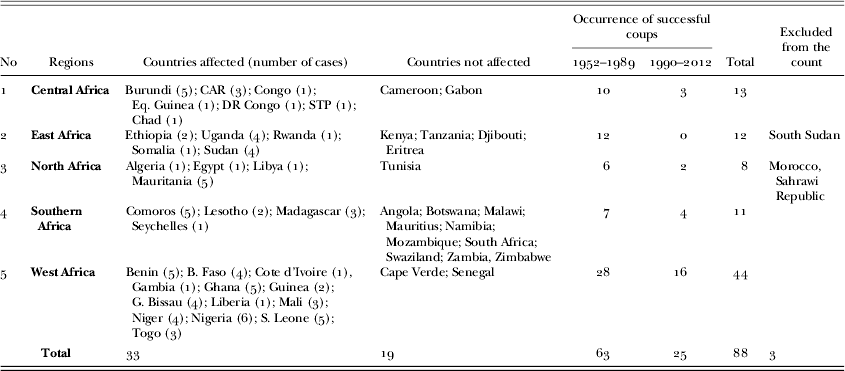
In the aggregated Table I, the start date of calculation for each country is the year of its independence, except Liberia and Ethiopia where the starting date is 1952, the year of the first successful coup in Egypt. This is because the two countries were not colonised. The countries are classified in five geographic regions, according to the AU's classification of its member states when considering regional representation in its various organs. Although it is an African country, Morocco is nevertheless excluded, given that it is not an AU member state and it has not had a successful military coup.
Successful military coups in Africa, 1952–2012

The beginning of the time series of the database from 1952, despite the fact that the OAU was only created in 1963, is merely a methodological one: on the one hand, because the database is meant to be comprehensive, and, on the other, because this allows the comparison of a complete record of post-colonial coups prior to 1990 to the occurrence of the same phenomenon since the end of the Cold War.
Table I shows a clear reduction in the occurrence of military coups since 1990, given that 63 (or 71·5%) of all the 88 successful coups were recorded before the wind of multipartyism began blowing across Africa in 1990. As will be shown later, this rate has further reduced since the year 2000. Another observation from Table I is that more than half (33) of the 54 member states of the AU have experienced successful coups, leaving only 20 countries as ‘political virgins’, with the exclusion of the Republic of South Sudan and the Sahrawi Arab Democratic Republic (SADR). These two states are not considered because of the newness of the former and the special situation (not yet a functioning state exercising its authority over a territory) of the latter.
Norm entrepreneurship: a yardstick for assessment
Norms may be defined as ‘standards of right and wrong, which proscribe certain activities [or courses of action] and legitimate others’ (Williams Reference Williams2007: 258). They could be defined also as standards of shared expectations of appropriate behaviour for actors within a given group identity or a community of states (Finnemore & Sikkink Reference Finnemore and Sikkink1998: 891; Checkel Reference Checkel2012: 1). A norm entrepreneur could therefore be thought of as an individual or an organisation that takes up a cause, and employs the necessary skills and resources to convince members of the group about the appropriateness or inappropriateness of the cause, with or without explicit incentives or enforcement mechanisms for conformers or deviators. The subject of the present article – AU's normative policy on military coups – perfectly fits in this framework.
How do we recognise the establishment of a norm and, most importantly, how do we assess its impact in the community and therefore the role of the norm entrepreneur? In the view of Finnemore & Sikkink (Reference Finnemore and Sikkink1998: 892), we recognise a norm's establishment when its violation generates disapproval or stigma and its obedience praise or – in the case of highly internalised and consolidated norms – no action at all, because it is now taken for granted. Another way of observing the consolidation of a norm is when violators spend a considerable amount of energy to justify their actions within the framework of the norm or deny ever violating it. An example here is the efforts of the US government to claim that its agents have not been using torture – a universally prohibited technique – at Guantanamo Bay since its establishment after the attacks of September 2001.
At this point, there is an important question to pose: do occasional violations of the norm mean that it is not working? The answer to this question can be affirmative only if no action whatsoever, even verbal condemnation, takes place. Williams (Reference Williams2007: 258) rightly shows that the strength of a norm should rather be measured by the level of opprobrium community members attract from others for engaging in behaviour that violates the norm. In other words, that people engage in criminal activities does not mean that laws rendering them as such are not working, so long as offenders are condemned, pursued and, if arrested and found guilty, punished. Such violations only mean that there is either a weak enforcement mechanism or that the cost of violation is minimal. Violation could even be accidental and not deliberate. It should however be acknowledged that repeated violations with clear weak or inconsistent enforcement mechanisms could, in the long run, compromise the authority of the norm and – eventually – of the norm entrepreneur.
But even if the norm is observed, how can we be sure that the observance is indeed due to the actions of a specific norm entrepreneur, like the AU with regard to military coups? Here, the ‘process tracing’ technique offers an interesting methodology for doing so (Fearon Reference Fearon1991; Checkel Reference Checkel2012: 6). Applying this technique to the case at hand, I will attempt to establish the effect of AU's normative policy on the dwindling rate of military coups by imagining what could have happened had this policy not been in place. Comparing the rate of the occurrence of the phenomenon during the decade since the adoption of the policy to the rate of its occurrence in the 10-year period prior to this is a way of doing this.
AU'S NORMATIVE APPROACH TO MILITARY COUPS
This section deals with the AU's normative approach to military coups and, following Checkel's (Reference Checkel2012: 3) observation that we should avoid naively taking all new norms as ‘noble’, interrogates the logic underpinning it, with the objective of establishing its soundness or lack thereof.
Zero tolerance for military coups
In its normative policy about military coups, the AU, in continuation of the work of its predecessor, the OAU, has come up with the concept of Unconstitutional Changes of Government (UCG), which consists of a list of situations considered as such, including military coups as defined above. This broad definition is contained in three main policy instruments of the continental body. The first is the Lomé ‘Declaration on the Framework for an OAU Response to Unconstitutional Changes of Government’ (hereinafter referred to as the ‘Lomé Declaration’), adopted in the Togolese capital, Lomé, in July 2000 (OAU 2000). The second instrument is the Constitutive Act of the AU (2002), while the third one is the African Charter on Democracy, Elections and Governance, adopted in Addis Ababa in January 2007 (henceforth referred to as the ‘Addis Charter’) and which entered into force on 15 February 2012 (AU 2007).
Other situations considered by this normative framework as constituting instances of UCG are:
1. Intervention by mercenaries to replace a democratically elected government;
2. Replacement of democratically elected governments by armed dissident groups and rebel movements;
3. The refusal by an incumbent government to relinquish power to the winning political party after free, fair and regular elections; and
4. Any amendment or revision of the constitution or legal instruments, which is an infringement on the principles of democratic change of government.
Clearly, not all these situations qualify as military coups, as defined above. Bundling military coups together with these other situations has advantages, but also brings some complications in the AU's normative policy – especially with regard to coherence and consistency.
In any case, the starting point of the AU's normative approach regarding military coups is to consider them ‘as an unacceptable and anachronistic act’. In the preamble of the Lomé Declaration, African leaders state that ‘coups are sad and unacceptable developments in our Continent, coming at a time when our people have committed themselves to respect of the rule of law based on peoples’ will expressed through the ballot and not the bullet’ (emphasis added). There is therefore a zero tolerance for military coups. In addition to this, the AU prohibits, since the entry into force of the Addis Charter in February 2012, auto-legitimation of coup-makers by preventing them from participating in elections held to restore the democratic order or to hold any position of responsibility in political institutions of their state (AU 2007; Souaré Reference Souaré2009b; Witt Reference Witt2012: 9). Thus, in addition to its public condemnation and the call for the speedy return to constitutional order in the country concerned, this country should be suspended from all the decision-making organs of the AU while the new authorities are given a period of up to six months to restore constitutional order. At the expiration of the six-month suspension period, a range of limited and targeted sanctions against the regime that stubbornly refuses to restore constitutional order should be instituted.
It is worth noting that there was a weakness in the Lomé Declaration, in that it focused mainly on the mode of ‘accession to power’ while neglecting or proving powerless vis-à-vis ‘unconstitutional preservation of power’ (UPP) by sitting leaders (Ikome Reference Ikome2007: 33). Yet, it had acknowledged that strict adherence to ‘the principles of good governance, transparency and human rights’ would considerably reduce the risks of military coups on the continent. It had also omitted to prevent auto-legitimation of coup-makers or, in other words, the laundering of coups. But the Addis Charter addresses this lacuna in the AU's policy (Witt Reference Witt2012: 9).
Evolution of the AU's policy on military coups (and possible developments, in bold).
Nonetheless, as can be seen in Figure 1 above, there is still a missing aspect in the AU's normative policy. This is the fact that while condemning military coups and insisting on the ‘restoration of constitutional order’, the policy does not provide any explicit definition of what exactly constitutes the successful restoration of constitutional order: is it the reinstatement of the deposed leader, handing over power to his/her constitutional successor or a consensual national figure, or holding elections? In the absence of an explicit framework in this regard, the only guide here is what seems to be the acceptable practice (Witt Reference Witt2012: 11). This has generally encompassed all three scenarios, though the last one is the one considered as definitive. I will therefore use any of these three scenarios that occur earlier to mark the end of an unconstitutional regime in the quantitative assessment below.
In any case, it would seem that African leaders adopted this normative policy after a careful review of various patterns of regime change and settled on constitutional channels as the only acceptable means of coming to power. Indeed, the adoption of the Lomé Declaration in July 2000 took place about ten years after the end of the cold war and the start of a widespread democratisation process on the continent. Democracy had ‘emerged as the most popularly accepted form of government […] even among Africa's not-too-democratic leadership’ (Ikome Reference Ikome2007: 29).
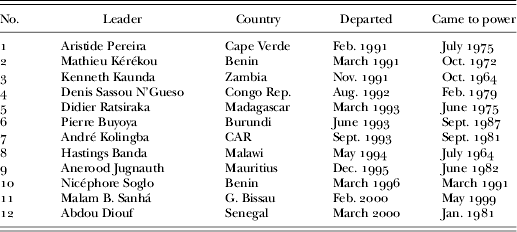
As noted above, military coups were a normal occurrence in Africa in the period prior to 1990. In this period, most African rulers left office through a military coup, political assassination, or some other form of violent overthrow (Decalo Reference Decalo1976: 5; Posner & Young 2007). Up until 1990, only one African leader left power after losing elections, which happened in Mauritius following the June 1982 general elections (Souaré Reference Souaré2009b). This pattern changed dramatically immediately after the cold war, as many long-time rulers left power after losing elections. Thus, between January 1990 and July 2000, when the Lomé Declaration was adopted, as many as 12 African leaders left power after being defeated in elections, often by long-standing opposition figures (see Table II).
African Heads of State who left power ‘after losing elections’, 1990 – July 2000
Yet, some of these democratic changes or the prospect of similar ones elsewhere were undermined by military coups at a preoccupying rate. To be more specific, of the 15 successful coups registered on the continent between 1990 and July 2000, more than half of them overthrew democratically elected leaders that were ruling their countries generally democratically (Burundi, 1993, 1996; The Gambia, 1994; Niger, 1996; Sierra Leone, 1997), or transitional ones preparing for multiparty elections (Nigeria, 1993; Guinea-Bissau, 1999; Comoros, 1999).
It is against the backdrop of this changed political environment on the continent that the AU's normative policy should be read. While regime stabilility might have motivated the support of some leaders as a way of self-protection, the process of arriving at the Lomé Declaration indicates a clear pro-democratic drive behind the policy (Witt Reference Witt2012: 5). This is illustrated by the fact that the most significant step taken by African leaders towards the adoption of the Lomé Declaration came at the 33rd summit of the OAU held in Harare, Zimbabwe, in early June 1997, following a coup d’état in Sierra Leone, barely a week earlier. The putsch overthrew the democratically elected government of Ahmed Tejan Kabbah, who had been elected after nearly half a decade of a brutal civil war in the country. Perhaps more forcefully than ever before, African leaders jointly and unequivocally condemned and rejected that coup and any unconstitutional change of government on the continent and resolved to maintain a united stance on this issue in future.
Interrogating the AU's normative policy
As noted above, not all norms are good ones. Thus, the assessment of the soundness of the AU's norm on military coups should be based on its underpinning postulates that, on balance, (i) the new political order which the continent has been striving to adopt or perfect since the end of the cold war (i.e. multiparty democracy and constitutionalism) is a better political dispensation than what existed before 1990; and (ii) that military coups are a true menace to this new order.
Regarding the first postulate, the empirical data on military coups in Africa shows that some regimes bequeathed by coups have turned out to be relatively better than the ones they overthrew, some of which were constitutional regimes in the legal sense of the word. It is perhaps this fact that led Ikome (Reference Ikome2007: 35) to suggest that ‘some coups are acceptable, and therefore could be said to be good coups, whereas others are not acceptable, and are therefore bad coups’. Williams (Reference Williams2007: 274) asks ‘whether bloodless coups d'état that topple authoritarian regimes may advance the [African] Union's stated goal of democratisation’. Referring to the case of President Robert Mugabe of Zimbabwe, Collier (Reference Collier2008, Reference Collier2009) contends that because elections are not always free and fair in Africa, Western governments should declare their readiness to accept military coups if that is the only way to remove ‘African despots’ from power.
Indeed, military coups are sometimes the consequence of bad governance by the ousted regime, as the Lomé Declaration acknowledges. But the assertion these authors make poses a number of problems. One is that notwithstanding a few exceptions, the ‘majority’ of coup-born regimes have not governed any better than the regimes they replaced. Perhaps a way to establish this fact is to cross-examine military regimes against their own justifications for interfering in politics (Onwudiwe 2004: 23–30), since many of these justifications relate to issues of governance. Wiking (Reference Wiking1983) and Agbese (Reference Agbese, Kieh and Agbese2004) have provided a good basis for this exercise. The former prepared a list of military regimes’ own justifications for intervening in politics in Africa in the period from 1958 to 1980. He culled these justifications from transcripts of radio programmes containing the initial declarations of junta leaders. Chief among these justifications, related to the governance record of the overthrown regimes, are claims of misrule and bad governance, lack of democracy, lack of success in nation-building, corruption and economic failure (Wiking Reference Wiking1983: 72–3). Even though his study is only concerned with the comparison between the explanations found in the literature and justifications given by military officers themselves, Wiking contends that a military coup is ‘an undue interference in the politics of a country’ (Wiking Reference Wiking1983: 10).
Agbese (Reference Agbese, Kieh and Agbese2004), in his study, examines military performance in terms of their record in economic management, the fight against corruption and for political stability and adherence to the rule of law and principles of human rights. Based on many empirical case studies, he finds that, politically, military regimes routinely side-step due political and constitutional process and engage in recurrent human rights violations, while, economically, they generally mismanage resources and encourage corruption. In the social sphere, he argues that ‘social malaise continues, unabatedly afflicting ordinary people in large numbers, while the soldiers and their collaborators live in opulence’ (Agbese Reference Agbese, Kieh and Agbese2004: 85–6). This explains Houngnikpo's (Reference Houngnikpo2010: 106) assertion that ‘with very few exceptions, the governments that military coups put into power have been as corrupt, inept, and brutal as the civilians’ they replaced, resulting in ‘great wealth for the ruling elite and their generals but abject poverty for the population’. This converges with Clark's contention that military rulers have, in most cases, ‘turned out to be at least as corrupt and authoritarian as the civilians whom they replaced’ (Clark Reference Clark2007: 141). Finally, McGowan (Reference McGowan2003: 340) concludes by stating that ‘the historical record shows that military rulers “govern” no better than elected civilians in Africa, and often much worse’. The crux of the matter is that coups that have been described as ‘good coups’ have generally been so in retrospect, when the coup leaders had left power having respected their initial promises of bringing about a positive change.
A recent case in point is the coup staged by Captain Moussa Dadis Camara and fellow military officers in Guinea in December 2008. Many Guineans cheered these officers, believing them to be their ‘saviours’ (Souaré Reference Souaré2009a). But a few months down the line, in September 2009, the whole world was outraged by the massacre of unarmed populations committed by soldiers under the command of the same junta (HRW 2009; UN 2009).
It can be surmised from the above that some constitutional regimes may violate their terms of office and the very constitutional arrangements that brought them to power. However, there are more peaceful ways through which they can be made to respect these provisions, which seldom exist under unconstitutional regimes (Souaré Reference Souaré2009b: 5; Onwumechili Reference Onwumechili1998: 59–62; Agbese Reference Agbese, Kieh and Agbese2004: 86). Consequently, one could argue that the constitutional order, on which the AU's normative policy is based, is better than the prior political dispensation characterised by the prevalence of coup-born regimes. And because military coups generally lead to the establishment of unconstitutional regimes, this method of acquiring power is a true menace to the aspiration of Africa to adopt constitutional norms in the governance systems of its countries, as implied by the second underpinning postulate of the AU's policy. In the final analysis, therefore, the AU's policy is a valid and sound one, notwithstanding the difficulty and the occasional dilemma of applying it in the face of popular euphoria in favour of some coups.
the au and military coups in africa: an empirical assessment of the norm
Sturman & Hayatou (Reference Sturman, Hayatou, Engel and Porto2010: 70) contend that it is on UCGs that ‘there has been the most significant progress in the institutionalization of a norm’ in the work of the AU in general, and that of its Peace and Security Council (PSC) in particular. But what has this work consisted of and what has been its impact on the rate of military coups? This section looks at the AU's normative policy in action and tries to assess its effectiveness with regard to the subject matter. To this end, a number of cases are considered and some challenges facing the norm are identified.
AU's normative policy in action: a critical analysis
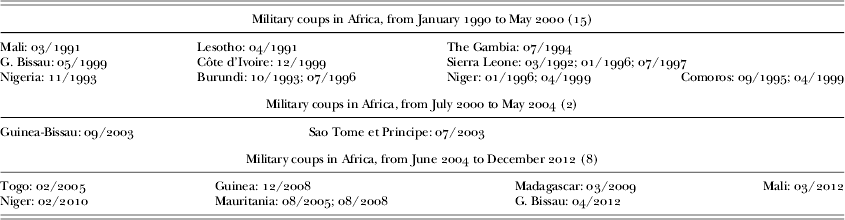
For an effective assessment of the AU's normative actions on military coups, it is useful to engage in both a quantitative and qualitative analysis of the impact of these actions. Regarding the quantitative one, it should first be recalled that there were 25 cases of military coups recorded on the continent from January 1990 to December 2012. The start of this quantitative assessment from 1990 allows for some comparisons between two decades, unlike the case if we were to start the calculation, say, before 1990. Of these 25 cases of military coups, 15 happened before the adoption of the Lomé Declaration in July 2000, two between this date and the inauguration of the PSC in May 2004, and a further eight cases from June 2004 to December 2012 (see Table III).
Military coups in Africa, 1990–2012
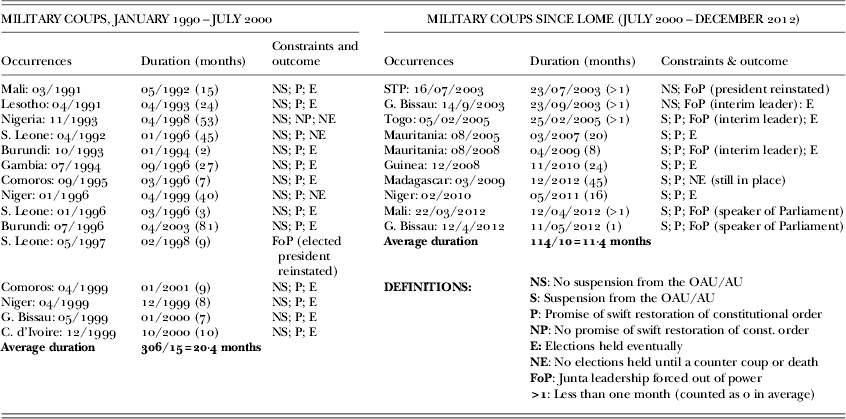
Quantitatively, Table III shows that the Lomé Declaration might have had a deterrent effect on military coups, particularly in the first four years of its adoption, as there were only two successful cases. The inauguration of the PSC in 2004 was expected to provide a further consolidation of the AU's normative policy on military coups. Indeed it did, notwithstanding the occurrence of eight coups between this date and December 2012. Comparing the decade of the 1990s that preceded the Lomé Declaration to the decade since then, at least four differences point to a possible positive impact of the norm on the occurrence of military coups on the continent. First, since the adoption of the Lomé Declaration, all coup-born regimes have hastened to state their commitment to restore constitutional order as soon as possible. They all did or were forced to do so with varying duration of their stay in power. As can be seen in Table IV, the only exception is Madagascar since March 2009. Yet, this was not the case prior, and two of the 15 coup-born regimes between January 1990 and July 2000 were only ended through the death of their leader (Sani Abacha in Nigeria, 1993–1998) or through a counter-coup (Valentine Strasser in Sierra Leone, 1992–1996).
Duration and constraints of coup-born regimes in Africa from 1990 to 2012
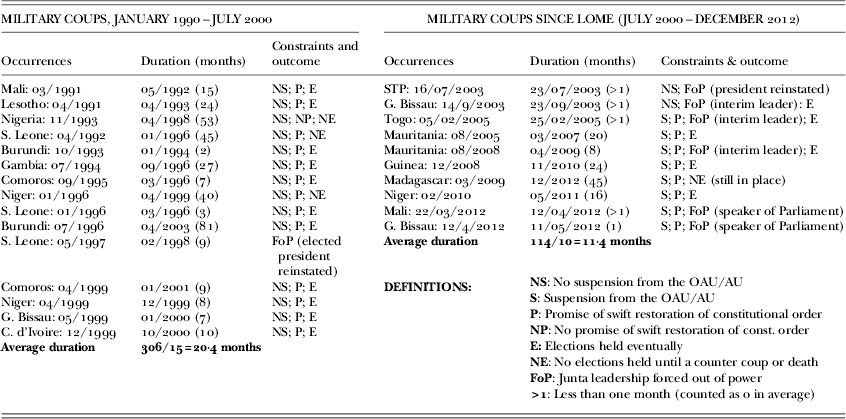
Secondly, the 15 coup-born regimes between 1990 and July 2000 spent a total of 306 months in power before handing over office to either a transitional or an elected government. This is an average of 20·4 months per regime, including five of them spending more than 25 months in power. Compare this with the 114 months that the 10 similar regimes spent in power from July 2000 to December 2012 (taking into account the case of Madagascar that was still on-going when this article was completed). This is an average of 11·4 months and only Madagascar's went beyond 25 months. In fact, half of these regimes stayed in power for only a month (Guinea Bissau, 12 April – 11 May 2012) or less (Guinea-Bissau, 2003; Sao Tome e Principe, 2003; Togo, 2005; Mali, 2012). Third, only one coup-born regime (Sierra Leone, 1997–1998) was forced out of power prior to Lomé, whereas half of the 10 such regimes (the five cases mentioned above) since Lomé were pressured to give up power either to the overthrown leader, the constitutional successor or to a consensual caretaker president within a month or less. One factor that may have aided the AU's normative stance, which is the fourth difference, is that since Lomé, unconstitutional regimes are required to restore constitutional order while suspended from the OAU/AU, which was never the case before.
The foregoing clearly shows the evolution and consolidation of the AU's response to military coups, even if there is still room for improvement. But how can it be established that it is indeed the AU's normative policy – and not other factors – that has led to these changes? In other words, using the counterfactual or process-tracing technique proposed above, what role can one recognise in this process for ‘the natural disposition’ of some coup-makers to restore constitutional order, with or without the AU's policy; the rise of democratisation process around the world; domestic opposition to putschists; the stance of some international actors; and the disengagement of big powers that hitherto supported coup-born regimes?
In answering this question, it is important first to recognise that the achievements registered on military coups have been the result of a combination of efforts by national, regional and international (non-African) actors. But while this is what it is, the point being made here is that the AU's policy has played the most significant – but not the only – role in the process, without which the outcome might have been very different. Let us discuss some of these possible alternative explanatory factors individually.
Regarding the disposition of some coup-makers to restore constitutional order, it is difficult to establish this case given that all coup-makers since Lomé, and some even before 1990, readily declared their commitment to restore constitutional order ‘as soon as possible’. While it may be misleading to consider the pre-1990 period in this comparison, given that there were fewer constitutional regimes on the continent at the time, the quantitative analysis above clearly shows that the post-Lomé era has seen quicker processes of restoring constitutional order than the period prior, even when constitutional regimes had become numerous in Africa. What can be deduced from this is that left alone, coup-makers tend to prolong their stay in power for self-enrichment purposes, but given Lomé's opposition to this, many would-be coup-makers may have been deterred from doing so.
The democratisation hypothesis is a salient one. But it is interesting to note in this regard that – judged by the outcome of elections and enthusiasm for them – the democratisation drive was stronger on the continent in the 1990s than it has been since Lomé. Yet, it has been illustrated above that there were more coups in this period than has been the case since 2000, and some of these coups overthrew democratic governments. Imagine that the OAU and ECOWAS did not stand by Tejan Kabbah in Sierra Leone and had accepted the fait accompli of the putschists, and that the OAU/AU had accepted all subsequent unconstitutional regimes. While domestic forces could have protected the constitutional order in a few countries, it is very likely that such regimes would have continued at a higher rate on the continent, as they did when there was no such a policy. In view of this, the stance of the continental body (supported by the ECOWAS) on Sierra Leone contributed to the democratisation process on the continent.Footnote 1 There is no denying the fact that more consistency in such cases would have contributed to greater promotion of democracy and thus reduction of the rate of military coups on the continent; hence the issue of consistency is considered below as one of the challenges facing the AU in its policy.
This ties up with another hypothesis: the role of domestic/national forces. On this, it is useful to remember that domestic norms are deeply entwined with the workings of international norms, for international norms must always work their influence through the filter of domestic structures and domestic norms, and domestic norm entrepreneurs often use international norms to strengthen their position in domestic debates, even if their position is a minority one at home (Finnemore & Sikkink Reference Finnemore and Sikkink1998: 893). From this, it is evident that the role played by national actors in determining the success of the AU's policy on military coups is normal. In most of the coups cases since Lomé, the AU has found national partners to pressure military juntas to restore constitutional order, including at times from within the junta itself. However, one could argue that national actors may have found it difficult to achieve the restoration of constitutional order without the pressure and legitimating role of international actors spearheaded by the AU and its regional pillars.
Two recent examples are illuminating in this regard. In the aforementioned Guinean coup of December 2008, there was huge domestic support for Dadis Camara given the nature of the overthrown regime, whereas the AU and ECOWAS maintained their anti-putsch stance and that constitutional order needed to be restored. Many Guinean actors thought the continental response was at best ‘insensitive’ to their sentiments and aspirations (Souaré Reference Souaré2009a).Footnote 2 However, when it became clear to the same actors that their bet on the military junta was misplaced and they revolted against the junta in the run-up to the September 2009 massacre, it was the continental position that they invoked and the AU, through the International Contact Group it had put in place, continued putting pressure on the junta until the holding of presidential elections in late 2010.Footnote 3
Likewise, in Mali in 2012, domestic forces opposed to the military junta were in a minority vis-à-vis the masses that came out in support of the junta (Whitehouse Reference Whitehouse2012). But here again, ECOWAS and the AU insisted on the removal of the military junta, an outcome they obtained through a framework agreement signed on 6 April 2012 with the junta, which then handed over power to the speaker of parliament. While the military remained influential in the background, the fact that it publicly abided by this injunction and accepted civilian leadership – despite its many local supporters – indicates the important role played by the continental body – assisted by the regional one – in ensuring the enforcement of the norm. In fact, a very sharp anti-AU and anti-ECOWAS sentiment was propagated in the pro-junta quarters and journals until – at least publicly – the military intervention of French and African forces in mid-January 2013 in an attempt to stop northern rebel groups from extending their control to the south of the country.Footnote 4
Last but not least is the role of international actors, particularly the European Union (EU) and some individual European countries as well as the USA, which have been the main partners of the AU in enforcing its norms on governance and security. One recent policy action of the AU is the imposition of sanctions against coup makers. The first country against whose junta the AU imposed targeted sanctions – beyond suspending the country from membership – was Mauritania, following the 6 August 2008 military coup that overthrew the democratically elected government of Sidi Ould Cheick Abdallahi (N'Diaye Reference N'Diaye2009). Indeed, one could argue that it was partly because of these sanctions that Mohamed Ould Abdoulaziz, the leader of the junta, accepted to step down in April 2009 in favour of a caretaker president and undergo elections in July 2009 that returned him to power – thereby abiding by the norm, albeit with a little twist through coup laundering (Souaré Reference Souaré2009c).
This said, it would appear that the Mauritanian authorities at the time felt more threatened by the sanctions of the EU than those of the AU (Engel Reference Engel2010: 14). The same is true for the sanctions imposed by both organisations on the military junta in Guinea in 2009. In both cases, the EU's withholding of development support funds previously earmarked for the two countries was felt more threatening by their respective authorities than the AU's sanctions, which did not include withholding any development funds that it does not provide anyway. This raises the question as to whether it was European sanctions or those of the AU that determined the outcome.
It is important to recognise the crucial role of the EU's sanctions, with the caveat that these sanctions supported other measures and that some military juntas, such as that of Guinea, had other resources that could have allowed them to stay in power longer without any financial assistance from outside, so long as they did not care about development concerns. Secondly, EU measures happened within the framework of the International Contact Group (ICG) set up by the AU on both countries, as a measure to complement its own efforts by enlisting in this action more international partners.Footnote 5 This is not to say that the EU could not have imposed these sanctions unilaterally. Indeed, it could have and this would have had an impact, but combined with the stance of the AU and that of the region gave the sanctions greater weight. Take the example of Western sanctions against the Mugabe regime in Zimbabwe since the mid-2000s. There is no denying the fact that these sanctions have brought the Zimbabwean economy to its knees, a situation that Mugabe has often used to justify some of his actions. However, Mugabe's enjoyment of strong regional and continental support has been instrumental in avoiding the fall of his regime, which was the intention of some of these sanctions, one could argue.
It can therefore be posited that while national, regional and international partners play an important role in pressurising unconstitutional regimes, AU's policy gives a legitimating cover to the first two while it uses international ones in support of its actions. The influence of pronouncements of organisations and countries such as the Commonwealth on the 1997 military coup in Sierra Leone, the Francophonie on many coups that happen in its member states in Africa as well as those of the USA, the UK and France should be read in this context. This is because the targeted African countries value their bilateral relations with these Western countries or fear the loss of some financial support from these entities. However, the latter are often encouraged in this stance when they are on the same page with the AU or other African organisations. This helps them avoid any accusation of ‘neo-colonialism’ by targeted African countries. The justifications of France's intervention in Cote d'Ivoire in early 2011 are very illustrative of this: the request by ECOWAS and later by the UN.
Challenges facing AU's work on military coups
A number of cases point to some challenges faced by the AU in its norm entrepreneurship vis-à-vis military coups. Without claiming any exhaustiveness in the listing, one such challenge is the weakness of AU's stick and carrot powers, which is important in giving teeth to the policy injunctions. The AU's over-reliance on international partners in this regard is a challenge to the success of its policy. This is because if some of the powerful international actors, either as a group like the EU, or as individual countries, do not collaborate sincerely in enforcing this policy, then the AU may find it difficult to enforce its policy to its liking and according to its own timing. France's sympathies with the post-March 2009 authorities in Antananarivo could explain the delay in finding an African-led solution to the crisis and an early end to the unconstitutional regime (Engel Reference Engel2010: 14).
A second challenge is how to ensure timely and firm action against sitting leaders that make the bed for their unconstitutional overthrow by violating principles of democratic governance. For it would take a difficult and subjective analysis by the continental body to declare elected regimes as having ceased to be constitutional. Even more challenging would be the mechanism through which they could be removed from power if they do not change their attitude.
A third challenge related to the above is how to ensure consistency in condemning UCGs regardless of the nature of regimes overthrown or the person responsible for it. As noted above, partly in recognition of the fact that military coups are sometimes the result of the behaviour of sitting leaders, and partly in an attempt to silence potential critics in case of a focus on military coups alone, AU's normative framework is broadened to include certain acts by sitting leaders. But without consistency in applying the norm to all cases to which it should apply, the policy is exposed to the same criticisms and this constitutes a challenge. Tolerating sitting leaders that make the bed for military coups illustrates the second scenario, while showing sympathies to certain coup-makers exemplifies the first one. The case of Niger following the February 2010 coup is illustrative of this point. Although both the AU and ECOWAS condemned the coup and Niger remained suspended from both organisations, there seemed to be a tacit welcome of the coup, given that it overthrew an unconstitutional regime that had defied both organisations (Miller Reference Miller2011). True, General Salou Djibo kept his promise by handing over power to the elected civilian government in elections held in April 2011. But there was inconsistency in the message sent, pragmatic as it was.
CONCLUSION
This article has considered the phenomenon of military coups in Africa and the impact of the AU's normative policy on the rate of occurrence of this phenomenon. It found that the policy seems to have had an impact on the dwindling rate of military coups, even if other national, regional and international actors have also supported this.
Some challenges were also identified. Regarding the challenge of overreliance on external support for the effectiveness of sanctions, there is no better measure to overcome this than for African countries to contribute more to the AU's budget, both through direct contributions and allowing mobilisation of funds from the various levies that have been suggested by the AU Commission. This would allow the continental body not only to execute its mandate through African resources, but also to offer certain support to member states, which could be withheld from those that violate its principles, like the EU does.
A shorter ‘grace period’ for the restoration of constitutional order may also be considered. One could argue that the current six-month window gives the leaders of coup-born regimes ample time to consolidate their position. The adoption of an explicit definition of what constitutes the restoration of constitutional order after a military coup is imperative to ensure consistency. In this definition, immediate reinstatement of surviving overthrown leaders (regardless of the nature of their regimes), coupled with firm stances against sitting leaders that violate democratic principles, could be a measure that could contribute to more efficiency in the application of the normative policy. There is no denying the fact that cases are different, but the durable consolidation of the norm entails taking some bold decisions to ensure consistency and authority. After all, norm entrepreneurship is a bold undertaking to break up with the status quo and chart a new way forward.