NOMENCLATURE
- OXY
ground inertial coordinate system
- LOS
line of sight
 $a_{mi,t}$
normal overload
-
$d_{ri,qi}$
a disturbance in the direction LOS and the normal direction of LOS
-
$\skew6\hat{d}_{ri,qi}$
the estimates
-
$M_{i}$
the missile i
-
$q_{i,if}$
LOS angle and terminal LOS angle
-
$r_{i}$
LOS
-
$t_{f,go}$
end time of attack and the time-to-go
- T
target
-
${u_{ri,qi} }$
acceleration component of the direction of LOS
-
$v_{mi,t}$
speed of the missile i and the target
-
${w_{r,q} }$
acceleration component of normal direction of LOS
-
${\sigma _{mi,t} }$
ballistic inclination angle
-
${\varphi _{d} }$
expectation impact angle


1.0 INTRODUCTION
Cooperative missile attack refers to the realisation of instantaneous saturation attack by controlling multiple missiles to attack the target at the same time at a specified angle(Reference Huang, Zhang and Liu1–Reference Jeon, Lee and Tahk3). It has two features: first, the impact time does not need to be specified in advance, but through the information, the interaction between missiles can achieve consistent impact time; second, multiple missiles can impact the target at different angles to achieve a comprehensive attack on the target and improve the strike effect. This is of great benefit to the realisation of missile penetration and enhancement of strike effect(Reference Taub and Shima4, Reference Wang, Zheng and Lin5).
At present, there are many methods for designing the cooperative control guidance law for the missile impact time and angle. In Ref. (Reference Zhang, Wang and Ma6), the authors designed a biased proportional guidance law for cooperative control with the Lyapunov theory. In Ref. (Reference Lee, Jeon and Tahk7), the authors designed an optimal guidance law for simultaneous control of impact time and angle by using optimal control theory and taking control energy optimisation as the performance index. In Ref. (Reference Li, Wang and Fan8), the authors used the model to predict static programming and, based on the CPN guidance method, to guess the initial control quantity and to iteratively update the control quantity for the impact angle, so as to meet the requirements of the missile’s impact time and angle constraints. In Ref. (Reference Kumar and Ghose9), the authors proposed a two-stage method for missile control, which can control the impact time and angle by switching the guidance law. However, all the impact times in the guidance laws mentioned above need to be loaded onto the missile-borne computer before the missile is launched. If there is no information interaction between the missiles, no real cooperative combat will be achieved.
In order to achieve a truly cooperative attack by relying on the communication network between missiles, in Ref. (Reference Zhang, Song and Hou10), the authors adjusted the proportionality coefficient through the difference of the time-to-go of each missile and designed a cooperative biased proportional guidance law with time-varying coefficients. In Ref. (Reference Zhao, Zhou, Wei and Quanxin11), the authors adopt the leader-follower strategy to design the state regulator to control the follower approach to the assumed virtual point, so as to achieve the goal of cooperative control of impact time and angle. The guidance law used in Refs. (Reference Zhang, Song and Hou10) and (Reference Zhao, Zhou, Wei and Quanxin11) belongs to centralised cooperative guidance law, which has high requirements on the communication network between missiles and can only attack static targets. In order to enable the missiles to cooperatively attack the manoeuvring target and reduce the requirements on the communication network between missiles, Ref. (Reference LLv, Lv and Li12) that is based on the theory of finite-time consistency and sliding mode control, designs the finite-time cooperative guidance law with LOS angle constraint, which can be used to attack the manoeuvring target. However, the discontinuous symbol function term in the guidance law in Ref. (Reference LLv, Lv and Li12) can generate strong chattering. Although using the saturated function to replace the symbolic function cannot completely eliminate chattering, and the robustness of the sliding mode will be reduced.
Therefore, based on the research in Ref. (Reference LLv, Lv and Li12), for the missiles with adjustable thrust, a distributed communication is adopted to design the cooperative guidance law for multiple missiles with impact angle constraint, which can be used to attack manoeuvring targets. In LOS direction, the multi-agent cooperative control theory and super-twisting control algorithm are combined to design the impact time cooperative guidance law. In the normal direction of LOS, the finite-time convergence sliding surface and the fast power reaching law are selected to design the guidance law satisfying the impact constraint so that the missile can hit the target. The target manoeuvring information in the two part guidance laws need not to be clearly understood, and the non-homogeneous disturbance observers are designed to estimate and compensate, which is beneficial to the engineering application. The guidance law adopts distributed communication, which reduces the requirement of the communication network and enhances the anti-jamming capability of missile cooperation. The high sliding mode control algorithm is adopted in the design of the guidance law, which can effectively suppress the chattering phenomenon and improve the guidance accuracy while facilitating the tracking of missile autopilot.
2.0 PROBLEM DESCRIPTION
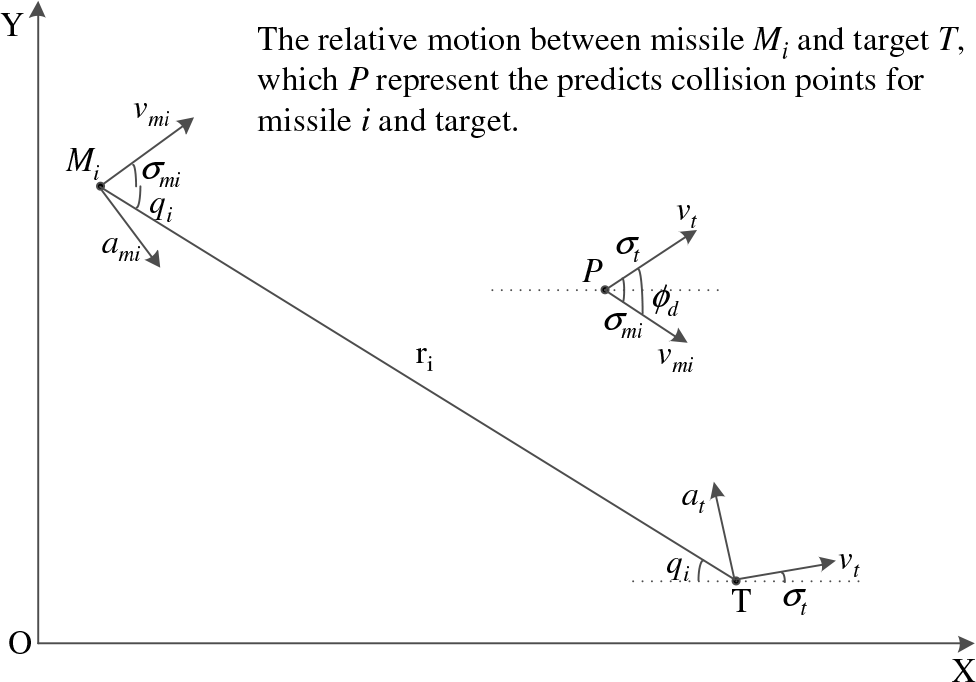
Considering multiple missiles attacking the manoeuvring target in a two-dimensional plane, assuming that missiles are uniformly accelerated, the relative motion between the missile i and the target is shown in Fig. 1.
Relative motion between missile and target.

In Fig. 1, each symbol variable is defined as follows: OXY denotes the ground inertial coordinate system;  $M_{i}$
and T denote the missile i and the target, respectively;
 $r_{i}$
the LOS;
 $q_{i}$
the LOS angle, which is positive when the LOS is rotated clockwise from
 $r_{i}$
;
 ${\sigma _{mi} }$
represents the
 $M_{i}$
ballistic inclination angle;
 ${\sigma _{t}}$
represents the T ballistic inclination angle and specifies that the velocity is positive when it is above the horizontal baseline;
 $v_{mi}$
,
 $a_{mi}$
,
 $v_{t}$
and
 $a_{t},$
respectively, represent the speed and normal overload of the missile i and the target;
 ${\varphi _{d} }$
is the expectation impact angle equal to the difference between
 $\sigma _{mi}$
and
 $\sigma _{t}$
; P represents the predicted collision points for missiles and targets. The guidance system model of the missile i can be obtained from Fig. 1:
 \begin{eqnarray}
&\skew3\dot{r} _{i} =v_{t} \cos (q_{i} -\sigma _{t} )-v_{mi} \cos (q_{i} -\sigma _{mi} )&
\label{eqn1}
\end{eqnarray}
 \begin{eqnarray}
&r_{i} {\dot{q}_{i} } =-v_{t} \sin (q_{i} -\sigma _{t} )+v_{mi} \sin (q_{i} -\sigma _{mi} )&\label{eqn2}\end{eqnarray}
 \begin{eqnarray}
&{\dot{\sigma}_{mi} } =\dfrac{a_{mi} }{v_{mi} }&\label{eqn3}\end{eqnarray}
 \begin{eqnarray}
&{\dot{\sigma}_{t} } =\dfrac{a_{t} }{v_{t} }&
\label{eqn4}\end{eqnarray}
where the superscript “ $\cdot$
” denotes the first order derivative with respect to the variable. Take the derivative of Equations (1) and (2) and substitute them into the Equations (3) and (4).
 \begin{eqnarray}
&\ddot{r}_{i} =r_{i} {\dot{q}_{i}}^{2} +w_{r} -u_{ri}&\label{eqn5}\end{eqnarray}
 \begin{eqnarray}
&\ddot{q}_{i} =-\dfrac{2{\skew3\dot{r}_{i} } {\dot{q}_{i} }}{r_{i} } +\dfrac{w_{q} }{r_{i} } -\dfrac{u_{qi} }{r_{i} },&
\label{eqn6}\end{eqnarray}
where the superscript “ $\cdot\cdot$
” denotes the second derivative of variable.
 ${u_{ri} }, {u_{qi} }, {w_{r} }$
and
 ${w_{q} }$
, respectively, represent the acceleration component of
 $M_{i }$
and T in the direction of LOS and the acceleration component of the normal direction of the LOS. The corresponding expression is as follows:
 \begin{eqnarray}
&u_{ri} ={\dot{v}_{mi} } \cos (q_{i} -\sigma _{mi} )+a_{mi} \sin (q_{i} -\sigma _{mi} )&\label{eqn7}\end{eqnarray}
 \begin{eqnarray}
&u_{qi} ={-\dot{v}_{mi} } \sin (q_{i} -\sigma _{mi} )+a_{mi} \cos (q_{i} -\sigma _{mi} )&\label{eqn8}\end{eqnarray}
 \begin{eqnarray}
&w_{r} = {\dot{v}_{t} } \cos (q_{i} -\sigma _{t} )+a_{t} \sin (q_{i} -\sigma _{t} )&\label{eqn9}\end{eqnarray}
 \begin{eqnarray}
&w_{q} = {-\dot{v}_{t} } \sin (q_{i} -\sigma _{t} )+a_{t} \cos (q_{i} -\sigma _{t} )&
\label{eqn10}\end{eqnarray}
The traditional terminal guidance design only requires the normal acceleration of the LOS to ensure that the LOS angular rate converges to zero in a limited time, thus ensuring that the missile hits the target. While the guidance task in this paper is multi-missile cooperative attack, in order to ensure cooperative attack and make the relative distance of the missile and the target converge in a limited time, the acceleration in the direction of sight of the missile should be designed. At present, because of the development of the ramjet engine, the technology of engine thrust control has made great progress. For some missiles equipped with thrust controllable engines, both LOS and LOS normal acceleration can be controlled simultaneously(Reference Wang, Shi and Liu13, Reference Chen, Zhang and Sun14). Therefore, the guidance law of this paper is to design  ${u_{ri} }$
and
 ${u_{qi}}$
separately in the direction of LOS and the normal direction of LOS, so that multiple missiles can achieve time coordinated attack while satisfying the respective impact angle constraints.
3.0 GUIDANCE LAW DESIGN IN THE DIRECTION OF LOS
The design of this guidance law combines the multi-agent cooperative control theory and the super-twisting control algorithm to control the impact time of multiple missiles converging in finite time. In the super-twisting algorithm, the chattering phenomenon is effectively suppressed after the symbol function is hidden in the integral. The non-homogeneous disturbance observer is designed to estimate the target manoeuvring information in the system without prior information about the target manoeuvring, which is good for engineering.
3.1 Impact time coordination problems and design objectives
The time-to-go of missile  $M_{i }$
can be expressed in the following formula:
 \begin{equation}
t_{goi} =-\frac{r_{i} }{{\skew3\dot{r}_{i} } }
\label{eqn11}
\end{equation}
If  $n(n> 1)$
missiles jointly impact the target, the time-to-go of n missiles converge in finite time T, then n missiles can impact the target simultaneously. Namely:
 \begin{equation}
\mathop{\lim }\limits_{t\to T} \left(r_{i} -r_{j} \right)=0,\mathop{\lim }\limits_{t\to T} \left({\skew3\dot{r}_{i} } - {\skew3\dot{r}_{j} } \right)=0,j\in n
\label{eqn12}
\end{equation}
Let  ${x_{1i} =r_{i} ,x_{2i} = \skew3\dot{r} _{i} }$
, according to Equation (5), the cooperative guidance system model of impact time in LOS can be obtained as:
 \begin{equation}
\left\{\begin{array}{l} {{\dot{x}_{1i} } =x_{2i} } \\[3pt] {{\dot{x}_{2i} } =x_{1i} \ {{\dot{q}_{i} }}^{2} +w_{r} -u_{ri} } \end{array}\right.
\label{eqn13}
\end{equation}
In Equation (13), the target manoeuvring information  $w_{r}$
is considered as a disturbance
 $d_{ri}$
in the direction LOS, and the non-homogeneous disturbance observer is designed for estimation. The design objective of the guidance law in this section is to establish the guidance target Equation (12) through the designing
 ${u_{ri} }$
.
3.2 Guidance law design and stability analysis
The system (13) is regarded as a second-order multi-agent system. According to the relevant knowledge of undirected graph(Reference LLv, Lv and Li12), it is assumed that in the cooperative guidance process of n missiles, the communication topology graph G is always undirected and connected. Then, according to the multi-agent cooperative control theory(Reference Song, Song and Xu15, Reference Mi, Zou and Li16), the following control input is designed to make the system (Reference Wang, Shi and Liu13) consistent and convergent in finite time.
 \begin{equation}
u_{i} =k_{1r} sig\left[\sum _{j=1}^{n}a_{ij} \left(x_{1i} -x_{1j} \right) \right]^{a_{r} } +k_{2r} sig\left[\sum _{j=1}^{n}a_{ij} \left(x_{2i} -x_{2j} \right) \right]^{\frac{2a_{r} }{1+a_{r} } }
\label{eqn14}
\end{equation}
Where  ${0<a_{r} <1},{k_{1r} >0},{k_{2r} >0},{sig(x)^{a_{r} } =\left|x\right|^{a_{r} } sgn(x)}$
, then
 $a_{ij }$
is the weight coefficient in communication topology graph G. If the missile
 $M_{i}$
and the missile
 $M_{j}$
are connected, then
 $a_{ij}=1$
; otherwise,
 $a_{ij}=0$
.
For system (Reference Wang, Shi and Liu13), based on the Cooperative Control Theory of Multi-Agent Systems, integral sliding surface is designed as follows:
 \begin{equation}
s_{1} =x_{2i} -x_{2i} (0)+\int _{0}^{t}u_{i} dt
\label{eqn15}
\end{equation}
To suppress chattering, the super-twisting control algorithm is selected as follows:
 \begin{equation}
\left\{\begin{array}{l} {{\skew3\dot{s}_{1} } =-a_{1} \left|s_{1} \right|^{\frac{p-1}{p} } \textrm{sgn}(s_{1} )+w(t)} \\[4pt] {{\dot{w}(t)} =-a_{2} \left|s_{1} \right|^{\frac{p-2}{p} } \textrm{sgn}(s_{1} )} \end{array}\right.
\label{eqn16}
\end{equation}
Where  ${a_{1} >0},{a_{2} >0},{p\ge 2}$
and are positive integers. When using the super-twisting control algorithm, the function may be hidden behind the
 $p-1$
integral elements, so effectively suppressing the chattering phenomenon.
Take the derivative of Equation (15) and substitute Equation (13) into it:
 \begin{equation}
{\skew3\dot{s}_{1} } =x_{1i} \ {{\dot{q}_{i} }}^{2} +d_{ri} -u_{ri} +u_{i}
\label{eqn17}
\end{equation}
By comparing Equations (16) and (17), the control input of Equation (13) of the system can be written as:
 \begin{equation}
\left\{\begin{array}{l} {u_{ri} =u_{i} +x_{1i} \ {{\dot{q}_{i} }}^{2} +d_{ri} +a_{1} \left|s_{1} \right|^{\frac{p-1}{p} } \textrm{sgn}(s_{1} )-w(t)} \\[4pt] {{\dot{w}(t)} =-a_{2} \left|s_{1} \right|^{\frac{p-2}{p} } \textrm{sgn}(s_{1} ),p\ge 2} \end{array}\right.
\label{eqn18}
\end{equation}
When the dynamic delay is not considered, Equation (18) of the guidance law can make the state variables x1i and x2i in system (Reference Wang, Shi and Liu13) converge consistently in finite time and effectively suppress the chattering phenomenon.
For the disturbance  $d_{ri}$
, in the direction of LOS caused by target manoeuvring in Equation (17), according to the definition of non-homogeneous disturbance observer with finite-time convergence in Ref. (Reference Zhou, Song and Song17), the following form of non-homogeneous disturbance observer is designed to estimate the disturbance
 $d_{ri}$
in Equation (18)
 \begin{equation}
\left\{\begin{array}{l} {z_{roi} =v_{roi} +x_{1i} \ {{\dot{q}_{i} }}^{2} -u_{ri} +u_{i} } \\[4pt] {v_{roi} =-\lambda _{2i}L^{\frac{1}{3} } \textrm{sig}(z_{roi} -s_{1} )^{\frac{2}{3} } -u_{2i} (z_{roi} -s_{1} )+z_{r1i} } \\[4pt] {{\dot{z}_{r1i} } =v_{r1i} } \\[4pt]
{v_{r1i} =-\lambda _{1i} L^{\frac{1}{2} } \textrm{sig}(z_{r1i} -v_{roi} )^{\frac{1}{2} } -u_{1i} (z_{r1i} -v_{roi} )+z_{r2i} } \\[4pt]
{{\dot{z}_{r2i} } =-\lambda _{0i}L\,\textrm{sgn}(z_{r2i} -v_{r1i} )-u_{0i} (z_{r2i} -v_{r1i} )} \\[4pt] \skew6\hat{d}_{ri} =z_{r1i} \end{array}\right.
\label{eqn19}
\end{equation}
Where  ${\lambda _{ji} >0,u_{ji} >0}$
and are all constants,
 $\skew6\hat{d}_{ri}$
is the estimate of
 $d_{ri}$
, which can converge to the real value
 $d_{ri}$
of the target manoeuvring disturbance in finite time.
The following is a theorem for the design of guidance law in the direction of LOS.
Theorem 1. According to the guidance system in Equation (13) and the design of the non-homogeneous disturbance observer in Equation (19), the disturbance in the system converges to the estimated value  $z_{r1i}$
in a finite time with design of integral sliding mode surface Equation (15) that based on multi agent control theory, selecting super-twisting control algorithm Equation (16) and designing the direction of LOS guidance law in Equation (18), so that it can make guided target Equation (12) formed in a limited time.
Proof. After the observation value Equation (19) designed in this section is stable, the proof of system stability and finite-time convergence is divided into two steps. The first step is to prove that the system state reaches the sliding surface in finite time by using the Lyapunov function method, and the second step is to prove that the system state moves along the sliding surface and converges to the desired value in finite time.
Step 1: Prove that the system reaches the sliding surface in finite time.
The Lyapunov function is selected from Equation (13) of the system:
 \begin{equation}
V_{1} =\frac{p}{2( p-1)} a_{2} \left|s_{1} \right|^{\frac{2( p-1)}{p} } +\frac{1}{2} w(t)^{2}
\label{eqn20}
\end{equation}
Take the derivative of Equation (20) and plug in Equations (17) and (18)
 \begin{equation}
\begin{array}{ll} {\skew4\dot{V}_{1} } &=a_{2} \left|s_{1} \right|^{\frac{p-2}{p} } \textrm{sgn}(s_{1} ){\skew3\dot{s}_{1} } +w(t) {\dot{w}(t)} \\[4pt]
&=a_{2} \left|s_{1} \right|^{\frac{p-2}{p} } \textrm{sgn}(s_{1} )\left(-a_{1} \left|s_{1} \right|^{\frac{p-1}{p} } \textrm{sgn}(s_{1} )+w(t)\right)+w(t)\left(-a_{2} \left|s_{1} \right|^{\frac{p-2}{p} } \textrm{sgn}(s_{1} )\right) \\[4pt]
&=-a_{1} a_{2} \left|s_{1} \right|^{\frac{2p-3}{p} } \end{array}
\label{eqn21}
\end{equation}
According to the LaSalle invariant principle, when  ${a_{1} >0,a_{2} >0}, {{\skew4\dot{V}_{1} } =0}$
has a unique solution
 $s_{1}=0$
, so Equation (21) asymptotically converges to 0. Moreover, Equation (21) is a homogeneous system with negative homogeneity degree
 $-1$
. It can be known from the homogeneous system theory(Reference Zhou, Song and Song17) that
 ${s_{1} ,\skew3\dot{s} _{1} }$
in the system (Reference Mi, Zou and Li16) converges to 0 in the limited time
 $T_{ri}$
.
Step 2: Prove that the system state converges to the expected value in finite time.
Take  ${T_{r} =\max \{ T_{r1} ,\ldots,T_{ri} ,\ldots,T_{rn} \} }$
, then when
 ${t\ge T_{r} }$
and
 $s=0$
, take the derivative of Equation (15) and combine with Equation (13) of the system, you get:
 \begin{equation}
_{\left\{\begin{array}{l} {{\dot{x}_{1i} } =x_{2i} } \\[2pt] {{\dot{x}_{2i} } =u_{i} } \end{array},\right. }
\label{eqn22}
\end{equation}
where the expression of  $u_{i}$
is shown in Equation (14). According to the multi-agent cooperative control theory, the system state
 ${x_{1i} \to x_{1j} ,x_{2i} \to x_{2j} }$
; that is, the time-to-go of
 $n(n>i)$
missiles tends to be consistent within the finite time T, and the target can be impacted simultaneously. The prove above is finished.
4.0 GUIDANCE LAW DESIGN IN THE NORMAL DIRECTION OF LOS
The design of the guidance law in the normal direction of LOS is based on zeroing the LOS rate thought(Reference Liu, Sun and Li18). The sliding mode surface with finite-time convergence and the fast power reaching law are selected to design the guidance law that meets the impact angle constraint and impacts the target in finite time. For the unknown disturbance caused by target manoeuvring in the system, the non-homogeneous disturbance observer is designed to estimate. By using the finite-time convergent sliding surface, the system state is guaranteed to converge to 0 in finite time while satisfying the angle-of-attack constraint. By using the fast power reaching law, chattering is effectively suppressed while the sliding surface is rapidly convergent.
4.1 The problem of angle constraint and design objective
Assuming that the impact angle of the missile can be approximately 0 when it hits the target, the impact angle of the missile can be approximately the difference between the ballistic inclination of the missile and the target. Let the expectation angle be  ${\phi _{di} }$
, then
 \begin{equation}
\phi _{di} =\sigma _{mi} -\sigma _{t}
\label{eqn23}
\end{equation}
According to the zeroing LOS rate thought(Reference Zhou, Song and Song17), the time of missile impacting the target at the following:
 \begin{equation}
v_{t} \sin (q_{if} -\sigma _{tf} )=v_{mi} \sin (q_{if} -\sigma _{mif} )
\label{eqn24}
\end{equation}
Set
 \begin{equation}
{\frac{v_{mi} }{v_{t} } =\frac{\sin (q_{if} -\sigma _{tf} )}{\sin (q_{if} -\sigma _{mif} )} =k}\label{eqn25}
\end{equation}
Solve Equation (24) and substitute Equations (23) and (25) into it:
 \begin{equation}
q_{if} =\arctan \left(\frac{k\sin \left(\phi _{di} +\sigma _{tf} \right)-\sin \left(\sigma _{tf} \right)}{k\cos \left(\phi _{di} +\sigma _{tf} \right)-\cos \left(\sigma _{tf} \right)} \right)
\label{eqn26}
\end{equation}
It can be seen from Equation (26) that, for each specified expected impact angle  ${\phi _{di} }$
, there is a terminal LOS angle
 ${q_{if} }$
corresponding to one, so the problem of missile impact angle constraint can be transformed into the tracking problem of LOS angle.
If  ${x_{3i} =q_{i} -q_{if} ,x_{4i} ={\dot{q}_{i} } }$
, then the cooperative guidance system model with impact angle constraint is:
 \begin{equation}
\left\{\begin{array}{l} {x_{3i} ={\dot{x}_{4i} } } \\[3pt] {{\dot{x}_{4i} } =-\frac{2\skew3\dot{r} _{i} x_{4i} }{r_{i} } -\frac{u_{qi} }{r_{i} } +\frac{w_{q} }{r_{i} } } \end{array}\right.
\label{eqn27}
\end{equation}
The purpose of the design guidance law in this section is to make Equation (27) converge to 0 in finite time through designing  ${u_{qi} }$
, the first equation in Equation (27) guaranteed that the missile satisfies the impact angle constraint in finite time, and the second equation in Equation (27) guaranteed that the missile hits the target in finite time. In the system, the target manoeuvring information
 $w_{q}/r_{i}$
is regarded as the disturbance
 ${d_{qi} }$
in the normal direction of LOS, which is estimated by the non-homogeneous disturbance observer to avoid the conservatism caused by artificial estimation.
4.2 Design of guidance law and stability analysis
For Equation (27), the finite-time convergent sliding surface is selected as follows:
 \begin{equation}
s_{2} =x_{4i} +\frac{nx_{3i} }{t_{f} -t}
\label{eqn28}
\end{equation}
Where  $\textrm{n}>1$
is a positive integer,
 $t_{f}$
is the end time of attack, when multiple missiles are satisfied for coordinated attack,
 $t_{f}$
of all missiles is consistent and
 ${t_{f} -t}$
is the time-to-go
 $t_{go}$
of the missile.
In order to make Equation (27) rapidly converge to Equation (28) of the sliding mode surface and to suppress the chattering phenomenon, the fast power reaching law is selected as follows:
 \begin{equation}
{\skew3\dot{s}_{2} } =-k_{1q} s_{2} -k_{2q} sig(s_{2} )^{\rho }
\label{eqn29}
\end{equation}
Where  ${k_{1q} >0,k_{2q} >0},{0<\rho <1}$
Take the derivative of Equation (28) and plug in Equation (27)
 \begin{equation}
{\skew3\dot{s}_{2} } =-\frac{2\skew3\dot{r} _{i} x_{4i} }{r_{i} } -\frac{u_{qi} }{r_{i} } +d_{qi} +\frac{nx_{4i} t_{go} +nx_{3i} }{t_{go} ^{2} }
\label{eqn30}
\end{equation}
By comparing Equations (29) and (30),  ${{\skew3\dot{s}_{2} } }$
is eliminated by Equation (29) subtracting Equation (30) and then
 ${u_{qi} }$
is moved to the left side of the equation separately, and the design of the guidance law in the normal direction of the LOS is obtained as follows:
 \begin{equation}
u_{qi} =-2 {\skew3\dot{r}_{i} }\, x_{4i} +\left(d_{qi} +\frac{nx_{4i} t_{go} +nx_{3i} }{t_{go} ^{2} } +k_{1q} s_{2} +k_{2q} sig(s_{2} )^{\rho } \right)r_{i}
\label{eqn31}
\end{equation}
The guidance law Equation (31) can make Equation (27) converge to 0 in finite time, that is, hitting the target while satisfying the impact angle constraint. When the system is far from the sliding surface, the linear term  ${k_{1q} s_{2} }$
plays a major role in Equation (31), which accelerates the system to the sliding surface. When the system is close to the sliding mode surface, the non-linear term
 ${k_{2q} sig(s_{2} )^{\rho } }$
plays a major role in Equation (31), which slows down the speed of the system approaching the sliding mode surface, thus effectively inhibiting the chattering phenomenon.
For the perturbation in the normal direction of LOS caused by target manoeuvring in Equation (30), it is estimated with the non-homogeneous disturbance observer designed in Equation (19). The design observer is as follows:
 \begin{equation} \left\{\begin{array}{l} {z_{qoi} =v_{qoi} -\frac{2\skew3\dot{r}_{i}\, x_{4i} }{r_{i} } -\frac{u_{qi} }{r_{i} } +\frac{nx_{4i} t_{go} +nx_{3i} }{t_{go} ^{2} } } \\[5pt]
{v_{qoi} =-\lambda _{2i}L^{\frac{1}{3} } sig(z_{qoi} -s_{2} )^{\frac{2}{3} } -u_{2i} (z_{qoi} -s_{2} )+z_{q1i} } \\[5pt] {{\dot{z}_{q1i} } =v_{q1i} } \\[5pt] {v_{q1i} =-\lambda _{1i} L^{\frac{1}{2} } sig(z_{q1i} -v_{qoi} )^{\frac{1}{2} } -u_{1i} (z_{q1i} -v_{qoi} )+z_{q2i} } \\[5pt] {{\dot{z}_{q2i} } =-\lambda _{0i} L\,\textrm{sgn}(z_{q2i} -v_{r1i} )-u_{0i} (z_{q2i} -v_{q1i} )} \\[5pt] {\hat{d}_{qi} =z_{q1i} } \end{array}\right. \label{eqn32}
\end{equation}
Where  $\lambda _{ji} >0,u_{ji} >0$
and all are constants,
 $\skew6\hat{d}_{qi}$
is the estimated value of
 $d_{qi}$
and
 $\skew6\hat{d}_{qi}$
can interfere
 $d_{qi}$
via converging in finite time to the normal direction of LOS carried by target manoeuvre.
The following is a theorem to give the guidance law design in the normal direction of LOS.
Theorem 2. According to the guidance system Equation (27), in the design of the non-homogeneous disturbance observer Equation (32), the interference of the system in finite-time convergence to estimate  ${z_{q1i} }$
, the selection of finite-time convergence sliding mode surface Equation (28) and the fast power reaching law Equation (29), the design of guidance law Equation (31) in the normal direction of LOS makes the system state
 ${x_{3i} ,x_{4i} }$
converge to zero in finite time.
Proof. The proving process of Theorem 2 is the same as Theorem 1.
Step 1: Prove that the system reaches the sliding surface in finite time
Select the Lyapunov function as follows:
 \begin{equation}
V_{2} =\frac{1}{2} s_{2} ^{2}
\label{eqn33}
\end{equation}
Take the derivative of Equation (33) and substitute Equations (27), (29) and (32) into it:
 \begin{equation}
\begin{array}{l} {{\skew4\dot{V}_{2} } =s_{2} {\skew3\dot{s}_{2} } } \\[3pt] {\ \quad=s_{2} \left(-k_{1q} s_{2} -k_{2q} sig(s_{2} )^{\rho } \right)} \\[3pt] {\ \quad=-k_{1q} s_{2} ^{2} -k_{2q} \left|s_{2} \right|^{\rho +1} \le 0} \end{array}
\label{eqn34}
\end{equation}
According to the theory of finite-time stability, the sliding mode surface  $s_{2}$
converges to 0 in finite-time
 $T_{qi}$
.
Step 2: Prove that the system state converges to the expected value in finite time.
Select  ${T_{q} =\max \{ T_{q1} ,\ldots,T_{qi} ,\ldots,T_{qn} \} }$
, when
 ${t\ge T_{q} }$
, make:
 \begin{equation}
s_{2} =x_{4i} +\frac{nx_{3i} }{t_{f} -t} =0
\label{eqn35}
\end{equation}
Namely:
 \begin{equation} {\frac{dx_{3i} }{x_{3i} } =\frac{nd\left(t_{f} -t\right)}{t_{f} -t} }\label{eqn36}
\end{equation}
Assuming that at some time  $t^{*}$
in finite time
 $t_{f}$
, the state variable
 $x_{3i}$
is
 $x_{3i}^{*}$
, Equation (36) is integrated from (
 $t^{*}, x_{3i}^{*}$
) to a future state point (
 $\textit{t}, x_{3i}$
) in
 $t_{f}$
, and the expression is:
 \begin{equation}
\int _{x_{3i} ^{*} }^{x_{3i} }\frac{1}{x_{3i} } dx_{3i} =n\int _{t^{*} }^{t}\frac{1}{t_{f} -t} d\left(t_{f} -t\right),t>t^{*}
\label{eqn37}
\end{equation}
The solution of Equation (37) is obtained:
 \begin{equation}
\ln \frac{x_{3i} }{x_{3i} ^{*} } =\ln \frac{\left(t_{f} -t\right)^{n} }{\left(t_{f} -t^{*} \right)^{n} }
\label{eqn38}
\end{equation}
Take the exponent operation of Equation (38) and get:
 \begin{equation}
x_{3i} =\frac{x_{3i} ^{*} }{\left(t_{f} -t^{*} \right)^{n} } \left(t_{f} -t\right)^{n}
\label{eqn39}
\end{equation}
Take the first derivative of Equation (39) and get:
 \begin{equation}
x_{4i} =-\frac{nx_{3i} ^{*} }{\left(t_{f} -t^{*} \right)^{n} } \left(t_{f} -t\right)^{n-1}
\label{eqn40}
\end{equation}
It can be known from the analysis of Equations (39) and (40) that when  $\textit{n}>1$
, at the end of the missile impact time
 $t_{f}, x_{3i} \to 0, {x_{4i} \to 0}$
, meets the requirements of the guidance model Equation (27). The prove above is finished.
5.0 SIMULATION ANALYSIS
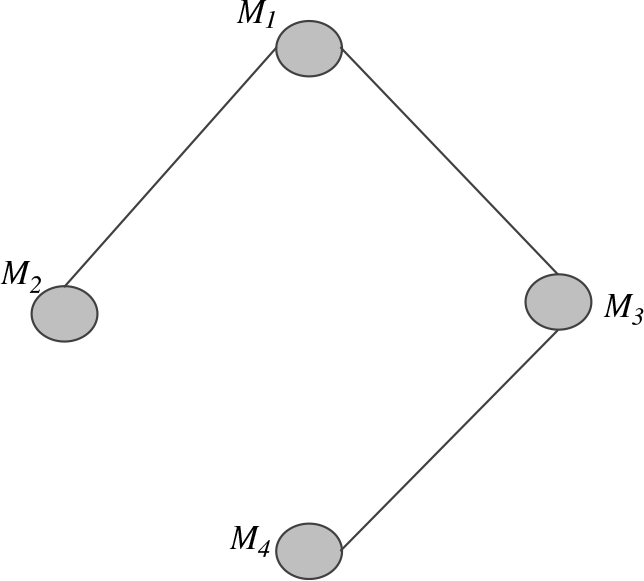
In order to verify the effectiveness and superiority of the guidance law designed in this paper, it is compared with the guidance law proposed in Ref. (Reference LLv, Lv and Li12), four missiles at different locations are designated to impact the manoeuvring target simultaneously. The communication topology diagram of the four missiles is assumed as follows:
According to the knowledge of the undirected graph, the weight coefficient matrix corresponding to it is:
 \begin{equation*}\Omega =\left(\begin{array}{c@{\quad}c@{\quad}c@{\quad}c} {0} & {1} & {0} & {0} \\[2pt]
{1} & {0} & {1} & {0} \\[2pt]
{0} & {1} & {0} & {1} \\[2pt]
{0} & {0} & {1} & {0} \end{array}\right)\end{equation*}
The parameters corresponding to the guidance law in Equation (18) in the direction of LOS are selected as follows:  $k_{1r}=5,k_{2r}=5, a_{1}=2, a_{2}=3, p=4, a_{r}=0.5$
. The parameters corresponding to the guidance law in Equation (31) in the normal direction of LOS are selected as follows:
 $k_{1q}=3, k_{2q}=5, n=4, {\rho =2/3}$
. Parameter selection corresponding to Equations (19) and (32) of the non-homogeneous disturbance observer as follows:
 ${\lambda _{0i} =1.1}, {\lambda _{1i} =1.5}, {\lambda _{2i} =2}; {u_{0i} =3}, {u_{1i} =6}, {u_{2i} =8}; {L=0.1}$
. In Ref. (Reference LLv, Lv and Li12), the parameters of the guidance law are chosen to set corresponding parameters to the guidance law in this paper.
Assume that the initial coordinates of the target is (10,000m, 0m), the velocity  $v_{t}=20$
m/s, the initial ballistic inclination
 ${\sigma _{t} =20^{\circ } }$
, the acceleration in the normal direction of velocity,
 $a_{t}=0.2g$
, the tangentially upward acceleration of the velocity,
 ${{\dot{v}_{t} } =0}$
, and
 $g=9.81 m/s^{2}$
.
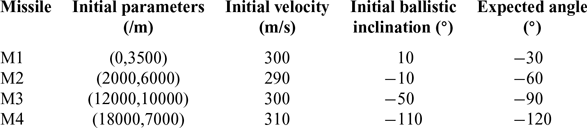
The initial state information and LOS angle constraints of the four missiles are shown in Table 1:
Initial parameters and expected angle

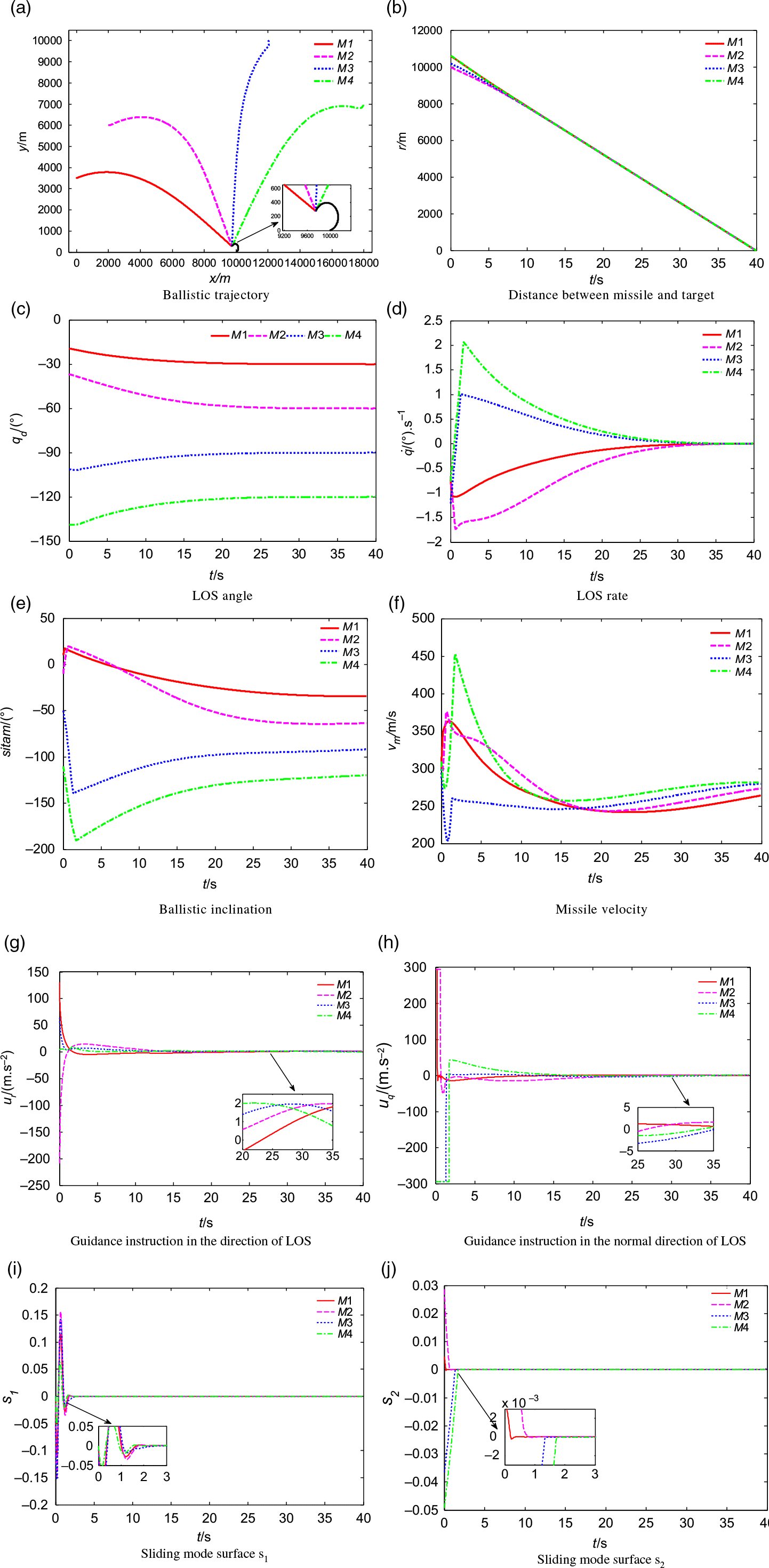
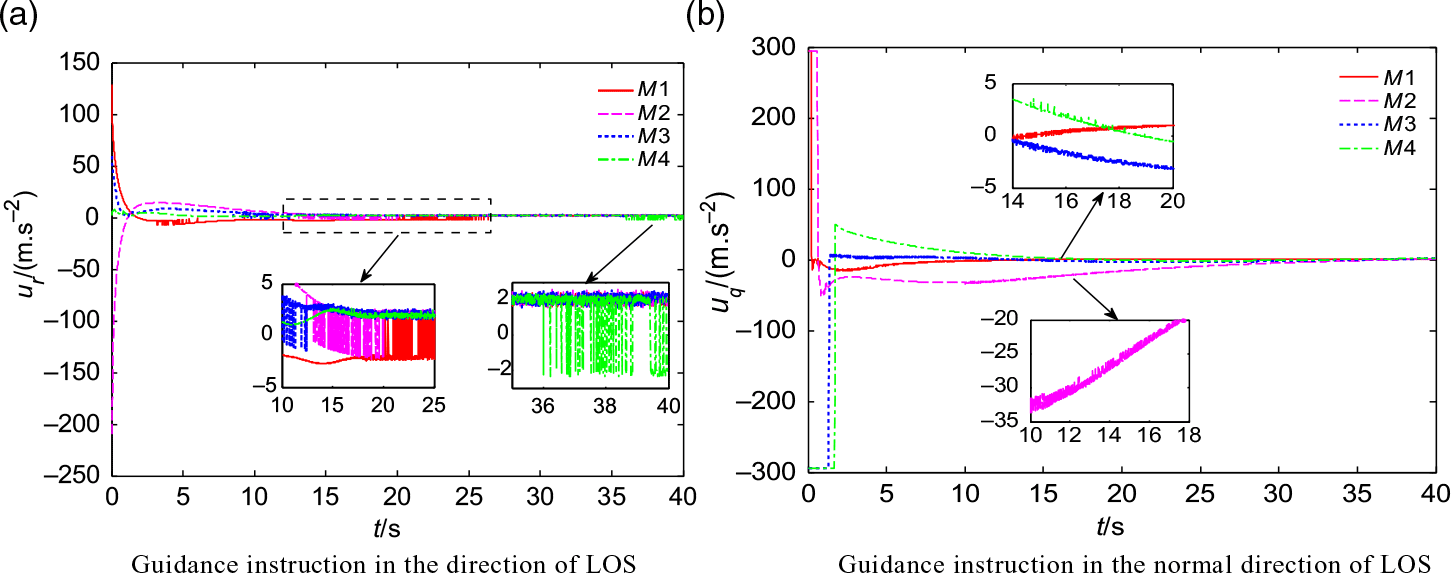
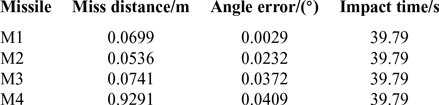
The guidance blind area is set as 10m; that is, the autopilot stops when the distance between missile and target is equal to 10m. The missile flies according to inertia, and the overload limit of the missile is 30g. The simulation step length is set as 1 millisecond. In the simulation of the two guidance laws, the saturation function is not used to approximate the sign function, which avoids the degradation of the guidance performance. The simulation results of the proposed guidance law are shown in Fig. 3 and Table 3, and the simulation results of acceleration under the guidance law of Ref. (Reference LLv, Lv and Li12) are shown in Fig. 4:
Communication topological structural for four missiles.

Simulation results of four missiles cooperative attack (a) Ballistic trajectory, (b) Distance between missile and target, (c) LOS angle, (d) LOS rate, (e) Ballistic inclination, (f) Missile velocity, (g) Guidance instruction in the direction of LOS, (h) Guidance instruction in the normal direction of LOS, (i).Sliding mode surface  ${\rm s}_{1}$
, (1ptj) Sliding mode surface
 ${\rm s}_{2}$
.

Simulation results of four missiles acceleration under Ref. 12 guidance law. (a) Guidance instruction in the direction of LOS, (b) Guidance instruction in the normal direction of LOS.

From Table 2 and Fig. 3(a) and (c), it can be seen that four missiles in different locations accurately hit the target with miss distance of not more than 0.1m, their impact angle error is less than 0.01 $^\circ$
, satisfying the requirements of impact angle constraint, and all impact times are 39.79s, thus showing the missile impacting the manoeuvring target cooperatively. It can be seen from Fig. 3(d) that the LOS angle rate of the guidance at the initial stage changes greatly and the LOS angle rate tends to be 0 at the terminal stage of the guidance, which ensures that the missile can accurately hit the target. It can be seen from Fig. 3(e) that the ballistic inclination of each missile tends to be constant at the terminal guidance stage, while the ballistic inclination of the manoeuvring target can be predicted by the tracking filter, which verifies the correctness of transforming terminal impact angle constraint into LOS tracking. In Fig. 3(f), the velocity of four missiles changes greatly at the early stage and tends to be consistent at the later stage. This is because the impact time of each missile is adjusted through the change of missile velocity at the early stage. When the distance to the target of these four missiles tends to be consistent, the velocity of the four missiles also tends to be consistent. From Fig. 3(g) and (h), it can be seen that the acceleration instruction in the direction of LOS and the normal direction of LOS changes greatly in the early stage, which is because the adjustment of the distance toward the target of the four missiles tends to be consistent and the LOS rate rapidly converges to 0, realising the coordination of the impact time of missiles and hitting the target. When the distance toward the target of each missile tends to be consistent and the LOS rate tends to be 0, the acceleration instruction in the direction of LOS and the normal direction of LOS also tends to be 0, and there is no chattering in the convergence process, and the corresponding temporal change corresponds to Fig. 3(b) and (d). In Fig. 4, the acceleration in the LOS direction and the LOS normal direction under the guidance law of Ref. (Reference LLv, Lv and Li12) appears to have the chattering phenomenon to varying degrees, which is not conducive to the tracking of the missile’s autopilot. It can be seen from the above that the guidance law designed in this paper has stronger robustness and better conservativeness than the previous literature. From Fig. 3(i) and (j), it can be seen that the two designed sliding surfaces rapidly converge to 0, and there is no chattering phenomenon in the process of convergence.
Simulation results of four missiles cooperative attack

In this section, the saturated function is not used to replace the symbolic function in the simulation process, so as to avoid the drop of the guidance conductivity. In the simulation results, there is no chattering phenomenon, and the flight time of the missile under the guidance law of Ref. (Reference LLv, Lv and Li12) is shorted by 0.2 seconds, which verifies that the proposed guidance law has good guidance conductivity while completing the cooperative impact task.
6.0 CONCLUSION
In this section, based on missiles with adjustable thrust, the guidance law of multi-missile cooperative attack with impact angle constraint is designed, which can be used to attack manoeuvring targets. Distributed communication reduces the need for communication. As long as the missile communication topology is connected and undirected, the missiles’ cooperative impact can be realised under the guidance law. The design of the guidance law is divided into two parts: the LOS direction and the normal direction of LOS. The guidance law is designed in LOS direction based on multi-agent system cooperative control theory and super-twisting algorithm, which can control the missiles’ time-to-go converging in finite time. In normal direction of LOS, the other guidance law is designed to control missiles hitting the target with impact angle constraint based on zeroing LOS rate thought and finite-time sliding mode control theory. The target manoeuvring information in the two-part guidance law is regarded as an external disturbance, and the non-homogeneous disturbance observer is designed to estimate the disturbance. According to the different location of the different initial states of the four missiles directed to impact the same manoeuvring target, the simulation verification is operated. The simulation results show that the guidance law designed in this paper has excellent guidance performance. Each missile hit the target cooperatively in their specified angle, and the chattering phenomenon did not emerge in the guidance law, which is good for improving the guidance precision and autopilot tracking. The algorithm designed in this paper has obvious novelty and high practical application value, and it has certain actual application value. However, it is still worth further research on the design of cooperative guidance law with communication topology considering time varying and how to optimise the overload distribution.