


1. Introduction
Serpentinites provide an outstanding opportunity to understand the tectonic processes in the Zagros Suture Zone (ZSZ). This zone comprises two thrust sheets formed in the Neo-Tethys Ocean. They were thrust over the Arabian plate in two distinct phases of subduction and collision, during Late Cretaceous and Mio-Pliocene times (Jassim & Buday, Reference Jassim, Buday, Jassim and Goff2006), to form the Penjween–Walash sub-zone (Fig. 1). According to Aswad (Reference Aswad1999), this zone is subdivided into two allochthonous nappes: Lower and Upper. These nappes are called thrust sheets by Jassim, Suk & Waldhausrova (Reference Jassim, Suk, Waldhausrova, Jassim and Goff2006). Many serpentinite bodies referred to as serpentinite imbricates (Jassim, Suk & Waldhausrova, Reference Jassim, Suk, Waldhausrova, Jassim and Goff2006) are exposed along the thrust faults. Field evidence suggests that some of these are not main components of dismembered ophiolite massifs of the Zagros Suture Zone (N. Aziz, unpub. Ph.D. thesis, Sulaimani Univ., 2008). Consequently, the serpentinite bodies are divided into two types: (1) highly sheared serpentinites which occupy the lower contact of the ophiolitic massifs within the Upper Allochthon and (2) serpentinite–matrix mélanges which occur on both sides of the Lower Allochthon (see Mawat cross-section inset in Fig. 1). The first type, which is associated with ophiolites, includes serpentinite broken formation (massive blocks of metabasite enclosed in a matrix of serpentinite schist) of 80–110 Ma (Aziz, Elias & Aswad, Reference Aziz, Elias and Aswad2011). The second type has drastically different petrogenesis, age and regional field relationships, consists of exotic blocks of mixed age (150 and 200 Ma) and has initial epsilon Nd values εNd(i) of down to −30 (Aziz, Elias & Aswad, Reference Aziz, Elias and Aswad2011). The low εNd(i) values are indicative of maximal incorporation of old crustal rocks into the serpentinite–matrix mélanges. Hence the second type of serpentinite is considered to be a true serpentinite–matrix mélange, occurring mostly on both sides of the Lower Allochthon (Fig. 1). The serpentinite–matrix mélanges occur along thrust faults which superpose the metamorphosed volcano-sedimentary succession of Albian–Cenomanian age (Upper Allochthonous Sheet) onto the underlying unmetamorphosed Tertiary volcano-sedimentary succession (Lower Allochthonous Sheet). Examples are found in the Halsho, Hero and Pushtashan area, referred to as the HHP serpentinite–matrix mélange. They also occur within the lower part of the Tertiary volcano-sedimentary succession (e.g. the Galalah, Qalander and Rayat area) and are thus termed GQR serpentinite–matrix mélanges. Using the above geological and tectonic setting criteria, it is assumed that the GQR and HHP serpentinite–matrix mélanges were emplaced in the late Maastrichtian and the late Palaeogene, respectively.
Top: Geological map of the northwestern Zagros Suture Zone (Kurdistan Region) showing the area of the serpentinites studied. Inset – Upper Allochthon with HHP serpentinite–matrix mélanges at base. Bottom: Cross-section passing through Mawat.

The present study deals with constraints on petrogenesis and offers a new discussion of the evolution of these two types of serpentinite: serpentinite imbricates and serpentinite–ophiolite associates. Based on field observations, the serpentinite imbricates are interpreted to have been emplaced along the upper and the lower thrust contacts of the Lower Allochthon and are referred to as the HHP and GQR serpentinite–matrix mélanges, respectively. Therefore, special emphasis is placed on the petrogenesis of the GQR and HHP serpentinite–matrix mélanges associated with the two allochthonous thrust sheets mentioned above.
2. Analytical techniques
The sample locations, marked in Figure 1, represent the serpentinite imbricates along the upper and the lower thrust contacts of the Lower Allochthon (Walash volcano-sedimentary series, Paleocene–Eocene). The localities are Halsho, Hero and Pushtashan, and Galalah, Rayat, and Qalander. The serpentinites of the remaining localities (i.e. Penjween, Mawat and Pauza) exhibit highly sheared serpentinites, occupying the lower contact of the ophiolitic massifs. Various analytical techniques were employed for petrographical and geochemical studies. Bulk-rock major, trace and rare earth elements (REEs) were determined at the GeoAnalytical Laboratory, School of Earth and Environmental Science, Washington State University, USA. The major and trace elements were analysed with ThermoARL Advant'XP+ XRF using single low dilution Li-tetraborate fused beads, while REEs were determined with a Sciex Elan 250 inductively coupled plasma-mass spectrometer (ICP-MS) using a combined fusion/dissolution procedure. The chemical compositions of minerals were determined with an electron microprobe technique at the Department of Geology, Uppsala University, Sweden, using a CAMECA SX50 microprobe. The operating conditions were 20 kV accelerating potential and 15 nA beam current. Probe size was normally 1–2 micrometres (serpentine 10 micrometres).
3. Petrography and mineral chemistry
The Zagros Suture Zone serpentinites reveal the relics of original minerals such as olivine, pyroxene and Cr-spinel, and the formation of several metamorphic assemblages. These latter indicate that the original ultramafic protoliths of harzburgite, dunite and to a lesser extent lherzolite, were serpentinized under greenschist to amphibolite facies conditions. The most common textures preserved are pseudomorphic mesh, bastite and hourglass textures after olivine and pyroxene, which preserve the pre-serpentinization textures of the ultramafic precursor (Figs. 2a, b), and non-pseudomorphic (interpenetrating and interlocking) textures. Interpenetrating textures consist of elongated blades of serpentine across previous serpentine generations and textures (Fig. 2c). Interlocking textures, on the other hand, consist of more equigranular grains of serpentine, and may consist of a combination of lizardite, chrysotile and antigorite, especially within the sheared type of serpentinite (Fig. 2d).
(a) Photomicrograph of mesh texture after olivine. (b) Bastite texture after orthopyroxene. (c) Interpenetrating texture. (d) Interlocking texture.

Microprobe analysis indicated that the serpentinites contain olivine relics (Fo = 90.6–91.6) and pyroxene relics (En49.25–47.41 Fs0.53–5.18 Wo50.21–47.41), while the metamorphic serpentine group consists of lizardite–chrysotile. The metamorphic serpentine group includes the amphibole types tremolite, actinolite, anthophyllite and paragasite, whereas the chlorite types are clinochlore, penninite and talc-chlorite. The analysis also indicated that the serpentinites contain sulphide, the minerals pyrrohotite ((Fe0.822 Ni0.001 Zn0.001)8.24 S1.673) and chalcopyrite ((Cu Fe Ni)0.991 S1.591), garnet (andradite) ((Ca3.388 Fe2.097 Si3.163) O12) and sphene ((Ca1.029 Ti1.073 Si0.963) O5). The Cr-spinels show a wide range of YCr (Cr/(Cr + Al) atomic ratio) from 0.37 to 1.0, and XMg (Mg/(Mg + Fe2+) atomic ratio) ranges from 0.0 to 0.75. Three stages, from core to rim, have been recognized in the spinels studied: the residual mantle stage, Cr-rich spinels and a very narrow rim of magnetite. These three stages are represented by primary Cr-spinel, pre-serpentinization spinel and syn- or post-serpentinization spinel, respectively (Fig. 3) (Aswad, Aziz & Koyi, Reference Aswad, Aziz and Koyi2011, this issue).
Backscattered image of primary Cr-spinel (a) and Cr-spinel rimmed by magnetite (b).

4. Geochemistry
Selected major and trace element variation diagrams were prepared using MgO as the differentiation index (Figs 4, 5). Major element geochemistry shows that the majority of the serpentinite samples indicate ultramafic matrix domains, while a few samples contain < 30 wt% MgO and their values differ considerably from that of the ultramafic protolith (Table 1). In addition, they either form discrete metabasic blocks (serpentinite–ophiolite associates) or are thoroughly mixed with serpentinite matrix along a mélange channel (typical serpentinite–matrix mélange). Unlike the ophiolite-associated serpentinites (with the exception of Pauza serpentinites, which display high MgO > 30% as well as low MgO < 10%), serpentinite–matrix mélanges defy a simple geochemical categorization. On a water-free basis the variation diagrams of MgO versus SiO2, Al2O3, Na2O and TiO2 generally display a wide scatter, and the existence of more than one population of cases can be deduced (Fig. 4). Assuming that SiO2 and Al2O3 are both immobile during serpentinization, the mean MgO loss or depletion with respect to SiO2 is attributed to both metasomatism and variable mechanical mixing between metabasic and metasedimentary blocks and serpentinite matrix processes (Fig. 4). Thus the variation in MgO v. TiO2 displays a wide scatter and their trends much exceed the corresponding TiO2 concentrations in ultramafic protoliths, which are represented by the Mawat peridotite (Mirza, unpub. Ph.D. thesis, Sulaimani Univ., Iraq, 2008). The high concentrations of moderately incompatible TiO2 (> 0.10%) concomitant with low MgO contents (< 25%) may indicate that there are considerable subducted components intermixed with serpentinite matrix in the mélange zone. This may be the result of mechanical mixing of serpentinite matrix with SiO2-rich components (King et al. Reference King, Bebout, Moriguti and Nakamura2006).
Variation diagrams of MgO (wt%) v. SiO2, Al2O3, TiO2 and Na2O for ophiolite–serpentinite associates and ophiolitic mélange serpentinites (all analyses plotted on an anhydrous basis). Mawat peridotites after Mirza (unpub. Ph.D. thesis, Sulaimani Univ., Iraq, 2008). Fields for parental end members are as follows: B and S – basaltic and sedimentary blocks, respectively, all metamorphic grades of the Catalina Schist; P – peridotites of the Horoman Complex, Japan (King et al. Reference King, Bebout, Moriguti and Nakamura2006).

Variation diagrams of MgO (wt%) v. Cr, Ni and Sc for ophiolite–serpentinite associates and ophiolitic mélange serpentinites. Abbreviations as in Figure 4. Note: Pauza samples display high MgO > 40% as well as low MgO < 10%, which are not typical mélange serpentinites (i.e. broken formation). (See text for more information.) Mawat peridotite after Mirza (unpub. Ph.D. thesis, Sulaimani Univ., Iraq, 2008).

In the present analysis, the compatible trace elements of serpentinites are represented by Cr (chromite-compatible element), Ni (olivine-compatible element) and Sc (pyroxene-compatible element). MgO versus Cr and Ni shows coherent trends, demonstrating a compatible trace element character by virtue of their positive correlation with MgO. Sc, however, demonstrates an incompatible trace element character with negative correlation with MgO. In the lherzolite, most of the Cr is contained in Al-chromites and less in clinopyroxene; whereas in the dunite and harzburgite, Cr is contained mainly in Al-chromite (Liu & O'Neill, Reference Liu and O'neill2000). Ni is regarded as immobile during metamorphism (Govindaraju, Reference Govindaraju1995); Sc is geochemically strongly incorporated into pyroxene, which is more abundant in basic blocks. There is much variation in Cr and Ni in the serpentinite–matrix mélange (Fig. 5), while the emphasis on the very low concentration of these compatible elements might indicate that these samples represent variable amounts of mélange blocks (i.e. metabasic and metasediment). Serpentinite–ophiolite associates, however, intermittently contain metabasic blocks (e.g. Pauza, Fig. 5). They are tectonically detached masses of oceanic crust (i.e. broken formation) associated with the thrust mechanism.
Whole-rock major (wt%) and trace (ppm) element analysis of Zagros Suture Zone serpentinites

4.a. Geochemistry of REEs
The overall chondrite-normalized REE patterns of the Zagros Suture Zone serpentinites studied (Table 2) display significant REE variability, implying that serpentinites of different origins are present. Accordingly, the serpentinites studied fall into two main groups, Group One and Group Two. Their respective REE patterns are shown in Figure 6. The Group One REE pattern displays enrichment in the total REEs of more than 1 × chondrite (CI) (i.e. > 1 × chondrite). In contrast to this, the REE pattern of Group Two (Fig. 6), less than 1 × chondrite (CI) (i.e. < 0.01 to 1 × chondrite), indicates that the mantle protolith composition varies from lherzolite through harzburgite to dunite. This perhaps represents a distinctive boninitic magma of island-arc affinity (fore-arc) related to the suprasubduction zone. The REEs in the GQR serpentinite–matrix mélanges (Fig. 7) have a noticeably positive Eu anomaly, while the heavy REEs (HREEs) never reach more than 1 × chondrite (CI) (i.e. < 0.01 to 1 × chondrite). Because the HREEs are less disturbed, their concentrations should reflect pre-serpentinization partial melting of the mantle wedge much better than light REE (LREE) concentrations do. In the GQR serpentinite–matrix mélanges, however, the LREE and Eu during serpentinization of peridotites must physically reside in highly serpentinized domains. Among all known residual mantle phases (olivine, Opx, Cpx and spinel), Cpx has higher mineral/melt partition coefficients than residual olivine, Opx and spinel (Salters et al. Reference Salters, Longhi and Bizimis2002). For this reason the progressive partial melting of the mantle wedge is concomitant with decreasing HREE concentrations. Bulk-rock samples also display slightly-to-steeply sloped LREE profiles. As all peridotites are serpentinized to various extents, the elevated abundance of LREEs could be due to serpentinization, a hydrothermal metamorphic process (250–400°C with up to 13 wt% H2O in serpentinites), during which the LREEs could be mobile and incorporated (Niu, Reference Niu2004). The positive Eu anomalies of the GQR serpentinites are interpreted to be related, LREE-enhancing serpentinization processes (Niu, Reference Niu2004). The absence of Ce anomalies in the REE plot may suggest that seawater effects on serpentinization processes were negligible (Niu & Hekinian, Reference Niu and Hekinian1997). The REE patterns displayed by this group of samples are strictly related to Group Two (Fig. 6). Worth noting is that the REE patterns of the GQR serpentinites differ significantly from those of the HHP serpentinite–matrix mélange, which are either equally divided between the two REE patterns groups (Hero and Halsho) or inclined towards Group One (e.g. Pushtashan) (Fig. 7). The obvious differences between GQR and HHP serpentinite–matrix mélanges might be related to the evolution of the Zagros Suture Zone.
Whole-rock REE analysis of Zagros Suture Zone serpentinites

Chondrite-normalized REE diagram of all datasets. Note that analyses for this and subsequent diagrams have not been recalculated on an anhydrous basis.

Chondrite-normalized REE diagram for the serpentinites studied classified according to their locality: GQR (Galalah, Qalander and Rayat) and HHP (Hero, Halsho and Pushtashan) serpentinite–matrix mélanges (Group One – light grey and Group Two – dark grey).

4.b. Normalized multi-element diagrams
The distinct differences between Group One and Group Two are graphically displayed in multi-element variation diagrams (spider diagrams) of all datasets, in which the trace elements are arranged in order of decreasing incompatibility from left to right, and normalized to the N-MORB source mantle concentrations of Sun & McDonough (Reference Sun, McDonough, Saunders and Norry1989). Bulk-rock MORB-normalized profiles of Group Two are almost flat in the MREE–HREE region with the flattening of profiles in the Gd–Lu range (> 3 times MORB composition). Compared with Group One, Group Two has extremely high content of REEs, displaying variable depletions in the moderately incompatible high-field-strength elements (HFSE) (Zr, Hf, Y) relative to their adjacent REEs (Fig. 8). Notable differences in the Group One spider diagram patterns (Figs 9, 10) include: (1) Large-ion lithophile element (LILE) and LREE values are notably lower for samples HS8 and HR25 with a Zr negative anomaly compared with HR18 and PZ9; (2) The spider diagrams show a significant negative Pb anomaly for all samples, with relatively flat patterns in the HFSEs; (3) PZ9 and HR18 show indistinguishable spider diagram patterns in which Cs, Rb, Nb, Pb and Nd negative anomalies are observed. The low variations in Cs, Rb and Pb concentrations and the ‘spiky’ LILEs indicate interaction with hydrothermal fluids and mobility of these trace elements during serpentinization; (4) The HR25 sample shows clear negative anomalies for Th, U and Sr. There are lower REE contents with flatter REE patterns (lower La/Yb ratios) in HS8 typical of cumulate gabbros, or otherwise mechanical mixing between gabbroic (and/or sedimentary) blocks and serpentinized tectonic matrix. High LREE/MREE ratios are displayed by HR18 and PZ9 in comparison to normal MORB. This shows that these rocks were already changed by additions from the subducted slab, although some characteristics of MORB (e.g. low LREE/MREE ratio) are still preserved in HR25 and HS8. The tectonic environment of this group is clear from the spider diagram pattern, which reflects the MORB source varying between N-MORB sources (HS8) and T-MORB or E-MORB sources for the other samples. In fact, hydration/dehydration experiments (e.g. You et al. Reference You, Castillo, Gieskes, Chan and Spivack1996; Kogiso, Tatsumi & Nakano, Reference Kogiso, Tatsumi and Nakano1997) under both shallow and relatively deep subduction zone conditions demonstrate consistently that Nb, Zr–Hf are essentially immobile. The above reasoning suggests that the distinct negative anomalies in Nb, Zr and Hf relative to their adjacent REEs, which are displayed by a few samples of Group One (i.e. Mawat M7 and Penjween PN1, Fig. 10), indicate higher partition coefficients of the residual phases (i.e. retention of Nb, Zr and Hf in the residual HFSE-rich titanites?). The sources of these serpentinites appear to record the addition of Nb- and Zr–Hf-depleted silicate melts, possibly derived from subducted slabs, to a depleted mantle protolith. They are consistent with an important role for residual rutile. The data, and the spatial relationships of M7 and PN1, indicate a NW–SE chemical variation in serpentinites (i.e. GQR through HHP towards the Mawat–Penjween ophiolite massifs), owing to differences in source terrane, and in the processes that transported them into the mélange via subducted slabs.
A multi-element spider diagram, normalized against N-MORB of all datasets. Values of normalizing constants are from Sun & McDonough (Reference Sun, McDonough, Saunders and Norry1989). Elements arranged in order of increasing compatibility (Hofmann, Reference Hofmann1988). Sample numbers referred to in the inset are classified by locality: PU – Pushtashan; HR – Hero; HS – Halsho; R – Rayat; Q – Qalander; G – Galalah.

Multi-element spider diagram normalized against N-MORB of GQR and HHP serpentinite–matrix mélanges. Values of normalizing constants are from Sun & McDonough (Reference Sun, McDonough, Saunders and Norry1989). Elements arranged in order of increasing compatibility (Hofmann, Reference Hofmann1988). Light and dark grey represent Group One and Group Two, respectively.

Multi-element spider diagram normalized against N-MORB of serpentinites associated with ophiolite massif. Note that PZ9 (Pauza Gp 1) displays low MgO < 10%, which is not typical mélange serpentinite (i.e. broken formation. See text for more information). Group One – light grey and Group Two – dark grey. Note changes in HFSE depletion with concomitant changes in REE.

5. Constraints from Th/La, U/La and Ba/Th ratios on sediment recycling in subduction zones
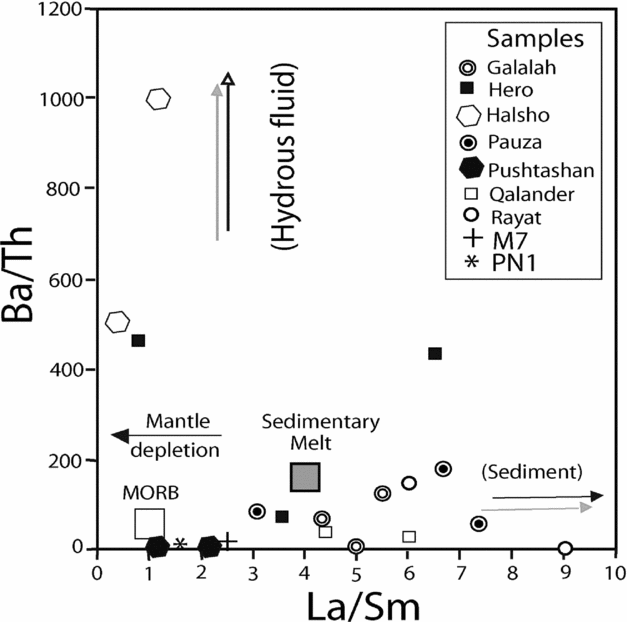
Mélange formed through the synergistic effects of deformation and metasomatic fluid flow affecting peridotite, basaltic and sedimentary protoliths to form hybridized bulk compositions, are not typical of seafloor ‘input’ lithologies. Geochemical investigations might suggest that the mélange studied contains heterolithic, chaotic subducted slabs incorporated into a serpentinite matrix. The latter, however, preserves no primary silicate minerals. The relics of unaltered primary Cr-spinel may provide useful petrogenetic information on the serpentinite matrix. This is because it maintains its compositional signature after serpentinization (N. Aziz, unpub. Ph.D. thesis, Sulaimani Univ., 2008). Hence, the composition of primary Cr-spinels of the studied serpentinites indicates that much of the serpentinite matrix appears to be derived from harzburgite and lherzolite of fore-arc affinity (Aswad et al. unpub. data, Reference Aswad, Aziz and Koyi2011). Mantle metasomatism by influx of subduction-derived components is the essential event resulting in enriched mantle wedge materials. The components derived from dehydration of a subducting slab are highly variable and include hydrous fluids/melts (e.g. Plank & Langmuir, Reference Plank and Langmuir1993; Stern et al. Reference Stern, Kohut, Bloomer, Leybourne, Fouch and Vervoot2006). Type of metasomatic agent (e.g. hydrous fluids or melts) and degree of metasomatism may lead to distinct chemical variations in mantle wedge material. For instance, elevated ratios of Ba/Th (1–1200), U/Th (0.04–90), Ba/La (1–285), Sr/Ce (0–422) and Ba/Rb (1–125) infer such metasomatism of their mantle source by slab-derived hydrous fluids. Th/Nb, also taken as an index of sediment melting by Elliott et al. (Reference Elliott, Plank, Zindler, White and Bourdon1997), varies in the serpentinites studied from 0.09 to 75. This is an order of magnitude higher than the Th/Nb of ~ 0.05 for MORB and is also significantly higher than the Th/Nb of ~ 0.24 for subducted sediment. Note that rutile as a residual phase accounts for the depletion of Nb, Ta and Ti in the melt. Therefore, the high Th/Nb and low Nb/La and Zr/Sm ratios appear to record the addition of Nb- and Zr–Hf-depleted silicate melt interacting with the overlying mantle wedge. The high Ba/Th, low La/Sm ratios (Fig. 11) (HS2; Ba/Th = 1200; La/Sm = 20) represent mantle modified by fluids from altered oceanic crust.
Ba/Th v. La/Sm of the studied serpentinites. Halsho serpentinites display higher Ba/Th and lower La/Sm ratios than the remaining samples, implying that the hydrous fluid influx had more influence on the serpentinization processes. These changes in Ba/Th and La/Sm ratios are likely to be a response to a gradual change in the influence of slab-derived fluids v. bulk sediment or sediment–melt involvement in serpentinite genesis.
In speculation on the origins of the subducted sediments incorporated into a serpentinite matrix, ratio plots such as the U/La and Ba/Th plot are used (Fig. 12). The subducted sediments in the area studied contain hemipelagic and carbonate components (i.e. Qulqula Radiolarite and Balambo limestone). By arranging the elements in order of their overall hemipelagic/carbonate ratio (U, Cs, Th, K, Pb, La, Y, Ba, Sr), it become clear that U/La and Ba/Th ratios provide maximum separation between the hemipelagic and carbonate components (Patino, Carr & Feigenson, Reference Patino, Carr and Feigenson2000). Ba/Th is exceptionally enriched in the carbonate section and provides a first-order tracer of the carbonate sediments. U/La is similar in MORB and carbonates but much higher in hemipelagic sediments. Therefore, U/La is used to track the hemipelagic sediment signal, whereas Ba/Th tracks the carbonate sediment signal. Wide separation of the fluid and melt compositions in a U/La versus Ba/Th diagram creates diagnostic mixing curves with an E-MORB source. Fluid from mature oceanic crust has high U/La, fluid from carbonate sediment has high Ba/Th, and fluid and melt from hemipelagic sediments both have high U/La and Ba/Th. Halsho serpentinites (i.e. HS18, HS2 and HS8) have high Ba/Th and low U/La, whereas Rayat (R2 and R9) serpentinites tend to have high U/La and low Ba/Th (Fig. 12). The high Ba/Th of Halsho serpentinites imply that carbonate sedimentary components have had more influence on the mélange-forming processes. By employing a binary mixture of U/La values between the mantle (0.190) and the hemipelagic sediments (3.085), the tectonic signature of the serpentinite was distinguished from any sedimentary signature. The larger hemipelagic sediment contribution is only observed in the sample G3 from Galalah (1.6) (≈ 49% hemipelagic sediment). Otherwise, all the studied serpentinite ‘mélanges’ are tectonic in nature.
Ba/Th v. U/La. Halsho serpentinites display higher Ba/Th and lower U/La ratios than the remaining samples, implying that carbonate sediment has more influence on the serpentinization processes. Carbonate and hemipelagic sediments are from the DSDP (Deep Sea Drilling Project) (Patino, Carr & Feigenson, Reference Patino, Carr and Feigenson2000).

6. Tectonic implications
The serpentinite–matrix mélange of the Zagros Suture Zone represents an oceanic subduction channel related to Mesozoic subduction. This provides evidence for a long history of subduction, accretion, mélange formation and uplift. Study of major and trace elements shows that the exhumation of subducted components in the serpentinite–matrix mélange must have been accompanied by chemical interaction with serpentinites along the entire retrograde path. The data and the spatial relationships of the rocks studied ascribe a NW–SE chemical variation in serpentinites to differences in source terrane and in the processes that transported them into the mélange channel. This is confirmed through the changes in Ba/Th and La/Sm ratios, which are likely to be a response to a gradual change in the influence of slab-derived fluids versus bulk sediment or sediment–melt involvement in the serpentinite genesis. The thickness of the Lower Allochthon decreases considerably from northwest to southeast. For that reason, GQR and HHP serpentinite–matrix mélanges can only be distinguished in the northern part of the studied area. The prevalent view is that during a period of oceanic subduction (Late Cretaceous), the oceanic crust, the overlying sediments (i.e. hemipelagic sediment of Qulqula) and serpentinized peridotite from the overlying mantle wedge, part of which can be decoupled from the crust and accreted to form the accretionary wedge, were pulled at depth along the subduction zone into the subduction channel (e.g. Gerya & Stöckhert, Reference Gerya2002). The GQR serpentinite–matrix mélanges were unroofed by erosion during subduction at the end of Maastrichtian time. Field evidence based on Paleocene–Eocene arc activity (i.e. Walash volcanites, 43–32 Ma), suggests that the occurrence of these clasts of serpentinite–matrix mélanges in the Tanjero flysch (Maastrichtian age) does not necessarily constrain the end of subduction (Fig. 13). The emplacement of the serpentinite–matrix mélanges is more likely to have taken place before the resorption of the oceanic lithosphere. The average upward velocity of serpentinite depends on the width of the subduction channel, the viscosity of serpentinite (and hemipelagic sediment associates) and the dip angle of subduction (Horodyskyj, Lee & Luffi, Reference Horodyskyj, Lee and Luffi2009). The average net upward velocity is the difference between the upward channel velocity and the downward-sinking velocity of the slab. The latter is a function of the relative plate velocity and β, which is the angle of oblique convergence (0° reflects pure normal convergence and 90° represents pure strike-slip motion) (Horodyskyj, Lee & Luffi, Reference Horodyskyj, Lee and Luffi2009). Based on the data obtained from six GPS receiving stations of the Iraqi Geospatial Reference System (IGRS) (Kadir, unpub. Ph.D. thesis, Mosul Univ., Iraq, 2008), the angle of oblique convergence (β) in the studied area ranges between 47° and 50°NW with a relative plate velocity of 35 mm yr−1. The occurrence of two magma series in the Walash volcano-sedimentary sequences (i.e. basaltic and andesitic series; A. Koyi, unpub. M.Sc. thesis, Mosul Univ. Iraq, 2006) in a single volcanic edifice could be equally formed during metasomatism of the pre-existing mantle wedge by either the supercritical melt (Stage I) or aqueous fluid (Stage II) released by the subducted slab of the Arabian plate, which dipped at a high angle (~ 70°). The high-angle dip is characterized by the occurrence of two magma series in the Walash volcano-sedimentary sequences (i.e. basaltic and andesitic series; A. Koyi, unpub. M.Sc. thesis, Mosul Univ. Iraq, 2006) from a single volcanic edifice (Fig. 14).
Sketch showing the tectonic evolution of the proto-foreland basin of the Kurdish Zagros Suture Zone (KZSZ) (Maastrichtian–Palaeogene).

Tectonic model of accretion of Qulqula Radiolarite and GQR serpentinite–matrix mélanges onto the Arabian continental margin through Maastrichtian–Palaeogene time.

Increasing field-based evidence for the involvement of serpentinized peridotite from the overlying mantle wedge in the subduction channel (Hermann, Miintener & Scambelluri, Reference Hermann, Miintener and Scambelluri2000; Schwartz et al. Reference Schwartz, Stenner, Costa, Smalley, Ellis and Velasco2001) indicates that this channel could have played a major role in subduction dynamics down to depths limited only by the stability of serpentine minerals (Wunder, Baronnet & Schreyer, Reference Wunder, Baronnet and Schreyer1997; Schmidt & Poli, Reference Schmidt and Poli1998). The serpentinite channel could represent a convenient exhumation pathway for subducting components. Serpentinite has a much lower density than the mantle (2700 kg/m3 compared to 3300 kg/m3) and very low viscosity (Hilairet et al. Reference Hilairet, Reynard, Wang, Daniel, Merkel, Nishiyama and Petitgirard2007). The former provides a strong buoyancy force generating a pressure gradient that can drive the serpentinite to the surface, whereas the low viscosity reduces the viscous resisting forces (Ernst, Maruyama & Wallis, Reference Ernst, Maruyama and Wallis1997; Guillot et al. Reference Guillot, Hattori, De Sigoyer, Nagler and Auzende2001). Coupled with erosion of the serpentinite at the surface, considerable upward transport along this serpentine channel may occur. It is important that there is a relationship between the thickness of the serpentinite (and hemipelagic sediments) and the ascent rate, because the thinner the layer the greater the viscous resisting forces and the slower the ascent rate. Thus, large layer thicknesses are needed for mélange ascent rates to exceed the downward pulling force associated with the subducting slab (layer thicknesses must be > 10 km for a ~ 10 cm yr−1 plate velocity (Schwartz et al. Reference Schwartz, Stenner, Costa, Smalley, Ellis and Velasco2001). The rocks locally exhibit the block-in-matrix structure of accretionary mélanges, with a combination of metamorphosed oceanic crust fragments, dismembered ophiolites and sedimentary exotic blocks in serpentinite matrix. With this in mind the strength of serpentinite mélange might differ owing to the existence of variable amount of exotic blocks in the block-in-matrix structure or bimrock (Lindquist & Goodman, Reference Lindquist, Goodman, Nelson and Laubach1994). Given the configuration stated above, which is based on the coexistence of intraoceanic subduction types, the early tectonomagmatic episode is considered to be related to the closure of the Tethys Ocean, which culminated in two subduction types (Aswad, Reference Aswad1999). It is assumed here that this tectonic regime was activated by a high converging velocity (Agard et al. Reference Agard, Jolivet, Vrielynck, Burov and Monié2007), which caused stresses to accumulate in the oceanic lithosphere leading to the formation of an additional subduction of the oceanic crust away from the Neo-Tethyan palaeo-ridge or proximal to the Arabian platform. The volcanic units of the Gemo Group (Albian–Cenomanian), which are dominated by boninitic volcanism (Farjo, unpub. M.Sc. thesis, Mosul Univ. Iraq, 2006), overlie the uppermost part of the Mawat ophiolitic sequence. These rock units with their arc signature strongly suggest an infant-arc subduction of Albian–Cenomanian age (97–118 Ma; Aswad & Elias, Reference Aswad and Elias1988). Based on ophiolite mantle flow structures, a number of authors have proposed that subduction was initiated at the locus of the Neo-Tethyan palaeo-ridge (Nicolas, Reference Nicolas1989; Boudier & Nicolas, Reference Boudier and Nicolas1988; Nicolas et al. Reference Nicolas, Ildefonse, Boudier, Lenoir and Ben Ismail2000). The infant-arc episode was followed by at least two further episodes of orogenic activity impacting the Neo-Tethyan margin prior to its final incorporation into the Arabian plate (see for example, Aswad, Reference Aswad1999). The Late Cretaceous, however, saw a radiolarite rise coupled with a flysch basin on its inboard side. The facies changes were probably triggered by plate convergence incipient in the early Campanian (first episode) and continuing through the Palaeogene period (second episode), where the volcanic flysch and nummulite carbonates were still accumulating on the remaining oceanic lithosphere. The Qulqula Radiolarite Formation, which apparently records deposition in a deep marine setting distal to the Arabian continental margin (and serpentinite mélange), was removed from the subducting plate and accreted against the overriding plate forming an accretionary wedge, which marks the transition from passive margin to the foreland basin setting (Fig. 15). Deformation of the Arabian platform flysch is much slower than that of the accreted sediments. High-degree deformation of the latter was attained during exhumation as a consequence of the development of an accretionary prism related to the late subduction. This tectonic episode may have been caused by abrupt increases in the convergence rates from c. 2–3 cm yr−1 to 6 cm yr−1 as a result of worldwide intraplate instabilities in response to superplume events (Agard et al. Reference Agard, Jolivet, Vrielynck, Burov and Monié2007). The time lapse between the velocity increase and the initiation of subduction (105 ± 5 Ma; Aswad & Elias, Reference Aswad and Elias1988) is estimated at over 20 Ma, and would correspond to the time necessary for the build-up of an accretionary wedge and for rupture of the oceanic lithosphere. This short-term variation in the convergence rate was responsible for creation of a new intraoceanic subduction zone, culminating in the Palaeogene arc volcanicity of Walash (43.1 ± 0.3–32.3 ± 0.4 Ma, Middle Eocene–Late Eocene) (A. Koyi, unpub. M.Sc. thesis, Mosul Univ. Iraq, 2006). Therefore, the final resorption of the oceanic domain must have taken place slightly after 32.3 Ma followed by collision. This proposed model, however, predicts fast exhumation velocities for the hemipelagic sediments and the oceanic crust (> 1 cm yr−1). The sediments are efficiently decoupled from the oceanic crust and tend to accumulate in the accretionary wedge (Qulqula rise). Further to the east of the Qulqula rise, however, a Neo-Tethyan strand remained open into the Palaeogene, following major ophiolitic serpentinite mélange emplacement.
Postulated tectonic evolution model for the Kurdish Zagros Suture Zone (KZSZ) during late-Mesozoic to mid-Palaeogene time. See text for discussion.

7. Conclusions
Geochemical analysis in combination with geological observations allows the following conclusions:
(1) There are two types of serpentinite: (1) serpentinite imbricates and (2) serpentinite–matrix mélanges. The first type, which is associated with ophiolites, includes serpentinite broken formation (massive blocks of metabasite enclosed in a matrix of serpentinite schist) of 80–110 Ma. The second type of serpentinite has drastically different petrogenesis, age and regional field relationships, consists of exotic blocks of mixed age (150–200 Ma) and possesses εNd(i) down to −30 (Aziz, Elias & Aswad, Reference Aziz, Elias and Aswad2011).
(2) Unlike the serpentinites associated with the ophiolites, serpentinite–matrix mélange defies a simple geochemical categorization. It was formed through the synergistic effects of deformation and metasomatic fluid flow affecting peridotite, basaltic and sedimentary protoliths to form hybridized bulk compositions.
(3) Based on the available geological and tectonic setting criteria, the serpentinite–matrix mélanges are subdivided into: (1) HHP (Hero, Halsho, Pushtashan) serpentinite–matrix mélange and (2) GQR (Galalah, Qalander and Rayat) serpentinite–matrix mélange.
(4) The overall chondrite-normalized REE patterns of the serpentinites display significant REE variability and are divided into two main groups: Group One (i.e. > 1 × chondrite) and Group Two (i.e. < 0.01 to 1 × chondrite). This implies different origins.
(5) GQR serpentinite–matrix mélanges have a noticeably high LREE and positive Eu anomaly. Their HREEs never reach more than 1 × chondrite (CI) (i.e. < 0.01 to 1 × chondrite) and they are allotted to Group Two. The HHP serpentinite–matrix mélanges are either equally divided between the two REE pattern groups (e.g. Hero, Halsho) or inclined towards Group One (e.g. Pushtashan)
(6) Plots of the U/La and Ba/Th ratios suggest that subducted sediments (i.e. Qulqula Radiolarite and Balambo limestone?) were consecutively incorporated into a serpentinite–matrix mélange.
(7) The influx of subducted components into the mantle wedge relies heavily on the composition of the sedimentary inputs, which varies considerably with time from hemipelagic (Qulqula Radiolarite) to carbonate sediments (Balambo limestone).
(8) Based on field evidence, it is concluded that the GQR and HHP serpentinite–matrix mélanges were emplaced in late Maastrichtian and late Palaeogene time, respectively.



