Introduction
Members of the family Sciaenidae are distributed worldwide, with approximately 70 genera and 300 species of fish in marine and estuarine habitats. Only a few genera have species in freshwater habitats; for example, Plagioscion, Pachypops and Pachyurus, which are widely distributed throughout South America, North America, Cambodia, Sumatra, Thailand and Vietnam (Nelson, Reference Nelson1994). Plagioscion squamosissimus Heckel, 1840, with common names of ‘corvina’, ‘pescada-branca’ and ‘silver croaker’, is endemic to the Amazon Basin, but this species has also been introduced into the São Francisco and Paraná-Uruguai Basins (Cassati, Reference Cassati2005). This species is considered piscivorous and a generalist, but Goulding & Ferreira (Reference Goulding and Ferreira1984) showed that in many water bodies in the Amazon region, the diet of this fish is primarily based on crustaceans. Plagioscion squamosissimus is an important part of the natural ecosystems in which it occurs and provides basic functional components in the food web (Barthem, Reference Barthem1985; Cassati, Reference Cassati2005). These relationships can be studied in more detail by understanding the fauna of the parasites of fish in a region and ecosystem, as knowledge of parasites can provide basic insight into their biological and ecological relationships. Therefore, we have been working to understand the helminth fauna of fish from the Oriental Amazon region of Brazil and herein provide a description of a new acanthocephalan species of the genus Neoechinorhynchus Stiles & Hassall, 1905 that utilizes at least one intermediate host in its life cycle.
The 88 nominal species in the genus Neoechinorhynchus occur as parasites of freshwater, brackish and marine fish. These acanthocephalans have been classified into two subgenera: Hebesoma Van Cleve, 1928, with 11 species, and Neoechinorhynchus Stiles & Hassall, 1905, with 77 species (Amin, Reference Amin2002). Thirty-two (36%) of the recognized species occur in North American hosts (particularly freshwater fish), but this proportion may be due to sampling efforts because the fauna of fish in the neotropics remains poorly known (Amin, Reference Amin2002).
In Brazil, six species are known, including N. macronucleatus Machado-Filho, Reference Machado-Filho1954; N. buttnerae Golvan, Reference Golvan1956; N. paraguayensis Machado Filho, 1959; N. curemai Noronha, Reference Noronha1973; N. pterodoridis Thatcher, Reference Thatcher1981; and N. pimelodi Brasil-Sato & Pavanelli, Reference Brasil-Sato and Pavanelli1998; which are all parasites of freshwater and marine fish (Amin, Reference Amin2002; Santos et al., Reference Santos, Gibson, Tavares and Luque2008). Thus far, only Rhadinorhynchus plagioscioni Thatcher, Reference Thatcher1980, a parasite of P. squamosissimus, has been reported. The present study describes a new species of Neoechinorhynchus (Neoechinorhynchus) and distinguishes it from other related species that have been reported previously.
Materials and methods
A total of 29 P. squamosissimus specimens were obtained from a local fisherman who caught the fish in the estuary of the Guamá River and the neighbouring Guajará Bay in areas adjacent to the city of Belém (1°15′S–1°29′S, 48°32′W–48°29′W) in the Brazilian state of Pará between February 2007 and August 2010. The fish were transported alive in plastic containers to the laboratory and examined with a stereo-dissecting microscope. All worms found were removed from the fish intestines, subsequently rinsed in phosphate-buffered saline (PBS) and then fixed in alcohol–formalin–acetic acid (AFA). For light microscopy, worms were cleared with Aman's lactophenol, and temporary mounts were prepared by placing the worms on a 2 × 3 microscope slide under a No. 1 cover glass. Drawings were produced with the assistance of a drawing tube, computer scanning and Adobe Photoshop CS3™ (Hewlett Packard Company, San Jose, California, USA). All measurements are presented in micrometres unless otherwise indicated and expressed as the range, followed by the mean and standard deviation in parentheses. For scanning electron microscopy (SEM), fixed specimens were postfixed in 1% osmium tetroxide in phosphate buffer, dehydrated through a graded alcohol series, critical-point dried in CO2, and sputter-coated with gold. The samples were examined using a LEO 1450VP scanning electron microscope at an accelerating voltage of 15 kV.
Results and discussion
Neoechinorhynchus veropesoi n. sp
Description
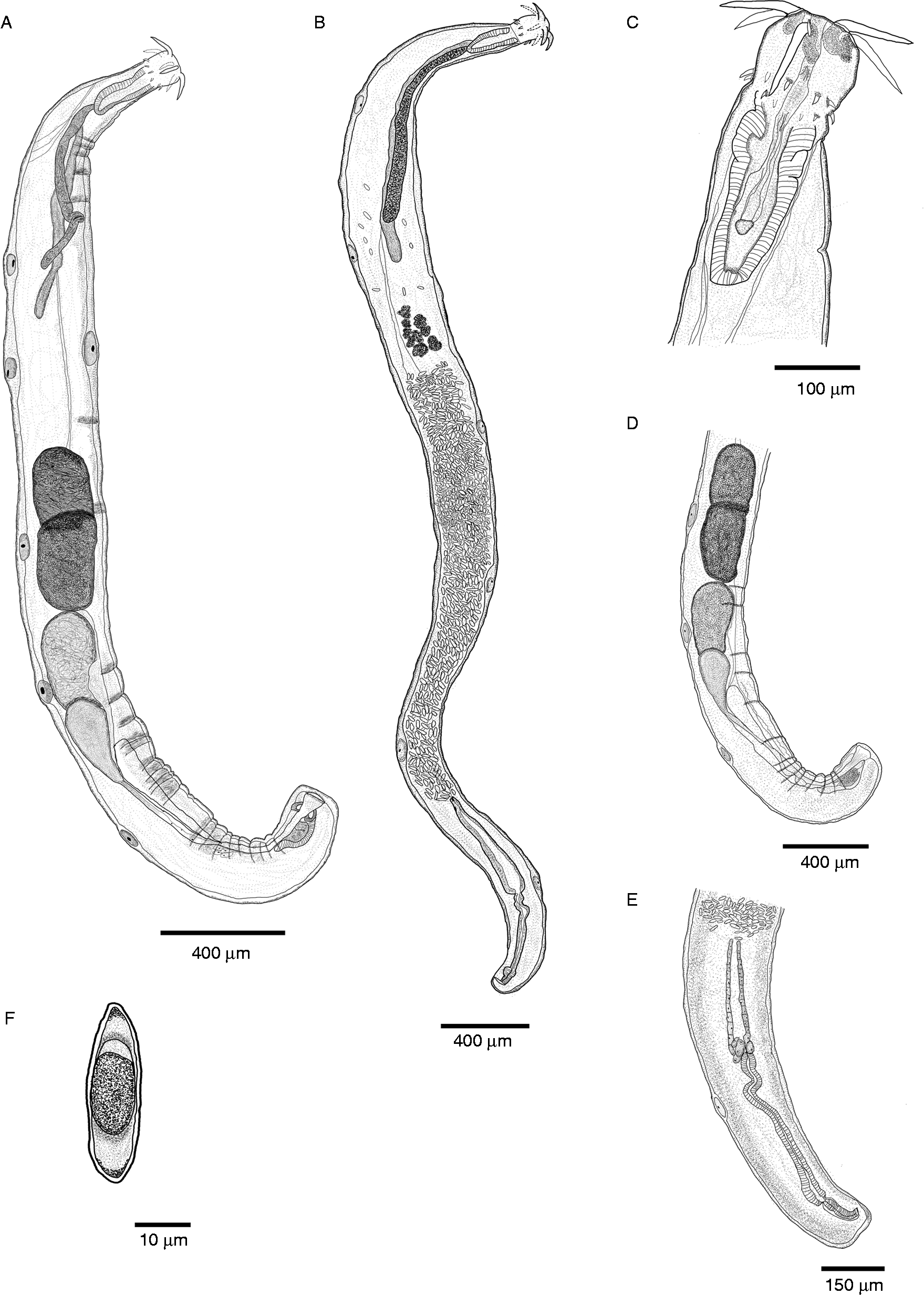
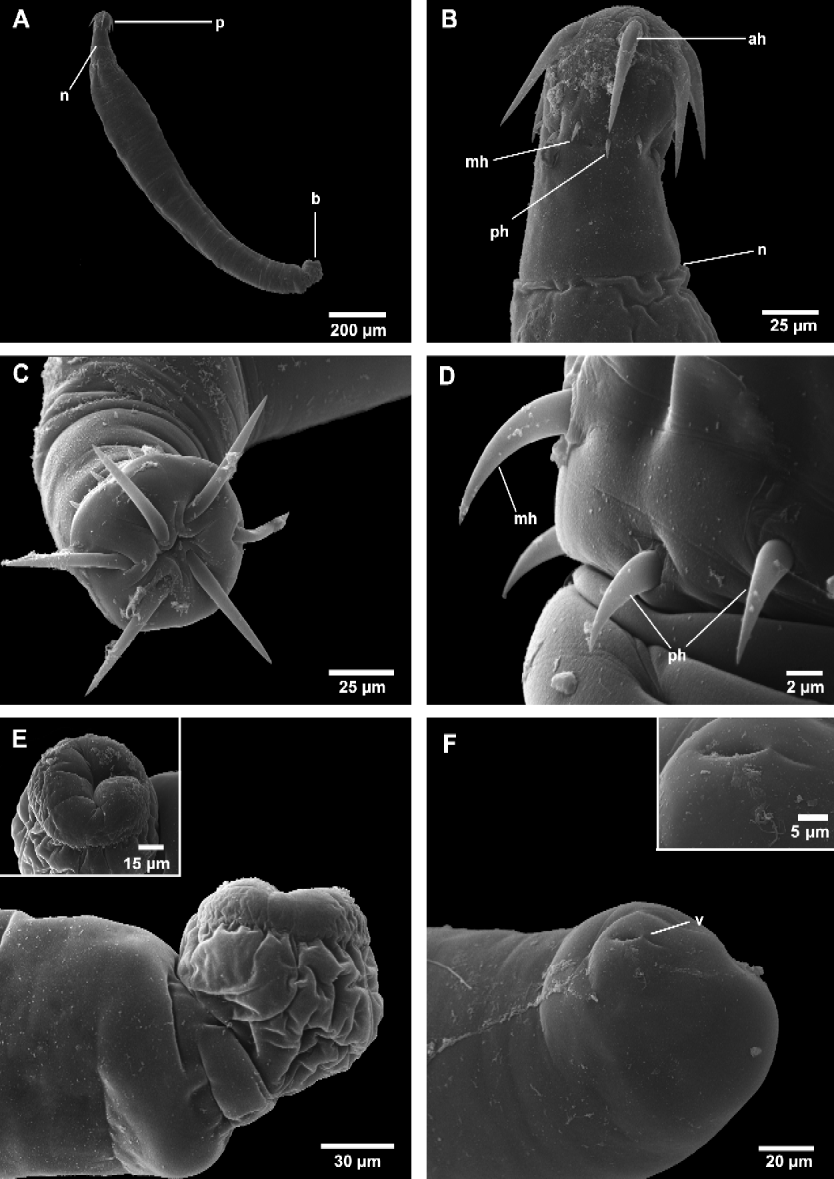
Trunk aspinose, fusiform curved ventrally, relatively small ( figs 1A, B; 2A). Six giant nuclei present in the body wall, five dorsal, one ventral (fig. 1A, B). Proboscis short, globular, slightly longer than wide. Proboscis with three circles with six hooks each (figs 1C ). Proboscis receptacle a relatively short, simple, single-walled sac (fig. 1C). Lemnisci elongate, unequal (fig. 1A, B). Testes spherical, contiguous, postequatorial (fig. 1A, D). Cement-gland syncytial, cement reservoir ovoid, and Saefftigen's pouch present (fig. 1A, D). Genital pore terminal in males and sub-terminal in females (figs 1D, E; 2A, E, F). Eggs oval, elliptical and elongated, with concentric shells without polar prolongation of the fertilization membrane (fig. 1F). In marine, freshwater or estuarine fish.
Morphology of Neoechinorhynchus veropesoi n. sp., showing: (A) entire male; (B) entire female; (C) proboscis, with three rows of six hooks decreasing posteriorly; (D) reproductive system at posterior end of the male; (E) reproductive system at posterior end of the female; and (F) egg.

Ultrastructure of Neoechinorhynchus veropesoi n. sp., showing: (A) male with proboscis (p), neck (n) and copulatory bursa (b); (B) anterior male end with totally reverted proboscis with anterior (ah), middle (mh) and posterior (ph) hooks decreasing in size in each row, and the limits of the neck; (C) partially reverted proboscis, in which the disposition of the anterior proboscis hooks can be counted and observed; (D) details of the disposition of the middle hooks (mh) and posterior hooks (ph); (E) male posterior end showing the copulatory bursa (inset: detail of the copulatory bursa aperture); and (F) female posterior end showing the sub-terminal vagina aperture (v) (inset: detail of the shape of vagina aperture, which is a simple longitudinal groove in the ventral portion of the body).
Males (based on five mature specimens). Trunk 2.1–3.5 (2.8 ± 0.64) mm × 250–260 (244 ± 6.5) (figs 1A; 2A). Hypodermis 23.6–42.1 (32.1 ± 7.5) width. Length-to-width ratio (LWR) 11:1. Proboscis 68.3–89.5 (80 ± 7.8) × 63.2–84.2 (75.4 ± 7.5) (figs 1A; 2B). Length of proboscis hooks in the anterior circle 63.2–71.1 (67.9 ± 3.43), the middle circle 20.5–24.2 (22.2 ± 1.35), and the posterior circle 10–14 (12 ± 1.49) (figs 1C). Proboscis receptacle 181.6–263.2 (225.3 ± 20.4) × 92.1–139.5 (103.7 ± 20.1) (fig. 1C). Neck 92.1–134.2 (121 ± 12.8) × 84.2–100 (91 ± 9.04) (figs 1C; 2A, B). Longer lemniscus 671–913.15 (800.5 ± 118.2); shorter lemniscus 513.2–742.1 (615.3 ± 95.2) (fig. 1A). Reproductive system usually occupies less than half of the body length, at 35.6–36.7 (36)% (fig. 1A, D). Testes oval, partly overlapping and occasionally contiguous. Anterior testis 116.8–207.8 (173.8 ± 35.6) × 64.9–103.9 (79 ± 16.14); posterior testis 116.8–157.1 (139.8 ± 18.25) × 71.4–103.9 (81.8 ± 13.7). Cement gland 155.4–240.2 (203.6 ± 33) × 65–82.5 (75.8 ± 10). Cement reservoir 87–150.6 (113.6 ± 26) × 45.4–71.4 (55.2 ± 10) and rounded; spermatic vesicle 168.8–279.2 (214.8 ± 45.2) × 39–50 (43.4 ± 4.6). Saefftigen's pouch 51.9–77.9 (64.5 ± 10.6) × 31.8–38.9 (33.6 ± 3) (fig. 1A, D) and bursa 58.4–103.8 (82.7 ± 20) × 51.9–71.4 (63.6 ± 7.1) (fig. 2A, E).
Females (based on seven mature specimens). Trunk 4.0–8.19 (5.87 ± 1.33) mm × 333.3–466.6 (379 ± 37.5) (fig. 1B). Hypodermis 37.01–58.4 (46.9 ± 9.1), LWR 15:1. Proboscis 97.4–123.4 (114.44 ± 9.1) × 90.9–120.3 (108.6 ± 10.7) (fig. 1B). Length of proboscis hooks in the anterior circle 77.9–90.9 (87.1 ± 4.6), the middle circle 22.9–30.2 (25.5) and the posterior circle 12–14 (13.8 ± 1.1). Neck 136.8–192.1 (157.1 ± 18.27) × 115.7–142.1 (132.3 ± 8.8) (fig. 1B). Proboscis receptacle 321.1–392.1 (350 ± 22.4) × 115.6–128.9 (126.3 ± 5.2). Longer lemniscus 1.1–1.4 (1.2 ± 0.137) mm; shorter lemniscus 0.6–1.0 (0.9 ± 0.133) (fig. 1B). Uterine bell 225.33–373.33 (275.61 ± 63.83) × 80–133.33 (97.90 ± 16.5); uterus 320–560 (460.18 ± 42.1) × 53.33–80 (77.52 ± 13.6); vagina 93.33–160 (110.85 ± 22.8), with genital pore sub-terminal (figs 1B, E; 2F). Length of reproductive system from the anterior margin of the uterine bell to the genital pore 453–1036 (846.6 ± 143.1), at 11–16 (14)% of the trunk length (fig. 1B, E). Size of mature eggs 30.3–41.4 (35 ± 4.6) × 10.2–11.81 (11 ± 0.66) (fig. 1F).
Taxonomic summary
Type host. Plagioscion squamosissimus (Heckel, 1840) (Teleostei: Sciaenidae).
Site of infection. Small intestine.
Type locality. Guajará Bay, Belém, Pará, Brazil (01°28′03″S; 48°20′18″W).
Type data and depository. The holotype (HWML. 68499), allotype (HWML. 68500), and four paratypes (HWML. 68501) were deposited in the Parasite Collection of the Harold W. Manter Laboratory of Parasitology at the University of Nebraska State Museum.
Etymology. The species has been named after the main fish market of the Belém city (Ver-o-peso Market), where thousands species of fish are bought and sold every day, including P. squamosissimus.
Host–parasite data. Prevalence 38%.
Remarks
The new species presents characteristics similar to those described by Amin (Reference Amin2002), which allowed us to include this species in the genus Neoechinorhynchus, subgenus Neoechinorhynchus. Neoechinorhynchus veropesoi n. sp. belongs to the group that presents proboscis hooks in the anterior circle that are equal, lemnisci equal or subequal, with small worms, anterior proboscis hooks at least three times as long as the middle hooks, and middle and posterior proboscis hooks unequal, which gradually or abruptly decrease in length. This group includes the species N. paraguayensis Machado-Filho, Reference Machado-Filho1959, N. pteridoridis Thatcher, Reference Thatcher1981 and N. pimelodi Brasil-Sato & Pavanelli, Reference Brasil-Sato and Pavanelli1998.
Neoechinorhynchus paraguayensis was collected from ‘peixe martin’ from Rio Paraguay (Machado-Filho, Reference Machado-Filho1959), the Guandu-Açu River, Rio de Janeiro (Nickol & Padilha, Reference Nickol and Padilha1979) and, recently, the Guamá River, Pará, northern Brazil (Melo et al., Reference Melo, Santos, Giese, Santos and Santos2012). However, N. veropesoi n. sp. can be differentiated from N. paraguayensis by having a length of 2.08–3.39 mm and LWR 11:1 in males and a length of 4.0–7.19 mm and LWR 15:1 in females, with smaller proboscis hooks measuring 63.2–71.1 (67.9) in the anterior, 20.5–24.2 (22.2) in the middle and 10–14 (12) in the posterior in males, and 77.9–90.9 (87.1) in the anterior, 22.9–30.2 (25.5) in the middle and 12–14 (13.8) in the posterior in females. Neoechinorhynchus paraguayensis can be distinguished from N. veropesoi n. sp. by a total length of 3.5 mm in both sexes. The LWR is 3:1 in males and 2:1 in females, with a proboscis size (130 × 136) and hook lengths of 82–94 (87) in the anterior, 22–26 (24) in the middle and 17–22 (20) posterior in males and 120–130 (125) in the anterior, 22–26 (25) in the middle and 19–24 (22) in the posterior in females. The testes are larger, measuring 307–691 (515) × 242–480 (363) in the anterior and 259–547 (387) × 288–586 (426) in the posterior. In addition, one important characteristic is that the eggs are simple in the new taxon and ovoid in N. paraguayensis, with an internal tube-like ornamentation measuring 26–38 (33) × 22–26 (24). The new species is most similar to N. pteridoridis and N. pimelodi, in that it possesses five dorsal and one ventral giant nuclei, although it presents sub-equal lemnisci sizes and the latter species present lemnisci equal in size, with smaller uterine bells and larger hooks. Neoechinorhynchus veropesoi n. sp. can be separated from N. pteridoridis, reported from Manaus, Amazonas, Brazil (Thatcher, Reference Thatcher1981), because it has a longer total length, higher LWR and smaller proboscis hooks. Neoechinorhynchus veropesoi n. sp. differs from N. pimelodi, which was reported by Brasil-Sato & Pavanelli (Reference Brasil-Sato and Pavanelli1998), in the São Francisco River basin, Três Marias, Minas Gerais, Brazil, because the latter species has a smaller size, with a total length of 1.15–1.67 (1.45) mm in males and 1.18–3.97 (2.44) mm in females; a LWR of 2:1 for both sexes; and anterior, middle and posterior proboscis hooks measuring 100–112 (105), 32–40 (36) and 20–27 (23) in males and 102–142 (129), 34–55 (47) and 27–35 (29) in females, respectively.
Amin (Reference Amin2002) also included a key for species that could not be included in any subgenus. According to this key, N. veropesoi n. sp. belongs to the group of species with a proboscis: (1) hooks in each circle different from the hooks in other circles; (2) anterior proboscis hooks considerably or relatively larger than the middle hooks; and (3) anterior proboscis hooks at least three times as long as the middle hooks. This group includes two species: N. topseyi and N. argenatus. Although N. veropesoi n. sp. has similar anterior proboscis hook sizes to those in N. topseyi and a sub-terminal female gonopore, it differs from the latter species by being smaller and having different sizes of the middle and posterior hooks. When compared with N. argenatus, the new species differs, as N. veropesoi n. sp. has different hook sizes and different female gonopore positions (N. argenatus terminal and the new species sub-terminal).
Thus far, in the Central and South American regions, 14 species of the subgenus Neoechinorhynchus have been described that occur in freshwater, estuarine/brackish, and saltwater fish: N. macronucleatus Machado, 1954; N. butternae Golvan, Reference Golvan1956; N. paraguayensis Machado, 1959; N. prochilodorum Nickol & Thatcher, 1971; N. curemai Noronha, Reference Noronha1973; N. golvani Salgado-Maldonado, Reference Salgado-Maldonado1978; N. roseum Salgado-Maldonado, Reference Salgado-Maldonado1978; N. pterodoridis Thatcher, Reference Thatcher1981; N. villoldoi Vizcaino, 1992; N. pimelodi Brasil-Sato & Pavanelli, Reference Brasil-Sato and Pavanelli1998; N. chimalapasensis Salgado-Maldonado et al., 2009; N. brentnickoli Monks et al., Reference Monks, Pulido-Flores and Violante-González2011; N. mamesi Pinacho-Pinacho et al., Reference Pinacho-Pinacho, Pérez-Ponce de León and García-Varela2012; and N. panucensis Salgado-Maldonado, Reference Salgado-Maldonado2013 (Amin, Reference Amin2002; Thatcher, Reference Thatcher2006; Santos et al., Reference Santos, Gibson, Tavares and Luque2008; Salgado-Maldonado et al. Reference Salgado-Maldonado, Caspeta-Mandujano and Martınez-Ramırez2010; Monks et al., Reference Monks, Pulido-Flores and Violante-González2011; Pinacho-Pinacho et al., Reference Pinacho-Pinacho, Pérez-Ponce de León and García-Varela2012; Salgado-Maldonado, Reference Salgado-Maldonado2013). Of the 14 species mentioned, six were described as parasitizing fish in Brazil. Of those six, three were previously distinguished from the new species (N. paraguayensis, N. pimelodi and N. pterodoridis). However, the new species is also different from N. curemai described by Noronha (Reference Noronha1973), as it has anterior proboscis hooks all with the same size, whereas the latter species has lateral posterior proboscis hooks and larger lateral anterior hooks than others of the same row. Additionally, the new species has a larger general body size, different LWR (11:1 in males and 15:1 in females), and different internal organ sizes. Neoechinorhynchus veropesoi n. sp. can be easily distinguished from the N. butternae described by Golvan (Reference Golvan1956) in freshwater fish from the Amazon River, Manaus, Amazonas, Brazil, because the latter species possesses a larger total length (males 22 mm and females 33 mm), more giant nuclei (seven versus six) and different LWR (2:1 in both sexes). In addition, the new species differs from N. butternae in that the new species has a simple vagina and vulva and the latter species has a vulva typical of these species, presenting a complex structure of a spherical sac that joins the vulva to the dorsal body wall laterally and sensory papilla on each side of the neck just behind the last circle of hooks. Neoechinorhynchus veropesoi n. sp. was compared with the N. macronucleatus described by Machado-Filho (Reference Machado-Filho1954) from Juparanã pond, Espirito Santo, Brazil. However, this species is easily differentiated by the number of giant nuclei (six for the new taxon and four in this species), a larger total length (5–7 mm in males and 3–16 mm in females), different LWR (10:1 in males and 16:1 in females), a small proboscis (83 × 83), and small hooks (anterior 50, middle 16 and posterior 12).
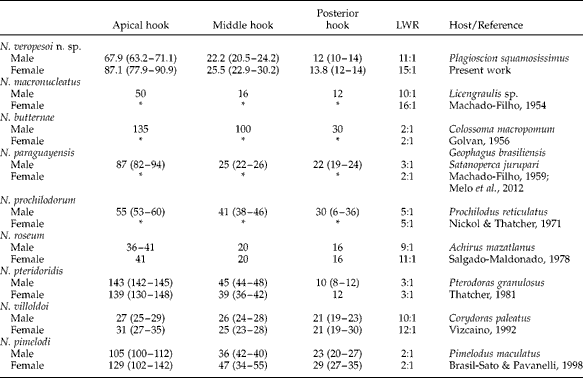
Of the other six species, two have been described in South American fish: N. villoldoi from Buenos Aires, Argentina, and N. prochilodorum from Colombia. Four were described in Mexico: N. roseum from Laguna de Caimanero; N. chimalapasensis Rio Negro, Santa Maria Chimalapa; N. brentnickoli and N. mamesi from the south-western coast of Mexico (Nickol & Thatcher, 1971; Salgado-Maldonado, Reference Salgado-Maldonado1978; Vìzcaino, Reference Vìzcaino1992; Salgado-Maldonado et al. 2009; Monks et al., Reference Monks, Pulido-Flores and Violante-González2011; Pinacho-Pinacho et al., Reference Pinacho-Pinacho, Pérez-Ponce de León and García-Varela2012). Comparing the new species with the other species distributed in South America, N. veropesoi n. sp. differs from N. volloldoi in that it has a larger total length, different LWR, different number and disposition of giant nuclei (5 dorsal and 1 ventral versus 1–2 dorsal and 1–3 ventral), and larger proboscis hooks; and from N. prochilodorum, although both having similar body lengths, with the new taxon having sexual dimorphism in the trunk size and different LWRs (11:1 in males and 15:1 in females versus 5:1 for both sexes), larger hooks, and the longer lemniscus does not reach the level of the anterior testis, which is observed in N. prochilodorum. Table 1 summarizes the main differences between the new taxon and co-generic related species in South America based on hook lengths, LWR and host report.
The length-to-width ratio (LWR) and mean hook size (μm) of the apical, middle and posterior hooks of the proboscis of Neoechinorhynchus (Neoechinorhynchus) veropesoi n. sp. and other species from South America; range in size in brackets, and *=no data.
Neoechinorhynchus veropesoi n. sp. can be recognized as distinct from the other five species described in Central America according to many morphological differences. The new species is smaller compared with N. roseum, which is a larger worm, having a total length of 6.06–7.1 mm and LWR of 9:1 in males and total length of 7.84–9.27 mm and LWR of 11:1 in females, compared with 2.08–3.39 mm and LWR 11:1 in males and 4.0–7.19 mm and LWR 15:1 in females in N. veropesoi n. sp. Neoechinorhynchus veropesoi n. sp. also has larger proboscis hooks, at 63.2–71.1 (67.9) in the anterior, 20.5–24.2 (22.2) in the middle, and 10–14 (12) in the posterior in males and 77.9–90.9 (87.1) in the anterior, 22.9–30.2 (25.5) in the middle, and 12–14 (13.8) in the posterior in females compared with N. roseum (36–41, 20 and 16; 41, 20 and 16, respectively, in males and females). The new species is distinct from the other two species described in Central America according to total length and proboscis hook sizes. Neoechinorhynchus veropesoi n. sp. has a length of 2.08–3.39 mm and LWR of 11:1 in males and a length of 4.0–7.19 mm and LWR of 15:1 in females, with smaller proboscis hooks measuring 63.2–71.1 (67.9) in the anterior, 20.5–24.2 (22.2) in the middle, and 10–14 (12) in the posterior in males and 77.9–90.9 (87.1) in the anterior, 22.9–30.2 (25.5) in the middle, and 12–14 (13.8) in the posterior in females. Neoechinorhynchus brentnickoli and N. mamesi, which have smaller sizes, present different LWRs (4:1 in males and 6:1 in females, and 3:1 in both sexes, respectively), different number of giant nuclei (seven in total: 5 dorsal and 2 ventral), apical hooks that differ in length and smaller proboscis hooks.
Recently, Salgado-Maldonado (Reference Salgado-Maldonado2013) performed a redescription of N. golvani and included this species in the subgenus Neoechinorhynchus, described a new species for the genus N. panucencis and proposed a key for the species described in freshwater fish in Central and South America. Comparing the new taxon with the recently described species N. panucensis, these species can be differentiated based on the sizes of the proboscis and proboscis hooks, which are larger in N. veropesoi n. sp. This difference is easily observed when the key proposed by Salgado-Maldonado (Reference Salgado-Maldonado2013) is followed. According to this key, N. veropesoi n. sp. could be included in the group of long and slender worms, with the female gonopore just ventral to the posterior extremity, less than 11 mm in males and 17 mm in females, a proboscis longer than 50 mm in males and 55 mm in females, with five giant dorsal hypodermal nuclei and 1–2 ventral hypodermal nuclei, and an elongated trunk without a conical anterior region and with proboscis hooks in the anterior row of the same size. This group includes only two species: N. chimalapasensis and N. golvani. However, the new species is easily distinguishable from N. golvani in that N. veropesoi n. sp. is a smaller species with larger proboscis hooks and does not have the a ovoid trunk that gradually tapers on both ends, as does N. golvani. The new species of Neoechinorhynchus described herein is most similar to N. chimalapasensis in the number of giant nuclei (both species have six), but N. veropesoi n. sp. is a smaller species, with a total length and LWR of 2.08–3.39 mm and 11:1, respectively, in males, and 4.0–7.19 mm and 15:1, respectively, in females. In contrast, N. chimalapasensis has a total length and LWR of 3.831–7.672 (5.458) mm and 9:1, respectively, in males and 7.76–13.11 (9.83) mm and 14:1, respectively, in females. Additionally, the latter species has unequal lemnisci with a small proboscis and has anterior proboscis hooks of markedly different lengths. These hooks are 33–35 (34.2), 15–20 (19) and 15–19 (16.4) in the anterior, middle, and posterior, in males, respectively, and 36–40 (38), 19–22 (20) and 15 (15) in females, respectively.
Based on these characteristics, the present work describes the first species of the genus parasitizing P. squamosissimus, the second species of Acanthocephala described from this host, the seventh species of the genus described from Brazil, the third for brackish/estuarine fish, and the thirteenth for the neotropical region. The North American continent has the largest number of species known in this genus (Amin, Reference Amin2002); few species from South America are currently known. Thus, the present work contributes by adding a new species and new host for the genus Neoechinorhynchus. In addition, this paper represents the first report of parasites from Sciaenidae fish.
Acknowledgements
We are grateful to Dr Hilton Tulio Costi (Laboratory of Scanning Electron Microscopy/MPEG) for his technical support with the SEM analyses. We also thank Djane Clarys Baía da Silva, Tássia Fernanda F. Gomes and Thais Reis from the Universidade Federal do Pará for their valuable assistance. This study is part of the doctoral thesis of the first author from the Programa de Pós-Graduação em Biologia de Agentes Infecciosos e Parasitários/ICB-UFPA.
Financial support
Financial support for the study was obtained from the CAPES Foundation, Ministry of Education of Brazil (Grants CAPES-PROCAD NF/2009, CAPES–PARASITOLOGIA BÁSICA/2010 and Scholarship Sandwich Doctorate n° 9489/12–2).
Conflict of interest
The authors have no conflict of interest to declare.