Introduction
In recent years, the competition among airlines has become increasingly fierce in relation to an increasing demand for air travel. In this regard, improving passengers comfort has become the primary strategy for airlines to increase competitiveness (Hiemstra-van et al., Reference Hiemstra-van, Meyenborg and Hoogenhout2016; Li et al., Reference Li, Yu, Yang, Pei and Zhao2017). During the flight, the most imperative part of an aircraft cabin is the seat, owing to the fact that aircraft passengers spend most time of their trips sitting on their seats (Ciaccia and Sznelwar, Reference Ciaccia and Sznelwar2012). Sitting in a restricted or fixed position for a long time could result in long-term body static load, which is regarded as a risk factor for discomfort, musculoskeletal complaint and disorder (Fazlollahtabar, Reference Fazlollahtabar2010; Luttmann et al., Reference Luttmann, Schmidt and Jaeger2010; Cascioli et al., Reference Cascioli, Heusch and Mccarthy2011). Besides, in terms of the human perception, aircraft passengers are affected by the psychological invasion of personal space in the narrow and enclosed environment (e.g., the small seat space and active areas), which is often a contributory factor to the ordeal of discomfort (Lewis et al., Reference Lewis, Patel, D'Cruz and Cobb2017). This discomfort induced by invasion will also reflect on passengers’ sitting postures; thus, passengers tend to lean to the side of the empty seat. Consequently, research on passengers’ sitting postures has been an important strategy to reduce passengers’ discomfort and can be employed to measure emotions, discomfort, physical wellness, and healthy sitting behavior (Tan et al., Reference Tan, Slivovsky and Pentland2001; Tessendorf et al., Reference Tessendorf, Arnrich, Schumm, Setz and Troster2009; Lan et al., Reference Lan, Ke and Wu2010; Foubert et al., Reference Foubert, McKee, Goubran and Knoefel2012).
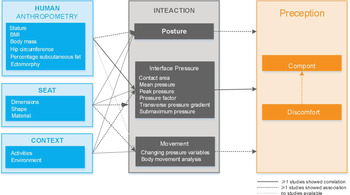
In terms of sitting postures studies, Mastrigt et al. (Reference Mastrigt, Groenesteijn, Vink and Kuijt-Evers2016) discussed the relationship among context, seat, behavior, sitting posture, cushion pressure, and discomfort in aircraft (Fig. 1). According to Mastrigt et al. (Reference Mastrigt, Groenesteijn, Vink and Kuijt-Evers2016), the sitting postures of aircraft passengers were influenced by three factors: (1) human anthropometry, such as height, body mass, and hip circumference; (2) seat, such as dimensions, shape, and reclined backrest angle; and (3) context, which include activities and the environment. A similar research by Vanacore et al. (Reference Vanacore, Lanzotti, Percuoco, Capasso and Vitolo2019) on posture induced by activity (Kamp et al., Reference Kamp, Kilincsoy and Vink2011; Ellegast et al., Reference Ellegast, Kraft, Groenesteijn, Krause, Berger and Vink2012; Groenesteijn et al., Reference Groenesteijn, Ellegast, Keller, Krause and Looze2012), and effect of posture on seat-interface pressure distribution (Vos et al., Reference Vos, Congleton, Moore, Amendola and Ringer2006; Moes, Reference Moes2007; Tessendorf et al., Reference Tessendorf, Arnrich, Schumm, Setz and Troster2009; Kyung and Nussbaum, Reference Kyung and Nussbaum2013), showed the closest correlation between objective measure and subjective (dis-)comfort rating. Thus, human anthropometry, seat, and context should be involved in the study of sitting postures.
Overview of relationships between the variables.

Recent advancement in machine learning has culminated in the application of machine learning algorithms in many studies, such as prediction of the three-dimensional posture of the spine in various activities (Gholipour and Arjmand, Reference Gholipour and Arjmand2016), prediction of the subjective perceptions of drivers’ comfort (Kolich, Reference Kolich2004) and classification of sitting postures (Zhu et al., Reference Zhu, Martinez and Tan2003; Meyer et al., Reference Meyer, Arnrich, Schumm and Troster2010; Zemp et al., Reference Zemp, Tanadini, Plüss, Schnüriger, Singh, Taylor and Lorenzetti2016; Ma et al., Reference Ma, Li, Gravina and Fortino2017). Machine learning has also been applied in research bordering on aircraft passengers’ discomfort as well as seat design and manufacturing. Aircraft seat sensors can provide some feedback information, which can help to identify passengers’ status and comfort in the near future with machine learning. Airbus commercial laboratory pointed out that the measurement of the lifting frequency of intelligent seat armrest employing sensors can provide guidance for design engineers on how to carry out armrest durability design. Thus, the detection and recognition of sitting postures employing machine learning methods have been widely studied because of its potential in improving people's comfort and forestalling the occurrence of related diseases. It can adequately educate chair users about their sitting postures (Zubic, Reference Zubic2007) and guide them in adopting beneficial postures that could efficaciously prevent workplace musculoskeletal diseases (Yoo et al., Reference Yoo, Yi and Kim2006). According to Mutlu et al. (Reference Mutlu, Krause, Forlizzi, Guestrin and Hodgins2007), posture recognition could help infer emotional states, detect irregular behaviors, and control human–computer interaction applications. The research above provided a theoretical basis and foundation for the adoption of machine learning methods to study aircraft passengers’ sitting postures. Consequently, machine learning methods will be exploited in this study to detect and recognize the sitting postures of aircraft passengers.
There are two main types of sitting posture measurement: image processing technology (Lan et al., Reference Lan, Ke and Wu2010; Song-Lin and Rong-Yi, Reference Song-Lin and Rong-Yi2010) and sensor-based technology (Li et al., Reference Li, Wang, Johan, Jen and Young1999; Tan et al., Reference Tan, Slivovsky and Pentland2001; Kamiya et al., Reference Kamiya, Kudo, Nonaka and Toyama2008; Tessendorf et al., Reference Tessendorf, Arnrich, Schumm, Setz and Troster2009; Foubert et al., Reference Foubert, McKee, Goubran and Knoefel2012). Image recognition is easy, noninvasive, and user-friendly, but be complicated by variations in the lighting or background condition, camera or subject positions, and subject appearance (Mota and Picard, Reference Mota and Picard2008). In addition, passengers’ privacy will be violated if cameras are installed in aircraft. Compared with image processing technology, pressure sensors can accurately collect the pressure information between passengers and seat in real-time, which will aid research on the discomfort of aircraft passengers. Furthermore, passengers’ sitting postures can be detected in real-time employing pressure sensors which could help detect (1) the duration of their static sitting postures, (2) the frequency of changes in their sitting postures and muscle force, and (3) load on specific body parts, etc. Thus, pressure sensors were exploited to detect and recognize sitting postures in many researches.
The recognition of sitting posture employing pressure sensors that has long been studied by researchers. The concept of instrumented or sensing chairs was first introduced by Tan and co-workers (Tan et al., Reference Tan, Slivovsky and Pentland2001; Tan and Ebert, Reference Tan and Ebert2002). The authors placed surface-mounted pressure distribution sensor mats over the seat pan and the backrest to obtain real-time information of the chair–user interaction. Mota and Picard (Reference Mota and Picard2008) employed the same measuring system to analyze nine different sitting positions but in a dynamic setup. In order to teach the pattern recognition algorithm, two observers labeled the different sitting positions employing video analysis, which produced an overall classification accuracy of 87.6% in new subjects. Tessendorf et al. (Reference Tessendorf, Arnrich, Schumm, Setz and Troster2009) employed pressure distribution patterns acquired from a pressure mat to generate 16 prototype sitting postures which they used to classify incoming pressure data. Similarly, Xu et al. (Reference Xu, Gang, Wang, Shen and Shen2012) developed a technique to recognize nine different sitting postures based on binary pressure distribution data. Meanwhile, in order to reduce the complexity and cost of the measurement system, some studies focused on the analysis of sitting postures using several single axis force or pressure sensors apart from the pressure distribution sensor mat. Schrempf et al. (Reference Schrempf, Schossleitner, Minarik, Haller and Gross2011) proposed a method based on a regular adjustable office chair which was equipped with four independent, specially designed force transducers; Meyer et al. (Reference Meyer, Arnrich, Schumm and Troster2010) employed a textile pressure sensor mat with 96 elements on the seat pan and 1 element on the backrest to classify 16 different static sitting positions. The Smart Cushion system introduced by Xu et al. (Reference Xu, Huang, Amini and He2013) consists of a 16 × 16 textile pressure sensor mat placed at the seat pan of a conventional chair. By applying a time warping-based classification algorithm, an accuracy level of almost 86% was achieved for seven different postures. Zemp et al. (Reference Zemp, Tanadini, Plüss, Schnüriger, Singh, Taylor and Lorenzetti2016) developed an instrumented chair with force and acceleration sensors to determine the accuracy of automatic identification of the user's sitting position by applying five different machine learning methods. The classification accuracy varied between 81% and 98% for the seven different sitting positions. Jongryun et al. (Reference Jongryun, Hyeong-Jun, Kwang and Hyeong2018) developed a system that measured a total of six sitting postures and demonstrated the possibility of classifying the sitting postures even though the number of sensors was reduced. The above-reported studies demonstrate that it is possible to detect different sitting postures with considerable accuracy by means of conventional and single axis force sensor mats. In this study, pressure sensors [Body Pressure Measurement System (BPMS) of Tekscan] were employed to ensure a flawless and precise recognition accuracy.
Among the studies conducted on sitting postures, we found that passengers’ sitting postures play an important role in the discomfort of aircraft passengers. However, there are few studies that have analyzed the sitting postures of aircraft passengers to the best of our knowledge. Most of the studies focused on the discomfort induced by office chairs and driver's seats (Mastrigt et al., Reference Mastrigt, Groenesteijn, Vink and Kuijt-Evers2016). Furthermore, the sitting postures adopted in previous studies did not involve factors of human anthropometry, seat, and context and was inconsistent with the actual sitting postures. In addition, pressure sensors could detect different sitting postures with considerable accuracy, making them a suitable method for detecting passengers’ sitting postures. Thus, the aim of this study is to detect the sitting postures of aircraft passengers and recognize these postures employing several machine learning methods. Based on the above studies, two hypotheses were constructed in this paper: (1) Several types of specific sitting postures of aircraft passengers would be obtained from the flight simulated experiment. (2) The sitting postures classified above would be recognized with pressure sensor data using machine learning methods with ideal accuracy.
In this study, the term sitting posture is used to connote posture that is related to movement of the trunk, back, and legs of passengers’ body when they were strapped to the seat. Activities refer to the specific behavior of passengers such as eating, working, and sleeping, while behavior refer to an action in a general sense.
Materials and methods
Subjects
A total of 24 Chinese subjects (16 females and 8 males) in the age bracket of 22–30 were recruited. The demographic characteristics are presented in Table 1. It shows the subjects’ indicators [age, height, body mass, and body mass index (BMI)] and their related descriptive statistics, expressed as mean ± standard deviation. The sample of 16 females and 8 males (height ranging from 1.56 to 1.80 m) may represent the mean and larger percentiles of Chinese people (Li et al., Reference Li, Yu, Yang, Pei and Zhao2017). Participants were carefully selected; the subjects were pain free and healthy. Informed consent was obtained from participants and the study was approved by the Ethics Committee of Northwest Polytechnic University.
Demographic characteristics of the participants (n = 24)

Experimental design
We conducted our experiment in a laboratory situated in Northwest Polytechnic University. The room temperature of the laboratory was 23 ± 2°C, the relative humidity was between 48% and 60% (Li et al., Reference Li, Yu, Yang, Pei and Zhao2017), and the environment noise level was set to 40–60 dB.
Before the experiment, participants had about 10 min to relax and prepare and were fully informed of the content, duration of the experiment, the purpose of the study, and the methods for analysis of the collected data. In order to make subjects exhibit real feelings and behaviors during the experiment, we had a conversation with them about their previous feelings before the experiment, in a bid to evoke their flying experiences.
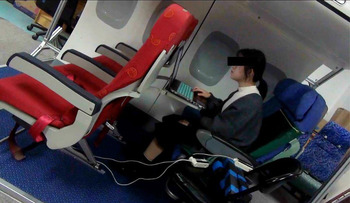
During the experiment, subjects took turns to complete the following activities according to the instruction of the experimenter: used mobile phone for 10 min, chatted for 20 min, worked for 25 min, ate for 15 min, and slept for 50 min. Subjects were not given any additional guidance or feedback except five predefined sequential activities as our goal was to obtain subjects’ natural sitting postures. During the 2 h experiment, subjects’ sitting postures data was recorded with two pressure sensors [Body Pressure Measurement System of Tekscan (BPMS), South Boston, MA, USA] and a video camera in real-time. Pressure data was recorded at 5 Hz with the BPMS software matched with the pressure mat in order to obtain more precise data from the two pressure sensors. The movements and postures of participants were recorded by a video camera during the whole experiment. The experiment involving human subjects carried out in the laboratory is shown in Figure 2. The experiment would be terminated once an anomaly is observed in the data of the two pressure sensors and camera during the experiment. It should be noted that the 2 h duration setting of this experiment was aimed at studying the sitting posture of regional airliner in short and medium-haul flight.
Experiment of subjects in the laboratory (the length, width, height, and seat pitch of the seat are 53, 52, 116, and 98 cm, respectively).

After the experiment, participants’ demographics (gender, age, height, body mass, and BMI) were measured and the participants were thanked for their participation. The flowchart of the experiment is shown in Figure 3.
Flowchart of the experiment.

Sitting postures detection
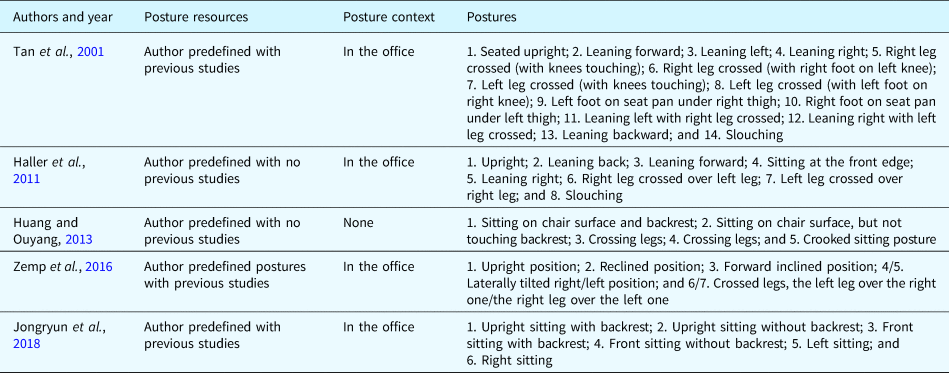
The sitting postures reported in previous studies are summarized in Table 2. As can be seen from the table, the sitting postures reported in different studies were completely different. Moreover, these sitting postures adopted by many studies emanated from either the earlier studies or defined by the authors with less contextual information. For example, the sitting postures reported in Zemp et al. (Reference Zemp, Tanadini, Plüss, Schnüriger, Singh, Taylor and Lorenzetti2016) emanated from previous studies (Mota and Picard, Reference Mota and Picard2003; Haller et al., Reference Haller, Richter, Brandl, Gross and Inami2011; Xu et al., Reference Xu, Huang, Amini and He2013). Furthermore, the sitting postures reported by Haller et al. (Reference Haller, Richter, Brandl, Gross and Inami2011) were predefined directly by them. However, as mentioned above, sitting postures were influenced by human anthropometry, seat, and context. Thus, this study went a step further in the classification of passengers’ sitting postures.
Summary of previous studies on sitting postures definition and recognition

In our experiment, flight scenario was simulated with subjects of a variety of human anthropometry. The five most common activities were set, which basically covered the three factors (human anthropometry, seat, and context) that influenced the sitting postures of passengers. After the analysis of sitting posture data, we found that the sitting postures of each subject varied a little due to individual differences and personal habit, and each subject exhibited only a limited number of specific sitting postures. Although the sitting posture of each subject was not the same, they still had something in common.
In the experiment, it was found that activities had a great influence on the sitting postures and the postures of different activities were different. Specifically, subjects exhibited a proclivity for leaning forward when they worked. Contrarily, they leaned backward when they assumed a relaxed and resting posture (i.e., chat, use mobile phone, eat, and sleep). Besides, subjects changed several postures owing to the long duration of sleep. Also, subjects maintained one posture for a long time because of the inactive state of the body. All the changes associated with the five activities mentioned above reflected on the positions of three key parts of the subjects’ body (i.e., trunk, back, and legs). Thus, the three key parts of the subjects’ body were the most imperative body parts that affected passengers’ sitting postures. For example, when subjects leaned forward, their trunks moved forward; when they leaned backward, the position of their trunks was opposite. The same situation was observed when subjects leaned to the right and left. In addition, when subjects crossed their legs, there was a significant change in the sitting postures. Based on the above analysis, the sitting postures were classified according to the positions of the three key parts of the body, which we described further in the “The recognition of sitting posture” section.
Sitting postures recognition methods
In the data analysis, we discovered that each posture of the 24 subjects was maintained for a period of time and then changed into another posture. In other words, although the experimental time lasted for 2 h, each subject exhibited only about 20 postures. Thus, 489 sitting postures were extracted from the experimental video and the pressure data of the 489 sitting postures was employed to construct machine learning models. Each pressure data of the 489 sitting postures contained 16 dimensions pressure data, while the whole model involved 7824 pressure data. The 16 dimensions pressure data refers to the 8 dimensions pressure data (i.e., object pressure, peak object pressure, peak contact pressure, peak force, contact area, contact pressure, force, and force center) of the backrest and seat pan, respectively.
Previous studies showed that several different machine learning methods were exploited for the classification of sitting postures (Zemp et al., Reference Zemp, Tanadini, Plüss, Schnüriger, Singh, Taylor and Lorenzetti2016; Jongryun et al., Reference Jongryun, Hyeong-Jun, Kwang and Hyeong2018). In this study, five algorithms [K-nearest neighbor, support vector machine (SVM), random forest, decision tree, and Naïve Bayes] were compared to obtain the highest classification accuracy.
-
(1) K-nearest neighbor
K-nearest neighbor algorithm categorizes different classes by measuring the distance between different eigenvalues (Cover and Hart, Reference Cover and Hart2003). Its working principle is hinged on the existence of a sample data set, also known as the training sample set, and each data in the sample set has a label that shows the corresponding relationship between each data in the sample set and its classification. After inputting the new data without labels, each feature of the new data was compared with several corresponding features of the sample data, and then the classification labels of the most similar data (nearest neighbor) of the sample were extracted. In this study, the best classification performance was achieved when n_neighbors were set to 6 after grid searching for different parameters.
-
(2) Support vector machine
Support vector machine is a group of supervised learning methods that can be used for classification or regression purposes (Burges, Reference Burges1998; Gao et al., Reference Gao, Zhang, Duan, Yang and Zhang2010). It is a two class classification model. Its basic model is defined as the linear classifier with the largest interval in the feature space. Its learning strategy is to maximize the interval, which can be transformed into a convex quadratic programming problem. In this study, the best classification performance was achieved when radial basis function (RBF) kernel was employed and the regularization coefficient was set to 5 after the trial of different parameters.
-
(3) Random forest
In machine learning, random forest is a classifier with multiple decision trees, and the output category is determined by the mode of the output category of individual trees (Breiman, Reference Breiman2001). Random forest integrates multiple trees by exploiting the idea of ensemble learning into an algorithm. Its basic unit is decision tree, and its core essence is tied to a big branch of machine learning ensemble learning method. The best classification performance was achieved when n_estimators were set to 800, max_depth was set to 5 after the trial of different parameters in this study.
-
(4) Decision tree
Decision tree classification algorithm is an inductive learning method that is based on instances in which tree classification models can be extracted from given disordered training samples (Safavian and Landgrebe, Reference Safavian and Landgrebe2002). The decision tree algorithm first divides a pile of data into subsets according to a certain condition (feature) to construct a tree. Thereafter, a new data emerges for comparison of the new data one after the other according to the conditions specified during construction of the tree, until the leaf node is found to determine the category. The best classification performance was achieved when the criterion was set to entropy, and random_state was set to 5 after the trial of different parameters.
-
(5) Naïve Bayes
Naïve Bayes is a classification method based on the Bayes theorem and independent assumption of feature conditions (Bermejo et al., Reference Bermejo, Gamez and Puerta2014). For a given training data set, the joint probability distribution of input/output is learned based on the independent presumption of characteristic conditions. According to this model, the output with the maximum a posteriori probability for a given input is obtained employing the Bayesian theorem. In this study, the model of the algorithm was set to GaussianNB.
In the construction of the machine learning model, the data set of training and test were classified randomly based on the 24 subjects’ pressure data (totaling 8313 data), of which 6256 data belonged to the training set and 2057 data belonged to the test set.
In the algorithm analysis, principal component analysis (PCA) was exploited to reduce the dimensionality of the data as well as extract the features (principal components) that represented the most informative data due to the redundancy of the 16 dimensions pressure (Tan et al., Reference Tan, Slivovsky and Pentland2001). Finally, 16-dimensional pressure data were reduced to 4-dimensional pressure data with 95% of the original data retained. In this regard, on the basis of ensuring the seamless performance of the algorithm, the calculated amount of the model was reduced. In this study, scikit-learn algorithm toolkit based on Python was used to build the machine learning models.
Results
The detection of sitting postures
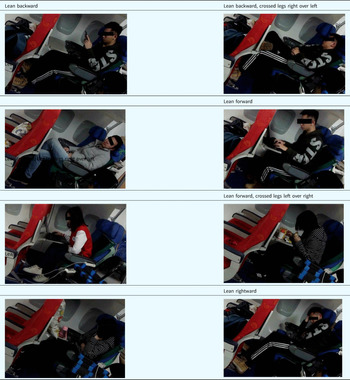
As mentioned in the “Sitting postures detection” section, the three key parts of the human body (i.e., trunk, back, and legs) were the basis for our classification of the sitting postures of aircraft passengers. Based on the above analysis, and report of previous studies (Zemp et al., Reference Zemp, Tanadini, Plüss, Schnüriger, Singh, Taylor and Lorenzetti2016; Jongryun et al., Reference Jongryun, Hyeong-Jun, Kwang and Hyeong2018), we finally classified passengers’ sitting postures into eight types, as seen in Table 3. These eight sitting postures were the most prevalent and representative sitting postures of airplane passengers.
The eight types of sitting postures of aircraft passengers

As discussed above, the sitting postures in aircraft were different from that of office and driving sitting postures (see Table 2). The uniqueness of aircraft passengers’ sitting postures is hinged on: (1) the fact that sitting space is very narrow; (2) passengers will spend several hours in the journey, and most of the time they are strapped to their seats; and (3) passengers perform only a few specific activities, while most people will sleep during the journey. The uniqueness of the above sitting postures induced special sitting postures during the flight. Thus, the eight sitting postures which emanated from the simulation flight experiment could fully reflect the uniqueness (affected by human anthropometry, seat, and context) of aircraft passengers’ sitting postures. In this regard, the hypothesis (1) was confirmed.
The recognition of sitting posture
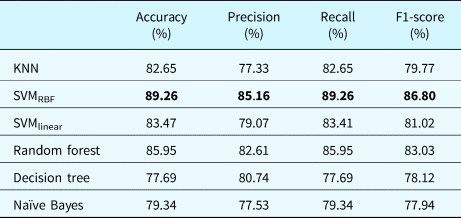
In this section, the sitting postures classified above were recognized by five machine learning models mentioned in the “Sitting postures recognition methods” section. Regarding the recognition of the sitting postures, the output was eight sitting postures mentioned in the “The detection of sitting postures” section, and the input was the pressure data of the two pressure sensors installed on the backrest and seat pan of the 24 subjects for 2 h. The recognition results were analyzed from four dimensions: accuracy, precision, recall, and F1-score. After loading the pressure data into different machine learning models and debugging different parameters for the best results, we were able to compare several machine learning models. The SVM with RBF kernel attained the best classification accuracy of 89.26%, as shown in Table 4. The results revealed that the random forest model also achieved satisfactory classification results. Thus, the hypothesis (2) was also confirmed.
Comparison of sitting postures recognition of different machine learning models based on the pressure data

These bold values are the best performance data among all the models.
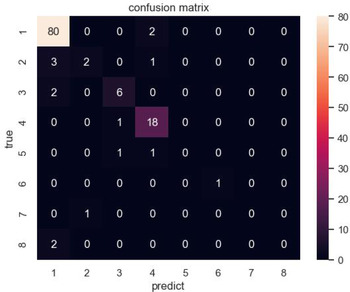
The confusion matrix of SVM with RBF kernel is presented in Figure 4. From the confusion matrix of SVM, sitting postures 1 (leaning backward) and 4 (leaning forward) were the two most accurate postures predicted by the model.
Confusion matrix of SVM with RBF kernel. Rows indicate predicted labels, columns refer to true classes. Class labels represent 1: lean backward; 2: lean backward, crossed legs right over left; 3: lean backward, crossed legs left over right; 4: lean forward; 5: lean forward, crossed legs right over left; 6: lean forward, crossed legs left over right; 7: lean leftward; and 8: lean rightward.

Discussion
This study focused on sitting posture detection and recognition of aircraft passengers. A total of eight types of sitting postures of subjects were classified through the flight simulation experiment and recognized according to the seat pressure sensors data employing machine learning models. Among several machine learning methods, SVM with RBF kernel attained the best classification performance of 89.26%, which showed that seat pressure sensors data had good classification capacity for the recognition of aircraft passengers’ sitting postures. Based on the classification results, we can distinguish passengers’ sitting postures employing the pressure data of seat in order to improve the comfort and experience of aircraft passengers.
As discussed above, sitting postures were affected by human anthropometry, seat, and context. However, the sitting postures of previous studies did not involve these three factors, as seen in Table 2. In our experiment, the sitting postures obtained fully reflected the three factors and therefore were more in line with the real scene. Furthermore, we found that the three factors that affected sitting postures would ultimately be reflected in trunk, back, and legs of the human body. Based on the above analysis, all the sitting postures in our experiment (totaling 489 sitting postures) were classified into eight types, which were the most prevalent and representative sitting postures of airplane passengers. Thus, the sitting postures classification method demonstrated in this study provides a insight for the study of sitting postures that sitting postures are not isolated, but closely related to human activities and context.
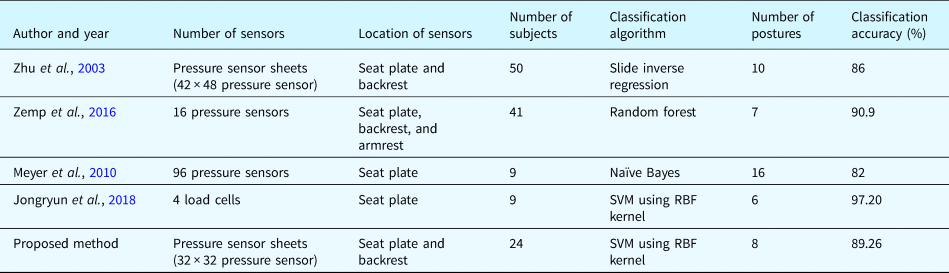
There were two methods employed for the recognition of sitting postures. One was to induce the corresponding sitting posture. Another method was to collect the pressure data of subjects’ sitting postures in real context, which we adopted in this study. In the first method, their effect has focused on recognition of static postures made by participants who intentionally position themselves into postures as requested and predefined by the experimenter. Then, the experimenter collected the cushion pressure data which was used to recognize the sitting postures. This kind of research could generally produce a high recognition accuracy, but the disadvantage is that these postures are deliberately made by the subjects, with no real context information. However, as mentioned above, passengers’ sitting postures were greatly influenced by the context and other factors. These isolated postures did not match passengers’ real sitting postures. Table 5 shows the comparison of sitting posture classification between previous studies and the proposed method. Although the classification accuracy of this study was not the highest, the recognition of sitting postures in this study was still valuable. Firstly, we gathered data of naturally occurring postures, as opposed to the other studies presented in Table 5, in which their postures were deliberately made and with few context factors. Secondly, the sitting postures of other studies presented in Table 5 were all in office context, with no aircraft passengers’ sitting posture. Hence, the eight types of sitting postures we classified in this study provided foundation for aircraft passengers’ sitting postures. It should be noted that the purpose of this study was not to achieve the highest classification accuracy, but to demonstrate and prove the feasibility of our research method. In other words, the acceptable high recognition accuracy could still be obtained through the natural sitting postures. Therefore, this study provides a new idea that sitting postures should be detected within their specific scene, rather limited to the deliberately setting. This type of recognition of sitting postures holds high practical application value for passengers’ comfort (Zhu et al., Reference Zhu, Martinez and Tan2003; Zemp et al., Reference Zemp, Tanadini, Plüss, Schnüriger, Singh, Taylor and Lorenzetti2016).
Comparison of sitting posture classification of previous studies and this study

The detection and recognition with machine learning methods of passengers’ sitting postures promises potential advancement in terms of passengers’ discomfort as well as seat design and manufacturing. Passengers’ discomfort could be measured by the pressure data of the sitting postures. According to Arnrich et al. (Reference Arnrich, Setz, Marca, Troster and Ehlert2010b), sitting posture could be used for measuring healthy sitting behaviors. Passengers’ sitting postures could be detected in real-time with seat pressure sensors, which could help detect the duration of their static sitting postures, change frequency of their sitting postures, muscle force and load on specific body parts, etc. During the flight, passengers may change their postures owing to cumulative fatigue when they maintain a stationary posture for a period of time. This type of change in posture could be detected by pressure data. A similar research by Le et al. (Reference Le, Rose, Knapik and Marras2014) showed that frequent movements by the driver over time helped reduce stress from discomfort. In this regard, passengers’ discomfort could further be reduced by seat design. The studies of De Looze et al. (Reference De Looze, Kuijt-Evers and Dieën Jaap2003), Franz et al. (Reference Franz, Kamp, Durt and Kilincsoy2011), and Zemp et al. (Reference Zemp, Taylor and Lorenzetti2015) indicated that a large contact area between the seat and human body decreased the effect of discomfort perception. Therefore, Smulders et al. (Reference Smulders, Berghman, Koenraads, Kane, Krishna, Carter and Schultheis2016) presumed that developing an aircraft seat based on human contour could ameliorate pressure distribution and accordingly decrease discomfort perception. Also, the seat could be designed to adjust automatically or be realigned to prevent muscle fatigue and even diseases induced by long-term fatigue and static sitting in relation to the detection and recognition of sitting postures. Furthermore, passengers’ potential needs could be satisfied by seat design that permits automatic adjustment of seat's angle to promote healthier sitting behaviors for passengers, and facilitate the turning off of lights when passengers fall asleep, etc. Posture channel also contains affective information related to passengers’ experience. With posture recognition, posture sequences could be conducted to discover affective interpretations associated with postural behaviors. Bull presented results showing that both body movements and positions transmit information about emotions. For example, the upsetting passengers may reveal higher variance of movements. In a further study, Arnrich et al. (Reference Arnrich, Kappeler-Setz, Schumm and Trooster2010a) incorporated sensor technology into an airplane seat with the aim of unobtrusively measuring physiological signals to recognize passengers’ emotion with reliable and unobtrusive recording of relevant physiological signals. Therefore, the integration of multiple physiological measures (near-infrared spectroscopy, electromyography, electrocardiography, skin electricity, etc.) into the sensing chair to measure the discomfort and experience of passengers is also a direction of seat design.
On the basis of previous studies, several existing classical machine learning methods were compared in this study. After comparing KNN, SVM with linear kernel and RBF kernel, Random Forest, Decision Tree, and Naïve Bayes with the trial of different parameters on the four indexes (i.e., accuracy, precision, recall, and F1-score), SVM with RBF kernel was found to have the highest recognition accuracy. Compared with other studies presented in Table 5, it was found that the algorithm attained the highest recognition accuracy was different in terms of different types of sitting postures. Consequently, different machine learning methods should be explored to achieve the highest recognition accuracy of sitting postures in follow-up studies. In this study, the posture that achieved the highest classification accuracy was sitting posture 1 (leaning backward). Interestingly, according to Zemp et al. (Reference Zemp, Tanadini, Plüss, Schnüriger, Singh, Taylor and Lorenzetti2016), sitting posture 4 (leaning forward) had the highest classification accuracy. The reason for this difference can be attributed to the different sitting contexts. In Zemp et al. (Reference Zemp, Tanadini, Plüss, Schnüriger, Singh, Taylor and Lorenzetti2016) study, people tended to lean forward when they were working in office, while in this study, passengers tended to lean backward for relaxation in flight. This difference also confirmed that sitting postures were affected by the context.
There were some limitations associated with this study. Limited to the experimental environment, we could only simulate passengers sitting activities in the simulated laboratory. In addition, the ages of our experimental subjects varied from 22 to 30; so, the results are only suitable for Chinese in the same age bracket. Mastrigt et al. (Reference Mastrigt, Groenesteijn, Vink and Kuijt-Evers2016) reported that sitting postures and pressure distribution are also influenced by age. Seat surface temperature is also a factor that affects the sitting postures of passengers. Sitting on the seat for a long time will cause the skin surface temperature of the human body parts in contact with the seat to rise, causing discomfort (Hales and Bernard, Reference Hales and Bernard1996; Lengsfeld et al., Reference Lengsfeld, Van Deursen, Rohlmann, Van Deursen and Griss2000; Konz, Reference Konz2002; Szeto et al., Reference Szeto, Straker and Raine2002). In this scenario, passengers would change their sitting postures to relieve discomfort. In this study, although we used the seat in the plane to conduct the experiment, subjects’ buttock and back were not directly in contact with the seat surface and backrest, but with the pressure cushion. Consequently, the sitting postures of subjects were also affected by the pressure sensors.
Conclusion
This study has explored the detection and recognition of aircraft passengers’ sitting postures. In the flight simulated experiment, eight types of sitting postures were detected based on the trunk, back, and legs of the human body and recognized with pressure sensors by SVM with RBF kernel that achieved the classification rates of 89.26%. The recognition of aircraft passengers’ sitting postures provided some reference point and baseline information on aircraft passenger discomfort. Furthermore, intelligent seat can be designed by the recognition of passengers’ sitting posture, which could be employed to detect passengers’ sitting postures at any time and respond automatically to passenger's potential needs in aircraft.
Competing interest
The authors report no conflicts of interest. The authors alone are responsible for the content and writing of the paper.
Wenzhe Cun is a doctoral candidate at Shaanxi Engineering Laboratory for Industrial Design in Northwestern Polytechnic University. He obtained his BSc degree (2015) in Guangxi University and MSc degree (2018) in Guizhou University, China, both in Industrial Design. His research interests are aviation seat comfort, multimodal human–machine interaction, aircraft cockpit design, etc.
Rong Mo is a professor at Northwestern Polytechnic University. She obtained a master's degree major in Automatic Control from Xi'an Jiaotong University; another master's degree in Aerospace Manufacturing Engineering from Northwestern Polytechnic University (1982), and a doctor's degree in Aerospace Manufacturing Engineering (1994). She worked as a joint doctoral student in Northwestern Polytechnic University and Berlin University of Technology in Germany from 1992 to 1994. Her research interests are computer graphics, aeronautics, and astronautics.
Jianjie Chu is a professor at Shaanxi Engineering Laboratory for Industrial Design in Northwestern Polytechnic University. His research interests are computer-aided industrial design, human–computer interaction of aircraft cockpit, user experience, etc.
Suihuai Yu is a professor at Shaanxi Engineering Laboratory for Industrial Design in Northwestern Polytechnic University. His area of focus is industrial design and computer-aided industrial design.
Huizhong Zhang is an assistant professor at Shaanxi Engineering Laboratory for Industrial Design in Northwestern Polytechnic University. His research interests are user experience, discomfort of aircraft passengers, and physiological data measurement.
Yanhao Chen is a doctoral candidate at Shaanxi Engineering Laboratory for Industrial Design in Northwestern Polytechnic University. He is interested in aircraft interior design, pilot's driving performance in the light environment.
Hao Fan is a doctoral candidate at Shaanxi Engineering Laboratory for Industrial Design in Northwestern Polytechnic University. His research area is human ear ergonomics. He visited the University of California, Berkeley, as a visiting scholar from 2019 to 2020.
Mengcheng Wang is a doctoral candidate at Shaanxi Engineering Laboratory for Industrial Design in Northwestern Polytechnic University. She visited the University of California, Berkeley between 2018 and 2020 as a visiting scholar. Her research areas include human–robot interaction, robot posture research, etc.
Hui Wang is a doctoral candidate at Shaanxi Engineering Laboratory for Industrial Design in Northwestern Polytechnic University. Her research area is human perception in ergonomics.
Chen Chen is a doctoral candidate at Shaanxi Engineering Laboratory for Industrial Design in Northwestern Polytechnic University. Her research area is the research on group awareness of networked collaborative.