Introduction
Labiaplasty is a surgical procedure in women that usually reduces the degree of protrusion of the labia minora. The desire for labiaplasty is becoming increasingly common, with the incidence in the National Health Service (NHS) of 1726 in the year 2010–2011 (Health and Social Care Information Centre, 2012). The number of labiaplasties conducted in the private sector is unknown, but the procedure is often discussed in the media and marketed on the Internet. Liao et al. (Reference Liao, Michala and Creighton2010) identified 18 publications covering 937 case reports or series of labiaplasty worldwide up to March 2009. We conducted a similar search of reports published after March 2009 and found a further six publications and 64 additional cases.
Social and cultural factors might be driving demand for general cosmetic surgery. Some women may be seeking flat vulvas with no protrusion beyond the labia majora, from seeing porn actresses on the Internet or desiring a prepubescent aesthetic ideal that is seen in advertisements (Liao & Creighton, Reference Liao and Creighton2007) or women's magazines (Bramwell, Reference Bramwell2002). However there is still a lack of knowledge regarding the motivation and psychological characteristics of women who seek labiaplasty. Bramwell et al. (Reference Bramwell, Morland and Garden2007) have conducted a qualitative study, involving a thematic analysis of a structured interview, on six women who had previously undergone labiaplasty. They reported that all the women described feeling their genital appearance as ‘weird’ or abnormal prior to the surgery. Women reported the appearance of their genitals as having a negative impact on their sex lives, including inhibition of sexual relationships. Braun (Reference Braun2009) has also reviewed the reasons for undergoing labiaplasty in previous case reports provided by surgeons and found that they fell broadly into either aesthetic or functional categories.
Some women seeking labiaplasty may have body dysmorphic disorder (BDD). This is characterized by a preoccupation with a perceived defect that is not observable or appears slight to others while the person's concern is markedly excessive. Crouch et al. (Reference Crouch, Deans, Michala, Liao and Creighton2011) have described the size of the labia of women seeking labiaplasty to be within normal published limits. To fulfill the diagnostic criteria for BDD, however, the perceived defect must be either significantly distressing or cause impairment in social, occupational or other important areas of functioning. The most common preoccupations in BDD are the facial skin, nose, eyes, eyelids, mouth and chin – or just being ugly in general (Neziroglu & Yaryura-Tobias, Reference Neziroglu and Yaryura-Tobias1993; Phillips et al. Reference Phillips, McElroy, Keck, Pope and Hudson1993; Veale et al. Reference Veale, Boocock, Gournay, Dryden, Shah, Willson and Walburn1996 a ,Reference Veale, Gournay, Dryden, Boocock, Shah, Willson and Walburn b ; Phillips & Diaz, Reference Phillips and Diaz1997). However, a preoccupation with the size or shape of the labia being abnormal or too large is an uncommon presentation of BDD in a mental health setting.
The current study was therefore exploratory and designed to discover more about the characteristics and motivation of women seeking labiaplasty by comparing such a population with a control group of women from the community who were not seeking labiaplasty. We hypothesized that women seeking labiaplasty, in comparison with control women, would report significantly worse symptoms of anxiety and depression, reduced sexual satisfaction, greater negative effect of body image on quality of life, lower genital appearance satisfaction, and greater frequency of BDD. Another aim of the study was to explore the motivation for seeking labiaplasty and to examine the extent to which women's concerns with their labia interfered in their life. We also wanted to identify the specific avoidance and safety-seeking behaviours that may be relevant for developing a psychological intervention. A safety-seeking behaviour is any behaviour performed in order to prevent or minimize a feared catastrophe (Salkovskis, Reference Salkovskis1991). For women seeking labiaplasty the catastrophe may include being humiliated or rejected by others. We hypothesized that the form of the behaviours may be similar to those seen in BDD (Lambrou et al. Reference Lambrou, Veale and Wilson2012). Thus the safety strategies may be designed to verify whether the labia are abnormal or to camouflage the genitalia during sexual encounters. Avoidance behaviours might include avoidance of intimacy or public changing rooms.
Method
Participants
We recruited 125 women who were categorized into two groups:
-
(1) Women seeking labiaplasty. We recruited 55 women seeking labiaplasty from the following sources: (a) 31 (56.4%) from a private cosmetic clinic. These were recruited from a total of 73 women who had labiaplasty in the recruitment period who were given written information about the study; (b) 19 (34.5%) from an NHS gynaecology clinic. These were drawn from a total of 35 women who had a labiaplasty and were given information about the study (c); five (9.1%) by an email from a research volunteer database of individuals in the community (Mind Search) at the Institute of Psychiatry, King's College London. The Mind Search database contains details of over 3500 individuals who have volunteered to participate in psychological or psychiatric research. The five women who volunteered were not seen in a clinic but were either seeking labiaplasty or indicated that they would seek labiaplasty if they could afford it in the future.
-
(2) Controls. We recruited 70 women for the control group from the following sources: (a) 31 (44.3%) from a gynaecology clinic in the state sector, where the individuals recruited by the surgeon were having a non-cosmetic gynaecological surgical procedure on the NHS; and (b) 39 (55.7%) by an email to the research volunteer database (Mind Search, described above). The women in the control group were asked to participate in a study that aimed to explore women's attitudes towards their external genitalia. They were characterized by not requesting or wanting labiaplasty.
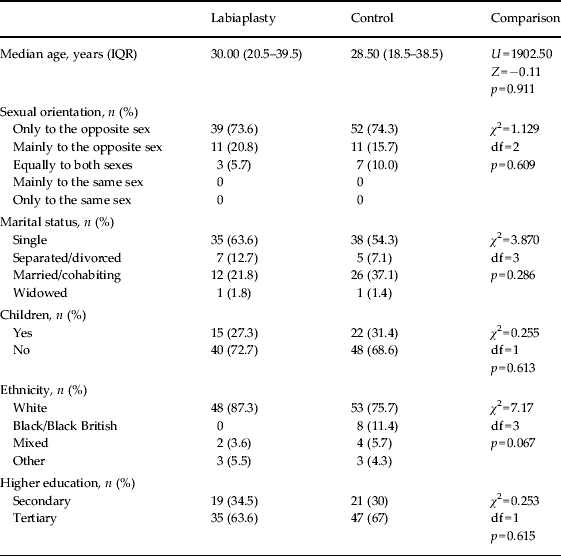
In order to take part, all participants were required to be between 18 and 60 years of age, and proficient in English (in order to provide consent and complete the questionnaires). There were no significant differences between the two groups in age, sexual orientation, marital status, education, ethnicity or pari Oty (Table 1). There was a trend towards Black or Black British women in the control group but this was not statistically significant.
Participant demographics and comparisons between the labiaplasty (n = 55) and control (n = 70) groups

IQR, Interquartile range; df, degrees of freedom.
Procedure
Participants in the gynaecology or cosmetic surgery setting were recruited after they had been assessed by a surgeon and invited to participate in the study. Participants were also recruited from Mind Search whereby their contact details (emails) were provided to us for 225 people. Of these volunteers invited to participate by email, 51 responded and 41 participated to completion. Participants from both groups completed the questionnaires listed below, either online or in a pen-and-paper format. Participants who scored more than the cut-off score on the Cosmetic Procedure Screening questionnaire (Veale et al. Reference Veale, Ellison, Werner, Dodhia, Serafty and Clarke2011) were interviewed to determine whether they might fulfil the diagnostic criteria of BDD. A trained research worker experienced in BDD conducted the interview.
Only participants in the labiaplasty group were asked about the duration of their problem and their motivation for seeking labiaplasty.
Materials
Hospital Anxiety and Depression Scale (HADS; Zigmond & Snaith, Reference Zigmond and Snaith1983)
The HADS is a 14-item self-report instrument used to examine the severity of anxiety and depressive symptoms in two separate subscales. Each subscale comprises seven items, and the possible range of scores is from 0 to 21 on each subscale. A score between 8 and 10 identifies borderline cases, 11 and 15 moderate cases, and 16 or above severe cases.
The Prolapse–Urinary Incontinence Sexual Function Questionnaire (PISQ; Rogers et al. Reference Rogers, Kammerer-Doak, Villarreal, Coates and Qualls2001)
The PISQ has 31 items. Each item has a range of 0–4 (except for item 5, which has a range of 0–5) and scores range from 0 to 125. Despite the name, the PISQ covers a broad measure of sexual satisfaction in women. Higher scores represent increasing sexual satisfaction.
Body Image Quality of Life Inventory (BIQLI; Cash & Fleming, Reference Cash and Fleming2002; Hrabosky et al. Reference Hrabosky, Cash, Veale, Neziroglu, Soll, Garner and Phillips2009)
The BIQLI is a 19-item self-report assessment scale that measures the impact of body image concerns on a broad range of life domains (e.g. sense of self, social functioning, sexuality, emotional well-being, eating, exercise, grooming). Each item is rated by the participant on a seven-point Likert scale, ranging from −3 (very negative effect) to + 3 (very positive effect). The BIQLI is scored as an average numeric score of the 19 items, where a more negative score reflects a more negative body image affecting the quality of life.
Genital Appearance Satisfaction (GAS) scale (Bramwell & Morland, Reference Bramwell and Morland2009)
The GAS scale contains 11 statements about attitudes towards genital appearance to be rated by the participant. Each item is scored between 0 and 3 on a Likert frequency scale. Total scores range from 0 to 33. Sample items include ‘I feel discomfort around my genitalia when I wear tight clothes’; ‘I feel that my genital area looks asymmetric or lop-sided’; and ‘I feel my labia are too large’. Higher scores represent greater dissatisfaction with the genitalia. Cronbach's α for the overall scale is 0.82.
Cosmetic Procedure Screening Scale for BDD (COPS; Veale et al. Reference Veale, Ellison, Werner, Dodhia, Serafty and Clarke2011) and Yale–Brown Obsessive Compulsive Scale for BDD (BDD-YBOCS; Phillips et al. Reference Phillips, Hollander, Rasmussen, Aronowitz, Decaria and Goodman1997)
The COPS is a nine-item questionnaire that is validated for screening for BDD in people with general appearance concerns. Participants are asked to list the features of their body in the order for which they had concerns. The items follow the diagnostic features of BDD. The total scores range from 0 to 72. The questionnaire has acceptable internal consistency (Cronbach's α is 0.91). Participants who scored more than the cut-off score of 40 were interviewed using a module within the Structured Clinical Interview for DSM-IV disorders (SCID; First et al. Reference First, Spitzer, Gibbon and Williams1995). We did not use the SCID to determine other psychiatric disorders unless body image symptoms were better explained by another diagnosis (e.g. anorexia nervosa). Those found to have a diagnosis of BDD were then interviewed with the BDD-YBOCS (Phillips et al. Reference Phillips, Hollander, Rasmussen, Aronowitz, Decaria and Goodman1997). This is a 12-item observer-rated scale. Items are rated on a scale from 0 to 4, and the range for total score is from 0 to 48. Higher scores indicate greater BDD symptomatology. A clinical case is likely to score 24 or more on the BDD-YBOCS.
Cosmetic Procedure Screening for labiaplasty (COPS-L; Veale et al. Reference Veale, Eshkevari, Ellison, Cardozo, Robinson and Kavouni2013)
The COPS has been modified to focus on concerns about the appearance of the labia rather than general appearance. The domains follow the diagnostic criteria for BDD and include items such as perceived abnormality, effect on sexual relationship, interference with leisure activities, noticeability in public). The COPS-L is thus a general measure of genital appearance distress and overlaps to a certain extent with the GAS scale. The measure consists of nine items, with total scores ranging from 0 to 72 and higher scores indicating greater impairment. Cronbach's α is 0.91.
Avoidance and safety-seeking behaviours
A checklist of avoidance and safety-seeking behaviours related to the genitalia was drawn from those commonly occurring in BDD (Lambrou et al. Reference Lambrou, Veale and Wilson2012). We modified items to relate to the genitalia and generated additional items after interviewing six women seeking labiaplasty, before commencing the study. The final avoidance checklist consisted of eight items and the final safety-seeking behaviour checklist consisted of 13 items that participants rated on a Likert scale of frequency ranging from 0 (never) through to 4 (always). Respondents had the opportunity to add any avoidance and safety-seeking behaviours that they did which were not listed.
Past cosmetic procedures
Participants were asked an open question: ‘Have you had any cosmetic procedure(s) in the past (including Botox injections, dermabrasion, cellulite treatment, chemical peels, collagen injections, laser hair removal or laser skin resurfacing, as well as surgery like breast implants, nose reshaping or liposuction)?’ They were then requested to report up to five previous procedures.
Interference in life
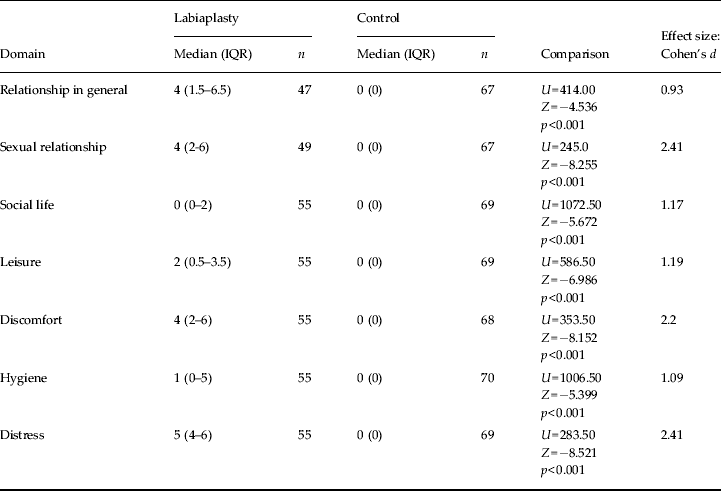
We asked specific questions concerning the extent to which the labia interfere with life. The scale was based on the Work and Social Adjustment Scale (Mundt et al. Reference Mundt, Marks, Shear and Greist2002) in which participants are asked to rate the degree of interference in: (a) relationships in general or dating; (b) sexual life; (c) social life; (d) leisure; (e) discomfort; (f) hygiene; and (g) distress in general. Interference and distress were rated on an eight-point Likert scale from 0 (‘not at all’) to 8 (‘extremely’).
Labiaplasty group only
A surgeon measured the degree of protrusion of the labia minora and width of each labium with a disposable tape measure in the labiaplasty group. All measurements were made in the lithotomy position with minimal stretching of the labia. The width was measured anterior-posteriorly from the clitoral hood and the lower aspect of the labia minora. We took the average of left and right measurements.
The labiaplasty group completed two additional measures:
-
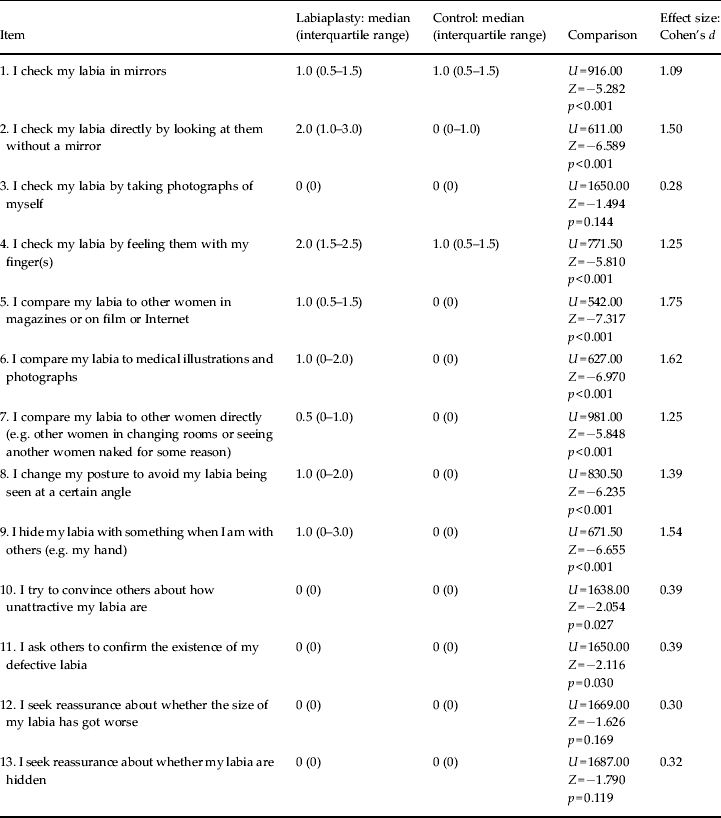
(1) Reported motivation for labiaplasty. We explored the motivation for seeking labiaplasty by asking an open-ended question: ‘Please describe your main reason for seeking labiaplasty’. The responses were analysed independently by two raters (D.V. and E.E.) and coded into three categories, which emerged from the participants’ accounts: aesthetic, functional and sexual. The researchers discussed the process by which the themes were derived to ensure the analysis was logical and valid. There was also a ‘combination’ category where two or three reasons were provided. The category ‘aesthetic’ was defined as any response that included the evaluation of the appearance of the genitalia, such as being ugly or unfeminine, sapping confidence or causing self-consciousness. The category ‘functional’ was defined as any response that referred to physical symptoms such as irritation, discomfort or pain or interference in physical activities (other than sexual ones). The category ‘sexual’ was defined as any reason grounded in a sexual context, including avoidance and interference in intimacy and sexual relationships. Two of the authors rated participants’ responses independently (n = 48).
-
(2) Duration of the problem. Participants were asked to report the duration of the problem with their labia with the following questions: (a) ‘For how long have you felt there was a problem with the appearance or function of your labia?’; (b) ‘How long is it since you wished to have a procedure to reduce the size of your labia?’.
Statistical analysis
Data were analysed using SPSS v20 (IBM, USA). Given the non-normal distribution of most of these variables, as demonstrated from Kolmogorov–Smirnov tests, non-parametric parameters (e.g. median and interquartile range; IQR) and comparison tests (χ 2, Mann–Whitney U tests) are reported. All tests were two-tailed and α was set at 0.05%.
Ethics
The Joint South London and Maudsley Trust and the Institute of Psychiatry NHS Research Ethics Committee granted ethics permission (09/H0807/33). Consent to contact was obtained by the surgeon. Informed consent was obtained over the telephone.
Results
Standardized questionnaires
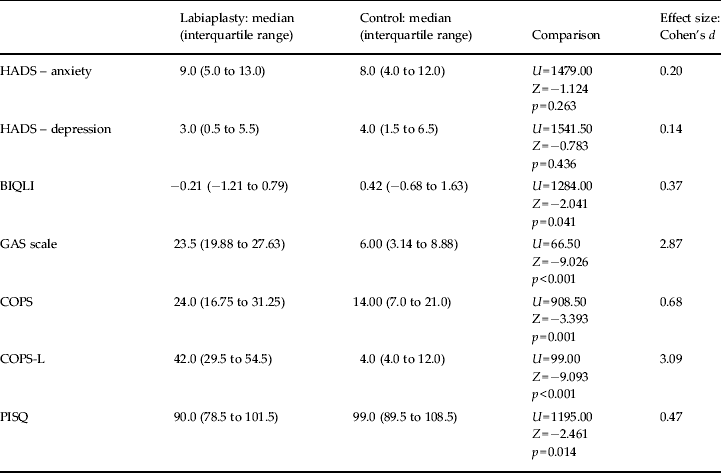
Table 2 reports the differences between the two groups on the standardized questionnaires. There were no significant differences in the severity of symptoms of anxiety or depression on the HADS.
Comparisons of the labiaplasty (n = 55) and control (n = 70) groups on standardized questionnaires

HADS, Hospital Anxiety and Depression Scale; BIQLI, Body Image Quality of Life Inventory; GAS, Genital Appearance Satisfaction; COPS, Cosmetic Procedure Screening Scale for body dysmorphic disorder; COPS-L, Cosmetic Procedure Screening for labiaplasty; PISQ, Prolapse–Urinary Incontinence Sexual Function Questionnaire.
The control group had significantly higher body image quality of life than the labiaplasty group as evident on the BIQLI, with a small effect size. As expected, the labiaplasty group had significantly higher dissatisfaction towards the appearance of their genital area compared with the control group as evident on the GAS and the COPS-L total scores, with a large effect size. The labiaplasty group had significantly lower overall sexual satisfaction than the control group as evident on the PISQ, with a small effect size.
Avoidance and safety-seeking behaviours
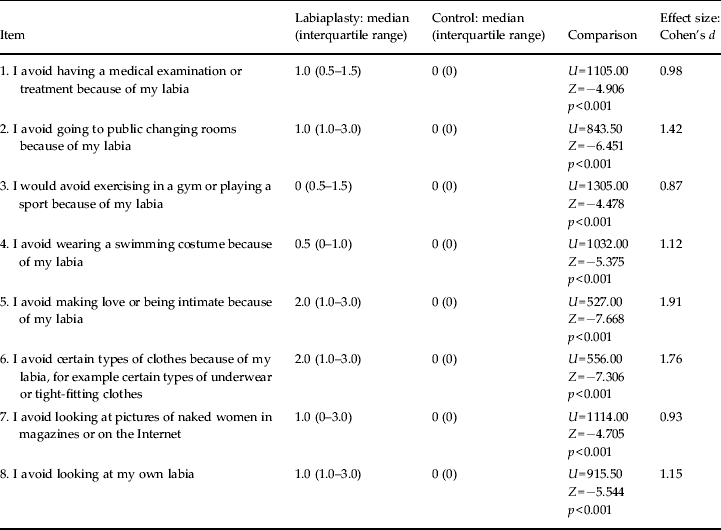
Women seeking labiaplasty reported a significantly greater frequency of avoidance behaviours compared with the control group on all the domains assessed (Table 3). Large effect sizes were found for avoidance of the sight of their own genitalia; going to public changing rooms; sexual intercourse or intimacy; and wearing certain types of clothes (e.g. underwear or tight-fitting clothes or a swimming costume).
Avoidance behaviours reported by women seeking labiaplasty (n = 55) and controls (n = 70) a

a Additional avoidance behaviour reported by the labiaplasty group in an open-ended question included ‘being naked in front of my own children’; ‘having a bikini wax’; ‘partner giving oral sex’; ‘having any light on during sex’; ‘being naked when I am on my own’; ‘anything that might irritate the genital area (e.g. scented soaps or panty liners, certain types of condom)’; ‘using tampons’; ‘wearing any underwear’.
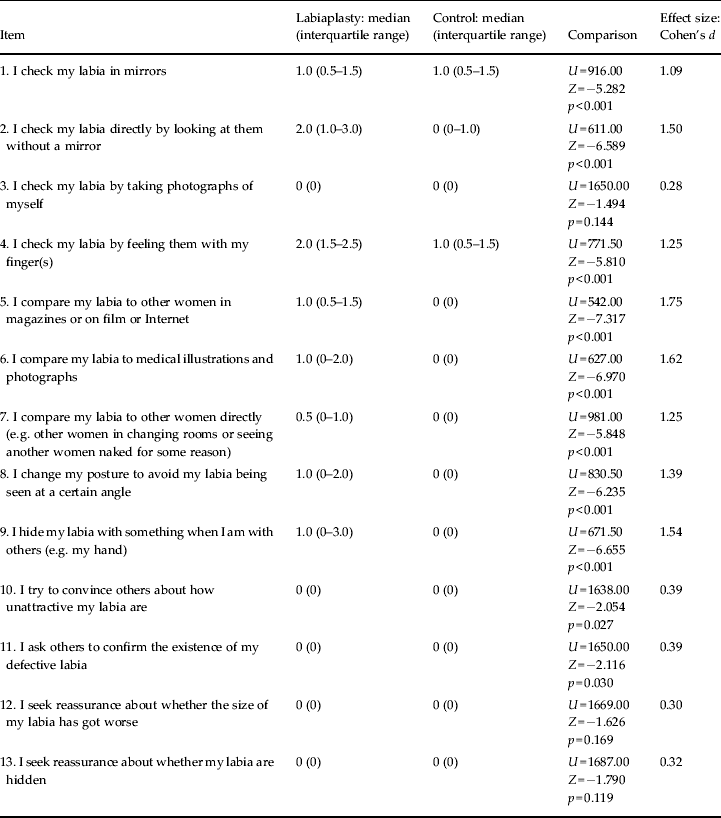
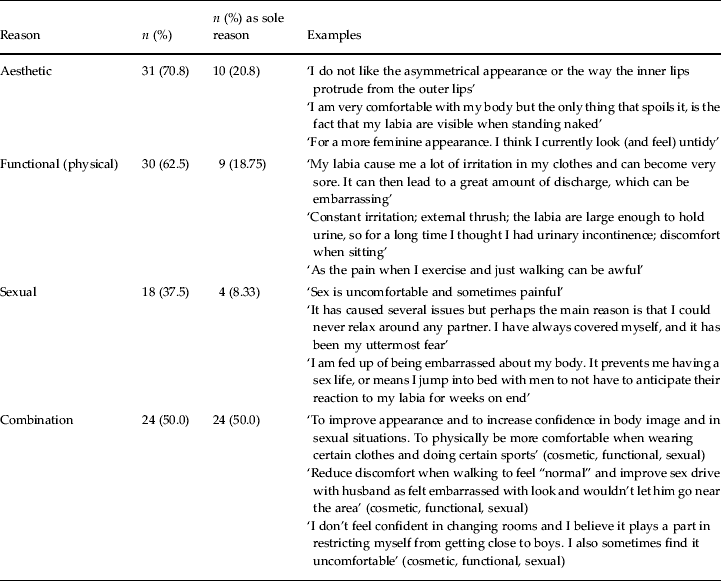
The frequency of safety-seeking behaviours was also significantly greater for all the domains, except for those that involve reassurance seeking or checking by photographing of the labia (Table 4).
Safety-seeking behaviours in women seeking labiaplasty (n = 55) and controls (n = 70)
Interference in life
There were significant differences between the labiaplasty group and the control group for all the domains assessed (Table 5). The highest effect size was found for interference in sexual life, discomfort and distress in general. Examples of qualitative responses for the questions on interference in life are shown below:
-
(1) Relationships in general: ‘My husband has no empathy regarding my labia-concerns, and I can't understand why he doesn't think I'm a freak and therefore why he isn't forcing me to get a labiaplasty’; ‘It doesn't affect the dating so much, just the build up to sleeping with the person isn't exciting – the relationship is stressful rather than fun’.
-
(2) Sexual relationships: ‘The labia can get trapped in my vagina during intercourse. It's uncomfortable and then I have to release them’; ‘I won't date and I have been celibate for 5 years’; ‘I feel very uncomfortable about my partner giving oral sex’.
-
(3) Social life: ‘It restricts what I can wear so certain things I cannot go to as I cannot get comfortable which then ruins the outing’; ‘…when I walk or wear tight clothes and it isn't always convenient to re-adjust myself’.
-
(4) Leisure: ‘Any kind of sports – running, bike riding – are all uncomfortable. The labia rub more and are more uncomfortable’; ‘I used to swim weekly, however since private showers are no longer available I will not go’.
-
(5) Discomfort: ‘It gets trapped between my underwear and my leg and is very painful, I am constantly trying to readjust myself to get comfortable all the time’; ‘Labia are long and get in the way, I sit on them sometimes’.
-
(6) Hygiene: ‘More skin generates sweat therefore feels more dirty’; ‘I feel I have to be more particular when washing and drying myself – it's sometimes difficult to get my vagina dry properly after a shower’; ‘Sometimes after going to the toilet, it drips as there is so much of it’.
-
(7) General distress: ‘I feel like a “freak”. I know it doesn't bother other women but to me they were very ugly’; ‘It is disgusting, not natural and certainly not something a 22 year old should have. I get very upset over it’; ‘I feel they are unsightly and look like an elephant's vagina! Big and grey – ugh!’
Interference in life in women seeking labiaplasty (n = 55) and controls (n = 70)

IQR, Interquartile range.
Labia measurements
Comparisons of the average width of the labia minora of the private patients (mean = 28.09 mm, s.d. = 6.04 mm, n = 23, range 17–41.5 mm) and the NHS patients (mean = 40.27 mm, s.d. = 6.99 mm, n = 11, range 30–52.5 mm) in a non-parametric independent-samples comparison test demonstrated that the NHS patients appeared to have significantly greater labia minora width than the private patients (U = 20.50, Z = −3.91, p < 0.001). It was not possible to check on the inter-rater reliability of the two surgeons. All the women were, however, in the normal range found for women in the community. For example, Lloyd et al. (Reference Lloyd, Crouch, Minto, Liao and Creighton2005) found that women had a mean width of 21.8 mm (s.d. = 9.4 mm, range 7–50 mm, n = 50).
The association between the degree of protrusion of the labia minora and the degree of dissatisfaction with the labia (as reflected on the GAS scores) was explored using Spearman's rho. A non-significant correlation was found between measurements of the protrusion of the labia minora and the GAS scores in the private patients (r = −0.405, p = 0.068, n = 21) and in the NHS patients (r = 0.455, p = 0.160, n = 11).
Motivation for seeking labiaplasty
The mean duration of the problem with the labia reported by the women seeking labiaplasty was 13.4 (s.d. = 10.0) years, with responses ranging from 18 months to 37 years. The mean time taken to decide to make a labiaplasty request was 2.9 (s.d. = 2.96) years. A total of 48 responses were provided for motivations for seeking labiaplasty and were coded. Table 6 summarizes the motivations and includes some examples from the open question. For two discordant responses, consensus was reached following discussion. However, one response was not coded, as it did not fit coherently with any of the other reasons. (‘I wanted to use some of my money to do something that might make a positive impact on my life.’)
Reported motivation for seeking labiaplasty a
a Note that percentages do not add up to 100%, as participants were able to provide reasons that fulfilled multiple categories, and these are included in the coding.
Previous cosmetic procedures
In the labiaplasty group, 37 (71.15%) women reported no cosmetic procedures in the past; 15 (28.9%) women reported having had at least one cosmetic procedure. Of these, five reported having two cosmetic procedures and one of these had had three procedures. Of these 15 women with a history of cosmetic procedures, nine (60%) were private patients, four (26.7%) were NHS patients, and two (13.3%) were community controls from Mind Search. The procedures included breast augmentation (n = 6), dermafiller (n = 2), Botox (n = 3), rhinoplasty (n = 2), laser resurfacing (n = 2), pinnaplasty/otoplasty (n = 1), laser hair removal (n = 2), scar treatment (n = 1), mole removal (n = 1) and cellulite treatment (n = 1). None had had previous genital cosmetic surgery.
A total of three controls (5.88%) reported having had cosmetic procedures in the past, and 64 (94.12%) reported no cosmetic procedures in the past. Of these three participants, two also reported a second and third procedure. The procedures included breast augmentation (n = 2), laser hair removal (n = 2), dermabrasion (n = 1) and liposuction (n = 1). A Pearson's χ 2 test demonstrated a significant difference between the groups, with more cosmetic procedures in the labiaplasty group (χ 2 = 11.66, degrees of freedom = 1, p = 0.001).
BDD
A total of 10 women in the labiaplasty group and four control women scored above the clinical cut-off on the COPS screening scale and were thus identified as having possible BDD. Clinical interviews were performed on these participants, except for two control participants. A total of 10 individuals (18.2%, 95% confidence interval ± 7.9%) in the labiaplasty group and no controls were subsequently diagnosed with BDD (seven women reported labia-only preoccupation and three had a preoccupation about their general appearance that included the labia as their main feature of preoccupation). All of these participants had labia minora within the normal range according to the surgeon's measures.
Of the labiaplasty participants with BDD, six (60%) had specific concerns with their genitalia only, while the remaining four (40%) participants with BDD had concern with both their genitalia and other features of their body. Also, eight of the participants with BDD listed their labia as their first feature of concern, while the remaining two listed another body part as their first feature of concern and their labia as their second.
The individuals with BDD in the labiaplasty group were compared with the remainder of the labiaplasty group. On the COPS-L total score, those with BDD (median COPS-L score = 56.5, IQR = 47.62–65.38) scored higher than the remainder of the labiaplasty group (median COPS-L score = 32.5, IQR = 21.62–43.38) and this was statistically significant (U = 54.50, Z = −3.69, p < 0.001, effect size r = −0.50). It was possible to complete the BDD-YBOCS in six of the 10 participants with BDD, and scores obtained ranged from 21 to 40 (the individual scores were 21, 23, 26, 27, 30 and 40; median = 26.5, IQR = 21.5–31.5). Therefore five out of six were in the mild to moderate range on a standardized observer-rated measure of BDD symptomatology.
Discussion
We have conducted the first descriptive study of women seeking labiaplasty compared with a control group who had no significant difference in age, marital status, education level, ethnicity and parity. There were no significant differences between women seeking labiaplasty and controls in terms of symptoms of anxiety or depression. The hypothesized differences between the labiaplasty group and the control group occurred in the specific measures of the GAS scale and on preoccupation, distress and interference with life. The labiaplasty group experienced reduced sexual satisfaction and quality of life related to body image compared with the control group. The labiaplasty group was also more likely to have previously undergone cosmetic procedures, suggesting that, for at least for some of the women, it was a life-style choice and they placed greater value on enhancing their appearance. Another reason is the increased likelihood of a diagnosis of BDD for the labiaplasty group than for the control group.
Participants’ specific beliefs about their genitalia can be identified on the GAS scale and the distress item on the interference with life scale. These included feelings that the labia were asymmetrical, abnormal and ‘too large’; or that they were causing discomfort, self-consciousness and/or an enormous sense of shame. It is possible that some of the distress occurs from a lack of awareness regarding the normal variation in labia size. This suggests a role for healthcare professionals, especially gynaecologists, in providing reassurance and psycho-education to some patients (Lloyd et al. Reference Lloyd, Crouch, Minto, Liao and Creighton2005) but it is not known how effective this is in reducing genital dissatisfaction. Women may accept or know that their labia minora are normal in size but still feel they are abnormal or ugly. Reassurance may also be ineffective at reducing symptoms such as discomfort or pain and is ineffective for cosmetic interventions in people with BDD.
Women on the NHS had all been referred by their general practitioner who acted as a ‘gate keeper’ for more functional reasons for labiaplasty. Those who requested labiaplasty in the private sector were more likely to be self-referrals who reported more cosmetic reasons than in the NHS. Functional reasons might be related to social expectations to wear tight-fitting spandex clothing and underclothing that may cause increased discomfort. If there is loose clothing and no obvious cause then the physical symptoms may fall into the category of being medically unexplained.
The checklist of avoidance and safety-seeking behaviours enabled the authors to identify a wide range of behaviours that occurred more frequently in the labiaplasty group. This information could be used clinically for a psychological intervention for some women seeking labiaplasty. Frequent comparisons with other women, pictures in the media, or checking with or without a mirror are all likely to increase preoccupation and distress (Veale et al. Reference Veale, Gournay, Dryden, Boocock, Shah, Willson and Walburn1996b ; Neziroglu et al. Reference Neziroglu, Khemlani-Patel and Veale2008). It may be possible to develop a psychological intervention that involves behavioural experiments and graded exposure to public situations (e.g. changing rooms). However it will be difficult to test out worries in sexual situations if the woman does not have a sexual partner.
It was a surprising finding that the duration of concern in women seeking labiaplasty had a mean of 10 years. It suggests that the onset of the problem including possible links to specific aversive memories (e.g. teasing) may be worth exploring.
The limitations of this study include the sample size and whether it is representative, the type of labiaplasty performed, and the measurements of the labia. A future larger sample size would allow the exploration of subgroup analyses (e.g. those with BDD versus those without BDD; those presenting privately versus those presenting in the NHS; those presenting for different motivations). However, the present study was designed to be exploratory. It is not known how representative the women in the present study are with respect to women seeking labiaplasty, as we do not have information on those who declined to participate. The sample was predominantly heterosexual, with no women in either group sexually oriented only or mainly to the same sex. Our question on cosmetic procedures was open and we did not systematically ask about all types of cosmetic procedures. Lastly, limiting the number of cosmetic procedures that could be coded to five may have influenced the result. Another limitation is that the sample was one of convenience, and the results may not be generalizable to other groups of women (e.g. in other practice settings or countries).
There were possible variations in the measurement of the size of the labia by site and it is not known if this reflects a true difference between the NHS and private patients or by surgeon. It would therefore be important to obtain inter-rater reliability scores before a study commences in future research.
It is also not possible to comment on the prevalence of BDD, as this was an opportunistic and small sample. However, the estimate is slightly higher than other studies on the prevalence of BDD in cosmetic settings (Crerand et al. Reference Crerand, Menard and Phillips2010). However, the focus of the preoccupation was specific to their genitalia. In other areas, the diagnosis of BDD may be associated with poor outcome (Phillips et al. Reference Phillips, Grant, Siniscalchi and Albertini2001; Veale et al. Reference Veale, De Haro and Lambrou2003; Tignol et al. Reference Tignol, Biraben-Gotzamanis, Martin-Guehl, Grabot and Aouizerate2007; Crerand et al. Reference Crerand, Menard and Phillips2010). Further research is required to repeat the measures after labiaplasty to determine the satisfaction and psychosexual outcomes of this procedure, particularly in those with BDD and to report on any complications.
Acknowledgements
We acknowledge support from the National Institute for Health Research (NIHR) Biomedical Research Centre for Mental Health at South London and Maudsley NHS Foundation Trust and the Institute of Psychiatry, King's College London. This paper presents independent research funded by the NIHR. The views expressed are those of the authors and not necessarily those of the NHS, the NIHR or the Department of Health.
Declaration of Interest
None.