Introduction
The number of Italian municipalities has stood at around 8,000 for decades. This figure has always been considered both historically rooted (and therefore inevitable and unlikely to be altered) and administratively complex (due to the often challenging conditions of the smallest municipalities). The high number of municipal authorities (so-called municipal fragmentation) is shared with most of the states belonging to the Napoleonic tradition, France and Spain being the most typical examples. Italian governments perceived this as both physiological and pathological, assuming different attitudes and stances at different periods, which changed territorial policy accordingly, but never addressed the number of municipalities directly as a problem and, most importantly, produced only negligible variations in the total.
In the context of the global economic crisis, however, territorial policy dramatically changed the pre-existing conditions as far as local government was concerned: consolidation measures (defragmentation) entered the national policy agenda. If it is true that in recent years other institutional reforms have been introduced or attempted – such as those on fiscal federalism, on public administration and on constitutional and electoral rules (Bull Reference Bull2011; Capano and Pritoni Reference Capano and Pritoni2016; D’Alimonte Reference D’Alimonte2015; Fabbrini Reference Fabbrini2013; Farinelli and Masetti Reference Farinelli and Massetti2011) – it is also true that those affecting local government have had a remarkable impact. The territorial institutional reforms introduced since 2010 – culminating with the so-called Delrio law in 2014 – actually altered several fundamental features of local government (Gardini Reference Gardini2015; Bolgherini Reference Bolgherini2015). The major effects were the hollowing-out of the powers of the provinces, the effective introduction of the metropolitan cities, and the measures to address municipal fragmentation. The focus of this article will be on the latter.
In order to show how municipal fragmentation was differently approached in time and, in particular, to explain why defragmentation policy brought some numeric results only in the last period, a 27-year-long time span (1990–2017) will be covered, with special attention to the last decade. Municipal unions and amalgamations will be considered as the main policy instruments for addressing this issue. Focusing attention on defragmentation allows us both to shed light on an ancient but highly neglected issue, and hence to highlight its relevance in the current debate on the size and efficiency of local democracy, and to put the Italian case in the context of territorial reform aiming at consolidation and rescaling throughout Europe.
The analysis will adopt a public policy lens, by presenting the different national policy strategies adopted in different periods as well as describing the stances of the various stakeholders. Some explanatory factors of the different results achieved by defragmentation policy through the years will be singled out. To reach this comprehensive overview, a critical review of normative acts and of their legislative process has been conducted, along with a documental analysis based on the official reports of national and local stakeholders. Over 40 in-depth interviews were also conducted in 2015 with privileged interlocutors at the local level.
After having introduced the multifaceted nature of the (de)fragmentation issue and its growing relevance in Italy (section 2), three main phases in Italian territorial policy will be singled out as the analytical framework for the different visions and strategies adopted by the national government (section 3). The relevant (differing) results in each phase (section 4) will be discussed by framing them in a context where institutional-political elements and the stances of the involved actors are the main explanatory factors for these different outcomes (section 5). Some concluding remarks resume the analysis (section 6).
Municipal (de)fragmentation
Territorial fragmentation – and its counterpart, i.e. consolidation – are the two poles of a trade-off between democracy and economic efficiency (Swianiewicz Reference Swianiewicz2010). In the usual perception fragmentation and decentralisation secure more democracy and citizen participation while consolidation (or defragmentation) tends to ensure functional efficiency and economy of scale (Swianiewicz Reference Swianiewicz2002; Denters et al Reference Denters, Goldsmith, Ladner, Mouritzen and Rose2014). Moreover, both perspectives concern the search for the optimal local government size, which is also one of the most debated issues in local government studies since the early theoretical works of Keating (Reference Keating1995) and Sharpe (Reference Sharpe1995).
As far as the Italian case is concerned, municipal fragmentation is a truly historical issue. Italy inherited, together with other south European countries, the traditional Napoleonic administrative system (Loughlin, Hendriks and Lidström Reference Loughlin, Hendriks and Lidström.2010) – hence the principle according to which each community, regardless of its size, should have its own municipality (Vandelli Reference Vandelli2015). This had a strong impact on municipal organisation and numbers. In 1861 municipalities in the newly unified Italy numbered 7,720; at the beginning of 2017 there were 7,983, after peaking at 8,101 in 2001. The only attempt to reduce Italian municipal fragmentation – that is, defragmentation – took place during Fascism when the number of municipalities dropped to 7,311. After the Second World War their number rose, slowly but steadily, again.
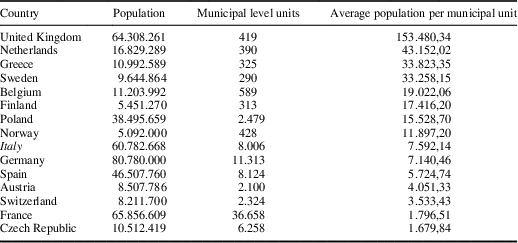
Nonetheless, as shown in Table 1, Italy is not the most fragmented country in Europe (Germany and France scoring much higher) and, considering the average population size per municipal unit, Italy occupies an intermediate position. Since the 1960s many European countries have experienced defragmentation attempts in search of a balance between size and efficiency (among others Steiner Reference Steiner2003; Teles and Kettunen Reference Teles and Kettunen2016).
Population, number of municipal level units and relevant average population in some European countries, 2016

Source: Author’s compilation from CEMR database ( http://www.ccre.org/).
Since the Risorgimento, the debate on Italian (de)fragmentation has presented two opposite positions (Rotelli Reference Rotelli2003; Fedele and Moini Reference Fedele and Moini2006). The first argued that municipal proliferation would benefit the whole country by allowing a direct management of community needs; the second stood for an overall municipal amalgamation, striving for more efficient authorities in communities with a minimum of 20,000 inhabitants. These positions have persisted until today,but since the 1990s the issue of municipal (de)fragmentation has been coupled with other aspects, in particular with efficiency issues, in the context of the organisational and functional proliferation that was typical of many Italian public sectors especially during the 1980s and the 1990s (Capano and Gualmini Reference Capano and Gualmini2011; Bolgherini and Dallara Reference Bolgherini and Dallara2016).
Already during that period Dente (Reference Dente1985, Reference Dente1991) argued that institutional (and social) fragmentation was a constitutive feature of Italian polity, as a result of heterogeneity (i.e. the variety among local authorities in organisation, functioning, resources, and relations with the centre) and uniformity (the same legal structure). Fragmentation should therefore not be ignored but instead governed, by focusing on intergovernmental relations and by relying on public policy analysis.
Despite this recommendation (de)fragmentation has never been approached in these terms (Dente Reference Dente1991) or as a matter of urgency (Casula and Marotta Reference Casula and Marotta2016) and the different policies adopted by the national government produced little result, above all in terms of reducing the number of municipalities. However, the global economic crisis marked a turning point and municipal fragmentation abruptly became a critical policy issue to be addressed in order to cope with the unbalanced budgets and inefficiencies of small municipalities. Hence, since 2010, the results show that the new policy has had some success, as discussed later. In the following section we will try to answer why the most recent defragmentation policy succeeded, in contrast to those of the past.
Pursuing defragmentation in three steps: norms and strategies
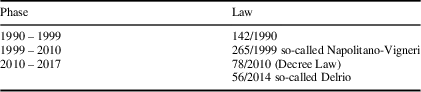
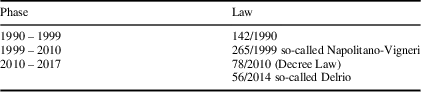
In the time span under scrutiny here (1990–2017), three major phases in the national government’s attempts to pursue municipal defragmentation can be singled out. The decisive step from one phase to another and their scansion in time has depended on the change in attitude of the national policymaker towards this issue and on the consequent normative provisions mirroring those visions. Each phase (displayed in Table 2) has been characterised by a crucial normative provision. The first phase covers the decade of the 1990s: Law No. 142/1990 started the territorial policy pursuing defragmentation and set the first phase until 1999; the second phase began with Law No. 265/1999, which changed policy vision, and lasted until 2010; finally, decree law No. 78/2010 opened the third phase, marked by Law No. 56/2014, and likely to end definitely in 2017. The first two phases relied on a consolidated normative scansion, usually employed for describing administrative reforms in the 1990s (Vandelli Reference Vandelli1997) or the development of inter-municipal cooperation (Politi Reference Politi2012). Here the focus is instead on the territorial policy and therefore a third phase has been added (2010–2017).
The three phases of Italian defragmentation policy and main relevant normative acts
Source: Authors’ compilation.
All phases will be described here by pointing out the different goals and visions as well as the strategies pursued by the national government to address the (de)fragmentation issue. The aim is to provide a background against which the different policy results may be interpreted.
The first two phases
Law no. 142/1990 represented the starting point for the Italian defragmentation policy, being the first explicit attempt in the Republican era to cope with the high number of municipalities. Within the general attempt to introduce corporatisation in Italian local autonomies (Dente Reference Dente1997; Bobbio Reference Bobbio2005; Fedele and Moini Reference Fedele and Moini2007), this law introduced a number of novelties, aimed at increasing municipal efficiency in local public services provision, in particular through several forms of inter-municipal cooperation – i.e. convenzioni (conventions), consorzi (consortiums), accordi di programma (programme agreements), and unioni di comuni (municipal unions). Municipal unions (MUs) were by far the most interesting tool from our perspective. In this respect Law no. 142 provided that two (or more) adjacent municipalities, each with under 5,000 inhabitants, could create a municipal union for the purposes of providing services and functions. After ten years, member municipalities should either dissolve the MU or merge into a single municipality. The merging solution was compulsory if they had previously received public financing.
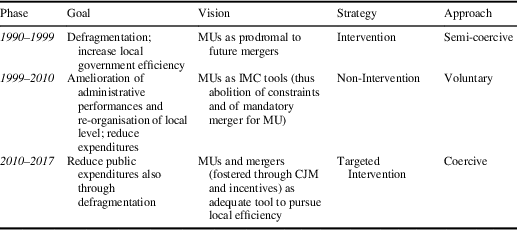
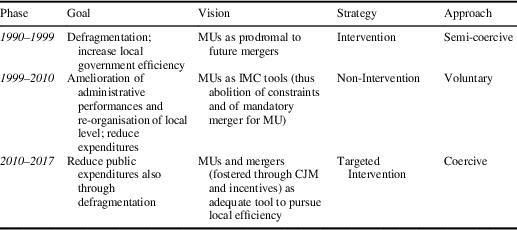
During the first phase (1990–1999) MUs were conceived as more than a mere tool for municipal cooperation: they were envisaged as the first step towards municipal amalgamation. Therefore an interventionist strategy was launched, aimed at reducing the number of municipalities and increase efficiency through a semi-coercive approach (see Table 3). It entailed the introduction of voluntary municipal unions which, however, were also intended to lead to compulsory mergers and thus to the reduction of municipal fragmentation. This two-step choice has been explained by the need to prevent possible local resistances from citizens and administrators, above all in those areas where strong parochialism was present as a legacy of the past (Messina Reference Messina2005; Elia Reference Elia2002; Putnam, Leonardi and Nanetti Reference Putnam, Leonardi and Nanetti1994). Nonetheless the forced amalgamation after ten years for those municipalities that wanted to try the experience of the MUs was perceived as too strong a constraint by local actors.
Goal, vision, strategy and approach in the three phases of Italian territorial policy
Source: Authors’ compilation.
A decade later this policy orientation changed. Law No. 265/1999, the so-called Napolitano-Vigneri, revised the vision about MUs and inter-municipal cooperation (IMC) in general. The political and institutional context within which both these laws were approved was characterised by the uncertain transition to the Second Republic (Allum and Newell Reference Allum and Newell2003; Morlino Reference Morlino2013); the strengthened role of the mayors after the introduction of their direct election in 1993 (Di Virgilio Reference Di Virgilio2005; Fabbrini Reference Fabbrini2001); and the rise, since the 1980s, of the Lega Nord, a political party with autonomistic ideologies that greatly impacted on Italian territorial policy during the 1990s and later (Diamanti Reference Diamanti2003; Reference Diamanti2010; Toubeau and Massetti Reference Toubeau and Massetti2013).
As for the MUs, this law drastically modified their nature: they no longer had specific formal restrictions (e.g. municipalities of over 5,000 inhabitants could also participate in an MU and their duration could be unlimited). In other words MUs became less constraining for Italian municipalities, but consequently maintained fragmentation as it was. After the step back of Law No. 265/1999, the defragmentation issue disappeared from the national political agenda and the norms regulating MUs, IMC and amalgamations remained untouched for the following decade. In that period, the priority was the more general reorganisation of local autonomies (Lippi Reference Lippi2011). The two major provisions – the Testo Unico sull’ordinamento degli Enti Locali (TUEL) in 2000 and the 2001 Constitutional Reform – did not in fact alter the IMC regulations. The TUEL simply confirmed what Law No. 265/1999 had introduced and the Constitutional Reform empowered local autonomies (Vandelli Reference Vandelli2015). In the second phase the idea that MUs should be a first step toward a future amalgamation was set aside (see again Table 3). MUs thus became an ordinary instrument of cooperation among municipalities and a tool of enhancing IMC in general (Citroni, Lippi and Profeti Reference Citroni, Lippi and Profeti2013). The ambition to rapidly reduce the number of municipalities in Italy was replaced by another goal, i.e. to reduce expenditure, always coupled with increasing the efficiency and efficacy of municipal government. Inter-municipal cooperation and MUs were once again the policy tools through which this goal was to be achieved. MUs, as we have said, acquired a new profile, losing almost all constraints foreseen in the first phase. National government thus chose a strategy of non-intervention on the defragmentation issue directly, pursuing instead the amelioration of municipal performances. This change also reflected a different approach towards the role of local authorities – a more voluntary approach, indicating the desire to preserve the autonomy of local communities so that municipalities retained the option to choose how and with whom to cooperate, and levering their cooperation through financial and normative incentives. The role of local administrators in the realisation of the general strategy was also emphasised.
The third phase (2010–2017)
The global economic crisis and the consequent austerity-driven measures provided the overall frame for all the normative provisions of the third phase. In those years the municipal (de)fragmentation issue re-entered the national agenda, and the Italian parliament introduced the compulsory joint management (CJM) of basic municipal tasks (gestione associata obbligatoria) for small municipalities, thus forcing them to co-manage their basic functions with other municipalities (Bilancia Reference Bilancia2012; Pennacchietti Reference Pennacchietti2013; Vandelli et al. Reference Vandelli, Tubertini, Barrera and Tessaro2014). Compulsory joint management had been formally introduced by the decree law No. 78/2010, which established that all municipalities with a population of between 1,000 and 5,000 were obliged to jointly manage a series of functions through conventions and/or municipal unions.Footnote 1 It was Law No. 135/2011 that better specified the basic municipal tasks and that reaffirmed the CJM principle for small municipalities with under 5,000 inhabitants as far as those tasks were concerned.Footnote 2 Interestingly, this law foresaw several progressive and gradual steps to implement CJM, aware of the difficulties local administrations would be met with. It specified that a group of three functions should be co-managed by 1 January 2013, and the other six by 1 January 2014.Footnote 3
Three years later, in 2014, as part of a comprehensive reform of local autonomies, both inter-municipal cooperation and the (de)fragmentation issue were addressed by Law No. 56/2014, the so-called Delrio Law. This law, despite its officially-declared provisional nature, currently represents the most important move of recent years on the (de)fragmentation issue and the ‘last step’ so far in the re-mapping of Italian local administrative geography.
As for the MUs, the Delrio Law leaves member municipalities free to choose their partners, the duration of the cooperation, and the tasks they want to share and in which form. In particular this law a) gives regions important margins of decision on this matter (Bolgherini, Lippi and Maset Reference Bolgherini, Lippi and Maset2016); Footnote 4 b) simplifies norms (the special MU for those municipalities of under 1,000 inhabitants has been abolished); c) fosters MUs as effective municipality-replacing local authorities (by e.g. revising their organs of government, cutting their members’ salaries). But the law’s organic policy design in pursuing defragmentation is even more visible if amalgamation is considered. Law No. 56/2014 tries in fact to promote municipal amalgamations in two ways. First, by displaying a greater range of financial incentives, for example by establishing a ten-year funding for new merged municipalities. Secondly, by introducing organisational simplifications, e.g. the so-called amalgamation through incorporation – that is, an amalgamation where a municipality incorporates all the political and organisational organs of the other member municipalities, thus avoiding, among other things, new elections. Moreover, in order to induce local administrations to amalgamate, the law provided additional facilitations for small municipalities and devoted particular attention to the issue of local identity (Tubertini Reference Tubertini2015).
In spring 2016 a constitutional reform was approved by parliament but was rejected by popular referendum in December. This reform was intended to complete the policy design of the Delrio Law but its failure – and the consequent fall of the Renzi government which had strongly pushed for the reform as well as for the Delrio Law – led to a stalemate on this issue. The third phase has therefore come to an end, for 2017 is the year when both the creation of the new MUs and amalgamations decided in 2016 will take place, and CJM has to be fully implemented (should no further reform on this matter be introduced).
During the third phase (2010–2017), the Delrio Law shaped MUs as a potentially adequate tool to pursue efficiency in local services provision and empowered them as IMC tools in general (see again Table 3). Defragmentation started to be pursued more convincingly: conspicuous incentives for municipal amalgamations and MUs as well as forced cooperation (CJM) were established. The national policymaker deployed a strategy of targeted intervention with a clearly coercive approach, in contrast to the strategies of the two previous phases. The coercive approach is goal-oriented and aimed at obtaining the planned results by imposing policy choices on selected actors and through selected policy tools. This hinders the adoption of a proactive role by local government, which simply has to comply with the norms. During this phase, in order to achieve savings rapidly, the national government – although still stressing the idea of inter-municipal cooperation as a tool for achieving more effective and efficient results in the management of public services – decided to concentrate its legislative interventions on specific local authorities. Since decree law No. 78/2010, the national government clearly defined as a policy target all municipalities of under 5.000 inhabitants, and acted accordingly. This strategy has been confirmed, two years later, by the legislative decree No. 95/2012 in which precise deadlines for the implementation of the CJM have been established. This change in strategy and approach has not been exempt from criticism: it has been labelled a ‘counter-reform’ (Ruggeri and Salazar Reference Ruggeri and Salazar2012), because it is only partially congruent with the revised Title V of the Italian constitution.Footnote 5 The recent norms point in fact to a renewed predominance of the state over small municipalities and over their managing of their own basic functions, thus paving the way toward a further swing in the centre-periphery pendulum (Bolgherini Reference Bolgherini2014; Reference Bolgherini2016; Bilancia Reference Bilancia2012). This orientation has been amply confirmed by the Delrio Law, against which several regions have raised questions of constitutionality concerning the alleged violation of regional autonomy by the state (Salerno Reference Salerno2015). The approval of Law No. 56/2014 has empowered the targeted strategy of Italian policy makers to rapidly realise stable forms of inter-municipal cooperation through a coercive approach. Municipal unions have now become a more accessible and strongly supported policy instrument, as well as (again) a first step towards successive mergers.
This most recent national policy orientation is nonetheless doomed to failure if no organic reform intervenes in the near future. The failure of the 2016 constitutional reform, which was intended to particularly integrate the Delrio Law in relation to second-tier entities (provinces but also MUs), has undoubtedly called into question the possibility of further steps in this policy area. Local governments and IMCs are therefore likely to remain locked in a stalemate.
The results of territorial policy
At the beginning of the first phase, in 1991, Italian municipalities numbered 8,100, while in the early second phase, in 2001, the figure was 8,101.Footnote 6 In the third phase the number of municipalities declined to 7,983. Five municipal amalgamations were realised during the first phase, eight during the second (only three of them from 2000 to 2010), and 82 in 2017. Finally, MUs amounted to 16 in 1999, 313 in 2010, and 535 in 2017 (Table 4). As far as the total number of municipalities is concerned, no significant variation occurred between the first and the second phase, while a slight decrease is to be detected between the second and third. Considering amalgamations, their number almost doubled between the first two phases and skyrocketed between the second and the third. In the second phase, the number of MUs was more than 20 times those in the first phase, while from the second to the third phase they increased by almost 100 per cent.
Number of municipalities, MUs and amalgamations during the three phases of Italian territorial policyFootnote 1

1 Numbers are those present at the end of the first and second phase (i.e. 1999, 2010) and at the time of writing (February 2017) for the third phase.
Source: Authors’ compilation from ANCI data.
In the first phase the results of the defragmentation-oriented territorial policy were extremely poor. Only a few amalgamations took place and MUs did not take off: the goal of defragmentation had clearly failed. During the second phase results were more conspicuous in terms of numbers, but it is only in the third phase that defragmentation policy seems to have achieved some true results.
Indeed there is still a long way to go: figures are negligible thus far (a decrease of around 100 municipalities out of 8,000) and scepticism and resistance are still widespread among both local administrators and citizens. However, it is evident by looking at the overall results that the third phase does show a different pace and the fast increasing number of MUs and amalgamations reflects both the different approach and strategy used by national government in territorial policy and the changing reactions of the local actors to it, as discussed in the following section.
Stakeholders’ stances and institutional elements as explanatory factors
When, if and to what extent fragmentation is perceived as a problem, greatly depends on the values local governments place at the top of their political agendas (Dente Reference Dente1991; Swianiewicz Reference Swianiewicz2002). Defragmentation may appear as a solution, often through consolidation measures that may range from amalgamation to inter-municipal cooperation. The measures adopted also depend on the priorities set at different times and by the different actors and stakeholders.
In the (de)fragmentation policy arena, since it is an institutional policy and therefore a constituent one (Lowi Reference Lowi1972), the state plays a major role through its executive and legislative organs, whose role in the three phases has already been discussed. But municipal and technical actors, both single and collective, are also involved in this policy: local administrators (e.g. mayors, municipal councillors) and the National Association of Italian Municipalities (Associazione Nazionale Comuni d’Italia, ANCI) – a trade association that enables single municipalities to participate in collective demands, lobbying policy-making bodies and influencing policy implementation. Technical actors are the so-called research organisations (Howlett and Ramesh Reference Howlett and Ramesh2003), that is, scholars – mostly, but not exclusively, political scientists and jurists – who specialise in local government studies.
Studies of the Italian case and the role of stakeholders in the policy arenas traditionally assigned political parties and party politics a predominant position (La Palombara Reference La Palombara1994; Morlino Reference Morlino1991). Despite their still undeniable relevance in most policy sectors (Lizzi Reference Lizzi2011), since the 1990s the gatekeeping role of political parties has diminished (Capano, Lizzi and Pritoni Reference Capano, Lizzi and Pritoni2014) and centre-periphery relations have surely become more direct and unmediated. Hence local and technical actors may have had a notable influence (Leech Reference Leech2010) in the different policy phases. Neither should the role of institutional factors, which have helped to shape the context, be disregarded. Within this analytical framework, an initial descriptive discussion of the possible explanatory factors for the different results in the three phases will be attempted.
1990–1999: a faltering beginning
Until the approval of Law No. 142/1990, only technical stakeholders were interested in the municipal (de)fragmentation issue. Already at the end of the 1950s several academics had conducted research focused on the functioning and (in)efficiency of municipalities. In 1959, the eminent jurist Feliciano Benvenuti published a pioneering reform proposal aiming at an organic reorganisation of local autonomies. The main deadlock at that time was that local government was still ruled by century-old legislation dating back to Reference Benvenuti1959, which was clearly inadequate to answer the new demands of Italian local administrations (Pototschnig Reference Pototschnig1975). The scholarly debate continued and greatly intensified in the successive decades. In the mid-1980s one of the most important researches on municipalities was conducted by Mannozzi and Visco Comandini (Reference Mannozzi and Visco Comandini1990): they found out that a conspicuous part of the municipal tasks could not be complied with by small and very small municipalities. Their estimated ‘effectiveness rate’ in municipal tasks management was around only 29 per cent. In other words, as Vandelli later pointed out (1997, 834), despite the identity and democratic issues recalled in its defence, the small municipal dimension seemed to blatantly show its weaknesses in terms of inefficiency and inadequacy.
In those same years it was inter-municipal cooperation (IMC) that attracted scholarly attention. It was considered by some (Pototschnig Reference Pototschnig1985, 681) as a possible remedy to the ‘total and paradoxical uniformity of the norm, despite the huge radical variations among the more the 8,000 Italian municipalities’: in other words to what Dente (Reference Dente1985, Reference Dente1991) called uniformity and heterogeneity respectively – resulting in institutional (municipal) fragmentation. The debate on IMC – differently from that on the municipal size – did not remain confined within academic classrooms or scientific journals, but entered the parliamentary stage. Let us quote two examples. In 1970 a new bill, the so-called Legge generale sull’amministrazione (local administration law) was proposed by a team of researchers at the University of Padua (Vesperini Reference Vesperini2010), whilst at the end of the 1980s the experts of the Public Administration Science Institute (ISAP) wrote a counterproposal to the forthcoming L. 142/1990 (Rotelli Reference Rotelli2009). Both examples show the committed role of Italian academics in local territorial and organisational reforms, strongly contrasting with the then fence-sitting attitude of the national government and of the political parties (Dente Reference Dente1991).
As described in Section 3, national policymakers showed some first signs of interest in the issue of municipal (in)efficiency and (de)fragmentation during the formulation phase of Law No. 142/1990. For the first time, the inefficiency of Italian municipalitiesin delivering public services, mainly due to their inadequate dimensions, was openly declared and agreed upon: hence (de)fragmentation became a policy issue. Nonetheless, its entrance onto the agenda and the growing interest of governmental actors collided with the interests of the local political class. Local politicians feared the introduction of compulsory mergers for small municipalities and the loss of local identity (and local political posts) that such a measure could entail. From this perspective, defragmentation policy profiled itself as a contentious issue (Casula and Marotta Reference Casula and Marotta2016). This conflict probably explains the final choice of the national government to opt, in the upcoming Law No. 142, for inter-municipal cooperation as a first stage towards voluntary rather than compulsory municipal mergers.
This compromise solution paved the way for a greater interest in the issue of local stakeholders themselves, in particular mayors. Until Law No. 142, the stances of local administrators had been conveyed mainly through the national municipal association (ANCI), which had claimed generic attention and more resources from the state for municipalities, but had taken no specific position – or, if any, a reluctant one (Dente Reference Dente1991) – on defragmentation policy. As Renzo Imbeni,Footnote 7 former mayor of Bologna, put it, ANCI lacked in ‘autonomy, planning and pro-positive capacity, as well as credibility with respect both to national interlocutors and its members (municipalities)’ because of the ‘prevalence of party affiliation and party line’ in taking a position on this issue. In other words during the formulation of Law No. 142, municipal interests were brought forward and safeguarded more within parties rather than within ANCI. Hence parties, in line with the mainstream interpretation in those years (Morlino Reference Morlino1991), acted as gatekeepers for municipal interests in the parliamentary and governmental debate, thus overriding the relevant representative organisations.
Nonetheless, the poor performance of Law 142 as far as territorial policy and defragmentation are concerned may also be explained by the diverse resistance from local governments.Footnote 8 Considering the local administrators’ mindset may help understand this reaction: the identification of MUs as a first step towards a future mandatory merger indeed clashed with the long municipal tradition rooted in the Italian regions. In other words, during the first phase, the persistent Italian parochialism inhibited any effective result.
Furthermore, institutional reasons should also be considered: during the whole first phase, MUs lived in a sort of institutional limbo since they were not recognised as local authorities, and several uncertainties hung upon their institutional status,Footnote 9 which consequently hindered a clear stance and commitment by local actors in favour of defragmentation.
1999–2010: mediation and status quo
Local administrators played a crucial role especially in the implementation phase: Law No. 142 was in fact poorly observed and in the first phase only a few MUs were created. The choice made in 1999, at the beginning of the second phase, to remove forced amalgamation, conceded to municipalities the leeway to interpret inter-municipal cooperation more freely and, above all, to autonomously decide the partners with whom to associate. Moreover, being now endowed with the status of a local authority, MUs increased their political value in the eyes of local administrators and thus started to be used by political parties to secure their presence in the locality (Baccetti Reference Baccetti2008). Some minor changes resulted. However, if it is true that national policymakers had not yet elaborated any decisive government strategy and their decisions could be seen as a mere adaptation to local resistance, it is also true that in this phase local actors still did not exhibit a real will to drastically change their ways. Both MUs and amalgamations data show that when central strategy was not particularly constraining (as during the first two phases), local administrators always found a way not to change their way of governing. This emerged crystal-clear in a report to the Chamber of Deputies before the approval of Law No. 265/1999, where it was pointed out that the normative intention of territorial reorganisation had been ‘contradicted by reality: … ineradicable municipally-oriented attitudes persist; it is difficult to think in terms of institutional engineering aimed at eliminating cultural, social and economic realities and interests, not easily eradicable with a law or the stroke of a pen’.Footnote 10
Indeed it was the stance of the ANCI that changed in this second phase. In those years, the official declarations of the national association moved closer and closer to the national government’s goals. The possibility of a larger agreement was also due to the government’s change of orientation, which – with a voluntary approach and a non-intervention strategy – had avoided, since the late 1990s, a full-on collision with local administrators. This conciliatory attitude of the national-level stakeholders persisted at least until the economic crisis, when a turning point occurred.
2010–2017: results despite divergence
In the third phase (2010–2017) the positions of the ANCI and national government started to diverge again. The ANCI stood strongly against the strongly government-supported CJM, i.e. the compulsory joint management of basic municipal tasks, for reasons which, interestingly, were very close to those expressed two decades earlier against Law No. 142/1990. A correct implementation of CJM requires a strong involvement of local administrators, as well as their effective will to fulfil national provisions. As Marotta (Reference Marotta2015) recently pointed out, it is not rare to observe in several regions the creation of ‘showcase cooperation’, i.e. MUs that even if they formally exist, are substantially inactive and merely provide a facade of compliance. Hence it is self-evident that a strong municipal commitment is indispensable in order to have a really functioning CJM: an attitude of sabotage would considerably impair its effective implementation.
Municipal resistance plays a major role in this phase. As for relations with the central institutions, in this third phase the ANCI started to wage a tough lobbying against CJM, which they defined as a ‘cleaver’ of municipalities (Guerra Reference Guerra2010). Current ANCI lobbying activity is nonetheless different to that practised during the approval of Law No. 142. In the first phase the ANCI had been overridden by political parties as a stakeholder in defragmentation policy and in territorial policy at large; in the third phase the ANCI is instead directly acting as a lobbyist and as a promoter of a clear policy orientation. The ANCI’s highly critical stances towards the governmental measures are exemplified during the annual conferences of small municipalities, as well as in the consistent number of disapproving articles and notes published in its monthly magazine. Also emblematic is the fact that, in November 2015, an ANCI delegation was heard by the Constitutional Affairs Commission at the Chamber of Deputies. On that occasion, the ANCI specifically asked for the abolition of CJM, as well as for a greater involvement of mayors in local policymaking. This attitude has brought some undeniable successes up to now: the complete implementation of the CJM has already been delayed four times and is heading towards a possible integral abolition, thus allowing it to be framed as a symbolic policy (Casula Reference Casula2016).
Nonetheless, as discussed before, national policymakers adopted a more purposeful strategy on this topic together with a coercive approach, thus obtaining a higher compliance than in the past: both the number of MUs and of their member municipalities have progressively increased over all the country. The CJM for small municipalities is certainly playing a crucial role in this whole process by boosting the creation of MUs. Nonetheless data also shows that mergers are growing in number.
A possible explanatory factor could be the progressive change of mindset which occurred among local actors towards defragmentation, in particular towards amalgamation. This partially emerged from our interviews with administrators, mayors, and political parties’ representatives at the local level. All these actors declared their support for mergers in recent years more strongly than in the past. As regards parties, for example in some regions such as Emilia-Romagna and Tuscany, the centre-left Democratic Party (Partito Democratico) is strongly encouraging consolidation solutions for small and medium municipalities.Footnote 11 If it is true that these positions are influenced by the closeness between the national party and the party in regional government, it is also true that political parties do not everywhere play such an important role. In fact, where there is a lack of a strong party-led leadership in supporting defragmentation, a crucial part is played by both local administrators and citizens. The first have often been the promoters of the amalgamation processes, by both interacting with the regional level and discussing future mergers in roundtable discussions at a supra-municipal level. In several other cases it was, instead, the citizens who made themselves promoters of the entire amalgamation process. This is surely quite a different stance from that of the past, although not widespread in all Italian regions and certainly not yet overwhelming.
What is worth stressing however is the fact that some numerical results seem to have been achieved despite the oppositional stance of a crucial actor (ANCI) representing the municipalities. At the same time a different way of perceiving defragmentation is partly surfacing among the same municipalities, which may have facilitated some of the obtained results, coupled with the more coercive approach adopted by the national policy-maker. If, how and to what extent this mixed influence will produce further results remains to be seen.
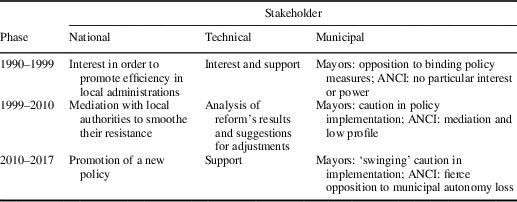
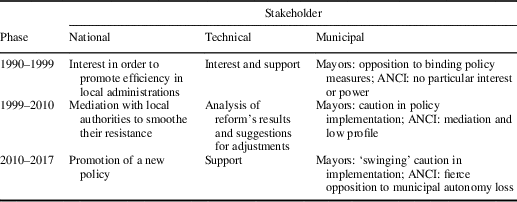
In the different outcomes of this last phase, exogenous factors also intervened: as said before, the economic crisis and the need to contain costs determined a drastic acceleration in the policy process. This mix of endogenous and external elements allowed the opening of a policy window (Kingdon Reference Kingdon1984) for defragmentation in the most recent years. Table 5 summarises the discussion thus far, always following the three-phase scansion.
Main stakeholders and relevant stance towards defragmentation in the three phases
Source: Authors’ compilation.
Conclusion
Municipal (de)fragmentation is a long-term issue but its relevance has been differently perceived over time. The overview of this aspect of territorial policy during the last 25 years (1990–2017) reveals quite varying pictures.
The main normative provisions introduced to cope with fragmentation have been reviewed here in their principal contents and three main phases have been singled out: a first one (1990–1999) when defragmentation was to be achieved through MUs that were intended to precede forced amalgamations; a second one (1999–2010) where MUs were instead conceived as mere cooperation and task management tools while municipal merging disappeared from the scene; and a third one (2010–2017) when both MUs and amalgamations were once more strongly fostered as the main policy tools for addressing defragmentation. While in the first phase the national actors chose a semi-coercive approach (that is, addressing municipal (de)fragmentation through MUs and only then through compulsory mergers), the opposition to such constraints from local actors obliged national policy makers to reorient, in the second phase, towards a non-intervention strategy and a totally voluntary approach. The budget-constraining effects of the global crisis forced national actors to change strategy again in the third phase: since 2010 a targeted intervention in small municipalities of under 5,000 inhabitants has been enacted through a clear coercive approach and the CJM tool.
We then presented the results of the different ways used to address territorial policy and to cope with (de)fragmentation. This scrutiny attests to how the third phase was the only one that significantly started to impact on the numbers both of MUs (which rose to more than 500) and amalgamations (which increased from eight before 2010 to 82 in 2017).
The review of the stances of the main stakeholders (technical and municipal-level) involved in defragmentation has provided an interesting interpretative key for these results. While the experts have substantially supported defragmentation as well as the policy tools envisaged to cope with it (MUs and mergers) throughout the three phases, national and municipal actors assumed different and mutually influencing stances. In the first phase (and even before), it was mainly academic scholars that dealt with this issue. Their attention was nonetheless mainly focused on juridical and constitutional aspects, rather than on territorial reform as a policy issue, which had to involve dimensional and institutional performances. Local administrators maintained a passive attitude until the approval of the norms, only to react immediately after, in particular by trying to implement them as restrictively as possible in order not to lose their operational and decision-making autonomy. The same happened during the whole second phase, when all involved stakeholders purposely maintained a low profile. National-level actors tried in fact to reach compromises with local actors in order to avoid a complete rejection of the defragmentation tools and a total failure in the implementation of the whole policy.
By contrast, in the third phase the national level decided to assume a more firm position by openly addressing defragmentation and by imposing coercive measures on small municipalities and by not necessarily looking for a compromise with them (except perhaps on the CJM matter). In fact compulsory joint management of basic functions (CJM) has been harshly opposed by local actors. While municipal actors played (and still play) a crucial role in the implementation of the new CJM strategy, with mixed results, the ANCI engaged in arm-wrestling with the national government for its revision (or even abolition). The several governmental adjustments CJM experienced after its first introduction in 2010 have indeed been a consequence of the constant lobbying made by the ANCI against what it considered an excessively top-down logic adopted by the national government.
The figures of the third phase may thus derive from the combination of several factors: a) exogenous factors, not least the austerity-driven reforms and the consequent idea of municipal defragmentation (also) as a way to reduce costs and enhance municipal efficacy and efficiency; b) the coercive approach and the targeted intervention pursued in this phase; c) but also, in some cases, the slowly-changing mindset of local actors towards these policy tools. More often than in the past local stakeholders (administrators, mayors and also citizens) are inclined to support amalgamations, a clear taboo only a few years ago. Albeit lukewarm, some first signs of a different mindset, especially as far as amalgamation is concerned, can be detected.
The full implementation of the 2014 Delrio Law (still pending and not at all problem-free), and a possible (but unlikely) new territorial reform, will be decisive for the future of Italian defragmentation and local government.
Whatever happens, the descriptive overview conducted thus far shows quite clearly how (de)fragmentation has recently become a crucial issue in territorial policy, and may inform subsequent research on both the challenging aspects of the changing centre-periphery relations and on the role of policy stakeholders.
Notes on contributors
Silvia Bolgherini is Assistant Professor at the University of Naples Federico II (Italy). She is research fellow at the Istituto Carlo Cattaneo, Bologna, and Ladislao Mittner Laureate for Political Science German Academic Exchange Service (DIH/DAAD). She has published widely on comparative politics, electoral studies, and local government.
Mariano Marotta obtained his PhD in political science at the University of Calabria (Italy). His research interests and publications focus on inter-municipal cooperation and institutional reforms.
Mattia Casula is PhD student, Honorary Fellow and currently Adjunct Professor in Analysis and Evaluation of Public Policies at the Department of Political Studies, LUISS University Rome. His research interests and publications cover cohesion policy in underdeveloped European regions and defragmentation policy in Italian regions.