Introduction
The conversion of glycerol to acrolein in the gas phase has been studied over the past 15 years and continues to receive much attention because this reaction is attractive for valuable applications of biodiesel-derived glycerol (Catuzo et al., Reference Catuzo, Possato, Sad, Padro and Martins2021; Wang & Liu, Reference Wang and Liu2021). A surplus of glycerol exists in the current chemical markets because of a continuously increasing demand for biodiesel. Glycerol is produced in large quantities as a by-product of the transesterification process of triglycerides (animal fats or vegetable oils) for making biodiesel (Viswanadham et al., Reference Viswanadham, Vishwanathan, Chary and Satyanarayana2021). Acrolein is a versatile intermediate in chemical industries. At present, acrolein is prepared by the oil-based propylene route (Zhao et al., Reference Zhao, Wang, Wang, Wang and Huang2020).
The gas-phase dehydration of glycerol to acrolein is catalyzed by acidic catalysts. Various solid acid catalysts have been tested including heteropoly acids (Massa et al., Reference Massa, Andersson, Finocchio and Guido2013a; Wang & Liu, Reference Wang and Liu2021), zeolites (Ali et al., Reference Ali, Lan, Arslan, Gilani, Wang and Wang2020), and metal oxides (Lauriol-Garbey et al., Reference Lauriol-Garbey, Postole, Loridant, Auroux, Belliere-Baca, Rey and Millet2011; Liu et al., Reference Liu, Yu, Wang, Sun, Liu, Shi and Wang2021), etc. To the best of the current authors’ knowledge, these catalysts still have some drawbacks such as rapid deactivation due to the formation of coke. Recent studies have been aimed at reducing the rate of coking by fast diffusion over mesoporous materials as catalysts (Wang & Liu, Reference Wang and Liu2021; Zhao et al., Reference Zhao, Wang, Wang, Wang and Huang2020). The supported 30 wt.% H3PW12O40 (sample 30HPW) on mesoporous MSU-x silicas gave the greatest yield of acrolein (69.7%); a 4 h run led to the formation of 12 wt.% coke, however (Wang & Liu, Reference Wang and Liu2021). The greatest yield of acrolein was 68% over 10−50% H4PMo11VO40/mesoporous MCM-41 silicas according to Viswanadham et al. (Reference Viswanadham, Vishwanathan, Chary and Satyanarayana2021). The hierarchical SAPO-34 zeolite (S34-P) achieved the greatest acrolein yield (89.8%) after a 1 h run; after a 7 h run the acrolein yield decreased to ~70% (Zhao et al., Reference Zhao, Wang, Wang, Wang and Huang2020). The S34-P catalyst had a coke content of ~4.3%, whereas other SAPO-34 zeolite catalysts showed a coke content of 8.6−11.8 wt.% after a 15 h run. Though mesoporous silicas such as MCM-41 and MSU-x exhibit fast diffusion, their hydrothermal stability is poor.
In addition to the porosity of the catalyst (related to diffusion limitation), the acidic properties of catalyst such as acid amount and type of acid sites also affect catalyst deactivation (Wu et al., Reference Wu, She, Tesser, Serio and Zhou2020; Liu et al., Reference Liu, Yu, Wang, Sun, Liu, Shi and Wang2021). It is accepted generally that Brönsted acid sites favor the dehydration of glycerol to the target product, acrolein, and Lewis acid sites promote the production of the by-product acetol (Wang & Liu, Reference Wang and Liu2021). Brönsted acid sites are also the centers of coke formation, however, and a large amount of strong Brönsted acid sites may accelerate coking (Katryniok et al., Reference Katryniok, Paul, Bellière-Baca, Rey and Dumeignil2010). Hence, the cooperation effect of Brönsted and Lewis acid sites of catalysts on acrolein yield and coke formation needs to be taken into consideration when designing novel catalysts (Wang & Liu, Reference Wang and Liu2021).
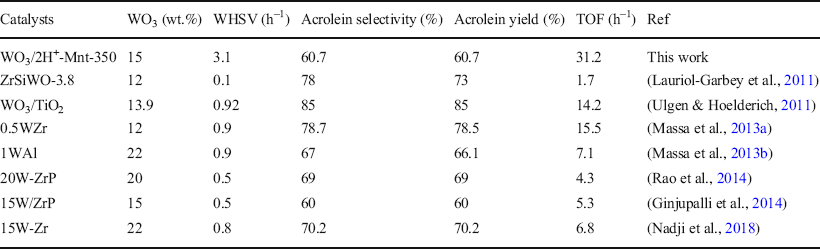
WO x species, in combination with supports, tuned acid sites of supported-WO3 catalysts and exhibited significant catalytic activity in the dehydration of glycerol to acrolein (Nadji et al., Reference Nadji, Massó, Delgado, Issaadi, Rodriguez-Aguado, Rodriguez-Castellón and LópezNieto2018). The supported 12−37 wt.% WO3 catalysts were prepared by means of impregnation of Al2O3, SiO2, and ZrO2 with ammonium paratungstate (Massa et al., Reference Massa, Andersson, Finocchio and Guido2013a, Reference Massa, Andersson, Finocchio, Busca, Lenrick and Wallenbergb). The 37 wt.% WO3/ZrO2 catalyst (2WZr) exhibited abundant Brönsted acid sites and gave a small TOF value (5.1 h–1) with an acrolein yield of 79.4%. TiO2 is well known as Lewis acidic material and is used also as a support for WO3/TiO2 catalysts for glycerol dehydration; a maximum of 73% acrolein selectivity was achieved with a high coke loading (4.6 wt.%) formed on the WO3/TiO2 catalyst after a 6 h run (Dalil et al., Reference Dalil, Carnevali, Dubois and Patience2015, Reference Dalil, Carnevali, Edake, Auroux, Jean-Luc Dubois and Patience2016). According to Ulgen and Hoelderich (Reference Ulgen and Hoelderich2011), the best result was 85% acrolein selectivity with a TOF value of 14.2 h–1 over 13.9% WO3/TiO2 catalyst (Table 1). A fundamental study was performed by Ginjupalli et al. (Reference Ginjupalli, Mugawar, Pethan, Balla and Komandur2014, Reference Ginjupalli, Balla, Shaik, Nekkala, Ponnala and Mitta2019) on the effect of supports on surface acidity and catalytic performance. Those authors prepared supported-WO3 tetragonal zirconia (TZ), monoclinic zirconia (MZ), and aluminum, titanium, and zirconium phosphate (AlP, TiP, and ZrP) catalysts. The 15W/TiP (15 wt.% WO3 loading) catalyst showed good catalytic performance and gave a TOF of 7.0 h–1 at an acrolein selectivity of 80%. Those authors further showed that the choice of support made a significant difference in the total acidity (0.35−4.6 mmol/g) and the catalytic performance.
Literature data for the gas-phase conversion of glycerol over the supported WO3 catalysts

Montmorillonite (Mnt) is a layered aluminosilicate mineral (Madejová, Reference Madejová2003). The Mnt unit layer (individual platelet) is composed of a central [AlO4(OH)2] octahedral sheet between two [SiO4] tetrahedral sheets. In the interlayer spaces of Mnt, some hydrated exchangeable cations such as Ca2+ and Na+ exist (van Olphen, Reference van Olphen1964). Such a unique structure makes the use of Mnt straightforward as a solid acid catalyst with tunable acidity and acid sites via various modifications such as acid-treatment, cation exchange, pillaring, and impregnation, etc. (Huang et al., Reference Huang, Liu, She, Zhong, Christidis and Zhou2021). Among these modifications, relatively few studies on impregnation of Mnt with transition metal oxides have been carried out. Tungsten oxides exhibit multiple structures and different activities. A simple impregnation of Mnt with tungsten oxides can tune acidity. Besides, acid treatment of Mnt can create Brönsted and Lewis acidity and lead to significant increases in specific surface areas and porosity beneficial to mass transfer (Rožić et al., Reference Rožić, Novaković and Petrović2010).
In the current work, Mnt was activated by H3PO4 solution and WO3 species were supported on the H3PO4-activated Mnt by impregnation using ammonium metatungstate (AMT) as WO3 precursor followed by calcination at 350, 450, and 550°C, respectively. The materials obtained were tested as catalysts for the glycerol dehydration reaction. The objective was to determine the effects of H3PO4 concentrations and calcination temperature on textural properties, development of WO3 species, acid amount, acidic strength, acid sites, and catalytic performance of the catalysts. Another purpose was to gain a deeper understanding of the cooperative role of Brönsted and Lewis acidity on glycerol dehydration.
Experimental
Materials
Mnt was obtained from a bentonite deposit in Anji, Zhejiang, China. The structural formula of Mnt is Na0.03K0.13Mg0.16Ca0.35(Si7.91Al0.09) (Al2.74FeIII0.17Mg1.08Ti0.01)O20(OH)4 based on its chemical composition: 66.83% SiO2, 20.29% Al2O3, 2.73% CaO, 6.97% MgO, 1.92% Fe2O3, 0.144% Na2O, 0.893% K2O, 0.096% TiO2. The chemical composition of Mnt was determined using X-ray fluorescence (XRF) analysis on an ARL ADVANT’X IntelliPower 4200 instrument (Thermo Fisher Scientific, Carlsbad, California, USA) with Rh as a target element of the X-ray tube at Zhejiang University of Technology (Hangzhou, Zhejiang, China). The measurements were repeated three times and the average chemical composition was calculated. The half-unit-cell charge density of Mnt is 0.59. The cation exchange capacity (CEC) of Mnt is 79.2 meq/100 g. The CEC of Mnt was measured by the ammonium chloride-HCHO titration method (Zhu et al., Reference Zhu, Zhu, Zhu and Xu2008; Yu et al., Reference Yu, Ren, Tong, Zhou and Wang2014). AMT ((NH4)6[H2W12O40]·4H2O, 99.5%) was purchased from Shanghai Aladdin Biochemical Technology Co., Ltd. (Shanghai, China). H3PO4 (analytical grade, ≥85.0%) was provided by Shanghai Lingfeng Chemical Reagents Co. Ltd. (Suzhou, Jiangsu, China). Aqueous formaldehyde (37.0−40.0%) solution and glycerol (analytical grade, ≥99.0%) were purchased from Hangzhou Shuanglin Chemical Reagent Co., Ltd. (Yuhang, Hangzhou, China).
Purification of Raw Bentonite
The <2 μm size fraction of Mnt particles was separated using sedimentation under gravity according to Stokes’ law. Typically, the raw bentonite was air dried at 100°C for 2 h and cooled to room temperature and then crushed to <5 mm particle size. The dried and crushed bentonite (10 g) was dispersed in deionized water (990 mL) and stirred mechanically for 1 h at 500 rpm. The resulting mixture was kept static for 24 h to ensure the swelling. Subsequently, the mixture was stirred for 1 h at 800 rpm, and left to sediment for 8 h to allow solid particles to settle. The supernatant above a depth of 10 cm was collected and identified as purified Mnt. The collected Mnt was dried at 110°C until water evaporation was complete, and then ground in an agate mortar and passed through a 200-mesh sieve for further use.
Catalyst Preparation
Preparation of H3PO4-Activated Mnt
The ratio of aqueous H3PO4 solution to dried Mnt was 5:1 (volume/weight) in the mixture. The concentrations of aqueous H3PO4 solution were 1, 2, and 4 mol/L. Typically, the dried Mnt (5 g) was added to an aqueous H3PO4 solution (25 mL, 2 mol/L) in a round-bottomed 100-mL flask equipped with a reflux condenser and stirred vigorously for 4 h at 85°C, then cooled to room temperature. The resulting slurry was washed with deionized water (175 mL), then centrifuged at 1900×g for 30 min. The supernatant solution was discarded and the solid residue was washed four times with deionized water. The wet solid residues were air dried at 80°C for 24 h, followed by calcination at 350°C for 4 h in air to obtain H3PO4-activated Mnt (labeled as xH+-Mnt, where x = 1, 2, or 4, and refers to molar concentration of H3PO4 in aqueous solution).
Preparation of 15 Wt.% WO3/2H+-Mnt Catalysts
2H+-Mnt as a support was impregnated in an aqueous AMT solution. The ratio of aqueous AMT solution to 2H+-Mnt was 2:1 (volume/weight). AMT concentration in the impregnation mixture was calculated to obtain a nominal 15 wt.% WO3 content in the final catalyst. Before impregnation, the calcined 2H+-Mnt sample was ground in an agate mortar and passed through a 200-mesh sieve. Typically, 0.73 g of AMT was dissolved in 8 mL of deionized water to obtain a homogeneous aqueous AMT solution. Then the aqueous AMT solution above was added dropwise onto 2H+-Mnt (4 g), to ensure that the surface of 2H+-Mnt was wet. After being kept static for 10 h at room temperature, the resulting mixture was ultrasonicated for 1 h, and then the excess water in the catalyst was removed using a rotary evaporator at 60°C. The solid product was air dried at 120°C for 12 h, and followed by calcination at 350, 450, or 550°C for 4 h, respectively. The samples were designated as WO3/2H+-Mnt-T, where T = 350, 450, or 550°C.
The powder samples were prepared by grinding in an agate mortar and passing through a 200-mesh sieve for catalyst characterization.
Catalyst Characterization
N2 adsorption-desorption isotherms were measured at −196°C on an Autosorb IQ3 instrument (Quantachrome Instrument Co., Boynton Beach, Florida, USA). Before the measurement, the powder samples were outgassed under vacuum for 3 h at 300°C. Specific surface areas and pore-size distributions were obtained using the Brunauer-Emmett-Teller method and the Barret-Joyner-Halenda (BJH) model, respectively.
Powder X-ray diffraction (XRD) patterns were collected using a PANalytical X’Pert PRO diffractometer (PANalytical, Almelo, The Netherlands), with Ni-filtered CuKα radiation (λ = 0.1542 nm) operated at 40 kV and 30 mA. The powder samples were mounted in a sample holder and scanned at 2.0°2θ/min with a step width of 0.020°2θ in the angular range 2−40°2θ.
Fourier-transform infrared (FTIR) spectra were recorded on a Nicolet 6700 spectrometer (Thermo-Nicolet, Madison, Wisconsin, USA) using the KBr pressed-disc technique in the 400−4000 cm−1 region at room temperature. The KBr pellets were prepared by pressing the mixtures of powder samples (0.9 mg) and KBr (80 mg). All spectra were collected using 64 scans with a resolution of 4 cm−1.
Surface morphology was examined by scanning electron microscopy (SEM) using a Hitachi S4700 (II) scanning electron microscope (Hitachi, Ibaraki, Japan) operating at 15 kV accelerating voltage. The powder samples were coated with a thin layer of gold for better resolution of SEM images.
X-ray photoelectron spectroscopic (XPS) analyses were carried out on a Kratos Axis Ultra DLD X-ray photoelectron spectrometer (Shimadzu, Kyoto, Japan) using a standard MgKα (1253.6 eV) X-ray source operated at 7.5 mA and 10 kV. Double-sided adhesive tape (3 mm×4 mm) was stuck to a Cu sheet, then a small amount of powder sample was placed on the double-sided tape and the unfixed samples on the tape were blown away. The C 1s line at 284.6 eV was used as an internal standard for the calibration of binding energies in order to eliminate the influence of adventitious carbon on the powder sample surface. The base pressure was kept below 10−10 bar. Curve fitting and background subtraction were done also.
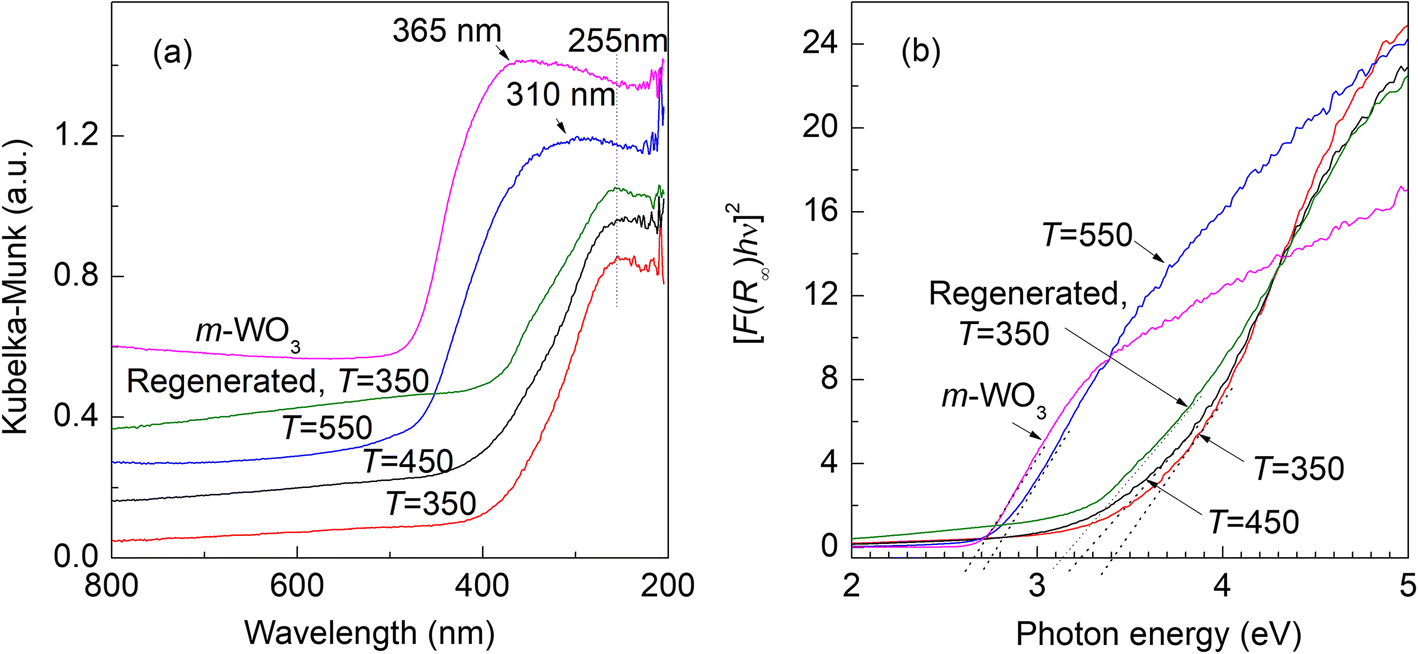
Diffuse reflectance ultraviolet-visible (DR UV-Vis) spectra were collected using a Shimadzu UV-2550 spectrometer (Shimadzu, Tokyo, Japan). The baseline was recorded using the normative contrast powder BaSO4 as a reference. The powder samples were added to a sample holder . The spectra were plotted by the Kubelka-Munk function F(R ∞) versus wavelength (λ). The edge energy (E g) for direct allowed transition (i.e. monolayer dispersion of WO3 species on the surface of the catalyst) was obtained from the point where the tangent line of the absorption edge intersected the X-axis in the plot of [F(R ∞) hν]2 versus hν (eV), where hν is the incident photon energy (Kim et al., Reference Kim, Burrows, Kiely and Wachs2007).
Temperature-programmed desorption of NH3 (NH3-TPD) analyses were conducted using a Micromeritics ASAP 2920 instrument (Norcross, Georgia, USA) equipped with a thermal conductivity detector (TCD). The powder sample was pressed into pellets, and then crushed and sieved to 30−40 mesh. Catalyst (50 mg) was added to a quartz tube fixed-bed reactor. The catalyst was degassed at 300°C for 1 h under a flow of helium (30 mL/min), and then cooled to 80°C. Subsequently, a mixture gas (1% NH3, 99% N2) flow at 30 mL/min was passed over the catalyst for 1 h to adsorb NH3 and followed by a flow of helium (30 mL/min, 1 h) to remove physically adsorbed NH3 on the catalyst surface. TPD analysis of chemically adsorbed NH3 was carried out under a helium flow (30 mL/min) at 80–800°C with a heating rate of 10°C/min.
Diffuse reflectance FTIR (DR FTIR) spectra of the chemisorbed pyridine were recorded on a Nicolet Avatar 370 FTIR spectrometer (Thermo Electron Co., Madison, Wisconsin, USA). Powder samples (50 mg) were poured loosely into sample cups and outgassed under vacuum at 250°C for 4 h, then cooled to ambient temperature. Subsequently, two drops of pyridine were placed on each of the samples. After pyridine was adsorbed for 30 min, the samples were kept in an air oven at 120°C for 1 h to remove physically adsorbed pyridine. After cooling the samples, FTIR spectra were collected with 256 scans and at a resolution of 4 cm–1 using KBr background.
Thermogravimetric (TG) analyses were carried out using a Mettler Toledo TGA/DSC 1 instrument (Mettler Toledo Corp., Zurich, Switzerland). The powder samples (30–35 mg) were placed in an Al2O3 crucible and heated at a temperature ramp of 10°C/min from room temperature to 800°C with a N2 gas flow at 60 mL/min.
Catalytic Reaction and Reuse Test of Catalyst
The reaction was carried out in a vertical fixed bed reactor 8 mm in diameter and 500 mm in height. 0.2 g of catalyst was used and diluted with quartz (2.0 g). The catalyst powder was pressed into pellets, and then crushed and sieved through a 30−40 mesh sieve before its activity was evaluated. The reaction products were collected in a cold trap and analyzed using a gas chromatograph (Shimadzu GC-2014, Kyoto, Japan) equipped with a capillary column (FFAP 30 m×0.32 mm×0.33 μm) and a flame ionization detector (FID). The aqueous products were quantified by comparison with the calibration curves using 1-butanol as the internal standard without preliminary extraction and separation of water. The analyses were repeated three times. The conversion of glycerol and the selectivity and yield of the product were calculated using Eqs 1, 2, and 3.


After the first 15 h on-stream run, the deactivated WO3/2H+-Mnt-350 catalyst was regenerated using a combination of solvent extraction and calcination. The spent catalyst was added to a mixture of ethanol and chloroform. The mixture was stirred for 3 h at 50°C, and the catalyst was then recovered by filtration using a glass sand core filter funnel. The excess solvents in the catalyst were removed using a rotary evaporator at 60°C, and then the resultant solid (extracted WO3/2H+-Mnt-350) was calcined at 400°C for 4 h. The regenerated catalyst was used in a subsequent run under the same reaction conditions as before and was analyzed by DR UV-vis spectroscopy and TG analyses.
Results and Discussion
N2 Adsorption-Desorption Isotherms
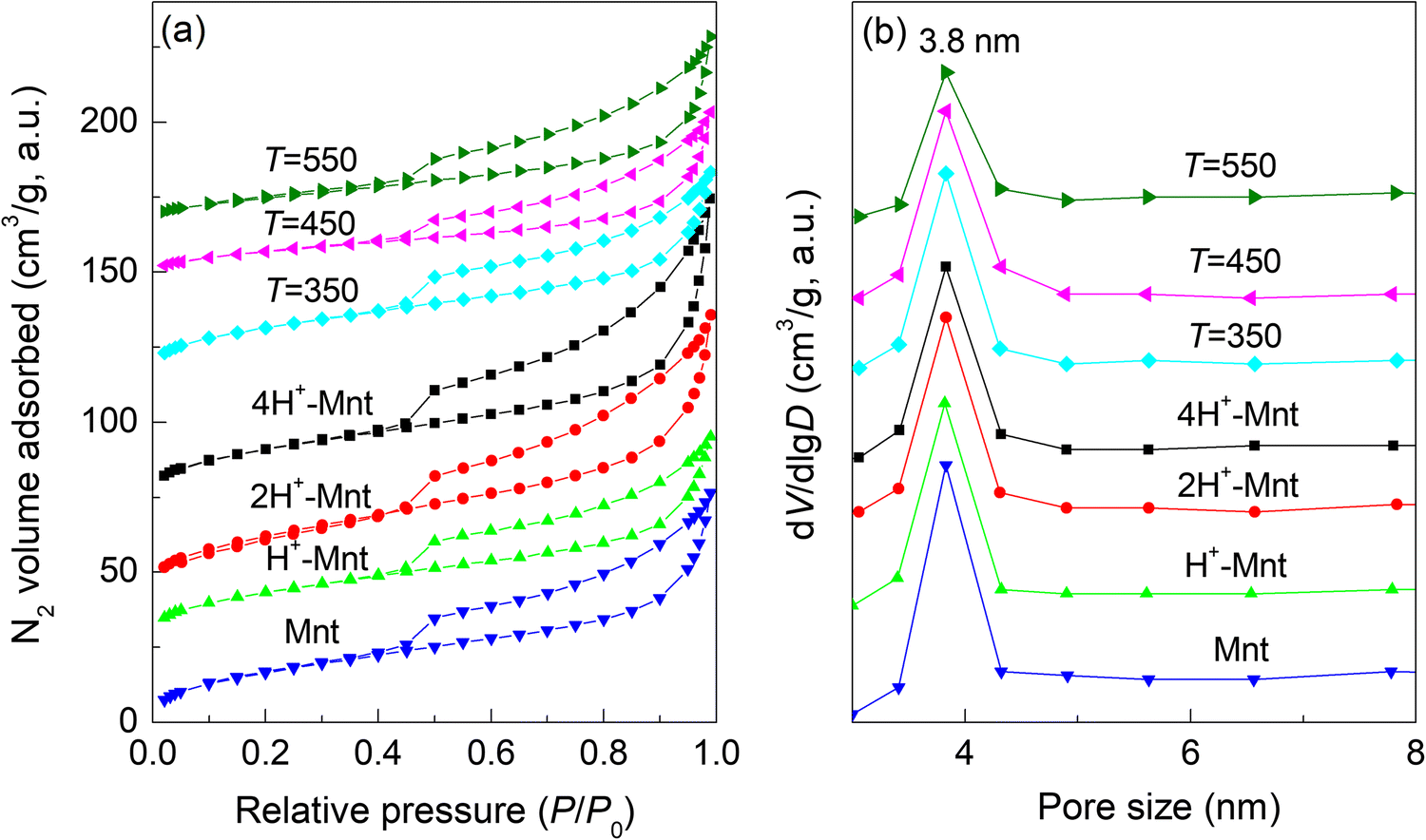
As revealed by the N2 adsorption-desorption isotherms (Fig. 1a), all the samples showed a characteristic type IV isotherm with the N2 hysteresis loops of H3 type, a feature of Mnt with slit-shape mesopores (Gregg & Sing, Reference Gregg and Sing1982). The materials possessed a uniform, narrow pore-size distribution at ~3.8 nm (Fig. 1b). The calcination at elevated temperatures did not change the mesoporosity of the Mnt.
a Nitrogen adsorption–desorption isotherms and b the corresponding BJH pore-size distributions for Mnt, xH+-Mnt, and WO3/2H+-Mnt-T

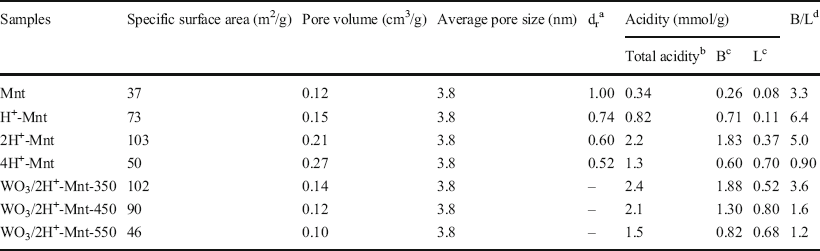
H3PO4 activation of Mnt increased the specific surface area from 37 to 103 m2/g and pore volume from 0.12 to 0.27 cm3/g (Table 2) because the layered structure of Mnt was partly broken by H3PO4 activation and the Mnt platelet edges were opened (Wang et al., Reference Wang, Liu, Wu, Li, Chen and Teng2010). 2H+-Mnt had the largest specific surface area (103 m2/g). Support of WO3 on 2H+-Mnt resulted in decreases in the specific surface areas and pore volumes. The specific surface area of WO3/2H+-Mnt-T decreased from 102 to 46 m2/g when calcination temperature increased from 350 to 550°C because the external surfaces were covered by and some pores were clogged by WO3 particles (Kumar et al., Reference Kumar, Ramacharyulu, Prasad and Singh2015).
Textural properties and acidity of catalysts

a dr refers to the relative b-axis order degree and dr=di/d0, here d0 and di refer to the b-axis order degrees of Mnt and xH+-Mnt and were determined by the ratio of the height of the (020) reflection peak to the width at the 2/3 height of the (020) reflection peak in the XRD patterns of the samples (Lu et al., Reference Lu, Cui and Song2003).
b Total acidity calculated by the areas of the desorption peaks in the NH3-TPD profiles.
c Amounts of Brönsted and Lewis acid sites.
d Concentration ratio of Brönsted (B) to Lewis acid (L) sites.
XRD Patterns
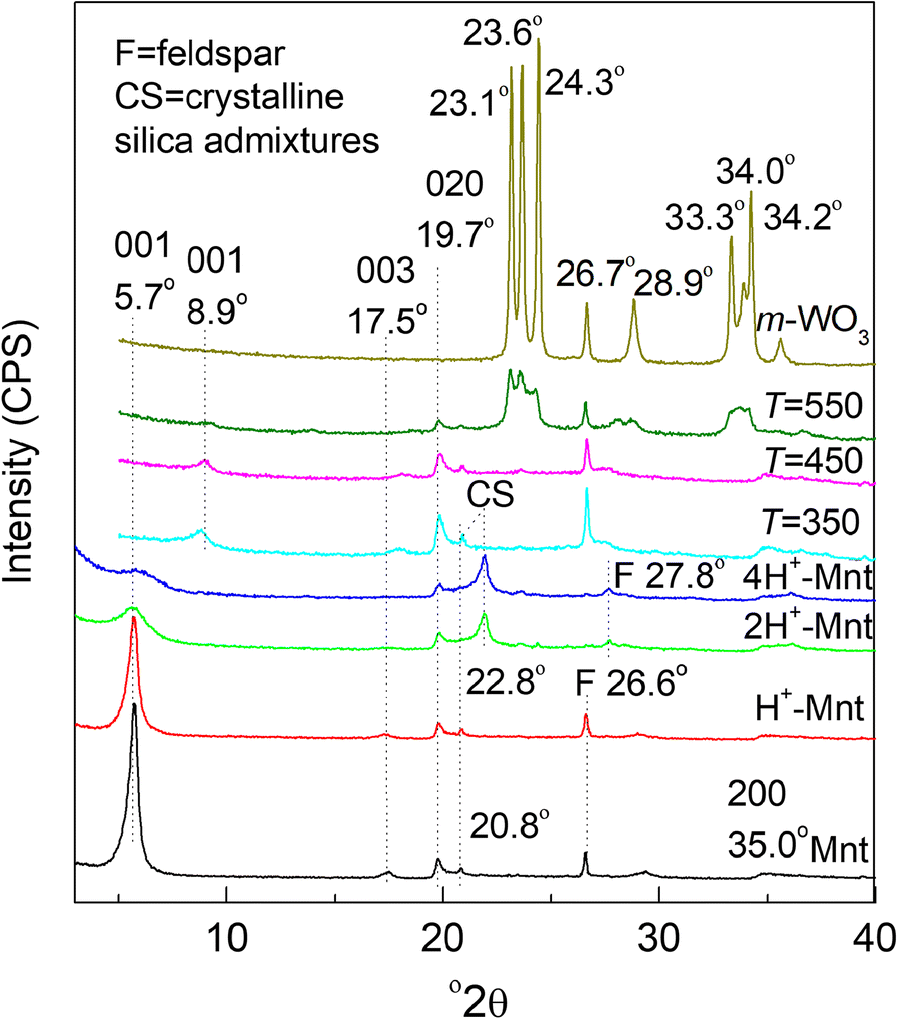
In the XRD patterns (Fig. 2), Mnt exhibited a (001) reflection at 5.7°2θ. Based on the Bragg equation, the d 001 value of Mnt was 1.54 nm. The XRD peaks at 17.5, 19.7, and 35.0°2θ were assigned to the (003), (020), and (200) reflections of Mnt, respectively (Zatta et al., Reference Zatta, Ramos and Wypych2013). This confirmed that Mnt had a layered structure (Wu et al., Reference Wu, Tong, Zhao, Yu, Zhou and Wang2014).
XRD patterns for Mnt, xH+-Mnt, WO3/2H+-Mnt-T, and the reference m-WO3

xH+-Mnt exhibited the same (001) reflections at 5.7°2θ as Mnt. The XRD pattern of H+-Mnt looked like that of Mnt. Hence, 1 mol/L H3PO4 solution for acid activation of Mnt had little influence on the Mnt structure. Compared to H+-Mnt, xH+-Mnt (x = 2 and 4) exhibited weaker and broader (001) reflections and the (003) reflections disappeared. The findings suggested that some delamination of the Mnt structure started when the concentration of H3PO4 solution was >2 mol/L, and H3PO4 concentration had a remarkable influence on the stacking order of the layers along the c axis. All the xH+-Mnt maintained (020) reflections. The results indicated that the Mnt after H3PO4 activation retained the periodic structure in the direction of the b axis. The relative b-axis order degrees of xH+-Mnt to Mnt decreased from 0.74 to 0.52 with increasing H3PO4 concentration from 1 to 4 mol/L (Table 2), suggesting that the decrease in the b-axis ordered structure of Mnt was due to dissolution of more octahedral cations in Mnt during acid treatment (Lu et al., Reference Lu, Cui and Song2003). The (001) reflections for WO3/2H+-Mnt-Ts shifted to 8.9°2θ and had less intense peaks after WO3 loading, indicating a particle-size reduction along the c axis. Besides, WO3/2H+-Mnt-T exhibited the same (020) reflection at 19.7°2θ as 2H+-Mnt and the intensities of the (020) reflection decreased with an increase in the calcination temperature from 350 to 550°C due to the decrease in the b-axis degree of order.
Only in WO3/2H+-Mnt-550 were a strong triplet reflection at 23.1, 23.6, and 24.3°2θ and two broad reflections at 28.9 and 33.3−34.2°2θ observed, similar to those for the reference monoclinic WO3 (m-WO3). These reflections were ascribed to m-WO3 crystals (Corà et al., Reference Corà, Patel, Harrison, Dovesi and Catlow1996; Nadji et al., Reference Nadji, Massó, Delgado, Issaadi, Rodriguez-Aguado, Rodriguez-Castellón and LópezNieto2018). For WO3/2H+-Mnt-T samples, new sharp reflections at 26.7°2θ were observed and their intensities decreased with increasing calcination temperature compared with those for 2H+-Mnt. These reflections were related to a hexagonal WO3 (h-WO3) phase (JCPDS 33-1387) (Guo et al., Reference Guo, Yin, Dong and Sato2012; Kalpakli et al., Reference Kalpakli, Arabaci, Kahruman and Yusufoglu2013). Thus, when the calcination temperature was increased from 350 to 550°C, more m-WO3 particles formed on the surfaces of WO3/2H+-Mnt-550, whereas for WO3/2H+-Mnt-T (T = 350 and 450), a h-WO3 phase existed mainly on their surfaces.
In the XRD pattern of Mnt, the reflections at 20.8 and 26.6°2θ were ascribed to crystalline silica admixtures and feldspar, respectively (Mojović et al., Reference Mojović, Banković, Milutinović-Nikolić, Nedić and Jovanović2010; Pentrák et al., Reference Pentrák, Hronský, Pálková, Uhlík, Komadel and Madejová2018). These admixtures suggested that Mnt had minor or trace impurities. These impurities were inert for glycerol dehydration and had hardly any effect on the catalytic results (Zhao et al., Reference Zhao, Zhou, Wu, Lou, Li, Yang, Tong and Yu2013). H+-Mnt showed intensities of the reflections at 20.8 and 26.6°2θ similar to those of Mnt, indicating the unchanged phases in these admixtures. For xH+-Mnt (x = 2 and 4), the reflections at 20.8°2θ shifted to 22.8°2θ (crystalline silica admixtures) and their intensities increased, while the reflections at 26.6°2θ shifted to 27.8°2θ (feldspar) and became very weak compared with Mnt. The results suggest that acid-treatment led to some crystal defects and changes in the relative contents of the admixtures due to dissolution of some impurities when the H3PO4 concentration was >2 mol/L. Similar findings were reported in previous studies (Pentrák et al., Reference Pentrák, Hronský, Pálková, Uhlík, Komadel and Madejová2018; Zatta et al., Reference Zatta, Ramos and Wypych2013). After supporting WO3 on 2H+-Mnt, the reflections at 22.8°2θ (crystalline silica admixtures) shifted to 20.8°2θ and their intensities decreased due to coverage of WO3 on the surfaces of Mnt. The surface WO3 affected the reflections of these admixtures.
FTIR Spectra
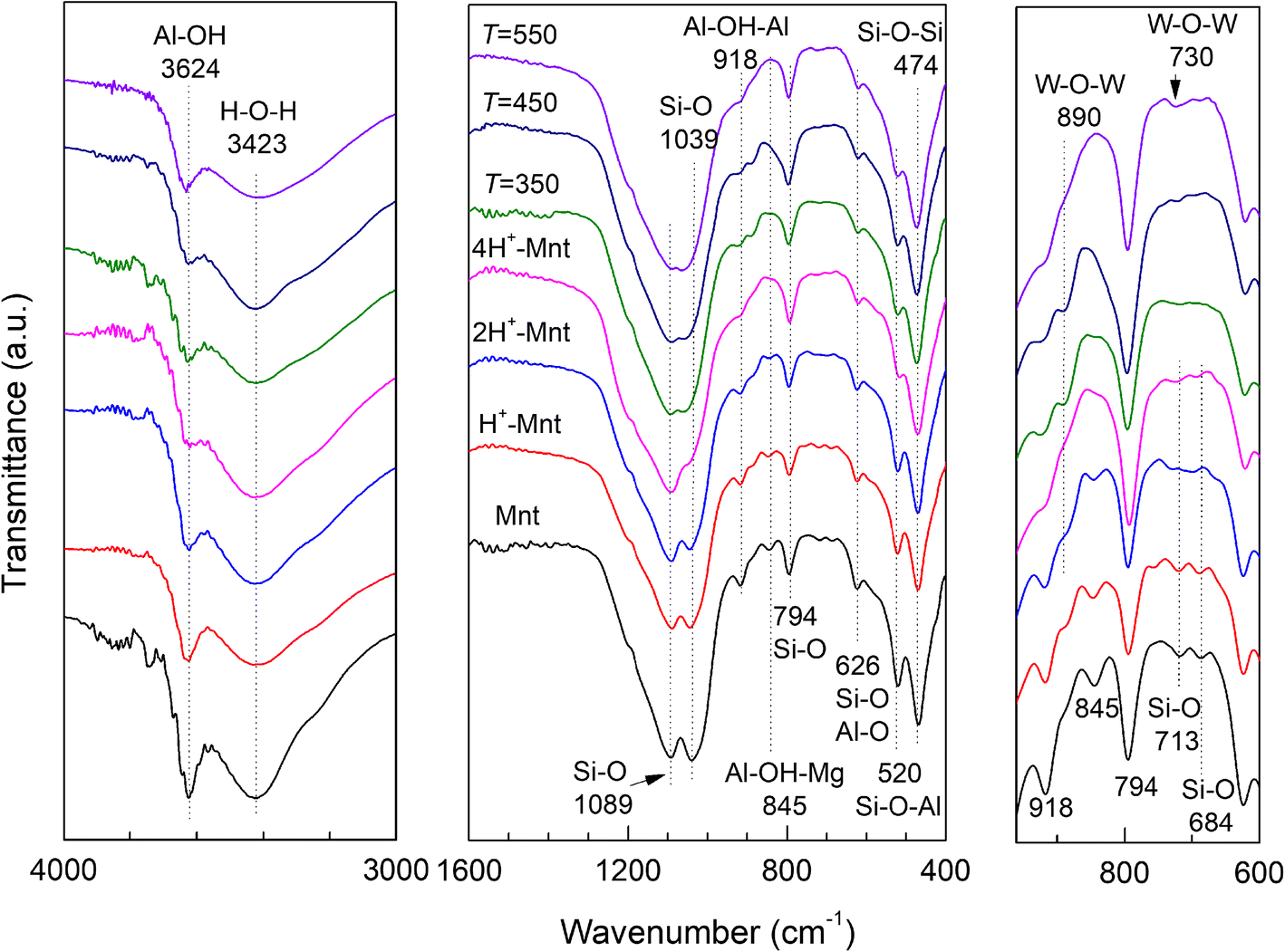
In the FTIR spectra of Mnt (Fig. 3), the absorption bands at 474 and 520 cm–1 are attributed to the bending vibrations of Si–O–Si groups in the tetrahedral sheet and Si–O–Al (octahedral Al) groups in the Mnt lattice, respectively (Pentrák et al., Reference Pentrák, Hronský, Pálková, Uhlík, Komadel and Madejová2018). The 626 cm–1 band originates from the bending vibrations of the coupled Al–O and Si–O groups (Madejová & Komadel, Reference Madejová and Komadel2001). Two weak absorptions at 845 and 918 cm–1 are attributed to the OH-bending vibrations from Al–OH–Mg and Al–OH–Al in the octahedral sheet, respectively. The result indicated that the octahedral Al3+ was partly substituted by Mg2+ in the Mnt lattice (Madejová, Reference Madejová2003; Zatta et al., Reference Zatta, Ramos and Wypych2013). The 1039 cm–1 band is ascribed to the tetrahedral-sheet Si–O stretching vibration. The 794 and 1089 cm–1 bands are assigned to the Si–O stretching vibration from crystalline silica admixtures such as quartz and a cristobalite-like phase (Madejová & Komadel, Reference Madejová and Komadel2001). The 713 and 684 cm–1 bands originate from the Si–O stretching vibrations in feldspar (Pentrák et al., Reference Pentrák, Hronský, Pálková, Uhlík, Komadel and Madejová2018). The 3423 and 3624 cm–1 bands are caused by the stretching vibrations of OH from water adsorbed in the Mnt interlayer spaces and of structural hydroxyl groups (Al–OH) in the octahedral sheet (Madejová, Reference Madejová2003).
FTIR spectra of Mnt, xH+-Mnt, and WO3/2H+-Mnt-T

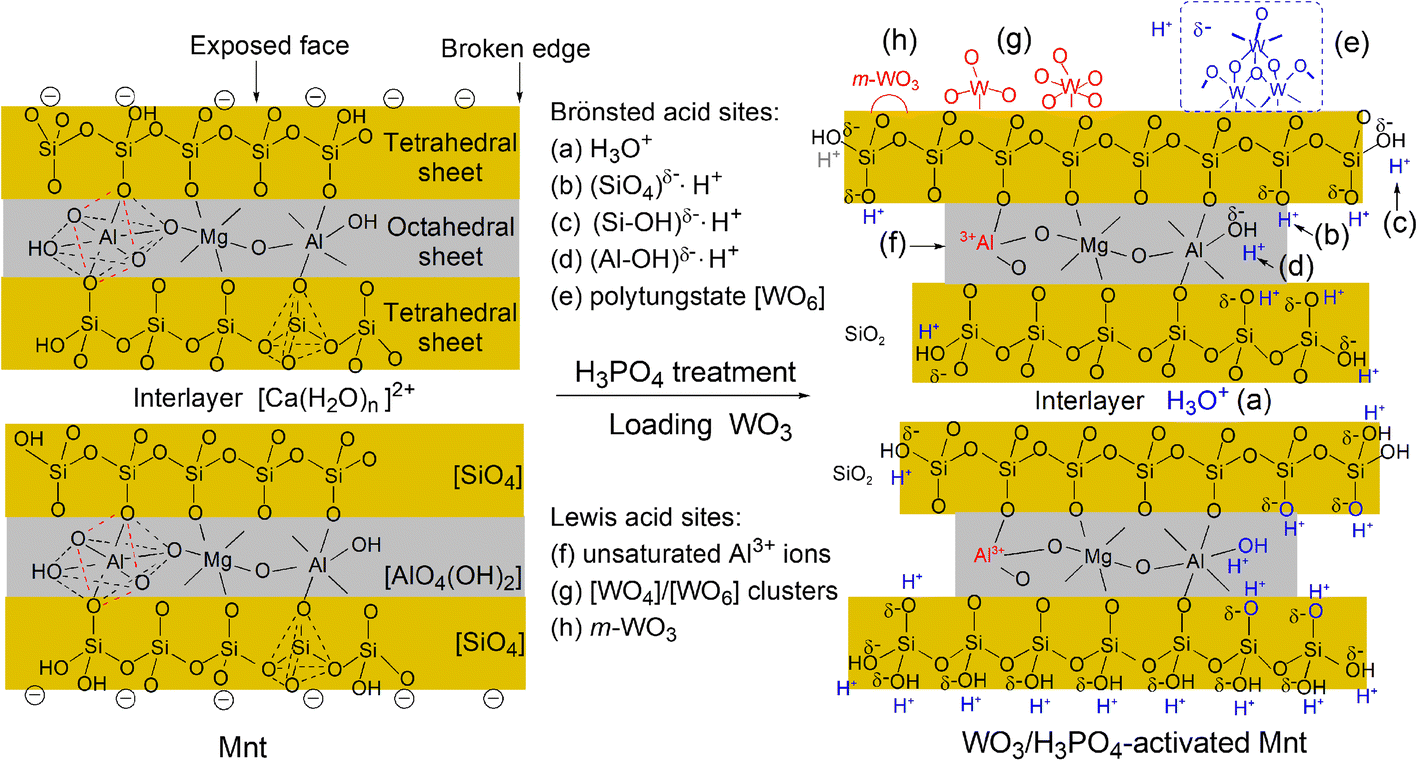
The possible change in chemical bonds (Fig. 4) during H3PO4 activation as reflected by the FTIR spectra revealed a greater understanding of the role of acid treatment of Mnt. For xH+-Mnts, the intensities of the 520, 845, 918, and 3624 cm–1 bands decreased with increasing H3PO4 concentration compared with Mnt. The reduced intensity of these bands was caused by the partial dissolution of the octahedral sheets in the process of H3PO4 activation. This observation was in agreement with the XRD patterns. During acid treatment, the protons (H+) attacked preferentially the structural OH groups in the octahedral sheet, which led to octahedral dehydroxylation. As a result, the octahedral cations such as Al3+ and Mg2+ were leached out of the Mnt structure (Pentrák et al., Reference Pentrák, Hronský, Pálková, Uhlík, Komadel and Madejová2018). Thus, the framework unsaturated Al3+ ions were exposed on the external surfaces and created Lewis acid sites (Fig. 4f) (Yadav et al., Reference Yadav, Chudasama and Jasra2004). The amount of unsaturated Al3+ ions depended on acid concentration and length of acid exposure time. Besides, with the dehydroxylation from the octahedral sheet, the Si–O–Al bond was broken to form negatively charged Si–O groups (denoted as (SiO4)δ–), which decreased the intensities of the 520 (Si–O–Al) cm–1 bands. The negatively charged Si–O groups provided conditions suitable for creating Brönsted acid sites because they could bind protons (Fig. 4b) (Zhou et al., Reference Zhou, Li, Zhuang, Wang, Tong, Yang, Lin, Li, Zhang, Ji and Yu2017). Thus, the Al–O octahedral sheets were partly dissolved. Then, the tetrahedral sheets also began to partially dissolve under the acid attack and some amorphous silica formed (Zatta et al., Reference Zatta, Ramos and Wypych2013). The dissolution of some tetrahedral sheets led to a pronounced decrease in the 1039 (Si–O) cm–1 band intensities (Pentrák et al., Reference Pentrák, Hronský, Pálková, Uhlík, Komadel and Madejová2018). The 1039 (Si–O) cm–1 band intensity weakened with the increase in H3PO4 concentration because a greater concentration of H3PO4 solution brought about more dissolution of the tetrahedral sheets. For xH+-Mnts, the presence of 474 (Si–O–Si) and 520 (Si–O–Al) cm–1 bands from the Mnt lattice and their almost unchanged band positions and intensities after acid treatment indicated that the Mnt layered structure remained (Zatta et al., Reference Zatta, Ramos and Wypych2013; Pentrák et al., Reference Pentrák, Hronský, Pálková, Uhlík, Komadel and Madejová2018).
Creation of the acid sites using H3PO4 activation and WO3 loading on Mnt

Compared to the parent 2H+-Mnt, an additional weak band at 890 cm–1 as a characteristic of polytungstate was observed for WO3/2H+-Mnt-T (T = 350 and 450) (Szilágyi et al., Reference Szilágyi, Santala, Heikkilä, Kemell, Nikitin, Khriachtchev, Räsänen, Ritala and Leskelä2011). Rao et al. (Reference Rao, Rajan, Sekhar, Ammaji and Chary2014) also detected the 840 cm–1 band in the FTIR spectra of the impregnated-WO3/ZrP catalysts. They thought that the 840 cm–1 band was caused by the W–O–W vibration from a link between two WO6 octahedra. WO3/2H+-Mnt-550 exhibited a new very weak band at 730 cm–1 in comparison to WO3/2H+-Mnt-T (T = 350 and 450). The 730 cm–1 band was related to m-WO3 (Soriano et al., Reference Soriano, Concepción, Nieto, Cavani, Guidetti and Trevisanut2011). The 700−1000 cm–1 bands from the W−O−W stretching vibrations were observable mostly in the FTIR spectra of tungsten oxides (Hunyadi et al., Reference Hunyadi, Sajó and Szilágyi2014). Thus, WO3 species were present on WO3/2H+-Mnt-T.
Surface Morphology
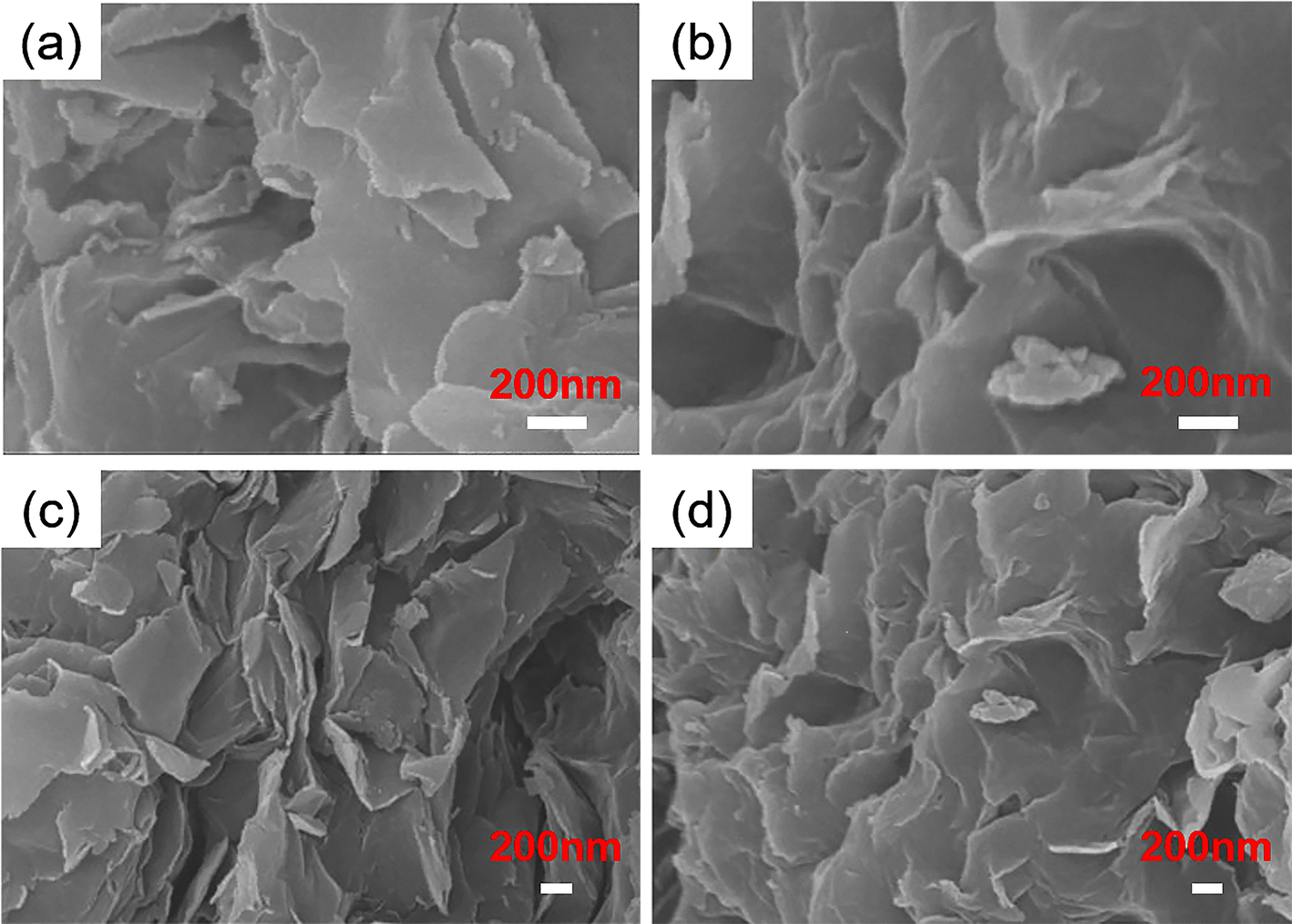
In the SEM images (Fig. 5), the particles of Mnt and xH+-Mnt appeared as flat platelets, indicative of a Mnt layer structure. H3PO4 treatment did not damage the Mnt layer structure much. xH+-Mnt exhibited smaller particle sizes than Mnt. The increase in H3PO4 concentration brought about a decrease in the layered stacking of the Mnt platelets. The results further confirmed that the H3PO4 activation created more edges of the Mnt platelets and led to the increased porosity and surface areas in the resultant materials (Rožić et al., Reference Rožić, Novaković and Petrović2010). These changes were caused by partial dissolution of octahedral and tetrahedral sheets of Mnt and some impurities during acid treatment. This observation was in accord with the data above from N2 adsorption-desorption, XRD patterns, and FTIR spectra.
SEM images of a Mnt, b H+-Mnt, c 2H+-Mnt, and d 4H+-Mnt

XPS Spectra
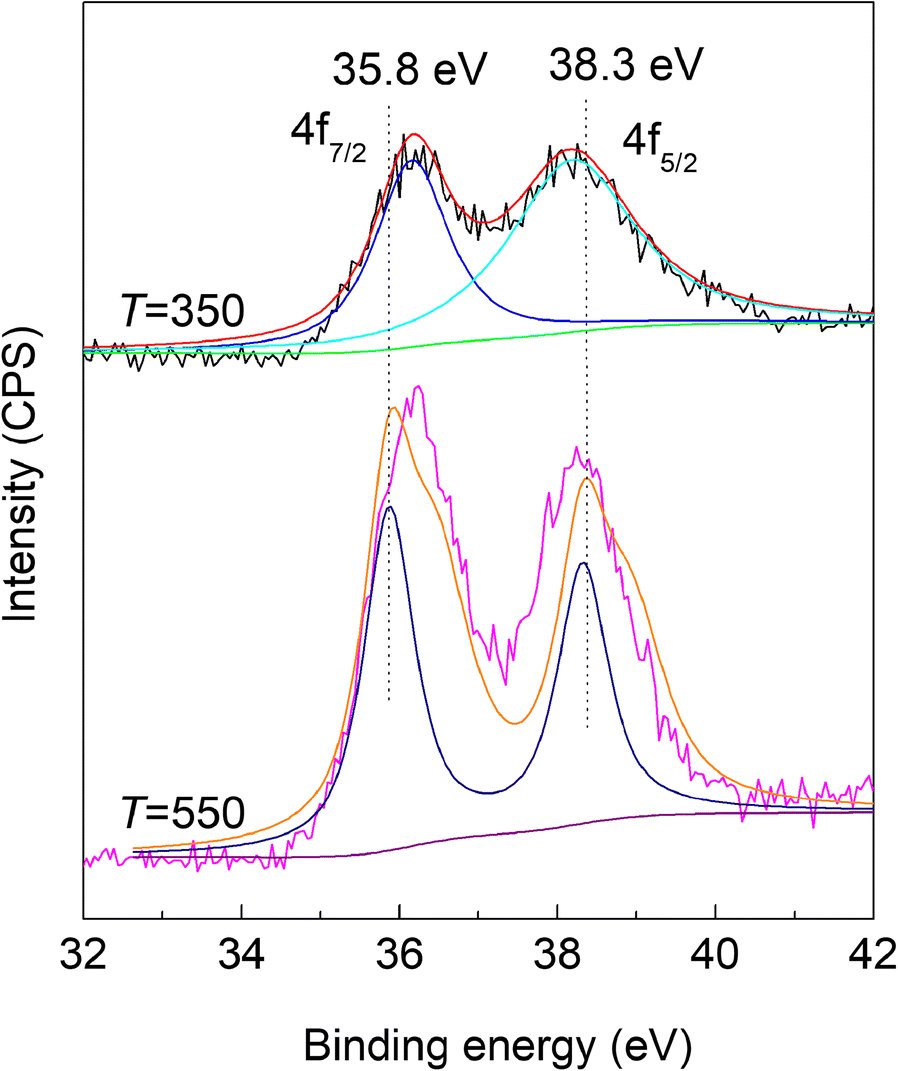
X-ray photoelectron spectra are often used to study the oxidation state of elements present on the surface. The binding energies of 35.5−36.5 and 37.9−39.1 eV, 34.6−35.1 and 36.7−37.2 eV for W4f7/2 and W4f5/2 were ascribed to W6+-states (Palcheva et al., Reference Palcheva, Spojakina, Tyuliev, Jiratova and Petrov2007; Song et al., Reference Song, Li, Yin, Xiao, Zhang, Song and Dong2015) and W5+-states of tungsten oxides (Liu et al., Reference Liu, Tao, Yu, Zhou, Ma, Mao and Zhou2015), respectively. Regarding XPS spectra of the catalysts (Fig. 6), the binding energies for W4f7/2 and W4f5/2 were 35.8 and 38.3 eV in WO3/2H+-Mnt-550, and 36.1 and 38.1 eV in WO3/2H+-Mnt-350, respectively. The result demonstrated the presence of W6+ species, not W5+ species on the surfaces of the catalysts.
XPS spectra of WO3/2H+-Mnt-T

DR UV-vis Spectra
The W coordination environment was characterized by DR UV-Vis spectra (Fig. 7). The reference m-WO3 showed a broad absorption band at ~365 nm. WO3/2H+-Mnt-550 exhibited absorption bands similar to the reference m-WO3. The result suggested that WO3/2H+-Mnt-550 had a m-WO3 phase. The strong absorption bands were centered at 255 nm for WO3/2H+-Mnt-T (T = 350 and 450), indicative of the presence of isolated tetrahedral [WO4]/octahedral [WO6] clusters (Song et al., Reference Song, Zhang, Zhang, Tang and Tang2013; Liu et al., Reference Liu, Tao, Yu, Zhou, Ma, Mao and Zhou2015).
DR UV-Vis spectra of fresh and regenerated WO3/2H+-Mnt-T and the reference m-WO3

The E g value of WO3/2H+-Mnt-550 was 2.74 eV, close to that of m-WO3 (2.66 eV), indicating that WO3/2H+-Mnt-550 had a characteristic of bulk-like m-WO3. For WO3/2H+-Mnt-T (T = 350 and 450), the E g values were 3.40 and 3.24 eV, respectively, which was attributed to the absorption of polytungstate [WO6] species (Song et al., Reference Song, Zhang, Zhang, Tang and Tang2013).
Based on the XRD patterns, on the FTIR and XPS spectra, and on the DR UV-Vis data above, WO3 species appeared in the forms of polytungstate, isolated [WO4]/[WO6] clusters, and m-WO3 with the variations of calcination temperature. h-WO3 phases as polytungstate or isolated tetrahedral [WO4]/octahedral [WO6] clusters were dispersed on WO3/2H+-Mnt-T (T = 350 and 450), and the m-WO3 phase dominated in WO3/2H+-Mnt-550.
Sources of Acid Sites
For the acid-treated Mnt, Brönsted acid sites were derived from three sources (Fig. 4): (1) the interlayer H3O+ ions originated from cation exchange with Ca2+ ions in the interlayer spaces of Mnt (Fig. 4a) (Yadav et al., Reference Yadav, Chudasama and Jasra2004; Zatta et al., Reference Zatta, Ramos and Wypych2013); (2) protonation of the negatively charged Si–O groups in the tetrahedral sheets of Mnt due to the breakage of Al–O–Si bonds upon acid attack (Fig. 4b) (Liu et al., Reference Liu, Yuan, Liu, Tan, He, Zhu and Chen2013; Zhou et al., Reference Zhou, Li, Zhuang, Wang, Tong, Yang, Lin, Li, Zhang, Ji and Yu2017); and (3) attraction of protons by the Si–OH and Al–OH groups on the exposed face or broken-edge surfaces of Mnt in acid environments (Fig. 4c, d) (Wang et al., Reference Wang, Liu, Wu, Li, Chen and Teng2010). Lewis acid sites were derived from the unsaturated Al3+ ions at the broken edges of Mnt (Fig. 4f) (Yadav et al., Reference Yadav, Chudasama and Jasra2004).
The acidity of WO3/2H+-Mnt-T was mainly from H3PO4 activation beside the WO3 species. The polytungstate species were correlated to Brönsted acid sites (Fig. 4e) because they had the extended networks that could form a delocalized excess negative charge. The excess negative charge could bind protons (Baertsch et al., Reference Baertsch, Soled and Iglesia2001), whereas the isolated [WO4]/[WO6] clusters (Fig. 4g) and m-WO3 particles (Fig. 4h) contributed Lewis acid sites because they could accept electrons (Song et al., Reference Song, Zhang, Zhang, Tang and Tang2013; García-Fernández et al., Reference García-Fernández, Gandarias, Requies, Güemez, Bennici, Auroux and Arias2015).
DR FTIR Spectra of Adsorbed Pyridine
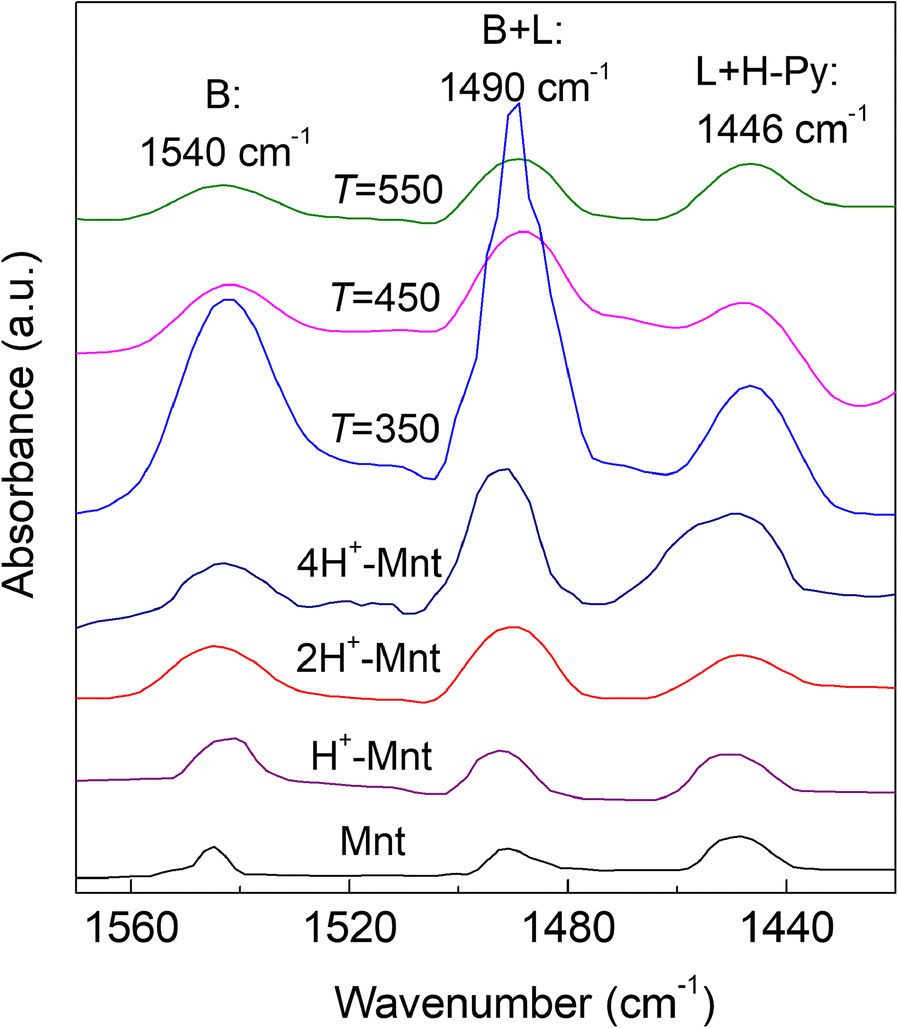
According to DR FTIR spectra of the chemisorbed pyridine (Fig. 8), all the samples showed absorption bands at 1540, 1490, and 1446 cm−1. The absorption band at 1540 cm−1 was caused by pyridinium ions binding to Brönsted acid sites (Ravindra Reddy et al., Reference Ravindra Reddy, Bhat, Nagendrappa and Jai Prakash2009). The 1490 cm−1 band indicated the presence of both pyridinium ions (Brönsted acid sites) and pyridine bonded to Lewis acid sites (Zatta et al., Reference Zatta, Ramos and Wypych2013). The 1446 cm−1 band was considered to result from the overlapping bands of pyridines connected to Lewis acid sites and linked by hydrogen bonding (Liu et al., Reference Liu, Yuan, Liu, Tan, He, Zhu and Chen2013). Thus, the concentration ratio of Brönsted to Lewis acid sites (B/L) (Table 2) can be calculated as follows:

DR FTIR spectra of adsorbed pyridine for xH+-Mnt and WO3/2H+-Mnt-T. Note: B and L refer to Brönsted and Lewis acid sites, respectively. H-Py refers to hydrogen-bonded pyridine

where A B and A (B+L) were the relative areas of the bands at 1540 and 1490 cm−1, respectively.
The surface acidity of the catalysts (Table 2) revealed that the B/L value of Mnt was 3.3. The Lewis acidity of Mnt is quite weak and it usually displays Brönsted acidity (Wang et al., Reference Wang, Lu, Liang and Ji2020). After the H3PO4 treatment of Mnt, the number of Brönsted and Lewis acid sites increased, though the increases were in varied proportions. Compared to Mnt, xH+-Mnt (x = 1 and 2) increased the B/L value, whereas for 4H+-Mnt, the B/L value decreased. This occurred for two reasons; high H3PO4 concentration favored the release of more octahedral Al3+ ions from Mnt to form Lewis acid sites and led to a high level of the collapse of Mnt layer structure, which decreased the interlayer protons (Zhao et al., Reference Zhao, Wang, Hao, Liu and Liu2015). After supporting WO3 on 2H+-Mnt, the B/L values of WO3/2H+-Mnt-T decreased from 3.6 to 1.2 with increasing calcination temperature due to the difference in WO3 species.
NH3-TPD
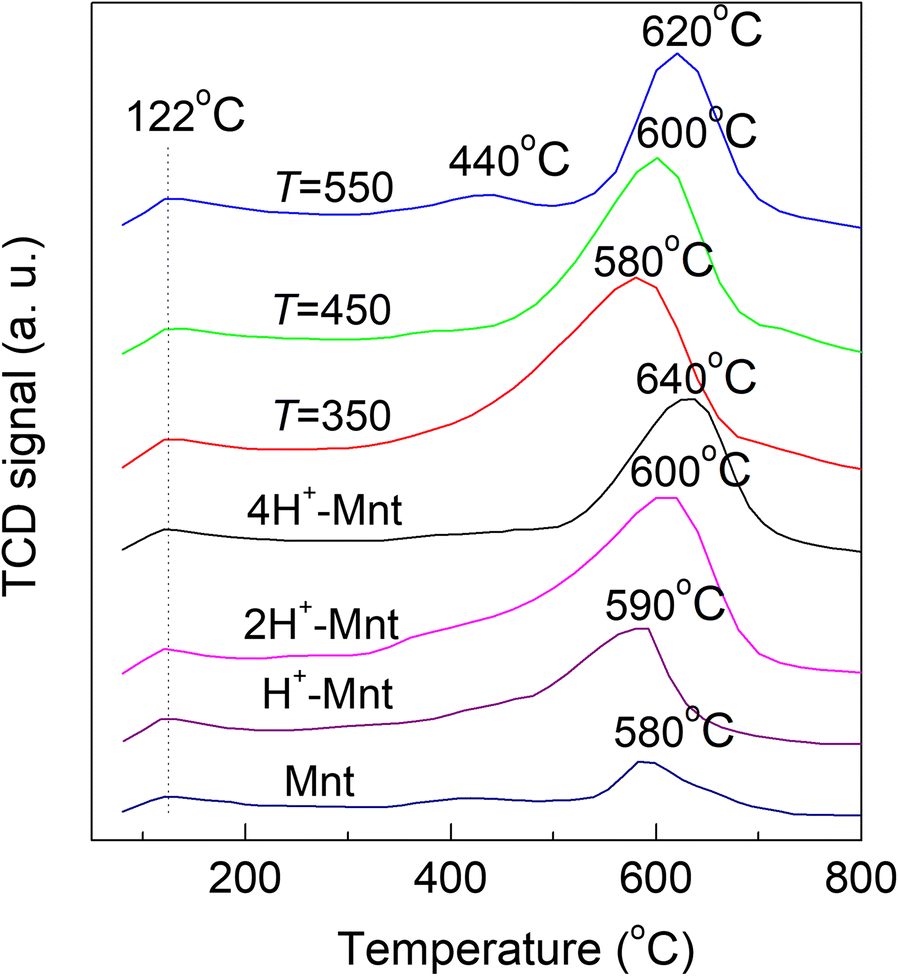
The acid strength of the catalysts was determined by NH3-TPD experiments (Fig. 9). The acid strengths of all the samples appeared bimodal. The initial NH3 desorption occurred at ~122°C and was related to the physically adsorbed, free H+ ion-bound, and weak acid site (Brönsted acid site)-bound NH3 molecules (Liu et al., Reference Liu, Yuan, Liu, Tan, He, Zhu and Chen2013). The further NH3 desorption occurred at ~300−700°C, which was correlated with strong/medium-strength acid sites and resulted from the unsaturated Al3+ ions (Lewis acid sites) (Liu et al., Reference Liu, Yuan, Liu, Tan, He, Zhu and Chen2013; Tong et al., Reference Tong, Zheng, Yu, Wu and Zhou2014). The results indicated the presence of both weak and strong acid sites on all the samples. Compared to Mnt and H+-Mnt, xH+-Mnt (x = 2 and 4) exhibited greater strength of strong acid sites. NH3 desorption at 120−150 and 450−600°C for the acid-activated K-10 Mnt was observed by Bokade and Yadav (Reference Bokade and Yadav2011) and Varadwaj et al. (Reference Varadwaj, Rana and Parida2013). Those findings indicated that strong acid sites are common for acid-treated Mnt due to the presence of unsaturated Al3+ ions.
NH3-TPD profiles for xH+-Mnt and WO3/2H+-Mnt-T

WO3/2H+-Mnt-T showed bimodal acid strengths similar to 2H+-Mnt. The strong acid sites stemmed mainly from acid activation of Mnt because WO x species appeared probably as moderate acid sites (Soriano et al., Reference Soriano, Concepción, Nieto, Cavani, Guidetti and Trevisanut2011; Rao et al., Reference Rao, Rajan, Sekhar, Ammaji and Chary2014). For instance, the NH3 desorption was centered at 240–350°C for tungstate metal phosphate acid catalysts (WO x /MP, M = Al, Zr, and Ti) (Ginjupalli et al., Reference Ginjupalli, Balla, Shaik, Nekkala, Ponnala and Mitta2019). In the WO3/2H+-Mnt-T samples, there was a small shift of strong acid sites or the presence of moderate acid sites due to the introduction of WO3 species onto 2H+-Mnt. Compared to 2H+-Mnt, WO3/2H+-Mnt-350 exhibited a slight shift of the strong acid sites from 600 to 580°C due to the presence of polytungstate species (Brönsted acid sites). The NH3 desorption temperature increased from 580 to 620°C with the increase in calcination temperature from 350 to 550°C. The result suggested that the strength of strong acid sites could be enhanced by increasing calcination temperature due to the formation of more isolated [WO4]/[WO6] clusters (Lewis acid sites) on WO3/2H+-Mnt-450 or more m-WO3 particles (Lewis acid sites) on WO3/2H+-Mnt-550 at higher temperatures. Liu et al. (Reference Liu, Yuan, Liu, Tan, He, Zhu and Chen2013) proposed that the weak-strength acid sites were caused by Brönsted acid sites, whereas Lewis acid sites were responsible for strong/medium-strength acid sites.
The total acidity of xH+-Mnt increased at first, and then decreased with increasing H3PO4 concentration. Similar findings in HNO3-treatment of Na+-Mnt were observed by Zhao et al. (Reference Zhao, Wang, Hao, Liu and Liu2015) because the collapse of the layered structure of Mnt decreased the total acidity which originated from the interlayer protons. WO3/2H+-Mnt-350 afforded a maximum total acidity of 2.4 mmol/g. For WO3/2H+-Mnt-T, when the calcination temperature increased from 350 to 550°C, total acidity decreased from 2.4 to 1.5 mmol/g (Table 2). The decrease in total acidity was due to the formation of more m-WO3 during calcination besides removal of protons from the interlayers in the form of water at higher temperature.
Catalytic Conversion of Glycerol to Acrolein
Reaction Routes
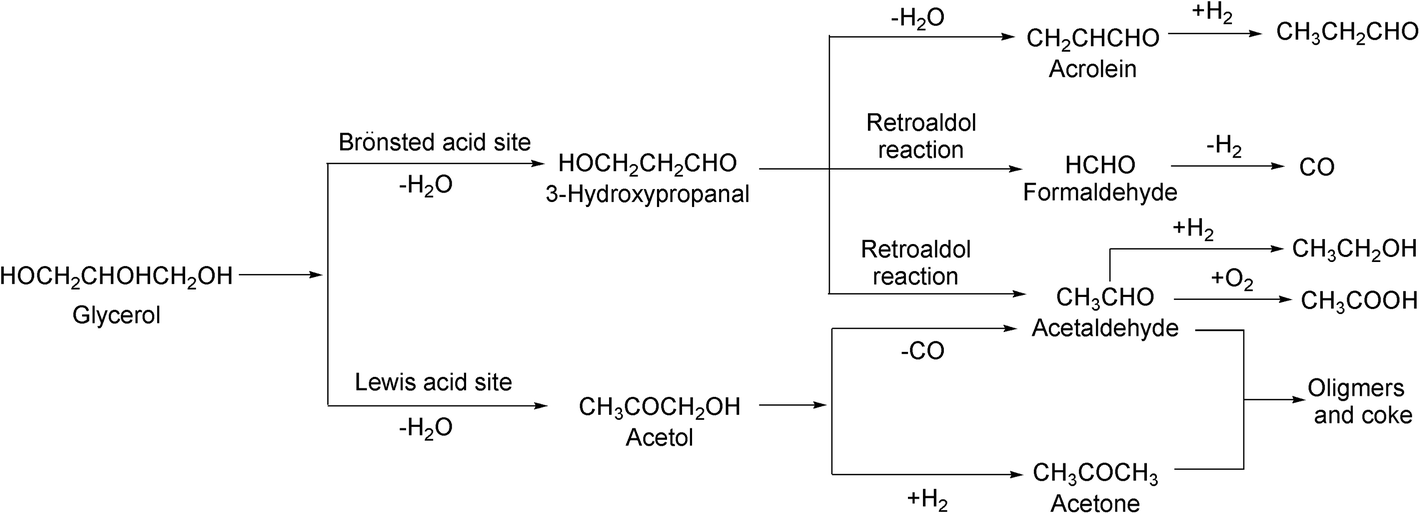
In the present study, acrolein was produced as the main product, and acetol and acetaldehyde were the primary by-products. Small amounts of acetone, propanal, acetic acid, and ethanol were detected. Based on the products detected, the catalytic dehydration of glycerol in the presence of oxygen proceeded by means of two reaction routes (Fig. 10). In one route, acrolein formed over Brönsted acid sites. In another, acetol was produced over Lewis acid sites. By-products are very complex and their formation and distribution depend on catalysts and reaction conditions (Jiang et al., Reference Jiang, Zhou, Tesser, Serio, Tong and Zhang2018). 3-hydroxypropanal (3-hydroxypropionaldehyde), an intermediate, formed via the acrolein route over Brönsted acid sites. 3-hydroxypropanal was not detected because it is very unstable and it readily underwent dehydration to acrolein (Chai et al., Reference Chai, Wang, Liang and Xu2007; Corma et al., Reference Corma, Huber, Sauvanaud and O'Connor2008). Meanwhile, a retro-aldol reaction starting from 3-hydroxypropanal and acetol led to the formation of acetaldehyde and formaldehyde (Corma et al., Reference Corma, Huber, Sauvanaud and O'Connor2008; Katryniok et al., Reference Katryniok, Paul, Bellière-Baca, Rey and Dumeignil2010). Acetaldehyde is always detected, whereas formaldehyde cannot be analyzed. Acetaldehyde was further oxidized to acetic acid in the presence of oxygen or was reduced to ethanol under the action of hydrogen. Acrolein was also hydrogenated to form propanal. Several probable routes of H2 production such as decomposition of formaldehyde to CO and H2, steam cracking of glycerol, and dehydrated species at high temperature (≥600°C) were proposed in the reports (Chai et al., Reference Chai, Wang, Liang and Xu2007; Corma et al., Reference Corma, Huber, Sauvanaud and O'Connor2008; Deleplanque et al., Reference Deleplanque, Dubois, Devaux and Ueda2010). In the present study, although formaldehyde was not confirmed, it is reasonable to assume that formaldehyde decomposed into CO and H2 because some by-products such as propanal and ethanol were detected. The glycerol dehydration over Lewis acid sites produced acetol, and the consecutive side-reactions led to the production of acetone, acetaldehyde, oligomers, and coke by starting from acetol.
Reaction routes in glycerol dehydration over acid catalysts in the presence of air

In terms of the reaction mechanisms, the conversion of glycerol depends not only on the catalyst surface properties such as acidity and texture but also on the reaction conditions.
Effect of Catalyst Acidity
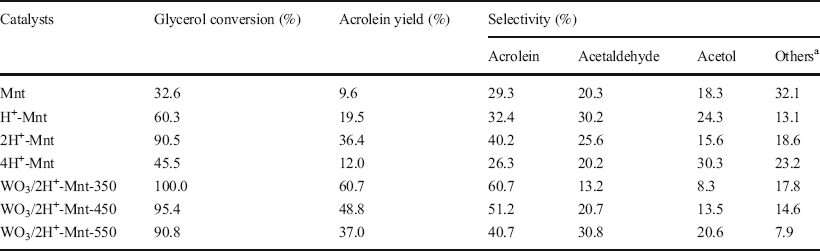
To examine the effect of catalyst acidity on catalytic performance, catalysts with various acidities were evaluated under optimized reaction conditions (Table 3). The order of glycerol conversion was found to be: WO3/2H+-Mnt-350 > WO3/2H+-Mnt-450 > WO3/2H+-Mnt-550 > 2H+-Mnt > H+-Mnt > 4H+-Mnt > Mnt. Mnt as control gave a minimum glycerol conversion of 32.6% due to the lowest acidity (0.34 mmol NH3/g).
Catalytic performances of Mnt, xH+-Mnt, and WO3/2H+-Mnt-T

a Selectivity for others = 100 − Σ (selectivity of each listed product). Others contain acetone, propanal, acetic acid, ethanol, and unidentified by-products. Reaction conditions: catalyst 0.2 g, aqueous glycerol 10 wt.% and 0.1 mL/min, air carrier gas 10 mL/min, 320°C, 4 h.
Among xH+-Mnts, 2H+-Mnt achieved a maximum of 90.5% glycerol conversion with 40.2% acrolein selectivity. The result implied that acidity and textural structure of catalysts affected their catalytic activities. 2H+-Mnt had the greatest acidity (2.2 mmol NH3/g) and the largest specific surface area (103 m2/g). The low acidities of H+-Mnt (0.82 mmol NH3/g) and 4H+-Mnt (1.3 mmol NH3/g) were responsible for their low glycerol conversions (≤60.3%). In addition, the higher concentrations of Brönsted acid sites on H+-Mnt (B/L = 6.4) and Lewis acid sites on 4H+-Mnt (B/L = 0.90, Table 2) led to their low acrolein selectivities (≤32.4%). For H+-Mnt, acetaldehyde selectivity (30.2%) was greater than acetol selectivity (24.3%) because the large Brönsted acid sites accelerated the formation of both acrolein and by-product acetaldehyde. For 4H+-Mnt, acetaldehyde selectivity (20.2%) was lower than acetol selectivity (30.3%) because the large Lewis acid sites (strong acid sites) helped the production of by-product acetol. The suitable ratio of Brönsted to Lewis acid sites (B/L = 5.0) for 2H+-Mnt promoted a high acrolein yield (36.4%) due to their cooperative effect. Thereby, 2H+-Mnt was chosen to be a support for loading WO3.
Compared to 2H+-Mnt, WO3/2H+-Mnt-T exhibited greater catalytic activity, indicating that supporting WO3 on 2H+-Mnt improved the catalyst properties. The best result with 60.7% acrolein selectivity at 100% glycerol conversion was obtained with WO3/2H+-Mnt-350 because it had a larger specific surface area (102 m2/g) and the greatest acidity (2.4 mmol NH3/g), more Brönsted acid sites (Table 2), and weaker strong acid sites among WO3/2H+-Mnt-T (Fig. 9). For WO3/2H+-Mnt-T, glycerol conversion and acrolein selectivity decreased with total acidity from 2.4 to 1.5 mmol/g and the concentration ratio of Brönsted to Lewis acid sites (B/L) from 3.6 to 1.2 (Table 2). On the contrary, the selectivity for by-products of acetol and acetaldehyde increased. Clearly, the cooperative effect of Brönsted and Lewis acid sites dominated the catalytic results.
Apparently, there is a relationship between total acidity, the concentration ratio of Brönsted to Lewis acid sites, and the catalytic activity. Moreover, high total acidity, an appropriate concentration ratio of Brönsted to Lewis acid sites, and the weak strength of strong acid sites favored the catalytic activity of WO3/2H+-Mnt-T. WO3/2H+-Mnt-350 was advantageous over other catalysts in view of acrolein selectivity and glycerol conversion. Consequently, WO3/2H+-Mnt-350 was chosen to be investigated in more detail.
Effect of Concentration of Glycerol Feedstock
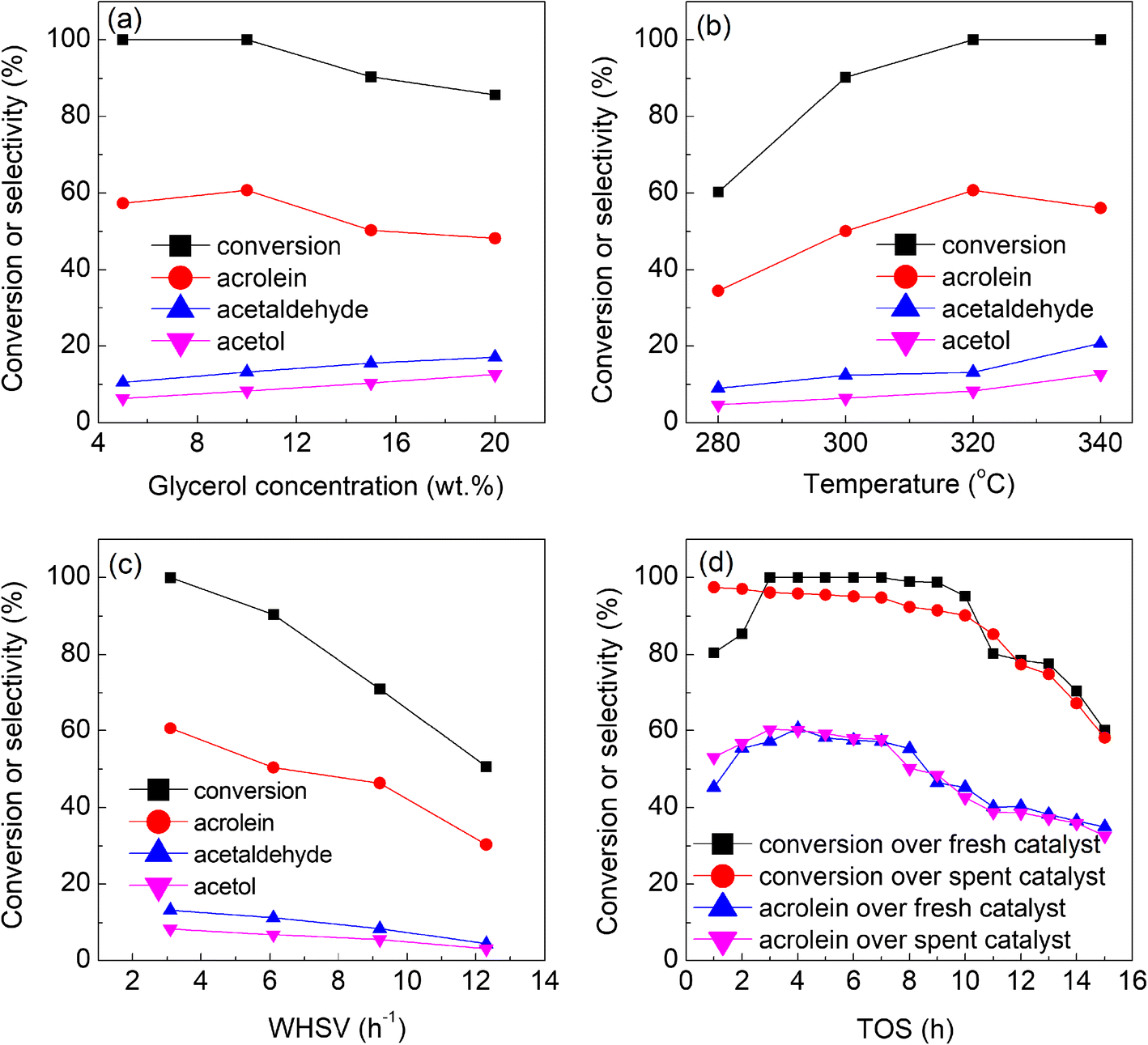
Glycerol as a feedstock in the reaction needs dilution with water to reduce viscosity and resistance to mass transfer. In the present work, 5, 10, 15, and 20 wt.% aqueous glycerol were used to test the catalytic activity of WO3/2H+-Mnt-350 (Fig. 11a). When glycerol concentration was increased from 5 to 10 wt.%, acrolein selectivity increased slightly from 57.3 to 60.7% at complete glycerol conversion. The result suggested that the low glycerol concentration (5−10 wt.%) had little impact on glycerol conversion. When glycerol concentration increased from 15 to 20 wt.%, glycerol conversion reduced from 90.3 to 85.7% with a decrease in acrolein selectivity from 50.3 to 48.3%. On the contrary, the selectivity of acetol and acetaldehyde rose. For these reasons, a large glycerol concentration (15−20 wt.%) was able to activate Brönsted acid sites and accelerated the formation of coke. Meanwhile, more side-reactions emanated from acetol to acetaldehyde and acetone took place over Lewis acid sites. Thus, 10 wt.% aqueous glycerol was suitable for further study.
Effects of a glycerol concentration, b reaction temperature, c WHSV, and d TOS on the catalytic performances of WO3/2H+-Mnt-350. Reaction conditions: catalyst 0.2 g, air carrier gas 10 mL/min; a aqueous glycerol 0.1 mL/min, 320°C, 4 h; b aqueous glycerol 10 wt.%, 0.1 mL/min, 4 h; c aqueous glycerol 10 wt.%, 320°C, 4 h; and d aqueous glycerol 10 wt.%, 0.1 mL/min, 320°C

Effects of Reaction Temperature and WHSV
The reaction temperature had a significant effect on catalytic activity of WO3/2H+-Mnt-350 (Fig. 11b). When the temperature increased from 280 to 320°C, glycerol conversion and acrolein selectivity increased. A further increase in the temperature from 320 to 340°C resulted in a decline in the acrolein selectivity and an increase in the selectivity for acetaldehyde and acetol, however. At 320−340°C, a complete glycerol conversion remained. On the one hand, when the reaction temperature was >320°C, the precedent product acrolein was accelerated to decompose thermally into acetaldehyde and formaldehyde (Carriço et al., Reference Carriço, Cruz, Santos, Pastore, Andrade and Mascarenhas2013; Ding et al., Reference Ding, Wang, Zhang, Zhao, Zhao, Lu and Huang2019). On the other hand, the active temperature for Lewis acid sites was greater than that for Brönsted acid sites. The higher reaction temperature could activate Lewis acid sites toward the acetol route reaction and furthered the formation of oligomers and coke (Katryniok et al., Reference Katryniok, Paul, Bellière-Baca, Rey and Dumeignil2010). As a result, the acrolein route over Brönsted acid sites weakened. To obtain the target product, acrolein, the optimal reaction temperature was set at 320°C in subsequent studies.
WHSV (weight hourly space velocity, which represents the glycerol mass (g) per gram catalyst, per hour, h–1) was set as 3.1, 6.1, 9.2, and 12.3 h–1, corresponding to 0.1, 0.2, 0.3, and 0.4 mL/min of aqueous glycerol, respectively. The increase in WHSV from 3.1 to 12.3 h−1 caused the decreases in glycerol conversion and acrolein selectivity (Fig. 11c). A large WHSV means more glycerol passed the catalyst per hour. More glycerol in the reaction system would cause further polymerization of acrolein and by-products such as acetol, acetaldehyde, and coke deposition (Jiang et al., Reference Jiang, Zhou, Tesser, Serio, Tong and Zhang2018). Thereby, a small WHSV value of 3.1 h–1 was used in the next reaction system.
Time-on-Stream (TOS) Study
The stability of WO3/2H+-Mnt-350 was examined during a 15 h on-stream reaction (Fig. 11d). In the first 2 h on stream, the catalyst exhibited 45.3−55.4% acrolein selectivity at 80.4−85.4% glycerol conversion. Reaction on-stream for 4 h gave a maximum selectivity for acrolein (60.7%). In 3−7 h on stream, the acrolein selectivity (57.2−60.7%) remained stable at a full glycerol conversion. After 7 h on stream, the glycerol conversion and acrolein selectivity decreased slowly. 15 h on stream caused its deactivation.
TOF Study
TOF reflects the productivity of acrolein (mol) on the active sites (WO3 species) per mole, per hour. According to the definition of TOF, the TOF value was calculated as follows:

where 231.8 and 92.1 are molecular masses of WO3 and glycerol (g/mol), respectively.
In terms of the calculation equation, the TOF value may be high when acrolein yield is low at a high WHSV. For example, a high TOF value (50.8 h–1) was obtained at a high WHSV (9.2 h–1) and a low acrolein yield (32.9%) under the reaction conditions (i.e. aqueous glycerol 10 wt.%, 0.3 mL/min, 320°C, 4 h). Such a high TOF value is not desirable because the acrolein selectivity is low (46.4%). A very high WHSV used in the reaction led to a low acrolein selectivity (Jiang et al., Reference Jiang, Zhou, Tesser, Serio, Tong and Zhang2018). Clearly, the TOF values depend on the activity of the catalyst and the reaction conditions. Hence, the TOF values based on a high selectivity to acrolein and a close WO3 loading (15 wt.%) on the supported-WO3 catalysts are listed for comparison (Table 1).
WO3/2H+-Mnt-350 reached a greater TOF (31.2 h–1) at a maximum selectivity of 60.7% for acrolein in this work compared with the literature TOF values (Table 1). The result showed that WO3/2H+-Mnt-350 exhibited significant productivity of acrolein and catalytic activity.
Catalyst Deactivation Cause
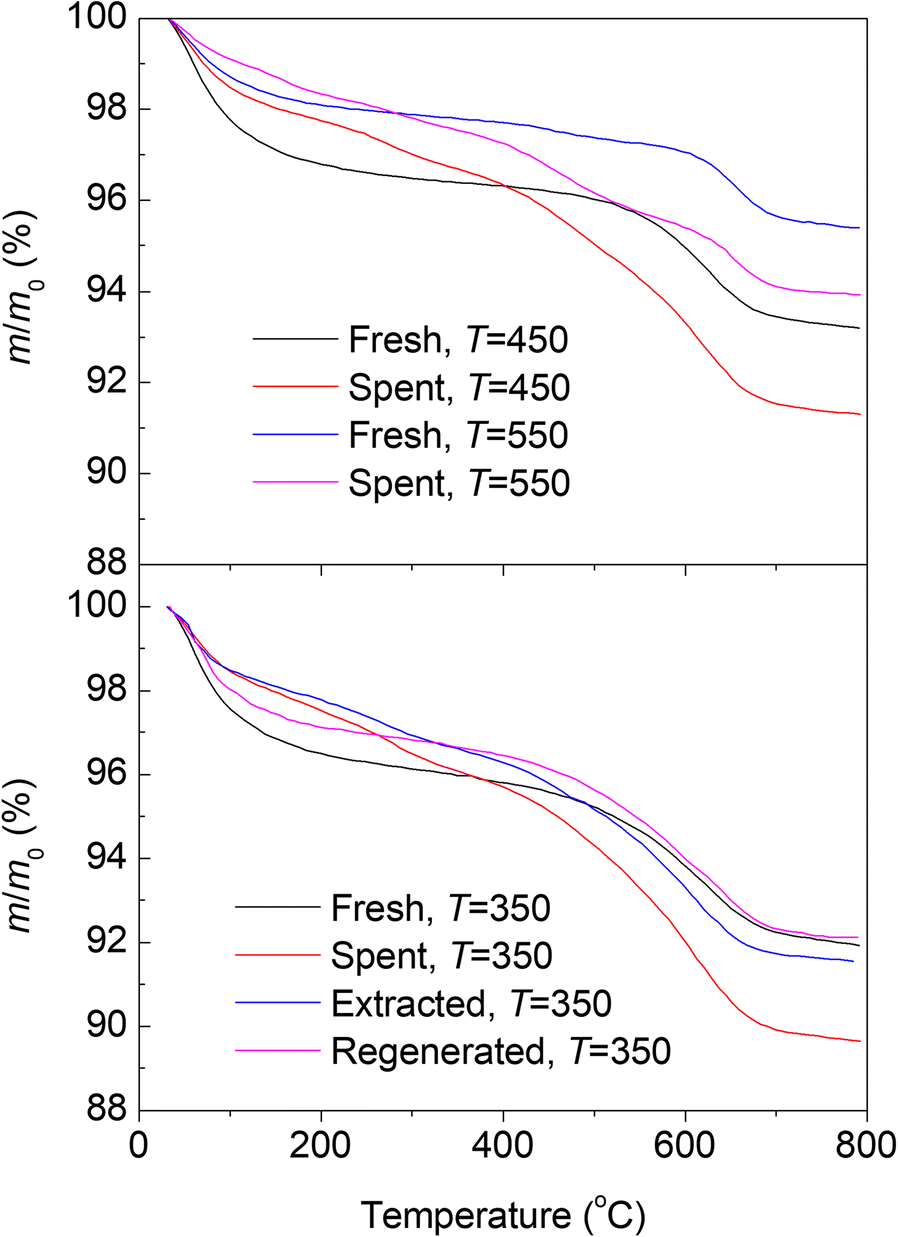
The mass losses in the 30−180 and 180−750°C regions were caused mainly by the removal of physically adsorbed water and of adsorbed organic compounds (the coke), respectively (Fig. 12). After 15 h of on-stream reaction, the increased values of mass losses in the 180−750°C region (coke loadings) for spent WO3/2H+-Mnt-T (T = 350, 450, and 550) were 3.3, 2.8, and 1.7 wt.%, respectively, compared with fresh catalysts. The result indicated that WO3/2H+-Mnt-350 underwent greater coke deposition. The probable reason was that WO3/2H+-Mnt-350 had greater acidity and more Brönsted acid sites than WO3/2H+-Mnt-T (T = 450 and 550). Brönsted acid sites are commonly accepted as the active centers of coke formation (Katryniok et al., Reference Katryniok, Paul, Bellière-Baca, Rey and Dumeignil2010). A positive correlation was observed between level of coking and concentration of Brönsted acid sites.
TG curves of fresh, spent, extracted, and regenerated WO3/2H+-Mnt-T. m/m 0 (%) is the percentage of sample mass to initial mass of sample

Deactivation is a major drawback for acid catalysts due to coke formation during glycerol dehydration. The WO x /ZrP catalyst was found by Ginjupalli et al. (Reference Ginjupalli, Balla, Shaik, Nekkala, Ponnala and Mitta2019) to give rise to 28 wt.% of coke loading. The coke contents were 24.6−37.0, 8.6−21.5, and 10.3 wt.% for the MWW zeolites, the H-zeolites, and the 8Nb/SiZr5 catalyst, respectively (Jiang et al., Reference Jiang, Zhou, Tesser, Serio, Tong and Zhang2018). By contrast, in the present study, WO3/2H+-Mnt-Ts exhibited smaller coke loadings (˂3.3 wt.%).
Regeneration and Reuse of Spent Catalyst
The increased values of mass losses for the spent, extracted, and regenerated WO3/2H+-Mnt-350 catalysts were 3.3, 1.6, and 0.4 wt.%, respectively, in comparison with mass loss of the fresh catalyst in the 180−750°C region (Fig. 12). The result confirmed that most of the adsorbed organic compounds (coke precursors) on spent WO3/2H+-Mnt-350 were removed. The UV-Vis data also confirmed that the regenerated WO3/2H+-Mnt-350 had similar WO3 species compared with the fresh catalyst (Fig. 7). Both the fresh and regenerated catalysts displayed strong absorption bands at 255 nm.
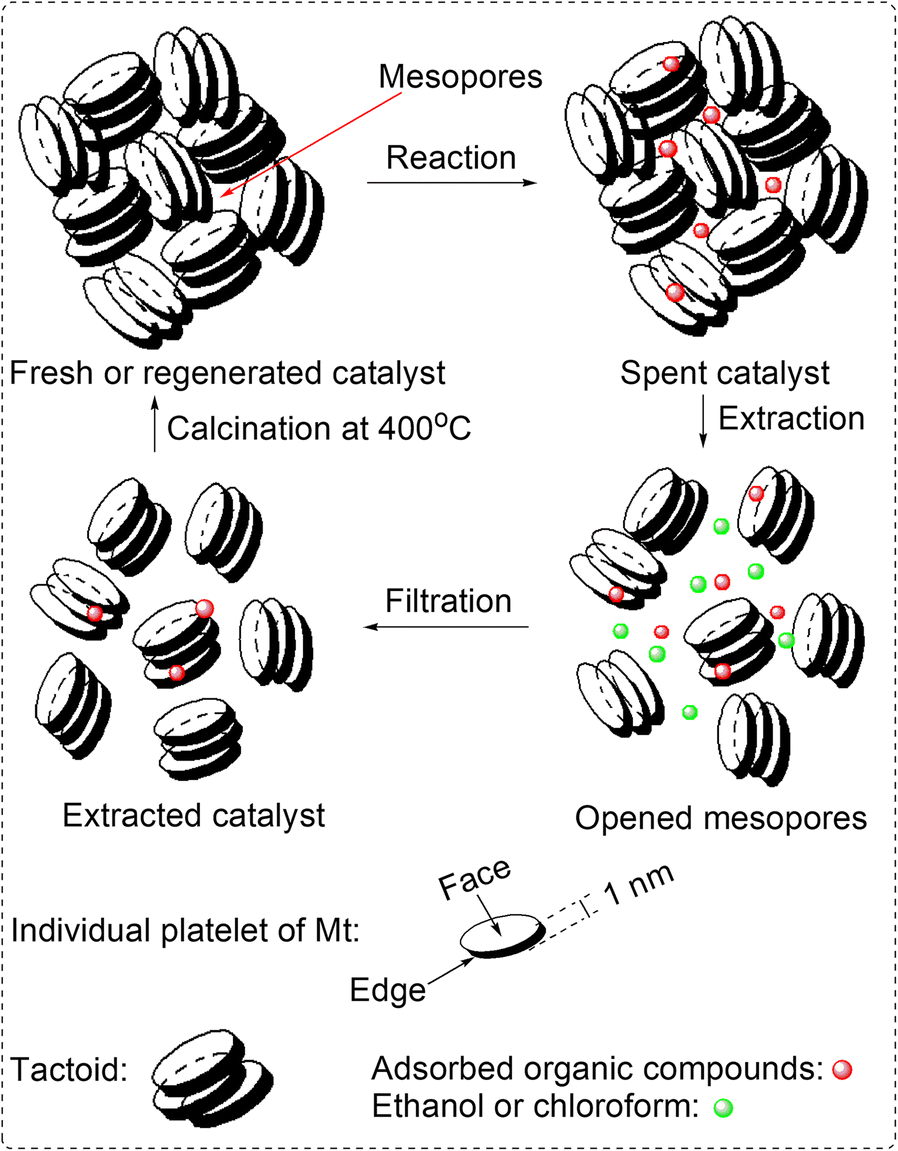
The slit-shaped mesopores of Mnt materials were formed by loose assemblages of tactoids (a few platelets of Mnt) due to the electrostatic attractions between the negatively charged faces and the positively charged edges of Mnt platelets under acid environment (van Olphen, Reference van Olphen1964; Kruk & Jaroniec, Reference Kruk and Jaroniec2001). During reaction, some organic compounds were adsorbed inside the pores of the catalyst. When spent catalyst was stirred in a mixture of ethanol and chloroform, some mesopores were probably opened due to disassociation of the tacoids (Fig. 13). As a result, the organic compounds adsorbed inside the pores were easily dissolved in the solvents and were removed by filtration. The catalyst extracted was then calcined at 400°C to remove residual organic compounds. The mesopores were reversibly rebuilt through face (negative charge)-to-edge (positive charge) association in the regenerated catalyst.
Probable regeneration process of spent WO3/2H+-Mnt-350. The spent catalysts were subjected to the 15 h-on-stream reactions (reaction conditions: catalyst 0.2 g; aqueous glycerol 10 wt.%, 0.1 mL/min; air carrier gas 10 mL/min; 320°C)

The catalyst was regenerated for up to three cycles. The regenerated WO3/2H+-Mnt-350 was placed in the same reactor for a new run under the same reaction conditions and exhibited catalytic activity which was similar to that for the fresh catalyst (Fig. 11d). The results indicated that WO3/2H+-Mnt-350 exhibited good reusability.
Conclusion
The activation of Mnt with H3PO4 solution increased the porosity and specific surface areas and caused partial dissolution of the octahedral and tetrahedral sheets of Mnt, while the mesoporosity and the layered structure of Mnt remained. Mnt activated with 2 mol/L H3PO4 solution (2H+-Mnt) is suitable as a support for solid acid catalysts.
The different calcination temperatures (350, 450, and 550°C) for the WO3/H3PO4-activated Mnt catalysts resulted in changes of surface WO3 species (i.e. polytungstates, isolated [WO4]/[WO6] clusters, and m-WO3 phase), total acidity, acid strength, and the number of Brönsted and Lewis acid sites on the catalysts. The calcination at 350°C led to more Brönsted acid sites, while higher-temperature calcination (550°C) led to more Lewis acid sites. Correlation existed among WO3 species, surface acidity, and catalytic performance of the catalysts. The cooperation of Brönsted and Lewis acidity favored formation of target product acrolein and less coke. 15 wt.%WO3/2H+-Mnt-350 catalyst exhibited high catalytic activity, stability, and a good reusability in the catalytic dehydration of glycerol to acrolein in the presence of air.
Acknowledgments
This work was supported by the National Natural Scientific Foundation of China (22072136, 21506188), Engineering Research Center of Non-metallic Minerals of Zhejiang Province, Zhejiang Institute of Geology and Mineral Resource, Hangzhou, China (ZD2020K09), and the Zhejiang Provincial Natural Scientific Foundation of China (LY16B030010, LQ19F050004).
Funding
Funding sources are as stated in the Acknowledgments.
Declarations
Conflict of Interest
The authors declare that they have no conflict of interest.