Historical background and introduction
Since the discovery of the Svalbard archipelago by Willem Barentz in 1596, there has been more or less continuous human activity on Svalbard (Arlov Reference Arlov2003). Exploitation of biological resources started in the early seventeenth century with whaling, followed by hunting and trapping. Scientific exploration grew during the nineteenth century and revealed, among other things, valuable mineral deposits. Coal mining developed after 1900 and required a year-round presence, which resulted in the establishment of a few small, semi-permanent settlements. The Boston-based Arctic Coal Company established Longyearbyen in 1906. Ten years later, the coal mine and the property were bought by the Norwegian company Store Norske Spitsbergen Kullkompani (SNSK). Throughout the twentieth century, SNSK was the cornerstone of Longyearbyen, and as late as the 1970s the community was still a ‘company town’.
In 1976, the Norwegian government nationalised SNSK and started a process of ‘normalisation’, or rather modernisation, of Longyearbyen. Coal production was unprofitable and required heavy subsidies. Since the 1990s the government has actively supported a diversification of local activities to make Longyearbyen less dependent on coal mining (Grydehøj and others Reference Grydehøj, Grydehøj and Ackrén2012). Tourism and service industries were stimulated, in addition to research and higher education (Arlov and Holm Reference Arlov and Holm2001; Kvello Reference Kvello2006). The decision to establish the University Centre in Svalbard (UNIS) in 1993 was a direct result of this policy (Arlov Reference Arlov2003; Arlov Reference Arlov, Jensen and Moxnes2008).
The Treaty of Svalbard of 9 February 1920 gave Norway sovereignty over the archipelago, which for 300 years had been regarded as a terra nullius, a no man's land. Norwegian jurisdiction was formally established in 1925, when the Storting – the Norwegian parliament – passed the Svalbard law and put the treaty into force. In essence, the treaty recognises the ‘full and absolute sovereignty’ of Norway (Article 1), ensures equal rights for the citizens of all signatory nations, and states that all taxation must be utilised locally, that Svalbard is a non-military area and that Norway is responsible for environmental protection.
At present, there are five more-or-less permanent settlements on Svalbard (Longyearbyen, Barentsburg, Ny-Ålesund, Sveagruva and Hornsund). Longyearbyen with its 2,100 inhabitants (Bjørnsen and Johansen Reference Bjørnsen and Johansen2014; Statistics Norway 2016a; 2016b) is the northernmost family community in the world with a fully developed infrastructure – international airport, bank, church, hospital, hotels, school, shops, advanced telecommunications and so on. The community is among the most international in Norway with a 25% foreign population representing 46 nationalities. There is an 86% employment rate among the adult population (25–66 years), and 70% of the population is younger than 45 years of age. Mobility is high; the average residency is about seven years. Of the work-years in Svalbard in 2015, industry including mining, construction and transport represented 28%, public sector 9%, education and science 12%, trade and services 9%, and travel and leisure 39% (Statistics Norway 2016). Of a total annual business revenue in 2014 of about 500 million EUR, coal mining contributed 45% (Bjørnsen and Johansen Reference Bjørnsen and Johansen2014). One year later the mining industry suffered severe losses due to a reduction in the world market coal price, and it was practically bankrupt.
In addition to the Norwegian community in Longyearbyen, there is a Russian settlement in Barentsburg. This settlement has primarily been based on mining, but is now diversifying with the expansion of tourism. The Russians used to produce coal in Grumantbyen and Pyramiden as well, but these mines were abandoned in 1962 and 1998, respectively. There was also a coal mine at Ny-Ålesund until 1963. Thus, mining has been a cornerstone not only for the Norwegian population, but for settlements in Svalbard in general. Scientific activities have increased, particularly since the 1990s, and several Norwegian and foreign institutions have established research stations and installations on the archipelago. Russian research in Barentsburg has longstanding traditions that date back to the 1960s. Similarly, the Polish research station in Hornsund, that was established during the International Geophysical Year in 1957–1958, has operated on a year-round basis since 1978. Ny-Ålesund was transformed into a base for increasingly international research from the late 1960s. Currently, 14 institutions from ten different countries have established permanent research facilities in Ny-Ålesund. There are a few other stations located in other areas of Svalbard. Thus, a significant amount of research is carried out on the archipelago. A survey in 2014 showed that research-related visits, measured as the number of scientist days, amounted to some 61,000; of which, Norway contributed approximately half (Aksnes and Rørstad Reference Aksnes and Rørstad2015). Nevertheless, as a basis for permanent settlement, research still plays a limited role as most of the activity involves short-term visits by scientists with the exception of UNIS staff in Longyearbyen, and scientists and technicians based in Ny-Ålesund, Barentsburg and Hornsund who live in Svalbard year-round. During the polar night, there is generally less ongoing scientific research and most of the research stations are closed or have minimal staff.
For the best part of the last 100 years, the Norwegian presence on Svalbard has been dependent on coal mining. SNSK has produced coal in different mines in Longyearbyen and Sveagruva continuously since 1916, except for a few years during World War II. However, production has varied substantially. In 1925–1941, SNSK produced about 150,000 and 320,000 tons of coal, and had up to 700 employees (Westby Reference Westby2003). Between 1945 and 1980, production reached 480,000 tons of coal annually from an overwintering staff of up to 1,300 people. At the end of the 1980s, a combined market and resource crisis occurred that threatened the mining industry, and hence also the local community. This triggered the abovementioned business development and diversification process, which proved very successful. During the 1990s, more new jobs were created than lost in the coal mining industry. Furthermore, development was accelerated in 2000 by the opening of the modern Svea Nord coal mine. The previously doomed SNSK became a profitable company with annual production volumes up to four million tons of coal (Arlov Reference Arlov, Jensen and Moxnes2008; Mikalsen and Solberg Reference Mikalsen and Solberg2009; Bjørnsen and Johansen Reference Bjørnsen and Johansen2014). Thus, coal mining remained an important factor in community development and accounted for a substantial component of the rapid growth in Longyearbyen.
The international coal market experienced a dramatic reduction in prices in 2014. SNSK experienced grave difficulties, since coal prices were too low to sustain economically viable production. In 2015, the government refinanced the company, partly by taking over its properties. However, the political will to support coal mining on Svalbard has waned, and there is growing realisation of the negative effects of burning fossil fuels on the climate (Helgesen and others Reference Helgesen, Holmén and Misund2015). Therefore, SNSK has scaled-down its mining activity, put the new Lunckefjell mine near Sveagruva on hold and reduced the number of employees from about 400 in 2014 to about 100 in 2016. Norwegian authorities have expressed concern regarding development in Svalbard and Longyearbyen in particular. This is reflected in the recent White Paper on Svalbard approved in the Storting in autumn 2016 (Ministry of Justice and Public Security 2016).
In many ways, the present situation of the local community in Longyearbyen resembles the situation in 1990 – a crisis in coal mining has caused concern for related activities and for communities in general. To sustain the size and quality of the community, new jobs and opportunities have to be created. In the 1990s, the introduction of higher education and an expansion of research activities provided one of the solutions, and UNIS was established. Today, many are hopeful that UNIS will again play a predominant role by increasing its activities. Evidently, UNIS has played an important part in the diversification of the local community since 1993, but how successful has the institution been from an academic point of view? And how realistic is it to believe that a further expansion of research and education may compensate for disappearing jobs related to coal mining? To answer these questions it is necessary to study UNIS development so far. Our analysis of the development of UNIS is based on the quantification of activities during the first 20 years (1993–2013; Aksnes Reference Aksnes2013), with some more recent updates.
Methods
In this paper, the development of UNIS is partly described by quantitative indicators. To evaluate the academic merits of UNIS we will focus on the scientific and educational output, and the staff and student growth during the first 20 years of operation. Here we describe the methodological basis for the indicators applied in the study.
The publication analysis is limited to scientific publications, and does not include any other type of publication, for example popular science contributions, reports or text books. The analysis is based on bibliographic data sources, including the Web of Science (WoS) and the Scopus databases. In addition, we used supplementary sources, including the CRIStin database (which is a joint system for the registration of scientific publications by Norwegian higher education institutions, institutes and hospitals), UNIS annual reports and the ten year anniversary bibliography of UNIS (Lindner and Jakobsen Reference Lindner and Jakobsen2003). First, we searched the WoS database for publications with UNIS (using spelling variants for the institution), Svalbard or Longyearbyen in the author address field. Then we searched the Scopus database using the same search criteria. Finally, we identified publications from the supplementary sources that were not found on the WoS and Scopus database searches. These publications had to be checked manually to verify whether an UNIS affiliation had been used and whether the publication channel was accredited as being scientific.
The analyses of collaborations are only based on the WoS and Scopus subset of publications (837) because complete bibliographic information of the co-authors’ institutional affiliations was required and this information is only available for the WoS and Scopus records.
The individual researcher represents the basic unit of this study, and the data were subsequently aggregated to the level of UNIS department. As the main bibliometric measure, we have used the number of publications, ‘whole counts’, and not derivative measures, such as publication points or fractionalised publications. This is the most common and simplest way of measuring publication output. It should be noted, however, that most publications are multi-authored and are the result of collaborative efforts involving more than one researcher or institution. Thus, the UNIS contribution may, in several cases, be minor. The indicator may therefore be interpreted as the number of publications in which UNIS has ‘participated’.
Finally, the analysis of the staff employed at UNIS from 1993–2015 is based on annual employee lists, with information on the length of each person's employment, appointment terms, position, age, etc. The analyses of students and PhD candidates at UNIS is based on data collected through the UNIS archives.
The establishment of UNIS
Scientific and university-based excursions to Svalbard have been a tradition for decades, and ideas for a more permanent institution emerged in Norway during the 1980s. In 1992, Minister for Science and Education Dr Gudmund Hernes attended a study tour around Svalbard and became convinced that setting up a university centre might be feasible. With unprecedented and breath taking speed, plans were developed and by the following autumn UNIS opened with the first 23 students (Arlov Reference Arlov, Tjelmeland and Zachariassen2004).
In February 1993, the four Norwegian universities of Oslo, Bergen, Trondheim and Tromsø were invited to propose appropriate university programmes and courses, specifically relevant for Svalbard, to be offered at UNIS. The University of Tromsø was asked to review the propositions and form a curriculum. Based on this, university courses in Arctic Geology and Arctic Geophysics were established from the autumn 1993 semester. Scientific staff at the Norwegian universities put considerable effort into designing the content of the courses and identifying lecturers. This ensured the scientific quality of the curricula and a link to the Norwegian universities, which was essential for a successful beginning. The educational programmes at UNIS were designed as an addition to Norwegian university education.
In 1993, UNIS was located in an office building in central Longyearbyen in anticipation of a new university building being completed. The four Norwegian universities and UNIS signed a cooperation agreement on 18 January 1994. This regulated issues concerning cooperation in education, research, lecturers, internationalisation and administrative services. In 1994, a new scientific department was introduced, Arctic Biology, and in 1996, the Arctic Technology Department was opened, offering courses on topics such as engineering on frozen ground, ice mechanics and pollution from industrial activities in the Arctic.
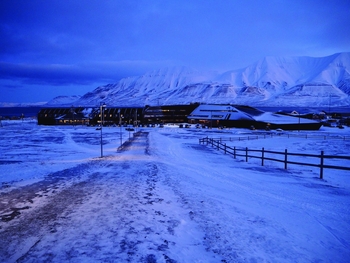
The first UNIS building was opened by King Harald V of Norway in 1996. Ten years later, His Majesty opened the Svalbard Science Park (MacKeith Reference MacKeith2006), built in conjunction with the first UNIS building. UNIS still owns the first building and rents about 85% of the Svalbard Science Park from Statsbygg – a governmental body that owns and operates public buildings in Norway. A department of the Norwegian Polar Institute (NPI), Svalbard Museum and Svalbard Science Forum (part of the Research Council of Norway) are the other main tenants, but several other research institutes and universities rent offices in the building. The Svalbard Science Park is a signal building awarded for its architecture (Fig. 1).
Svalbard Science Park February 2017, in the “blue” period of the year when daylight is gradually returning to Longyearbyen, Svalbard (photo: Hanne Christiansen, UNIS).

In 2011, UNIS signed a renewed cooperation agreement with the eight current Norwegian universities. An action plan for further development of the educational administrative systems, rules and regulations was adopted in 2013. Collaboration with Norwegian universities at all levels of the institution is important for UNIS; ensuring that the courses offered at UNIS are truly additional to the Norwegian mainland universities course curricula. A central mechanism in the cooperation with the universities on the Norwegian mainland is the annual dean meeting to approve the UNIS curriculum and progression based on course revision work at UNIS after hearings in the Norwegian universities. The first dean meeting in 2013 was attended by eight delegates. Attendance increased to 14 delegates in 2014 and 22 delegates in 2015. This is an indication of the increasing effort that the Norwegian universities are putting into cooperation with and the development of UNIS, which represents their joint Arctic branch.
Staff and capacity
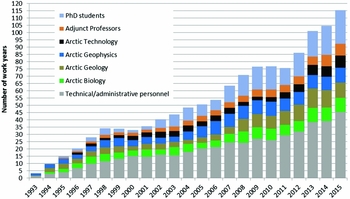
The number of staff at UNIS increased significantly between 1993 and 2015. In 1993, the number of work-years (full-time equivalents) was only 3.2. In 2015, 115 work-years were carried out (Fig. 2). This increase is a reflection of the very strong growth of government appropriations to UNIS during this period, allowing for the recruitment of more staff. In 2015, UNIS had a staff of about 130 persons; of which, 75 held scientific positions.
The number of work-years (full-time equivalents) for staff at UNIS 1993–2015.

UNIS has four scientific departments in addition to central administration, study administration and technical departments. Fig. 2 shows the number of work-years carried out within each department during 1993–2015. Clearly, there has been strong growth in the number of work-years in all departments during this period. The growth was particularly strong in the Arctic Geology Department, which has increased from approximately six work-years in 2006 to 19 in 2015. The Arctic Geophysics Department has been the largest in terms of work-years for a long time.
Between 1993 and 2012, 23 people were employed as full professors, 51 as associate professors, 22 as postdoctoral researchers, 60 as PhD candidates, 51 as adjunct professors/associate professors, and 20 in other scientific positions. In addition, 64 people were employed in administrative positions and 38 in technical positions.
Compared to universities in Norway, the proportion of professors is lower at UNIS, whereas the number of associate professors is higher. This is probably a consequence of the institution's young age and that until 2009 only three-year contracts were provided. UNIS also has an unusually high proportion of personnel in adjunct positions, which reflects their strategy to hire external professors for teaching and research, ensuring good cooperation with the Norwegian mainland universities.
The different groups of scientific staff have varied in size over the 20 years since establishment. One notable change is the increasing number of work-years carried out by PhD candidates, particularly since 2001 when UNIS was, for the first time, assigned PhD students as part of its funding from the Ministry for Education and Knowledge. UNIS cannot award PhD degrees (exams are taken at the home institution), but has been the employer of a significantly increasing number of PhD candidates. Over the course of 2006–2008, the number of professors has also grown substantially.
UNIS is characterised by a very international profile in terms of both staff and students. Through time, numerous foreign scientists have been recruited for academic positions at UNIS – on average only 30% of PhD candidates have been Norwegian. Of the work-years carried out by professors during 1993–2012, 53% were by Norwegian citizens. The proportion of Norwegian citizens working as associate professors is 63%, postdoctoral researchers 60% and adjunct professors/associate professors 80%. The majority of technical and administrative personnel have been mainly Norwegian (95%). Staff from Germany account for the largest number of work-years carried out by foreigners (50), followed by Denmark (46), the UK (32), Sweden (29), Russia (25), France (14) and Finland (13). Staff from other countries have carried out a total of 60 work-years.
UNIS only started offering permanent positions in 2009. Before 2005, staff were employed for a fixed-term of 3 + 3 years. As a consequence, there was a high turnover in staff. Between 2005 and 2009, staff could apply for an unlimited number of additional three year periods. The number of new appointments has been higher than the number of terminations for most years, thus the number of employees has risen. In recent years, the turnover has been much lower and there is more stability, particularly in the scientific staff. In 2014, mobility of the UNIS staff was calculated to be about 10%. Six scientists and six people in technical/administrative positions have been working at UNIS for more than ten work-years.
Scientific production
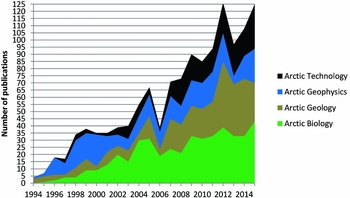
In total, almost 1,300 UNIS publications were published during 1993–2015. The annual number has gradually increased to 124 publications in 2012 and in 2015 (Fig. 3). The main reason for this growth is that UNIS has increased considerably in size and number of scientific staff during this period. There is large interannual variation, but all departments have shown a significant increase in the volume of research published over time.
Annual number of scientific research publications involving UNIS 1993–2015.

UNIS has developed into a major contributor to Norwegian polar research. This was documented in a recent analysis by Aksnes and Rørstad (Reference Aksnes and Rørstad2015). Among the Norwegian universities and institutes active in polar research, UNIS ranks at number five in terms of the number of polar research articles for 2010–2014, after the University of Tromsø, the University of Oslo, the University of Bergen and the NPI. When considering the publications related to Svalbard only, UNIS ranks at number one.
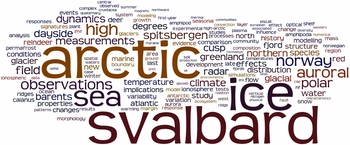
The staff at UNIS have been active in research covering a variety of topics. Some indications of the content of the research can be obtained by analysing the titles of the publications quantitatively. The results of analysing word frequency in titles are presented in Fig. 4, where the size of the word is proportional to the number of times the word appears in the titles. By far the most frequently used words are ice, Arctic and Svalbard, with frequencies in the range of 170–190 times. Sea and high are the fourth and fifth most frequently used words.
Analysis of word frequency in the titles of scientific research publications involving UNIS 1993–2015.

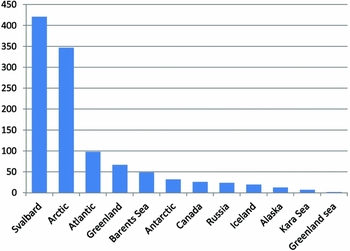
Research at UNIS has not been limited to Svalbard only. Throughout the years, the scientists have been involved in research in many parts of the Arctic. An indication of this may be provided by identifying geographical terms in the titles and abstracts of the articles (Fig. 5). Svalbard and Svalbard areas accounted for more than 420 unique publications or 45% of all UNIS publications (Fig. 5). This suggests that more than half of the publications are not specifically related to Svalbard. An important example here is the marine research carried out in seas and waters beyond the coastline of Svalbard. As an example, there are 67 articles in which Greenland appears in the title or abstract. It should be noted that some publications may be based on observations or measurements in Svalbard without specifically mentioning the archipelago in the title or abstract.
Identification of geographical terms in the titles and abstracts of the scientific research publications involving UNIS 1993–2015.

Scientific collaboration
Co-authorship is a commonly used indicator of national and international research collaboration. When researchers from different institutions author a publication together, this indicates that the research has involved collaboration. Increasing collaboration in research is an international phenomenon, and is one of the most important changes in publication behaviour among scientists during recent decades, particularly within the natural sciences.
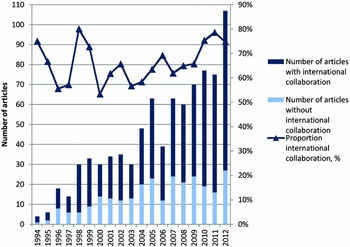
Of all the UNIS publications (1994–2012), 68% had co-authors from other countries. Thus, the extent of international collaboration is wide, apparently involving the majority of UNIS research. The proportion of research involving international collaboration has varied from 53% to 80% during the 20 year period, with no systematic trend (Fig. 6). The high rate of international collaboration may be a reflection of the high turnover of positions at the institution, and the fact that many researchers are recruited from overseas.
The proportion of UNIS research involving international collaboration published 1993–2015.

The UK is the most important collaborating nation, with 27% (226 articles) of the UNIS articles co-authored in the UK. Then the USA, Denmark and Sweden with 20%, 11% and 10%, respectively.
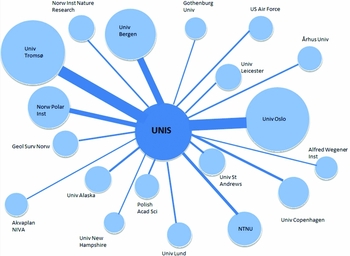
The universities in Tromsø and Oslo rank at the top of the list of institutions with collaborative articles (190 and 189 collaborative articles, respectively, during 1994–2012). Thus, almost 25% of the UNIS articles had co-authors from these institutions. It should be noted, however, that when a researcher at UNIS reports dual address affiliations in the publications (for example, due to an adjunct position at UNIS), this will be recorded as a collaborative article. If such articles had been removed, the figures would have been lower, particularly for the Norwegian institutions. The University of Bergen follows as the third most frequent collaborative partner with 120 articles. NPI ranks highest among collaborative institutes by being the fourth largest overall partner with 82 joint articles (Fig. 7). Thus, NPI seems to be following recommendations for close collaboration between polar institutes and the university sector (Summerhayes Reference Summerhayes2015). Likewise, institutes such as the Norwegian Institute of Nature Research, the Geological Survey of Norway and Akvaplan Niva have had productive scientific collaborations with UNIS. Of the foreign universities, the University of Copenhagen, the University of Alaska and the University of St Andrews are most frequently involved in cross-border collaboration with UNIS (Fig. 7).
Universities and institutes that had productive scientific collaborations with UNIS 1993–2015.

Education
For the first semester, UNIS received 37 applications from Norwegian students; of which, 23 were granted admission for the academic year 1993/1994. Five courses were offered at the basic level by the two scientific departments. In 1994/1995, 38 students, including a few international students, were admitted to nine courses. From 1995, UNIS attracted the first master's students, who collected data and wrote their master's thesis at UNIS. At the same time, the student population became increasingly international (about 25%). The number of courses offered increased to 15 in 1995, and it was decided that all teaching should be conducted in English. UNIS offers research-based education at bachelor's, master's and PhD level.
Starting in 1997, UNIS has offered some specialist interdisciplinary courses and mandatory safety courses. In 1998, the first 24 students finished their master's theses, the number of international students exceeded 45% and the course portfolio reached 33 courses across the four scientific departments.
Due to an insecure economic situation in 1999, the number of courses decreased; the number of students remained stable, but the proportion of foreign students reached approximately 50%. UNIS celebrated its ten year anniversary in 2003. By then 279 students were admitted; of which, 63% were international and representative 28 different nations. UNIS became a member of The University of the Arctic (UArctic), and has operated the UArctic Field School Secretariat since 2004. When the UNIS facilities were expanded by moving into the Svalbard Science Park in 2005, the learning environment was significantly improved and the annual student intake increased to 331. After a budget reduction in 2008/2009, the number of students and courses offered declined; this followed well into 2010. From 2011, the number of students increased and 459 students attended UNIS courses that year. The ratio of foreign students remained high (59%) and represented 31 different countries.
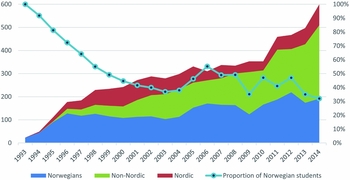
In 2012, 467 students from 23 countries studied at UNIS (Fig. 8). The proportion of international students was 53%. There were several UNIS courses which had a waiting list for students, as the maximum number of students attending each course is typically limited to around 20 due to fieldwork and excursions. The number of applications had increased by 21% from 2011, totalling 1,487 applications for the 61 courses offered in 2012. The increase from 37 applications for nine subjects in 1993 is evident, and indicates that UNIS has established itself as a competent and reputable university institution in the Arctic. The increase in number of students has continued in recent years, and by 2014 about 600 students studied at UNIS (Fig. 8).
Number of Norwegian and international students enrolled at UNIS 1993–2015.

The number of students in each scientific department has varied through time. It is closely related to the available courses, as several courses are offered every other year due to limitations in available teaching resources. Most students take more than one course and are therefore included for each course separately. Over the years there has been a shift in focus regarding the courses offered. Until 2005, more student credits were produced at bachelor's level. Recently, more courses have been offered at the master's and PhD levels, and hence, more student credits are produced at this advanced level.
The number of international students has increased annually (Fig. 8). Since its establishment, UNIS has had very good collaboration with other academic institutions, primarily the Norwegian universities, but also with other universities within the circumpolar area. This, and the fact that all education at UNIS is in English, attracts large numbers of foreign students, despite no systematic marketing of UNIS study opportunities to students outside Norway. Allocations from the Ministry of Foreign Affairs and the Norwegian Centre for International Cooperation in Education (SIU) have partly contributed to the high numbers of international students by providing good scholarship schemes for Russian, Canadian and American students.
In total, 72 candidates have received PhD degrees during the period of 1996–2012 from studies at UNIS. The Arctic Geophysics Department accounts for the highest number of the degrees (27). These numbers include PhDs fully or partly conducted at UNIS, but the degrees are awarded by the Norwegian or international home university. In total, 53 PhD degrees have been awarded by Norwegian universities and 19 by international universities.
Discussion
As UNIS is a unique institution as a High Arctic university centre relying on cooperation with all of the Norwegian universities on an equal basis, benchmarking its development and output with other organisations is not straightforward. However, there are more than 900 field stations scattered around the world (National Research Council 2014), so some comparisons are possible, even if UNIS is not to be considered a field station. The almost 1,300 publications produced during the first 23 years of UNIS compares well with the over 3,000 publications produced at the La Selva Biological Station during a 50 year period from 1956–2007 (Michener and others Reference Michener, Bildstein and McKee2009). Likewise, the total scientific production at UNIS is of the same level as that of the Rocky Mountain Biological Laboratory (RMBL), which by 2011 reported more than 1,300 publications (Inouye unpublished). The annual publication rate at UNIS of more than 120 publications a year, which is higher than that of RMBL by about 35 scientific publications a year (Billick and others Reference Billick, Babb, Kloeppel, Leong, Hodder, Sanders and Swain2013). The number of PhD theses based on education and research at UNIS (70) compares well with those based on activities at RMBL (about 100; Inouye unpublished).
The production of approximately 1,300 scientific publications in the first 23 years of its operation shows that UNIS is becoming an important Arctic institution. UNIS was recently identified as number 15 in the top 25 UArctic members list in terms of size of funding for Arctic research for the period 2006–2015 (Osipov and others Reference Osipov, Radford, Aksnes, Kullerud, Hirshberg, Skold, Latola, Moskaleva and Sorensen2016), and the thirty-second largest in terms of number of Arctic scientific publications 2011–2015 (Aksnes and others Reference Aksnes, Osipov, Moskaleva and Kullerud2016). Scientific productivity, in terms of number of publications per researcher, is higher for UNIS than at comparable universities in Norway (Aksnes Reference Aksnes2013). A factor that probably contributes to this high productivity is that the scientific personnel at UNIS spend 40% of their time on education and 60% on research. For the main Norwegian universities there is generally a 50/50 distribution. In addition, the scientific staff at UNIS have the right to apply for sabbatical leave to focus on research every fourth year. Finally, UNIS provides basic financial research support to all scientific staff, thereby enabling an increase in research activity.
As we have outlined, science and education have become major pillars upon which the Longyearbyen community is based. Two of the three other Norwegian settlements in Svalbard are also based mainly on scientific activity. In Ny-Ålesund, the Norwegian company Kings Bay facilitates research stations for institutes with polar interests from 14 nations. In winter, a staff of about 30 maintain the village with some scientists staying as well, and in the summer there are scientists in all stations and hectic activity. Cruise vessels are allowed to enter, subject to permission. The mining company SNSK is still present in Sveagruva, but the board has decided to put the mining operations there on hold. This decision was recently supported by the owner, the Norwegian government. Still, there will be some activity in Sveagruva to maintain the facilities. Sveagruva, with its access to the Van Mijen fjord that freezes regularly during winter, is also regularly used for scientific and educational activity. In fact, the use of the infrastructure at the settlement is also rapidly moving towards educational, research and tourism activities and away from coal mining.
Maintaining Longyearbyen as a modern, high-quality Arctic family community has long been one of the main priorities of Norwegian Svalbard policy. With the ongoing reduction in traditional coal mining, other public and business activities need to scale up to compensate for the loss of work places. In the strategic business plan for Svalbard (Longyearbyen Town Council and Svalbard Business Association 2014) developed by the Business Association of Svalbard in cooperation with the Local Board of Longyearbyen, it is suggested that education and research might double in the years to come. UNIS is specifically said to have the potential for such a development. However, it might be challenging for the further development of UNIS and other Norwegian research organisations, such as NPI, to fully compensate the loss of work places in the coal mining industry (Longyearbyen Town Council and Svalbard Business Association 2014). Other industries, such as tourism, logistics and other services, might also have to be developed further if the population in Longyearbyen is to be maintained (Longyearbyen Town Council and Svalbard Business Association 2014). However, so far the population of Longyearbyen has not seen a large reduction. Indeed, tourism has expanded during the last few years and contributed to keeping the population in Longyearbyen stable. However, the tourism industry is characterised by high work force turnover, international recruitment and many young, single employees. This is not ideal, as the Norwegian authorities want to promote a stable family-based community, preferably with a high number of Norwegian citizens. Recently, the number of school and preschool children in Longyearbyen has declined, as well as the proportion of Norwegian citizens. Whether the growth of tourism will also result in higher population turnover in the coming years remains to be seen. In comparison, UNIS staff represents a relatively stable family-dominated element of the Longyearbyen community, whereas the students obviously contribute to a generally higher mobility rate.
In view of the downscaling of the coal mining industry and the expectations of the local community, the UNIS Board in December 2014 decided that UNIS could develop further to play a larger role in Longyearbyen. This should be based on maintaining high-quality education and research, High Arctic relevance and continued cooperation with the Norwegian universities.
Throughout 2015 the UNIS Board made further decisions concerning the development of UNIS. In September 2015, as input to the new White Paper on Svalbard, the board communicated to the Ministry of Education and Research that UNIS could double in size in the coming years. This may be done by strengthening the existing scientific areas and/or adding new scientific areas, but is dependent on expanding the physical infrastructure, as Svalbard Science Park is at full capacity. Suggestions for new thematic areas included Arctic safety, tourism, climate change and energy transfer, and selected areas in the humanities and social sciences. At the request of the Ministry of Education and Research, in December 2015 UNIS outlined how further development could be carried out.
The field of Arctic safety is being developed on the basis of the existing safety courses given to all new students and external partners before doing fieldwork in Svalbard. Safety training and natural science observations already carried out at UNIS such as within meteorology, snow distribution for avalanche danger, glacier dynamics, biological threats and protection from freezing, navigation, first aid, snow mobile driving and polar bear protection (flare guns, rifles) are included to obtain the best and safest Arctic field operations. The first grant for developing this field was provided by the Ministry of Foreign Affairs Arctic 2030 programme in autumn 2015 for a three year planning project of an Arctic Safety Centre at UNIS with national and international partners. Increased human activity in the Arctic and improved technologies are expected, and safe operations founded on improved understanding are necessary to ensure the best conditions for life, infrastructure, research and education in the Arctic.
At Svalbard, tourism, research and governance seem to have developed in a symbiotic relationship (Viken Reference Viken2011). For a long time, there has been a demand for qualified and experienced tourist guides. A two semester Arctic Nature Guide (ANG) course at Svalbard was started in 2009 through a cooperation between the Svalbard tourist industry, UNIS and the Finnmark University College in Alta, Norway. This course is now part of the University of Tromsø curriculum as Finnmark University College merged with University of Tromsø in 2011. The local tourist organisation Visit Svalbard has suggested that the ANG course should be developed into a full bachelor's degree at UNIS.
As early as 1996, the UNIS Board appointed a committee of university representatives to draft courses within the humanities and social sciences. Its report the following year outlined several course opportunities within history, archaeology, political science, international law and languages. The plans were never implemented, although some elements have been realised either as separate courses (for example, ‘The History of Svalbard’) or as individual lectures in other courses (for example, on law in ‘Arctic Environmental Management’). Obviously, there could be potential to expand the scientific profile of UNIS to include selected fields in the humanities and social sciences that are particularly relevant for Svalbard and the Arctic.
As expected, the new White Paper on Svalbard (Ministry of Justice and Public Security 2016) gave rather clear indications about the further development of UNIS. The organisation should be strengthened based on the natural prerequisite of its location, in cooperation with the Norwegian universities, and a balance of 50% Norwegian and 50% international students should be the aim. In these indicators there were both directions for the future development of the organisation, but also implicit criticism of the way the organisation has been developed so far. The government undoubtedly recognised the importance of the organisation, and suggested further development in cooperation with the Norwegian universities and in accordance with its location in the High Arctic, meaning that natural science themes, such as those already established (Arctic Biology, Arctic Geophysics, Arctic Geology and Arctic Technology) should be the basis for the research and education activity. But new topics, such as those suggested by the board in autumn 2015, can also be interpreted to be included in the ‘natural prerequisite of its location’.
The percentage of Norwegian students accepted to study at UNIS has become too low, according to the government (Ministry of Justice and Public Security 2016). This is being addressed by the quota system allowing Norwegian universities to have quota places for their students in UNIS courses since 2015. At the same time, increasing cooperation between UNIS and the Norwegian universities has been initiated with the aim to have more Norwegian students study at UNIS. Thus, the strategic and political goals of the institution also become visible: UNIS is there to secure Norwegian interests at Svalbard, and a civil presence through Norwegian students and staff remains important.
How this balance between Norwegian and foreign students will be reached is a central issue in the cooperation with Norwegian universities in the years to come, and was the main issue on the agenda for the dean meeting in August 2016. Most likely the criteria for intake of students will be adjusted to give priority to Norwegian students. UNIS is financed by the Norwegian state, so the priority for Norwegian students is logical and justifiable. At the same time it is very important to recognise the achievement for such a small and very specialised and unique institution to attract so many international students to live and study at 78°N without any systematic effort and without much financial support. This demonstrates the need for and value of development of UNIS.
Acknowledgements
We are grateful to two anonymous reviewers, who in two review processes provided valuable comments and criticism enabling us to improve the manuscript. Likewise, the communication with the Editor of Polar Record, from considering an early version of our manuscript to the final version, has been encouraging. Professional text editing by Proof-Reading-Service improved the language.