Competitive authoritarian regimes face two threats to survival: elections and coups. Winning elections—even unfair elections—costs money, in the form of transfers to specific voters. Averting coups also costs money, in the form of transfers to powerful elites. To accomplish both with a limited budget, incumbents often introduce distortions that privilege these groups at society's expense. To what extent, and for whom, do competitive authoritarians sacrifice the general welfare?
Scholars have long used trade policy to answer this type of question. Free-trading governments are seen as “welfare-minded,” in the sense of doing what's best for society as a whole. Governments that impose barriers to trade are instead presumed beholden to special interests, in that they favor powerful protectionist industries at society's expense.Footnote 1 The empirical trade literature uses tariffs and nontariff barriers to quantify this notion of welfare-mindedness and to study its determinants,Footnote 2 finding that democracies are more welfare-minded than autocracies—and that all governments appear more welfare-minded than we might expect.Footnote 3
These canonical estimates of welfare-mindedness can illuminate hard-to-measure political priorities. But their reach is limited. A defining feature of the underlying theoretical models—namely, that governments weigh the general welfare against contributions from tariff-seeking protectionist industries—is ill-suited to contexts in which the relevant lobbies are not protectionists but altogether different interests. Scholars have acknowledged this limitation, noting that, for example, South Korea might appear less welfare-minded “if the models theoretically and empirically also accounted for special interests that lobbied for export subsidies.”Footnote 4 In other words, trade policy illuminates political priorities only when we model the policy instrument(s) and lobbies that are most relevant in a given context. Just as studying import subsidies would tell us little about the political economy of the United States (where import subsidies are rare, the short-lived subsidy on Brazilian green coffee notwithstanding), studying tariffs alone tells us little about the political economy of (for example) Iran.Footnote 5 In short, the politics of trade policy is not reducible to the politics of protectionism.
We develop and estimate a model to address this limitation, using original data from a canonical competitive authoritarian regime: Venezuela under Hugo Chávez.Footnote 6 The welfare-mindedness (or lack thereof) of the Chávez government has been the subject of extensive scholarly and public debate.Footnote 7 But tariffs provide a misleading picture. Venezuela cut tariffs after acceding to the General Agreement on Tariffs and Trade, in 1990, before Chávez came to power; Chávez, for all his campaign talk of protectionism, never reinstated them.Footnote 8 Thus while tariffs make Chávez look no less welfare-minded than his (heterodox but largely market-oriented) predecessor, casual observation suggests that Chávez's commercial policy was highly distortionary and geared toward special interests.
We investigate the primary trade policy instrument of the Chávez administration: a targeted exchange-rate subsidy used to underwrite hundreds of billions of dollars of imports. Like tariffs, these subsidies had significant distributional consequences. In our model, a welfare-minded government will eschew the subsidy entirely (just as welfare-minded governments eschew tariffs). A government concerned with organized interests can allocate the subsidy to poor consumers, in the form of low prices for imported goods, or to importers, in the form of profits. As in many other countries,Footnote 9 importers were politically powerful: some had participated in a general strike that nearly toppled the Chávez government; others had ties to the military.
We use an original data set of firm-level imports and firm-level subsidies to estimate the government's weights on welfare and on organized interests. While structural estimates from tariff data imply a weight on welfare greater than 85 percent, we estimate just 44 percent.Footnote 10 Moreover, among organized interests, we estimate a much higher weight on importer profits than on poor consumers (in contrast to the rhetoric of the Chávez administration). As we discuss, our estimate of the government's weight on welfare is lower than tariff-based estimates both because of features of the data and because of our theory: Chavez embraced exchange-rate subsides while eschewing tariffs and, in our model, these subsidies were inherently more favorable to special interests.
Our model could be applied to data from any of dozens of regimes with targeted exchange-rate subsidies.Footnote 11 Just as Goldberg and Maggi provide a framework for estimating the welfare-mindedness of governments who weigh protectionists against the general welfare,Footnote 12 we provide a framework for estimating the welfare-mindedness of governments who weigh importers against consumer welfare. Qualitative studies from Nicaragua, Iran, and Nigeria, among others, describe a political dynamic not dissimilar to that of our model.Footnote 13 More generally, we argue that models of this type provide a useful approach to quantifying governmental priorities. Rather than focus exclusively on tariffs and nontariff barriers, scholars could exploit the allocation of import subsidies, export subsidies, and other commercial instruments to quantify welfare-mindedness and study its determinants.
Our structural estimates of Chávez's welfare weights echo descriptive analysis of the data. Descriptive analysis has the benefit of transparency and flexibility; it is easy to see which features of the data drive the results. But they leave unspecified the form of the equilibrium relationship between the exchange-rate subsidy and firm characteristics. Our model derives this relationship under explicit assumptions. On the other hand, our structural estimates are sensitive to modeling assumptions, just as in the empirical trade literature.Footnote 14 The descriptive analysis and structural estimation are thus complementary.Footnote 15
In addition to the trade politics literature we cited, these findings contribute to literature on trade policy and regime type. Autocracies are more protectionist than democracies; they impose higher barriers to trade and foreign capital,Footnote 16 and are more likely to fix the exchange rate.Footnote 17 We investigate the political logic of a different trade distortion—a targeted exchange-rate subsidy—in a competitive authoritarian regime. We also contribute to literature on the political economy of exchange rates,Footnote 18 developing a political economy framework for understanding dual exchange rates and providing empirical evidence from an emblematic case.
Finally, we contribute to the literature on the political economy of Chavismo and competitive authoritarianism.Footnote 19 While it sometimes seems that this regime endured despite disastrous macroeconomic mismanagement, we describe how the regime survived because of it.
Context: Venezuela's Exchange-Rate Regime
The government of Hugo Chávez subsidized certain foreign currency purchases for ten years, from March 2003 through Chávez's death in March 2013. During this time, those with access to the preferential exchange rate could purchase US dollars much more cheaply than everyone else. In January 2012, for example, everyone else had to pay 9.42 bolivars for one US dollar, compared to just 4.23 bolivars for that same dollar at the subsidized exchange rate.
This was not a small program. The Chávez administration sold more than 200 billion cheap dollars, often called Cadivi dollars, because Cadivi was the agency charged with allocating the subsidy. Cadivi sold between 50 and 70 percent of all foreign currency purchased in Venezuela, depending on the year; the rest was traded on the parallel market (see Table C2 in the online supplement). Both markets were therefore meaningful drivers of prices in the economy.
The origin of Chávez's exchange controls bears on the political interpretation of the results we present. The controls were introduced in January 2003 as an emergency measure to deal with a crisis induced by a national strike called in protest of the Chávez government.Footnote 20 The controls quickly achieved their initial objective: capital outflows slowed, and foreign reserves recovered. By June, “the economic arguments for the controls no longer exist[ed],”Footnote 21 and many observers expected the government to float the bolivar. “We kept thinking, they will float the bolivar next month. No, next month,” the head of a brokerage firm told us in an interview. “But they didn't, because they realized that it was a tremendous form of political control.”
We study the political uses of the exchange-rate subsidy. Approximately 80 percent of all Cadivi dollars were sold to importers, with the de jure requirement that the dollars be used to purchase goods abroad and bring them into the country.Footnote 22 De facto, the dollars were disbursed directly to suppliers, and only after firms showed proof that the imports actually arrived at a Venezuelan port.Footnote 23 The government portrayed this import subsidy as a boon to consumers, and especially poor consumers: Cadivi dollars for imports were meant to lower prices. Yet critics charged that the policy instead subsidized “importers” who over-invoiced the government and/or sold imports domestically at high prices.
What do the exchange-rate subsidy data tell us about the government's actual political priorities? This question guides our empirical inquiry.
The Political Economy of Dual Exchange Rates
To structure this inquiry, we model the allocation of an exchange-rate subsidy across importing firms. The allocation depends on the government's political priorities.
With every dollar of its own foreign exchange—earned through the sale of natural resources—the government can either (a) make a lump-sum transfer to citizens or (b) subsidize one or more imported goods. Goods are distinguished along two dimensions: whether they are subject to price control, and whether they are necessity goods (disproportionately consumed by the poor) or luxury goods.Footnote 24 A consumer-welfare-maximizing government will eschew the subsidy altogether, preferring lump-sum transfers (which are more efficient). A government primarily concerned with importer profits will subsidize goods that are not subject to price control, thus allowing the importing firms to capture the subsidy.Footnote 25 And a government primarily concerned with organized electoral constituents—in this case, lower-income voters—will subsidize price-controlled basic goods, avoiding luxury goods and goods not subject to price control. The government's relative weights on consumer welfare, electoral constituents, and importer profits determine the allocation of the exchange-rate subsidy.
Consumer Interests
To see this, consider a small economy comprised of consumers whose preferences over goods are identical and given by
 $${u = x_0 + \mathop \sum \limits_{i = 1}^N u_i( {x_i} ) } $$
where x 0 is consumption of the numéraire good, x i is consumption of good i (i ∈ {1 … N}), and u i is an increasing concave function.Footnote 26 Consumer demand is then x i = d i(p i), where d i( ⋅ ) is the inverse of  $u_i^{\prime} ({\cdot} ) $, and p i denotes the price of good i. The indirect utility of a person with expenditure E facing a vector of prices p is then
 $$ {V( {{\boldsymbol p}, \;E} ) = E + \mathop \sum \limits_{i = 1}^N s_i( {\,p_i} ) } $$
where s i(p i) = u(d i(p i)) − p id(p i) is the consumer surplus for good i.
All goods are imported by retailers for sale to consumers. For simplicity, we assume that each firm imports one good, and that no two firms import the same good. We can therefore think of i as indexing firms.
The government receives income R from the sale of a natural resource, and it can spend this income on either (a) a lump-sum transfer to each consumer or (b) an importer-specific (good-specific) subsidy, which allows importers to buy goods abroad at a discount. (In our application, this subsidy takes the form of access to foreign currency at a preferential rate.) This subsidy, denoted t i, may or may not be passed through to retail prices p i, such that
 $$\matrix{ {{\rm Wholesale\;prices\colon \;}{\hat{p}}_i} \hfill & { = p_i^W -t_i{\rm , \;\;where\;}p^W{\rm \;is\;the\;world\;price}\qquad } \hfill & {} \hfill & \qquad \hfill \cr {\hskip1.4pc{\rm Retail\;prices\colon \;}p_i} \hfill & { = p_i^W -k_it_i{\rm , \;\;}0 < k_i \le 1\qquad } \hfill & {} \hfill & \qquad \hfill \cr } $$
The profits of importing firms,  $\pi ( {p_i, \;{\hat{p}}_i} ) $, are increasing in the retail price and decreasing in the wholesale prices. As k i approaches 0, more and more of the subsidy implied by access to official-rate currency is captured by firms; when k i = 1, the subsidy is entirely passed on to consumers. As noted before, we consider price controls the main determinant of k i; in the absence of price controls, we assume that importers “profit handsomely from the arrangement: they import goods cheaply at the official overvalued exchange rate and then resell them at much higher prices,” as Steinberg described the case of bazaari in Iran.Footnote 27 For the formal discussion we treat k i as exogenous from the perspective of the agency allocating the exchange-rate subsidy; we relax this assumption in Section B2 of the supplementary material.
Thus, letting m i denote imports of good i, consumer welfare is
 $$A = \underbrace{1}_{{\scriptstyle {\rm Labor} \atop \scriptstyle {\rm income} } } + \underbrace{{\sum\limits_{i = 1}^n {( {\hat{\,p}}_i-p_i^W ) } m_i( p_i) }}_{{{\rm Cost\ of\ subsidy}}} + \underbrace{{\sum\limits_{i = 1}^n {s_i} ( p_i) }}_{{\scriptstyle {\rm Consumer\ } \atop \scriptstyle {\rm surplus} } }. $$
Consumer surplus translates into political support differently for different goods. We define a function g i( ⋅ ) as the extent to which low prices for good i dispose voters toward the incumbent government. We hypothesize that goods that feature prominently in the consumption of the poor have greater political rewards and thus higher value to the government, g i.
Interests Left Out of the Model
The targeted exchange-rate subsidy has many consequences that our framework does not capture. We consider importers and consumers but exclude import-competing domestic industry—which, in Venezuela, suffered under the flood of artificially cheap imports. We also leave out certain implications for monetary policy. For example, exchange controls trap domestic currency in the country; this lowers the cost of borrowing and thus the government's cost of servicing debt denominated in domestic currency. Nor do we model all intricacies of the exchange-rate subsidy for imports. For one thing, Cadivi sometimes approved a request for dollars but disbursed them only after a long delay; we do not consider the consequent costs. For another, multinationals often struggled to repatriate profits. Moreover, we do not explicitly model over-invoicing; if we did, our estimates would likely reflect an even higher weight on importer profits. Overall, the goal of our formal framework is not to comprehensively model the effects of the policy; as noted, we ignore the 20 percent of Cadivi dollars allocated for purposes other than imports (such as travel abroad). Rather, the model provides structure for estimating the government's weights on welfare and on specific interests.
Government's Objective and Optimal Subsidy
Again following Grossman and Helpman,Footnote 28 we note that strategic interaction between firms and the government implies that the equilibrium subsidy schedule maximizes
 $$\Omega = \alpha \underbrace{{A( {\cdot} ) }}_{{\scriptstyle {\rm Consumer} \atop \scriptstyle {\rm welfare} } } + \; \beta _1\underbrace{{\sum\limits_{i = 1}^n {g_i} ( p_i-{\hat{\,p}}_i) }}_{{\scriptstyle {\rm Subsidy} \atop \scriptstyle {\rm externality} } } + \; \beta _2\underbrace{{\sum\limits_{i = 1}^n {g_i} ( p_i) }}_{{\scriptstyle {\rm Consumption} \atop \scriptstyle {\rm externality} } } \,+ \; ( 1-\alpha -\beta _1-\beta _2) \underbrace{{\sum\limits_{i = 1}^n {\pi _i} ( p_i, \;{\hat{\,p}}_i) }}_{{\scriptstyle {\rm Importer} \atop \scriptstyle {\rm profits} } }.$$
 ${\rm subject\;to\;}\sum _{i = 1}^n ( {p_i^W -{\hat{p}}_i} ) m_i( {p_i} ) \le R$.
 $ A\left( \cdot \right)$, consumer welfare, is given in Equation (3), and α is the weight on consumer welfare. β 1 and β 2 capture the government's weights on two related but distinct electoral benefits. β 1 is the electoral return to subsidizing importers of necessity goods even when firms capture the subsidy; this benefit could accrue if, for example, voters were ignorant of the extent of passthrough and rewarded the government for advertised subsidies to food importers, regardless of retail food prices. β 2 is the electoral return to low prices on necessity goods.
We can thus think of Equation (4) as consumer welfare (A) plus political “contributions.” This is subtly different from the objective function used by Grossman and Helpman, which comprises aggregate welfare plus contributions. Grossman and Helpman's welfare term includes producer profits, while ours excludes importer profits. While a welfare-minded government might value the development of domestic industry, it is less clear why a welfare-minded government would value importer profits—especially profits of multinationals, which were often repatriated. Indeed, traditional models do not include importers in welfare. For all of the failures of import-substituting industrialization in midcentury Latin America, protecting domestic industry does have some history of promoting growth.Footnote 29 In contrast, rather than import-substituting industrialization, the government in our model might be thought of as practicing import-subsidizing deindustrialization.
Given the objective function in Equation (4), what is the government's optimal allocation of discounted dollars across firms? We take the derivative of Ω with respect to  $\hat{p}_i$, the price at which retailers are able to purchase inputs.Footnote 30 Setting
 $\partial \Omega {\rm /}\partial \hat{p}_i$ equal to 0 and solving for the optimal subsidy
 $t_i^\ast{ = } p_i^W -\hat{p}_i$ gives
 $${t_i^\ast{ = } \displaystyle{{\beta _1} \over \alpha }\displaystyle{1 \over {m_i^{\prime} }}\left( g_i^{\prime} \times \displaystyle{{k_i-1} \over {k_i}}\right) + \displaystyle{{\beta _2} \over \alpha }\displaystyle{1 \over {m_i^{\prime} }}g_i^{\prime} + \left( \displaystyle{{1-\alpha -\beta _1-\beta _2} \over \alpha }-1\right) \displaystyle{{m_i( {\,p_i} ) } \over {m_i^{\prime} }}\displaystyle{{k_i-1} \over {k_i}}} $$
where  $g_i^{\prime} $ denotes
 $\partial g_i{\rm /}\partial \hat{p}_i$ and
 $m_i^{\prime} $ denotes ∂m i/∂p i.
This equation generates the predictions outlined. If α = 1, meaning that the government values only consumer welfare and puts zero weight either on electoral constituents or on importer profits, then the government will eschew subsidies all together, preferring instead lump-sum transfers.Footnote 31 Placing a positive weight on organized interests leads the government to use the exchange-rate subsidy. Which companies get the subsidy depends, in turn, on the relative weights the government places on electoral constituents (β 1, β 2) and on importer profits (1 − α − β 1 − β 2). The former lead to subsidies for companies importing price-controlled basic goods, the latter, to subsidies for companies importing goods not subject to price control.
Estimating Equation
To apply Equation (5) to data, we follow the literature in expressing the subsidy as a negative ad valorem tariff,Footnote 32 defined in our notation as  $t^A = ( {p^W-\hat{p}} ) {\rm /}p^W$. In the supplementary material, we rearrange terms to write Equation (5) as
 $$ {\displaystyle{{t_i^A } \over {1 + t_i^A }}e_i = \gamma _1K_iG_i + \gamma _2G_i + \gamma _3K_i + \epsilon _i} $$
where  $t_i^A $ is the ad valorem subsidy for firm i; e i is the import elasticity of demand for the products imported by firm i; G i captures the electoral return on subsidizing i,K i = (k i − 1)/k i; and
 $\epsilon_i $ is an error term. The coefficients γ 1, γ 2, and γ 3 relate to the structural parameters of interest α, β 1, and β 2 as follows:
 $$ {\alpha = \displaystyle{1 \over {\gamma _1 + \gamma _2 + \gamma _3 + 2}}\qquad \beta _1 = \displaystyle{{\gamma _1} \over {\gamma _1 + \gamma _2 + \gamma _3 + 2}}\qquad \beta _2 = \displaystyle{{\gamma _2} \over {\gamma _1 + \gamma _2 + \gamma _3 + 2}}} $$
As described before, we treat as fixed a firm's decision over what and how much to import. Anecdotal evidence provides some support for this assumption: at a minimum, companies’ import decisions were not determined entirely by Cadivi access. According to a cable from the US embassy in Caracas, as Cadivi sales declined with the oil price through 2009, importers increasingly accessed the parallel market.Footnote 33
To evaluate how severely such violations might affect our estimates, we re-estimate Equation (6), restricting the sample to firms with low import elasticity of demand—that is, the firms for which our assumption is more likely to hold. In Table C3 (in the supplementary material) we show that our structural estimates change little with this restriction.
Data and Descriptive Analysis
Our model specifies a mapping between the government's political priorities and the allocation of Cadivi dollars. That allows us to use data on the allocation of Cadivi dollars to draw inferences about the government's political priorities, by estimating the parameters of the model: the government's weights on consumer welfare, organized consumers, and importers. In this section, we describe the data.
Measuring the Firm-Specific Subsidy
Measuring the allocation of the exchange-rate subsidy is straightforward. Cadivi, the Venezuelan government agency charged with allocating cheap dollars, periodically published online lists of the quantity of cheap dollars purchased by each importing firm in a given period.
The value of the subsidy depends on both the quantity of cheap dollars purchased and the per-dollar discount. We measure the per-dollar discount as the difference between the price of a dollar on the parallel market and the price charged by the government.Footnote 34 Thus, we define the ad valorem subsidy per firm i as
 $$ {t_i^A = \displaystyle{{{\rm parallel}-{\rm official}} \over {{\rm parallel}}} \times \displaystyle{{{\rm dollar}{\rm s}_i} \over {{\rm import}{\rm s}_i}}} $$
where imports i is the total dollar value of firm i's imports, and dollars i is the total quantity of cheap dollars that firm i purchased from Cadivi. We calculate the total volume of each firm's imports (imports i) using microdata on the universe of Venezuelan imports between 2008 and 2012.Footnote 35 We can thus think of  $t_i^A $ as the percent discount on a firm's imports: if the official exchange rate were 50 percent of the parallel rate, and if a firm were able to purchase cheap dollars equal to 50 percent of its total import bill,
 $t_i^A $ would be 25 percent. For details and descriptives, see the supplementary material.
Measuring and Validating Price Controls
To determine whether a firm imports goods that are subject to price control, we first use announcements in Venezuela's Official Gazette to construct a list of price-controlled goods. In the supplementary material we provide evidence that de jure price controls were enforced de facto. We merge this list with the import microdata mentioned earlier, creating an indicator for whether each shipment consisted of goods subject to price control.Footnote 36 Sixteen percent of firms import price-controlled goods.
One of the assumptions of the theory we outlined is that, in a small open economy, the import subsidy will not automatically lower consumer prices; only price controls ensure that the subsidy reaches consumers. In our empirical analysis, we set k i to 0.99 if the firm imports price-controlled goods and 0.1 otherwise. In the supplementary material we present evidence consistent with this assumption: the prices of goods subject to price control are much less sensitive to movement in the parallel exchange rate than are the prices of goods not subject to price control.
Measuring the Luxury of Imported Goods
Our theory proposes that low prices for certain goods—namely, goods important to the consumption of the poor, or necessity goods—produce electoral rewards for political incumbents. We measure a product's necessity score as the log of the ratio of a product's weight in the consumption basket of the poorest income quartile to its weight in the consumption basket of the richest income quartile. Rice constitutes 1.66 percent of expenditure in poor households but only 0.23 percent in rich households; the log ratio is 1.98. Gasoline constitutes 0.35 percent of expenditure in poor households and 2.17 percent in rich households; the log ratio is −1.82.Footnote 37
To construct firm-level measures from these product-specific necessity scores, we again use the import microdata described. For each firm, we take a weighted average of the log ratio across all products imported, where the weights correspond to import value (in dollars). A firm that imports 40 percent rice and 60 percent gasoline (by value) would have a necessity score of (0.4 × 1.98) + (0.6 × −1.82) = −0.3.Footnote 38 Across the approximately 30,000 firms in our sample, those with the lowest scores are generally in the automobile sector.Footnote 39
Price Controls and Necessity Scores Predict Allocation of the Subsidy
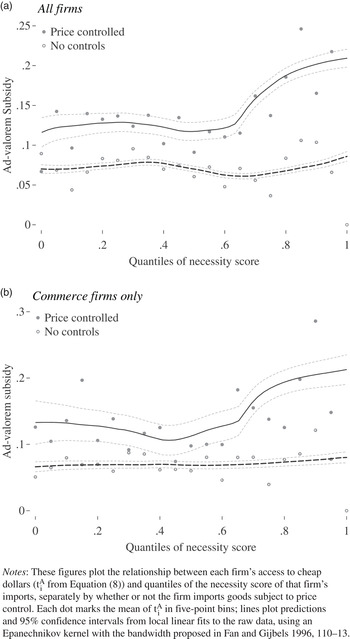
Figure 1a plots each firm's ad valorem subsidy (Equation (8)) against quantiles of the necessity score of its imports, our operationalization of G i from Equation (6). At all levels of necessity score—that is, holding fixed the mix of necessity and luxury goods—firms importing price-controlled goods enjoy more subsidy than firms not importing price-controlled goods. And among firms importing price-controlled goods, importing necessity goods (as opposed to luxury goods) is positively correlated with access to cheap dollars. Figure 1b reports these descriptives only for firms in the General Commerce sector (which includes consumer products other than food and beverages), showing that the patterns in Figure 1a are not driven exclusively by differences across sectors.
Necessity scores, price controls, and cheap dollars.

Because only 16 percent of importers buy any Cadivi dollars at all, these relationships are largely driven by the extensive margin, the proportion of firms with nonzero subsidy, as opposed to the size of the subsidy among firms with Cadivi dollars. The same is true of the structural estimates we present later.
Of course, the correlations in Figure 1 could be driven by other factors. Most importantly, there is a strong relationship between the value of a firm's imports and access to the subsidy: firms importing at least USD 1.5 million worth of goods—the top 20 percent of firms—were much more likely to buy Cadivi dollars than their smaller counterparts. Moreover, a large percentage of all Cadivi dollars went to the firms with the most imports: the top 0.1 percent of firms were responsible for nearly 30 percent of imports and purchased 28 percent of all Cadivi dollars (see Figure C6 in the supplementary material).
To consider how the relationships among price controls, necessity scores, and Cadivi dollars change when we account for import volume (among other characteristics), we estimate descriptive regressions that capture the relationships in Figure 1 while also adjusting for covariates (in the supplementary material). Overall, controlling flexibly for the total volume of firm imports and/or including sector fixed effects produces results in line with the patterns in Figure 1: importing goods disproportionately consumed by the poor strongly predicts Cadivi allocations among firms importing price-controlled goods.
Arbitrage for Sale?
These descriptive relationships are informative but limited. They tell us that, consistent with rhetoric, the Chávez administration did target Cadivi dollars toward price-controlled goods and toward necessity goods. They also tell us that this targeting was incomplete: we observe many cheap dollars sold to importers of luxury goods that were not subject to price control. But without more structure, it is difficult to interpret the magnitude of these descriptive relationships.Footnote 40 Compared to trade policies in other countries or under other regimes, do Chávez's exchange controls look relatively welfare-minded? Or relatively geared toward special interests?
To help answer these questions, we turn to our structural estimates of the government's weights on consumer welfare, electoral constituents, and importer profits. As we discuss in detail, we can compare our estimates to those from the empirical trade literature.Footnote 41 In these studies, the null hypothesis is that the government's weight on welfare is 1 (that is, 100%)—meaning that the government ignores pressure from protectionist lobbies (i.e., places zero weight on “political contributions”). Scholars reject this null hypothesis when they find empirical evidence of a positive (nonzero) weight on protectionist lobbies.Footnote 42 Rejection of the null hypothesis of a completely welfare-minded government leads to the conclusion that, as Grossman and Helpman proposed,Footnote 43 trade protection is for sale: import-competing industries successfully bribe the government for tariffs.
Empirically, early studies often failed to reject the null hypothesis of entirely welfare-minded governments, estimating near-100 percent weights on welfare and near-0 percent weights on “political contributions”—so much so that an influential handbook article questioned whether protection was for sale after all.Footnote 44 Subsequent research found that a straightforward but widespread specification problem had produced the systematic underestimation of governments’ weights on contributions. In these authors’ corrected estimates for thirty-two countries, the median weight on welfare is 94 percent, and the mean is 90 percent. Weights range from 98.8 percent (Singapore, the most welfare-minded) to 54 percent (Ethiopia, the least welfare-minded). Our case, Venezuela, appears relatively welfare-minded in these tariff-based estimates, with a 98 percent weight on welfare.Footnote 45 This makes sense in light of Venezuela's low tariffs since the early 1990s.Footnote 46
We describe these estimates to provide context for our own structural results. Relative to these benchmarks, our model and our data make Chávez's Venezuela look decidedly not welfare-minded.
We estimate a weight on consumer welfare (α) of just 44 percent—no greater than the implied weight on importer profits, which is also 44 percent (Table 1, Column 1). Organized electoral constituents also earn a positive weight in the government's objective function ( $\hat{\beta }_2 = 10\% $), reflecting the fact that the exchange-rate subsidy was targeted toward firms importing price-controlled necessity goods (Figure 1a). (By contrast, the weight on subsidizing necessity goods not subject to price control, β 1, is estimated at close to 0, suggesting that the government did not much value whatever electoral benefits might obtain from these subsidies.)
Political economy weights

Notes: Estimates of Equation (6). α represents the government's weight on consumer welfare; β 1, the government's weight on low importer prices for necessity goods; β 2, the weight on low consumer prices for necessity goods; and (1 − α − β 1 − β 2), the government's weight on importer profits. Standard errors, calculated by the delta method, in parentheses.  $t_i^A $is measured per Equation (8); e i from Kee, Nicita, and Olarreaga Reference Kee, Nicita and Olarreaga2008; G i is i's quantile in the distribution of necessity scores; K i = (k i − 1)/k i; k i = 0.99 if the firm imports price-controlled goods and 0.1 otherwise.
These estimates make Chávez look much less welfare-minded than comparable estimates from the empirical trade literature. The contrast arises both from features of the data and from features of our model: the data reveal that importers benefited from the policy; the model excludes these benefits from welfare, for reasons discussed earlier. Under Chávez, Venezuela's expensive and extensive exchange-rate subsidy deviated more dramatically from the welfare-maximizing zero-subsidy ideal than tariffs did from the zero-tariff ideal; that is the feature of the data that drives our results. At the same time, our model implies that exchange-rate subsidies are generally more anti-welfare than tariffs. Thus our estimate of the weight on welfare (α) is lower than tariff-based estimates, both because Chávez embraced exchange-rate subsides while eschewing tariffs and because these subsidies were inherently more favorable to special interests.
Qualitative evidence underscores our interpretation of these estimates. The apparently large weight on importer profits (44%, or 1 − α − β 1 − β 2) implies that a significant fraction of Cadivi dollars were sold to companies importing goods not subject to price control. The qualitative record provides examples: a cable from the US embassy noted that Cadivi “authorized transactions of USD 71 million for whiskey so far this year (which is only slightly less than the USD 82 million Venezuela spent on wheat, though Venezuela produces no wheat domestically).” Whiskey was not subject to price control, and the managing director of one spirits multinational told embassy officials that “business had never been better” and that the firm planned to develop “a new whiskey brand for Venezuela, which they hope will increase Venezuela's standing from the seventh largest consumer of whiskey worldwide.”Footnote 47
Columns 2–4 of Table 2 estimate the welfare weights using data from three subsets of importers: those in the food and beverage sector (N = 1,514), those in the general commerce sector (N = 8,096), and those in the automobile sector (N = 2,766). These results reveal that the overall weights are driven neither by differences across sectors nor by domestic market structure. That is, even within the food and beverage sector, the government allocated the exchange-rate subsidy so as to provide significant rents to importers.
We present these results with an important caveat: they are sensitive to the theoretical framework.Footnote 48 For example, the estimates change somewhat when we deviate from the model by including an intercept in the estimating equation and/or arbitrarily adding controls, as is often the case in empirical trade applications.Footnote 49 We therefore present the results as estimates of relative political economy weights within the framework of the model, and only following descriptive analysis of the data. In pairing the structural estimates with descriptives, we aim for transparency in the sense of Andrews, Gentzkow, and Shapiro, “helping skeptical readers learn from the results even when they do not fully accept all the model assumptions.”Footnote 50
Our results also help resolve two outstanding puzzles from the literature. The first stems from an apparent mismatch between the theory of Grossman and HelpmanFootnote 51 and global trade policy. Grossman and Helpman predict the widespread use of import subsidies as a means of making transfers to organized consumers. Critics have charged that this prediction is at odds with reality: import subsidies are not widespread.Footnote 52 But import subsidies, we note, are often partially disguised as dual exchange rates, with a preferential rate for importers. And while the use of dual exchange rates has declined since the 1950s—when more than half of countries used them—one-fifth of countries used dual or multiple rates as recently as 2016.Footnote 53 Our model clarifies the conditions under which preferential exchange rates function as import subsidies, suggesting that import subsidies may not be so rare after all.
The second puzzle is described by Bueno de Mesquita and colleagues, who note that dual exchange rates generate arbitrage rents for elites.Footnote 54 Their theory predicts that dual exchange rates should extend the tenure of leaders accountable to a small group (i.e., leaders in nondemocracies), and they find support for this prediction in cross-national data. But they also find that dual exchange rates extend the tenure of leaders more accountable to voters, a result they attribute to data limitations.Footnote 55 Our model and estimates clarify how, at least in the short term, dual exchange rates can both subsidize certain voters’ consumption and provide a private, excludable good to certain elites. These twin benefits are especially valuable in competitive authoritarian regimes, where leaders need both to win elections and to co-opt or control powerful groups. In contrast to the conclusion one might draw from looking at tariffs, we find that the Chávez administration used commercial policy for this dual political purpose.
Qualitatively, it is not difficult to outline the political return on this investment. In the decade between the birth of Cadivi and his death in 2013, President Hugo Chávez consolidated political power, winning a string of elections. Moreover, he faced no extra-electoral threat on par with those he faced in 2001 to 2003, including the general strike that prompted the exchange controls in the first place. In the words of Francisco Rodríguez, a Venezuelan economist who headed the country's Congressional Budget Office at the time the controls were imposed, “Chávez imposed the exchange controls as an emergency measure and then realized that they served a really important political goal: not having the private sector conspiring against him. He said, ‘OK, [chamber of commerce], you called a strike to try to topple me? Well, you can't do that anymore.’ Because he controlled the dollars.”Footnote 56
Conclusion
Consider two competing narratives about Venezuela under Hugo Chávez—the same two narratives that compete for adherents in many competitive authoritarian regimes. The first celebrates the government as protecting the economic interests of the people against attacks from special interests. The second tars the government as a “reverse Robin Hood,”Footnote 57 stealing from the poor to feed powerful elites.
Venezuelanists have attempted to adjudicate between these competing narratives by studying the magnitude and quality of social spending, among other things. Trade scholars have provided a view from tariffs. We instead provide evidence based on Chávez's signature commercial policy: the provision of a targeted-exchange rate subsidy for imports.
To structure our analysis, we adapt a formal framework from the empirical trade literature.Footnote 58 Our model proposes a mapping from the government's political priorities to its allocation of exchange-rate subsidies, allowing us to use data on exchange-rate subsidies to draw inferences about political priorities. Compared to estimates from the empirical trade literature, which uses tariff schedules and nontariff barriers, we find that the Chávez government placed relatively little weight on consumer welfare. This suggests that exchange-rate arbitrage was for sale: the inefficient and distortionary subsidy primarily served organized special interests.
Beyond Venezuela and competitive authoritarianism, we make two contributions. First, we provide a model that can be applied to data from any country with a market exchange rate alongside a targeted exchange-rate subsidy (the “official” or preferential rate).Footnote 59 Second, and more generally, we demonstrate that the structural empirical trade approach to estimating “welfare-mindedness” can be applied even in contexts where tariffs are not the primary trade policy instrument, and/or where import-competing industries are not the primary special interests. We adapt a model of tariffs and protection to the study of subsidies and arbitrage, while retaining the interpretation of the key parameter of the model: the government's weight on welfare. Future work could similarly answer Gawande, Krishna, and Olarreaga's call to estimate “welfare-mindedness” using a broader set of commercial policy instruments.Footnote 60
Data Availability Statement
Replication files for this research note are available from the authors and the International Organization editorial office.
Supplementary Material
Supplementary material for this research note is available at <https://doi.org/10.1017/S002081832100031X>.
Acknowledgments
Special thanks to Kishore Gawande for extensive guidance. For comments, we also thank Tulia Falleti, Jeff Frieden, Julia Gray, Marc Meredith, Francisco Rodríguez, Marcel Roman, Shanker Satyanath, Beth Simmons, Stefanie Walter, colleagues at the University of Chicago and the University of Pennsylvania, and workshop participants at Columbia, NYU, the University of Washington, UCLA, IPES, and APSA.