Significant outcomes
-
∙ Sub-threshold hypomanic symptoms may represent a prodrome of bipolar disorder.
-
∙ Non-psychotic severe depression may often occur secondary to physical diseases.
-
∙ Electroconvulsive therapy is effective for severe depression regardless of the presence of any psychotic features.
Limitations
-
∙ The present study utilised a retrospective design and lacked a structured interview for diagnoses.
-
∙ The findings refer to severe, hospitalised cases, and therefore cannot be generalised to outpatient or community samples.
-
∙ Treatment was not controlled for this study.
Introduction
Many cases of bipolar disorder (BD) present with depressive episodes at onset, accounting for more than half of the initial episodes (Reference Etain, Lajnef and Bellivier1). Misdiagnosis of BD may imply a variety of negative outcomes such as inadequate use of antidepressants, a greater number of recurrences, longer episodes, and a higher level of social impairment (Reference Perlis2).
A severe depressive episode (severe depression, as diagnosed by ICD-10) may be a risk factor for diagnostic conversion into BD (Reference Angst, Sellaro and Stassen3), and severe depression with psychotic symptoms [psychotic depression (PD)] has been consistently associated with BD (Reference Goldberg, Harrow and Whiteside4,Reference Souery, Zaninotto and Calati5). The rate of diagnostic conversion from severe depression to BD and its clinical variables are informative for selecting treatment options, because some options such as lithium or atypical antipsychotic augmentation and modified electroconvulsive therapy (ECT) are known to be effective for both severe depression and BD.
PD is known to have a higher number of depressive episodes, a higher number of admissions to hospitals, longer length of episodes, and more impaired performance in activities of daily living, as well as a higher suicide rate and mortality compared with non-psychotic depression (non-PD) (Reference Basso and Bornstein6–Reference Kingston, Scully and Browne9). However, whether PD is best considered to be separate from non-PD or simply a more severe form of depression remains unsettled.
Therefore, the aims of the present study were to examine the stability of diagnosis of severe depression within an inpatient setting and to compare the clinical characteristics of psychotic and non-psychotic severe depression, as well as to assess the effectiveness of ECT.
Materials and methods
A retrospective chart review of patient medical records was performed. We reviewed age at onset, duration of observations, number of depressive episodes, time spent within a psychiatric ward, history of suicide attempts and psychotic symptoms at admission, family history of any psychiatric disorders, ECT during hospitalisation, use of mood stabilisers at discharge, and sub-threshold hypomanic symptoms during hospitalisation. We defined sub-threshold hypomanic symptoms as a depressive episode with sub-threshold hypomania (hypomania without impairment, or the presence, over at least several days, of persistent elation or irritability with three or more manic symptoms, but an insufficient number of symptoms to meet full criteria for hypomania (Reference Angst, Cui and Swendsen10)). A manic or hypomanic episode during antidepressant treatment that met the criteria even after stopping antidepressants was included in the criteria for a manic or hypomanic episode in BD.
A total of 336 patients with depression consistent with the ICD-10 diagnostic criteria (F32 and F33 at intake) were hospitalised from 2001 to 2010 in a psychiatric ward at Tokushima University Hospital, whose Institutional Review Board approved the study. Ultimately, 89 of the 336 (26.5%) inpatients (28 men [31.5%] and 61 women [68.5%]) with a primary diagnosis of severe depression (PD: n=33 [37.1%]; non-psychotic severe depression: n=56 [62.9%]) consistent with the ICD-10 criteria (F32.2, F32.3, F33.2, F33.3) were enrolled in the study. Patients with diagnosis of mood disorders due to a general medical condition were excluded. Mean age of the patients at their initial hospitalisation was 55.7±13.9 years (range: 16–82 years). Mean follow-up time was 74.8±37.7 months (range: 15–137 months). The sample included in the study consisted of patients examined and diagnosed by individual consultant psychiatrists in our department. Their diagnoses at intake were also checked by various psychiatrists during a conference. Follow-up assessments were made regularly (at least every 3 months) by individual consultant psychiatrists. A retrospective chart review was independently conducted by at least two trained psychiatrists (N.M., N.K., and J.I.).
Student’s t-test, Fisher’s exact test, and the linear regression tests were used for analyses. p<0.05 was considered to be significant. Diagnostic conversions were evaluated using survival analyses.
Results
BD converters versus non-converters
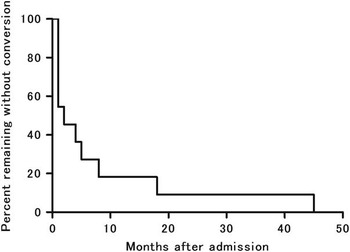
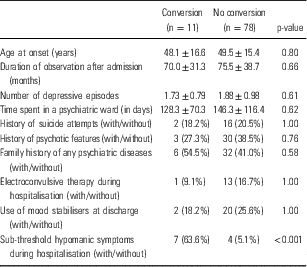
By the 75th month of follow-up, diagnostic conversion from severe depression to BD was observed in 11 patients (12.4% of the total sample), of which nine patients (81.8% of the converters) had their diagnosis changed within 1 year after admission (Fig. 1). Among the 11 converters, four patients’ diagnoses changed because of manic or hypomanic episodes during their antidepressant treatment, but they met the criteria even after discontinuing their antidepressants. In addition, among the 11 converters, five patients had manic episodes and six of them had hypomanic episodes. The mean time between admission and diagnostic conversion was 7.9±13.3 months. Comparison of clinical variables related to patients who had (or did not have) their diagnosis converted from severe depression to BD is presented in Table 1. Only one patient had a family history of BD within our sample. Patients who had their diagnosis changed to BD were characterised by a significantly higher frequency of sub-threshold hypomanic symptoms during hospitalisation (converters: 63.6% vs. non-converters: 5.1%, p<0.001). The groups did not differ in any other characteristics.
Survival analysis illustrating the percentage of 11 patients who eventually developed bipolar disorder (BD).

Comparison of clinical variables related to patients who had (or did not have) their diagnosis converted from severe depression to BD

Student’s t-test and Fisher’s exact test were used for analyses.
PD versus non-psychotic severe depression
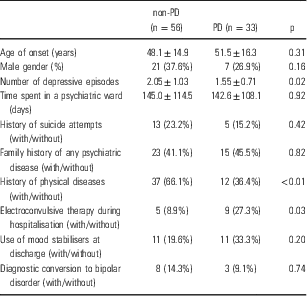
Among 89 inpatients with primary diagnosis of severe depressive episodes, 33 (37.1%) were diagnosed with PD (F32.3, F33.3), while 56 (62.9%) were diagnosed as non-PD (F32.2, F33.2). A comparison of clinical variables related to patients with PD and non-PD is presented in Table 2.
Comparison of clinical variables in patients with non-psychotic (non-PD) versus psychotic depression (PD)

The Student t-test and Fisher’s exact test were used for analyses.
The mean age at onset of severe depression was 49.3±15.5 years (range: 13–79 years). The proportion of women in the sample was significantly higher than that of men (28 men [31.5%] and 61 women [68.5%], p<0.001). Number of depressive episodes (PD: 1.55±0.71 vs. non-PD: 2.05±1.03, p=0.02) and history of physical diseases (PD: 36.4% vs. non-PD: 66.1%, p<0.01) were significantly increased in non-PD patients compared with PD patients, whereas ECT during hospitalisation was significantly increased in PD patients compared with non-PD patients (PD: 27.3% vs. non-PD: 8.9%, p=0.03). The groups did not differ in other characteristics.
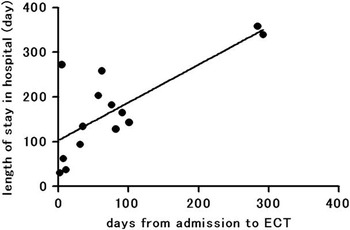
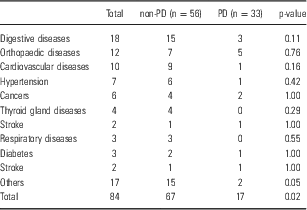
Table 3 lists the results regarding the association between physical diseases and PD and non-PD. Digestive diseases such as chronic hepatitis C and duodenal and gastric ulcer, as well as orthopaedic diseases such as bone fracture and rupture, are frequent in both non-PD and PD patients. Digestive diseases, thyroid gland diseases, cardiovascular diseases, and hypertension showed tendencies to be more frequent in non-PD than in PD patients. The number of physical diseases in total was significantly increased in non-PD compared with PD patients (p<0.03). There were no significant differences in the length of stay in a hospital between PD and non-PD patients treated with ECT. However, there were significant correlations between the length of stay in a hospital and the number of days from admission to ECT (linear regression test n=14, r 2=0.58, p<0.01, Fig. 2) and between length of episode and the days from onset to ECT (linear regression test n=14, r 2=0.82, p<0.0001). There was a modest but non-significant correlation between the number of days from onset to ECT and the number of ECT treatments (linear regression test n=14 r 2=0.27 p=0.06).
Significant correlation between the days from admission to electroconvulsive therapy (ECT) and length of stay at the hospital (in days) (linear regression test: r 2=0.58, p=0.0016).

Associations between physical diseases and presence of non-psychotic (non-PD) versus psychotic depression (PD)

Fisher’s exact test was used for analyses.
Discussion
The rate of the conversion from severe depressive episode to BD in our group of patients was 1.99% per year (12.4÷74.8×12). Despite the higher onset age of our patients, this finding was comparable with previously published results, which report a lower age at onset and longer follow-up periods (Reference Angst, Sellaro and Stassen3,Reference Goldberg, Harrow and Whiteside4,Reference Coryell, Endicott and Maser11–Reference Dudek, Siwek and Zielinska13). Akin to previously reported data showing higher rates of diagnostic conversion or progression early in follow-up (Reference Fiedorowicz, Endicott and Leon14), our analysis showed a more rapid progression in the first year of follow-up, followed by a slower, linear decline thereafter (Fig. 1). Importantly, most diagnostic conversions (9/11) occurred during the first year after admission. This result indicates that patients with severe depression should be monitored through careful observation of their manic symptoms, especially during the first year after admission.
Recently, sub-threshold hypomanic symptoms during depressive episodes were reported to be associated with the diagnostic conversion to BD (Reference Angst, Cui and Swendsen10,Reference Fiedorowicz, Endicott and Leon14). Consistently, sub-threshold hypomanic symptoms often accompany bipolar depressive episodes (Reference Goldberg, Perlis and Bowden15). In the present study, 11/89 (12.4%) patients with severe depression presented with sub-threshold hypomanic symptoms during hospitalisation, and 7/11 (63.6%) patients who had sub-threshold hypomanic symptoms converted to BD. These findings are comparable with a previous report, which showed that two-thirds of patients who experienced bipolar depressive episodes had sub-threshold hypomanic symptoms (Reference Goldberg, Perlis and Bowden15).
The rate of PD in the present sample (37.1%) fell in line with findings from several studies of inpatients with major depressive episodes (Reference Coryell, Pfohl and Zimmerman16,Reference Gournellis, Lykouras and Fortos17). The distribution of sex (37% males in non-PD, and 26.9% in PD) was also in line with findings from several studies on non-PD (Reference Bock, Bukh and Vinberg18) and PD patients (Reference Ostergaard, Petrides and Dinesen19).
The number of depressive episodes was significantly increased in non-PD compared with PD patients (PD: 1.55±0.71 vs. non-PD: 2.05±1.03, p=0.02) in our sample. This finding was inconsistent with previous studies, because the severity of a depressive episode was reported to predict shorter time to recurrence and a higher number of recurrences (Reference Holma, Holma and Melartin20,Reference Hardeveld, Spijker and De Graaf21); this result may imply that our sample with non-psychotic severe depression was more severe than that of previous studies, and non-psychotic ‘very’ severe depression might have a higher number of episodes compared with PD. A recent population-based historical prospective cohort study from Danish registers revealed that diagnostic conversion to BD was prevalent among patients with PD (Reference Ostergaard, Straszek and Petrides22); however, the rate of diagnostic conversion from PD to BD in our sample was not higher compared with non-PD patients. This inconsistency may be due to our small sample size. The low conversion rate and low number of depressive episodes among PD patients may also be explained by the studied population’s relatively older age and fewer episodes of depression, because occurrence of the first depressive episode at a younger age and recurrent depressive episodes are known to increase the risk of conversion to BD.
A history of physical diseases was significantly increased in non-PD compared with PD patients (PD: 36.4% vs. non-PD: 66.1%, p<0.01). In the present study, digestive diseases including chronic hepatitis C and duodenal and gastric ulcer, as well as orthopaedic diseases such as bone fracture and rupture, frequently occurred in both non-PD and PD patients. Furthermore, digestive diseases, thyroid gland diseases, cardiovascular diseases, and hypertension were more prevalent in non-PD than in PD patients. Although interferon-induced depression was not included in our sample, chronic hepatitis C may be associated with severe depression (Reference Rowan, Al-Jurdi and Tavakoli-Tabasi23,Reference Nelligan, Loftis and Matthews24). Recent evidence supports an association between depression and increased risk of fracture and bone loss, which may be mediated by antidepressants (Reference Wu, Liu, Gallegos-Orozco and Hentz25,Reference Wu, Bencaz, Hentz and Crowell26). Diseases with a vascular pathogenesis such as cardiovascular diseases and hypertension were associated with non-psychotic severe depression (Reference Ostergaard, Petrides and Dinesen19,Reference Nemeroff and Goldschmidt-Clermont27). Moreover, a recent register-based study revealed that a history of physical diseases such as ischaemic heart disease, hypertension, stroke, and chronic lower pulmonary disease increased the risk for the subsequent development of non-PD compared with psychotic severe depression (Reference Ostergaard, Petrides and Dinesen19). The present findings, noting differences in the two, add some support to the hypothesis that non-psychotic severe depression may often occur secondary to physical diseases (environmental risk factor) compared with PD, which, in contrast, may be a more ‘primary’ disorder, characterised by a stronger genetic predisposition (Reference Leckman, Weissman and Prusoff28–Reference Domschke30).
ECT during hospitalisation was significantly increased in PD patients compared with non-PD patients (PD: 27.3% vs. non-PD: 8.9%, p=0.03), because the days from admission to ECT were not significantly different between PD and non-PD patients. This result suggests that PD often occurred without life events such as a history of physical disease, and often became treatment-refractory and required ECT. Although we could not find significant differences in the length of stay in the hospital and the length of episodes between PD and non-PD treated with ECT, there were significant correlations between length of stay in the hospital and the number of days from admission to ECT (see Fig. 2) and between the length of episodes and the number of days from onset to ECT. These findings suggest that ECT is effective for severe depression, regardless of the diagnostic conversion to BD or the presence of psychotic features, which falls in line with the previous reports (Reference Lam, Bartley and Yatham31–Reference Ostergaard, Leadholm and Rothschild34).
The main limitation of our study is that patients were retrospectively studied; therefore, we could not conduct structured interviews for diagnoses, which could have increased diagnostic uncertainty. The present findings are limited to severe hospitalised cases, and therefore cannot be generalised to outpatient or community samples. Finally, treatment was not controlled for this study, and patients received a variety of treatments during follow-up.
Acknowledgements
Dr. Kimiya Nakamura and Dr. Naoki Matsumoto contributed to the acquisition and analysis of data. Dr. Junichi Iga contributed to the conception and design of the research plan. Prof. Tetsuro Ohmori contributed to the final approval of the manuscript submitted for publication.
Financial Support
None.
Conflicts of Interest
None.
Ethical Standards
The authors assert that all procedures contributing to this work comply with the ethical standards of the relevant national and institutional committees on human experimentation and with the Helsinki Declaration of 1975, as revised in 2008.