Introduction
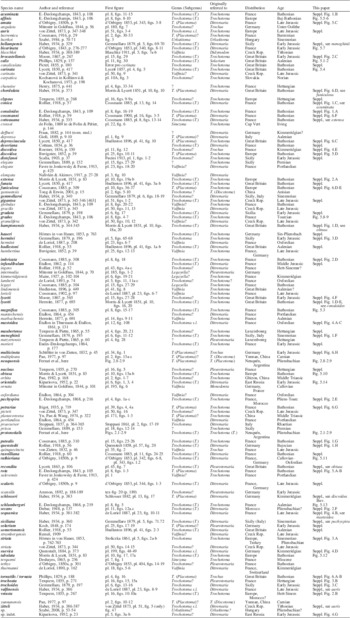
Pleurotomarioidean gastropods were abundant and diverse in marine Paleozoic and Mesozoic shallow waters, but during the Cenozoic they became rare, and now tend to be limited to deep-water environments (Harasewych, Reference Harasewych2002). The very distinctive late Triassic–Jurassic family Trochotomidae Cox, Reference Cox1960 is included in the superfamily Pleurotomarioidea Swainson, Reference Swainson1840 by most authors (see discussion below), but its phylogenetic affinities are in fact problematic. This group includes trochiform shells with an elongate elliptical trema that have been grouped into the genus-group taxa Trochotoma Eudes-Deslongchamps, Reference Eudes-Deslongchamps1843, Discotoma Haber, Reference Haber1934non Mulsant, Reference Mulsant1850 (here renamed Placotoma), Valfinia Cox, Reference Cox1958, and Legayella Fischer, Reference Fischer1969. Urkutitoma Szabó, Reference Szabó1984 is another taxon tentatively included in the family by Szabó (Reference Szabó2009). Almost 120 species names have been referred to this group, most of them instituted in the nineteenth century, with many figured solely by drawings and only poorly characterized, and a few were never figured (Table 1 and Supplementary Data). The family needs a thorough revision to elucidate its phylogenetic relationships with other vetigastropod groups, such as Scissurelloidea Gray, Reference Gray1847 and Haliotoidea Rafinesque, Reference Rafinesque1815.
List of nominal species once referred to Trochotomidae, with an indication of their updated generic affinities. Those discussed in this paper (including supplementary data) are in bold type. Taxa doubtfully related to this family are indicated with question marks.

Early Jurassic marine gastropods from South America were studied by Bayle and Coquand (Reference Bayle and Coquand1851), Behrendsen (Reference Behrendsen1891, Reference Behrendsen1922), Möricke (Reference Möricke1894), Burckhardt (Reference Burckhardt1900, Reference Burckhardt1902), Jaworski (Reference Jaworski1925, Reference Jaworski1926a, Reference Jaworski1926b), Weaver (Reference Weaver1931), Feruglio (Reference Feruglio1934), Wahnish (Reference Wahnish1942), Gründel (Reference Gründel2001), and Damborenea and Ferrari (Reference Damborenea and Ferrari2008). Ferrari (Reference Ferrari2009, Reference Ferrari2011, Reference Ferrari2012, Reference Ferrari2013, Reference Ferrari2014) and Ferrari et al. (2014) recently provided new data on the taxonomic composition of early Jurassic marine gastropod faunas from west-central Patagonia. Ferrari (Reference Ferrari2009) pointed out that some genera are cosmopolitan, being known from the Southern Hemisphere and other regions of the world (i.e., Europe), and are represented by some endemic species in west-central Patagonia and other localities in Argentina and Chile. Ferrari (Reference Ferrari2011, Reference Ferrari2012, Reference Ferrari2013, Reference Ferrari2014) reported 13 gastropod families from the early Jurassic (Pliensbachian–Toarcian) marine deposits of Chubut Province. These include 20 genera, two subgenera, and 36 species. Most of these genera were recorded for the first time in the Argentinean Jurassic, and at least nine new species seem to be endemic to the Patagonian region.
Nevertheless, early Jurassic gastropods from the Neuquén Basin are still poorly known, despite being widely distributed and locally diverse (see synthesis of previous knowledge in Ferrari, Reference Ferrari2009; Riccardi et al., Reference Riccardi, Damborenea, Manceñido and Leanza2011). Their potential use in paleobiogeography and paleoecology awaits updated systematic revisions. At least 15 gastropod species were preliminarily reported from the uppermost lower Pliensbachian beds at Piedra Pintada (southern Neuquén) by Damborenea et al. (Reference Damborenea, Manceñido and Riccardi1975). This paper deals with two of these species from the Piedra Pintada area and nearby localities. The two new species are the first Trochotomidae to be described from the Southern Hemisphere.
Geological setting
The Neuquén Basin is a well-known back-arc basin developed on the eastern margin of the Paleo-Pacific (or Panthalassa) Ocean, which had a rich depositional history spanning most of the Mesozoic. The late Triassic and early Jurassic extensional time (Uliana and Biddle, Reference Uliana and Biddle1988) was followed by the deposition of a thick sedimentary succession in which several sedimentary cycles can be recognized, each with different paleogeographical and temporal extension (Legarreta and Uliana, Reference Legarreta and Uliana1996, Reference Legarreta and Uliana2000). The initial transgression occurred through the Curepto Strait (Vicente, Reference Vicente2005) in southern Mendoza Province, and the first filling was accommodated in pre-existing rift depocenters. During Pliensbachian times, the transgression spread and became generalized, attaining the first of the two largest marine floodings of the basin: the Pliensbachian–Toarcian and the Tithonian–Neocomian (see Gulisano and Gutiérrez-Pleimling, Reference Gulisano and Gutiérrez-Pleimling1995; Arregui et al., Reference Arregui, Carbone and Martínez2011).
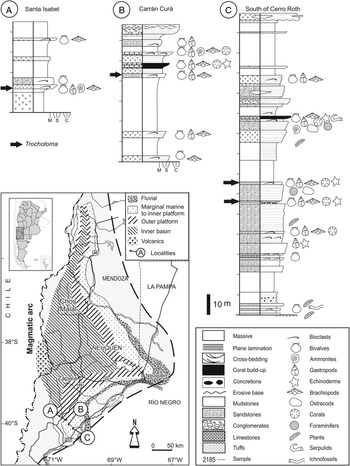
The material studied here was found in localities near the southern end of the embayment (Fig. 1) in sublittoral deposits of Pliensbachian age. Most specimens were recorded from the classical Piedra Pintada fossil locality discovered near the end of the nineteenth century by an expedition organized by the Museo de La Plata (Roth, Reference Roth1899). In this particular area, a variety of marginal marine and littoral environments developed (Gulisano and Pando, Reference Gulisano and Pando1981) within the Cuyo Mesosequence (Legarreta and Gulisano, Reference Legarreta and Gulisano1989), which represents the first Mesozoic marine sedimentation in this part of the basin. In the Piedra del Águila–Carrán Curá region, the volcanic influence was quite persistent. Several lithofacies were recognized by Gulisano and Pando (Reference Gulisano and Pando1981, p. 561); the gastropods described here are associated with what they called “light colored sandstones, mudstones and tuffs facies.” These sediments were deposited in a moderate- to high-energy shoreface to foreshore environment, with frequent pyroclastic input, referred by Gulisano and Pando (Reference Gulisano and Pando1981) to the Lajas Formation (Weaver, Reference Weaver1931). Other authors (see Arregui et al., Reference Arregui, Carbone and Martínez2011) use the local name Piedra Pintada Formation (Stipanicic et al., Reference Stipanicic, Rodrigo, Baulies and Martínez1968) for these deposits. The marine sediments overlie Lower Jurassic volcanic and pyroclastic rocks (Sañicó Formation).
Location map and simplified logged sections at Santa Isabel (A), Carrán Curá (B) and Cerro Roth (C) in southern Neuquén Province, Argentina. Beds with Trochotoma indicated with an arrow. Paleogeography after Legarreta and Uliana (Reference Legarreta and Uliana2000), sections adapted from Damborenea et al. (Reference Damborenea, Manceñido and Riccardi1975) and Damborenea (Reference Damborenea1987).

Damborenea et al. (Reference Damborenea, Manceñido and Riccardi1975) distinguished two main biofacies and seven sub-biofacies in these deposits. The beds bearing the gastropods described here belong to their sub-biofacies A2, characterized by high-diversity systematic and ecological assemblages, dominated by an epifauna with a large percentage of cemented organisms. This sub-biofacies includes coral buildups, which locally form small bioherms. It is associated with the ‘light coloured sandstones, mudstones and tuffs’ lithofacies already mentioned.
Zonal successions spanning the Pliensbachian–Tithonian interval were recognized on the basis of abundant, diverse, and stratigraphically significant cephalopod, bivalve, and brachiopod taxa, which are correlated with the international standard scale (see Riccardi et al., Reference Riccardi, Damborenea, Manceñido and Leanza2011), and are used as the time frame for this study.
Materials and methods
Specimens were collected at three localities (Cerro Roth, Carrán Curá, and Estancia Santa Isabel, Fig. 1), all in southern Neuquén Province. The stratigraphic sections logged there were described by Damborenea et al. (Reference Damborenea, Manceñido and Riccardi1975, fig. 3) and Damborenea (Reference Damborenea1987, fig. 5). The accompanying fauna is both abundant and highly diverse, comprising mostly epifaunal bivalves, brachiopods, other gastropods, and corals. The material from Piedra Pintada was found in uppermost lower Pliensbachian beds (Austromorphites behrendseni Zone), according to the local ammonite biozonation (Riccardi, Reference Riccardi2008a, Reference Riccardi2008b; Riccardi et al., Reference Riccardi, Damborenea, Manceñido and Leanza2011). At Estancia Santa Isabel, ammonites indicate a slightly younger age (Fanninoceras fannini or F. disciforme Zones), i.e., lower upper Pliensbachian.
The material is housed in the collections of the División Paleozoología Invertebrados, Museo de Ciencias Naturales de La Plata (MLP), and Museo Carmen Funes, Plaza Huincul (MCF-PIPH). Newly collected shells were prepared by technical staff at the Museo Paleontológico “Egidio Feruglio” (MPEF) laboratory. All specimens were coated with ammonium chloride to enhance sculptural details for photography.
Systematic paleontology
Institutional abbreviations
MLP: Museo de Ciencias Naturales la Plata, La Plata, Argentina; MCF-PIPH: Museo Carmen Funes, Plaza Huincul, Neuquén, Argentina; MPEF: Museo Paleontológico “Egidio Feruglio”, Trelew, Chubut, Argentina.
Superfamily Pleurotomarioidea Swainson, Reference Swainson1840
Family Trochotomidae Cox, Reference Cox1960
Remarks
Although Ditremariinae Haber, Reference Haber1934 (p. 320), available under ICZN Art. 13.2.1 (Bouchet and Rocroi, Reference Bouchet and Rocroi2005, p. 66, 176) would hold priority as a family group name (still used by Wang, Reference Wang1978, p. 399), Trochotomidae Cox (in Knight et al., Reference Knight, Cox, Keen, Smith, Batten, Yochelson, Ludbrook, Robertson, Yonge and Moore1960, p. 220) is to be maintained because it was proposed before 1961 and has gained prevailing usage (ICZN Art. 40.2).
Trochotomids are frequently related to reef environments of the Tethyan region (Europe, northern Africa). Outside of this region they were only mentioned from northern Russia by Kiparisova (Reference Kiparisova1952), and from western Argentina by Damborenea et al. (Reference Damborenea, Manceñido and Riccardi1975, Reference Damborenea, Ferrari, Manceñido and Griffin2012b). This last record is in fact a preliminary identification of nearly all the material described below. Except for such records, the family was unknown either from the rest of the Americas or other Austral regions.
Genus Trochotoma Eudes-Deslongchamps, Reference Eudes-Deslongchamps1843
Type species
Trochotoma conuloides Eudes-Deslongchamps, Reference Eudes-Deslongchamps1843, p. 109, pl. 8, figs. 16–19, from the Bathonian of France, subsequent designation by Woodward, Reference Woodward1851, p. 148, pl. 10, fig. 26.
Remarks
Woodward (Reference Woodward1851, p. 148) already regarded Trochotoma Eudes-Deslongchamps, Reference Eudes-Deslongchamps1843 and Ditremaria d’Orbigny, Reference d’Orbigny1843 as subjective synonyms, and used the first name as valid. The reasons for preferring the generic name Trochotoma over Ditremaria were also explained by Pictet (Reference Pictet1855, p. 179), Hermite (Reference Hermite1877, p. 688), and Fischer and Weber (Reference Fischer and Weber1997, p. 151). Despite this, some authors used Ditremaria as the valid genus name (i.e., Rollier, Reference Rollier1918; Haber, Reference Haber1934; Dubar, Reference Dubar1948). A few other authors did not regard them as synonyms, and notably, Eudes-Deslongchamps (Reference Eudes-Deslongchamps1868, p. 215) restricted Ditremaria to shells with two closely set tremata and Trochotoma to shells with a single trema (see also Stoliczka, Reference Stoliczka1867, p. 384; von Zittel, 1873, p. 341; and Burckhardt, Reference Burckhardt1897, p. 203).
The genus had a Mesozoic stratigraphic distribution, and greatly diversified very early in Jurassic times. Middle and late Triassic records, mostly from China (Yu et al., Reference Yu, Pan and Wang1974; Pan, Reference Pan1977, Reference Pan1982; Tong and Erwin, Reference Tong and Erwin2001) and Slovakia (Kollárová-Andrusovová and Kochanová, Reference Kollárová-Andrusovová and Kochanová1973), are few and doubtful. Even some Permian species were referred to Trochotoma (Gemmellaro, Reference Gemmellaro1889), but they clearly do not belong to this genus. Similarly, the Miocene species described by Deshayes (Reference Deshayes1865) as Trochotoma terquemi was later referred to the Scissurellidae genus Sukashitrochus Habe and Kosuge, Reference Habe and Kosuge1964 by Lozouet et al. (Reference Lozouet, Lesport and Renard2001). It is now included in Sinezona Finlay, Reference Finlay1926 (Geiger, Reference Geiger2012, p. 593). Likewise, the living species described as Trochotoma crossei de Folin (in de Folin and Périer, Reference Damborenea, Manceñido and Riccardi1869, p. 144, pl. 22, fig. 6) is now regarded as a species of Sinezona. The specific diversity of Trochotoma was high until the latest Jurassic, and there is a single record from Lower Cretaceous deposits (Trochotoma barremica Cossmann, Reference Cossmann1916). These genus names have also been applied to members of Trochotoma: Rimulus d’Orbigny, 1841, p. 199, (nom. nud.), and Ditremaria d’Orbigny, Reference d’Orbigny1843, p. 276.
Subgenus Trochotoma Eudes-Deslongchamps, Reference Eudes-Deslongchamps1843
Trochotoma (Trochotoma) protonotialis new species
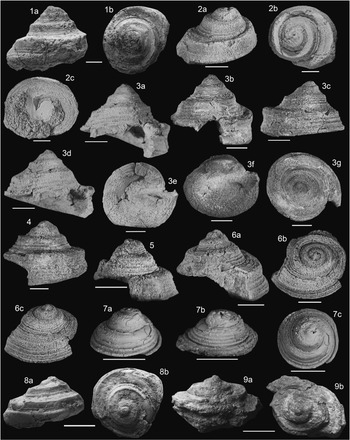
(1–7) Trochotoma (Trochotoma) protonotialis n. sp. (1) MLP 26172, holotype, (1a) lateral view; (1b) apical view. (2) MLP 12168, paratype. (2a) lateral view; (2b) apical view; (2c) basal view. (3) MCF-PIPH 554. (3a, b, c) lateral views; (3d) apertural view; (3e, f) basal and umbilical views; (3g) apical view. (4) MCF-PIPH 553, lateral view. (5) MCF-PIPH 684, lateral view. (6) MCF-PIPH 555. (6a) lateral view; (6b, c) lateral and apical views. (7) MLP 12167. (7a, b) lateral views; (7c) apical view. (8, 9) Trochotoma (Placotoma) neuquensis n. sp. (8) MLP 26171, holotype. (8a) lateral view; (8b) apical view. (9) MLP 26173, paratype. (9a) lateral view; (9b) apical view. Scale bar represents 5 mm.

Type material
Holotype MLP 26172; complete teleoconch; paratypes MLP 12168, 26169, two specimens.
Diagnosis
Shell turbiniform, gradate, broadly pseudomphalous; teleoconch with 5 whorls; ramp and outer face slightly concave; suture visible in a narrow furrow; spiral elements on the shell surface predominant; three to four cords between two peripheral angulations on mature whorls; elliptical trema on the adapical angulation; peristome prosocline and discontinuous in mature growth stages, but with deep notch in juvenile growth stages; base flat to slightly excavated, with spiral threads intercepted by fine prosocline growth lines.
Type locality and horizon
Estancia Santa Isabel, Neuquén Province, Argentina. Early Jurassic (lower upper Pliensbachian, Fanninoceras fannini or F. disciforme Zones), Piedra Pintada Formation.
Description
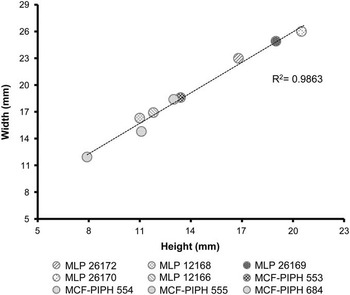
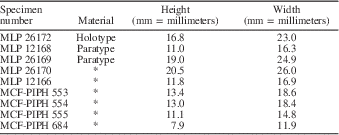
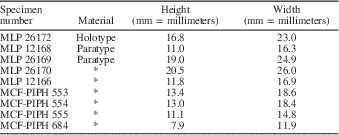
Dextral, turbiniform, gradate, broadly pseudomphalous shell. Protoconch not preserved. Teleoconch consisting of five whorls. Juvenile whorls slightly convex, with narrow, flat subsutural ramp. Sutural ramp abaxially delimited by rounded angulation. Outer face of juvenile whorls also flat. Ramp and outer face slightly concave on mature teleoconch. Width of ramp gradually increasing with growth. Angulation sharp on penultimate whorl; surface well rounded between the adapertural end of trema and outer lip. Suture visible in very narrow but distinct furrow. Ornament consisting of clearly visible spiral elements; three to four spiral cords developed on outer face between two peripheral angulations. Elongate elliptical trema situated on adapical angulation a short distance behind aperture. Adapical angulation not continuing beyond trema; shell surface consequently changing abruptly from sharply angular to gently convex between trema and peristome. Adult peristome prosocline, discontinuous. Juvenile peristome with deep notch, reflected on shell as selenizone on adapical angulation. Base flat to slightly convex, widely excavated, with broad, funnel-shaped false umbilicus. Spiral threads intercepted by fine prosocline growth lines on base. Figure 3 is a diagram of the variations of height and width of T. protonotialis n. sp. See Table 2 for measurements.
Diagram showing the variations of height/width ratio in Trochotoma protonotialis n. sp. Note that R2 indicates a good correlation between these parameters.

Measurements of Trochotoma (T.) protonotialis n. sp.
Etymology
Latinized adjective derived from Greek protos=first and notios=southern, referring to the first Southern Hemisphere occurrence of the genus, in the Jurassic of South America.
Additional material
Eight almost complete specimens and one internal mold (MLP 12166, 12167, 26170; MCF-PIPH 553, 554, 555, 564, 684) from uppermost lower Pliensbachian (Austromorphites behrendseni Zone) to lower upper Pliensbachian (Fanninoceras fannini or F. disciforme Zones) in the Piedra Pintada area (Cerro Roth, Carrán Curá, and Estancia Santa Isabel), southern Neuquén. All material collected by the authors during several field trips since 1973, as mentioned by Damborenea et al. (1975, table I, #53).
Remarks
The type species, Trochotoma conuloides Eudes-Deslongchamps (Reference Eudes-Deslongchamps1843, p. 109, pl. 8, figs. 16–19; d’Orbigny, Reference d’Orbigny1853, p. 385–386, pl. 341, figs. 14–17; Hermite Reference Hermite1877, pl. 14, figs. 4–5; Cossmann, Reference Cossmann1885, pl. 10, figs. 38–39), from the Bathonian of France, can be compared to the Argentinean species; the European form has a more elongate spire, more convex-to-flat teleoconch whorls, finer spiral cords on the shell surface, and an oblique trema. Trochotoma acuminata Eudes-Deslongchamps (Reference Eudes-Deslongchamps1843, p. 108, figs. 11–15; d’Orbigny Reference d’Orbigny1853, p. 384–385, pl. 341, figs. 8–13), from the Bathonian of France, and T. lycetti Hermite (Reference Hermite1877, p. 693; Morris and Lycett Reference Morris and Lycett1851, pl. 10, figs. 16, 20, as T. conuloides and T. acuminata respectively), from the Bathonian of Great Britain, differ from T. protonotialis n. sp. in having trochiform shells with flattened whorls and a poorly developed sutural ramp, finer spiral cords, better developed collabral elements, and opisthocyrt lunulae.
Trochotoma calix (Phillips, Reference Phillips1829, pl. 11, fig. 30; Hudleston, Reference Hudleston1885, pl. 4, figs. 6a–b; Reference Hudleston1896, p. 445, pl. 41, figs. 6–7), from the Middle Jurassic of England, is also similar to the new species; however, it has a single spiral keel and a more depressed aperture. Trochotoma affinis Eudes-Deslongchamps (Reference Eudes-Deslongchamps1843, p. 106, pl. 8, figs. 8–10; Eudes-Deslongchamps, Reference Eudes-Deslongchamps1868, pl. 8, figs. 6a–b; d’Orbigny, Reference d’Orbigny1853, p. 381–383, pl. 341, figs. 1–3; Hudleston Reference Hudleston1896, p. 447, pl. 41, fig. 4; including T. carinata Lycett Reference Lycett1850, p. 417; 1857, pl. 4, fig. 5), from the Middle Jurassic of the European area, differs from the Argentinean species in having a slightly more concave outer face. Close affinities of T. (T.) protonotialis n. sp. can be seen with Trochotoma gradus Eudes-Deslongchamps (Reference Eudes-Deslongchamps1843, pl. 8, figs. 4–7; Eudes-Deslongchamps, Reference Eudes-Deslongchamps1868, pl. 4, figs. 2a–b; d’Orbigny, Reference d’Orbigny1843, p. 276, not figured, as Ditremaria bicarinata; Fischer and Weber, Reference Fischer and Weber1997; p.150, pl. 24, figs. 5a–c), from the Early Jurassic of France. However, d’Orbigny’s species is larger, has nine spiral cords on the spire whorls, the whorl side is almost vertical, and the elliptical trema is widely open. The Argentinean material has only five spiral cords per whorl and the whorl side is slightly inclined. The trema in Trochotoma (T.) protonotialis n. sp. seems to be slightly more elongate and located on a low but clearly distinct funnel-like elevation of the shell. This elevation appears to be far more reduced or missing in d’Orbigny’s and Fischer and Weber’s figures. The aperture is only partially visible in our material, but it appears to be somewhat more tangential.
The late Jurassic species most similar to the one described here is Trochotoma rathieriana (d’Orbigny, Reference d’Orbigny1850b, p. 9; Reference d’Orbigny1853, pl. 342, figs. 6–8, pl. 343, figs. 1–2), from the Oxfordian of France; but T. rathieriana has a teleoconch with more numerous whorls. Another European Bathonian species similar to T. (T.) protonotialis n. sp. is Trochotoma obtusa Morris and Lycett (Reference Morris and Lycett1851, p. 83, pl. 10, figs. 15a–b; Fischer Reference Fischer1969, pl. 14, figs. 20–21a–c), from the Middle Jurassic of England and France; however, T. obtusa differs from T. (T.) protonotialis n. sp. in having more convex whorls, a less conical shell, and a more elliptical trema. Trochotoma tabulata Morris and Lycett (Reference Morris and Lycett1851, p. 83, pl. 10, figs. 17–17a; Cossmann, Reference Cossmann1885, pl. 8, figs. 13–14), from the Middle Jurassic (Bathonian) of England, has a narrower apex than in T. protonotialis n. sp., and the side of the whorls is nearly flat instead of concave. Trochotoma magnifica Cossmann (Reference Cossmann1885, pl. 8, figs. 15–17; 1900, pl. 14, figs. 10–11), from the Bathonian of Europe, differs from the Argentinean form in having more teleoconch whorls (seven to eight), a more elongate trema, a concave selenizone, and better-developed collabral elements on the ramp of the whorls and on the base.
Trochotoma extensa Morris and Lycett (Reference Morris and Lycett1851, p. 83, pl. 10, figs. 19a–b; Fischer Reference Fischer1969, pl. 14, figs. 19a–b), from the Middle Jurassic (Bathonian) of England and France, differs from T. (T.) protonotialis n. sp. in having flattened whorls and weaker spiral ornament.
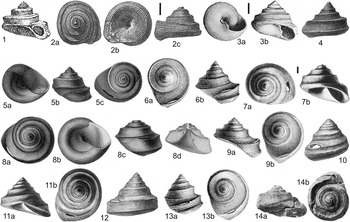
The general shell morphology of the Argentinean Jurassic species is even superficially similar to some extant Scissurellidae, with the most obvious difference being size. Sinezona singeri Geiger (Reference Geiger2006, p. 19, figs. 14–16), from the western Indian Ocean, is much smaller than T. (T.) protonotialis n. sp., and it has an adult teleoconch with 23–26 fine axial ribs, a convex outer face, and a convex base with a strong constriction below the selenizone. Sukashitrochus morleti (Crosse, Reference Crosse1880), from New Caledonia to central Pacific, has more developed prosocline axial ribs on the shell surface, a stronger adapical keel on the outer face, and a more convex base (Geiger, Reference Geiger2006, p. 23, fig. 17). Figure 5 shows illustrations of some species comparable to T. (T.) protonotialis n. sp.
Subgenus Placotoma (=Discotoma Haber, Reference Haber1934non Mulsant, Reference Mulsant1850) new subgenus
Type species
Ditremaria amata d’Orbigny, Reference d’Orbigny1850b, p. 9, from the Callovian of France, by original designation (Haber Reference Haber1934, p. 366).
Diagnosis
Same as the diagnosis provided for the preoccupied name “Discotoma” in Haber (Reference Haber1934, p. 368).
Etymology
Derived from the Greek plakos=plate, and tome = a cutting, referring to the strongly depressed shell with trema.
Remarks
Haber (Reference Haber1934, p. 368) proposed Discotoma as a subgenus of Ditremaria. Depressed trochotomid shells have been widely referred to this taxon, which may be retained at subgeneric level. However, the name Discotoma was already in use for a coleopteran genus (Mulsant, Reference Mulsant1850, p. 215), a fact overlooked by previous authors, and thus it cannot be used for this gastropod taxon. We propose here the name Placotoma to replace the pre-occupied name Discotoma Haber non Mulsant.
Trochotoma (Placotoma) neuquensis new species
Type material
Holotype: one almost complete shell (MLP 26171) from uppermost Lower Pliensbachian beds at Cerro Roth, Piedra Pintada, Neuquén Province. Paratype: a slightly deformed shell (MLP 26173) from the same locality and level.
Diagnosis
Shell trochiform, gradate, depressed; teleoconch with four convex whorls; suture slightly impressed; whorls strongly angular at midwhorl; last whorls delimited by an irregular peripheral swollen belt; trema elongate, elliptical on midwhorl angulation; peristome prosocline, discontinuous; base flat to slightly convex, with eight regularly spaced spiral cords.
Type locality and horizon
Cerro Roth, Neuquén Province, Argentina; lower Pliensbachian (Austromorphites behrendseni Zone), Piedra Pintada Formation.
Description
Trochiform, gradate and depressed shell, with mean height of 11.50 mm and mean width of 23.47 mm. Protoconch not preserved. Fragmentary teleoconch comprising four convex whorls. Suture slightly impressed in narrow spiral furrow. Upper portion of whorls forming flat, almost horizontal ramp. Ramp smooth, rendering shell outline strongly gradate. Outer face slightly concave to flat, ornamented with three spiral cords. Periphery of last whorl subangular, with irregular, keel-like swollen belt. Elongate elliptical trema present on adapical angulation very near aperture. Angulation bearing selenizone terminating at trema. Base convex, ornamented with eight regularly spaced spiral cords. Peristome strongly prosocline, discontinuous. Dimensions: MLP 26171 (holotype), height: 11.0, width: 23.6; MLP 26173 (paratype), height: 12.03, width: 23.34.
Etymology
Refers to the occurrence in Neuquén Province, Argentina.
Remarks
The most similar species to the one described here is Trochotoma (Placotoma) cossmanni (Rollier, Reference Rollier1918, p. 59; figured by Cossmann, Reference Cossmann1900, pl. 16, figs. 3–5 as Trochotoma imbricata; Bigot, Reference Bigot1935, pl. 39, fig. 4 as Trochotoma petrariae; Fischer, Reference Fischer1953, pl. 1, figs. 1-2; Reference Fischer1964, pl. 2, figs. 10–11), from the Bathonian of France, but this apparently lacks spiral threads on the base. T. cossmanni is one of the few species illustrated with good photographs (Cossmann, Reference Cossmann1900; Fischer, Reference Fischer1964). Fischer (Reference Fischer1969, p. 125) considered Trochotoma petrariae Bigot to be a junior synonym of T. cossmanni.
Trochotoma funiculosa Cossmann (Reference Cossmann1885, pl. 10, figs. 36–37; Fischer, Reference Fischer1969, pl. 14, figs. 22a–c), also from the Bathonian of Europe, has a wider and slightly convex upper portion of the whorls, with more prominent spiral threads, and a nearly vertical outer face of the whorls. The specimens described and figured by Morris and Lycett (Reference Morris and Lycett1851, pl. 10, figs. 10a–c) as Trochotoma discoidea Roemer, Reference Roemer1836, which have been referred either to T. cossmanni (Rollier, Reference Rollier1918) or to T. funiculosa Cossmann (Reference Cossmann1885), have no trema or exhalant outlet on the shell; however, these specimens were included by those authors in Trochotoma because their general shell morphology agree with that of species referred to this genus.
The type species of Placotoma, Trochotoma amata d’Orbigny (Reference d’Orbigny1850b, p. 9; Reference d’Orbigny1853, p. 389, pl. 343, figs. 3–8; de Loriol, Reference de Loriol1890, pl. 18, figs. 3–4; Knight et al., Reference Knight, Cox, Keen, Smith, Batten, Yochelson, Ludbrook, Robertson, Yonge and Moore1960, figs. 135.2a–b) from the late Jurassic of France, can also be compared to T. (P.) neuquensis n. sp. The European species, however, is more depressed than the Argentinean one, and has a more prominent marked spiral ornament and prosocline threads on the ramp. Trochotoma? discoidea Buvignier (Reference Buvignier1852, pl. 25, figs. 10–11), from the Bathonian of Europe, has fewer whorls (three) and a more depressed, lower shell than the Argentinean species. The shell of the European species is also more discoidal and widely umbilicate, and the spiral cords are crossed by very fine, oblique striae.
Trochotoma (Discotoma) gansuensis Tong and Erwin (Reference Tong and Erwin2001, p. 15, pl. 2, figs. 5–10), from the Triassic of China, differs from Trochotoma (P.) neuquensis n. sp. in having more convex whorls, with the last teleoconch whorl more expanded than the spire whorls, ornament consisting of spiral threads and collabral lines, and a row of elongate opisthocline nodes on the ramp. Such characters are missing in T. (P.) neuquensis n. sp. Most probably the species described by Tong and Erwin (Reference Tong and Erwin2001) does not belong to Trochotoma, considering that it has very convex whorls and lacks the elliptical trema. Trochotoma? gansuensis seems to be more similar to other pleurotomarid forms, such as the representatives of Ptychomphalidae Wenz, Reference Wenz1938.
Finally, Trochotoma (P.) neuquensis n. sp. differs from T. (T.) protonotialis n. sp. in having a more depressed shell, a more convex base with better-developed spiral cords and in lacking prosocline collabral growth lines.
Systematic affinities
Trochotomids are currently included in the Pleurotomarioidea, but in the past they were alternatively referred to Eotomarioidea Wenz, Reference Wenz1938 and Haliotoidea Rafinesque, Reference Rafinesque1815 (Hudleston, Reference Hudleston1881; Tong and Erwin, Reference Tong and Erwin2001). The family Pleurotomariidae Swainson is the only family of Pleurotomarioidea to survive beyond the Jurassic into the Recent fauna. Pleurotomarioideans were abundant and diverse components of shallow-water marine faunas throughout the Paleozoic and Mesozoic, while most living Pleurotomariidae are restricted to depths ranging from 100–1000 m (Harasewych, Reference Harasewych2002).
According to Harasewych (Reference Harasewych2002), the majority of contemporary classifications follows Knight et al. (Reference Knight, Cox, Keen, Smith, Batten, Yochelson, Ludbrook, Robertson, Yonge and Moore1960), and defines Pleurotomarioidea as containing 20 extinct families (one of which is the family Trochotomidae), and considers the Pleurotomariidae, Scissurellidae, and Haliotidae as the living members of the superfamily. The inclusion of Haliotidae and Scissurellidae within the Pleurotomarioidea was based on the presence of a slit or series of tremata, and vestiges of bilateral symmetry in the mantle cavity. These families appear in the fossil record during the late Mesozoic. Haszprunar (Reference Haszprunar1989) pointed out that the anatomy of the Paleozoic and Mesozoic families usually included into Pleurotomarioidea might have been more similar to that of living Scisurellidae than to the anatomy of Pleurotomariidae. He suggested that the extinct families previously included in Pleurotomarioidea might be more appropriately assigned to Scisurelloidea. The family Trochotomidae, as defined by Knight et al. (Reference Knight, Cox, Keen, Smith, Batten, Yochelson, Ludbrook, Robertson, Yonge and Moore1960), is an extinct member of Pleurotomarioidea. However, trochotomid species share some anatomical and functional features, such as the trema or foramen for the exhalant water current, characteristic of some extant Scisurellidae. On the other hand, species of Haliotidae have a row of siphonal holes a short distance away from the edge of the shell. Living members of the Haliotidae are grazers on marine algae and live on exposed shores at low-tide level. In contrast, extant members of Scisurellidae and Pleurotomariidae are more commonly found from intertidal to abyssal depths, even though fossil members of Pleurotomariidae were diverse and abundant in shallow marine environments until the Late Cretaceous.
Probably, the development of a trema or row of tremata for an excretory function that is present in different gastropod clades (Bellerophontidae, Haliotidae, Fissurelloidea, Trochotomidae) evolved independently during the Paleozoic and Mesozoic and, as suggested by Szabó (Reference Szabó1984), it was the result of an adaptation to strongly agitated waters.
Paleoecology
Szabó (Reference Szabó1984) regarded the development of a trema, rather than an open selenizone, as an adaptation to strongly agitated waters because an uninterrupted peristome is more resistant to mechanical damage; thus trochotomids were common in reefs whereas other pleurotomarioids were rare or absent in that environment.
The deep slit of most pleurotomarioids is also expected to affect negatively the resistance of the gastropod shell to breakage by predation (Lindström and Peel, Reference Lindström and Peel2010). The proportion of specimens with repaired shell injuries is high in both fossil (Lindström and Peel, Reference Lindström and Peel2010) and living (Harasewych, Reference Harasewych2002) slit-bearing pleurotomarioids. A continuous peristome is more resistant to predator attacks, especially crustacean peeling, which is a very common shell injury in slit-bearing living pleurotomariids in comparison to sympatric trochids with a continuous aperture (see examples and discussion in Harasewych, Reference Harasewych2002, figs. 13–15).
The distribution of most Jurassic trochotomid species shows a high environmental dependency, being associated with coral reefs in the shallow Tethys (Dubar, Reference Dubar1948; Bertling and Insalaco, Reference Bertling and Insalaco1998). The Argentinean trochotomid specimens are found in tuffs and sandstones, and are associated with epifaunal bivalves, ammonites, brachiopods, echinoderms, and coral patch reefs at one of the localities (Cerro Roth, Piedra Pintada). They are also restricted to litho- and biofacies that include coral biostromes or small bioherms (Damborenea et al., Reference Damborenea, Manceñido and Riccardi1975).
Paleobiogeography
Cretaceous and Cenozoic gastropods have proven to be very useful from a paleobiogeographical point of view, but the Jurassic gastropod fauna is still very unevenly known, especially in the Southern Hemisphere. Thus, any new addition to the faunas of poorly known regions, such as South America, provides new and interesting material for paleobioegeographical analyses.
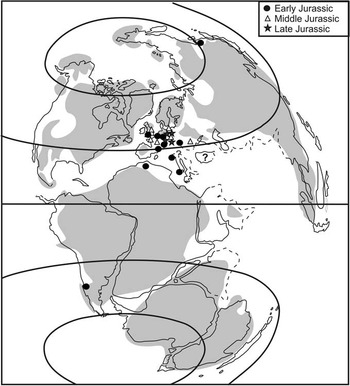
The extinct genus Trochotoma is well represented in the Tethyan region. It has been found commonly in the Mesozoic of Europe, ranging from the early to late Jurassic, and has also been recovered from the early Jurassic of Russia and northern Africa (Table 1). The oldest (although doubtful; see above) occurrence of Trochotoma is dated from the Middle Triassic of China (Tong and Erwin, Reference Tong and Erwin2001). In the present research, we provide the southernmost record of this particular vetigastropod group from the early Jurassic (Pliensbachian) of Neuquén basin, Argentina (Fig. 4).
Paleobioegeographical distribution of Trochotoma s.l. species. Base map depicting early Jurassic paleogeography compiled from various sources.

Monari et al. (Reference Monari, Valentini and Conti2011) discussed the distribution in time and space of two species from Europe, Trochotoma vetusta Terquem, Reference Terquem1855 and T. clypeus Terquem, Reference Terquem1855. Monari et al. (Reference Monari, Valentini and Conti2011) pointed out that the evolutionary history of Trochotoma was characterized by a Sinemurian major adaptive radiation that involved the European epicontinental shelf and the marginal and intra-Tethyan carbonate platforms. They argued that the occurrence of a number of Trochotoma species in Hettangian sediments demonstrates that the diversification of these pleurotomarioidean taxa began very early in the Jurassic.
The occurrence of Trochotoma in the Pliensbachian deposits of Neuquén Basin certainly testifies to paleobiogeographical connections with the Western Tethys at that time, and possibly provides evidence of the faunal radiation that occurred during the early Jurassic.
The new species reported here are endemic to the Argentinean Jurassic and represent the southernmost occurrence of the genus Trochotoma (Fig. 4) and also of the family Trochotomidae. Particularly, the subgenus Trochotoma (Placotoma) was known previously from the Triassic of China (?) and the Jurassic of Europe. The presence of Trochotoma (Placotoma) neuquensis n. sp. in the Pliensbachian marine deposits of Argentina extends the paleobiogeographical distribution of the subgenus into the Mesozoic of South America, showing a new early Jurassic record of this group in the Southern Hemisphere.
Ferrari (Reference Ferrari2011, Reference Ferrari2014) suggested that the Jurassic distribution patterns of some Patagonian marine gastropods might be clarified taking into consideration the dispersal routes of the shallow marine bivalve faunas during the early Jurassic. This supports the idea of a shallow marine connection between the western Tethys and the eastern Pacific as early as Pliensbachian times, related to the Hispanic Corridor (see Damborenea and Manceñido, Reference Damborenea and Manceñido1979; Damborenea et al., Reference Damborenea, Echevarría and Ros2012a, and references therein). The Hispanic Corridor seems to be the most plausible hypothesis to explain the trochotomid faunal exchange between the western Tethys and the Neuquén Basin through the eastern Pacific during the Pliensbachian.
The Argentinean material is associated with coral patch reefs of shallow, open-marine environments within the photic zone, and in this it agrees with the known habitats for other trochotomid species from the western Tethys. Thus, these new data support the statements by Conti and Monari (Reference Conti and Monari1991) and Gatto and Monari (Reference Gatto and Monari2010), who pointed out that the diffusion of suitable environmental conditions played a major control on Tethyan gastropod dispersal and spatial distribution.
Reproduction of original illustrations of some species comparable to T. protonotialis n. sp. (1, 2) Trochotoma (T.) calix (Phillips). (1) from Phillips Reference Phillips1829, pl. 11, fig. 30; (2) from Hudleston Reference Hudleston1885, pl. 4, figs. 6, 6a–b. (3) Trochotoma (T.) magnifica Cossmann, from Cossmann Reference Cossmann1885, pl. 8, figs. 15, 16. (4) Trochotoma (T.) carinata Lycett, from Lycett Reference Lycett1857, pl. 4, fig. 5. (5, 6) Trochotoma (T.) affinis Eudes-Deslongchamps. (5) from Eudes-Deslongchamps Reference Eudes-Deslongchamps1843, pl. 8, fig. 8–10; (6) from Eudes-Deslongchamps Reference Eudes-Deslongchamps1868, pl. 8, fig. 6a, b. (7) Trochotoma (T.) bicarinata (d’Orbigny), from d’Orbigny Reference d’Orbigny1853, pl. 340, fig. 9, 10. (8, 9) Trochotoma (T.) gradus Eudes-Deslongchamps; (8) from Eudes-Deslongchamps Reference Eudes-Deslongchamps1843, pl. 8, fig. 4–7; (9) from Eudes-Deslongchamps Reference Eudes-Deslongchamps1868, pl. 4, figs. 2a, b. (10) Trochotoma (T.) obtusa Morris and Lycett, from Morris and Lycett Reference Morris and Lycett1851, pl. 10, fig. 15b. (11) Trochotoma (T.) rathieriana (d’Orbigny), from d’Orbigny Reference d’Orbigny1853, pl. 342, figs. 7, 8. (12) Trochotoma (T.) tabulata Morris and Lycett, from Morris and Lycett Reference Morris and Lycett1851, pl. 10, fig. 17a. (13) Trochotoma (T.) schlumbergeri Eudes-Deslongchamps, from Eudes-Deslongchamps Reference Eudes-Deslongchamps1868, pl. 8, fig. 5a, b. (14) Trochotoma (T.) orientalis (Kiparisova), from Kiparisova Reference Kiparisova1952, pl. 6, figs. 1a, c Scale bars=5 mm.

Acknowledgments
We are grateful to the Dirección General de Patrimonio Cultural, Secretaría de Estado de Cultura de la Provincia de Neuquén and to L. Zingoni, who allowed access to outcrops in southern Neuquén Province. We are also grateful to R. Coria (Museo Carmen Funes, Plaza Huincul, Neuquén, Argentina) for arranging the loan of the gastropod material collected by the authors, and we thank S. Bessone (Centro Nacional Patagónico, CENPAT, Pto. Madryn) and V. Melemenis (Museo de La Plata, MLP) for their laboratory work. Critical reviews by J. Szabó, R. Gatto, S. Monari, and A. Beu of an earlier version of this manuscript contributed to improvements and are gratefully acknowledged. This study is part of a long-term project financed by CONICET grants, last one PIP 112-200801-01567.
Supplementary Material
To view supplementary material for this article, please visit http://dx.doi.org/10.1017/10.1017/jpa.2014.28.