Introduction
Body image is a broad, vital and complex issue, but has not been well characterized in cancer patients (Fingeret, Reference Fingeret, Duffy and Valentine2016). Body image is difficult to define, but Cash (Reference Cash and Pruzinsky2002) summarizes “the profoundly human experience of embodiment” as body image. In addition, there are many terms that can capture subjective experiences such as “weight satisfaction, size perception accuracy, body satisfaction, appearance satisfaction, appearance evaluation, appearance orientation, body esteem, body concern, body dysphoria, body schema, body percept, body distortion, body image, body image disturbance, and body image disorder” (Cash, Reference Cash and Pruzinsky2002). Researchers have attempted to explain the dynamic and the multidimensional nature of body image from a cognitive behavioral standpoint (Cash, Reference Cash and Pruzinsky2002). In general, body image work has been limited to constructs such as weight and sex (especially in female patients).
With regard to psychiatric oncology, cancer patients experience various physical adverse effects because of different cancer treatments, such as general changes from hair loss, nail discoloration, weight loss/gain, to more specific changes, such as disfigurement or dysfunction. As a result, cancer patients may experience heightened distress anxiety and exacerbation of depressive symptoms. In the oncology setting, some variables that are considered important for appearance-related concerns are duration of time since the diagnosis of cancer, visibility of the physical change, and stability of the physical change in appearance (Annunziata et al., Reference Annunziata, Giovannini and Muzzatti2012). In addition, cancer site, cancer stage, and cancer treatment may affect the patient's emotional health (Annunziata et al., Reference Annunziata, Giovannini and Muzzatti2012).
To date, research on body image has focused on distress observed in specific types of cancer patients (Bullen et al., Reference Bullen, Sharpe and Lawsin2012; Fobair et al., Reference Fobair, Stewart and Chang2006; Rhoten et al., Reference Rhoten, Murphy and Ridner2013). Some researchers have assessed appearance-related concerns across the cancer continuum. In 2009, a study conducted in an outpatient oncology clinic assessed whether age and sex affect appearance changes and distress in cancer patients. They reported women experienced more distress than men and age (younger age group) was an important factor in certain types of cancer (Nozawa et al., Reference Nozawa, Shimizu and Kakimoto2013). More recently, a pilot study in a palliative care clinic evaluated the association between body image dissatisfaction, weight changes, and symptom burden in patients with advanced and recurrent cancer (Rhondali et al., Reference Rhondali, Chisholm and Filbet2015). They found an association between body image dissatisfaction and distress, anxiety as well as depression scores, and that elevated dissatisfaction scores were statistically significant for elevated anxiety, distress, and depression scores (Rhondali et al., Reference Rhondali, Chisholm and Filbet2015).
To build upon previous reports, the current project was set forth to assess the prevalence of appearance problems in cancer patients across the disease continuum and to evaluate if there were differences in depression, anxiety, and distress symptoms in patients who endorse physical appearance problems versus those who do not.
Methods
Sample
This report includes all adult patients (N = 1,939) with active cancer diagnosis seen in the M.D. Anderson Cancer Center (MDACC) outpatient psychiatry oncology clinic (June 2014–May 2017). Data shown were taken from a single visit (i.e., the first visit immediately after obtaining informed consent) per patient only; therefore, this was a cross-sectional, observational study design and does not go beyond descriptive analysis. The Institutional Review Board at The University of Texas MDACC approved the study and all patients provided written informed consent.
Methods
Physical appearance problems
Using the National Comprehensive Cancer Network (NCCN) Distress Thermometer (DT) checklist, physical appearance problems (hereafter referred to solely as appearance problems) were assessed as a categorical, binomial (yes/no) variable; these were originally coded as 0 and 1 for raw data entry and analyses.
Depression
Depressive symptoms were assessed with the Patient Health Questionnaire (PHQ-9). The PHQ-9 is a nine-item scale that assesses symptoms of depression per Diagnostic and Statistical Manual of Mental Disorders IV criteria, with a cutoff score between 8 and 11 (Kroenke et al., Reference Kroenke, Spitzer and Williams2001; Manea et al., Reference Manea, Gilbody and McMillan2012). Some questions included in the PHQ-9 are “little interest or pleasure in doing things,” “feeling down, depressed and hopeless,” and “feeling bad about yourself or that you are a failure or have let yourself or your family down.” The score ranges from 0 to 27, with scores >20 indicative of severe depression. The PHQ-2 comprises the first two questions on the PHQ-9 (Arroll et al., Reference Arroll, Goodyear-Smith and Crengle2010). The PHQ-2 is helpful to assess cardinal depressive symptoms and avoid the neurovegetative symptoms of depression.
Anxiety
Anxiety symptoms were assessed with the Generalized Anxiety Disorder scale (GAD-7). The GAD-7 is a seven-item scale to evaluate for presence and severity of generalized anxiety disorder in clinical settings (Spitzer et al., Reference Spitzer, Kroenke and Williams2006). Some questions on the GAD-7 include “feeling nervous, anxious, or on edge,” “trouble relaxing,” and “feeling afraid as if something awful might happen.” The score ranges from 0 to 21, with scores >15 indicative of severe anxiety (Spitzer et al., Reference Spitzer, Kroenke and Williams2006).
Distress
The DT total score used to measure levels of distress. The DT tool is used for screening of psychosocial distress in cancer patients, with a cutoff score of 4 (Holland & Bultz, Reference Holland and Bultz2007).
In addition, we included outcomes for the Edmonton Symptom Assessment Scale (ESAS) for a total symptom distress score (TSDS), and the physical distress subscale score (PHS) and the psychological distress subscale score (PSS), as used previously (Rhondali et al., Reference Rhondali, Chisholm and Filbet2015). The ESAS is a 10-item scale used to assess symptom distress in palliative care settings. The overall score ranges between 0 and 100 (Bruera et al., Reference Bruera, Kuehn and Miller1991). In our study, we used the 12-item ESAS developed at our institution; it includes two additional components which are financial and spiritual distress (Tanco et al., Reference Tanco, Vidal and Arthur2017).
Demographic variables included age, sex, race/ethnicity, and relationship status, which were extracted from the electronic medical record.
Data were analyzed using chi-square or one-way analysis of variance as appropriate for categorical and continuous variables. Significant interactions were probed using Fisher's least significant difference post hoc tests. Demographic differences between groups were included as covariates, but these did not change the overall pattern of results (data available upon on request). Effect sizes were calculated using Cohen's d, where 0.2 = small, 0.5 = medium, and 0.8 = large (Cohen, Reference Cohen1988). Data are presented as percentages or mean ± SD.
Results
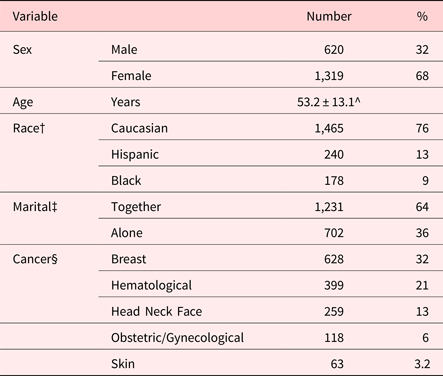
In the current study, patients were approximately 50 years of age, mostly female, Caucasian, and most were in a committed relationship. In addition, the majority of patients had breast, hematological, and head, neck, and face cancers (Table 1). Importantly, only patients with an active cancer diagnosis were included in this report (N = 1,939). Data from other patients seen in the psychiatry oncology clinic were excluded if they were designated as noncancer (N = 34), other cancer (N = 86), multiple cancer diagnoses (N = 17), or past cancer (N = 63).
Demographics and cancer types for full sample (N = 1,939)

^ Data reflect mean ± SD.
† Patients who specified Asian and mixed race are not shown here.
‡ Together = married, partnered, committed relationship; alone = single, separated, widowed, divorced.
§ Only major cancer types are shown here.
The overall prevalence rate of individuals who endorsed appearance problems in this study was 35.6%. Those patients who endorsed appearance problems (yes), versus those who did not (no), were more likely to be younger (50.2 ± 13.2 vs. 54.9 ± 12.7 years, F(1,1937) = 59.0, p < .0001), female versus male (40.3% vs. 25.8%, chi-square = 38.4, p < .0001), Black or Hispanic versus Caucasian (43.3%, 39.2% vs. 34.6%, chi-square = 10.4, p = .016), and those with a relationship status of “alone” (single, separated, divorced, widowed) versus “together” (married, partnered) (44.2% vs 30.9%, chi-square = 34.4, p < .0001).
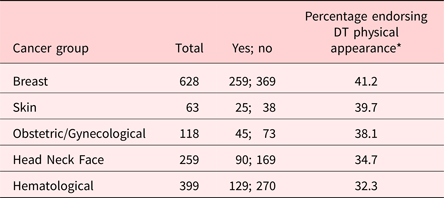
Patients who endorsed appearance problems, versus those who did not, were more likely to have the following cancer types: breast (41.2%), skin (39.7%), and obstetric/gynecological (38.1%) (chi-square = 21.8, p = 0.005) (Table 2).
Cancer types and physical appearance problems

* Percentages were calculated as the number who endorsed yes divided by the total sample size for that cancer type.
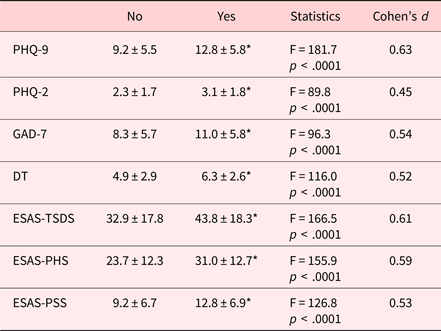
Importantly, those patients who endorsed appearance problems, versus those who did not, exhibited significantly higher levels of depressive symptoms assessed by the PHQ-9 and PHQ-2 (all p < .0001; Table 3). Similarly, patients who endorsed appearance problems, versus those who did not, exhibited significantly higher levels of anxiety and distress, measured using the GAD-7 and DT (all p < .0001). Last, patients who endorsed appearance problems, versus those who did not, exhibited significantly higher scores on the ESAS-TSDS, ESAS-PHS, and ESAS-PSS (all p < .0001).
Key symptom outcomes for physical appearance problems

DT, Distress Thermometer; ESAS, Edmonton Symptom Assessment Scale; GAD, Generalized Anxiety Disorder; PHQ, Patient Health Questionnaire; PHS, physical distress subscale score; PSS, psychological distress subscale score; TSDS, total symptom distress score.
All data reflect mean ± SD.
*p < 0.05 yes or no.
Discussion
The data from the current report indicate that approximately one-third of patients seen at the MDACC ambulatory psychiatry oncology clinic self-report appearance problems and that these individuals exhibit significantly higher scores for depression, anxiety, and distress, and these outcomes were of medium effect size.
In our results, approximately 40% of females and 26% of males endorsed appearance problems. In general, appearance problems have been studied mostly in female cancer patients. Some studies have evaluated sex differences with regard to appearance-related concerns. In one report, female patients and patients with functional limitations were more likely to have distress related to appearance (Krok et al., Reference Krok, Baker and McMillan2013). Similarly, a separate study tested the sex difference hypothesis and their data revealed that women experienced more distress related to physical changes. Specifically, researchers evaluated patients with oral or oropharyngeal cancer and found female patients were more likely to report concerns related to appearance changes, despite the fact that the study sample had a predominance (57%) of males (Flexen et al., Reference Flexen, Ghazali and Lowe2012). Overall, the current study confirms previous reports that female patients were more likely to affirm appearance problems.
In the current report, a greater percentage of African American and Hispanic patients (compared with Caucasian patients) endorsed problems with appearance. These results are similar to the study conducted by Hawley and colleagues (Reference Hawley, Griggs and Hamilton2009), who evaluated patient involvement and patient attitude in a racially heterogeneous sample of breast cancer patients and their inclination toward mastectomy. They found patients who endorsed body image concerns were less likely to consider mastectomy. Additionally, in their analytic sample (N = 1,651), the importance of body image was statistically significant and expressed most often by African American women, followed by high acculturated Hispanics, then by Caucasian women, and last by low acculturated Hispanic women (Hawley et al., Reference Hawley, Griggs and Hamilton2009). The data from their study appear to coincide with the results presented in our current report.
Relationship status is another variable that may play a role for endorsing physical appearance concerns. For many patients, discussion about surgical choices with a partner, or apprehension about the partner's reaction, or change in sexual activity can contribute to depressive symptoms or distress related to physical changes. On the other hand, patients may give more emphasis to their appearance, especially if they are considering initiating a relationship. In our study, it came as no surprise therefore that patients who were alone (single, separated, divorced, widowed) were more likely to endorse physical appearance problems. Overall, social support for these individuals may be helpful to a certain extent.
We assessed depressive symptoms via the PHQ-9 and the average score was 30% higher in patients who endorsed appearance problems. Additionally, we assessed the PHQ-2 score, because the PHQ-2 eliminates the neurovegetative symptoms of depression, which are common among patients with cancer. Of interest, the average score for the PHQ-2 in this study was >3 in patients with appearance problems, which is relevant with regard to previous research showing that a PHQ-2 score of 3+ as the optimal cut point for depression screening purposes (Kroenke et al., Reference Kroenke, Spitzer and Williams2003). In the current report, anxiety symptoms were assessed using the GAD-7 scale and the average score was 25% higher in patients who endorsed appearance problems. Our results are similar to the pilot study conducted in a palliative care clinic, in which patients with more concern for body image had statistically higher depression and anxiety scores on the Hospital Anxiety and Depression Scale (with anxiety and depression subscales) (Rhondali et al., Reference Rhondali, Chisholm and Filbet2015).
The average DT score among patients with appearance problems was >6, and was significantly greater than those who did not report appearance problems.
Similarly patients who endorsed physical appearance problems had significantly higher ESAS total scores (ESAS-TSDS), and ESAS-PHS and ESAS-PSS scores. Our findings replicate those by Bruera and colleagues who found that patients who endorsed physical appearance-related concerns were more likely to have emotional and physical distress, using the same ESAS total and subscale scores (Rhondali et al., Reference Rhondali, Chisholm and Filbet2015) Of interest, we found a strong positive correlation between the ESAS-TSDS and the DT score (R = 0.69, p < .0001). Given this finding, we propose that the evaluation of distress can be simplified to the use of the DT in an outpatient setting. Furthermore, the problem list on the DT scale can serve as a quick assessment of patients’ psychosocial concerns and can provide a platform for further discussion.
Data from our clinic indicate the highest percentage patients that endorsed appearance problems had breast cancer, followed by skin cancer and then gynecological cancer. Notwithstanding, caution should be taken in interpreting these findings because the sample size of skin cancer was much smaller than the other cancer types specified. In a previous outpatient clinic study, maximum distress was endorsed by breast cancer patients, followed by gastrointestinal, and then hematological (Nozawa et al., Reference Nozawa, Shimizu and Kakimoto2013). The authors of the previous outpatient clinic study controlled for sex differences and still found more distress in patients with breast cancer (Nozawa et al., Reference Nozawa, Shimizu and Kakimoto2013). In our study, although females were likely to endorse physical appearance problems, the current findings highlight that location of the cancer may also be in an important variable.
The strengths of this observational study are the large sample size, consistency of most results (related to age, sex, and all key outcomes, including anxiety, depression, and distress) with the pilot study conducted in a palliative care clinic at MDACC (Rhondali et al., Reference Rhondali, Chisholm and Filbet2015), not being restricted to a specific cancer type or stage, and that our sample included a large cohort of breast, hematological, and head and neck cancers. In contrast to the pilot study described previously (Rhondali et al., Reference Rhondali, Chisholm and Filbet2015), the current report is an important contribution because it includes cancer patients across the continuum of disease progression, with a majority of the patients having a diagnosis of breast cancer.
Notwithstanding the strengths described, the study has some notable limitations. The first limitation is the predominance of female and Caucasian patients; however, these demographic differences were included as covariates and the overall outcomes were unchanged. Second, physical appearance was measured as self-report, using a nonvalidated instrument that is a simple binomial variable. An associated limitation is that we did not probe what physical appearance problems meant for individual patients, so we are unable to specify whether the appearance problems were a result of their cancer (e.g., surgical removal of the breast) or of cancer treatment (e.g., hair loss), but may instead have been because of some other physical anomaly causing general distress (e.g., aging). Nonetheless, the majority (>97%) of these patients were undergoing active treatment for their cancer, and cancer-associated issues dominate the talk therapy session; this knowledge leads us to infer that self-reported problems described in this report, are, indeed, related to their cancer. Because perception of appearance is a subjective experience, assessment of physical changes via self-report is valuable, additionally the response to “appearance problems” on the DT can serve as a platform for discussion or initiation of discussion about the issue. In future studies, appearance problems should be assessed in detail by clinical interview or using a validated instrument (i.e., Body Image Scale). In fact, our group has recently implemented use of the Body Image Scale for assessment of body image in the ambulatory oncology clinic. Third, this study is a one-time assessment of appearance problems, so the study design did not include assessment of change over time, although this is a subject for future investigation in our clinic. Fourth, the data do not allow us to discern the current cancer treatment status (i.e., chemotherapy, radiation and surgical interventions). Despite these limitations, the current study offers practical ways to assess “appearance problems” in cancer patients and to accurately measure depression, anxiety, and distress symptoms in a high-volume outpatient psychiatry setting.
Implications for clinical practice
The current study revealed an overall prevalence rate of appearance problems among cancer patients of approximately 36%. Importantly, those patients who endorsed appearance problems exhibited significantly higher levels of depressive anxiety, and distress; therefore, the results highlight the importance of body image issues and the need to evaluate them in cancer patients. Once identified, it would be an opportunity for discussion and referral to a mental health professional. In the meantime, healthcare professionals, especially oncologists, are encouraged to ask patients about concerns related to appearance before and after cancer treatment. One recommended communication model is the “three Cs” approach, in which the oncologists are encouraged to validate the physical changes associated with cancer and or cancer treatment, inquire about specific concerns related to the image changes, and the consequences of such physical changes for the patients (Fingeret et al., Reference Fingeret, Teo and Epner2014). Additional studies are needed to explore the relationship between body image concerns and psychosocial consequences in cancer patients.
Last, it is important to assess the concerns related to physical appearance in cancer patients early, and it will be critical to develop appropriate psychological interventions for these patients.
Acknowledgments
Funding for this research was provided by the Hackett Family. The authors thank Nirmala Joseph for expert assistance in extracting cancer diagnoses from Epic that were included in this report.
Conflicts of interest
All authors have declared no conflicts of interest.