Introduction
Furosemide is a loop diuretic that is secreted into the proximal tubule of the nephron through an anion channel and functions by inhibiting the Na+ /K+ /2Cl- cotransporter located in the ascending limb of the loop of Henle. Furosemide is highly protein-bound, and, as such, cannot be filtered by the glomerulus. When furosemide is administered in the oral form, anywhere from 10% to 90% can be absorbed, thus giving the diuretic erratic bioavailability. Not surprisingly, there is currently very little in the literature that helps to guide the use of furosemide with respect to optimal dosing in patients with acute decompensated heart failure (ADHF) in-hospital, let alone in the prehospital setting. The Diuretic Optimization Strategies Evaluation (DOSE) Trial published in the New England Journal of Medicine (Massachusetts Medical Society; Massachusetts USA) in March 2011 is one of the most comprehensive studies to date that sought to address this inquiry.Reference Felker, Lee and Bull 1 However, this study did not address furosemide dosing in the prehospital or emergency department (ED) setting where treatment commonly begins.
Some health care providers believe that intravenous (IV) boluses of a diuretic such as furosemide can cause harm by decreasing preload and, hence, cardiac output, particularly when considering other clinical mimics of heart failure, such as chronic obstructive pulmonary disease, pneumonia, and sepsis.Reference Mosesso, Dunford and Blackwell 2 - Reference McKinney, Brywczynski and Slovis 4 It is also thought that IV boluses of duiretics produce increased peak plasma drug levels and have the potential to cause large volume diuresis, thus leading to the depletion of intravascular volume and renal toxicity.Reference Llorens, Miro and Herreo 5 - Reference Salvador, Punzalan and Ramos 7 In a cohort study of 552 patients, Mehta et al examined the effects of diuretics in patients with acute renal failure and found an increased risk of death and nonrecovery of renal function in patients who received diuretics compared to those who did not.Reference Mehta, Pascual and Soroko 8 This created further impetus for the recommendation that the use of diuretics in patients with renal insufficiency be discouraged, particularly in the absence of randomized double-blinded studies that could refute the current evidence.
Conversely, a small study conducted by Epstein et al sought to examine whether or not short-term intraarterial boluses of furosemide altered intrarenal hemodynamics and found that large bolus doses given to patients with established renal failure neither improved renal function nor their overall clinical course.Reference Epstein, Schneider and Befeler 9 Additionally, a meta-analysis of five randomized controlled trials enrolling a total of 555 patients found that patients with renal failure receiving loop diuretics experienced a decline in serum creatinine (Cr) levels more quickly than controls.Reference Bagshaw, Delaney and Hasse 10 In the first randomized controlled trial published to date, comparing the use of diuretics administered via continuous infusion versus bolus therapy, there was no significant difference in renal function found between high dose and low dose lasix defined by 60 mg.Reference Felker, Lee and Bull 1
Determining the hazards of furosemide administration in the prehospital arena could give much needed guidence to medical control physicians when deciding dosage or when writing protocols for paramedics. There has yet to be a study, to the authors’ knowledge, that seeks to determine whether or not higher doses of furosemide administered in the prehospital setting portend to worsening renal function.
Methods
Study Design
This is a retrospective, 2-center chart review. Institutional Review Board approval was obtained from each institution. A search was undertaken of one Emergency Medical Services (EMS) prehospital record database (Zoll Medical Corporation, Broomfield, Colorado USA) for all patients transported via its Advanced Life Support (ALS) service who presented to either one of two EDs from June 5, 2009 through May 17, 2013. The authors identified 331 charts of patients transported by the service that had both a complaint of shortness of breath and were administered furosemide prior to ED arrival. These prehospital charts were then linked to ED and inpatient electronic medical records from the hospitals. Patient charts were deidentified with the assignment of numbers that were entered into a spreadsheet under which data for respective covariables were entered. One of the covariables includes the Charlson Comorbidity Index (CCI). One point, unless otherwise indicated, was applied to a prespecified list of comorbidities to obtain a comorbidity score with a maximum score of 33. The patient's age was then scored with a maximum score of four. The CCI was then calculated by adding the comorbidity score to the age score, denoted as i. The CCI, or Charlson Probability, was then calculated using the following combination of formulas:
 $${{\rm{Y}} = {\rm{{{e}\ {\hat }\ }(i\;^\ast\;0}}{\rm{.9)}}<! \\ > \cr{\rm{Z}} = {\rm{0}}{\rm{.983\;{\vskip -3pt \hat} \;Y,}}\,{\rm{where}}\,{\rm{Z}}\,{\rm{is}}\,{\rm{the}}\,{\rm{10 - year}}\,{\rm{survival}^{11}}<! \\ >}\eqno\rm$$
Setting
The emergency medical system has 26 regional ALS units that provide EMS to approximately three million people and has more than 160,000 9-1-1 requests per year. The system is 2-tiered with Basic Life Support (BLS) provided by the first medical response, followed by ALS. Each of the ALS units is staffed by two paramedics who are ALS-trained and receive over 1,000 hours of combined didactic and clinical training prior to being assigned to an ALS unit. Paramedics in the service have standing orders to administer a 20 mg bolus of furosemide to patients that present with symptoms of pulmonary edema. However, the medical control physician can order a different dosage, or additional doses, based on the paramedic's patient report. In this state, there must be a report given to a physician via online medical control for every patient treated, even if the paramedic operates under standing orders. One of the two EDs is an academic institution with an Emergency Medicine Residency Program, a Pediatric Emergency Medicine Fellowship, and an EMS and Disaster Medicine Fellowship. This ED has approximately 90,000 patient visits per year with approximately 60,000 adult ED visits and 19,000 adult admissions per year, of which, 4.8% are for ADHF. The other institution to which patients in this study were transported is a community hospital. This community ED has approximately 82,300 patient visits per year with 62,500 adult ED visits and 14,000 adult admissions per year, of which, 7.7% are for ADHF.
Inclusion and Exclusion Criteria
All patients 17 years of age or older, presenting with shortness of breath, and who received furosemide in the prehospital setting were included if they had either a history of heart failure or physical exam findings prompting the use of furosemide. Exclusion criteria were patients less than 17 years of age, pregnant patients, and patients requiring IV vasodilators or inotropic agents for heart failure. No charts were excluded for these reasons.
End Points
The study had one primary endpoint and several exploratory endpoints. The primary endpoint was worsening renal function defined as an increase in serum Cr level of more than 0.3 mg/dL from admission to any time during hospital stay. This level was based upon diagnostic recommendations of the Acute Kidney Injury Network.Reference Charlson, Pompei and Ales 11 Exploratory endpoints included length-of-stay (LOS), survival to hospital discharge, urine output within ED, final disposition from ED, change in BUN/Cr from admission to discharge, change in serum Cr from admission to discharge, and change in serum Cr from admission to 72 hours. Length-of-stay was defined as the total time, in hours, in the medical center, including in the ED and hospital, covering those who were placed in observation. Final disposition from ED was categorized as whether the patient was discharged to home, general medical floor, telemetry care, intensive care unit, or critical care unit, combining patients in the last two categories.
Statistical Analysis
The objectives, endpoints, variables, and analysis were discussed and agreed upon among the authors prior to data collection and were documented in the statistical analysis plan. Prehospital furosemide dose was primarily treated as a binary variable, with 20 mg as the low dose and doses greater than 20 mg as the high dose. Demographic variables, patient characteristics at admission (baseline), and exploratory endpoints were summarized descriptively. Categorical variables were compared using Pearson's chi-square test, normal variables were compared with 2-sample t tests with adjustment for unequal variances where applicable, and non-normal variables were compared with the Wilcoxon-Mann-Whitney test. Normality was assesssed using normality plots and the Shapiro-Wilk test. Equality of variances was assessed using the Folded F method. The ordinal endpoint was assessed using the Cochran-Mantel-Haenszal test. The primary endpoint was analyzed using a logistic regression model comparing high vs low dose of prehospital furosemide. Sensitivity analyses were also performed treating the dose as categorical and continuous variables. Certain covariates were selected for the model a priori, based on the judgement of the study team, and include Cr level at baseline. Remaining covariates were selected based on the stepwise selection method, with a forward and backward selection as a sensitivity selection methods. The Hosmer and Lemeshow Goodness-of-Fit Test and Pearson residuals was used to assess the fit of the final model. An exploratory analysis was performed on the time to target of at least 0.3 mg/dL increase in Cr using the Cox proportional hazards model, treating discharge or death as a censoring event. Kaplan-Meier plots were plotted based on adjusted estimates from the Cox model.
For all analyses, a P value <.05 was considered statistically significant. There were very few patients with more than one visit, so each visit was treated independently. Statistical analysis was performed using SAS version 9.3 (SAS Institute, Inc; Cary, North Carolina USA).
Results
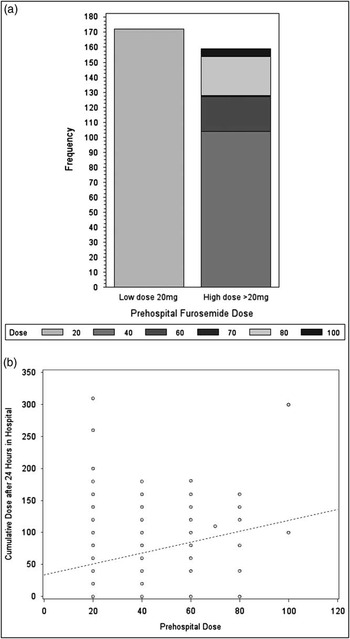
There were 331 patient charts included in this study. The distribution of furosemide doses among the patients is displayed in Figure 1a and Figure 1b. Nearly all prehospital doses were administered in 20 mg increments, and a majority of patients received 20 mg prehospitally.
Distribution of Prehospital Dose and Relationship to 24-hour Dose. A total of 51.8% of patients received 20 mg prehospitally. Prehospital dose is positively associated with 24-hour dose with r = 0.32 (P < .001).

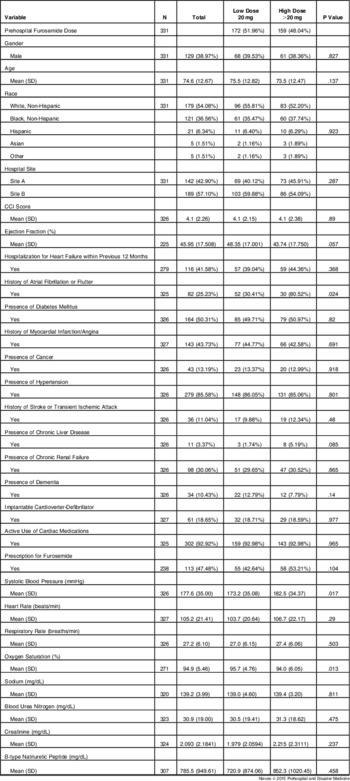
Demographics and patient characteristics at baseline are summarized in Table 1. Patients in the high-dose group were more likely to have a history of atrial fibrillation or flutter (P = .024), higher blood pressure (P = .017), and lower oxygen saturation (P = .013). No other significant differences were found at baseline.
Demographics and Baseline/Prehospital Characteristics

Abbreviation: CCI, Charlson Comorbidity Index.
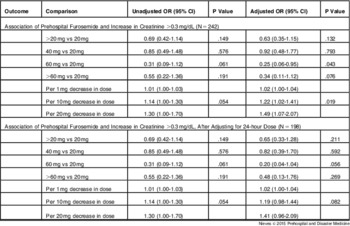
Analysis of the primary endpoint is displayed in Table 2. The logistic regression model adjusted for hospital site, CCI score, history of atrial fibrillation or flutter, LOS, and baseline values for Cr, systolic blood pressure, respiratory rate, and oxygen saturation level (%), which was determined to be a good fit for the data. The model was used on 242 charts, which included data for all the variables. A variable worth noting was the 24-hour dose. Understandably, prehospital dose was only the initial dose received and remaining doses during the hospital stay should also be considered. However, since 18% of patients did not have data recorded for a 24-hour dose, it was not included in the primary model, but instead is presented as an additional model in Table 2, using the same covariates. No association was found between an increase in Cr by more than 0.3 mg/dL from baseline and prehospital furosemide when the dose was treated as a binary variable. Patients taking 60 mg prehospitally were less likely to attain the 0.3 mg/dL increase compared to patients taking 20 mg prehospitally (adjusted OR = 0.25; P = .043); lowering the dose of prehospital furosemide was associated with higher odds of attaining the 0.3 mg/dL increase in Cr (adjusted OR = 1.49 for a 20 mg decrease; P = .019). When accounting for the 24-hour cumulative dose within the ED, the relationship was weaker. There was a strong association between attaining the 0.3 mg/dL increase in Cr and having a greater number of comorbidities, reflected in higher CCI scores (adjusted OR = 1.212; P < .01).
Analysis of the Primary Endpoint

Abbreviation: CCI, Charlson Comorbidity Index.
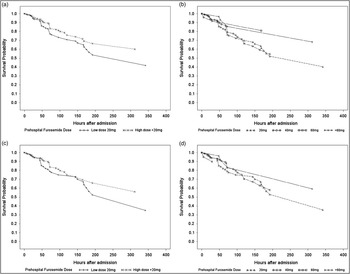
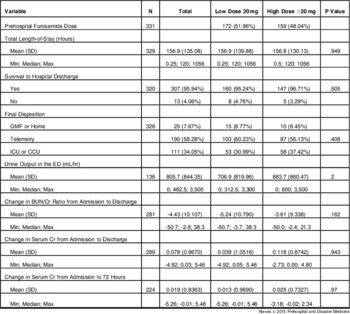
Kaplan-Meier estimates for each dose group were obtained from a Cox regression model with and without adjustment for the 24-hour cumulative dose and were plotted in Figs. 2a–2d. There were 91 patients who attained the 0.3 mg/dL increase in Cr during the study. Among these patients, the median time to target was 69 hours. Statistically significant differences were not found between dose groups. Exploratory endpoints are summarized in Table 3. No associations were found between prehospital dose and any exploratory endpoints.
Adjusted Kaplan-Meier Plots for Time to >0.3 mg/dL Creatinine by Dose Group. For Figures 2a and 2b: without adjustment for 24-hour dose (N = 264); for Figures 2c and 2d: with adjustment for 24-hour dose (N = 216).

Bivariate Analysis of the Exploratory Endpoints

Abbreviations: CCU, critical care unit; GMF, general medical floor; ICU, intensive care unit.
Discussion
There is currently a paucity of available literature to help guide the use of furosemide with respect to optimal dosing in patients with ADHF in-hospital, let alone in the prehospital setting. The DOSE Trial was the first study to-date, to the authors’ knowledge, that sought to address the uncertainties related to optimal dosing of in-hospital diuretics.Reference Felker, Lee and Bull 1 A retrospective chart review was performed of patients that received furosemide in the out-of-hospital setting. It was found that although there was no association between an increase in Cr of more than 0.3 mg/dL and prehospital furosemide when examined as a binary variable, the data suggest that patients who received 60 mg of furosemide prehospitally were less likely to achieve an increase of 0.3 mg/dL in Cr from baseline when compared to patients who received 20 mg of furosemide prehospitally (adjusted OR = 0.25; P = .043). Furthermore, the data conveyed that lowering the dose of prehospital furosemide resulted in increased odds of achieving the primary endpoint (adjusted OR = 1.49 for a 20 mg decrease; P = .019). It was observed, however, that when the 24-hour cumulative dose was controlled for, the relationship observed between higher doses of furosemide and an increase in Cr of greater than 0.3 mg/dL from baseline was weaker (Table 2). This is the first time, known to the authors, that higher doses of furosemide have been shown to result in less transient changes in renal function.
With respect to baseline characteristics, it was noted that patients with a past medical history of atrial fibrillation or atrial flutter, higher systolic blood pressures, and lower oxygen saturations were more likely to receive more than 20 mg of furosemide in the out-of-hospital setting. The authors of this study agree that this is probably of little clinical significance and more a secondary effect of the clinician's bias or opinion when considering a patient's history, physical exam, and objective information like vital signs.
Limitations
There were limitations in this study. First, as with any retrospective chart review, is the issue of data integrity. It is possible that, in some instances, the data collected may have been initially entered or documented incorrectly in both the out-of-hospital and in-hospital settings. A second limitation was the paucity of data. For instance, not all of the patient charts included in the study had documented ejection fractions, urine outputs, serum BUN/Cr ratios upon discharge, serum Cr at 72 hours, or serum Cr upon discharge. Lastly, it is possible the study results can only be extrapolated to this patient population.
Conclusion
There was no association found between the primary endpoint and prehospital furosemide when examined as a binary variable. The data do suggest that 60 mg of furosemide administered prehospitally leads to decreased odds of achieving an increase of greater than 0.3 mg/dL from baseline Cr during the in-hospital course. The data also suggest that lower doses of out-of-hospital furosemide result in higher odds of attaining the 0.3 mg/dL increase in Cr (adjusted OR = 1.49 for a 20 mg decrease; P = .019). If standard protocols defining the dosage and use of prehospital furosemide are to change, further prospective studies examining these relationships are needed.
Author Contributions
Drs. Merlin and Nieves had full access to the data in the study and take responsibility for the integrity of the data and accuracy of data analysis. The study and concept design was developed by Drs. Merlin, Nieves, and Ms. Young. All authors, with exception of Dr. Merlin and Ms. Young, were involved in the acquisition of data. Statistical analysis was performed by Dr. Young. All authors contributed to the interpretation of the data as well as the drafting of the manuscript.
Acknowledgements
Special thanks to the staff from the Department of Medical Records at Newark Beth Israel Medical Center (Newark, New Jersey USA) as well as Ms. Diana Parrett, RHIT (Department of Medical Records at Clara Maass Medical Center; Belleville, New Jersey USA) for their patience and diligence in procuring the ED and inpatient medical records required for this study. The authors thank MONOC EMS (Neptune, New Jersey USA) and Mr. Robert Bauter, MAS, CPM, NREMT-P (Director of Clinical Services at MONOC) for their efforts in providing the authors with the prehospital charts utilized for this study. The authors would also like to thank Eric J. Wasserman, MD, FACEP (Chairman, Emergency Medicine Department at Newark Beth Israel Medical Center) and Patrick Davis, MD (Emergency Medicine Attending Physician at Clara Maass Medical Center and member of MONOC's Medical Advisory Board) for the statistical data provided and related to their respective EDs.
Supplementary materials
To view supplementary material for this article, please visit http://dx.doi.org/10.1017/S1049023X14001411