Our book, Semantic Cognition: A Parallel Distributed Processing Approach (Rogers & McClelland Reference Rogers and McClelland2004), has provoked a wide range of reactions, ranging from supportive suggestions for new domains to address, to friendly amendments of aspects of our proposals, to points of criticism, either of specific elements of our argument or of the overall approach that we have taken. We thank the commentators for engaging seriously and thoughtfully with our work. We are gratified that the range of replies is broad enough to raise most of the reactions we have encountered as we have presented our work to different audiences.
We wish to address both the specific challenges, misunderstandings, queries, and criticisms raised by the various commentators, as well as the core issues underlying their alternative perspectives on our theoretical framework. To these ends, our response is organized around three themes, each addressing specific issues raised in the commentaries, and each touching on more general issues regarding the connectionist enterprise. These include (1) a discussion of how computational models should be used to support cognitive theories, (2) a treatment of putative limitations on the scope of our theory, and (3) a consideration of the relationship between our theory and a range of approaches cast in terms related either to Anderson's (Reference Anderson1991) “rational analysis” or Marr's (Reference Marr1982)“computational” level of analysis.
R1. What is the relationship between a model and a theory?
We begin by considering a set of questions raised by commentators that might seem at first glance to be fundamental, but which, we will argue, are best viewed as concerns about particular details of specific models. For instance, Snedeker wonders whether our use of localist representations in many of the models amounts to endorsing Fodor's claim that concepts are innate; Quinlan takes us to task for adding new units to the model in order to represent additional items in the environment; Marcus & Keil suggest that we use different models or measures of model performance to substantiate each theoretical claim; Rakison & Lupyan, Robbins, and others suggest that our training regime is unrealistic in ways they see as important; and Kropff & Treves argue that our feed-forward models, which do not have attractor dynamics, cannot explain important nonlinearities in children's conceptual development. None of these concerns, we believe, touch on criticisms of our actual theory – instead, they focus on less central details of particular pragmatic choices we made when devising simple model instantiations of the theory.
Of course, any such claim might justifiably be met with skepticism: It is very easy to attribute the strengths of a model to its core characteristics, and the limitations to superficial simplifications! How can the neutral observer determine whether any given aspect of a model really represents a critical theoretical claim or an unimportant implementational detail?
In answer to this question, we find it useful to invoke an analogy employed by Jorge Luis Borges (Reference Borges and Hurley1998) in a short fiction entitled “On the Exactitude of Science.” Borges tells of an empire in which cartographers strive for such perfect fidelity that the maps they create are built exactly to scale. The resulting products are a marvel of accuracy but, as maps, are essentially useless: The journey one would have to undertake to discern the distance between any two cities, for example, would be equally arduous in the map as in the real world. This satire illustrates an important and, we think, oft-neglected fact about the relationship between models in science and the systems they are modeling. Typically those systems are complex – perhaps too complex to understand in their entirety without aid. Faithful replication of the full system is, therefore, rarely if ever the goal of a modeling enterprise in science. Should such a program succeed, it might prove as difficult to understand the model as to understand the system itself! Rather, the function of a model is to simplify – to remove some of the complexity of the full system, and even to violate some of its known properties, so as to reveal more clearly other important characteristics.
This does not mean, of course, that all departures from the complex system are equally tolerable: It certainly seems fair to criticize the map that situates Paris closer to New York than to Marseilles. The question then arises, which departures from reality constitute helpful simplifications and which represent serious flaws? The answer to this question depends upon the model's intended function – that is, which aspects of the real, complex system the model is intended to illuminate, and how the theorist uses it to reason about the real system. The cartographer knows that the Earth is not small, or flat, or made of paper – he purposely sacrifices those elements of the real system so that his model better realizes its intended function (i.e., to facilitate an understanding of the spatial relationships among important landmarks in some region of the Earth). Because the mapmaker intends distances between points on the map to be proportional to distances among analogous points on the Earth, criticism of a map on these grounds is justified.
Thus, to evaluate whether criticisms of our models have important implications for our underlying theory, it is important to be clear about the intended function of the models we have presented. Often in cognitive science, it is understood that the primary function of a model is to fit data and to make predictions that can be tested empirically; but there are at least three less commonly acknowledged functions of models that have guided our work, which we believe to be equally important.
First, a model allows the theorist to investigate and better understand the implications of core theoretical principles. In our work, these include principles general to the parallel distributed processing (PDP) approach to cognition articulated in Rumelhart et al. (Reference Rumelhart and McClelland1986b; see especially Rumelhart & McClelland Reference Rumelhart, McClelland, Rumelhart and McClelland1986) and developed extensively over the past two decades, as well as additional principles specific to our theory of semantic cognition which are described in Chapter 9 of Semantic Cognition and summarized in the précis. They hold, among other things, that mental representations are patterns of graded activation values across simple processing units, rather than discrete symbols; that these patterns influence each other through mappings encoded in connections among the elements that participate in the representations; that learning involves graded changes in these mappings; that the architecture of the semantic system fosters convergent influence of all kinds of information on a common underlying representation; that learning within this system must be gradual and interleaved; and so on. An important function of the simulation work is to provide a tool for better understanding the implications of these core principles. It goes without saying that these implications are complex and non-obvious. Even very simple models like the Rumelhart model can exhibit counterintuitive behaviors. Computer simulations with such models allow the theorist to figure out how and why these counterintuitive behaviors occur, and what implications they then have for the ability of the theory to explain particular aspects of human behavior.
Second, the models help to demonstrate the sufficiency of the theory to address the phenomena it purports to explain. Suppose we had simply stated that a domain-general learning process based on the principles sketched in the preceding paragraph will give rise to a progressive differentiation of conceptual knowledge; that it acquires general before basic information about particular concepts but exhibits a basic-before-general trend in naming these same concepts; that it can explain why some categories are useful and informative and others not, why different properties become important for different semantic domains, how the semantic system comes to “ignore” irrelevant perceptual similarity and “hone in on” similarities and differences important for semantic generalization; and so on. None of this would have been believable, no matter how clearly articulated. The simulations provide a way of demonstrating that, in fact, an instantiation of the principles of the theory can lead to the consequences described. An actual model system really does exhibit the behavior we claim in the verbal articulation of the theory. Of course, extension of the model to more complex situations must also be addressed, but the initial demonstration in a simplified instantiation is important to counter claims that the approach cannot possibly work in principle.
Third, the model serves as a didactic tool for explaining to others how and why the relevant phenomena arise. Just as the simpler models make it easier for us, the researchers, to trace out the implications of certain assumptions, so too do these models aid our ability to communicate the important points to the reader. For instance, we might have begun our report of this work with a description of the most complicated model in Semantic Cognition, which (1) has a relatively large number of training items that vary in their category typicality, item frequency, and word frequency; (2) includes different contexts for naming items at different levels of specificity; (3) includes properties that are differentially “important” for different conceptual domains; and so on. All of the important effects in the book can be observed in this single model, which compared to the original Rumelhart model (Rumelhart & Todd Reference Rumelhart, Todd, Meyer and Kornblum1993), is relatively complex. For the purposes of understanding why the model gives rise to these effects, and communicating this explanation to the reader, this model is less than ideal. Precisely because frequency, familiarity, typicality, contextual specificity, and so on, are all operating in the model simultaneously, it is difficult to understand which factors are responsible for which effects and why, or how the different factors interact. The simpler versions of the model (discussed in Semantic Cognition, Chs. 3 and 4) held many of these factors constant and so made it easier to understand, and hence to communicate, fundamental aspects of the model's behavior. After establishing these fundamental behaviors, it becomes easier to communicate how additional factors then operate in the more complex model to explain a broader range of phenomena. So, when Marcus & Keil suggest we use different models to explain different phenomena, we view this aspect of our work as a virtue: The different models allow us to more clearly illustrate why a particular model works, as opposed to just demonstrating that it does.
R1.1. Three ways our models simplify our underlying theory
With these points in mind, we now consider some of the ways our model departs from the underlying theory, and some of the critical reactions these departures have provoked. In each case, we view the departure in question as a simplification adopted to promote the goals of understanding, demonstrating, and communicating implications of the underlying theory.
R1.1.1. Simplified input and output representations
In most simulations, we employed a single input unit to represent each subordinate level concept in the model's environment (i.e., one unit for rose, another for daisy, another for pine, etc.); a single unit for each different context (e.g., ISA, is, can, has); and a single unit for each possible output attribute (e.g., grow, fly, feathers, gills, etc.). Given our theoretical commitment to distributed representations throughout the semantic system, this use of “localist” inputs and outputs is clearly a simplification used for convenience (see, e.g., Semantic Cognition, Chs. 4 and 9). Still, some commentators have wondered about this choice. Snedeker asks, for example, if the use of localist input representations was tantamount to accepting Fodor's claim that representations of all concepts are essentially built in. If the use of localist input and output representations was a necessary condition for the success of the model, this might be a valid concern, but as we demonstrated with simulations described in Chapter 4 of the book, this is not the case.
We adopted localist input representations partly for historical reasons: The simplest version of the model was, in fact, the very model used by Rumelhart (Reference Rumelhart, Zornetzer, Davis and Lau1990). Rumelhart was specifically interested in using a connectionist model to encode the contents of systems of propositions like “canaries can sing” or “trees have roots.” We think the simplification here is natural and, essentially, uncontroversial. Although spoken words are, in our view, represented as distributed auditory patterns, the relationship between spoken word forms and their meanings is largely arbitrary, and it seems clear that our language-processing systems are capable of ignoring such similarities at the input level when mapping spoken word forms onto meanings (as distributed connectionist models also learn to do; see, e.g., Dilkina et al. Reference Dilkina, McClelland and Plaut2008; Plaut & Shallice Reference Plaut and Shallice1993). Note that the use of localist input units to represent distinct words does not amount to knowing the concepts in advance – it simply imbues the network with the ability to treat each possible word form as distinct from every other.
In Semantic Cognition, we were interested in understanding how people learn from experience with objects in the world, including statements about objects but also other aspects of experience, such as watching a canary and then seeing it fly away or hearing it sing. In this case the use of localist input representations is still a useful simplification for many purposes, but, like others, we were concerned that use of such representations might perhaps seem to presuppose too much “built-in” knowledge. In Semantic Cognition, Chapter 4, we showed that the model behaved essentially identically whether trained with a single unit to represent each subordinate concept or several different units to represent individual exemplars of each concept. We also replaced the localist input representations with distributed input patterns, and showed that this model behaved similarly to a model with localist inputs.
The distributed model could learn to overcome superficial input similarity (i.e., raw overlap in the input patterns), and to weight certain input features much more strongly than others, when mapping from inputs onto internal semantic representations. It also provided a more natural way of presenting novel items to the model: Rather than adding new units to represent new information – a procedure to which Quinlan particularly objects – new items could be presented as novel patterns of activation across existing units. The use of distributed input patterns, however, raised other issues that distracted from the main insights we wished to communicate. Specifically, such representations raise the question of what kind of “perceptual” similarity structure should be “built-in” to the inputs. Since we wished to show that the model's behavior does not depend upon building any similarity structure into the inputs, we continued to employ localist inputs for most simulations.
In short, our theory does not assume localist input representations. Our models used these for simplicity in many cases; but to demonstrate that the important effects did not depend upon this simplification, we also explored the use of distributed input representations. Similar issues arise regarding the context units in our model – as with the input units, we believe these representations to be distributed. Although we did not run simulations with distributed context representations in Semantic Cognition, we did consider the relationship between our framework and other models that learn distributed internal context representations in Chapter 9.
The situation with the attribute units is somewhat different: In this case, the outputs are in fact patterns with more than one active unit. For example, for the input canary can, the model learned to activate a pattern of activation across output units (specifically grow, move, fly, and sing). The pattern is coded over units that themselves are individually labeled with particular attributes; but what is important to the network is not the labels on the units, but the similarity relations among the patterns assigned to different items. In this regard, we think our models make quite defensible first approximations: For example, on the can units, canary overlapped the most with robin, somewhat less with salmon and sunfish, and very little with any of the plants. It is the pattern of overlap (both within and across contexts) and not the labels on the features that causes the network to learn and to behave as it does. These points are discussed in detail in Chapter 4 of our book.
R1.1.2. Simplified, unidirectional flow of activation
A second way in which our models simplify our theory concerns the flow of activation through the network. In Semantic Cognition, we used only feed-forward models, in which activation flows in only one direction, from inputs through internal representations toward outputs. In our theory, activation occurs as a recurrent, mutual-constraint satisfaction process, in which all of the units in the network participate in the activation of all other units (see e.g., Farah & McClelland Reference Farah and McClelland1991; Rogers et al. Reference Rogers, Lambon Ralph, Garrard, Bozeat, McClelland, Hodges and Patterson2004). Among other things, this means that activation can flow both from internal representations toward representations of specific sensory, motor, and linguistic attributes, and from the attribute representations toward the internal representations. The use of a feed-forward network greatly speeds up processing and learning in the model, but it also raised two issues in the commentaries.
One set of issues that arises here pertains to the representation of new items in the network (e.g., Snedeker, Quinlan). In our feed-forward networks, the properties of individual items are represented across the network's output units. Thus, to teach the network about something new, we not only require a new input unit as previously discussed; we also must provide specific information about the item in the form of target outputs. From such targets we used the backpropagation-to-activation method to allow the model to derive internal representations of novel items when given information about their properties. Although we see this approach as a valuable extension of the connectionist framework (introduced long ago by Miikkulainen & Dyer [Reference Miikkulainen and Dyer1987]) that can easily be motivated in conceptual terms (“Adjust your internal representation so that it accounts for the specified target properties”) it might be felt that presenting “input” to the network over output units is unnatural and that backpropagation is implausible biologically.
Appreciation of the computational properties of connectionist models has often been diverted by concern over the biological plausibility of backpropagation. These models are not intended, however, to exactly reproduce the actual processing activity of real biological neurons, but rather to make explicit certain computations that real biological systems might carry out in slightly different ways. In fact, it is now quite well established that in recurrent networks, the difference between activation values at different time points can be used to compute the very same error signals that are explicitly computed by backpropagation (Hinton & McClelland Reference Hinton, McClelland and Anderson1988; Hinton & Salakhutdinov Reference Hinton and Salakhutdinov2006; O'Reilly Reference O'Reilly1996). Thus, the abstract computational consequence we produce using backpropagation may be implemented through the activation process that occurs in a fully recurrent network.
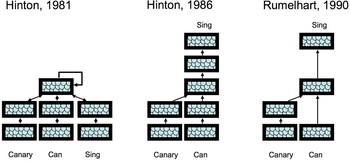
Regarding the presentation of “input” to a network across its output units, this issue does not arise in fully recurrent networks because the distinction between input and output units disappears. Hinton's (Reference Hinton, Hinton and Anderson1981) semantic network, the precursor of the feed-forward networks used later by Hinton (Reference Hinton1986; Reference Hinton and Morris1989) and then further simplified by Rumelhart, was a fully recurrent network. The three elements of a Item1-Relation-Item2 proposition like canary can fly are each represented by a pattern over a set of units that can serve as input and/or as output, and each has its own corresponding set of representation units (see Fig. R1). External inputs applied to any of the three input pools constrain the corresponding hidden unit representations through the propagation of ordinary activation signals. Thus, information such as the fact that a previously unknown item can move can be represented as a pattern over the Relation and Item2 pools, and propagation of activation will then constrain the representation assigned to this item over the Item1 internal representation units. In general, in recurrent models of semantic cognition, which we have employed extensively in other work (e.g., Farah & McClelland Reference Farah and McClelland1991; Lambon Ralph et al. Reference Lambon Ralph, Lowe and Rogers2007; Rogers et al. Reference Rogers, Lambon Ralph, Garrard, Bozeat, McClelland, Hodges and Patterson2004), there is no need to treat some units exclusively as “inputs” and others as “outputs.”
Schematic diagram illustrating the progressive simplification of Hinton's (1981) semantic representation model. The model was made strictly feed-forward in Hinton (Reference Hinton1986; see also Hinton Reference Hinton and Morris1989), and then further simplified by Rumelhart (Reference Rumelhart, Zornetzer, Davis and Lau1990).

A separate issue concerns differences in processing dynamics between feed-forward and recurrent networks. Specifically, in feed-forward networks, a given input generates an essentially static pattern of activation across successive layers. In recurrent networks, a given unit can influence and be influenced by the other units with which it is connected. Consequently, a given input initiates a dynamic interaction among units, and the resulting patterns of activation across units can evolve over time in complex and nonlinear ways. In particular, they can exhibit attractor dynamics, that is, a tendency to settle from any of a range of inputs into the same final state or fixed point. Also, the use of fully recurrent networks may, as Kropff & Treves suggest, help explain abrupt transitions in the course of cognitive development; slight changes in connection weights can suddenly lead to a change in the attractor structure, causing relatively abrupt transitions even if the underlying connection changes are subtle and gradual.
While we share Kropff & Treves's enthusiasm for attractor networks, we would note that the abruptness of developmental transitions may often be overstated. In fact, some developmental psychologists who used to argue for very discrete jumps from stage to stage in performance of certain tasks now advocate an “overlapping waves” model (Siegler & Chen Reference Siegler and Chen1998), and there are many signs of a fairly gradual change accompanied by a gradually increasing sensitivity to previously ignored information (McClelland Reference McClelland, Simon and Halford1995; Schapiro & McClelland, in press). Thus, while there may be good reasons to favor models with attractor dynamics, we are not sure that purported discontinuities in development are among them. The patterns of acceleration and deceleration seen even in feed-forward networks, discussed extensively in Semantic Cognition, Chapter 3, may be sufficient to address most aspects of these data (Schapiro & McClelland, in press).
In summary, we view the feed-forward networks that we have used as simplifications of the dynamically more complex, highly recurrent networks that are likely to be at work in the brain. Analysis of learning and processing in fully recurrent models is more difficult, though, and the use of backpropagation-to-activation in a feed-forward model captures much of what we might otherwise rely on recurrent networks for. We are interested in further exploring differences between these types of networks in their ability to explain patterns of change in development.
R1.1.3. Simplified environment
The third major simplification adopted in our work is in the training “environment,” that is, the set of patterns used to train the network. This is, of course, true of essentially all modeling work in this domain, connectionist or not, and as in all such work, the key question is whether the simplifications we have adopted capture enough of the characteristics of real-world structure to be interesting, or whether they are unrealistic in ways that critically influence the reported results.
According to ter Meulen and several others (Kemp & Tenenbaum, Rakison & Lupyan, Quinlan), children do not experience all of an item's properties every time they encounter the object. As a criticism of our model, this point is off target, since the model receives information at the same time only about those properties that are relevant to the current context. In the ISA (naming) context, for example, the model learns about an item's names; whereas in the has context, it learns about the item's parts; in the can context, it learns about behaviors; and so on. Context-sensitivity in our models is specifically intended to address precisely the concerns that the authors raise, that children only get exposed to partial information about an item's properties in any given situation or context.
This point aside, it is certainly the case that, for all of our models, both the training patterns themselves and the range of contexts in which items are encountered are hardly realistic, as Robbins notes, for instance. Does this simplicity undermine our arguments in favor of the overall approach exemplified by our simulations? For one thing, even the most complex model only learns about 21 different items, all living things. We think it is fair to ask whether the theory can scale up well to much larger training environments based on naturalistic corpora. The application of connectionist models to such corpora has been a key goal of work by McRae and colleagues (Cree et al. Reference Cree, McRae and McNorgan1999; McRae & Cree Reference McRae, Cree, Forde and Humphreys2002; McRae et al. Reference McRae, De Sa and Seidenberg1997), who have successfully used their models to understand a variety of phenomena in priming and speeded property verification. We would be deeply gratified if others would join us in exploring this extension of our work. In this connection it may be worth noting that recent advances on the machine learning side of connectionist modeling have greatly increased the efficiency of learning in connectionist networks (Bengio et al. Reference Bengio, Lamblin, Popovici and Larochelle2006; Hinton & Salakhutdinov Reference Hinton and Salakhutdinov2006; Ranzato et al. Reference Ranzato, Poultney, Chopra, LeCun, Schölkopf, Platt and Hoffman2007), and we are actively planning to work on such extensions drawing on these developments.
Specific criticisms can also be leveled at the particular contexts and attributes used in our networks. For example, the network is trained with attributes labeled can grow and ISA living thing. It seems unlikely that children have access to such information at early phases of their development, but it is important to recognize once again that the model's behavior is determined, not by the specific labels given to the Item, Context, and Attribute units, but by the relationships among the patterns with which it is trained. The important point is that the can grow and ISA living thing attributes are shared by all of the items in our training environments. We think it defensible that, in fact, plants and animals do share some attributes in common that are accessible to young children (again, see Semantic Cognition, Ch.4, for discussion).
What is important for the model is that, in the patterns used to train our networks, the attributes show systematic coherent covariation across the different items and contexts. Our theory explains many of the key phenomena in development (and adult semantic cognition) with reference to the ways that this assumed structure influences learning and processing. For these explanations to be correct explanations of the phenomena as they occur in humans, it must be the case that the actual experiences of children exhibit the structure that our simulations suggest is important. For example, we found that basic-level naming advantages arise in the model when basic-level labels pick out sets of things that share many properties with each other and few properties with other sets of things (as Rosch et al. [1976] originally proposed). If it is not the case that members of basic-level categories share many properties with one another and few with members of contrasting categories, then this would provide evidence against our account of basic-level effects. In this particular case, empirical evidence supports the assumptions that guided the construction of the training corpus: Basic level categories do appear to maximize distinctiveness and informativeness, as assessed in a variety of norming and experimental studies over the years (McRae et al. Reference McRae, Cree, Seidenberg and McNorgan2005; Murphy Reference Murphy, Keil and Wilson2000; Rosch et al. Reference Rosch, Mervis, Gray, Johnson and Boyes-Braem1976; Tanaka & Taylor Reference Tanaka and Taylor1991). Thus, whether or not the specific patterns used in our simulations are fully realistic in the sense that they capture information about the properties of a large set of actual objects that people are likely to know about, they may be realistic in the sense that they capture the essential aspects of structure that are important, under the theory, for producing the effects of interest.
In our view, the place where the theory is in most need of development is in the enrichment of its Context representations. We relied on a very small and somewhat arbitrary set of possible contexts, which came initially from the small set of relations used in Collins and Quillian's (Reference Collins and Quillian1969) propositional hierarchy and were in turn adopted by Rumelhart. But as Hampton points out, the range of variation of object properties across contexts is extremely rich, with important, and as yet unexplored, implications for the nature of conceptual representations. We look forward to extensions of our theory into a fuller investigation of these issues.
In summary, some of the features of the models used in Semantic Cognition are deliberate simplifications that should not be confused with assumptions of our underlying theory. It is important to be clear about where we have simplified, and we hope the preceding discussion clarifies these issues. It is also legitimate to ask: If we had not employed these simplifications, would a more complex model based on the theory still exhibit the phenomena we have illustrated with the simple models? If the answer is “yes,” then the simpler model can be viewed as a useful tool for understanding the behavior of the more complex reality that fully conforms to the principles of our theory. It would be possible to construct a more complex model that is truer to the theory, and there are good reasons why this should be pursued, but there will still be a place for the simpler models of the kind we have used, that exhibit many of the fundamental characteristics of our approach very clearly.
R2. Are there aspects of semantic cognition our approach cannot address?
Several commentaries focused on phenomena that we have not yet addressed in our work. We agree with Marcus & Keil when they state that we have not shown that “intercorrelations alone suffice for human reasoning.” A full account of all aspects of human reasoning is surely a task that will require far more than one book, and certainly new insights will be required before these books can be written. We do hope and expect that some of the ideas in Semantic Cognition will play a role in the gradual emergence of these insights.
For the most part, we found the focus in many of the commentaries on the yet-to-be-explained very positive, since it points to new opportunities to extend the coverage of the theory. We found that these comments fell into three types: Phenomena outside the current scope of the theory, either because we do not aspire to extend our approach to them, or because they lie beyond its current reach; phenomena to which the approach might relatively easily be extended; and phenomena that seem to challenge fundamental aspects of our approach. We consider the first type briefly before turning more detailed attention to the last two.
R2.1. Phenomena outside the theory's current scope
There are aspects of human cognition that we do not plan to address within our framework. For example, as Feeney, Crisp, & Wilburn (Feeney et al.) note, we have not tried to address explicit deductive inference – that is, the process of reasoning from premises to conclusions via the rules of logic. As we discussed in Chapter 9 of our book, we do believe these processes are deeply influenced by the kinds of implicit knowledge addressed in our book, and this separates us from cognitive scientists who treat the processing of logical syllogisms and other formal structures as indicative of the fundamental nature of human thought (e.g., Fodor & Pylyshyn Reference Fodor and Pylyshyn1988; Marcus Reference Marcus2001). We take the alternative view that such processes, though they can be mastered with practice, are not the natural basis for human cognition. Instead they are acquired skills that depend like other aspects of cognition on extensive relevant experience.
Just outside our model's current scope lies an important direction for future development of our approach: to address the relationship between the kinds of implicit processes examined in our model and processes that control or regulate these processes. Feeney et al. review evidence that control processes play a role even in fairly simple inductive inferences of a kind we think our model should address. We think this role occurs through the internal manipulation of context representations and the internal re-use of outputs of implicit cognitive processes as re-entrant inputs to the system, rather than through the use of some completely separate type of processing system. The PDP model of control of automatic processes in the Stroop task (Cohen et al. Reference Cohen, Dunbar and McClelland1990) and the latter part of the chapter in the PDP books on schemata and sequential thought processes (Rumelhart et al. Reference Rumelhart, Smolensky, McClelland, Hinton, McClelland and Rumelhart1986c) discuss these ideas. We agree with Feeney et al. that the fleshing out of these ideas will require another book.
A successor to our approach may someday begin to address the phenomena of insight and creativity – crucial features of human cognition that are not easily captured, we believe, in systems like those envisioned by, e.g., Fodor & Pylyshyn (Reference Fodor and Pylyshyn1988) and Marcus (Reference Marcus2001), and which a complete theory of human cognition should ultimately address. It is our belief that these characteristics of human thought arise from graded constraint-satisfaction-based processes dependent on implicit knowledge acquired by mechanisms of the sort that we explore in our book (as these are guided by control processes) rather than from the application of structure-sensitive or “algebraic” processes of the kind favored by Fodor and Pylyshyn (Reference Fodor and Pylyshyn1988) and Marcus (Reference Marcus2001). Actually developing a model that addresses these topics will be a challenge that is certainly worth undertaking.
R2.2. Phenomena compatible with the approach
The next group of phenomena are those we believe our framework could readily address, but which have not been a focus of our work to date.
R2.2.1. Initial saliency
Mandler, Quinn, and Rakison & Lupyan point out that although all properties are given equal initial weight in our simulations, in fact some properties are likely to be initially more salient to infants and so are likely to strongly shape early concept learning. As we indicated in Semantic Cognition, Chapter 4, saliency variations across different kinds of information can easily be incorporated into our framework. Salient features can be given more “weight” in a connectionist network in a number of ways: by scaling error derivatives accruing on the units that represent such properties; by scaling the learning rate associated with these properties; or by using more units to represent them. Any or all of these strategies would be available to evolution as a simple way of adjusting the relative salience of particular stimulus dimensions or attributes. We are not opposed to the possibility that development may reflect, in part, differential salience of some types of information relative to other types. Our effort has been to show that, in models with a convergent architecture, saliency scaling can arise automatically for properties that exhibit coherent covariation with one another. This kind of emergent saliency may be sufficient to account for many developmental phenomena, and where there is a convincing case to be made for differential salience of certain types of information, it is possible to incorporate this into the framework.
R2.2.2. Cross-linguistic influences on concepts
Majid & Huettig note evidence that people in different linguistic communities may organize their concepts somewhat differently, suggesting that the way we refer to objects and events in speech may influence the concepts we acquire. We agree with these points, and they are completely compatible with our framework, where producing and comprehending language is one of many abilities supported by the semantic system. In our models these abilities are supported in a small way through the ISA relation and attribute units, which capture information conveyed primarily through explicit labeling of objects by others in the environment. Consequently, the structure of a given language will influence the concepts we acquire, just as will other kinds of culture-specific experiences, including different degrees of exposure to different kinds of information, differential emphasis on certain distinctions in some languages or cultures relative to others, and so on. Some such influences were examined in our simulation of phenomena in expertise (see Semantic Cognition, Ch. 5), and other recent work is extending these ideas (Dilkina et al. Reference Dilkina, McClelland and Boroditsky2007).
R2.2.3. Different kinds of situations and contexts
Hampton notes that the different contexts adopted by our models – the situations in which different items are encountered that determine which attributes are of current relevance – are extremely simplistic, and wonders whether they could be expanded, perhaps by adopting a more extended context-coding scheme such as that employed by McRae and colleagues (e.g., McRae et al. Reference McRae, Cree, Seidenberg and McNorgan2005). We agree that a richer variety of contexts is necessary for further development of the theory. In addition to considering “semantically based” kinds of contexts, as Hampton suggests, we believe that it will be important to consider the temporal context in which items are encountered – that is, the sequence of events surrounding a particular encounter with an item – as well as other aspects of context, such as the particular settings in which various items are encountered, the items with which they tend to interact, and the linguistic contexts in which objects are designated by category labels at different levels of specificity. These and related issues are discussed in Semantic Cognition, Chapter 8.
R2.2.4. Accounting for delusions and other forms of semantic dysfunction
A major part of our research effort has been to use our models to better understand disorders of semantic cognition occurring as a consequence of neurodegenerative illnesses and other forms of brain damage (e.g., Lambon Ralph et al. Reference Lambon Ralph, Lowe and Rogers2007; Rogers & Patterson Reference Rogers and Patterson2007; Rogers et al. Reference Rogers, Lambon Ralph, Garrard, Bozeat, McClelland, Hodges and Patterson2004). MacDonald inquires whether our framework could further aid in understanding neuropsychiatric disorders in which delusions are a significant feature. For instance, some theorists have proposed that Capgras syndrome – where the sufferer believes that close family and friends have been replaced with impostors – arises from a functional disconnection between the systems that mediate person-recognition and the limbic system (Ellis & Lewis Reference Ellis and Lewis2001). Loved ones are recognized but fail to evoke the expected emotional response, a failure subsequently interpreted as evidence that that the individual is not “really” who she claims to be. This theory has a straightforward interpretation under the fully recurrent model implementations of our theory: Disruption of connections between the integrative semantic pool and a separate “limbic” pool that encodes emotional responses, for example, could produce partial recognition of a person without the associated emotional response.
In summary, the four phenomena considered here exemplify ways in which the theory might be fruitfully extended. The fact that the theory could likely be extended to address them testifies to its breadth and utility.
R2.3. Phenomena that challenge our framework
The third group consists of phenomena raised by several commentators (Opfer & Doumas, Marcus & Keil, Quinlan, Kemp & Tenenbaum) as fundamental challenges to our theory. These are aspects of human cognition that the commentators believe to be (1) a critical part of semantic cognition and (2) beyond the ability of our theory, in principle, to capture.
These comments almost all focused on the common idea that “deeper” aspects of human thinking involve setting aside superficial similarity relationships (e.g., physical similarity) among items, and taking note instead of similarities among the relations between items. On this view, two structured entities (domains, situations, etc.) are thought to be analogous if the items within them enter into a similar pattern of interrelations with one another. And, to the extent that two structures are analogous, alignment of the structures can promote detection of similarity (and subsequently inductive inference) between items that otherwise may have little in common (Gentner Reference Gentner1983). As one simple example, foxes prey on hens just as eagles prey on mice. By virtue of the shared preys on relation in these propositions, it is possible to recognize that eagles and foxes are in some sense similar kinds of things – more similar, in this respect, than are eagles and chickens, even though eagles and chickens may share more properties. The ability to detect such relational similarities and to use these to reason about object properties is thought by many to require knowledge representations that explicitly mark relations among different items – such as, for example, directed graphs or propositional hierarchies.
Accordingly, several commentators have raised questions about our framework's ability to deal with relations effectively. As one example, Opfer & Doumas state that:
children, unlike a PDP network, can represent these relations and their fillers in a manner that preserves relation-filler independence (i.e., relations and their fillers are represented independently), while simultaneously representing the bindings between roles and fillers in an explicit and dynamic fashion. Thus, children can appreciate how ‘Fido chases Felix’ is like ‘Felix chases Fido’ (same elements involved in the same relation) and how they differ (role-bindings are reversed).
A similar statement is made by Marcus & Keil, who suggest that such role-filler bindings cannot be achieved by connectionist networks without a “combinatorial explosion of input nodes.” Kemp & Tenenbaum reiterate these points, and further indicate skepticism that our framework could ever cope with the indefinite variability in the number of roles associated with different relations (e.g., two in chase (dog, cat) versus three in eat (boy, cereal, spoon) – what they call different “arities”), nested relations (e.g., eating food causes the canary to grow), or the ability to discern similarities among different kinds of relations (e.g., the fact that the relation terms has and possesses have near-identical meanings).
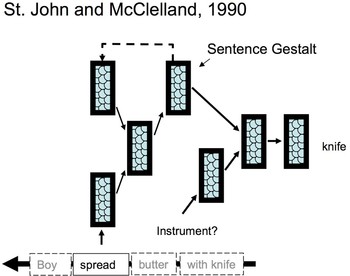
It is true that the simple Rumelhart network used in Semantic Cognition has some of these limitations, but these do not reflect a fundamental limitation of the framework. Indeed, three of these issues – the issue of relation-filler independence and binding raised by Opfer & Doumas, the problem of achieving role-filler binding without “a combinatorial explosion of elements” raised by Marcus & Keil, and the issue of different “arities” and nested relationships noted by Kemp & Tenenbaum – were addressed by the Sentence Gestalt model (St. John & McClelland Reference St. John and McClelland1990), which employed a simple recurrent network architecture in which a series of inputs are integrated over time into a single learned internal representation (Fig. R2). In this case, sentences involving any number of relations were presented to the model one word at a time, and the model was trained to answer queries about the meaning of the sentence. After training, the model would generate a distributed internal representation for any given sentence – the “sentence gestalt” – from which it could produce the answer to any question about the fillers of every role. Each sentence included a subject and several other optional arguments; and word order, prepositions, and semantic information determined the assignment of fillers in the sentences to roles including agent, patient, recipient, and instrument. Only the relation role appeared obligatorily in all sentences (the surface subject role was always filled as well, but its underlying role could vary as in, e.g., “The boy broke the window,” “the window broke,” “the hammer broke the window,” “the car was parked,” etc.). An extension of this model by Rohde (Reference Rohde2002) further addressed the issue of embedded relational structures.
Sentence Gestalt model of St. John and McClelland (Reference St. John and McClelland1990). In this model, words making up declarative sentences are presented one by one over the input layer of the network (pool of units at lower left). Each word is used, together with the sentence gestalt representation derived from the previous word, to create an updated sentence gestalt. Probes querying the filler of one of the roles in the sentence can be presented to the probe units. In the example shown, the words “Boy” and “spread” from the sentence “Boy spread butter on bread” have so far been presented. The network, when queried for the instrument, can already respond “knife” since in its experience knives are the only instruments used for spreading. Note that the sentences may contain an indefinite number of roles, one of which is the “action” role. A later model by Rohde (Reference Rohde2002) extended the probe syntax to allow querying specific arguments of specific clauses of multi-clause sentences.

Both of these models can be probed specifically for the filler of each of the roles in a sentence, including, crucially, the filler of the relation role. This would allow specification of the exact ways in sentences like “Fido chases Felix” and “Felix chases Fido” (or “lectures about movies” and “movies about lectures”; see Marcus & Keil) are similar (they involve the same relation) and how they are different (the fillers of the roles associated with these relations are reversed). The Sentence Gestalt model also learned appropriate similarity structure among the relations appearing in its training corpus (as did Elman's [Reference Elman1990] simple recurrent network model and Hinton's [1989] family trees model). Because the Sentence Gestalt model learned internal representations of sentences from inputs arriving one word at a time, it could capture role-filler bindings without encountering the “combinatorial explosion” of input nodes alluded to by Marcus & Keil. Rohde's (2002) extension of the model to embedded relations showed that the framework has no difficulty with the nested relations raised by Kemp & Tenenbaum.
In sum, many commentators appear to hold the intuition that our framework is incapable of dealing with knowledge about relations and view this as a critical flaw. The Rumelhart network's simplicity perhaps invites this reaction, but precisely these issues have been addressed in prior work. In Semantic Cognition, Chapter 9, we discuss alternative network structures, based in part on the Sentence Gestalt model and Rohde's (2002) extension of it, that would address these limitations while still preserving all of the positive features of our approach.
R2.4. Are connectionist networks merely statistical engines of a familiar kind?
We have not yet addressed three important points raised in the commentaries concerning the putative limitations of PDP approaches to cognition generally, and to semantic cognition in particular. Two were previously noted: The first of these is Kemp & Tenenbaum's claim that our theory cannot explain how people learn that different relation terms, such as has and possesses, have similar meanings. The second is the claim that our model will have difficulty capturing very abstract semantic relationships and concepts, such as the concept predator, which appears to group items, not on the basis of property overlap, but on the basis of a given item's relationship to other items – so that the eagle and fox are considered similar “kinds,” whereas the eagle and chicken are considered different “kinds,” despite the fact that eagles and chickens certainly share many properties with one another. We suspect that both of these issues arise from the underlying concern that connectionist models can only capture similarity structure that arises from direct property overlap. If our models only come to represent items as similar when they share sets of observable properties, then it is difficult to understand how we come to know that very dissimilar items are, in some ways, similar “kinds” of things; or how very abstract terms, such as relationship terms, might have quite similar meanings.
The third point is related and concerns statements by several commentators to the effect that connectionist models are merely statistical learning machines. For instance, Borsboom & Visser state that they only perform “statistical categorization procedures,” which they take to include hierarchical clustering analysis, factor analysis, principle components analysis, regression, and multidimensional scaling; Marcus & Keil call them “finely tuned statistical engines”; and Quinlan describes them as “connectionist counting machines.” It is difficult not to see such comments as dismissive of the general approach. Borsboom & Visser, for example, recommend that – since we use a variety of statistical methods to understand the model's behavior anyway – we simply dispense with the model and apply the same more standard statistical methods directly to the model training patterns. The assumption appears to be that the connectionist learning procedures themselves contribute essentially nothing – that standard multivariate analyses of the training patterns would reveal the same structure that emerges in our model; and that the various phenomena we account for in the book, such as the progressive differentiation of concepts, domain-specific patterns of attribute weighting, basic-level advantages in naming, and so on, would be fairly transparently related to the kinds of results yielded by these more standard analyses. A similar sentiment may underlie Quinlan's statement that the model only discovers structure that is obvious given the training examples, and Snedeker's suggestion that the “concepts” the model acquires are essentially built in.
The logic underlying such conclusions is not clear to us. It seems to be something like the following: Connectionist models are a kind of statistical categorization procedure; therefore they must have the same properties as other statistical categorization methods; therefore one can apply other methods to the same patterns to equal effect. But this is a fallacy, akin to concluding that bats, because they are mammals, must not be able to fly, since most more-familiar mammals cannot fly. Connectionist models may be a kind of “statistical categorization procedure” under some definitions, but this does not mean that they have exactly all and only the same properties as other statistical procedures.
We believe that connectionist models differ from many familiar statistical procedures in important ways. In the current section, we wish to demonstrate that this is so by doing just as Borsboom & Visser and Quinlan suggest: by showing that our models can learn structure that is not discovered by two commonly used unsupervised analysis methods, namely, hierarchical cluster analysis and principal components analysis. Furthermore, we will show that this structure is precisely the very abstract kind of structure that Kemp & Tenenbaum and others suggest is beyond the capability of connectionist approaches: Our model learns to treat items as similar when they enter into similar relations with other items even if they have no direct property overlap (as in the case of the predator concept); and it learns to treat different relation terms as similar when they capture comparable patterns of similarity among different items, even if they are associated with completely non-overlapping sets of properties.
Our demonstration relies on a corpus of patterns similar to those used in the simulations reported in Semantic Cognition, but coming in four completely non-overlapping sets, which we will call domains. Each domain contains eight items, and within each domain, the items can be encountered in four different contexts. The contexts do not overlap across domains – each domain has its own set of four contexts. Finally, each item has a set of attributes pertaining to it in each context, and as with items and contexts, each domain has its own completely distinct set. Thus, across domains, there is no overlap of any kind in any of the Item, Context, or Attribute layers.
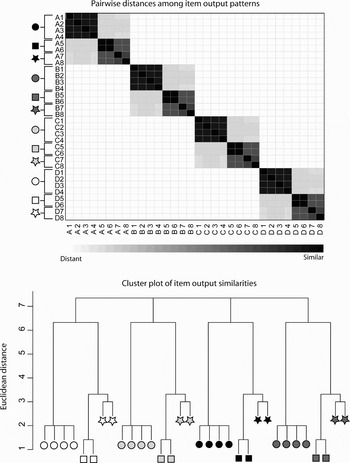
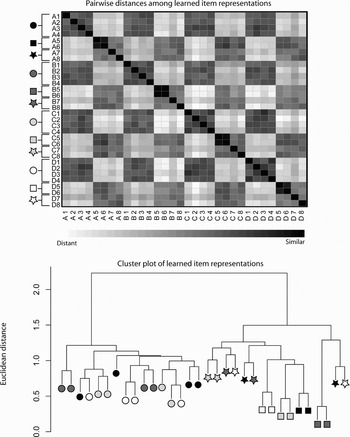
Within a given domain there exists similarity structure in the overlap of output attributes across items; and this similarity structure among the eight items within a domain is identical across the four domains. To see this, consider the similarity relations in Figure R3, which shows a hierarchical cluster analysis of the output patterns describing all 32 individuals. The cluster algorithm strongly differentiates the four domains, since individuals in different domains share no properties. The plot also shows that the within-domain similarity structure is the same for every domain: the shape of the tree beneath each superordinate node is identical. In this sense, the domains are “analogous” or “alignable.” Each domain contains two very similar individuals (squares), four individuals that are very similar to one another but distant from their other domain members (circles), and two “oddball” individuals (stars). It is important to note that this cross-domain structure is completely absent from the network's inputs (which are all localist) and from its outputs (see top panel of Fig. R3).
Similarities among the output training vectors for 32 items (collapsing across context) as captured by the actual pairwise distance matrix with cells shaded to reflect Euclidean distances between patterns (top) and by a hierarchical cluster analysis of these distances (bottom). The symbols to the left of the distance matrix indicate the branch labels shown on the cluster plot. Because there is no feature-overlap across domains, both snapshots of the output data suggest that items from different domains should be treated as distant from one another. Thus the distance plot shows no overlap at all between items in different domains; and in the cluster analysis places items from the same domain beneath a common superordinate node. Both plots also show that, within each domain, the eight items enter into precisely the same set of similarity relationships with one another: the patterns of pairwise distances within domain are identical in the distance plot; and the shape of the tree beneath each superordinate branch is identical across domains.

In other words, although items from different domains share no properties in this data set, there exists a second-order isomorphism across the domains: The individuals represented as circles of varying shades, for instance, have no properties in common, but each relates to the other individuals in its own domain in precisely the same way.
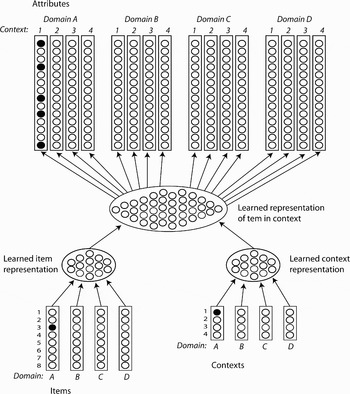
The architecture we employed for this simulation is shown in Figure R4. It is similar to that used in our book, except that we have added an additional hidden layer between the Context input units and the Hidden layer, so that the model must learn to represent each of the different contexts with a distributed pattern of activation across the units labeled Context Representation.
The architecture employed in our new simulations. As in the Rumelhart architecture, different individual items and contexts are represented locally in the input, and representations of attributes are distributed across output units. In this case, input items and contexts are organized into domains so that items from different domains never overlap in their inputs or outputs. In addition to learning a distributed internal representation of each individual, this model must also learn a distributed internal representation of each context (Context-rep) that is independent of the particular item being processed.

What does this version of the Rumelhart network learn about the 32 items in this corpus? To answer this question, we trained the model in the usual way. The connection weights in the network were initialized with very small random values, and on each trial, an Individual and Context unit was activated in the input. Activations were computed in a forward pass; the difference between the actual and desired outputs was computed and transformed to a measure of error; and the weights were adjusted in a backward sweep so as to reduce the error. The model was trained for 30,000 epochs without momentum and with a learning rate of 0.05, at which point 99% of the output units were activated to within 0.1 of their target values. We then stepped through the 32 individual inputs, recorded the learned pattern of activation across Representation units for each item, and computed the Euclidean distance matrix describing the dissimilarities among these learned representations. This simulation was run five times with different initial starting weights, and the resulting distance matrices were averaged across simulation runs, to ensure that the results do not reflect chance findings from a particular set of starting weights.
Figure R5 shows a hierarchical cluster analysis of the average distance matrix from these simulations. The model clearly finds a different organization of its internal representations than that expressed in the output vectors directly: In the representations learned by the network, individuals with corresponding similarity relations to other items within each domain are now treated as similar. The second-order similarity is now the dominant organizing structure in the representations assigned to these items in the network. This occurs, even though these individuals have no properties in common.
Similarities among the representations of 32 items learned by the model, as captured by the pairwise Euclidean distance matrix and by as hierarchical cluster analysis. In contrast to the analysis of the attribute vectors themselves (Fig. R3), the learned representations capture substantial cross-domain structure: items that play similar roles within their respective domains get represented as more similar to one another than do items that play quite different “roles” within the same domain.

Again, this result is not a strange artifact of the clustering algorithm, but can be observed directly in the pairwise distance matrix itself (Fig. R5 top): The model clearly captures cross-domain similarity structure based on an individual's role within the domain, while representing as dissimilar individuals who actually share some overt properties in common but who play very different roles within the same domain.
It looks as though the “statistical categorization procedure” embedded in connectionist models is different in some important ways from the procedures some of its critics (especially, Borsboom & Visser) equate it with. Multi-layer connectionist networks can certainly be seen as a kind of statistical learning machine, but they differ from other such procedures in their ability to discover interesting internal representations of their inputs as a consequence of the learning procedure and the particular network architecture. These differences make such networks especially relevant for understanding human semantic cognition. In this case the simulation demonstrates that there need not exist any direct overlap of properties in order for the model to learn to represent sets of items as similar to one another. That is, the model is capable of learning a kind of analogical similarity structure – representing as similar the items that occupy similar positions within alignable structures.
This simulation builds on the early “family trees” simulations of Hinton (Reference Hinton1986; Reference Hinton and Morris1989), and there are other related demonstrations of transfer between non-overlapping patterns in simple recurrent network simulations (e.g., Dienes et al. Reference Dienes, Altmann and Gao1999). There is one important difference between our simulation and Hinton's, however. In Hinton's simulations, items from different domains (i.e., members of different families) could appear in the same context (i.e., with the same “relation” unit activated in the input), so that in fact input patterns did overlap somewhat across domains. In contrast, we have used completely distinct context input units in each of the four domains so that items from different domains never overlap in any way in the input or output. So, we can also ask: Has the network learned anything interesting about the contexts themselves? Has it, in fact, been able to discover the cross-domain similarities in these contexts?
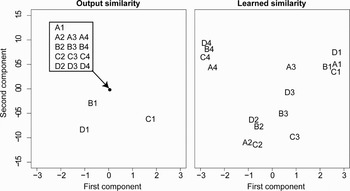
To answer this question, we used principal components analysis (PCA) to examine the similarities among (1) the output patterns associated with each context, and (2) the similarities among the 16 context representations learned by the model. Figure R6A shows plots of the first two components of a matrix encoding the average of the output patterns associated with each of the 16 individual contexts. Because each context is associated with a completely non-overlapping set of output properties, there is very little structure for the analysis to discover. The first component thus weakly differentiates the four individual contexts from domain 1; and the second component weakly differentiates domain 1 from all other domains. Subsequent components similarly serve to differentiate the individual contexts from one another without revealing any interesting substructure. As shown in Figure R6B, the same analysis conducted on the model's learned internal representations of contexts yields quite different results. In this case, the first principal component neatly organizes the contexts in a cross-domain fashion: context 1 in domain A is represented as similar to context 1 from domains B, C, and D, but different from other contexts; context 2 from domains A–D are represented as similar to one another and different from other contexts; and so on. The second component serves to differentiate the individual contexts, but with little additional apparent structure.
Principal components analyses of the 16 different contexts in the model training environment. The left panel (R6A) shows the first two components extracted from a matrix containing, for each context, the associated pattern of output activations averaged across all items. The right panel (R6B) shows the first two components extracted from the model's learned internal representations of the different contexts. Even though different contexts are associated with completely non-overlapping sets of output attributes, the model finds interesting structure that is not apparent from analysis of the training patterns alone. Specifically, it treats contexts as similar if their associated attributes express similar patterns of overlap among the eight items in each domain.

Why does the model learn to treat some contexts as similar to one another? The reason is that any given context captures a certain set of similarity relations among the items in the associated domain; and these similarity relations are also expressed in the corresponding contexts from the other domains. That is, context A1 captures the same similarity relations among domain A members as does context B1 among domain B members, context C1 among domain C members, and context D1 among domain D members. So, contexts A1, B1, C1, and D1 get represented as similar to one another. Context A2, in contrast, captures a different set of similarities among domain A members, and so gets represented as quite different from context A1. Though this simulation is abstract, it is easy to see that two different relations with near-identical meanings (whether in the same language or in different languages) – such as have, possess, and avoir – will come to be treated as quite similar by our model, contrary to the intuitions expressed by Kemp & Tenenbaum in their commentary.
In short, the model is capable of learning correspondences across domains between (1) items that share no input or output properties but relate to other items in their domains in similar ways and (2) relations/contexts that share no input or output properties, but which organize concepts in similar ways. These correspondences were not captured by other multivariate techniques applied to the output patterns themselves.
R2.5. They said it couldn't be done
In his commentary, Quinlan urges a focus on what connectionist networks like ours cannot do, and comes to a pessimistic assessment. Although his list of “can'ts” is short, others provide their own lists, and, if models like ours could do none of these things, it would indeed be worth discarding them for alternatives. But let us reconsider some of the key items on the list.
Connectionist networks can't learn relational similarity (Feeney et al; Marcus & Keil; Opfer & Doumas; Quinlan). In fact, they can. Indeed, ongoing work is beginning to show how this sensitivity to relational similarity can be exploited to explain specific phenomena in the empirical study of abstract concepts, analogy, metaphor, and so on. Clearly, dismissal of the research program on the basis these perceived limitations is not warranted.
Connectionist “counting-machines” are no different from “statistical categorization procedures” (Borsboom & Visser; Quinlan). We have shown that they are different. Principal components analysis and hierarchical cluster analysis both fail to discover structure that our network discovers.
All the interesting structure is “built in” to the inputs and outputs by the experimenters, so any old structure-sensitive statistical method will find it (Snedeker; Quinlan). While the structure is in some sense in the input, it is not true that just any statistical procedure will find it. In fact, as we have repeatedly stressed, the ability of our models to learn about cross-context and cross-domain structure in its training environment depends critically upon the convergent architecture used in our models. Models trained on exactly the same patterns with a different architecture would not acquire the same internal representations and would exhibit completely different patterns of learning and generalization. The convergent architecture encourages the discovery of cross-domain structure, a property we view as crucial for our domain-general structure-sensitive learning procedure.
It is impossible to learn new concepts in a connectionist system (or any other learning system), according to Snedeker, citing Fodor (Reference Fodor1998). Our model learns to group together items that have nothing in common in the input or the output, but that all relate to their respective domains in similar ways. If one considers the input and output units to correspond to “innate concepts,” as Snedeker suggests, then the model has essentially learned a new set of concepts – concepts that, like prey and predator, transcend the particular domain (e.g., of land animals or sea creatures) but that relate corresponding items across these domains.
Connectionist networks can't learn about how different contexts are similar to or different from one another. Kemp & Tenenbaum suggest that, because our model uses different units to represent different relations, it will not be able to learn that different relations can be, in some respects, similar. We have previously seen that they were wrong about this through the example of the Sentence Gestalt model, and our new simulation reinforces this demonstration.
In summary, our simulation illustrates that the capabilities and behaviors of even very simple feed-forward neural networks continue to be widely misunderstood and counter to the intuitions of many researchers in the field. Several of the critiques of our work appear to be based on mistaken claims about in-principle limitations of the framework. The very fact that these misconceptions are so ubiquitous provides evidence supporting our earlier argument regarding an important function of modeling work: It allows the theorist to uncover, demonstrate, and communicate insights about possible cognitive mechanisms that run counter to intuition.
R3. Different levels of analysis or alternative frameworks for capturing structure in cognition?
One remaining issue arising in the commentaries concerns levels of analysis in cognitive science. This issue was most directly raised by Kemp & Tenenbaum, who take the position that PDP approaches and structured approaches are compatible, aiming at explanations at different levels of analysis, as also suggested by Smolensky (Reference Smolensky1988). Though other commentaries were less explicit about levels of analysis per se, several commentators argued that full accounts of semantic cognition will require some form of structured symbolic representation (Opfer & Doumas, Marcus & Keil) and/or the exploitation of “rational analysis” (Quinlan, Feeney et al.). Thus, while our following comments directly address Kemp & Tenenbaum's remarks, they may be relevant to the points of some of these other commentators as well.
We agree that there are different ways of thinking about levels of analysis and the place of connectionist models in these taxonomies. We do not agree, however, that the difference between our approach and structured probabilistic approaches adopted by Kemp & Tenenbaum is primarily one of levels. Connectionist approaches may seem to be cast at a different level from some other approaches, but we believe this is a misperception. To us, the difference between our approach and Kemp & Tenenbaum's is one of overall framework, and cuts across Marr's (1982) computational, representational/algorithmic, and implementational levels. In what follows, we briefly contrast two such frameworks in cognitive science. Both take seriously the issue of levels – the idea that there is a higher level of fundamental principles, above the level of algorithms and implementation details. They differ, however, in their claims about what these fundamental principles are.
On one approach, which we will call the structuralist framework, theorists explain cognitive phenomena with reference to explicitly stipulated domain-specific relationships among structured symbolic objects – as Chomsky did, for example, in Syntactic Structures (Chomsky Reference Chomsky1957). The fundamental principles are those that govern the relationships, and these are taken as the ultimate explanatory basis for the characteristics of the domain itself. Different cognitive domains behave according to different principles, and the principles themselves specify both the structure of items in the domain and the conditions that determine which items are part of the domain (e.g., grammatical) and which items are not (e.g., ungrammatical).
For its advocates (which appear to include Opfer & Doumas and Marcus & Keil, along with Kemp & Tenenbaum) the structuralist approach appears to address a key challenge in language: On one hand, languages clearly have structure; but on the other, the actual structure of real languages appears to be quite complex and often somewhat arbitrary. The structuralist approach appeals to some because it suggests that the complex and arbitrary-seeming structure of real languages might arise from much simpler and more regular underlying structures that behave according to a relatively constrained set of fundamental principles. Other domains of cognition also exhibit their own characteristic structure, and so may similarly be amenable to examination through the structuralist framework (as proposed, e.g., by Keil Reference Keil1981).
The alternative, emergentist perspective, with which we associate ourselves, begins with the assumption that domain structure arises from the non-obvious interplay of domain-general principles and processes operating under constraints imposed by the domain-specific cognitive tasks and environments with which humans and other intelligent beings are faced. In language, for instance, many emergentist theorists treat the idealized characteristics of sentences, as elucidated by linguists, not as the starting point for an explanation of language, but as one aspect of the empirical facts about language that need to be explained. For example, Joan Bybee (Reference Bybee2001), a linguist whose vision of language places her outside the Chomskyian framework, has argued that the regularities found in language arise from domain-general principles of cognition as these come into play when faced with the task of communicating using a low-bandwidth communication channel (spoken language). A similar perspective has been proposed by MacWhinney (Reference MacWhinney2006). Christiansen and Ellefson (Reference Christiansen, Ellefson and Wray2002), Hare and Elman (Reference Hare and Elman1995), and Lupyan and McClelland (Reference Lupyan, McClelland, Alterman and Kirsh2003) have used simple connectionist models to show how characteristics of sentential and morphological structure could arise over historical time from models of individual speaker/hearers that embody many of the same domain-general principles that we have articulated in Semantic Cognition.
To appreciate the basic intuition underlying the emergentist view, consider Hofstadter's (Reference Hofstadter1995) example of the sand dune: a structure whose particular characteristics at a given moment emerge from the operation of multiple factors, including the mutual influences exerted on each other by particles of sand operating in concert with the effects of external forces such as winds, tides, and gravity. Sand dunes clearly have structure, but this structure is an emergent consequence of the elements and forces in play – a consequence that is to be explained by general principles that govern these elements and forces. Emergentists like Bybee argue that the structures of languages are like sand dunes, continually shaped by an ongoing interplay of forces that can produce both the systematic tendencies found in language, and arbitrary-seeming variations that are otherwise seen as distracting flies in the ointment.
With these perspectives in mind, we now turn to a brief consideration of the structured probabilistic approach advocated by Kemp & Tenenbaum in comparison to our framework. According to their approach (see also e.g., Tenenbaum et al. Reference Tenenbaum, Griffiths and Kemp2006), cognitive phenomena are best understood with reference to Bayesian inference processes operating over probabilistic graphical models which directly represent structure (e.g., they use a mutation hierarchy to represent generic properties of animals). So stated, our approaches seem similar in two senses: both appeal to completely domain-general underlying principles, and both are grounded in an optimal inference framework.
The point that connectionist models are grounded in optimization is important. It was not a main focus of our book, but it was and remains a crucial element of the framework, anticipated in important precursors of the PDP volumes, and subsequently explored in considerable depth (see e.g., Ackley et al. Reference Ackley, Hinton and Sejnowski1985; Hinton & Sejnowski Reference Hinton and Sejnowski1983; MacKay Reference MacKay1992; McClelland Reference McClelland, Oaksford and Chater1998; Rumelhart Reference Rumelhart and Dornic1977). While we do not see optimality as an easy guide to explanation of cognitive phenomena, we certainly believe that it is worthwhile to consider what is optimal in a given context, and to compare what is optimal to what is actually observed in human behavior.
There are, however, several important differences between the approaches, and these cut across Marr's levels. We focus here on differences at the level of the overall theory of the computation – in particular, the goal of the computations being performed – and differences at the level of representations and algorithms.
R3.1. Goal of the computation
For Kemp & Tenenbaum, and perhaps for other structuralists, it appears that the goal of learning is to discover the optimal representation of the underlying structure of the domain per se. The emergentist point of view entails a different goal for learning – namely, the goal of correctly capturing the statistical relationships between inputs and outputs experienced in an environment. This same goal underlies both backpropagation and Boltzmann machine learning (Ackley et al. Reference Ackley, Hinton and Sejnowski1985). Additional constraints on complexity are often incorporated and serve, in a domain-general way, to promote generalization to unseen inputs. Of course, the statistics that drive learning in these models ultimately depend on complex, abstract, nonlinear relationships and are not simply direct first-order relationships between observable variables – but in contrast to the structuralist view, the discovery of such structured representations is not itself the goal of the computation.
R3.2. Representations
According to the structured probabilistic approach of Kemp & Tenenbaum, the learner selects a specific structural form of representation from among a specified set of alternative forms or types. For example, Kemp & Tenenbaum suggest that learners select a probabilistic mutation hierarchy to represent the generic properties of animals, a continuous two-dimensional space to represent hues, and a one-dimensional space to represent the stances of Supreme Court justices. The approach does not require the theorist to pre-specify which structure is appropriate for a given domain, and so in this sense is domain general. It does appear to require, however, an enumerated catalog of structures available for selection, among which there must exist a structure suited to the domain which in turn must be imbued with a sufficiently high prior probability of selection (see also Perfors et al. [Reference Perfors, Tenenbaum and Regier2006] for related work on language).
Connectionist modelers like Hinton and ourselves, on the other hand, do not suggest that any such structures are available to the learner for selection; instead, learning operates in a completely continuous representational space. When the experiences provided by the environment actually arise from a specific form of structure (like a mutation hierarchy), a connectionist model will come to behave as though it has learned that structure, but the structure itself is not explicitly represented as such, nor is it selected from a set of possible alternative structures. As a consequence, learning is not constrained to be fully consistent with one of a set of pre-specified alternatives: under our approach, real structure in the environment need not exactly match some particular structure type. In our view, this continuous representational potential makes the connectionist framework ultimately more appropriate for new semantic learning.
R3.3. Algorithms
Kemp & Tenenbaum might argue that their approach makes no commitment at the algorithmic level: The goal is only to find the structure that best fits available data subject to priors and simplicity constraints. Yet in practice, they proceed differently than we do, in ways that seem consistent with other differences between the approaches. Specifically, they rely on comparative evaluation of alternative candidate structures and selection among these, a common approach used within the graphical models framework. This may be an importantly different kind of algorithm than the gradient-based algorithms employed in fully continuous neural networks. Apart from any consideration of their relative psychological or neural plausibility, there is reason to believe that fundamental issues of computational complexity favor gradient-based approaches (Bengio & Bengio Reference Bengio and Bengio2000). Fully continuous neural network models now represent the state of the art in several areas of machine learning and ameliorate the curse of dimensionality that plagues many other approaches (Bengio et al. Reference Bengio, Lamblin, Popovici and Larochelle2006; Hinton & Salakhutdinov Reference Hinton and Salakhutdinov2006; Rajat et al. Reference Rajat, Battle, Lee, Packer and Ng2007; Ranzato et al. Reference Ranzato, Poultney, Chopra, LeCun, Schölkopf, Platt and Hoffman2007).
Kemp & Tenenbaum suggest that structured probabilistic approaches are to be preferred because “they make more direct contact with previous psychological research on semantic cognition.” To us, this reflects the fact that these models are but a small step away from the commitments to innate domain-specific structure that have been articulated by many of the researchers whose work we addressed in our book. Our work instead makes contact with a newer body of connectionist research that applies a common set of domain general principles to address phenomena in perception, attention, memory, language, development of naive physics concepts, and now the fundamental structure of semantic cognition.
R4. The future of cognitive science
In this response we have tried to clarify the nature of our approach and to address misconceptions about its potential to address semantic cognition and other phenomena in cognitive science. In concluding, we consider the two predictions ventured by Kemp & Tenenbaum about the future of cognitive science: First, that “researchers will eventually understand how structured approaches to semantic cognition are implemented in the brain,” and second, that “deep insights at the neural level will only be possible once we have a deep understanding of the computations supported by structured semantic representations.” Although we agree with their statement that such predictions are “notoriously unreliable,” we offer alternative predictions of our own: That structured approaches will have an important role in our field, but that researchers will come to understand that this role is to provide useful approximate descriptions of emergent properties of cognitive systems. These descriptions will be understood to capture structure that emerges from the interplay of domain-general principles and mechanisms, interacting with the particular constraints that arise in domain-specific contexts.