Introduction
The archaeological excavations in Myndos Ancient City (an ancient Lelegian settlement), which is located in the Asar Island of Bodrum city (Halicarnassus), Turkey have been continued since 2005 under the directorship of Professor M. Şahin. The first settlements in the Asar Island have been dated to as early as the 5th century bc. During excavations in 2010, plant seeds (seven in total) were found in a pot unearthed from supposedly a kitchen of a burnt, one-room, ancient Byzantian house (dated to the 5th century ad). These seeds were sent to us by the archaeologists of the Uludağ University, Bursa, Turkey for identification of the plant species that produced these seeds.
Since seeds were intact and well preserved, their morphology suggested that they belong to the Leguminosae (Fabaceae) family. However, it is very difficult to identify legume species by seed characteristics alone, since there are over 13,000 species in the world. In Turkey alone, the Leguminosae family is represented by over 1100 species (Davis, 1965–Reference Davis1985; Davis et al., Reference Davis, Mill and Tan1988). About 700 of these species are found naturally in southern Turkey (Güner et al., 2000).
The age of the seeds was estimated to be around 1600 years, based on evidence from archaeological findings during excavations (Şahin, Reference Şahin2011). Before destroying the ancient seeds for DNA extraction, we were interested in getting additional information about viability (germinating capacity) of this material. Furthermore, to eliminate the possible contamination of seeds for ancient DNA (aDNA) studies, the ancient seeds were subjected to germination tests as well as tissue culturing in vitro. The tissues generated during germination tests were used for both plant regeneration and DNA extraction purposes.
The genetic identity of plant species can be deduced from their fossils and carbonized materials (wood, seeds, etc.), as well as from living tissues, such as leaves, buds, embryos and other tissues, using molecular methods developed for ancient specimens (Rogers and Bendich, Reference Rogers and Bendich1985; Rogers, Reference Rogers1994; Savolainen et al., 1995; Ma et al., Reference Ma, Rogers, Catranis and Starmer2000; Parducci and Petit, Reference Parducci and Petit2004; Gugerli et al., Reference Gugerli, Parducci and Petit2005; Rogers and Kaya, Reference Rogers and Kaya2006). Studying intraspecific aDNA from archaeological materials from excavation sites could provide valuable information for palaeobotany, ethnobotany, population genetics and phylogenetics of species, which may enhance our knowledge of past evolutionary processes and social life (Tani et al., Reference Tani, Tsumura and Sato2003; Gugerli et al., Reference Gugerli, Parducci and Petit2005; Nasab et al., Reference Nasab, Mardi, Talaee, Nashli, Pirseyedi, Noubari and Mowla2010). The extracted DNAs from most ancient plant samples are generally degraded. Therefore, DNA amplification studies based on genomic regions that are of small size and high copy number, such as chloroplast, mitochondrial or repeated nuclear sequences, produce the best results (Gugerli et al., Reference Gugerli, Parducci and Petit2005). Earlier aDNA studies from fossils and archaeological remains indicated that the authenticity of aDNA and its degradation were major concerns (Deguilloux et al., Reference Deguilloux, Pemonge, Bertel, Kremer and Petit2003; Tani et al., Reference Tani, Tsumura and Sato2003; Gugerli et al., Reference Gugerli, Parducci and Petit2005; Rogers and Kaya, Reference Rogers and Kaya2006). Thus, in aDNA studies, it is important to have contamination-free material as well as less degraded DNA (Rogers et al., Reference Rogers, Theraisnathan, Ma, Zhao, Zhang, Shin, Castello and Starmer2004; Rogers and Kaya, Reference Rogers and Kaya2006).
In this study we aimed to characterize the DNA from ancient seeds found in the archaeological site located in the Asar Island, Bodrum, Turkey by using the techniques and ground work established to sequence old plant materials (Rogers and Kaya, Reference Rogers and Kaya2006).
Materials and methods
Plant material, germination and in vitro callus formation
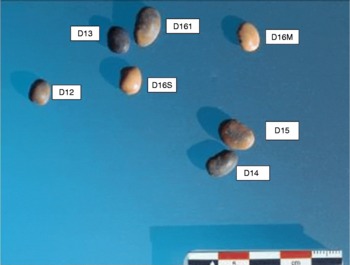
Seven plant seeds which were found in the Asar Island, Bodrum, Turkey, during the archaeological excavations by the archaeological team of the University of Uludağ, Bursa, Turkey, were obtained for species characterization. Two of these seeds, which were coded as D15 and D161, were reddish-brown, reniform in shape and somewhat larger relative to the other seeds (about 4.5 × 4.5 × 7 mm in dimensions: width × thickness × length) with extremely tough and thick seed coats. The other five seeds (coded as D12, D13, D14, D16M and D16S) were reniform in shape, yellow, brown or violet-bluish in colour and 0.8 × 0.6 × 1.1–13 mm in dimensions (Fig. 1).
The seven ancient seeds excavated from the Asar Island archaeological site (Ancient Myndos city) located in south-western Turkey (a colour version of this figure can be found online at http://www.journals.cambridge.org/ssr).

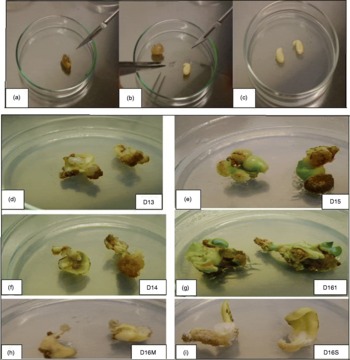
Initial examination of seeds with a dissecting microscope indicated that they were covered with a carbonized black, thick and very hard seed coat. The morphology of the seeds suggested that they likely belong to the Leguminosae family, and the region where the archaeological site is located is a well-known hot spot for Leguminosae family diversity (Maxted and Benett, 2001). An in vitro germination method was developed to overcome the problems that might hamper germination due to dry and hard seed coats. First, ancient seeds were sterilized with 70% ethanol for 5 min followed by commercial bleach (15% sodium hypochlorite) for 30 min in a shaker. They were then transferred to sterilized water and incubated in a water bath at 30°C for 24 h. After this treatment, or after further incubation for another 72 h, the seeds still failed to germinate. Finally, to break dormancy, seeds were treated with 800 ppm gibberellic acid (GA3) for 24 h at 30°C. This last treatment induced slight swelling that allowed removal of the seed coat and isolation of endosperm and embryo using a scalpel in a sterile cabinet (Fig. 2a–c).
(a–c) Removal of the seed coats from the ancient seeds. (d–i) Induced calli from cotyledons of ancient seeds. The labels indicate the codes given to six ancient seeds. (A colour version of this figure can be found online at http://www.journals.cambridge.org/ssr)

Although the ancient seeds failed to germinate, except D12, the healthy-looking cotyledons were used for callus induction experiments in order to increase the amount of material for ancient DNA extraction and possibly to obtain plantlets through tissue culture. Whole cotyledons of six ancient seeds were transferred to Murashige and Skoog (Reference Murashige and Skoog1962) medium (MS) containing 2 mg l− 1 2,4-dichlorophenoxyacetic acid (2,4-D), 20 g l− 1 sucrose and 7 g l− 1 agar and incubated at 25°C in darkness for 3 weeks. The callus induction experiment was terminated after 3 weeks since the callus size was sufficient to be used in further organogenesis studies and the DNA extraction procedure.
For shoot regeneration, callus tissues were incubated in MS medium supplemented with 2 mg l− 1 6-benzylamino purine (BAP), 0.2 mg l− 1 1-naphthaleneacetic acid (NAA), 20 g l− 1 sucrose, 2 mg l− 1 glycine and 7 g l− 1 agar. Growth conditions for shoot regeneration were set at 26°C with 16 h of light (1500 lux white fluorescent) and 8 h dark for 3 weeks.
DNA extraction
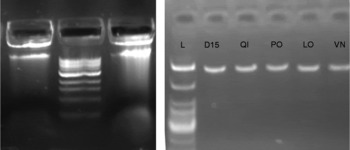
Total DNA was extracted from cotyledons or callus tissues generated by in vitro callus induction experiments, by the modified 2 × CTAB (cetyltrimethylammonium bromide) method of Doyle and Doyle (Reference Doyle and Doyle1987). Callus tissues from D15, D161, D16M, D13 and D14, as well as leaf tissues from four Vicia narbonensis specimens, as a control, were used to extract DNA. The extraction was initiated by grinding samples in liquid nitrogen using the extraction buffer supplemented with 1% PVP (polyvinylpyrrolidone) and 0.02% βME (β-mercaptoethanol), followed by extraction in chloroform:octanol (24:1), precipitation in isopropanol and washing in 70% ethanol. The extracted DNA was resuspended in double-distilled sterile water. After completion of the extraction, ancient DNA along with control DNA samples were run on 1% agarose gels for quantification and quality examinations (Fig. 3).
Left panel: DNA samples run on 8% agarose gel. DNA bands in the first and third lanes are from ancient seeds, while the DNA in the second lane is a 1 kb Gene ruler DNA marker. Right panel: ITS bands on 2% agarose gel. Lanes: L, ladder (Low MW DNA Ladder #N3233S, BioLabs New England, USA); D15, ancient seed; QI, Quercus ilex; PO, Picea orientalis; LO, Liquidambar orientalis; VN, Vicia narbonensis.

PCR amplification, DNA sequencing and BLAST sequence analysis
Polymerase chain reaction (PCR) was performed in 50 μl volumes containing 2.5 units Taq DNA polymerase, 1 × buffer (750 mM Tris.HCl, 200 mM (NH4)2SO4; MBI Fermentas, Lithuania), 1.5 mM MgCl2, 200 μM deoxynucleoside triphosphates (dNTP), 0.5 μM ITS1 and 0.5 μM ITS4 primers and 60 ng sample DNA. The primers ITS1 (5′-TCCGTAGGTGAACCTGCGG-3′) and ITS4 (5′-TCCTCCGCTTATTGATATGC-3′) (White et al., Reference White, Bruns, Lee and Taylor1990) were selected for the amplification of the intronic ITS1, ITS2 and exonic 5.8S regions of the nuclear DNA.
PCR amplification conditions were: initial denaturation at 95°C for 5 min, 35 cycles of denaturation at 95°C for 1 min, annealing at 60°C for 1 min and extension at 72°C for 1 min followed by a final extension at 72°C for 6 min.
The amplified products from ancient seeds and Vicia narbonensis species were sent to the sequencing centre (Refgen Co., Middle East Technical University, Ankara, Turkey). The sequences from amplified products were determined by employing the above primers using a Prism Ready Dye Deoxy Terminator Cycle Sequencing Kit (Applied Biosystems Inc., Foster, California, USA) and an Automated DNA Sequencer (Model 310, Applied Biosystems).
The sequences of five ancient seeds were compared with the ITS sequences from Vicia narbonensis and other legume species (Lathyrus and Cargana) which were obtained from NCBI (National Center for Biotechnology Information, Bathesda, Maryland, USA). BLAST searches of international sequence databases (using the Baylor College of Medicine internet site, gapped BLASTN search, http://searchlauncher.bcm.tmc.edu/seq-search/nucleic_acidsearch.html; and the NCBI site, BLASTN search, http://www.ncbi.nlm.nih.gov) were used to determine the most closely related species to the ancient seed sequences. The sequences from ancient seeds, Vicia species and other selected sequences were aligned using Mega 5.2 (Tamura et al., Reference Tamura, Dudley, Nei and Kumar2007). Phylogenetic analyses were conducted using MEGA 5.2 software (Phylogenetic Analysis using Parsimony; Tamura et al., Reference Tamura, Dudley, Nei and Kumar2007). The phylogram was generated by using maximum parsimony, heuristic search option, with gaps scored as a fifth base. Maximum parsimony analysis was also performed for the same data set scoring the gaps as missing data.
Results
Since the ancient seeds had very hard and impervious seed coats, our efforts to germinate them failed. Slightly swollen seeds were dissected and six out of seven seeds yielded healthy-looking cotyledons. We subjected the cotyledons to callus induction and all the material produced callus tissues (Fig. 2d–i). Cotyledons of the two seeds that were coded as D15 and D161 showed further development and produced green calli (Fig. 2e, g). Although sufficient and contamination-free tissue samples were obtained from six ancient seeds, the subsequent reculture of these calli failed to yield further callus or adventitious shoots. Thus, in vitro callus production and organogenesis experiments were terminated after two subculturing periods, about 3 months after the initiation of the callus induction experiments.
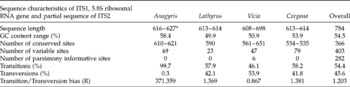
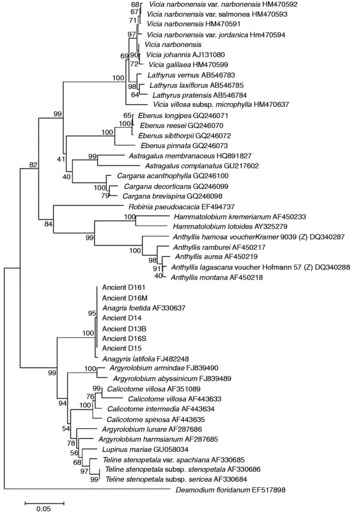
Extraction of the aDNAs from callus tissues was successful. The quality of the DNA was quite good. There was no sign of DNA degradation when the aDNAs were compared with the DNAs from contemporary samples of Q. ilex, P. orientalis, L. orientalis and V. narbonensis (Fig. 3). The PCR reaction mixtures and DNA amplification conditions appeared to be appropriate, so that internal transcribed spacer (ITS) regions in nuclear DNA (nDNA) of ancient seeds were successfully amplified. The sequences from amplified ITS DNA products of six ancient seeds indicated that the length of the whole ITS region (ITS1, 5.8S ribosomal RNA gene and ITS2) was 616–627 bp (Table 1). The GC content was 58.4%. The aDNAs from six ancient seeds did not have any variable sites. When the ITS sequences from ancient seeds were subjected to BLAST searches in international sequence databases (NCBI) to determine the most closely related species, it was found that the ITS sequences matched with Anagyris foetida (Fig. 4). The constructed phylogenetic tree with sequences from ancient A. foetida seeds and other related species of legumes also made it clear that the ancient DNA sequences of the ITS region should be grouped as A. foetida, with very high bootstrap values (94%) (Fig. 4).
Molecular diversity parameters for ancient Anagyris foetida. Diversity parameters were estimated using sequence data from this study as ancient Anagyris sequences, contemporary Anagyris and other genera related to Anagyris from the GenBank database of NCBI

* Complete sequence length of internal transcribed spacer 1 (ITS1) (240 bp), 5.8S ribosomal RNA (162 bp) and partial internal transcribed spacer 2 (ITS2) (about 220 bp).
† Although six aDNA samples yielded no variable sites, the sequences obtained from GenBank (AF330637 and FJ482248) were the sources of these variable sites.
Phylogenetic tree constructed from the ITS sequences from ancient Anagyris foetida and the sequences obtained from the NCBI databases from related species. The evolutionary history was inferred using the neighbour-joining method. The tree is drawn to scale, with branch lengths in the same units as those of the evolutionary distances used to infer the phylogenetic tree. The evolutionary distances were computed using the maximum composite likelihood method and are in the units of the number of base substitutions per site. The numbers on branches are the bootstrap values.

Discussion
Seven ancient seeds, about 1600 years old, were unearthed during an archaeological excavation in Asar Island which is located in south-western Turkey. These seeds were subjected to germination, in vitro callus induction and molecular characterization experiments. The results clearly indicated that the species to which these viable ancient seeds belonged was A. foetida.
The ancient seeds, which were provided to us for characterization, were recovered from an archaeological stratum 5.20 m below the soil surface. The seeds were found in a clay pot situated in a burnt kitchen of an early Byzantian house. Only one out of seven recovered seeds had lost its viability. The remaining six seeds were in very good condition and responded to the in vitro growth treatments. Callus induction was achieved for all six seeds, although further developments such as organogenesis were not observed. Extracted ancient DNAs did not show any sign of degradation. The ITS region of this legume species was amplified successfully. Since aDNA was extracted aseptically from in vitro induced callus tissues, common problems of aDNA research, such as DNA contamination and degradation (Deguilloux et al., Reference Deguilloux, Pemonge, Bertel, Kremer and Petit2003; Tani et al., Reference Tani, Tsumura and Sato2003; Gugerli et al., Reference Gugerli, Parducci and Petit2005; Rogers and Kaya, Reference Rogers and Kaya2006), were not detected. The ITS sequence analysis indicated that these seeds most likely originated from a single species, since no variable site was found among ITS sequences obtained from the six ancient seeds. The BLAST search in the NCBI database with these sequences revealed that the sequences belong to A. foetida, which is a relict Tertiary legume species of the Mediterranean and diverged from other relatives about 8.2 million years ago in the late Miocene (Ortega-Olivencia and Catalán, Reference Ortega-Olivencia and Catalán2009).
Although the age of seeds was not determined by radio-carbon dating or some other more reliable dating procedures, based on archaeological findings and evidence, the ancient A. foetida seeds may be as old as about 1600 years. A. foetida, like many other Mediterranean legume seeds, possesses extremely hard seed coats and exhibits long dormancy periods (Taylor, Reference Taylor2005). Even more recent seeds of A. foetida require long stratification and scarification treatments to germinate (Valtueña et al., Reference Valtueña, Ortega-Olivencia and Rodriguez-Riano2008; Avşar, Reference Avşar2009). There are reports that if the humidity of seeds is reduced to a low level and they are stored at low temperature and oxygen partial volume, many legume seeds will keep their viability for centuries (Toole, Reference Toole1986; Daws et al., Reference Daws, Davies, Vaes, van Gelder and Pritchard2007). Generally, seeds with a large size or with a large surface area/volume ratio, such as A. foetida, are likely to become buried in the soil surface because of their relative inability to pass through gaps in the soil or to sink as a result of the action of soil animals (Bekker et al., Reference Bekker, Bakker, Grandin, Kalamees, Milberg, Poschlod, Thompson and Willems1998). Thus, it is expected that the large, heavy and reniform seeds of A. foetida will be broadly confined to the surface layers of the soil (Valtueña et al., Reference Valtueña, Ortega-Olivencia and Rodriguez-Riano2008) unless seeds were buried or stored purposely in a pot, which was the case for the ancient seeds in the present study. A. foetida is a relict species endemic to the Mediterranean region and known to be growing in the eastern Aegean region of Turkey (Chamberlain, Reference Chamberlain1970). It is a shrub growing to a height of 3–4 m, which sheds seeds of reniform shape and violet-bluish colour (Valtueña et al., Reference Valtueña, Ortega-Olivencia and Rodriguez-Riano2008). In general, it has been given to animals to relieve swelling and as a herbal medicine for humans (Baytop, Reference Baytop1999). This may be the reason why ancient A. foetida seeds were found in a pot of an ancient early Byzantian house, located in the Asar archaeological site in south-western Turkey. Since there is evidence of fire in the recovery area, the ancient A. foetida seeds must have been dried to a level that was ideal (low humidity, low oxygen) for long-term storage. Also, seed structure and the conditions in the stored pot further created optimal conditions for long-term storage. Additionally, the testa of seeds of A. foetida is not only hard but also extremely smooth and shiny, and contains the toxic alkaloid anagyrine (Innocenti et al., Reference Innocenti, Dall'Acqua, Viola and Loi2006) which may have prevented fungal and bacterial infections. Thus, the biological characteristics of A. foetida seeds, as well as the storage conditions in the archaeological site, may have provided the ideal setting for maintaining viability of these ancient seeds for about 1600 years.
A number of studies have reported the viability of ancient seeds from archaeological sites and other sources (Toole, Reference Toole1986; Shen-Miller et al., Reference Shen-Miller, Mudgett, Schopf, Clarke and Berger1995; Shen-Miller, Reference Shen-Miller2002; Daws et al., Reference Daws, Davies, Vaes, van Gelder and Pritchard2007; Sallon et al., Reference Sallon, Solowey, Cohen, Korchinsky, Egli, Woodhatch, Simchoni and Kislev2008). For example, the viability of 1700-year-old Chenopodium album seeds was reported by Ødum (Reference Ødum1965). However, the studies that used archaeological evidence for determining the age of seeds were criticized, due to unreliability of dating. The importance of reliable dating has been emphasized in longevity experiments with ancient seeds (Toole, Reference Toole1986; Daws et al., Reference Daws, Davies, Vaes, van Gelder and Pritchard2007). Since 1995, the oldest viable seeds with reliable dating are believed to be sacred lotus seeds, which were dated as 1300 years old (Shen-Miller et al., Reference Shen-Miller, Mudgett, Schopf, Clarke and Berger1995), and ancient date palm seeds, which were over 2000 years old (Sallon et al., Reference Sallon, Solowey, Cohen, Korchinsky, Egli, Woodhatch, Simchoni and Kislev2008). However, a very recent discovery (Yashina et al., Reference Yashina, Gubin, Maksimovich, Yashina and Gakhova2012) revealed viable seeds and fruits that were 30,000 years old, preserved in fossil squirrel burrows, buried at a depth of 38 m in Late Pleistocene permafrost. These fruits were subjected to in vitro tissue culture and fertile plants were recovered.
Although a reliable dating method (carbon dating) was not used to determine the age of ancient seeds in the current study, it is remarkable that ancient A. foetida seeds have kept their viability by maintaining their DNA molecules, seed proteins and enzymes. Thus, A. foetida may be used as a model plant to further explore the mechanisms of seed longevity and to develop seed storage technology.