Introduction
Stroke is a major cause of death and disability worldwide, with the number of new and recurrent strokes growing each year (World Health Organisation, 2003). Access to inpatient stroke rehabilitation is increasingly recognised as a major contributor to positive outcomes post stroke (Langhorne & Duncan, Reference Langhorne and Duncan2001). Yet, worldwide, inclusion of people with stroke in inpatient rehabilitation is variable, with rates of admission ranging from 9.5% to 50% (Lai, Alter, Lai, & Sobel, Reference Lai, Alter, Lai and Sobel1998; Mahler et al., Reference Mahler, Zuger, Kaspar, Haefeli, Jenni, Leniger and Beer2008; Mayo et al., Reference Mayo, Hendlisz, Goldberg, Korner-Bitensky, Becker and Coopersmith1989; Rundek et al., Reference Rundek, Mast, Hartmann, Boden-Albala, Lennihan, Lin and Sacco2000; Schlegel et al., Reference Schlegel, Kolb, Luciano, Tovar, Cucchiara, Liebeskind and Kasner2003; Tran, Nadareishvili, Smurawska, Oh, & Norris, Reference Tran, Nadareishvili, Smurawska, Oh and Norris1999; Treger et al., Reference Treger, Ring, Schwartz, Tsabari, Bornstein and Tanne2008; Willems et al., Reference Willems, Salter, Meyer, McClure, Teasell and Foley2012). The variable distribution of inpatient rehabilitation services may be related to the lack of internationally accepted criteria to identify people with stroke who would benefit most from inpatient rehabilitation (Wade, Reference Wade2003), the poor rate of routine review and assessment of people with stroke for rehabilitation (National Stroke Foundation, 2012), and inconsistent outcomes between assessors (Hakkennes, Brock, & Hill, Reference Hakkennes, Brock and Hill2011), which are often based on non-clinical factors or clinical factors that may not have a relationship with rehabilitation outcome or capacity to improve (Illett, Brock, Graven, & Cotton, Reference Illett, Brock, Graven and Cotton2010).
In Australia, the decision to admit a person with stroke to inpatient rehabilitation is primarily at the discretion of the consultant medical officer (CMO). This may be a geriatrician, rehabilitation physician, medical physician or neurologist, with varying levels of input from the interdisciplinary team, which is consistent with other geographical locations, including Europe (Putman et al., Reference Putman, De Wit, Schupp, Beyens, Dejaeger, De Weerdt and Leys2007) and the USA (Conroy, DeJong, & Horn, Reference Conroy, DeJong and Horn2009). To date, few studies have explored the relative importance a CMO places on the multitude of potential factors that could contribute to the decision to admit a person with stroke to inpatient rehabilitation. Based on the limited literature available, it appears that people with stroke may not be considered for inpatient rehabilitation because of older age and lower pre- and post-stroke functional status (Kennedy, Brock, Lunt, & Black, Reference Kennedy, Brock, Lunt and Black2012; Putman et al., Reference Putman, De Wit, Schupp, Beyens, Dejaeger, De Weerdt and Leys2007; Rodgers, Dennis, Cohen, & Rudd, Reference Rodgers, Dennis, Cohen and Rudd2003). These factors are consistent with indicators of poor prognosis of a good functional outcome (independence) (Kwakkel, Wagenaar, Kollen, & Lankhorst, Reference Kwakkel, Wagenaar, Kollen and Lankhorst1996; Veerbeek, Kwakkel, van Wegen, Ket, & Heymans, Reference Veerbeek, Kwakkel, van Wegen, Ket and Heymans2011). Therefore, it is plausible that these prognosticators are being used clinically to aid the early identification and admission of people with stroke to inpatient rehabilitation. Organisational factors, including workforce capacity and anticipated length of stay, have also been found to influence the decision of a CMO (Kennedy et al., Reference Kennedy, Brock, Lunt and Black2012). It is not surprising that factors beyond the person have been reported to be influential given that patient-related factors have been found to account for less than one-third of practice variation when deciding to admit a person with stroke to inpatient rehabilitation (Lee, Huber, & Stason, Reference Lee, Huber and Stason1997). However, there is a lack of evidence comparing the relative importance of patient-related factors to other factors, including organisational and resource-based factors, from the opinion of the CMO, and this warrants evaluation. Thus, the first aim of this study was to identify the relative importance of factors that could favour or disfavour admission to inpatient stroke rehabilitation in Queensland, Australia.
Even less research has been directed at the decision-making process for continuation or cessation of inpatient rehabilitation services. Rising healthcare costs have placed significant downward pressure on all aspects of health care to deliver services that achieve greatest outcomes for the most efficient means (Saxena, Ng, Yong, Fong, & Gerald, Reference Saxena, Ng, Yong, Fong and Gerald2006). Thus, it is reasonable to speculate that if a person with stroke were to remain in a resource-intensive service such as inpatient rehabilitation, he or she would need to demonstrate considerable benefit. This is likely to be measured through continued functional gains. However, factors that contribute to this process remain ill-defined. Thus, the second aim of this study was to identify factors that favour continuation or cessation of inpatient rehabilitation in Queensland, Australia. In Queensland, this is commonly discussed at a weekly interdisciplinary case conference, which serves to inform the decision of the CMO to continue or cease inpatient rehabilitation.
Methodology
A cross-sectional web-based survey of CMOs in Queensland, Australia was completed. Ethical approval was granted from a university ethical review committee. All participants provided written informed consent and the study was conducted in accordance with the Declaration of Helsinki.
Participants
Consultant medical officers were invited to participate if they were (a) practising in Queensland Australia as at 1 May 2012; and (b) were members of either the Australian and New Zealand Society of Geriatric Medicine (ANZSGM; n ~ 90) or the Queensland Stroke Clinical Network (n ~ 30). The proportion of eligible CMOs who were members of both networks is unknown. Recruitment via both networks was performed to explore opinions across the stroke care continuum (acute hospitalisation through to inpatient rehabilitation) and specialties (acute hospital physicians, neurologists, rehabilitation physicians, geriatricians and general practitioners). According to the National Stroke Foundation of Australia, the primary CMOs in Queensland involved during acute hospitalisation are medical physicians and neurologists, while geriatricians and rehabilitation physicians are primarily involved during inpatient rehabilitation (National Stroke Foundation, 2012).
Survey Development
The content and language of the survey was drawn from previous studies (Conroy et al., 2009; Hakkennes et al., Reference Conroy, DeJong and Horn2011; Putman et al., Reference Putman, De Wit, Schupp, Beyens, Dejaeger, De Weerdt and Leys2007; Rodgers et al., Reference Rodgers, Dennis, Cohen and Rudd2003) and length was kept to a maximum of 30 minutes. The survey collected information about the participant's demographics (e.g., age, gender, area(s) and years of specialisation) and principal place of practice. Subsequently, participants were asked to list the top four factors that favour and disfavour their decision to admit a person with stroke to inpatient rehabilitation, to elicit their spontaneous thoughts (respondent-identified factors). This was followed by a series of closed questions to gain their opinion on a range of pre-identified factors grouped in seven categories: person with stroke and physical function (17 factors), cognitive ability (10 factors), type of stroke (8 factors), behaviour (3 factors), social and support network (7 factors), facility offering rehabilitation (4 factors) and referring hospital (5 factors) (Putman et al., Reference Putman, De Wit, Schupp, Beyens, Dejaeger, De Weerdt and Leys2007). A 5-point scale that ranged from ‘strongly favouring’ through to ‘strongly disfavouring’ admission was used to rate each factor. At the end of each category, participants were able to list and rate additional factors.
To identify factors that favour continuation or cessation of inpatient rehabilitation, the participant's spontaneous thoughts were again gained through identification of their top four factors that favour continuation and cessation of inpatient rehabilitation. Following this, participants were asked to rate 13 pre-identified factors derived from the researchers’ (K.S.H., P.D.A., S.G.B.) clinical experience. Factors were rated according to a 5-point scale that ranged from ‘strongly favouring’ continuation through to ‘strongly favouring’ cessation of inpatient rehabilitation. At the end of this section, participants were invited to list and rate additional factors.
The survey was piloted across four health disciplines to optimise clarity, readability and focus of the questions, in addition to confirming survey duration. Two researchers (K.S.H. and S.G.B.) evaluated pilot responses, and one researcher (K.S.H.) completed a member check with respondents to confirm improved clarity and readability of amended factor wording (n = 4).
Survey Distribution
The survey was made available through a web-based application (Survey Monkey, Palo Alto, California, USA) from 28 May to 31 June 2012. A central contact person from each network e-mailed an invitation with electronic link to eligible CMOs. To optimise the response rate, a weekly reminder was sent; members of the Queensland Rehabilitation Physiotherapists Network were e-mailed with an electronic link to the survey to remind their CMOs (or invite their CMOs if they had not received the link) to complete the survey; and paper-based surveys were available at a face-to-face meeting of the Queensland ANZSGM.
Data Analysis
Descriptive statistics were used to summarise demographic characteristics. To analyse respondent-identified factors (open questions), two authors (K.S.H., R.N.B.) collated responses according to the pre-identified categories. To determine the relative importance of pre-identified factors (closed questions), the proportion of responses according to the 5-point scale were calculated. To determine which pre-identified factors were most commonly rated, the proportion of all pre-identified factors rated to: (1) somewhat or strongly favour or disfavour admission; or (2) somewhat or strongly favour continuation or cessation of inpatient rehabilitation were collapsed.
Results
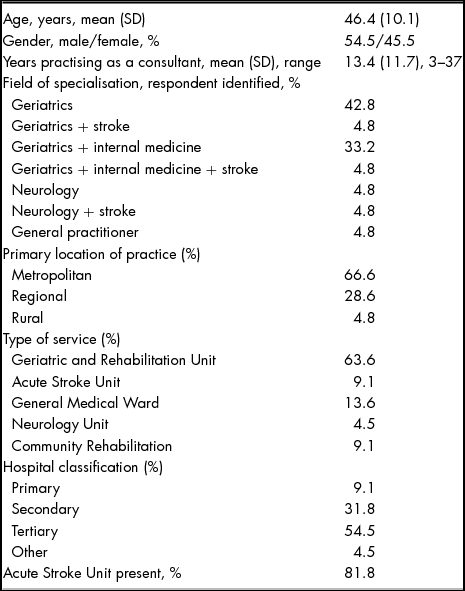
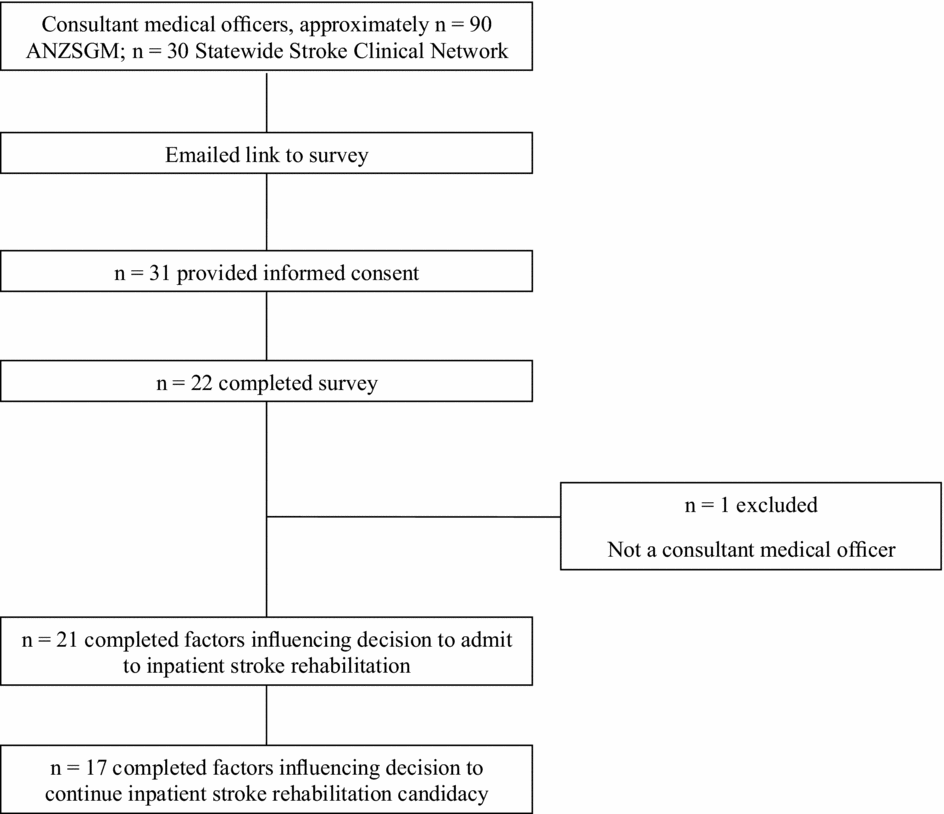
A total of 22 surveys were returned completed. An additional nine people accessed the survey, but did not complete the survey or identify reasons for non-completion (Figure 1). One survey was excluded as the respondent was not a CMO, which meant that 21 surveys were eligible for analysis. The response rate was 18/90 (20%) for ANZSGM and 4/30 (13%) for the Queensland Stroke Clinical Network (one respondent was identified as a member of both networks). Responses were found to cover 80% of all publically funded inpatient rehabilitation facilities in metropolitan Brisbane, Queensland, Australia. As shown in Table 1, on average, participants were 46.4 years old (SD 10.1) and had been CMOs for 13.4 years (SD 11.7). The majority of respondents practised primarily at a publicly funded facility (86%), located in metropolitan Brisbane (67%) within a Geriatric and Rehabilitation Service (64%), which had a co-located Acute Stroke Unit (82%). No respondents reported the use of an algorithm, set of criteria or tool for determining admission to or cessation of inpatient rehabilitation.
Demographics of Participants, n = 21

Flow of survey participants.
Admission to Inpatient Rehabilitation
Respondent-identified factors
Survey respondents identified 21 factors to favour their decision to admit a person with stroke to inpatient rehabilitation. The top four factors were related to the physical function of the person with stroke: good premorbid function (48% of respondents), younger age (33% of respondents), demonstration of a functional gain during acute hospitalisation (29% of respondents) and type of stroke (unspecified, 29% of respondents). Twenty-six factors were nominated to disfavour the decision to admit a person with stroke to inpatient rehabilitation. Similarly, the top three factors were related to the physical function of the person with stroke: poor premorbid functional capacity (38% of respondents), older age (24% of respondents) and severe disability post stroke (24% of respondents).
Pre-identified factors
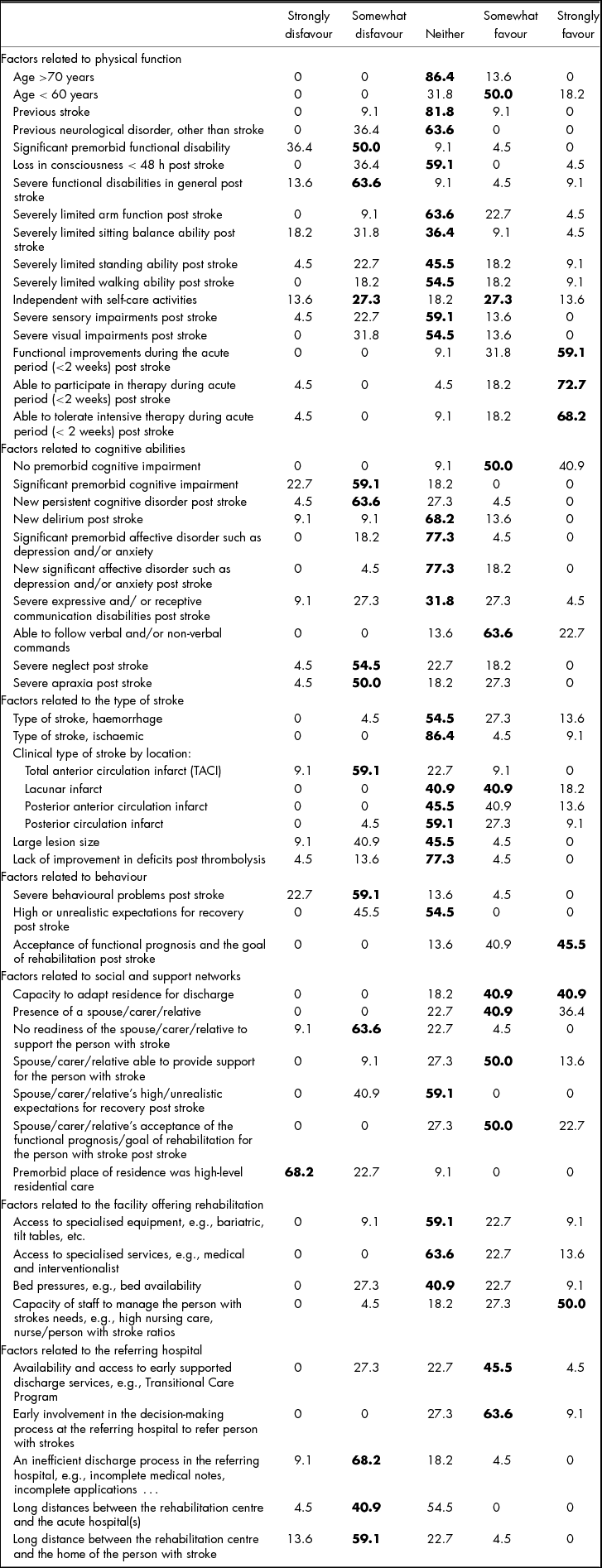
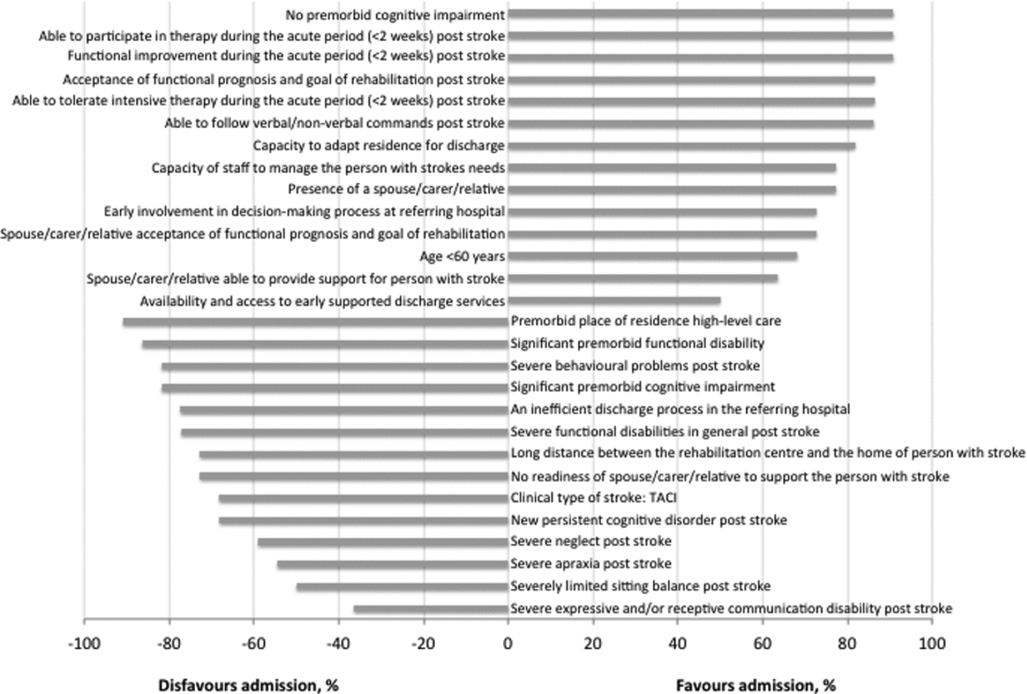
Table 2 outlines 54 pre-identified factors explored and the proportion of responses for each factor. Fourteen out of the 54 pre-identified factors investigated had a combined total proportion indicative of favouring the decision to admit a person with stroke to inpatient rehabilitation (Figure 2). The top three factors, rated by 90% of CMOs, were no premorbid cognitive impairment; ability to participate in therapy during acute hospitalisation (<2 weeks post stroke) and demonstration of functional improvements during acute hospitalisation (<2 weeks post stroke). Similarly, 14 factors had a combined total proportion indicative of disfavouring the decision to admit a person with stroke to inpatient rehabilitation (Figure 2). The top four factors, as indicated by more than 80% of CMOs were premorbid residence in high-level care; significant premorbid functional disability; severe behavioural problems post stroke; and significant premorbid cognitive impairment.
Impact of Pre-identified Factors in the Decision-making Process of Admission to Inpatient Rehabilitation, %. Bold Indicates Highest Proportion
Pre-identified factors reported to disfavour and favour the decision-making process related to admission to inpatient rehabilitation.
Continuation or Cessation of Inpatient Rehabilitation
Respondent-identified factors
Survey respondents identified 15 factors to favour continuation of rehabilitation. The most common factors were demonstration of continued improvements (94% of respondents), followed by a belief that engagement in rehabilitation might lead to a change in discharge level of care required (41% of respondents). Survey respondents identified 12 factors to favour cessation of inpatient rehabilitation. The most common response was a plateau or lack of demonstrated improvement (88% of respondents), followed by safe for discharge and can access ongoing rehabilitation requirements as an outpatient (47% of respondents).
Pre-identified factors
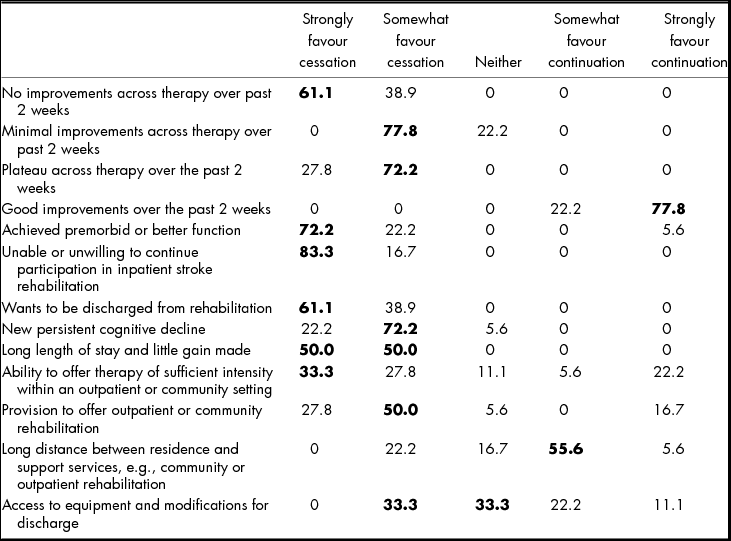
Thirteen pre-identified factors were presented to explore the continuation or cessation of inpatient rehabilitation (Table 3). Demonstration of good improvements over the past 2 weeks (77.8%) strongly favoured continuation of inpatient rehabilitation. Cessation of inpatient rehabilitation was favoured when no improvement had been made during therapy over the previous 2 weeks (61.1%), level of function was consistent with premorbid or better level (72.2%), the person with stroke was unable to continue to participate in inpatient rehabilitation (83.3%) or expressed a desire to be discharged from inpatient rehabilitation (61.1%). Finally, a long length of stay with little demonstrated functional gain (50%) favoured cessation of inpatient rehabilitation.
Impact of Pre-identified Factors in the Decision-making Process to Cease or Continue Inpatient Stroke Rehabilitation, %. Bold Indicates Highest Proportion
Discussion
The primary aim of this study was to identify factors that favour or disfavour admission to inpatient stroke rehabilitation in Queensland, Australia. Consultant medical officers surveyed most commonly identified factors related to the physical function of the person with stroke, along with the patient's social and support networks to favour admission. In contrast, factors identified to disfavour admission related not only to the physical function of the person with stroke, but also the presence of behavioural issues, capacity of staff to manage the needs of the person with stroke (e.g., high-level nursing care, nurse to patient ratio) and the patient's premorbid function. Factors that favoured continuation of inpatient rehabilitation included demonstration of functional gains, as well as the capacity and preference to continue to participate in inpatient rehabilitation. Cessation of inpatient rehabilitation was favoured when the functional status of the person with stroke had stabilised. While these factors were consistently identified across respondents, there was a multitude of factors that were rated with a high relative proportion.
Various factors were reported to influence the decision of the CMO to admit a person with stroke to inpatient rehabilitation from acute hospitalisation. Factors extended beyond the patient-related factors highlighted by prognostic studies (e.g., lower functional ability post stroke), and included non-clinical factors (e.g., premorbid place of residence, presence of social supports) and factors that may not have a relationship with rehabilitation outcomes or capacity to functionally benefit (e.g., geographical distance between acute and rehabilitation services). This is consistent with previous studies of factors influencing the decision to admit a person with stroke to inpatient rehabilitation (Kennedy et al., Reference Kennedy, Brock, Lunt and Black2012; Putman et al., Reference Putman, De Wit, Schupp, Beyens, Dejaeger, De Weerdt and Leys2007; Rodgers et al., Reference Rodgers, Dennis, Cohen and Rudd2003). Respondents of the current survey rated variables within all categories to have some influence on their decision-making process. This is consistent with a view that recovery after stroke is a highly individualised interaction between physical (e.g., severity of disability), personal (e.g., age, social support) and organisational factors (e.g., bed availability) (Prabhakaran et al., Reference Prabhakaran, Zarahn, Riley, Speizer, Chong, Lazar and Krakauer2008). Therefore, variation in the proportion of people admitted to inpatient rehabilitation from acute hospitalisation may stem from the multitude of factors to take into consideration during the decision to admit a person with stroke for inpatient rehabilitation. While absolute selection criteria are unlikely to be feasible (Wade, Reference Wade2003), there is a need for greater consistency in the decision-making process to improve equity of access to inpatient rehabilitation after stroke.
The Australian Stroke Coalition is an alliance of organisations and groups working in the field of stroke, united by their common mission to improve stroke care. This group has taken the initial steps to prompt greater equity in access to rehabilitation in Australia. They have developed a pathway and decision-making tool to support assessment for rehabilitation (Australian Stroke Coalition Rehabilitation Working Group, 2012), which was derived from a literature review and survey of hospital processes associated with assessment for rehabilitation. This tool was released after the conduct of the present study and thus explains why no CMOs reported its use in their practice. The strength of this tool is that it supports assessment of all people with stroke for rehabilitation, and provides a central avenue for screening and collation of information about possible factors that may contribute to the decision to admit a person with stroke to rehabilitation. However, use of the tool is voluntary, it does not provide guidance on the relative importance of possible factors, nor does it provide a structure to guide the admission decision. The current study provides information that may be useful to include as additional factors in future development of this tool, including ability to tolerate and participate in therapy.
Factors that determine, from the consultant's perspective, whether to continue or cease inpatient rehabilitation are ill defined in the literature. This study found that continuation of inpatient rehabilitation was favoured in the presence of continued functional gains, as well as the capacity and preference of the person with stroke to continue with active inpatient rehabilitation. It is not surprising that demonstration of a functional benefit from inpatient rehabilitation favoured continuation. Inpatient rehabilitation is a highly resource-intensive service, which is under continued pressure to deliver highly efficient and cost-effective services (Saxena et al., Reference Saxena, Ng, Yong, Fong and Gerald2006). In the absence of studies of cost benefit accrued from a patient engaging in inpatient rehabilitation as compared to another therapy model, e.g., community-based rehabilitation, a measure of efficiency applied is functional improvement relative to length of stay (Ng, Stein, Ning, & Black-Schaffer, Reference Ng, Stein, Ning and Black-Schaffer2007). Consistent with this, CMOs reported that cessation of inpatient rehabilitation was favoured when the functional status of the person with stroke had stabilised. However, the flexibility of this on a case-by-case basis, especially for those with severe functional deficits, warrants further investigation to explore equitable distribution of and access to services.
The unique contribution of this study is that it captures the spontaneous thoughts of CMOs who make the major decision about whether to admit a person with stroke to inpatient rehabilitation, and the subsequent cessation of that rehabilitation. Their views and practices are important because they are the gatekeepers to rehabilitation. However, the findings reflect their perspective of a single factor rather than the actual decisions made or the interplay between factors. To explore the dynamic decision-making processes used in clinical practice, a mix of field observations from an inception cohort, along with qualitative methods including interviews or focus groups, could be used to facilitate in-depth discussions about recent admission decisions and/or case scenarios from the perspective of CMOs from different fields of specialisation. This information would enhance our understanding of the dynamic nature of decision making.
The findings of this study must be considered in light of its limitations. Unfortunately, the response rate was low, despite considerable measures used in an attempt to increase the response rate. It is possible that the low response rate is a function of the cohort investigated, as other web-based surveys of CMOs working in this field have reported a response rate between 24 and 43% (New, Cameron, Oliver, & Stoelwinder, Reference New, Cameron, Oliver and Stoelwinder2011). Interestingly, no rehabilitation physicians responded. This may be reflective of practice differences between Queensland and other Australian states such as Victoria, where inpatient rehabilitation is serviced more frequently by geriatricians than by rehabilitation physicians (50% of inpatient rehabilitation is serviced by rehabilitation physicians in Queensland compared to 80% in Victoria) (National Stroke Foundation, 2012), or the networks used for recruitment. Finally, issues such as financial factors may have more relevance in countries that have greater privatisation of healthcare services.
Conclusion
In conclusion, many factors were highlighted to influence the decision of CMOs to admit a person with stroke to inpatient rehabilitation from acute hospitalisation in Queensland, Australia. Such variability indicates the need to explore options that will provide greater structure to this process and, therefore, ensure equitable and reliable distribution of services among people with stroke. In contrast, continuation or cessation of inpatient rehabilitation was largely related to the demonstration of continued functional benefit. This highlights the importance of providing as much opportunity as possible for active training during inpatient rehabilitation, so as to ensure optimal benefits from service usage.
Acknowledgments
Special thanks are given to the Queensland network of the Australian and New Society for Geriatric Medicine and the State-wide Stroke Clinical Network of Queensland for disseminating the survey to their members. K.S.H. was supported by an Australian Postgraduate Award scholarship and a co-funded National Heart Foundation National Stroke Foundation of Australia Biomedical Postgraduate Scholarship PB 09B 4847.
Conflict of interest
We declare that K.S.H., R.N.B. and S.G.B. are involved in a company developing a medical device to improve arm function after stroke (SMART Arm).