


1 Introduction
The examples in (1) instantiate one type of what are sometimes called movement paradoxes (e.g. Bresnan Reference Bresnan2001: 18). The point of interest here is the form of the verb in the preposed verb phrase.
- (1)
(a) We had both been thrown into the water to sink or swim, and swim we had – we had swum from very far apart. (attested; quoted in Ward Reference Ward1988: 193)
(b) They told him that he had to be there all day long and be there all day long he has! (constructed; from Ward Reference Ward1988: 193)
(c) They provided us with enough beer to drink all day long, and drink all day we have! (constructed; from Ward Reference Ward1988: 193)
(d) We had to stand firm, and stand firm we have! (constructed; from Ward Reference Ward1988: 193)
What makes constructions like those italicised in (1) appear paradoxical is that they seem to result from verb phrase preposing based on canonical structures where the main verb would have to be a perfect participle as traditionally conceived.
- (2)
(a) we had {swum / *swim}
(b) he has {been / *be} there all day long
(c) we have {drunk / *drink} all day
(d) we have {stood / *stand} firm
Oku (Reference Oku, Green and Motapanyane1996, Reference Oku1998) and Urushibara (Reference Urushibara, Ukaji, Nakao, Kajita and Chiba1997), the only authors to have published attempts at a grammatical derivation of this phenomenon so far (see section 2 below), refer to it as the ‘perfective participle paradox’. Following Huddleston (2002), among others, I conceive of the English perfect as a (secondary) tense, not an aspect, and I prefer to use the term perfective for an aspectual category that is not instantiated in the English aspect system. Consequently, I opt for the term perfect participle paradox, henceforth abbreviated as PPP.
As will be shown, sentences exhibiting the PPP cannot be dismissed as ungrammatical. They instantiate a genuinely grammatical phenomenon of present-day standard English which, ultimately, has to be accounted for within some – preferably explicit – theory of grammar,Footnote 2 just like any other phenomenon of natural language grammar. The present article aims at contributing to the foundations for full and explicit accounts of the PPP within grammatical frameworks of a broadly generative type featuring syntactic movement operations, rather than providing such an account itself. It does so by arguing, first, that the PPP is incompatible with two widespread assumptions about the architecture of grammar: (a) the assumption that the elementary building blocks of syntactic structures are items (inflected word forms or morphemes) that are drawn from the lexicon provided with a phonological representation, and (b) the assumption that syntactic operations cannot manipulate the content of these items. This strand of argument is foundational in the sense that it restricts the range of grammatical frameworks within which comprehensive accounts of the PPP can be attempted. As a second strand of argument, the article provides some analytic ideas that may be fruitfully drawn on in such accounts. The central point here is that, although the two assumptions just mentioned have to be discarded in view of the PPP, this does not entail a superiority of distributed morphology (DM) (and related frameworks), where they are discarded too, over those approaches that some proponents of DM explicitly oppose (i.e. ‘lexicalism’).Footnote 3
In section 2 I will present more attested examples of the PPP extracted from corpora and I will refer to the literature where the PPP has been discussed. In section 3 I will discuss the incompatibility of the PPP with the two assumptions about the architecture of grammar mentioned above. Section 4 presents some ideas of how the PPP may be accounted for so that its paradoxical character disappears, avoiding these assumptions. The brief section 5 glances at another area of the grammar of English where the idea underlying the account provided for the PPP might be fruitfully employed for an explanation. Section 6 concludes the article.
2 The perfect participle paradox
Judging from the references to the relevant literature in Oku (Reference Oku, Green and Motapanyane1996, Reference Oku1998), it appears that Ward (Reference Ward1988: 192ff.) was the first to explicitly point out and comment on the peculiarity of the PPP (see also Breul Reference Breul2004: 176ff.); there are earlier mentions in the literature of examples that show the phenomenon, but no accompanying comments as to its surprising morphological characteristics. Oku (Reference Oku, Green and Motapanyane1996, Reference Oku1998) and Urushibara (Reference Urushibara, Ukaji, Nakao, Kajita and Chiba1997) provide some discussion of it and make explanatory proposals; nothing else that would amount to an account seems to have been published. I will comment on Oku's and Urushibara's analyses of the PPP later in this section.
(4) and (5) below and the Appendix provide passages containing all those instances of the PPP from the Corpus of Contemporary American English (COCA; ~450 million words of American English) and the British National Corpus (BNC; ~100 million words of British English) that were retrieved (25 September 2012) by using the search strings in (3) followed by manual filtering the relevant hits:Footnote 4
- (3)
(a) and|but [v*] [p*] [have] [y*]
(b) and|but [v*] * [p*] [have] [y*]
(c) and|but [v*] * * [p*] [have] [y*]
For (3a) this means that the search tool produced hits where and or but is followed by an expression that is tagged as any kind of verb form, followed by an expression that is tagged as a pronoun, followed by a form of have, followed by punctuation. The search strings in (3b, c) differ from (3a) only in that they have one or two ‘*’ between ‘[v*]’ and ‘[p*]’, with ‘*’ matching any expression (including punctuation) separated from the preceding text by a blank.
(4) COCA:
(a) “They’re everywhere,” the source said, “just sitting there, waiting for him to slip,” and slip he has. When the same newspaper recently published a list of unofficial trips taken by the White House Chief of Staff on military jets, the long knives came out.
(b) And that kind of sense, which is really built in to the American character, is exactly what is necessary for science to prosper. And prosper, it has, and we are still by any measure the leading scientific nation in the world.
(c) As manager of America's biggest stock fund, the $15 billion Fidelity Magellan, Morris Smith has more than a passing interest in picking stocks that will bring above-average returns. And pick them he has. Since he took control of Magellan from Peter Lynch last May 31, Smith's track record has been impressive – a total return for Magellan of 8.6% through mid March, versus 6.3% for the Standard & Poor's 500.
(d) By being in his position, he was able to buy in KEENANFootnote 5And buy in he has. In deal after deal, Bronfman has called the shots in more than $50 billion worth of transactions in recent years, selling DuPont to pay for Universal Studios, selling Tropicana orange juice to by music leader Polygram.
(e) “To accept such precious gifts when one has nothing to give in return is humbling,” says Noonan. “The roadside garden was created because of a desire to return something to others.” And return something she has. Under a sign that reads “Free Vegetables” grow Swiss chard, lettuces, parsley, radishes, radicchio, and potatoes.
(f) “I have always tried to serve the King,” Paulus said. “And serve the King you have,” Mario said with a smirk.
(5) BNC:
(a) There seemed hardly time for anyone to wander off, but wander she had, and she had come to swinging happily on a swing in the park playground.
(b) I don't know how he found out that she belonged to that lass, but find out he has. God help her!
The instances in (6) are those in the COCA that were found by using the search strings in (3) and that show the construction with a canonical perfect participle. There is no corresponding occurrence in the BNC.
- (6)
(a) If Jaffa is opposed to judicial activism, why does he devote his time and energy to reviling its two most prominent and effective opponents in the past half-century – excepting possibly only Learned Hand and the newer arrivals, Justices Scalia and Thomas? How is the public interest served by that? And reviled them he has. His campaign against them has been shabby because he has attacked them not as a friendly critic or a disinterested scholar but personally, bitterly, and arrogantly.
(b) She never understood where she’d gotten the nerve to go to his room that night, but gone she had, Vana's cry of “You must be totally crazy!” going unnoticed.
(c) If I hadn't set up an extra, hidden cache while I’d been in the bank, I wouldn’t have even known that she’d used the room membrane. But used it she had. She’d not only tapped into the highly-protected prison database, she’d broken into its most secret files.
(d) Making concessions to terrorists provides an incentive for the commission of further acts of terrorism. Whatever else the U.S. government understood about the issue, it felt safe in clinging to that basic wisdom, and clung it has, even as terrorism has changed and appreciation of the problem has become far more sophisticated than it was in 1973.
(e) One death is a tragedy, a million deaths is a statistic. The ka must act when consensus can not be used, and acted she had. The millions of plants in this oasis had sustained the crew-kindred, had sustained what remained of her sanity, for this long journey.
The cases in (7) (both from the COCA) are ambiguous as to whether they instantiate the PPP or not.
- (7)
(a) “It is all psychobabble,” he said late last week. “I didn't need to come back to New York.” But come back he has, and by combining the retail network of Bank One with Morgan Chase's investment-banking power, Dimon is setting up what will arguably be the only broad, financial-services behemoth that can give his alma mater a serious run for its money.
(b) “But it wasn't all wonderful. And I wanted to put it all out there so people – especially the young people – would know you can do and be and overcome anything.” And overcome she has. The youngest of four children (two boys and two girls), she was born on August 29, 1944 into what she calls “the poorest house in Greenwood.”
Against the background of the very low frequency of verb phrase preposing in general, the ratio of examples that show the PPP and those that do not suggests that the PPP is a genuine morphosyntactic phenomenon, and that it is not a spurious linguistic pseudo-fact due to performance errors or typos. However, the acceptance of instances of the PPP and of their canonical counterparts is subject to variation. The scant discussion in the literature of the patterning of this variation is completely inconclusive, though.Footnote 6 It is thus not surprising that the brief note on the PPP in the Cambridge Grammar of the English Language (Huddleston & Pullum et al. Reference Huddleston and Pullum2002) within the chapter on ‘Information packaging’ (Ward et al. Reference Ward, Birner and Huddleston2002) is also vague in this respect. The authors give the examples in (8) below and write: ‘Although have normally takes a past participle, it is the plain form of the verb that is preferred in [(8a)]. The past participle is preferred in [(8b)], where it has been used in the preceding clause, but even here the plain form tell is acceptable’ (Ward et al. Reference Ward, Birner and Huddleston2002: 1381).
- (8)
(a) He said he wouldn't tell them, but {tell / told} them he has.
(b) He denies he has told them, but {tell / told} them he has.
Note in this context that in most of the attested examples of the PPP documented in the present article (including the Appendix), a word form that is identical or homophonous to the plain form of the preposed verb is mentioned in the preceding context, but that this potentially conditioning factor for the appearance of the preposed plain form is not present in examples (4c), (5b) as well as (b), (c) and (j) of the Appendix. Conversely, in (6b), a canonical perfect participle is used in the preposed verb phrase while the corresponding plain form appears in the immediately preceding context.
There is the PPP, but there is no corresponding passive participle paradox. Preposing a passive verb phrase headed by the plain form of a verb appears never to be grammatical. The four examples of preposed passive verb phrases from the COCA and the BNC retrievable by using the search string ‘and|but [v*] [p*] [be] [y*]’ are given in (9), where the plain verb forms instead of the participle forms would be ungrammatical.
(9) COCA:
(a) So on a Saturday night last May, Al's became, for a brief moment, the place for Manhattan's beau monde to be featured. And featured they were, the next Sunday in the style section of The New York Times, a week later in The New Yorker, and a week after that in Newsday.
(b) There's a mystery here, which has always struck Stanush himself as strange: why lift entire paragraphs from a 1946 Life magazine article so successful that it was excerpted in Reader's Digest unless you actually plan to be caught? And caught she was, in the most public way: on April 2, 1949, six weeks after her Collier’s story appeared, The New Yorker published two columns [u]nder the heading “Funny Coincidence Department.”
(10) BNC:
(a) It will never be known how Jarman was caught, but caught he was, and condemned to hang.
(b) They call them battered babies now, I don't think we did then. But battered she was, the poor kid, and by her own father.
The key claim of Oku Reference Oku, Green and Motapanyane1996 is what he calls ‘Licensing by Empty VP’: ‘[t]he feature of perfective have, but not the feature of progressive be, can be checked by some feature of an empty VP’ (Oku Reference Oku, Green and Motapanyane1996: 288). The idea here is that the perfect participle affix is the exponent of the feature that checks the matching perfect feature in the auxiliary; this affixal feature and consequently its exponent is not needed in PPP cases, since here the VP is moved away from its canonical position, leaving a trace. The trace counts as an ‘empty VP’ and contains a feature capable of checking the perfect feature of the auxiliary. To me this account does not seem convincing. There is no plausible theory of how the trace may come to have the relevant feature, given that it is obviously not already contained in the plain form of the verb or the phrase projected by it.
Urushibara (Reference Urushibara, Ukaji, Nakao, Kajita and Chiba1997) takes an approach according to which the perfect participle
is derived after spell-out at the level of Morphological Structure . . . proposed in Halle and Marantz (Reference Halle, Marantz, Hale and Keyser1993). At that level the features of the perfective have and the head of VP which is string-adjacent to have are spelled out as have-perf[ective participle] . . . [The perfective participle] is derived by a word formation rule in the sense of Anderson (Reference Anderson1992), applying to the string-adjacent have and the head of VP . . . (Urushibara Reference Urushibara, Ukaji, Nakao, Kajita and Chiba1997: 130)
Thus, her point concerning the PPP is that there is no perfect affix in the first place so that no perfect participle gets realised whenever the head of the VP and the perfect auxiliary are not string-adjacent,Footnote 7 as in PPP cases and pseudo-clefts like What he has done is {write / *written} a book,Footnote 8 while a perfect affix does get realised under string-adjacency with the auxiliary. Transposed into a more recent version of the distributed morphology approach taken by Halle & Marantz (Reference Halle, Marantz, Hale and Keyser1993), on which Urushibara partly relies, we may say that she treats the perfect participle affix as a piece of ornamental morphology (see Embick & Noyer Reference Embick and Noyer2007: 305ff.). Such pieces are assumed to be inserted at the syntactic interface to the articulatory-perceptual (or sensorimotor) system (PF) and ‘merely introduce syntactico-semantically unmotivated structure and features which “ornament” the syntactic representation’ (Urushibara Reference Urushibara, Ukaji, Nakao, Kajita and Chiba1997: 305). This is an idea that, technically, seems to work, given that one accepts the existence of ornamental morphology, which does not appear to have been backed up by a sufficient amount of research yet. There is another observation that makes me sceptical, though. One would expect such a piece of ornamental morphology to be rather systematically missing in a substantial range of the present-day varieties of English and at a certain stage during first language acquisition. As concerns varieties of English, there are only occasional references to varieties showing variable use of unmarked or uninflected perfect (or past or second) participles in canonical perfect tense contexts, and the cases in point are likely to be due to the influence of other languages spoken alongside English.Footnote 9 As concerns first language acquisition, I have found no mention in the literature of a stage where the plain form of a verb is characteristically used in perfect tense contexts. This may of course point to a gap in the research rather than support the claim of a lack of such a stage. But I take it to be unlikely that the existence of such a characteristic feature in the acquisition of English as a first language would have escaped the researchers’ notice or that they would have considered it unworthy of comment.Footnote 10 In view of the overall pervasiveness of inflected perfect participles, it appears improbable for the perfect affix to be a piece of ornamental morphology.
The account in Oku (Reference Oku1998) is different from his 1996 account. Similarly to Urushibara (Reference Urushibara, Ukaji, Nakao, Kajita and Chiba1997), Oku assumes that it is the plain verb form that enters the syntactic derivation of perfect tense clauses and that the canonical perfect morphology comes about by a word formation rule that operates on the plain verb form under adjacency with the auxiliary have in ‘the PF/Morphology component’ (Oku Reference Oku1998: 26). Different from Urushibara (Reference Urushibara, Ukaji, Nakao, Kajita and Chiba1997), he argues that a ‘“fronted” VP is base-generated in its surface position and lowers to the complement position of the Aux/Infl in the LF component, to satisfy the selectional property of the Aux/Infl’ (Oku Reference Oku1998: 28); as in this case the verb and the auxiliary are never adjacent in overt syntax, the relevant word formation rule does not operate and we get the PPP. In order to explain the existence of cases of VP-initial clauses where the PPP does not manifest itself, Oku (Reference Oku1998: 29) assumes that alternatively to a VP base-generated in clause-initial position there is a derivation where a VP is moved into clause initial position. This, however, creates a strong awkwardness in the account, for it presupposes that the operation of the ‘PF/Morphology’ word-formation rule precedes VP movement. Oku's (1998) account on the whole seems extremely contrived. Especially the idea that selectional requirements, which in any case involve purely formal selection, may be satisfied by lowering a phrase at LF is hardly compatible with any version of generative syntax. It amounts to the possibility of covertly merging a phrase into a position lower down in the syntactic tree that needs to be filled due to formal requirements, but has been kept open until the end of the derivation. This would be an extremely powerful mechanism that would have to be massively constrained in order to prevent a host of ungrammatical constituent orders at the syntactic surface. Base-generation of the preposed verb phrase in clause-initial position has to be dismissed in a generative framework.
3 The PPP and two (allegedly lexicalist) assumptions
In generative syntactic theories couched within the frameworks of principles and parameters or the minimalist programme, in which clauses with verb phrase preposing are derived by remerging (moving) the verb phrase into clause-initial position, the PPP, as exemplified again in (11), is problematic for two assumptions.
- (11)
(a) And he has helped them.
(b) And help them he has.
(c) *And he has help them.
Assumption 1:
A syntactic terminal is a fully inflected word form or a morpheme that comprises a phonological representation (phonological matrix, phonological form).
I.e. a participle like helped in (11a), or its components help and -ed, enter the syntactic derivation as lexical units in the sense that they consist of a pairing of a semantic and syntactic representation on the one hand with a phonological representation on the other hand.
Assumption 2:
Syntax may not manipulate the internal structure of syntactic terminals.
I.e. a participle like helped in (11a), or its components help and -ed, enter the syntactic derivation as complexes of semantic and syntactic and potentially phonological features that cannot be manipulated by syntactic operations other than syntactic feature checking or feature valuation.
Assumption 1 underlies all syntactic theories in which a syntactic terminal is conceived of as a linguistic (Saussurean) sign,Footnote 11 i.e. as a unity consisting of a phonological form associated with a syntactic-semantic form, stored in the lexicon and made available to the syntactic system by the lexicon. It is what Chomsky (Reference Chomsky1995: 239), for instance, presumes, ‘unless there is strong independent reason to the contrary’, when he writes:
A separate question is the form in which the information should be coded in the lexical entry. Thus, in the case of book, the optimal representation in the lexicon could include the standard phonological matrix PM, or some arbitrary coding (say, 23) interpreted within the phonological component as PM – presumably the former, unless there is strong independent reason for the latter.
Assumption 2 is reminiscent of the lexical integrity hypothesis, which says, in the words of Anderson (Reference Anderson1992: 331), that ‘syntax neither manipulates nor has access to the internal structure of words’. According to Anderson (Reference Anderson1992: 84), this assumption is what characterises the maximally strong form of the lexicalist hypothesis. The formulation chosen here is supposed to cover theories in which the syntactic terminals are morphemes, theories in which the syntactic terminals are stems and inflectional morphemes, and theories in which they are (potentially inflected) word forms.
Let us consider first why these assumptions are problematic if they are held in conjunction. If, according to Assumption 2, during the syntactic derivation, there cannot take place a manipulation of the phonological features of the lexical item helped, which are part of it according to Assumption 1, or of the item -ed in case that help and -ed are assumed to be separate lexical items, then (11b) ought not to be possible. Note that calling helped and help two syntactically conditioned alloforms, that is, saying that the semantic and syntactic features of the perfect participle are lexically associated with two matrices of phonological features so that we have two perfect participles available as lexical items in the sense of Assumption 1, would not do. At least, it would not do, if we do not want to say that either the lexicon or the syntactic system can ‘look ahead’ so that they already ‘know’ what the ultimate syntactic structure will look like and can provide or select the lexical items the syntactic system has to work with accordingly. The assumption of such a look-ahead property is to be dismissed as it would ascribe exactly that piece of ‘knowledge’ to the lexicon or the syntactic system that is to be described and explained.
Would it be possible to maintain Assumption 2 while dismissing Assumption 1? It would not, for the following reason: if the lexical item that is realised as help can satisfy the syntactic requirements in (11b), then (11c) ought to be possible, since the syntactic features of help that are addressed by the syntactic operations which lead to the underlying syntactic structure of (11b) before verb phrase preposing are identical to those that are addressed in the derivation of (11c), as are the syntactic operations themselves. Consequently, Assumption 2 can be ruled out in any case.
So, does the existence of the PPP rule out both assumptions? Not immediately. The reason is that we have to reckon with the possibility of PF-operations. If Assumption 2 is dismissed while maintaining Assumption 1, it is possible in principle to argue that verb phrase preposing entails a manipulation of the phonological feature matrix of the participle so as to ultimately result in the plain form. More specifically, there may, in principle, be a set of rules operating on phonological forms which convert, for instance, lived into live, landed into land, dwelt into dwell, bent into bend, shown into show, driven into drive, drunk into drink while they do not do anything to bet, come, run etc. Apart from the fact that we would need quite a battery of such rules, some of them operating only on a single item, this approach does not seem promising for another, more important reason: it would treat the fact that the output of the rule is the plain form of the verb as accidental. This is unlikely to be correct, and thus I will not pursue this line of approach any further. We are left with a rejection of both Assumptions 1 and 2.
A rejection of both Assumptions 1 and 2 is what is maintained by distributed morphology (DM) – DM heralds late phonological insertion into abstract non-root morphemes, in some versions also into roots (recall footnote 2 above), and allows for operations such as impoverishment, fusion and fission, i.e. operations within the syntactic component that do manipulate the feature composition of morphemes. Proponents of DM tend to mention at least one of these aspects of their approach in positioning themselves as opponents of lexicalism or lexicalist approaches (see e.g. Halle & Marantz Reference Halle, Marantz, Hale and Keyser1993: 111ff.; Marantz Reference Marantz, Dimitriadis, Siegel, Surek-Clark and Williams1997; Harley & Noyer Reference Harley and Noyer1999; Embick & Noyer Reference Embick and Noyer2007: 289ff.). At least one avowed lexicalist, however, Edwin Williams, explicitly denies that lexicalists are bound to Assumption 1 or 2. Williams (Reference Williams2007: 359) identifies the adherence to the following grammar-architectural idea as the only characteristic of DM that distinguishes it from lexicalism: ‘Phrases are built (directly) out of morphemes, with no intervening notion of word.’ This is the idea that has also become known as ‘Syntactic Hierarchical Structure All the Way Down’ (Harley & Noyer Reference Harley and Noyer1999: 3). While the questions whether Assumptions 1 and 2 are correct and whether ‘syntactic structure all the way down’ is correct are ultimately essential, it is does not matter what the theoretical positions that are characterised by (non-)adherence to any combination of these assumptions are called. I will provide an analysis of the PPP that is compatible with any position that rejects Assumptions 1 and 2.
4 Analysis
In terms of theories that work with the notion ‘lexeme’, the following fact of English is well known: the forms that are commonly distinguished as perfect participles on the one hand and passive participles on the other depending on their syntactic contexts are identical for every verb lexeme. Consequently, it has been maintained by some researchers (e.g. Ackema Reference Ackema1999; Guéron Reference Guéron2007: 375ff.; Ackema & Marelj Reference Ackema, Marelj, Everaert, Marelj and Siloni2012) that there is only one participle associated with each verb that gets realised in both a perfect and a passive context (the identity view), while other researchers conceive of the two participles as different, though homophonous items (the non-identity view).Footnote 12 As I have not yet seen a fully developed and convincing elaboration of the identity view, I am agnostic with respect to this issue and thus have to take into account both possibilities in what follows.
Concentrating on the purely syntactic aspects of the relation between auxiliary and participle, (13) can be taken to be an abstract partial representation within a feature-checking framework of generative syntax of the structure of canonical finite perfect tense clauses such as those in (12) at some point in their syntactic derivation.Footnote 13
- (12)
(a) He has watched it.
(b) They have been watching it.
(13)


In this tree structure the terminal designated Aux is an item that contains, among other features, the formal feature [Fpart] which is checked against a c-commanded matching [Fpart]. The feature [perf] in Aux represents whatever it is exactly that provides the perfect tense interpretation, possibly in combination with the semantics of the participle. The matching lower [Fpart] is contained, among other features, in the item that gets realised as the participle. In an approach where the phonological exponents are inserted late, we have to say that formal features are uninterpretable at LF and that checking them renders them invisible at LF while keeping them visible for PF such that they can signal which phonological exponents have to be inserted. (The strikethrough notation is intended to express this.) In cases like (12), Aux raises to a higher ±Past-head and merges with it so as to form a complex head. This is followed by an operation by which subject-verb agreement is generated, ultimately resulting in one of the forms have, has or had.
The structure corresponding to (13) for passives such as those in (14) differs from (13) by at least the fact that the passive Aux does not contain [perf]; see (15).
- (14)
(a) It was built by them.
(b) It has been built by them.
(c) It is being built by them.
(15)

Under the identity view of the perfect and corresponding passive participle, the Part-items in (13) and (15) are identical. Under the non-identity view there are several possibilities where the differences between them may lie. Their [Fpart]-features may be different, or their sets of semantic features may be different, or both.
The approach to the syntactic derivation of perfect and passive participle constructions just hinted at is only one out of several that can be taken (recall footnote 12 above). What I think is necessary and thus essential in more general terms is this: first, we need some feature in the constituent called Part in (13) and (15) which, at the end of the syntactic derivation, serves as a signal for the insertion of the appropriate phonological exponent; second, we need some mechanism that ensures that the Part constituent or a constituent projected by it can be merged with all and only those heads whose merger results in the perfect tense or passive voice interpretation. How this ought to be ultimately implemented is also dependent on many issues that have nothing to do specifically with perfect and passive participles.
The tree structures in (16) zoom in on the unanalysed structural domain below Part in (13). The three options (a, b and c) reflect three families of approaches to conceiving of the internal structure of Part.
(16)
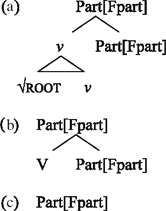
(16a) is the structure that corresponds to assumptions that are held in DM approaches, where the terminal marked √root is a variable for roots as conceived of in DM. The abstract morpheme v merges with the root and projects a verb.Footnote 14 The terminal labelled Part is an abstract and projecting morpheme containing the feature [Fpart]. Abstract morphemes do not come with a phonological representation in DM. Roots are characterised by Embick & Noyer (Reference Embick and Noyer2007: 295), as ‘sequences of complexes of phonological features’ and as ‘language specific combinations of sound and meaning’, which means that in the version of DM described by these authors in this article phonological insertion happens pre-syntactically for roots. In other versions, however, late phonological insertion holds for roots as well as for abstract morphemes (see e.g. Embick Reference Embick2010: 192, note 1 to chapter 2, and footnote 2 above). In any case, the phonological combination of the phonological matrix of the upper v with that of Part results in the traditional participle.
(16b) is the structure that corresponds to a view of the item with which Part merges as specified by at least semantic and syntactic features. That is, it is a lexical item in the sense that it contains, alongside semantic and syntactic features, a syntactic categorial feature or a combination of categorial features, or in the sense that its distributional properties are determined by its set of syntactically relevant features (on this last mentioned view see Rauh Reference Rauh2000a, Reference Rauh and Janßen2000b, 2010: 144). The Part morpheme is the projecting head of the structure. Depending in principle on the stand one takes with respect to early or late phonological insertion, the phonological forms of V and Part are either present right at the beginning of the syntactic derivation or inserted post-syntactically, with V and Part potentially being treated differently in this respect. If lexicalism is conceived as discussed by Williams (Reference Williams2007) (see above), then (16b) represents the various versions of the lexicalist position that distinguish themselves by whether there is phonological late insertion or not, and by whether the merger of V and Part is supposed to be formed by what Williams (Reference Williams2007) calls the phrase system or by what he calls the word system. Note again that, seen from Williams's (2007) perspective, the issue between lexicalism and DM is the status of the item labelled ‘V’ in (16b). Lexicalism treats V as an item that is supplied to the phrase system by the word system, these two systems being different in nature. Note also that in view of the PPP I have already ruled out the possibility that the complete phonological representation of what constitutes the top node of the structure in (16b) is already present when the node is addressed during the syntactic derivation in the phrase system.
(16c) is intended to reflect a word-based conception of participial morphology, where there is actually no structure at all below what is labelled Part in (13), no participial affix in the traditional sense and no verb stem in the traditional sense. The participle is made available by the lexicon to syntactic computation without there being any units in the lexicon below the level of the word form. Probably, this is a lexicalist position from anybody's point of view. In principle, it may also be held with different assumptions about when the phonological representation is associated with the semantic-syntactic one, just like the several varieties of lexicalism in Williams's sense covered by (16b). But again, in this article it is argued that the PPP requires a version of the approach reflected by (16c) where phonological late insertion is assumed.
As far as (16a) is concerned, the pairings in (17) between the semantic and syntactic representation of the terminal Part morpheme and its phonological representation can be assumed (see Bloch Reference Bloch1947; Carstairs-McCarthy Reference Carstairs-McCarthy1994: 746ff.).
(17)

Footnote 15 Certain phonological conditions obtaining, the phonological form /d/ is automatically changed to /t/ (e.g. kissed) or /id/ (e.g. waited), while /n/ is changed to /әn/ (e.g. eaten).
Note that there are some participles whose phonological form does not follow correctly from the correspondences given in (17) plus possible automatic phonological changes. This holds, for example, for borne, bound, bought, done, drunk, driven, had, said etc. Most of these are participles that involve a stem alternation alongside the phonological attachment of the exponents mentioned in (17). These would have to be accounted for by readjustment rules (see Halle & Marantz Reference Halle, Marantz, Hale and Keyser1993: 124ff.).
In the family of approaches represented by (16b), the pairings given in (17) can also be resorted to, in combination with either readjustment rules or appropriate pairings for phonological insertion into V.
In the approach represented by (16c), for which the PPP entails phonological late insertion, too, the pairings of the phonological with the semantic and syntactic representation of the participles will have to be as in (18) (where orthographic forms are used to represent phonological forms).
(18)
The automatic phonological changes apply here as well, while the effect of readjustment rules is achieved by listing.
What happens in the derivation of sentences that show the PPP, then? What happens is something that has been conceptualised in DM as impoverishment. According to Embick & Noyer (Reference Embick and Noyer2007: 311),
[w]hen Impoverishment occurs, a feature of a morpheme is deleted in a specific context; after deletion the morpheme in question escapes the insertion of any vocabulary item requiring that feature. The effects of Impoverishment are usually seen when in some particular circumstance a category fails to exhibit the expected exponent but instead exhibits a default exponent. This gives the effect of forms which ‘appear to be what they are not’.
Thus, as the key to the solution of the PPP, I suggest that the checked [Fpart] that is contained in Part is deleted when the verb phrase is preposed.Footnote 16 This solution presupposes late phonological insertion into the terminal Part nodes in all three approaches represented by (16a–c). The formulation of the impoverishment rule is dependent on whether one considers a perfect participle and its corresponding passive participle to be identical or not. The reason is that, as was pointed out earlier, preposed verb phrases involved in passive constructions never exhibit the PPP. Under the non-identity view one option of formulating the impoverishment rule is (19), which leaves passive participles unaffected.
(19) [Fpart] contained in Partperf is deleted (i.e. [Fpart → ø]) iff Partperf is not locally c- commanded by Aux[perf].
This will not do for the identity view, for then there is no Partperf distinct from Partpass, and [Fpart] is locally c-commanded by Aux[perf] neither in a canonical passive construction, nor where the passive verb phrase is preposed so that the rule would wrongly apply in these contexts too. A formulation which appears to work under the identity view is (20).
(20) [Fpart] contained in Part is deleted (i.e. [Fpart → ø]) iff Part moves out of the local c-command domain of Aux[perf].
I must leave the problem of deciding between these alternatives to future research.
Anyway, in the approaches represented by (16a and b), the rule has the effect that no specified phonological exponent can be inserted into the abstract Part morpheme that requires the presence of [Fpart]. Adopting an idea expressed by Halle & Marantz (Reference Halle, Marantz, Hale and Keyser1993: 133ff.) (as many do), I assume that the null exponent is the default for those cases where there is no specified and listed phonological representation for an abstract syntactic terminal. That is, inserting the default null exponent into the Part morpheme after the operation of rule (19) or (20) results in the Part word having the phonological make-up of the plain form of the verb. In an approach as represented by (16c), a rule or pattern will have to be postulated to the effect that any participle from which [Fpart] has been deleted is paired with the phonological form that corresponds to its plain form, i.e. (21).
(21)

As pointed out earlier, the PPP appears to be subject to idiolectal variation, perhaps also dialectal variation.Footnote 17 Moreover, as pointed out by Oku (Reference Oku, Green and Motapanyane1996: 13, 56), there appear to be discourse conditions which either favour or disfavour the manifestation of the PPP. I thus consider the rule in (19) or (20) to be an optional one.
What may be the reason why there is an impoverishment rule that affects participles in perfect tense contexts but not in passive contexts? If we extend the question by taking the progressive participle into account as well and asking why impoverishment does not affect all participles in verb phrase preposing, we may, as Oku (Reference Oku, Green and Motapanyane1996) does, invoke potential ambiguity avoidance.Footnote 18 That is, impoverishment applying to all participles in verb phrase preposing would leave us with potential ambiguities as in (22) (constructed by me, CB), which the system arguably avoids.
(22) The images of the eating and eaten shark would terrify me for the rest of my life, *but eat it was. (‘. . . but eaten it was.’ or ‘. . . but eating it was.’)
In the impoverishment approach, however, this consideration cannot play a role if we restrict ourselves to the original question concerning perfect and passive participles only. For if impoverishment applied to these, but not to progressive participles, then cases like (22) would not be ambiguous. They would still be unambiguously passive due to the auxiliary. Moreover, actual occurrences of ambiguities like that in (22) which cannot be pragmatically resolved are very probably much too infrequent in performance to be able to put functional pressure on the structure of the grammar along the lines of ambiguity avoidance in the first place (given that one grants the influence of functional pressure on the diachrony and ontogenesis of grammar in general). Thus, a different tack has to be taken.
Let us consider first where those features are located that cause a clause to be interpreted as a clause with perfect tense and as a clause in the passive voice respectively. Are they located in the perfect or passive auxiliary or in the perfect or passive participle? That is, considering (23),
- (23)
(a) The shark has eaten.
(b) The shark was eaten.
(c) The shark has been eaten.
is the feature complex that causes (23a) to be interpreted as perfect located in has (perfect auxiliary) or in eaten (perfect participle)? Is the feature complex that causes (23b) to be interpreted as passive located in was (passive auxiliary) or in eaten (passive participle)? Is the feature complex that causes (23c) to be interpreted as perfect located in has (perfect auxiliary) or in been (perfect participle)? Is the feature complex that causes (23c) to be interpreted as passive located in been (passive auxiliary) or in eaten (passive participle)? Note that, as exemplified by (23c), a form may be a participle and an auxiliary at the same time.
Urushibara (Reference Urushibara, Ukaji, Nakao, Kajita and Chiba1997: 133) observes that in English participial constructions ‘pres[ent participle] and pass[ive participle] can stand alone, but not perf[ective participle]’. She presents the examples in (24), to which I add those in (25).
- (24)
(a) Using a spelling checker, John can now submit typo-free papers.
(b) (Being) used by the millions, the spelling checker has proved to be very helpful.
(c) *(Having) used a spelling checker, John was able to submit a typo-free paper.
(d) Leaving for Paris, John decided to sell his house.
- (25)
(a) Eaten, the shark does not terrify them anymore.
(b) Having eaten, the shark does not terrify them anymore.
(c) *(Having) been eaten, the shark does not terrify them anymore.
Indeed, auxiliaryless eaten in (25a) can only be interpreted as a passive participle; it would need an accompanying perfect auxiliary in order to be interpreted as a perfect participle, as in (25b). The progressive participle having in (25c) does not need an accompanying auxiliary in order to be licensed – or, more precisely, must not have anything like a ‘progressive auxiliary’ accompanying it. In its simultaneous function as perfect auxiliary it is obligatory, since the perfect participle been needs an accompanying perfect auxiliary. Thus it can be concluded that the feature complex which is responsible for the interpretation of a clause as having perfect tense is located either in the perfect auxiliary alone or in the perfect auxiliary in combination with the feature equipment of the participle, while the feature complex which is responsible for the interpretation of a clause as being in the passive voice is located in the passive participle alone.Footnote 19
Let us assume now that there is a constraint on the development of impoverishment rules in grammars to the effect that such a rule is blocked from coming into existence when its application would result in a phonological exponent which prevents the recovery of what is associated with the exponent semantically. (Whether the blocking becomes operative in a specific grammar may very well be dependent on further specific circumstances.) Such a blocking constraint operative in English would explain why there is no impoverishment rule corresponding to (19) or (20) above that applies to the passive participle, given that the passive participle is the only item in the clause that is associated with the passive semantics. Impoverishment of the perfect participle is not blocked since the recovery of the perfect tense semantics is possible due to the presence of the perfect tense auxiliary.
The discussion of (24) and (25) above also shows that the feature complex which is responsible for the interpretation of a clause as having progressive aspect is located in the progressive participle. Actually, there is no ‘progressive auxiliary’ as there is a perfect auxiliary. This can be concluded from the fact that in non-finite clauses such as (24c) and (25c) there is no auxiliary corresponding to the progressive participle (having). The form of be that accompanies progressive participles in finite clauses is the carrier of the tense feature, but is not a ‘progressive auxiliary’.Footnote 20 Consequently, the blocking constraint invoked above prevents the coming into existence of an impoverishment rule corresponding to (19) or (20) for the progressive participle just as it does for the passive participle.
As it turns out, there is a relation between this account and Oku's (1996: 290) ambiguity avoidance approach to an explanation of the non-existence of passive and progressive participle paradoxes. The present account entails that a hypothetical existence of impoverishment rules for preposed passive and progressive participles would result in ambiguity between constructions with preposed verb phrases in passive and progressive contexts. But the non-existence of this ambiguity is here explained as an epiphenomenon of a constraint on the coming into existence of impoverishment rules; for the reasons mentioned above, ambiguity avoidance is not presented here as the cause of the absence of passive and progressive participle paradoxes.
5 A parallel?
I would like to point out briefly that the PPP as analysed here may not be a completely isolated phenomenon in the grammar of English. It seems that the usage of who and whom in relative and interrogative clauses shows some analogies to it. We have a gradation of acceptance for simple wh- interrogative and relative clauses of the kind exemplified by (26)–(28).
- (26)
(a) Who did you see?
(b) (?)Whom did you see?
(c) Who were you talking to?
- (27)
(a) Who were you talking to?
(b) (?)To whom were you talking?
(c) ?Whom were you talking to?
(d) *?To who were you talking?
- (28)
(a) The man who you were talking to . . .
(b) (?)The man to whom you were talking . . .
(c) ?The man whom you were talking to . . .
(d) *?The man to who you were talking . . .
The bracketed ‘?’ in the b-versions is due to the fact that, as pointed out by Lasnik & Sobin (Reference Lasnik and Sobin2000: 355), ‘for most speakers, nearly any use of whom is somewhat artificial or less than natural’; the stronger degradation of the c-versions can be explained by a stylistic clash between the artificiality of whom compared to who and the naturalness of preposition stranding compared to pied-piping. Let us assume that the form whom shows an overt phonological reflex of a checked object case feature. My suggestion, then, is that the occurrence of the form who in the most natural and most acceptable a-versions is due to an impoverishment rule, that is, to the deletion of the checked case feature in the wh-item when it moves out of the local c-command domain of the verb or preposition. The somewhat artificial or less than natural variety of English lacks this rule of impoverishment, so that the wh-item is realised as whom in any case. The d-versions are unacceptable for most speakers since the wh-item within the local c-command domain of the preposition should be realised as whom, since impoverishment does not operate in this case. The grammar of those speakers who accept the d-versions does not phonologically manifest a distinct exponent for the item that carries the case feature at all and does not contain the impoverishment rule, of course.
6 Conclusion
It has been argued in the present article that, within generative grammar, the existence of the PPP forces us to accept late phonological insertion and the possibility of the deletion of word- or morpheme-internal features during syntactic derivation (impoverishment). At the same time, the PPP is compatible with approaches that assume ‘syntactic structure all the way down’ as in DM as well as approaches that consider all of morphology to be part of the lexicon and approaches that consider some, but not all, morphology to be part of the lexicon. What the PPP seems to be incompatible with is an architecture of grammar where inflectional morphology is separated from syntax in the sense that lexical items enter syntactic computation inflected and supplied with their phonological form, and/or where the syntactic system is not able to delete inflectional features. There appears to be no way of reconciling the PPP with this view. However, this does not mean that the PPP is incompatible with a lexicalist position as long as the rejection or acceptance of ‘syntactic structure all the way down’ is what distinguishes lexicalist from non-lexicalist positions.
In addition to discussing these aspects of the architecture of grammatical theories against the background of the PPP, the article has also made the suggestion that an impoverishment rule may be used as the key grammatical mechanism in full and explicit accounts of this phenomenon within some broadly generative framework. The actual provision of such an account, which depends on the answer to some open questions – most importantly about the identity or non-identity of the passive and perfect participles – as well as many further decisions and commitments concerning theoretical options, is beyond what is aimed for by the present article. The same holds for an investigation into the factors that cause the occurrence or non-occurrence of the PPP. These lacunae will have to be filled by future research.
Appendix
All further unambiguous instances of the PPP from the COCA in addition to those given in (4) based on the search strings in (3):
(a) (Footage-of-MacGuff) Dr-MacGUFFIE: (Voiceover) . . . because the amazing things that have happened have been because of the children here knowing about what is going on there and deciding to help. (Footage-of-MacGuff) SPENCER: (Voiceover) And help they have. Unidentified Teen 1: I’m interested in helping to raise money.
(b) There's no magic wand to wave over the country that stops intoxicated people from getting behind the wheel. The only way to battle this menace is town by town, county by county, and state by state, and fight they have. A number of communities and local governments across the U.S. have made the reduction of drunk driving a top priority.
(c) Twelve years after China's economic boom first blasted off, I had returned to the Peking Duck, one of China's most famous, most durable restaurants, to find out how much Beijing's restaurant scene has changed. And change it has. The formal name for the restaurant is the China Beijing Qianmen Quanjude Roast Duck Restaurant.
(d) Why should she go easy on Zach or walk away from their marriage without one hell of a fight? And fight she had, with both fists raised.
(e) Its territory was also enlarged, giving its municipal government rare jurisdiction over adjacent rural districts – and a nearly unchecked ability to convert that land for development. And convert it has, at astonishing speed.
(f) Then, on a more serious note, she adds, “I need humor to connect with people.” And connect she has, with readers and critics.
(g) Salzman had spent much of his early adult life in that concentrated effort, desperate to escape the deep-and to him deeply depressing-philistinism of his family and especially of his father, a jobber of women's handkerchiefs and linen. And escape he had; meeting Salzman, you would spot him as Jewish, certainly, but you wouldn't be able to tell his social class or geographical origins.
(h) But his eyes, his smile, these were gifts from his gentle mother; from Gweneth, Karo's daughter, who had spent all her own strength in child-bed so that her son would have a chance to live. And live, he had; even prospered in this year of drought and famine.
(i) HOLMES Their Olympic campaign would have been successful without a win, but win they have, defeating giants like Portugal on route to Crete and a quarterfinal match against Australia.
(j) EARTHA KITT: No. I think I have more fun being Eartha Kitt than even the audience does, and I’m laughing at myself all the time, because I keep thinking, Who in the world would have done the things I’ve done? CHANTAL WESTERMAN: (voice-over) And do it she has. Eartha Kitt's career spans half a century, with nominations for Grammy, Tony, and Emmy awards.
(k) It has taken two weeks for Colonel Gadhafi to subdue the rebellion here in Zawiyah, but subdue it, he has. There were 20 people buried there.


