Most psychological scientists are trained in what is known as Kolmogorov (1933/1950) probability theory. This is also called “classical” probability theory, because it was originally developed with applications to classical physics in mind. However, in the 20th century, this theory was applied more broadly outside of physics to economics, psychology, and social sciences in general. This is the basic probability theory taught in all the psychology statistics classes, and it forms the foundation for almost all the the statistical work presented in psychological research. It is also the basic foundation for many psychometric test theories and cognitive psychology theories.
It may come as a surprise to many psychologists that there are other probability theories besides this classical theory! In fact, many other “generalized” probability theories have been developed (see, e.g., Narens, Reference Narens2015). It is interesting to ask the following question: If there is more than one probability theory, which one is most suitable for psychology? This is not such a strange question. Consider another example from geometry. For many centuries, scholars thought that there was only one geometry –Euclidean. However, later developments by Lobachevsky, Gauss, Minkowsky, and others introduced new geometries. Initially scholars thought that these new geometries were exotic, but later they became essential for physics (e.g., in general relativity theory). The same may be true of “generalized” probability theories for social sciences.
Von Neumann (1932/1955) probability theory is considered to be one of the “generalized” probability theories (Gudder, Reference Gudder1988). Von Neumann theory is called quantum probability, because it was developed for applications to the newer quantum mechanics that replaced classical mechanics and revolutionized physics. Quantum probability is considered to be a generalization of classical probability, because the von Neumann axioms are less restrictive than the Kolmogorov axioms. Quantum probability has recently been applied to fields outside of physics in including psychology (Busemeyer & Bruza, Reference Busemeyer and Bruza2012) and economics (Haven & Khrennikov, Reference Haven and Khrennikov2013) and social sciences more generally (Wendt, Reference Wendt2015).
Kolmogorov theory is based on the idea that events (e.g., predicting whether or not your opponent will defect in a prisoners’ dilemma game) are represented as subsets of a larger set called the sample space. This idea implies a logic of subsets, which is a Boolean logic that requires strict properties such as closure (if A, B are events in the same sample space, then  $A\mathop \cap \nolimits B$ is an event), commutativity,
 $\left( {A\mathop \cap \nolimits B} \right) = \left( {B\mathop \cap \nolimits A} \right)$, and distributivity,
 $A\mathop \cap \nolimits \left( {B\mathop \cup \nolimits \bar{B}} \right) = \left( {B\mathop \cap \nolimits A} \right)\mathop \cup \nolimits \left( {\bar{B}\mathop \cap \nolimits A} \right)$.
Quantum theory is based on the idea that events (e.g., deciding whether or not you intend to defect in a prisoners’ dilemma game) are represented as subspaces of a vector space called the Hilbert space. This idea implies a logic of subspaces, which is a “partial” Boolean logic: it relaxes the assumptions of closure, commutativity, and distributivity.
But of all the possible generalized probability theories, why pick quantum probability? The reason is that one of the main principles from quantum theory, Bohr’s famous principle of complementarity, is also a principle shared by psychology (Wang & Busemeyer, Reference Wang and Busemeyer2015). It is an interesting twist of history that Bohr, who introduced the concept of complementarity to quantum theory, actually became aware of this idea by learning about similar issues in psychology. Edgar Rubin, a Danish psychologist and friend of Bohr, acquainted Bohr with the writings by William James (Reference James1890) about complementarity. Complementarity refers to the condition in which different measurements can only be applied one at a time, but they are all necessary for a comprehensive picture of the phenomena under investigation (Plotnitsky, Reference Plotnitsky2012). An important consequence of the sequential nature of complementary measurements is that the specific sequence or order of the measurements may matter. The characteristics of the first measurement can change the context used to evaluate a subsequent measurement.
For example, consider two different measurement orders in a prisoners’ dilemma game. In one order, the player is first asked to predict what her opponent will do (before his move is revealed to her), and then decide what action she will take. In the opposite order, the player is first asked to decide what action she will take, and then predict what her opponent will do (before her play is revealed to him). The intuition is that the player can’t simultaneously think about what she will do and what her opponent will do. She may find it difficult to do these “measurements” at the same time, and instead she has to do this sequentially. She can first predict what her opponent will do and then decide what she will do, or she can decide what she will do and then predict what her opponent will do. But the order of measurement matters. In fact, it has been empirically found that the relative frequencies of pairs of answers to these questions change depending on order (Tesar, Reference Tesar2019).
Order effects demonstrate a way that non-commutativity enters into quantum probability theory. If the measurement of two events (e.g., what actions you and your opponent will take in a prisoners’ dilemma game) are non-commutative, then they are called incompatible. Not all measurements are incompatible (e.g. asking how old you are and where you live produce the same answers regardless of order), and in this case they are called compatible. One way to think about the difference between classical and quantum theories is that quantum theory would be equivalent to classical theory if all measurements were compatible. The inclusion of incompatible measurements is what makes quantum theory different.
If two events, A, B in the same Hilbert space are non-commutative, then there is no subspace equal to their intersection, which implies that there is no conjunction  $\left( {A\mathop \cap \nolimits B} \right)$, and so closure no longer holds. Also if A, B are non-commutative, then distributivity can fail because A does not necessarily equal (B and then A) or ( ∼ B and then A).
For these reasons, it turns out that quantum probability theory is not only useful in physics, but it also useful for psychology (Pothos & Busemeyer, Reference Pothos and Busemeyer2013; Blutner & beim Graben, Reference Blutner and Graben2016; Bruza et al., Reference Bruza, Wang and Busemeyer2015). Note that we are not necessarily proposing that the brain is some kind of quantum computer (see, e.g., Hameroff, Reference Hameroff2013 for an example of this interpretation), and instead, we are only using the mathematical principles of quantum theory to account for human behavior. More importantly, as we illustrate below, quantum probability theory provides some simple accounts of puzzling findings from psychology.
Example applications of quantum probability to psychology
Below we present three applications of quantum theory to several different interesting phenomena in psychology. For each example application, we present a simple 2-dimensional “toy” model to illustrate the essential ideas. After presenting each toy model, we also present the more general application of the theory. All of the articles to which we refer in this presentation are based on higher dimensional models. A very general formulation for building quantum models of cognition is presented in Busemeyer & Wang (Reference Busemeyer and Wang2018).Footnote 1
Question order effects
We start out with an example based on an actual national survey of 1005 participants concerning racial hostility conducted in the United States in 1996 and reported in Moore (Reference Moore2002). Participants were asked the following two questions in different orders: The WB question asked whether or not the participant thought that many white people dislike black people (yes or no), and the BW question asked whether or not the participant thought that many black people dislike white people (yes, no). The answers changed depending on the order producing a large and significant order effect. We start by illustrating how a quantum model produces order effects such as this. Although the reported results are based on aggregation, in the following, we will describe the model for a single participant. We begin with a ’toy’ example.
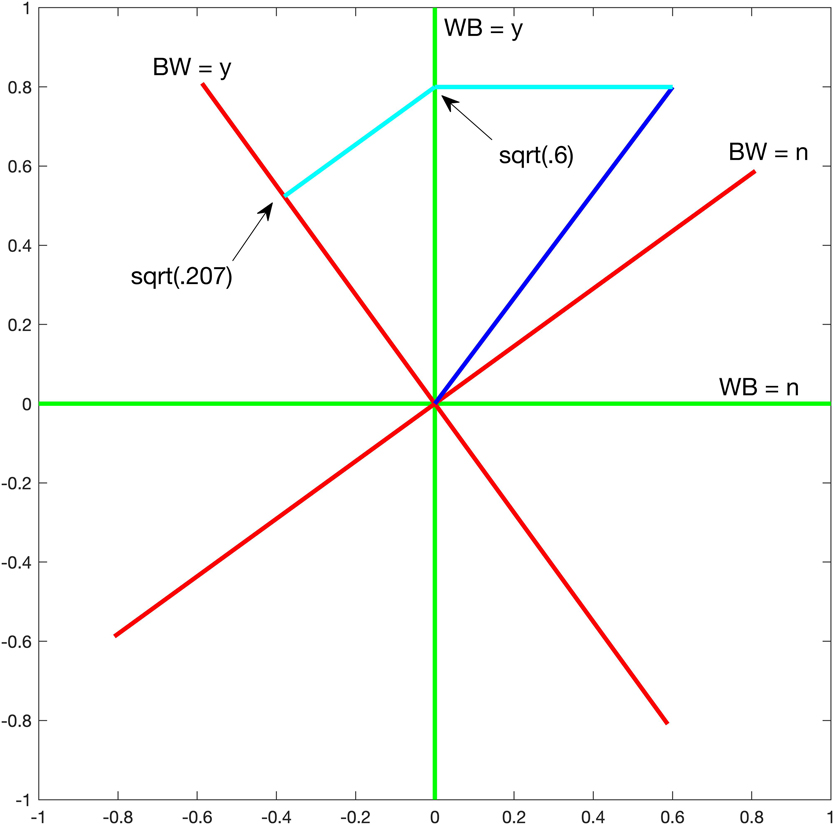
We assume that the two questions, WB, BW are incompatible. The intuition is that a person needs to put himself in the perspective of white person to answer the WB question, and he needs to put himself into the perspective of a black person to answer the BW question, and the person can’t view both perspectives at the same time. To make the model for this situation as simple as possible, we use a 2-dimensional vector space and one dimensional subspaces (rays) (see Figure 1). Wang & Busemeyer (Reference Wang and Busemeyer2013) present the actual N −dimensional model with multi-dimensional subspaces .
Two dimensional vector space. Green orthogonal axes represent WB answers, red orthogonal axes represent BW answers, blue line represents initial state.

The first step that we need to make is the choice of a basis to represent events for each question. The choice of the first basis is arbitrary because it simply determines the coefficients assigned to each coordinate. We will start with the simplest, standard basis, by assuming that the answers to WB question are represented by two orthonormal basis vectors (see green lines in Figure 1):
 $${V_n} = \left[ {\matrix{ 1 \cr 0 \cr} } \right],{V_y} = \left[ {\matrix{ 0 \cr 1 \cr} } \right].$$
The ray spanned by V y is the subspace representing the answer “yes” and the ray spanned by V n is the subspace representing the answer “no” to the W-B question. Each of these subspaces correspond to a projector:
 $${P_{WB}}\left( y \right) = {V_y} \cdot V_y^\dag = \left[ {\matrix{ 0 & 0 \cr 0 & 1 \cr} } \right],{P_{WB}}\left( n \right) = {V_n} \cdot V_n^\dag = \left[ {\matrix{ 1 & 0 \cr 0 & 0 \cr} } \right],$$
which projects vectors in the vector space onto the corresponding subspace ( $\dag$ represents the Hermitian transpose).
The participant’s beliefs about the WB question is determined by their background knowledge of racism. These beliefs are represented by a unit length vector in this vector space. Suppose the coordinates for the belief state regarding racial issues, with respect to the WB basis, are defined by the following 2 × 1 column matrix (see blue line in Figure 1)
 $${S_R} = \left[ {\matrix{ {\sqrt {.4} } \cr {\sqrt {.6} } \cr} } \right].$$
In this case, the person is “superposed” between the two possible answers: The square of the first coordinate (.4) gives the probability of answering no, and the square of the second coordinate (.6) gives the probability of answering yes. Even though the answers to be reported are mutually exclusive (the person can only pick one), both answers have non-zero probabilities of being selected.
The rule for computing the probability of an event is simple: project the belief state onto the subspace for the event, and take the squared length. Using this rule, the probabilities for each answer are (see the arrow associated with sqrt(.6) in Figure 1)
 $$\eqalign{ & p(WB = y) = {\left\| {{P_{WB}}(y)\cdot{S_R}} \right\|^2} = {\left\| {\left[ {\matrix{ 0 & 0 \cr 0 & 1 \cr} } \right]\cdot\left[ {\matrix{ {\sqrt {.4} } \cr {\sqrt {.6} } \cr} } \right]} \right\|^2} = {\left\| {\left[ {\matrix{ 0 \cr {\sqrt {.6} } \cr} } \right]} \right\|^2} = .6. \cr & p(WB = n) = {\left\| {{P_{WB}}(n)\cdot{S_R}} \right\|^2} = .4. \cr}$$
If the answer to the first question turns out to be “yes,” then the belief state is “collapsed” to this subspace, and a new state is formed by normalizing the projection on the answer yes, which becomes
 $$Sy = {{{P_{WB}}\left( y \right) \cdot {S_R}} \over {\sqrt {p(WB = y)} }} = \left[ {\matrix{ 0 \cr {\sqrt {.6} } \cr} } \right]/\sqrt {.6} = \left[ {\matrix{ 0 \cr 1 \cr} } \right].$$
with respect to the WB basis. Now, after answering “yes,” if asked again, the person is certain to say “yes” to the WB question.
What about the BW question? To represent these answers, we need to rotate from the original basis {V n, V y} used to represent the WB question to a new basis {U n, U y} that provides this BW perspective. Suppose that the basis vectors used to represent the BW answers are obtained from the WB basis vectors by the unitary matrix
 $${U_{BW}} = \left[ {\matrix{ {.8090} & { - .5878} \cr {.5878} & {.8090} \cr} } \right].$$
The first column of U, i.e.,  ${U_n} = \left[ {\matrix{ {.8090} \cr {.5878} \cr } } \right]$, represents the basis vector for “no;” the second column, i.e.,
 ${U_y} = \left[ {\matrix{ { - .5878} \cr {.8090} \cr } } \right]$, represents the basis vector for “yes” for the BW question (see red lines in Figure 1).
Then the projectors for the answers to the BW question equal
 $$\matrix{ {{P_{BW}}\left( y \right) = \left( {{U_{BW}} \cdot {P_{WB}}\left( y \right) \cdot U_{BW}^\dag } \right),} \cr { = \left[ {\matrix{ {.8090} & { - .5878} \cr {.5878} & {.8090} \cr} } \right] \cdot \left[ {\matrix{ 0 & 0 \cr 0 & 1 \cr} } \right] \cdot \left[ {\matrix{ {.8090} & {.5878} \cr { - .5878} & {.8090} \cr} } \right]} \cr { = \left[ {\matrix{ {.3455} & { - .4755} \cr { - .4755} & {.6545} \cr} } \right],} \cr {{P_{BW}}\left( n \right) = \left( {{U_{BW}} \cdot {P_{WB}}\left( n \right) \cdot U_{BW}^\dag } \right) = \left[ {\matrix{ {.6545} & {.4755} \cr {.4755} & {.3455} \cr} } \right].} \cr}$$
If the person first said “yes” to the WB question, then the conditional probabilities of each answer to the BW question equal
 $$\matrix{ {p\left( {BW = y|WB = y} \right) = {{\left\| {{P_{BW}}\left( y \right)\cdot{S_y}} \right\|}^2} = .6545,} \cr {p\left( {BW = n|WB = y} \right) = {{\left\| {{P_{BW}}\left( n \right)\cdot{S_y}} \right\|}^2} = .3455.} \cr}$$
Note that if the person answers “yes” to the WB question (so that the state has collapsed to S y, and the person is certain to say “yes” if asked again about the WB question), then the person must be uncertain about the BW question, because the state S y has non zero projections on both of the BW events. This illustrates how the quantum uncertainty principle arises. Being certain about one event (the answer to WB is yes) must make one uncertain about a different, incompatible event (the answer to BW is uncertain). A person cannot be certain about both incompatible measurements at the same time.
Finally the sequential probability of answering “yes” to the WB question and then “no” to the BW question equals (see the arrow associated with sqrt(.207) in Figure 1)
 $$\matrix{ {p\left( {WB = y,BW = n} \right) = p\left( {WB = y} \right)\cdotp\left( {BW = n|WB = y} \right)} \cr { = {{\left\| {{P_{WB}}\left( y \right) \cdot {S_R}} \right\|}^2} \cdot {{\left\| {{P_{BW}}\left( n \right) \cdot {S_y}} \right\|}^2}} \cr { = {{\left| {\left| {{P_{BW}}\left( n \right) \cdot {P_{WB}}\left( y \right) \cdot {S_R}} \right|} \right|}^2} = .2073.} \cr}$$
The opposite order produces
 $$\matrix{ {p\left( {BW = n,WB = y} \right) = p\left( {BW = n} \right)\cdotp\left( {WB = y|BW = n} \right)} \cr { = {{\left| {\left| {{P_{WB}}\left( y \right) \cdot {P_{BW}}\left( n \right) \cdot {S_R}} \right|} \right|}^2} = .3231.} \cr}$$
This produces an order effect.
Now we turn to the general model. We assume that events are represented as subspaces of a finite dimensional Hilbert space  ${\cal H}$. A finite dimensional Hilbert space is a vector space defined on a complex field endowed with an inner product. The dimension of the vector space can be arbitrary, say N −dimensional. The state representing the beliefs of a person is a vector
 $|S\rangle \in {\cal H}$. A projector for an event such as the answer “yes” to question A is an linear operator P A(y) in the Hilbert space that satisfies P A(y) = P A(y)† = P A(y) · P A(y). The projector for the complement, i.e., the answer to question A is “no”, is P A(n) = I − P A(y), where I is the identify operator, and note that P A(y) · P A(n) = 0. If question A is asked before question B, then we denote the probability of observing the answer “yes” to question A (e.g., the WB question) and then the answer “no” to question B (e.g., the BW question) as p(A = y, B = n). The opposite order is denoted p(B = n, A = y). Then the general model for question order states simply that
 $$\matrix{ {p\left( {A = y,B = n} \right) = {{\left\| {{P_B}\left( n \right)\cdot{P_A}\left( y \right)\cdot\left| S \right\rangle } \right\|}^2},} \cr {p\left( {B = n,A = y} \right) = {{\left\| {{P_A}\left( y \right)\cdot{P_B}\left( n \right)\cdot\left| S \right\rangle } \right\|}^2}.} \cr}$$
If we condition on the AB order, then the 2 × 2 joint frequencies for the A,B pair of questions can be described as a classical joint probability distribution; likewise. if we condition on BA order, then the 2 × 2 joint frequencies for the A,B pair of questions also can be described as a classical probability distribution. This produces two classical joint distributions that can perfectly describe the empirical results. But these are two separate and unrelated distributions, which simply reproduce the empirical results. The advantage of the quantum probability model comes from providing a mathematical system that relates the two different joint distributions and makes a priori predictions about this relationship. Wang & Busemeyer (Reference Wang and Busemeyer2013) proved the following theorem that makes an a priori prediction for any dimension N, and for any projectors representing questions A, B. The quantum probability model must predict a very special pattern of order effects that we call the QQ equality (Wang & Busemeyer, Reference Wang and Busemeyer2013):
 $$Q = \left( {p\left( {A = y,B = n} \right) + p\left( {A = n,B = y} \right)} \right) - \left( {p\left( {B = y,A = n} \right) + p\left( {B = n,A = y} \right)} \right) = 0$$
This theoretical prediction was established first, and then we empirically tested it later and we found it to be supported across a wide range of 70 national field experiments that examined question-order effects (Wang et al., Reference Wang, Solloway, Shiffrin and Busemeyer2014).
After we published our results, two other non-quantum and post hoc explanations were put forward to account for the QQ equality (Kellen et al., Reference Kellen, Singmann and Batchelder2018; Costello & Watts, Reference Costello and Watts2018). However, these accounts of the QQ equality were put forth after the empirical finding and they were designed specifically for this particular application and empirical finding. The advantage of the quantum probability model is that it is more general, and it makes new additional predictions. The same general quantum model for order effects has been successfully applied to new applications including (a) multi-valued (more than 2) ratings scales (Wang & Busemeyer, Reference Wang and Busemeyer2016a), and (b) for the effects that the ordering of evidence has on inference (Yearsely & Trueblood, Reference Yearsely and Trueblood2017). The non-quantum post hoc accounts of the QQ (Kellen et al., Reference Kellen, Singmann and Batchelder2018; Costello & Watts, Reference Costello and Watts2018) are unable to apply to these new situations.
Conjunction and disjunction probability judgment errors
Tversky & Kahneman (Reference Tversky and Kahneman1983) reported what are called “conjunction errors,” which might be considered the strongest evidence that human reasoning under uncertainty does not obey the Kolmogorov axioms. A conjunction error occurs when a person judges the probability of a conjunction of two events to be greater than one of the single events. One of the most famous examples is based on the “Linda” scenario (but there are many more examples and replications of this finding): Linda is initially described to appear to be a very strong and liberal and intellectual women. Then participants are asked to judge the likelihood of various statements about Linda, including the statement that “Linda is a bank teller” (B) and that “Linda is a feminist and a bank teller” (F and B). Participants typically judge the (F and B) event as more likely than the B event. Moreover, they also commit a “disjunction error:” they judge the likelihood of (F or B) to be less than the likelihood of F alone (e.g., Morier & Borgida Reference Morier and Borgida1984).
Below we begin with a “toy” quantum model to account for these probability judgment errors. To make the model for this situation as simple as possible, we again use a 2-dimensional vector space and one dimensional subspaces (rays). The actual full model for N −dimensional spaces and multi-dimension subspaces is described in Busemeyer et al. (Reference Busemeyer, Pothos, Franco and Trueblood2011).
We assume that the two questions about bank teller and feminist are incompatible. The intuition is that a person rarely experiences these together, and so they had very few opportunities to learn a compatible representation of features for the simultaneous occurrence of the two events. Instead, they need to view feminism relative to one set of attitude features, and then view bank teller relative to a different set of employment features.
The first step that we need to make is the choice of a basis to represent events for each question. The choice of the first basis is arbitrary and so we start with the standard basis. We will start by assuming that the (yes,no) answers to feminism question are represented by two orthonormal basis vectors:
 $${V_y} = \left[ {\matrix{ 1 \cr 0 \cr} } \right],{V_n} = \left[ {\matrix{ 0 \cr 1 \cr} } \right],$$
which produce projectors:
 $${P_F}\left( n \right) = \left[ {\matrix{ 0 & 0 \cr 0 & 1 \cr} } \right],{P_F}\left( y \right) = \left[ {\matrix{ 1 & 0 \cr 0 & 0 \cr} } \right].$$
The participant’s beliefs are initially determined by the Linda story. Given the story, it is plausible to assume that the coordinates for the belief state, with respect to the feminism basis, will have higher magnitudes assigned to “yes.” For example, the initial beliefs can be represented by the following 2 × 1 column matrix
 $${S_L} = \left[ {\matrix{ {.9877} \cr { - .1564} \cr} } \right].$$
Using the quantum rule for computing probability of an event, the probabilities for each answer are
 $$\matrix{ {p\left( {F = y} \right) = {{\left\| {{P_F}\left( y \right)\cdot{S_L}} \right\|}^2} = .9755,} \cr {p\left( {F = n} \right) = {{\left\| {{P_F}\left( n \right)\cdot{S_L}} \right\|}^2} = .0245,} \cr}$$
To represent the bank teller answer, we need to rotate to a new basis that provides this view. Suppose that the basis vectors used to represent the bank teller answers are obtained from the feminism basis vectors by the rotation matrix
 $${U_{BF}} = \left[ {\matrix{ {.3090} & { - .9511} \cr {.9511} & {.3090} \cr} } \right].$$
The first column of U represents the basis vector for “yes” and the second column represents the basis vector for “no” for the bank teller question. Then the projectors for the answers to the BW question equal
 $${P_B}\left( y \right) = \left( {{U_{BF}} \cdot {P_F}\left( y \right) \cdot U_{BF}^\dag } \right),{P_B}\left( n \right) = \left( {{U_{BF}} \cdot {P_F}\left( n \right) \cdot U_{BF}^\dag } \right).$$
Starting from the Linda story, the probabilities for the answers to the bank teller question are
 $$\matrix{ {p\left( {B = y} \right) = {{\left\| {{P_B}\left( y \right)\cdot{S_L}} \right\|}^2} = .0245,} \cr {p\left( {B = n} \right) = {{\left\| {{P_B}\left( n \right)\cdot{S_L}} \right\|}^2} = .9755.} \cr}$$
Finally the probability of answering “yes” to feminism and then “yes” to bank teller equals
 $$\matrix{ {p\left( {F = y,B = y} \right) = p\left( {F = y} \right)\cdotp\left( {B = y|F = y} \right)} \cr { = {{\left\| {{P_B}\left( y \right) \cdot {P_F}\left( y \right) \cdot {S_L}} \right\|}^2} = .0932.} \cr}$$
This last results reproduces the conjunction error because we have p(B = y) = .0245 which is less than p(F = y, B = y) = .0932.
The probability of the disjunction “feminist or bank teller” is computed from
 $$\matrix{ {p\left( {F = y\,or\,B = y} \right) = 1 - p\left( {\bar{B},\bar{F}} \right)} \cr { = 1 - {{\left| {\left| {{P_F}\left( n \right) \cdot {P_B}\left( n \right) \cdot {S_L}} \right|} \right|}^2}} \cr { = .9069.} \cr}$$
This last results reproduces the disjunction error because we have p(F = y) = .9755 which is greater than p(F = y or B = y) = .9069. Thus the same rotation of basis reproduces both the conjunction and disjunction errors.
Now we turn to the general model. Once again, we assume that events are represented as subspaces of a finite dimensional Hilbert space  ${\cal H}$. The dimension of the vector space can be arbitrary, say N −dimensional. We define
 $|S\rangle \in {\cal H}$ as the vector representing beliefs after hearing a experimental cover story (e.g. a story about Linda). Suppose A, B are two events and A is more likely than B. Define P A(y) as a projector operating in
 ${\cal H}$ representing the answer “yes” to question A (e.g., feminist) and define P B(y) as a projector operating in
 ${\cal H}$ representing the answer “yes” to question B (e.g. bank teller). According to quantum probability rules, the sequential probability of answering “yes” to question A and then “yes” to question B is
 $$p\left( {A = y,B = y} \right) = {\left\| {{P_B}\left( y \right) \cdot {P_A}\left( y \right) \cdot |S\rangle } \right\|^2}.$$
The probability of answering “yes” to question B by itself is
 $$\matrix{ {p\left( {B = y} \right) = {{\left\| {{P_B}\left( y \right) \cdot |S\rangle } \right\|}^2}} \cr { = {{\left\| {{P_B}\left( y \right) \cdot I \cdot |S\rangle } \right\|}^2}} \cr { = {{\left| {\left| {{P_B}\left( y \right) \cdot \left( {{P_A}\left( y \right) + {P_A}\left( n \right)} \right) \cdot |S\rangle } \right|} \right|}^2}} \cr { = {{\left\| {{P_B}\left( y \right) \cdot {P_A}\left( y \right) \cdot |S\rangle + {P_B}\left( y \right) \cdot {P_A}\left( n \right) \cdot |S\rangle } \right\|}^2}} \cr { = {{\left\| {{P_B}\left( y \right) \cdot {P_F}\left( y \right) \cdot |S\rangle } \right\|}^2} + {{\left\| {{P_B}\left( y \right) \cdot {P_F}\left( n \right) \cdot |S\rangle } \right\|}^2} + Int,} \cr}$$
where Int is called the interference term, which contains the remaining crossproduct terms produced by squaring the length of a sum of two parts. This interference term can be positive or negative or zero. According to this model, the conjunction fallacy occurs whenever  $Int < - {\left| {\left| {{P_B}\left( y \right) \cdot {P_F}\left( n \right) \cdot |{S_L}\rangle } \right|} \right|^2}$.
Although this account of the conjunction fallacy is very general (it does not depend on any specific dimension N. and it does not depend on any specific unitary matrix) it is post hoc. However, the quantum model makes many additional a priori predictions. In particular, if p(A = y, B = y) > p(B = y), then this model must predict that  $p\left( {B = y|A = y} \right) > p\left( {B = y} \right)$. There is supporting evidence for this prediction (see Busemeyer et al. Reference Busemeyer, Pothos, Franco and Trueblood2011). Also, this model cannot predict that p(A = y, B = y) > p(A = y) and p(A = y, B = y) > p(B = y) both occur. Although there is some debate about this issue, double conjunction errors are rare (see Busemeyer et al. Reference Busemeyer, Pothos, Franco and Trueblood2011). In addition, this model predicts that p(B = y) > p(B = y, A = y). That is, the model predicts conjunction fallacies depend on the order of evaluating questions. Some researchers (Costello et al., Reference Costello, Watts and Fisher2017) do not find empirical evidence for this prediction, whereas others (Yearsely & Trueblood, Reference Yearsely and Trueblood2017) report empirical evidence for a predicted correlation between order effects and conjunction errors.
Interference of categorization on decision
Another interesting application of quantum cognition concerns some puzzling findings obtained from a categorization - decision task (Busemeyer et al., Reference Busemeyer, Wang and Lambert-Mogiliansky2009). In these experiments, participants are shown faces. On some trials they categorize the faces as “good guys” or “bad guys”, and then decide to “attack” or “withdraw” (this is called the categorization-decision condition); on other trials they only decide to “attack” or “withdraw” without making any categorization (this is called the decision-alone condition). Participants are usually rewarded for “attacking” the “bad guys” and for “withdrawing” from the “good guys.” These experiments allow a test to see if the total probability of an action obtained from the categorization-decision condition
 $${p_T}\left( A \right) = p\left( G \right) \cdot p\left( {A|G} \right) + p\left( B \right) \cdot p\left( {A|B} \right)$$
equals the probability to attack p (A) under the decision alone condition. The difference Int = p(A) − p T(A) is called an interference effect, which indicates an effect of measurement about the category on the final action decision. Several experiments reported positive interference effects (Busemeyer et al., Reference Busemeyer, Wang and Lambert-Mogiliansky2009; Wang & Busemeyer, Reference Wang and Busemeyer2016b). Even more interesting, Busemeyer et al. (Reference Busemeyer, Wang and Lambert-Mogiliansky2009) found the largest interference effect, and in this experiment, the probability to “attack” after categorizing the face as “bad” was lower than the probability to “attack” when no categorization was made at all!
Below we show how a “toy” quantum model easily accounts for these interference effects. To make the model for this situation as simple as possible, we again use a 2-dimensional vector space and one dimensional subspaces (rays). The actual model used in Wang & Busemeyer (Reference Wang and Busemeyer2016b) was a 4 −dimensional model with 2-dimensional subspaces.
In this application, the incompatibility between the categorization and decision events arises from a dynamic process that first views the face from an evidence basis to select a category, and then rotates to an evaluation basis to choose an action. The first step that we need to make is the choice of a evidence basis to represent events for categorization. We will start by assuming that the (good,bad) answers to categorization question are represented by two orthonormal basis vectors:
 $${V_G} = \left[ {\matrix{ 0 \cr 1 \cr} } \right],{V_B} = \left[ {\matrix{ 1 \cr 0 \cr} } \right],$$
which produce projectors:
 $${P_C}\left( g \right) = \left[ {\matrix{ 0 & 0 \cr 0 & 1 \cr} } \right],{P_C}\left( b \right) = \left[ {\matrix{ 1 & 0 \cr 0 & 0 \cr} } \right].$$
The participant’s beliefs about the categories depends on the face. Suppose the face looks like a “bad guy,” and so coordinates for the belief state, with respect to the evidence basis, are defined by the following 2 × 1 column matrix
 $${S_F} = \left[ {\matrix{ {.9491} \cr { - .3150} \cr} } \right].$$
Using the quantum rule for computing the probability of an event, the probabilities for each answer are
 $$\matrix{ {p\left( {C = g} \right) = {{\left\| {{P_C}\left( g \right)\cdot{S_F}} \right\|}^2} = .10,} \cr {p\left( {C = b} \right) = {{\left\| {{P_C}\left( b \right)\cdot{S_F}} \right\|}^2} = .90.} \cr}$$
If the face is categorized as “good,” then the state collapses to  ${S_g} = {[\matrix{ 0 & 1 \cr } ]^\dag }$ in the evidence basis; and if face is categorized as “bad,” the state collapses to
 ${S_b} = {[\matrix{ 1 & 0 \cr } ]^\dag }$ in the evidence basis.
To represent the decision, we need to rotate to a new basis that evaluates the payoffs for actions. Suppose that the evaluation basis is obtained from the evidence basis vectors by the rotation matrix
 $${U_{DC}} = \left[ {\matrix{ {.7765} & {.6301} \cr { - .6301} & {.7765} \cr} } \right].$$
The first column of U represents the basis vector for “attack” and the second column represents the basis vector for “withdraw” for the evaluation basis. Then the projectors for the answers to the action decision equal
 $${P_D}\left( a \right) = \left( {{U_{DC}} \cdot {P_C}\left( b \right) \cdot U_{DC}^\dag } \right),{P_D}\left( w \right) = \left( {{U_{DC}} \cdot {P_C}\left( g \right) \cdot U_{DC}^\dag } \right).$$
Starting from the face, the probabilities for the decisions (when it is made alone) are
 $$\matrix{ {p\left( {D = a} \right) = {{\left\| {{P_D}\left( a \right)\cdot{S_F}} \right\|}^2} = .8751,} \cr {p\left( {W = w} \right) = {{\left\| {{P_D}\left( w \right)\cdot{S_F}} \right\|}^2} = .1249.} \cr}$$
The probability of the decision to “attack” conditioned on each category response equal
 $$\matrix{ {p\left( {D = a|C = g} \right) = {{\left\| {{P_D}(a)\cdot{S_g}} \right\|}^2} = .3971} \cr {p\left( {D = a|C = b} \right) = {{\left\| {{P_D}(a)\cdot{S_b}} \right\|}^2} = .6029.} \cr}$$
Note that the probability to “attack” in the decision alone condition equals .8751, which exceeds both of the above conditional probabilities. Therefore, this toy model produces both a positive interference effect as well as producing a higher “attack” rate for the decision alone condition as compared to the decision after categorizing the face as “bad.”
Now we turn to the general model again. As before, we assume that events are represented as subspaces of a finite dimensional Hilbert space  ${\cal H}$. The dimension of the vector space can be arbitrary, say N −dimensional. We define
 $|S\rangle \in {\cal H}$ as the vector representing beliefs about the category after seeing the face stimulus. Define P c (b) as a projector operating in
 ${\cal H}$ representing the answer “bad guy” to the categorization question, and define P c (g) as a projector operating in
 ${\cal H}$ representing the answer “good guy” to the categorization question. According to quantum probability rules, probability of deciding to “attack” in the decision alone condition equals
 $$\matrix{ {p\left( {D = a} \right) = {{\left\| {{P_D}\left( a \right) \cdot |S\rangle } \right\|}^2}} \cr { = {{\left| {\left| {{P_D}\left( a \right) \cdot {P_C}\left( g \right) \cdot |S\rangle } \right|} \right|}^2} + {{\left| {\left| {{P_D}\left( a \right) \cdot {P_C}\left( b \right) \cdot |S\rangle } \right|} \right|}^2} + Int,} \cr}$$
and again the interference term, Int, can be positive so that
 $$\matrix{ {{{\left| {\left| {{P_D}\left( a \right) \cdot |S\rangle } \right|} \right|}^2} > {{\left\| {{P_D}\left( a \right) \cdot {P_C}\left( g \right) \cdot |S\rangle } \right\|}^2} + {{\left| {\left| {{P_D}\left( a \right) \cdot {P_C}\left( b \right) \cdot |S\rangle } \right|} \right|}^2}} \cr { = p\left( {C = g} \right) \cdot p\left( {D = a|C = g} \right) + p\left( {C = b} \right) \cdot p\left( {D = a|C = b} \right).} \cr}$$
Wang & Busemeyer (Reference Wang and Busemeyer2016a) go further by quantitatively testing and comparing quantum versus Markov models with respect to their abilities to make new predictions for the categorization-decision task. They used a generalization criterion method: they estimated the parameters from both the quantum model and a classical Markov model using data obtained from a first set of payoff conditions. For this first set of conditions, the same number of parameters were estimated from the data for each model. Then they used the parameters estimated from the first set of payoff conditions to make generalization predictions for two new payoff conditions. The results supported the quantum model, which made more accurate generalization predictions than the Markov model.
Summary
In this article, we first provided psychological reasons for exploring the applications of quantum probability theory to human judgment and decision making behavior. Second, we presented three very different applications to puzzling findings from psychology using the same principles. The applications used “toy” models designed to illustrate how the theory works. The general models were briefly described, but more details can be found in the articles that we referenced. Finally, we presented summaries of actual empirical tests and evidence supporting the applications of quantum probability to these examples. There are numerous other applications of quantum cognition to similarity judgments (Pothos et al., Reference Pothos, Busemeyer and Trueblood2013), conceptual combinations (Aerts et al., Reference Aerts, Gabora and Sozzo2013), causal reasoning (Trueblood et al., Reference Trueblood, Yearsley and Pothos2017), violations of rational decision making (Pothos & Busemeyer, Reference Pothos and Busemeyer2009), confidence judgments (Kvam et al., Reference Kvam, Pleskac, Yu and Busemeyer2015), memory recognition (Brainerd et al., Reference Brainerd, Wang and Reyna2013), and perception (Atmanspacher Filk, Reference Atmanspacher and Filk2010). Of course, non-quantum models can be devised to explain any one of the phenomena that we discussed. However, the power of quantum models comes from using the same principles across a wide range of different examples, rather than designing a completely different model for each example. In sum, we hope the reader finds quantum cognition to be an interesting and viable new approach to understanding human judgment and decision making behavior.