Many previous studies have claimed that the earlier children are exposed to a second language (L2) in a naturalistic setting, the more likely they are to acquire nativelike pronunciation (Flege, 1988b, 1991, 1992; Oyama, 1976; Patkowski, 1990, 1994; Scovel, 1969, 1988, 1995). However, very little acoustic research gives us any clue as to how early exposure in a classroom situation affects the acquisition of L2 speech and, more specifically, to what extent children in an immersion program reach the native speaker's (NS) phonetic norm. The current study, which consists of an acoustic analysis and a foreign accent rating, examines the acquisition of the closure duration of single and geminate stops in Japanese by English-speaking children in a Japanese immersion program. In Japanese, the contrast between single and geminate stops is phonemic, and closure duration is one of the major cues that distinguish these stops. Learners who speak English, a stress-timed language (Ladefoged, 1993), have been reported to find it difficult to acquire this contrast in Japanese, a mora-timed language (Han, 1992). Furthermore, this study tests Flege's (1995) hypothesis, which states that although bilinguals can establish a new phonetic category for a L2 sound that is phonetically different from the closest first language (L1) sound, the phonetic category might differ from the category established by monolinguals. In the following sections, the closure duration of single and geminate stops in Japanese produced by NSs of Japanese and English learners of Japanese is discussed and then a brief description of phonological acquisition by immersion children is given. Finally, the age factor in L2 phonology as well as theoretical issues of bilingual phonology are discussed.
CLOSURE DURATION
Closure refers to “an articulation where the contact between active and passive articulators obstructs the airstream through the mouth and/or nose” (Crystal, 1991, p. 58). More specifically, closure duration means the period of time between oral closure and its release. Acoustically, the main phonetic realization of geminates (e.g., /pp, tt, kk/), which are defined as “two identical sounds pronounced next to each other” (Roach, 1992, p. 46), is a longer closure duration in comparison to the corresponding singleton consonant.
In Japanese, a basic syllable consists of an optional onset consonant plus a vowel. However, this syllable can also be closed by either a nasal or the first consonant of a geminate [i.e., (C)VC]. Shibatani (1990) defined geminates in Japanese [CC in (C)VCCV] as “a non-nasal consonant followed by a homorganic consonant of the following syllable” (p. 167); moreover, he stated that the second consonant of a geminate is usually a voiceless stop (although it can be a voiced stop in loanwords), an affricate, or a fricative (Vance, 1987). This syllable-final consonant takes one timing unit or one mora, and each unit is supposed to count for the same psychological length of time (Tsujimura, 1996), functioning as a syllabic consonant like

in a sequence such as

(e.g., button) or

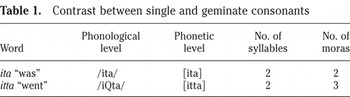
(e.g., little) in English. Phonemically, the syllable-final consonant that counts as one mora is traditionally transcribed as /Q/ in Japanese linguistics; phonetically, it is realized by holding the closure stage of the first consonant for a certain period of time. The contrast between a single and geminate consonant is illustrated in Table 1.
Contrast between single and geminate consonants

Although one of the most important acoustic cues in distinguishing single from geminate stops is the duration of the closure, researchers do not agree on the duration ratio of geminate to single stops. One view is that a geminate stop consists of a moraic stop + a single stop, and the total duration of these stops is longer than that of two successive single stops. Homma (1981) and Han (1992) supported this view and claimed that the duration ratio of geminate to single stops is 3:1. Support for this position would provide evidence that the mora is an abstract timing unit in Japanese. On the other hand, Beckman (1982) refuted this view, arguing that the mean ratio is 2.25:1 when voice onset time (VOT) is included as part of the stop and that the ratio is 2.79:1 when VOT is not included. In other words, in her view, the duration of the geminate is less than three times that of the single stop, whether or not VOT is included.
Han (1992) measured Japanese NSs' closure duration for both single and geminate consonants, with VOT not included, using a set of 10 minimal pairs such as the ita/itta pair illustrated in Table 1. She found that [t] and [tt] have shorter durations than [p] and [pp], respectively, and that the duration of the geminate stop is more than twice as long as the single consonant. (The resultant ratios from Han's study, which were calculated by the current author, are as follows: pp/p = 2.69, tt/t = 3.27, kk/k = 2.76.)
Although the closure duration is an important cue in identifying geminates, there might be other factors that affect the identification of a single versus a geminate stop because the segment duration varies according to phonetic environment. Another reliable cue is relative word duration. Han's (1994) results showed that the average ratio of two-mora words to three-mora words (e.g., ite “being,” itte “going”) is 2.00:2.99 and that of three-mora words to four-mora words (e.g., supai “spy,” suppai “sour”) is 3.00:4.01.1
The duration of syllables in many languages tends to be isochronous, whereas in Japanese it is not (Han, 1994; Port, Dalby, & O'Dell, 1987). In Japanese, as Port et al. reported, the durations of two words with the same number of moras tend to be equal in spite of differences in syllable structure.
In addition to this phonetic justification, both phonological and psychological justification accounts for the existence of moras in Japanese. Phonologically, the mora allows us to “specify the neutral location of accent as a neat generalization: the third mora from the end” (Vance, 1987, p. 66), which the concept of syllables would not allow us to do. Psychologically, the mora is a metrical unit in Japanese poetry and a basic unit in the writing system. The first consonant of a geminate corresponds to one unit in writing. However, it is to be noted that the concept of moras does not deny the existence of syllables in Japanese. Syllables play important roles in determining lexical accent; for example, nonsyllabic moras such as geminates cannot be accent-bearing units (Shibatani, 1990), and loanword accent placement can be accounted for by a syllable-based rule (Kubozono, 1999).
When word durations are viewed as relative values, the ratios show a striking resemblance to the corresponding mora values, supporting the hypothesis that this abstract unit, the mora, constrains word durations and thereby constrains both the mora and segment durations in Japanese. (p. 81)
Therefore, the contrast between single and geminate consonants relies not only on the closure duration but also on the duration ratio of words with a geminate to those without one. Closure duration treats the contrast in segmental terms, whereas word duration treats it in moraic terms.
In contrast, English has no phonemic distinction between single and geminate consonants; although there are double consonants across morpheme boundaries (e.g., catfish vs. cattail, get Mary vs. get Tom), these are reported to be only 1.8 to 2 times as long as single consonants (Han, 1992). This difference between the two languages leads us to predict that English learners of Japanese will have difficulty acquiring this contrast. Han analyzed the contrast between three-mora words with a single stop and four-mora words with a geminate. She found that two of the four advanced English-speaking learners of Japanese in her study made a phonological distinction between the two sounds by controlling the closure duration, but, phonetically, they produced single stops with longer closure durations and geminate stops with shorter closure durations than Japanese NSs. The ratios that resulted from the learners' performance were pp/p = 2.08, tt/t = 1.66, and kk/k = 1.91 (as calculated by the current researcher). As a result, the overall mean ratio of the closure durations of a geminate to a single stop for advanced learners was observed to be lower (1.88) than that of the Japanese speakers (2.91).
Additionally, Han's (1992) data also showed that the L2 speakers' closure duration ratio varied according to place of articulation: The ratio of the bilabial stop was highest and most nativelike and that of the alveolar stop was lowest and deviated most from the NSs'.3
One anonymous SSLA reviewer pointed out that the alveolar stop in American English is significantly different from bilabial and velar stops in that it is normally flapped in certain environments and that this might account for the lowest geminate-to-singleton ratio for the alveolar stop produced by the English-speaking learners of Japanese.
PHONOLOGICAL ACQUISITION BY IMMERSION CHILDREN
Immersion education is defined as a form of bilingual education in which a L2 is used as the medium of instruction in schools. Swain and Johnson (1997, pp. 6–8) identified eight core features of a prototypical immersion program:
- The L2 is a medium of instruction.
- The immersion curriculum parallels the local L1 curriculum.
- Overt support exists for the L1.
- The program aims for additive bilingualism.
- Exposure to the L2 is largely confined to the classroom.
- Students enter with similar (and limited) levels of L2 proficiency.
- The teachers are bilingual.
- The classroom culture is that of the local L1 community.
Compared to other traditional programs, such as FLES (foreign languages in the elementary school), children in an immersion program can receive a greater amount of input in a foreign language because the target language is used to teach regular school subjects, such as mathematics, science, or physical education.4
The most important features considered to distinguish immersion programs from each other are the grade level at which immersion is introduced and the extent of immersion. First, immersion programs can be identified in terms of when students begin: “early immersion” starts in kindergarten, “delayed immersion” starts in grade 4 or 5, and “late immersion” starts in grade 7 or 8 (Sternfeld, 1988, p. 222). Second, in terms of the extent of immersion or how much subject-matter instruction students receive in the L2, immersion programs fall into two main types: total immersion, in which 100% of subject-matter instruction is provided in the L2 for 1 year or more, and partial immersion, in which less than 50% of the curriculum is taught in the L2. In total immersion, L1 literacy development is introduced after L2 literacy training has begun, whereas in partial immersion, literacy training occurs simultaneously in both the L1 and L2 beginning in grade 1 (Genesee, 1987; Swain & Johnson, 1997).
Although there is some research on the acquisition of morphology and syntax by immersion students (e.g., Cohen, 1976; Hammerly, 1987; Harley, 1984; Plann, 1978), little comprehensive and systematic research on the acquisition of pronunciation has been documented. It is generally reported, however, that immersion students are unlikely to demonstrate nativelike pronunciation. Hammerly (1991) gave a detailed description of English-accented speech by French immersion students:
The results of immersion programs show that in the absence of specific pronunciation instruction, many years of communicative classroom interaction in an SL [second language] fail to result in accent-free speech. Early French immersion pupils, who enter the program at age five or six, still have an English accent 12 years later, though, to be sure, not nearly as marked as that of late immersion students who start at puberty. (pp. 59–60)
Genesee (1987) summarized the results of early and late French immersion students' pronunciation ratings based on oral interview tests. The findings indicated that although immersion students always outperformed students who were learning French in a traditional curriculum, they never reached the French NSs' level, and no noticeable progress in pronunciation was observed from grade 4 through grade 6. In another study that involved immersion students, Snow and Campbell (1983) investigated the pronunciation of children in a Spanish immersion program and found that students in grade 3 were rated higher than the kindergarten or grade 6 students. This result led the researchers to suggest that children in immersion programs are likely to regress in their pronunciation of the target language in the later grades.
Except for these studies, there is no systematic research on the acquisition of L2 pronunciation by children in immersion programs. This is also an area that has not yet benefited from rigorous acoustic analysis, although a large amount of acoustic research on L2 speech has been documented recently. The present acoustic study will make a significant contribution to studies on the acquisition of L2 speech in an instructional setting.
THE AGE FACTOR AND L2 PHONETICS/PHONOLOGY
One of the theoretical rationales for starting L2 instruction during the early elementary grades has its origins in neuropsychological research. It has been assumed that there is a critical period for language acquisition beyond which L2 learners cannot attain a nativelike level of competence (Oyama, 1976; Patkowski, 1990; Scovel, 1969). Although previous studies suggested that there is a maturational constraint on the acquisition of nativelike pronunciation (Flege, 1988a, 1991, 1995; Flege, Munro, & MacKay, 1995a, 1995b), it is uncertain when this deterioration begins to affect L2 speech learning. The proposed range for a sensitive period varies from study to study (Flege & Fletcher, 1992; Lenneberg, 1967; Patkowski, 1980, 1994; Scovel, 1988). Oyama's study suggested that this age could be as young as 6, whereas Long (1990) reported an age range of 6–12:
SL [second language] phonological attainment is strongly conditioned by learner age. Specifically, a native-like accent is impossible unless first exposure is quite early, probably before 6 in many individuals and by about age 12 in the remainder. (p. 266)
These previous studies might provide support for immersion education, in which L2 instruction starts at an early age. The current study will examine how children in an immersion program, who start to learn a L2 earlier than in a traditional foreign language program, acquire a new phonological system.
There is also some counterevidence with respect to the age factor in the acquisition of L2 speech. Some studies (Neufeld, 1978; Snow & Hoefnagel-Hohle, 1977) have shown that some adult learners can attain nativelike pronunciation. Recently, Bongaerts (1999) studied the acquisition of English or French pronunciation by Dutch-speaking late learners who learned their L2 in high school, and he found that the pronunciation of some of the subjects was consistently rated as nativelike. This finding, that late learners can be successful in attaining nativelike pronunciation, is difficult to account for on the basis of the age factor.
However, acoustic data have shown that learners can fail to achieve nativelike pronunciation even if they start to learn a L2 at an early age. In fact, they seem to end up at an intermediate stage between L1 and L2 (e.g., Caramazza, Yeni-Komshian, Zurif, & Carbone, 1973; Williams, 1980). These studies suggest that even balanced bilinguals who have acquired nativelike pronunciation tend to show a phonological effect of their dominant language in acoustic terms. This implies that there must be some phonological differences between monolinguals and bilinguals. Additionally, several judgment studies suggest that accent is detectable at an earlier AOL than generally predicted by the critical period hypothesis (Flege, 1988a, 1992; Flege & Fletcher, 1992; Oyama, 1976). Flege (1992) reported that “foreign accent first becomes evident at some time between the ages of five and seven years” (p. 590). However, these findings do not necessarily imply that the age factor alone explains why those who started to learn a L2 early failed to acquire authentic pronunciation and ended up at an intermediate stage.
Despite some findings that offer evidence against the critical period hypothesis and the fact that other factors (e.g., length of residence in a L2 context and L2 use) are often naturally confounded with AOL (Flege, 1988a), many of the cited studies claim that the age factor is one of the most important factors in predicting L2 speakers' overall degree of foreign accent. However, the critical period hypothesis does not explain what factor results in foreign accent: “neurological reorganization,” “cognitive changes,” or “psychological and/or sociolinguistic factors” (Flege et al., 1995a, p. 2). Flege et al. (1995b) and Yeni-Komshian, Flege, and Liu (2000) cast doubt on the critical period hypothesis, arguing that there is a near-linear relation between the AOL and degree of foreign accent—in other words, there is no discontinuity in foreign accent ratings at any age. If the critical period hypothesis were accurate, such a discontinuity would be expected to occur at the end of the hypothesized critical period. Flege (1992, 1995) has developed Weinreich's interaction hypothesis (as cited in Flege, 1999), which holds that a bilingual's two languages interact with each other, yielding a speech learning model (SLM). Flege (1999) argued that if the L1 phonetic/phonological system evolves throughout childhood and adolescence, then “the interaction hypothesis seems to be more consistent with the observed linear relation between AOA [age of arrival] and degree of foreign accent than does the CPH [the critical period hypothesis], which leads one to expect a discontinuity” (p. 108). The SLM explains why the ability to produce nativelike L2 segments deteriorates with the age of exposure, and this model assumes that a perceptual phonetic category5
Phonetic categories are defined as “language-specific aspects of speech sounds [that] are specified in long-term memory representations” (Flege, 1995, p. 239).

In terms of the current study, the first hypothesis predicts that if children in a Japanese immersion program discern the phonetic difference (e.g., closure duration) between short and long stops in Japanese, two new phonetic categories—one for singletons and one for geminates—will be established. The second hypothesis predicts that even if they establish the new phonetic categories for Japanese singletons and geminates, the closure duration of their consonants might differ from that of monolingual Japanese speakers. This study will test these hypotheses and provide insight into whether Flege's hypotheses about the acquisition of L2 speech, developed from studies in a naturalistic setting, will also apply to an immersion setting (which is very close to a naturalistic setting because immersion education provides children with much more input than traditional foreign language curricula).
The primary purpose of this study was to examine, both acoustically and perceptually, the contrast between Japanese singletons and geminates produced by English-speaking children in a Japanese immersion program. Specifically, this study consists of two parts: an acoustic study and a foreign accent rating study. The acoustic study addresses the following questions, which have remained largely unexplored: (a) Does a Japanese immersion program help English-speaking children acquire the contrast between single and geminate stops (/p, t, k/ and /pp, tt, kk/) in Japanese in terms of closure duration and segmental timing (i.e., the ratio of geminates to singletons and the mora ratio of two-mora syllables to one-mora syllables)? (b) Is there any variation in the children's production of these stops across grade levels? The foreign accent study addresses the following questions: (c) How accurate is the contrast between single and geminate consonants produced by the Japanese immersion children according to the judgments of Japanese NSs? (d) To what extent does the accent rating correlate with the acoustic data (i.e., the ratio of geminates to singletons)? An important secondary purpose of this study was to explore the extent to which Flege's (1995) hypotheses described earlier can account for the production of closure duration for single and geminate voiceless stops in Japanese by English-speaking immersion children.
METHOD
Participants
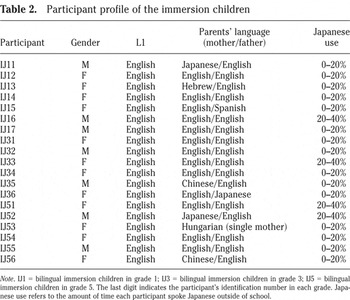
One group of English-Japanese bilingual children, one group of English-Japanese bilingual adults (immersion teachers), and one group of monolingual Japanese children volunteered to participate. The data for the study were collected from (a) 19 children (7 male, 12 female) in a Japanese immersion program on the West Coast of the United States, (b) 5 bilingual teachers (all female) in charge of this program, and (c) 12 monolingual Japanese children (6 male, 6 female). The total number of participants in the production study was 36 (13 male, 23 female). The immersion children consisted of 7 participants from grade 1 (age 6), 6 participants from grade 3 (age 8), and 6 participants from grade 5 (age 10) (see Table 2). They all spoke English as a L1 and had been exposed to Japanese mainly in the school setting.6
Three participants (one in each grade) whose parents spoke Japanese were included because the language background information showed that they most frequently spoke English at home and their amount of Japanese use outside of school did not exceed that of the other children. Additionally, two participants in grade 1, one in grade 3, and two in grade 5 who had a parent who spoke a language other than English and Japanese (i.e., Hebrew, Spanish, Chinese, Hungarian) were included because they all reported their Japanese use outside of school to be less than 20%. Furthermore, the data of all these participants fell within one standard deviation of the means of their own subgroup. Originally, the research design for this study proposed that all participants should be children whose family language background had nothing to do with Japanese. This criterion was difficult to implement because the Japanese immersion program had a limited number of children and, to make matters worse, it was extremely difficult to obtain participants from only English-speaking families. In the area where this research was carried out, many parents speak a language other than English as a L1. The ideal selection of participants would have been possible only if this research had been done in another part of the United States where monolingual English speakers are the norm.
Participant profile of the immersion children

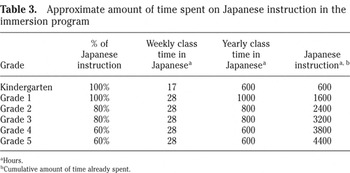
Approximate amount of time spent on Japanese instruction in the immersion program

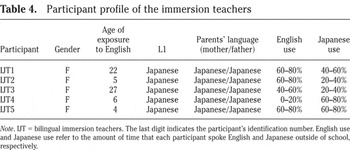
To investigate how input would contribute to the children's phonetic norms of Japanese singletons and geminates, data were gathered from the five English-Japanese bilingual teachers in the Japanese immersion program. They consisted of three early and two late bilinguals who had been exposed to English before or at the age of 6 and after the age of 20, respectively (see Table 4). The early bilinguals, who spoke Japanese at home and English elsewhere, were born and schooled in the United States, and the late bilinguals were born and schooled in Japan. The monolingual group was composed of a total of 12 Japanese-speaking children, with 6 participants in grade 1 and 6 participants in grade 5 at an elementary school in Saitama, Japan, which is located just to the north of Tokyo.
Participant profile of the immersion teachers

For the accent rating study, the total number of raters was 52. The accent rating tests were administered at two different universities: one in Tokyo and the other in a suburb of the greater Tokyo area. The group of raters in the first university consisted of 25 freshmen from the vicinity of Tokyo who spoke the Tokyo dialect. The second group was composed of 27 freshmen from different parts of the Kanto area, which includes seven prefectures near the Tokyo area.7
The subjects from Ibaraki Prefecture were excluded because they speak an accentless dialect of Japanese, in which “there is no native speaker recognition of the pitch pattern, though phrases are normally pronounced in a flat tone with a slight rise in the middle” (Shibatani, 1990, p. 213).
Procedures
For the collection of production data, each recording session consisted of a 20-min face-to-face pronunciation elicitation test administered before or after school. Each child was audio-taped while he or she interacted with the researcher in a quiet classroom. During each session, the child was shown pictures of objects that had been designed to elicit words that included the target voiceless stop consonants. The child was instructed to name an object in each picture and to provide each target word in a specific sentence frame used for all responses. The recordings were made using a SONY tape recorder with a tie-clip-type directional microphone. The data from the immersion teachers and the monolingual Japanese speakers were collected using the same method.
To maximize the children's attention span, each session was divided into two subsessions with a short break between them. In each of the subsessions, half of the randomized words were elicited. Also, to allow the subjects time to grow accustomed to the task, several nontarget tokens were added before and after each subsession.
The accent rating was done in a language lab. Raters heard 132 sentences (6 sentences × 19 immersion children + 6 sentences × 3 Japanese monolingual children) via headphones only one time. The raters were told that most but not all sentences had been spoken by English-speaking children at an elementary school where the children are learning Japanese as a foreign language. However, the raters were not told what the ratio was of NSs to nonnative speakers (NNSs). An additional two sets of sentences were used for practice.
On the basis of six sentence tokens, the raters were instructed to rate the degree of contrast between singletons and geminates as well as foreign accentedness. Moreover, they were asked to pay attention to segmental quality (i.e., the presence or absence of a geminate) and to ignore the factors of speech rate, pitch accent, and intonation. They marked a rating on an 11-interval scale that ranged from 0 (entirely no contrast between the singleton and geminate and heavy foreign accent) to 10 (clear contrast between the singleton and geminate and NS pronunciation). They marked only one accent rating for each speaker on the basis of the six tokens. The whole rating session lasted from 15 to 20 min.
Materials
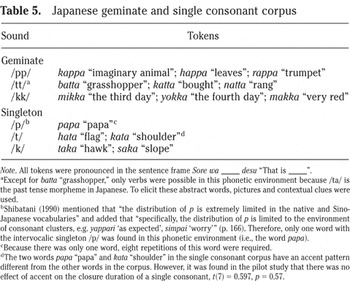
Due to the limits of the Japanese lexicon, it was not possible to find lists of matched Japanese words with the singleton and geminate stops in the same vowel environment. Nonetheless, the following criteria were taken into consideration in word selection: (a) the following vowel quality ([a] was selected to be the vowel following the target consonant), (b) disyllabic words, (c) the same pitch accent pattern (Low High for singletons and Low High High for geminates), and (d) concrete words that can be easily elicited from children.8
Because some verbal and abstract words (e.g., katta, natta, mikka, yokka, makka) were more difficult to elicit than the concrete nouns, all of the target words were reviewed with subjects in a practice session so that they could easily identify each picture.
Japanese geminate and single consonant corpus

The data for the accent rating were drawn from the production experiment just described. The second repetition of each word was selected for the accent rating, and each place of articulation for both single and geminate consonants was included. A list of the words used for the accent rating is presented in (1).

Sentences containing these tokens were digitized on a personal computer. A tape was made in which sentence stimuli were blocked by the speaker. Six sentences produced by each speaker were randomized within each speaker block. Each speaker block began with a double beep generated by sine waves and ended with a single beep. There was an 8-s silence between each speaker block, during which the raters evaluated the degree of accent for the speaker. The same six sentences produced by three Japanese monolingual children were included as a control. An example of one speaker block on the tape is provided in (2).

Data Analysis
Closure Duration.
For the production study, the total number of tokens elicited for the geminate corpus was 972 tokens (9 words × 3 repetitions × 36 subjects) and 864 tokens (4 words × 4 repetitions × 36 subjects + 1 word × 8 repetitions × 36 subjects) for the single consonants. The computer program Computerized Speech Lab was used for data measurement. To calculate a measure of speech rate, a part of the sentence-initial phrase ore wa was measured. The sentence-initial /s/ was not included because the beginning point of the voiceless alveolar fricative /s/ was not always clear. The starting point of /o/ was identified by the beginning of the second formant (F2), and the ending point of /a/ was defined by a cessation of energy in the region of F2 and higher formants. The reason for using F2 as the criterion is that a high vowel's first format can be confused with high fundamental frequency energy in child speech. Also, waveforms were used as a secondary reference.
The closure duration of both singletons and geminates was measured to the nearest millisecond. The voiceless stops—[p], [pp], [t], [tt], [k], and [kk]—were identified by a gap on the spectrogram showing the stop closure. The beginning of the closure was defined by a cessation of the F2 of the preceding vowel, and the end of the closure was defined by the burst of the following single or geminate consonant. When the burst was not visible, it was measured up to the beginning of frication. Also, VOT following the burst was not included in the closure duration of the stop because the target was the closure of the stop. A total of six mean closure duration values were calculated for each subject. The three mean closure duration values for /pp, tt, kk/ were calculated based on nine observations. The other three mean closure duration values for /p, t, k/ were obtained based on eight observations.
Additionally, to examine the relation between moras and syllables, the duration of the second syllable for three two-mora, two-syllable words (e.g., kata “shoulder”) and three three-mora, two-syllable words (e.g., katta “bought”) was measured instead of the whole word. For example, for the contrast between kata and katta, the duration of the syllables /ta/ and /tta/ was measured to examine the realization of the mora.9
The researcher is aware of the fact that the syllable boundary of the word is in the middle of the geminate (e.g., Tsujimura, 1996). Thus, phonologically, the first part of the geminate belongs to the preceding syllable, and the second part belongs to the following syllable. However, because there is no acoustic cue in the middle of the geminate that corresponds to the syllable boundary, the duration of the whole geminate and the following vowel was measured as the duration of the second syllable, which is exactly the duration of two moras.
Measurement reliability was evaluated with the test-retest approach. The researcher remeasured 100 randomly selected sentence frame tokens (i.e., ore wa) and 96 randomly selected closure duration tokens a few months following the initial measurements. The first and second sets of measurements were highly correlated (average measure intraclass correlation = .978 for sentence frames; average measure intraclass correlation = .981 for closure tokens).
Foreign Accent Rating.
The score range for the foreign accent rating was from 0 to 10 and the highest possible score was 520 points (10 points from each rater × 52 raters). The mean score for each speaker was obtained by averaging the total scores assigned by the raters. Given that the accent rating tests were administered in two different locations at different times (M = 7.14, SD = 0.66 for the first administration, and M = 6.55, SD = 1.45 for the second administration), the consistency between the two tests was checked with a t-test, which showed that there was no significant difference between the two rater groups, t(50) = 1.871, p = .067. Also, to examine interrater reliability among the 52 raters, Cronbach's coefficient alpha was calculated (average measure intraclass correlation = .991), which shows that the rating procedure was judged to be reliable across raters.
RESULTS
Closure Duration
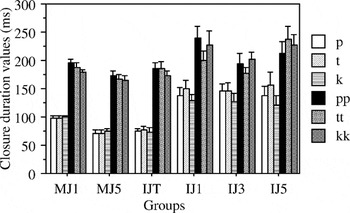
Figure 1 shows the mean closure duration of single and geminate stops across the three places of articulation for the monolingual Japanese speakers (MJ1 and MJ5: based on the average from six monolingual Japanese children in grades 1 and 5, respectively), the bilingual immersion teachers (IJT: based on the average from five bilingual teachers), and the Japanese immersion children (IJ1: based on the average from seven immersion children in grade 1; IJ3 and IJ5: based on the average from six immersion children in grades 3 and 5, respectively). Figure 1 shows that the monolingual Japanese speakers and the bilingual immersion teachers produced their singletons with much lower duration values than the geminates. The geminates were about two times the length of the single consonants (MJ1 = 188 ms vs. 98 ms; MJ5 = 168 ms vs. 72 ms; IJT = 181 ms vs. 75 ms). Additionally, the results show that the monolingual Japanese speakers who were in grade 1 produced both singletons and geminates with clearly longer closure duration values than the monolingual fifth graders. On the other hand, the immersion students' mean duration values for the singletons are much longer than those of both the monolingual speakers and the immersion teachers (IJ1 = 139 ms; IJ3 = 139 ms; IJ5 = 138 ms) and intermediate between the singleton and the geminate duration values produced by the monolingual speakers and the immersion teachers. In terms of geminate consonants, the immersion students produced longer closure duration values than the monolingual children and the immersion teachers (IJ1 = 222 ms; IJ3 = 191 ms; IJ5 = 226 ms).

The mean closure duration of singletons and geminates across places of articulation for the monolingual Japanese speakers, the bilingual immersion teachers, and the Japanese immersion children. MJ1 = monolingual Japanese speakers in grade 1; MJ5 = monolingual Japanese speakers in grade 5; IJT = bilingual immersion teachers; IJ1 = bilingual immersion children in grade 1; IJ3 = bilingual immersion children in grade 3; IJ5 = bilingual immersion children in grade 5. The error bars enclose ± one standard error.
Figure 1 also clearly illustrates the monolingual speakers' and the immersion teachers' differentiation between the single and geminate consonants and the immersion students' tendency to produce both types of stop with longer values and more variability. Although the geminates of the immersion students were clearly longer than their singletons, the differences between them were much smaller than those of the monolinguals and the immersion teachers. This means that the distinction made by the immersion children between the two types of stop is not as clear as that made by the monolingual Japanese NSs and the immersion teachers.
Across places of articulation, there were no differences between /p/, /t/, and /k/ among the monolingual speakers and the immersion teachers (MJ1: /p/ = 97 ms, /t/ = 98 ms, /k/ = 99 ms; MJ5: /p/ = 71 ms, /t/ = 71 ms, /k/ = 75 ms; IJT: /p/ = 74 ms, /t/ = 77 ms, /k/ = 73 ms), whereas the monolingual groups produced /pp/ with slightly longer duration values than /tt/ and /kk/, and the immersion teacher group produced both /pp/ and /tt/ with slightly longer duration values than /kk/ (MJ1: /pp/ = 196 ms, /tt/ = 189 ms, /kk/ = 179 ms; MJ5: /pp/ = 173 ms, /tt/ = 166 ms, /kk/ = 165 ms; IJT: /pp/ = 185 ms, /tt/ = 186 ms, /kk/ = 172 ms). Although Han (1992) reported that bilabial stops have longer durations than the other stops regardless of singletons or geminates, this is not the case with the singletons in this study. Compared to the NSs, the immersion groups show more variability: They tended to produce /p/ and /t/ with longer duration than /k/ (IJ1: /p/ = 137 ms, /t/ = 149 ms, /k/ = 130 ms; IJ3: /p/ = 145 ms, /t/ = 145 ms, /k/ = 127 ms; IJ5: /p/ = 137 ms, /t/ = 156 ms, /k/ = 120 ms), and no clear tendency was observed in the production of their geminates.
Prior to running the statistical procedure, the possibility of a significant difference in the speech rate among the subject groups was explored. To examine the consistency of the speech rate for each group, the duration of ore wa was measured. A group (6) one-way ANOVA revealed a significant difference in the speech rate among the subject groups, F(5, 210) = 34.092, p < .001. Tukey-Kramer post hoc tests showed that the speech rate of the first graders in both the monolingual group and the immersion group was significantly slower than that of the older students in their respective language groups and that the speech rate of all the immersion groups was significantly slower than that of both the monolingual speakers in grade 5 and the immersion teachers (p < .05). To control for the speech rate, the mean duration values obtained for each of the 36 subjects who produced both single and geminate consonants were submitted to a Group (6) × Type (2: singleton and geminate) × Place of articulation (3) three-way analysis of covariance (ANCOVA), in which the speech rate was a covariate. The procedure yielded a significant main effect due to group and type only and a significant two-way interaction between group and type (no other two-way interactions or three-way interactions were significant); group: F(5, 179) = 8.313, p < .001; type: F(1, 179) = 369.341, p < .001; Group × Type: F(5, 179) = 2.666, p < .025. Pairwise comparisons revealed that all the immersion groups significantly differed from both the monolingual speakers and the immersion teachers, and there was no significant difference across grade levels in the immersion groups. Because a two-way interaction between group and type was found, the data for each group were separately analyzed using a Type (2) × Place (3) two-way ANCOVA, in order to determine whether the immersion children can clearly differentiate singletons from geminates at each place of articulation. This test revealed that there was a main effect due to type only, with no interaction between type and place; type: grade 1: F(1, 42) = 46.940, p < .001; grade 3: F(1, 36) = 19.555, p < .001; grade 5: F(1, 36) = 28.221, p < .001. This suggests that all of the immersion groups significantly differentiated between the single and geminate stops regardless of the place of articulation.
Additionally, to investigate the input quality that the immersion children received, the immersion teachers' closure duration average was compared with that of the monolingual speakers. Pairwise comparisons show that there was no significant difference between them. This indicates that although three of the teachers were early Japanese-English bilinguals, the input that the immersion children received was equivalent in quality to input that they would have received had their instructors been monolingual speakers of Japanese.
Closure Duration Ratio and Mora Ratio
To examine whether the immersion children have acquired nativelike segmental timing control, both the closure duration ratio (e.g., the ratio of /tt/ to /t/ in itta and ita) and the mora ratio (e.g., the ratio of /tta/ to /ta/ in itta and ita10
In Japanese, the first consonant of a geminate takes one mora.
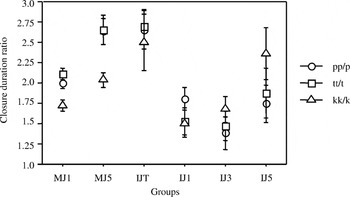
Figure 2 shows the mean ratio for the closure duration of a geminate to a single stop across place of articulation for the monolingual speakers (MJ1 and MJ5), the immersion teachers (IJT), and the immersion children (IJ1, IJ3, and IJ5). Both the monolingual children and the immersion teachers made the contrast between the two types of stop with ratios of about two times or more (MJ1 = 1.94, MJ5 = 2.44, IJT = 2.62), whereas the ratios for the immersion groups, with the exception of grade 5, were lower (IJ1 = 1.61, IJ3 = 1.51, IJ5 = 1.99). The ratio of the NS groups (monolingual children and immersion teachers), which is lower than the ratio suggested by Han (1992), supports Beckman's (1982) view that the NS geminate-to-singleton ratio is 2.79:1 when VOT is not included.

The closure duration ratio of geminates to singletons across place of articulation produced by the monolingual speakers, the immersion teachers, and the immersion children. MJ1 = monolingual Japanese speakers in grade 1; MJ5 = monolingual Japanese speakers in grade 5; IJT = bilingual immersion teachers; IJ1 = bilingual immersion children in grade 1; IJ3 = bilingual immersion children in grade 3; IJ5 = bilingual immersion children in grade 5. The error bars enclose ± one standard error.
Turning now to the variation in closure duration ratio across place of articulation (see Figure 2), the monolingual speakers and the immersion teachers produced the contrast between pairs of geminate versus singleton velar stops with a lower ratio than was found between similar pairs of bilabial and alveolar stops (MJ1: pp/p = 2.01, tt/t = 2.11, kk/k = 1.72; MJ5: pp/p = 2.63, tt/t = 2.65, kk/k = 2.04; IJT: pp/p = 2.66, tt/t = 2.70, kk/k = 2.50), although only the ratios of the monolingual speakers revealed a significant difference (p < .01 by the Tukey-Kramer test). As for the variation across place of articulation for the immersion groups, the ratio of /kk/ to /k/ tended to be higher than that of the remaining types of stops. This was true for the third and fifth graders, but not for the first graders: IJ1: pp/p = 1.81, tt/t = 1.53, kk/k = 1.50; IJ3: pp/p = 1.38, tt/t = 1.48, kk/k = 1.68; IJ5: pp/p = 1.74, tt/t = 1.87, kk/k = 2.36. However, a Group (6) × Place (3) two-way ANOVA revealed a main effect due to group, but neither a significant effect of place nor an interaction between group and place: group: F(5, 90) = 14.716, p < .001; place: F(2, 90) = 0.359, p = .700; Group × Place: F(10, 90) = 1.702, p = .092. This means that for the immersion groups, the ratio for the closure duration does not vary across place of articulation (i.e., pp/p, tt/t, kk/k). Tukey-Kramer post hoc tests revealed that although the immersion groups in grades 1 and 3 significantly differed from the monolingual speakers in grade 5, none of the immersion groups differed from the monolingual children in grade 1 (p < .01). This might suggest that the immersion children approximated the norm of the monolinguals in grade 1, who might have been still in the process of fine-tuning phonetic features in their L1 development, not for the closure duration values but the closure duration ratio. Additionally, it is worth noting that the immersion children in grade 5 marginally reached the norm of the monolingual children in grade 5 as well. This might imply that the fifth graders, who were exposed to Japanese in the immersion program for the longest period of time, have succeeded in acquiring the closure ratio between singletons and geminates. However, it should be noted that although the closure duration ratio for the fifth graders in the immersion program approximates the norm of the monolingual children most closely, a great many individual differences were observed due to the large variability among the speakers.
The teachers' ratio for the closure duration was significantly higher than the monolingual speakers in grade 1 (p < .01 by the Tukey-Kramer test), but the immersion teachers did not differ from the monolingual speakers in grade 5. Compared with Han's (1992) data, the immersion teachers' ratio falls within the NSs' range. This leads us to assume that their closure duration ratio is authentic and the input quality for the immersion children was nativelike.
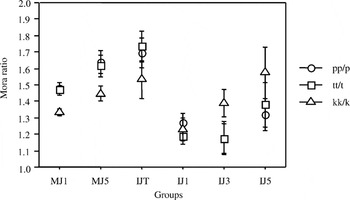
In the section that follows, the results of the mora ratio of two-mora syllables to one-mora syllables are presented (see Figure 3). In the monolinguals' and the immersion teachers' utterances, the ratio ranges from 1.43 to 1.65 (MJ1 = 1.43, MJ5 = 1.57, IJT = 1.65). In other words, a two-mora syllable is realized as about 1.5 times as long as a one-mora syllable. This result supports Han's (1994) finding that the mean relative duration of Japanese one-syllable words containing a single stop and a geminate stop is 1.00:1.46. In the production of these two types of syllable by the immersion children, the ratio ranges between 1.23 and 1.43 (IJ1 = 1.23, IJ3 = 1.25, IJ5 = 1.43), which is lower than that of the monolinguals and the immersion teachers, although IJ5 attains the same ratio as MJ1.

The mora ratio of geminates to singletons across place of articulation produced by the monolingual speakers, the immersion teachers, and the immersion children. MJ1 = monolingual Japanese speakers in grade 1; MJ5 = monolingual Japanese speakers in grade 5; IJT = bilingual immersion teachers; IJ1 = bilingual immersion children in grade 1; IJ3 = bilingual immersion children in grade 3; IJ5 = bilingual immersion children in grade 5. The error bars enclose ± one standard error.
In terms of the variation across place of articulation (see Figure 3), the mora ratio for velar stops produced by both the monolingual groups and the immersion teachers was the lowest (MJ1: pp/p = 1.48, tt/t = 1.47, kk/k = 1.33; MJ5: pp/p = 1.64, tt/t = 1.62, kk/k = 1.45; IJT: pp/p = 1.69, tt/t = 1.73, kk/k = 1.53), whereas the ratio for velar stops produced by the immersion children in grades 3 and 5 was the largest of the three ratios (IJ3: pp/p = 1.18, tt/t = 1.17, kk/k = 1.39; IJ5: pp/p = 1.32, tt/t = 1.38, kk/k = 1.58). To examine whether this difference was significant, the mean mora ratio for all the groups was submitted to a Group (6) × Place (3) two-way ANOVA, which revealed a significant main effect of group but neither a significant effect of place nor any interaction between the two factors: group: F(5, 90) = 12.033, p < .001; place: F(2, 90) = 0.035, p = .966; Group × Place: F(10, 90) = 1.790, p = .074. This shows that there is no significant variation in the mora ratio across place of articulation. Tukey-Kramer post hoc tests showed that although they reached the mora ratio of the grade 1 monolinguals, the immersion children in grades 1 and 3 significantly differed from the monolingual children in grade 5 and from the immersion teachers (p < .01). This means that the first and third graders in the immersion program did not clearly differentiate the one-mora syllable from the two-mora syllable (IJ1 = 1.23, IJ3 = 1.25), but that the fifth graders have approximated the targetlike mora ratio, with a ratio close to that of the monolingual children in grades 1 and 5 and the immersion teachers (MJ1 = 1.43, MJ5 = 1.57, IJT = 1.65, IJ5 = 1.43). However, it should be noted again that the immersion children in grade 5 did not significantly differ from any of the other immersion groups due to large individual differences.
Additionally, the mora ratio of the immersion teachers did not differ from either of the two monolingual groups', although the teachers showed more variability. This seems to imply that the immersion children received input consistent with NS speech.
Foreign Accent Rating
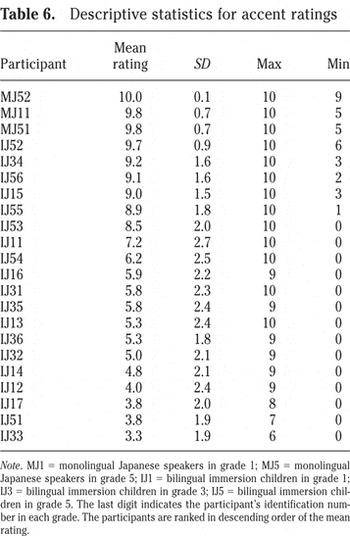
Table 6 shows the descriptive statistics for the accent ratings of the 22 speakers, which consisted of the 19 immersion children and 3 Japanese monolingual children. Each of the 3 Japanese monolingual children included as a control (MJ11, MJ51, MJ52: note that the last digit indicates the participant's identification number in each grade) scored, on average, 9.8 or above (10 = clear contrast between the singleton and geminate and no foreign accent). Furthermore, the small standard deviations suggest that the raters closely agreed on the scores of the Japanese monolingual speakers' tokens. Of the 19 immersion children, 4 scored more than an average of 9: 1 from grade 1, 1 from grade 3, and 2 from grade 5.
Descriptive statistics for accent ratings

Those children who scored high on the accent ratings (IJ15, IJ34, IJ52, IJ56) reported that they were exposed to Japanese outside of school to some extent. IJ15 and IJ34 attended a Japanese preschool for a short time before they entered the immersion program. IJ52 and IJ56 had the chances to speak Japanese with grandparents, siblings, or sometimes one of their parents. In other words, the findings suggest that Japanese input only in class was not sufficient for the children to acquire a nativelike contrast between the singletons and geminates even though they started to learn Japanese in kindergarten.
However, it is not guaranteed that children can acquire the contrast even if they are exposed to Japanese outside of school or even if one of their parents is a NS of Japanese. For example, IJ36's father and grandmother are NSs of Japanese; nonetheless, she received a score of 5.3, which was not as high as the other children who had at least one Japanese-speaking parent. Also, IJ51 (a Japanese American), who spoke Japanese outside of school for 20–40% of her daily life and received some Japanese input from her grandparents, scored the second lowest (3.8) of all participants. In contrast, it is noteworthy that several children with non-Japanese backgrounds who had not received any Japanese input outside of school learned to make a clear distinction between the two types of stops (e.g., IJ53: 8.5; IJ55: 8.9). Thus, this evidence indicates that additional Japanese input outside of school does not necessarily mean that children will acquire a clear contrast.
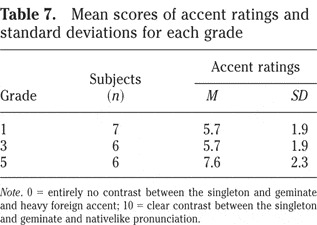
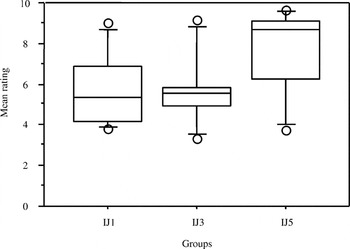
Table 7 shows the mean score and the standard deviation of the accent rating for each grade. Grades 1 and 3 have the same mean score, and students in grade 5 seemed to perform best in terms of the mean score. However, the larger standard deviation in grade 5 indicates that there was more variation across subjects. Visual inspection of Figure 4 suggests that the mean score of the outlier in grade 5 (score = 3.8) was much lower than the scores of all the other children in the grade and lowered the group mean.
Mean scores of accent ratings and standard deviations for each grade


Box plot showing the distributions of the mean scores of the accent rating for the 19 immersion speakers. The ends of the box are at the quartiles, so that the box length is the interquartile range (IQR). The median is marked by a line within the box. The two lines outside of the box extend to the extremest high and low scores still within 1.5 × IQR of the quartiles. The scores beyond 1.5 × IQR are plotted individually. IJ1 = bilingual immersion children in grade 1; IJ3 = bilingual immersion children in grade 3; IJ5 = bilingual immersion children in grade 5.
To test whether there is any significant difference in the accent rating scores among the three school grades, the mean scores for the immersion children were submitted to a group (3) one-way ANOVA. The main effect of group was not found to be significant, F(2, 16) = 1.946, p = .175. Although the mean score of grade 5 was higher than the other two groups, the negatively skewed distribution and the larger standard deviation for this grade resulted in no significant difference by group. Figure 4 clearly shows this result. However, it should be noted that although not statistically significant, there seems to be a tendency toward improvement of pronunciation by the end of the immersion program. Except for the few exceptions (e.g., IJ51 and IJ54), the fifth graders have developed better pronunciation, as determined by the raters.
However, the findings from both subjective evaluation by native listeners and the acoustic data described in the previous section seem to imply that by the fifth grade, even young children in an immersion program cannot completely acquire the nativelike contrast between single and geminate consonants. Additionally, there is great individual variability in the acquisition of the contrast between the two types of consonants. Although more research is required, this great variability might be caused by individual differences (e.g., phonetic coding ability, motivation, cognitive or learning style, learning strategies, or sociocultural experiences).
Because the accent rating was designed to measure the degree of contrast between the immersion students' Japanese singletons and geminates, the extent to which the ratings correlate with the acoustic measurement of the closure duration of the two types of consonant is also important and will now be considered. As discussed in the section on the production of the closure duration, three mean ratios of geminates to singletons for each subject were obtained (i.e., pp/p, tt/t, and kk/k). However, in the accent rating session, the raters listened to only six tokens (one example of each of the following consonants in the medial position: /p, t, k, pp, tt, kk/), and marked only one rating for each speaker. To parallel the data gathered for the accent rating (i.e., only one accent rating per speaker), the three mean ratios for closure duration were collapsed into one mean ratio of a geminate to a single consonant per participant.11
This acoustic ratio was based on the collapsed mean ratio obtained from eight observations for each singleton /p, t, k/ and nine observations for each geminate /pp, tt, kk/, rather than basing the ratio solely on the tokens that the accent raters heard. Because the raters provided a holistic score rather than a componential one, the mean ratio based on all production data from each speaker was used.
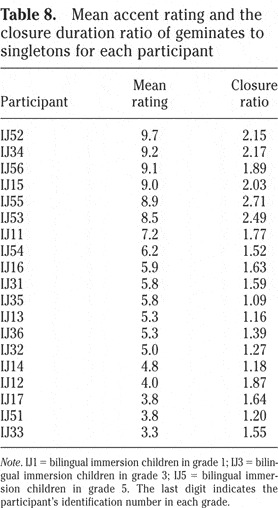
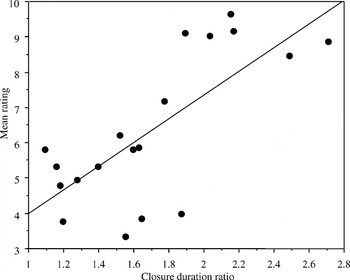
Table 8 shows the accent ratings and the acoustic ratios for the immersion children. Similar to Han's (1992) finding, the NNSs' ratio of the geminates to the singletons varied from 1.09 to 2.71, whereas that of Japanese monolingual speakers ranged from 1.82 to 2.79. Although ratios of less than 2.0 resulted in variations in the accent rating across speakers, ratios of over 2.0 consistently corresponded to a rating of 8 or 9 points. However, it is worth noting that the accent ratings and the acoustic properties do not exhibit a one-to-one relationship. For example, the ratios of participants IJ12 and IJ17 were 1.87 and 1.64, respectively, and those of participants IJ13 and IJ35 were 1.16 and 1.09, respectively. However, the latter two participants, despite having lower ratios, scored higher on the accent rating (IJ12 = 4.0 and IJ17 = 3.8 vs. IJ13 = 5.3 and IJ35 = 5.8). As Han (1994) and Hirata (1990a, 1990b, 1993) suggested, the closure duration ratio is not the only acoustic cue in identifying single versus geminate consonants. They argued that NSs of Japanese rely on the preceding vowel length, the word duration, and the speed of the following larger units as well as the closure duration for singleton versus geminate judgments. The raters might have focused on such acoustic features when they judged the degree of accentedness of these immersion students' singleton-geminate production.12
It could also be considered that the raters were influenced by other factors than those related to singleton-geminate contrast in their ratings; that is, other factors might have contributed to the overall foreign accent part of the rating, such as vowel quality, other consonants, speech rate, and prosody (S. Guion, personal communication, September 19, 2005).
Mean accent rating and the closure duration ratio of geminates to singletons for each participant

To examine the relation between the closure duration ratio and the rating received by each speaker, a Pearson product-moment correlation coefficient was obtained. Figure 5 shows the regression plot of the ratio to the mean rating score of each subject. The results show that the degree of contrast (perceived by the raters) for the immersion children correlated fairly highly with each child's ratio of geminates to singletons (r = .729, p < .001). This means that about 53% (R2 = .531) of the variance for the degree of perceived contrast can be accounted for by the closure duration ratio of geminates to singletons. This suggests that the closure duration ratio is a good measure of the acquisition of the contrast between single and geminate consonants in Japanese, although it is not a perfect predictor.13
Additionally, the correlation coefficient between the mean rating and the mora ratio was calculated, which showed a fairly high correlation (r = .636, p < .005). To determine which of the two ratios—closure duration ratio or mora ratio—is a better predictor, a stepwise multiple regression analysis was carried out, in which the variable for the mora ratio was excluded (R2 change = −.001, F change = 0.021, p = .888). The addition of the variable for the mora ratio to the model did not serve to better predict the accent rating scores for the immersion children.

Regression plot of the closure duration ratio to the mean rating scores.
In sum, the results of the ratings imply that, although not statistically significant, there is some tendency for the perceived contrast to become clearer by the time the immersion children reach the fifth grade. Moreover, the ratings correlate highly with the ratio of the closure duration of geminates and singletons. Therefore, the ratio is a very good measure for determining whether children have acquired the contrast between these sounds in Japanese.
DISCUSSION AND CONCLUSION
This study shows that the immersion students tended to produce closure duration of single stops in Japanese with much longer values than the Japanese monolingual children and the immersion teachers. Additionally, their geminate closure duration was a little longer than that of the Japanese monolinguals and the immersion teachers. Contrary to the expectation that the duration of English speakers' geminates would be shorter than that of the monolinguals (Han, 1992), the immersion students actually overshot their geminates in terms of length. However, although the immersion groups significantly differed from both the monolingual speakers and the immersion teachers in closure duration, statistical results show that they succeeded in acquiring the contrast between single and geminate stops. At the same time, it should be pointed out that the tendency of the immersion children's single stops to be about twice as long as those of the monolinguals and the immersion teachers obscured the distinction between the singletons and geminates.
The finding that the immersion children acquired the contrast between the two types of stop in Japanese might suggest that, in terms of Flege's (1995) first hypothesis, the immersion children (who started to learn Japanese in kindergarten) might have had the ability to discern phonetic differences that do not exist in their L1 and to establish two separate phonetic categories for single and geminate stops in Japanese. Their success in acquiring the contrast might be one of the important advantages of learning a L2 through immersion education at an early stage of life. However, it should be kept in mind that a perception study is required to determine whether they can discern slight phonetic differences between a L2 sound and the closest L1 sound or between similar L2 sounds.
The results from this study also showed that the immersion children's phonetic categories are far from identical to those of the L1 monolingual speakers or the immersion teachers. This finding can be well accounted for by Flege's (1999) interaction hypothesis. The reason that the immersion children overshot the closure duration for single stops in Japanese can be attributed to the fact that single stops in English are longer than their counterparts in Japanese (Han, 1992). It might be that, due to the longer single stop in their L2 Japanese, the immersion children find it necessary to further lengthen the geminate stop to maintain the contrast between the two sounds. Therefore, on the basis of the two findings from this study, the following interpretation suggests itself: If immersion children are exposed to a L2 at an early age, they are more likely than late learners to acquire a new phonetic category, and this new category will interact with that of the closest sound in their L1. As a result, even early learners might retain some L1 acoustic features that can be subjectively identified, as shown in the accent ratings here. In other words, the immersion students cannot develop a L2 phonetic category identical to that of L1 speakers even if L2 exposure begins in kindergarten. This finding supports Flege's (1995) hypothesis that “the bilingual's category is ‘deflected’ from an L1 category to maintain phonetic contrast between categories in a common L1-L2 phonological space” (p. 239). If data for English stops in the same phonetic environment were collected for comparison with their Japanese counterparts, this could be argued for more strongly.
The previous claim that the relatively smaller difference between the singleton and geminate stops for the immersion children might be due to the fact that their phonetic categories differ from those of L1 speakers' is supported by findings on the closure duration ratio and the mora ratio. The mean closure duration ratio of geminates to singletons for the immersion children ranged from 1.51 to 1.99, whereas that of the monolinguals and immersion teachers ranged from 1.94 to 2.62. Results also show that the mora ratio of a two-mora syllable to a one-mora syllable for the immersion children ranged from 1.23 to 1.43, whereas the ratio for the monolinguals and immersion teachers fell between 1.43 and 1.65. However, it is worth noting that although their ratios tended to be lower, findings show that the immersion children did not differ from the monolingual children in grade 1. This suggests that the learners have successfully developed the new phonetic categories for the single and geminate stops in Japanese to some extent, although the categories might not have been as well established as those of the monolinguals in grade 5 and the immersion teachers. In other words, assuming that the monolinguals in grade 1 are still developing their L1, it might be the case that the immersion children are still in the process of developing their closure duration and, in the long run, they might fine-tune their phonetic category to make it more nativelike.
As for the variation across grade levels, the immersion groups did not significantly differ from each other in closure duration values. This seems to suggest that even the fifth graders in the immersion program have not developed a nativelike pronunciation of single versus geminate stops despite 5 years of instruction in Japanese. Alternatively, the findings are consistent with the interpretation that the learners reached a ceiling in the first grade. However, an examination of the ratio of closure duration and the mora ratio reveals a difference among grade levels: Only the fifth graders marginally reached the norm of the monolingual children in grade 5 and the immersion teachers. This implies that a greater amount of input might make it possible to modify a once-established phonetic category to approximate a more nativelike category.
The accent ratings by the Japanese NSs suggest that the immersion children made a nonnativelike distinction between singletons and geminates despite some individual differences in their performance. Moreover, there is no statistical difference in the scores of accentedness across grade levels despite a tendency for the fifth graders to perform better than the other immersion groups. This finding suggests that although they succeeded in establishing a new phonetic category, it was different from that of a L1 speaker. Moreover, the degree of perceived contrast for all of the immersion children correlated fairly highly with their closure duration ratio of geminates to singletons. This suggests that this ratio is a good measure of the acquisition of the phonemic contrast, showing that the closure duration ratio of 2.0 or higher consistently corresponds to a high accent rating.
The children who started to learn Japanese in the form of total immersion in kindergarten reached neither the monolingual speakers' phonetic norm nor the immersion teachers' norm; moreover, their distinction between singletons and geminates was clearly identified as nonnativelike. Although the interaction hypothesis predicts this, other factors that might explain this finding include input quality, input amount, and L1 use. First, the quality of input that the immersion children received from their teachers was found to be authentic and did not differ from the monolingual speakers' input in the closure duration, its ratio, or in the mora ratio.14
One might expect that because “cross-language phonetic interference is bidirectional in nature” (Flege, 1995, p. 241), the phonetic features of the bilingual teachers would be different from those of monolingual speakers. For example, in Harada (2003), Japanese-English bilinguals produced Japanese voiceless stops with longer mean VOT values than monolingual Japanese speakers, which resulted from L2 influence on L1 speech. The presence or absence of L2 influence might be attributed to the degree of functional load. Phonologically, there is no distinction between voiceless unaspirated and aspirated stops or short-lag and long-lag VOT in Japanese, whereas closure duration plays an important role in distinguishing single from geminate stops. Thus, in the current study, a greater degree of functional load for closure duration might have minimized the influence of English (L2) on Japanese (L1) in the speech of the immersion teachers. More research is required.
Roffwarg, Muzio, and Dement (1966) reported that the total amount of daily sleep for 2- to 3 year-old children is around 12 hr, which implies that they are exposed to their L1 for roughly 12 hr per day.
Both additional production and perception research conducted in immersion settings will be required before it can be definitely concluded that children in an immersion program can establish a new phonetic category and that their L1 and L2 systems interact with one another. Additionally, follow-up studies will be needed to examine whether adolescent and adult learners who have attended the immersion program retain the new phonetic categories even after they are placed in a traditional language curriculum. Finally, to this researcher's knowledge, this study is the first to acoustically analyze L2 speech produced by children in an immersion program; I hope that it will contribute to children's L2 speech learning theories in classroom settings and give insight into the implementation of second and foreign language teaching at an early age.