Academics and politicians alike decry the deterioration of trust in American political institutions and in political participation. One oft-cited culprit for this deterioration is the conduct of campaigns for elective office, with especial ire focused upon political consultants and the consulting industry. The lack of a civil campaign ethic, it is said, means that the largely unregulated nature of political combat and speech generates campaigns rife with ad hominem attacks and “negative” ads that disgust, discourage, and alienate prospective voters. In response, some parts of the consulting industry have attempted to inculcate a higher level of campaign conduct through candidate and professional campaign codes. Another response is based in the several university programs that offer graduate degrees in political or campaign management, which include varying degrees of training regarding ethical considerations in campaigns.
One such program, located at Regent University's School of Government, has developed a series of interactive, webbased campaign ethics scenarios for its main campaign ethics course. (The ethics scenarios can be experienced by going to the Center for Grassroots Politics' campaign ethics web page: <www.regent.edu/acad/schgov/grassroots/ethics.html>; the scenarios require installation of the Shockwave Internet browser plug-in and Windows Media Player.)
This paper describes the context for the development of those scenarios, how they are used in an online teaching environment, and shows how the scenarios can be used to increase students' understanding of campaign politics. More importantly, however, I argue that the students who participate in discussions of campaign ethics in advance of campaign crises are better prepared for ethical decision making in a crisis. Furthermore, I argue that this tool prompts a reasoned approach that is superior to making ethical decisions “on the fly” in crisis situations.
Campaign Ethics and Concerns about Campaign Conduct
Concern about the conduct of American election campaigns has led to several studies of opinions regarding campaign conduct, including survey analysis of citizens and of campaigning practitioners. The Pew Charitable Trusts, for example, has funded studies and programs designed to assess campaign conduct and people's perspectives on campaigns and elections. American University's Center for Congressional and Presidential Studies and the Institute for Global Ethics each found that large majorities of the electorate are pessimistic about the ethical standards of candidates (IGE 1999; 2002; Thurber et al. 2000), but that campaigners mostly consider themselves to be ethical (Medvic 2001; Thurber and Nelson 2000). Carol Whitney (2002, 101), for example, writes, “I have yet to meet a political consultant who admits to doing anything unethical.” Campaigns and campaign communications have nonetheless been explicitly connected with declines in political participation (e.g., Bartels et al. 1998) and political trust (e.g., Fowler 1995; Neustadt 1997), broadening the locus of concern beyond individual campaigns to the United States' political system itself (e.g., Carter 1998; Kolodny 2002; Scher 1997).
Concerns about the impact of campaigns on public opinion and political participation have led to a variety of efforts to encourage “more ethical” campaign conduct. The major professional organization of political consultants, the American Association of Political Consultants, developed a professional code of conduct that all members must sign, but which has no enforcement mechanism (see the code at www.theaapc.org/ethics.html). Some individual political consultants encourage prospective clients to consider ethical campaign practices in advance, or require clients to sign ethics codes. Other groups undertake broader initiatives at the state and local levels designed to encourage ethical campaigning by urging candidates to agree to a code of conduct developed by both campaigns (see, for example, the publications and resources at the Campaign Conduct web site of the Institute for Global Ethics, www.globalethics.org/campaignconduct).
Still other approaches attempt to inculcate into campaign training some consideration of what ethical campaign conduct entails. There are several venues in which campaign ethics are addressed in the political training process. Parties and some interest groups provide campaign training for affiliated candidates. There are numerous books and articles written on campaigning by both academics and practitioners, most of which devote some space to discussions of campaign conduct and ethical considerations (a number of these are cited in Wielhouwer 2003). The principle trade magazine in the political consulting industry, Campaigns & Elections, often contains articles discussing campaign ethics, and incorporates discussions into its campaign training seminars. Several academic institutions have sponsored substantial research and outreach to consultants and politicians in efforts to report on and improve the conduct of American election campaigns; prominent among these are the University of Maryland's Campaign Assessment and Candidate Outreach Project (www.capc.umd.edu), American University's Improving Campaign Conduct program (www.american.edu/academic.depts/spa/ccps), and UCBerkeley's Center for Campaign Leadership (http://campaigns.berkeley.edu), all funded by grants from the Pew Trusts. Finally, ethical concerns are integrated into coursework at the seven universities that offer graduate degrees in campaign or political management (Regent University, George Washington University, University of Akron, Suffolk University, New York University, Florida State University, and the University of Florida). Moreover, many colleges offer undergraduate courses on ethics and politics, with varying degrees of concentration on election campaign conduct.
The Center for Grassroots Politics Campaign Ethics Initiative
The School of Government at Regent University offers a Master's level program in political campaign management. As director of the program, and through the Center for Grassroots Politics, I developed a series of interactive ethics scenarios focusing specifically on campaign conduct. The scenario development is an innovative way to actively engage students in debating campaign ethics, distinct from the traditional method of course delivery—reading and then discussing or writing a short paper about a problem. Because students retain and internalize information with which they interact better than information that they simply read (e.g., McKeachie 1999), I wanted to make the ethical scenarios more interesting, engaging, and interactive. To achieve this goal I adapted actual, rather than hypothetical campaign situations. Students are more engaged when they know the scenario is based in reality and is not a creation of the professor's imagination. In reality, of course, we often find that truth in politics is stranger than fiction.
This understanding has influenced the construction of all my courses, especially in my primary course on ethics and campaigning, “Principled Political Action.” My basic approach in designing the class is as follows: Students develop personal codes of ethics at the outset, and then approach campaign situations and the course readings in that context. I also assume that if students consider difficult questions in advance, they will be better equipped to make ethically coherent and consistent decisions in a crisis. Therefore, the course focuses on a normative framework for considering political realities—it is designed to equip students to make ethically coherent decisions in future crisis-driven environments, like election campaigns. The ethical dimensions of political management are systematically addressed in later courses in the degree program, for which the content of this course lays an important foundation.
The scenarios themselves, however, do not assume, nor do they require an $a$ priori normative ethical framework. They simply present ethical dilemmas as problems that emerge in the course of a campaign. Because Regent University is a Christian graduate school, however, the classes often address normative questions within a distinct normative framework for assessing personal behavior and integrity. The reader should thus understand that the examples below are pulled from student discussions assuming an evangelical Christian ethical perspective.
Of course, whether a student or consultant considers a particular problem to be an ethical dilemma at all is a matter of perspective. For example, one scenario involves a debate over using push polls in campaigns. While academics tend to be universal in their condemnation of push polls (see, for example, the academic-written contributions in Nelson, Dulio, and Medvic 2002a), practitioners are more divided. Nelson, Dulio, and Medvic (2002b) report that in a recent survey of political consultants, 26% consider push polls ethical, 37% consider them ethically questionable, and 38% consider them to be clearly unethical.
In discussion with the University's Instructional Support & Technology Center (IST), I proposed placing a series of interactive scenarios on the center's web site. We developed a framework for student interaction and brainstormed on how different web platforms could effectively communicate the dilemma reflected in each scenario. For example, Carol Whitney's campaign ethics curriculum (1999) contains the following scenario:
“A member of the kitchen cabinet hands me an envelope containing $400 and explains that a group of the candidate's friends, who wish for reasons of privacy to remain anonymous, took up a collection of $50 each and would like to contribute it to the campaign. Shall I accept it?”
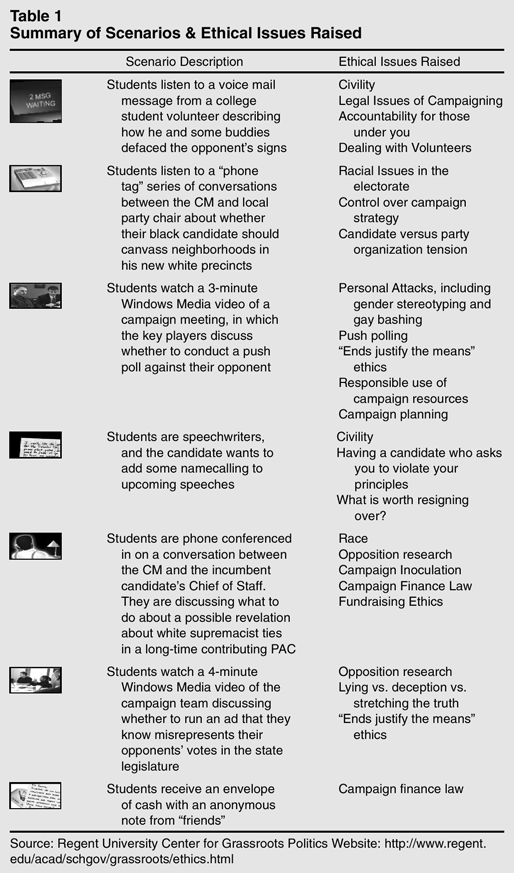
Instead of having students read this scenario, we proposed having them experience it through a brief Shockwave animation. In the basic model, students go to the Campaign Ethics web page and read the introduction: “You receive an anonymous donation. What would you do with money from an unknown source?” Clicking on the scenario icon starts a Shockwave animation that begins with an envelope overflowing with $20s and $50s entitled “Campaign Fund” and a note that floats out to the viewer reading (see Diagram below).
After viewing the animation, students click through to the class's online Blackboard discussion board and participate in an asynchronous dialogue about the scenario. The goal of the dialogues is to move students from abstract concept of campaign ethics to concrete applications of ethics, and from a rudimentary understanding of campaigning to a more complex understanding of ethics in context. Table 1 summarizes the Campaign Ethics scenarios, and the ethical issues they raised. Clearly, these scenarios address a wide range of campaign-related topics, including campaign finance issues, civility of campaign communications, lines of accountability in the campaign organization, the use of personal attacks and push polling, and race and gender stereotyping.
Alternative approaches in the online environment include student-faculty interaction in a synchronous virtual class discussion, and bringing in political consultants to provide “expert” commentary on the ethical dilemma posed by the scenario. The utility of the online scenarios is not limited to the electronic classroom experience. For example, students in traditional class settings could:
- View and prepare to discuss the scenario before coming to class.
- View the scenario and have a discussion during class (assuming that the course is being held in a smart classroom).
- View and discuss the scenario as part of a breakout discussion section.
- Use the scenario as a basis for a short written assignment.
Asynchronous Dialogues, and Digging Deeper
The online asynchronous dialogue format for scenario discussion has the effect, if managed well, of maximizing participation by students who might otherwise not take part in a live discussion. For example, students with little or no campaign experience might feel intimidated by those who are experienced campaigners. The format thus encourages student-directed learning, in the context of discussing what the teacher believes is an important issue, while providing a venue in which all students are required to participate. For example, in the scenario where students receive the anonymous cash donation, a first-semester student without campaign experience made the following posting:
Student 1: The ethical issue question is … would I be using money that is not really mine? How should I use this money would come across my mind, as well. Is this money stolen and someone wanted to get rid of it so they sent it to me? Many, many questions come to mind with this kind of scenario. I would first pray about it and then talk it over with my campaign manager before I spend the money. The right thing to do is to investigate who would send you money anonymously. Wait to hear a word from God before using the money.
Contrast this with the posting from an experienced campaigner:
Student 2: The key ethical issue is what to do with the money. You can't give it back—you don't know who gave it to you. And, working under the assumption that this is a federal election, any anonymous contribution in cash of more than $50 can't be kept. So the ethical issue surrounds the handling of the excess funds. FEC guidelines give clear directions on what must be done. When it comes to federal election laws, you don't want to act in ignorance. Campaign contributions are heavily regulated and must be documented and handled in accordance to those regulations. So I would go the FEC regs for directions on how to handle the contributions.
The experienced student went on to provide a detailed description, even citing specific Federal Election Commission regulations and rulings, of what could legally be done with the money. Based on the differences between the two responses, I was able to address a critical issue—the financial regulation of campaigning, without explicitly raising the issue myself. The first student had not known that campaign finance was subject to that kind of regulation, and had to change her answer, but it was another student who did the correction in a relatively non-threatening context, simply by giving his own response to the scenario. Students directed the learning experience, after I set the stage with the content. Moreover, this scenario raises the broader dilemma of whether ethical behavior is achieved by simply complying with the law.
Discussions often involved broader questions related to campaign strategy that are not usually considered “ethical,” per se. For example, one scenario is a 3-minute video we shot using local actors, and is viewed through Windows Media Player. In the video, the campaign team is discussing the dilemma of how to handle poll numbers that have plateaued, with their candidate just a few points below the opponent, and with only a few weeks left in the campaign. They debate whether to do a push poll that implies the opponent is a lesbian, but two students also raised other, more fundamental, problems:
Student 1: A couple of things that I noticed in the conversations made me wonder if the campaign had really been run well. Four days out from the election they still had not secured the base votes. That should have been done at the beginning of the campaign. Also where was all the money? They should have kept a good chunk for the final push. You always want to spend more at the end to get your name out. Walking and meeting people is not going to get you up the 5% points needed to win.
Student 2: In this scenario, a lot of things were done wrong by the campaign. First of all, I would never have a candidate's spouse engaged in strategy meetings. That is a no-no. Second, they have already spent most of their money and didn't save up for the end of the campaign. Campaigns should always save up enough money to have a final push at the end of a campaign…. Poor planning has put this campaign in a bad situation and now they are trying to use lies to bail them out. Might as well call in Frank Lautenburg.
The dialogue hit upon another subtheme raised by the students, whether a candidate's sexual orientation is fair game for campaign communications and tactics. While some students had internalized the position that push polling was unacceptable, there was more variation in whether sexual orientation is a character issue that merits action on the part of the campaign. In the exchange below, the student (Student 1) who is reticent to spread the word about the candidate's alleged sexual orientation also ends up proposing that it would be enough to disseminate the candidate's support for the gay political agenda.
Student 1: [Responding to an earlier posting by Student 2] I would not compromise my Christian values by putting out statements that may very well be true, but are totally personal against my opponent. I am basing this statement on what Dennis Thompson said in Shades of Gray…. I also do not believe that because someone is lesbian or gay, it will affect their performance in office.
Student 2: [To Student 1] Thank you for your support but let me clarify something. I agree with your idea, but I am curious about what you are meaning. Are you talking about performance in office or just the level of competence? I do believe that what one does in his or her personal life will affect what they do in office. For example, if you are a Christian, then your values and lifestyle will bleed into your campaign and into your political life.
Student 1 (later): I thought the consultant's proposal was rather amateurish as well as unethical. There is no need to ask respondents how they'd vote in response to the POSSIBILITY that my opponent is a lesbian when I could simply tell them of the CERTAINTY that she favors the homosexual agenda. Here I'm merely informing them of a fact and then asking their opinion. Whether this puts the idea in their mind that she is a lesbian is beside the point. After all, many people support the homosexual agenda without being homosexual. This would be just as effective as the push poll proposed by the consultant but more straightforward and honest.
Another scenario involves students listening in on a “phone tag” conversation between a campaign manager and a county party chair. In this situation, an African-American Republican candidate wants to walk precincts newly added to his district, but the local party chair fears that the knowledge among the local base Republican voters that the candidate is black will depress voter turnout in the precincts, jeopardizing the candidate's viability. The students are then asked what they would decide to do. The responses allow the class to consider how to address electorate racial bias, and the situation lends itself to addressing difficult strategic realities faced by candidates and voters alike.
Student 1: I think the key ethical question is should the voters be aware that Alan Sears is an African American. Is it using deception to win a campaign if they don't know? Do the voters have a “right” to know? I would argue that they do not. I would ask myself does his race have any affect on the kind of public servant he will be? That is the most important issue, his leadership. The people have a right to know about his views, character, and his religion, because those things reflect on his leadership abilities. As the campaign manager it is my job to form an ethical and intelligent strategy to win the race. By going into those neighborhoods I am setting my candidate up for failure. I am not advocating that Candidate Sears should hide in the shadows, not at all! However there are ways to be open without walking through racist neighborhoods. I think it is almost more unethical to convince the candidate to do it, because you know the consequences. The campaign should not try to conceal Mr. Sears' race anymore than they should set him up for failure by having him walk through that community.
Professor: But aren't you implicitly endorsing their attitudes by playing along?
Student 1: I don't see this as playing along, and I am certainly not endorsing any attitude that would believe a person should be elected based on the color of their skin. I am not saying Mr. Sears should hide away and not let anyone know in that community that he is an African-American, but I don't see any merit in forcing the issue either. There are other ways to gain name recognition among the voters without sending your candidate into a firestorm…. If the voters are foolish enough to not vote for someone based on their race, going door-to-door is not going to change their minds, it's only going to hurt Sears' bid for office. A good man will not get elected because his own campaign decided to make an issue of race.
The asynchronous context allows information processing to evolve over the time frame allocated for the dialogue. This means that if students miss the point of the exercise they are able to revisit the problem, and are not penalized for not getting to the point of the exercise on the first dialogue posting. Student 3, below, talks around the problem, but doesn't commit to a recommendation; I follow up and hold her accountable for completing the full assignment, which includes making a decision on what they would do.
Student 3: The key ethical issue/question is, as the campaign manager would I be contributing to and feeding the racism that this particular neighborhood holds? As an African American, regardless of sex, he or she will face racism and discrimination, therefore, Sears needs to get use to it and maybe face his fears … Like [another student] mentioned earlier, checking out the neighborhood is not a bad idea. I would try to run a test/survey and draw my own conclusion on how racist this precinct is. Sears could be making a statement for other African Americans or minorities who will have deal with the same situation. My final thought … Sears should step out on faith, hold his peace, and let God fight his battle against racism.
Professor: The concern I have with these responses is that they don't really make a concrete recommendation on an action to take. It is true that Sears will continue to have to deal with discrimination in electoral politics (indeed, if he is old enough to run for office, he has been dealing with it for a long time). As the CM, what action would you specifically recommend? Alternatively, as a future officeholder yourself, put yourself in Sears' place. What do you think you should do in this situation?
Conclusions
The opportunities presented by teaching in the online environment increase the learning timeline for students allowing them to maximize their grades, while also maximizing their input into a class discussion. The longer time allowed for posting responses to the scenarios also allows reflection on several possible response options, including other students' comments. Moreover, it promotes interaction between students at two different campuses and those who take the course over the Internet. The benefits of such an approach are clear in this situation. Finally, exposing new political management students to some of the ethical challenges faced by campaigners in the “real world,” lays important foundations for future ethical decision making. On the down side, some students (and faculty) may require additional training to acclimate them to the online teaching environment; still, the process is similar to a bulletin board, so there may not be a significant barrier to entry for the activity. The asynchronous approach to teaching also requires adapting the teacher's schedule—the course activities take place in bits and pieces across the week, instead of in one or more scheduled class sessions.
The purpose of teaching campaign ethics is to prepare campaign operatives and political consultants for ethical campaign practice. If the conduct of American election campaigns is even partly responsible for the deterioration of mass support for democratic political institutions, then campaign training is one area where a resolution lies. Individual campaigners, acting in their own campaigns, can raise the standard for their own behavior, thus raising the expectation for their election opponents. By actively engaging the political consultants and activists of the future, and by training them to consider their ethical decisions in advance of crises, damaging campaign decisions can be forestalled. The solution is unlikely to quickly change a generation's alienation and mistrust, but regardless of any single election's outcome, the political system benefits from campaigners' careful and advance consideration of the ethical boundaries of their conduct.
I am grateful to Carol Whitney, Carlyle Gregory, Brian Tringali, Paul Pelletier, Tammi Smith, and Guy Rodgers for their insights into campaign ethics; also to Chris Hansen, Eric Sandstrom, Christianne Page, and Shauna Tonkin of Regent University's Instructional Support & Technology Center for their hard work on making the scenarios a virtual reality; and most of all to four generations of students in my Principles of Political Management and Principled Political Action courses. The opinions expressed in this paper are those of the author alone, as is responsibility for any errors that remain. This paper is a revised version of a paper presented at the annual meeting of the Southern Political Science Association, Savannah, GA, November 2002, and of a poster presentation at the National Conference of the Midwest Political Science Association, Chicago, IL, April 2003. It also is Regent University's Center for Grassroots Politics Working Paper #201.