Introduction
There are several reasons why it is important to measure the quality of life (QOL) in dementia therapy and care. First, QOL has been recently recognized as the central purpose of healthcare, and it should be monitored if it is to be optimized (Riazi et al., Reference Riazi, Bradley, Barendse and Ishii2006). Second, drug therapy and dementia care should not be used at the expense of psychological well-being or QOL. A positive correlation of psychological well-being or QOL cannot be assumed with drug therapy and dementia care (Riazi et al., Reference Riazi, Bradley, Barendse and Ishii2006). Therefore, we should always evaluate psychological well-being or QOL in developing a new drug therapy or dementia care.
A comprehensive evaluation of QOL should consist of both subjective (self-administered) and objective (proxy assessment) domains. Direct assessment of QOL of patients with dementia may be reliable in the earlier stages of illness (Brod et al., Reference Brod, Stewart, Sands and Walton1999). However, neuropsychiatric symptoms (NPS) are common even in the early stages of dementia. NPS are significantly associated with caregiver assessment of patient's QOL but not with patient's self-assessed QOL (Karttunen et al., Reference Karttunen2011). That is, subjective evaluation of QOL is essential and important, but it cannot represent all areas of patient's QOL. Therefore, objective evaluation of QOL is needed even in early stages of dementia. Moreover, it is difficult to measure subjective states in patients with moderate to severe dementia. For this reason, objective assessment of QOL in patients with dementia is also important.
Before the year 2000, there were few objective QOL instruments focusing on positive and negative effects among dementia patients (Terada et al., Reference Terada2002). Therefore, in 2002 we developed a 31-item QOL questionnaire for Dementia (QOL-D) to objectively evaluate QOL of dementia patients, including positive and negative effects (Terada et al., Reference Terada2002). The QOL-D is widely used in dementia caregiving research in Japan (Funaki et al., Reference Funaki, Kaneko and Okamura2005; Yokota et al., Reference Yokota2006; Kazui et al., Reference Kazui, Harada, Eguchi, Tokunaga, Endo and Takeda2008; Ata et al., Reference Ata2010; Terada et al., Reference Terada2013). In recent studies, QOL-D has been reported to be sensitive to differences between states before and after an intervention (Yokota et al., Reference Yokota2006; Kazui et al., Reference Kazui, Harada, Eguchi, Tokunaga, Endo and Takeda2008). While QOL-D has excellent internal consistency, the length of the instrument may be a deterrent to its use in clinical and research environments.
Many objective scales for estimating QOL of patients with dementia have been developed, but most scales, including QOL-D, comprise more than 15 items (Ready and Otto Reference Ready and Ott2003; Ettema et al., Reference Ettema, Dröes, de Lange, Mellenbergh and Ribbe2005; Schölzel-Dorenbos et al., Reference Schölzel-Dorenbos2007; Gertz and Berwig, Reference Gertz and Berwig2008; Banerjee et al., Reference Banerjee2009). There have been few objective QOL scales for dementia with fewer than 15 items. The Quality of Life-Alzheimer's Disease scale (QOL-AD), a commonly used scale, has 13 items (Logsdon et al., Reference Logsdon, Gibbons, McCurry and Teri1999; Reference Logsdon, Gibbons, McCurry and Teri2002). The strengths of this scale are its brevity and its reliance on reports from patients, caregivers, or both (Ready and Ott, Reference Ready and Ott2003). A drawback is that it relies on a broad conceptualization of QOL and includes items about memory and activities of daily living (ADL; Ready and Ott, Reference Ready and Ott2003). Some authors noted that including items about cognition and physical functioning in QOL measures is problematic because including those items in a QOL scale means that QOL will also inevitably decline as dementia becomes more severe (Rabins et al., Reference Rabins, Kasper, Kleinman, Black and Patrick1999; Ready and Ott, Reference Ready and Ott2003). Evidence has indicated that there is little or no association between QOL and severity of cognitive impairment among people with mild to moderate stage dementia (Ready et al., Reference Ready, Ott, Grace and Fernandez2002; Hoe et al., Reference Hoe, Katona, Roch and Livingston2005). Therefore, we cannot assume that worsening of an individual's cognition inevitably leads to worsening of his or her QOL (Trigg et al., Reference Trigg, Skevington and Jones2007).
Certainly, one method is to use subscales (for instance, positive and negative effects) of QOL-D as a short version of it. However, it has not been ascertained whether the subscales are representative of the total QOL-D. Moreover, the validity of subscales has not been evaluated. Therefore, in this study, we aimed to design a short QOL-D that excludes items simply evaluating cognitive function and ADL to evaluate objectively QOL of dementia patients, especially in clinical settings.
Based on previous research, including our own (Lawton et al., Reference Lawton, Van Haitsma and Klapper1996; Weiner et al., Reference Weiner, Martin-Cook, Svetlik, Saine, Foster and Fontaine2000; Terada et al., Reference Terada2002; Burgener et al., Reference Burgener, Twigg and Popovich2005), we anticipated a two-dimensional model of objective QOL of dementia patients. One is positive dimension, and the other is negative dimension. To estimate the validity of short QOL-D, we simultaneously examined NPS and subjective depressive mood. We postulated that positive dimension scores would correlate with apathy and depression, and negative dimension scores would correlate with agitation and irritability. The positive dimension of an objective QOL was supposed to correlate with subjective depressive signs.
Methods
Study design
We used data from two studies. The first sample was from the QOL-D validation database; the data of the first sample were collected in 1999, and the detailed characteristics of the patients were previously reported (Terada et al., Reference Terada2002). Representative facilities from each of the six major types of institutions dealing with elderly people with dementia in Okayama and Hyogo prefectures were asked to participate in the study. In total, two psychiatric facilities, one hospital for elderly patients with dementia, one nursing home, three geriatric health service facilities (GHSF), one group home, and two adult day-care centers agreed to participate. All patients in these facilities with a diagnosis of dementia, except bedridden patients, were included in the first study.
Two hundred sixty-four patients with dementia were rated by the care staff (collection rate 88%). The average age of those rated was 81.5 years (standard deviation (SD) = 7.9). Of the samples, 68.2% (n = 180) were females. The diagnoses of the patients were Alzheimer's disease (AD; 45.1%, n = 119), AD with vascular lesions (14.0%, n = 37), vascular dementia (29.9%, n = 79), and others (11.0%, n = 27). Living accommodations were mostly GHSF (42.4%, n = 112) and hospital (39.4%, n = 104). Evaluation of the severity of dementia using the Nishimura Mental State Scale showed most patients as having moderate to severe dementia (Nishimura et al., Reference Nishimura1993).
The second sample comprised 395 consecutive outpatients receiving a detailed clinical examination at a memory clinic at Okayama University Hospital from September 2008 to February 2012. The mean age of the participants was 74.9 years (SD 7.1). Of the samples, 57.2% (n = 227) were females. The diagnoses of the patients were AD (35.5%, n = 141), AD with vascular lesions (10.8%, n = 43), dementia with Lewy bodies (4.0%, n = 16), vascular dementia (2.8%, n = 11), frontotemporal dementia (2.0%, n = 8), mild cognitive impairment (27.7%, n = 110), mental disorders (5.5%, n = 22), and others (11.6%, n = 46). The mean Mini-Mental State Examination (MMSE) score of participants was 22.0 (SD 5.0; Folstein et al., Reference Folstein, Folstein and McHugh1975). Evaluation of the cognitive function of patients showed most patients as having mild cognitive impairment or mild dementia.
QOL-D
The QOL-D comprises 31 items encompassing six domains: positive effect, negative effect and actions, communication, restlessness, attachment to others, and spontaneity (Terada et al., Reference Terada2002). Each item is ranked on a four-point scale (from 1 to 4). In the four domains of the QOL-D, viz. positive effect, ability to communicate, spontaneity and activity, and attachment to others, a high score means a higher QOL, whereas in the two domains of the QOL-D, viz. negative effect and actions and restlessness, a high score means a lower QOL. Domain scores are the mean values of item scores. The QOL-D was rated by the care staff in the first sample, and by primary family caregivers in the second sample.
Other instruments
In the second sample, we examined patients using several other instruments to elucidate the relationship between objective QOL and various patient characteristics.
The MMSE is a cognition screening test used widely in many parts of the world. The MMSE has a maximum score of 30 points. It assesses aspects of orientation, recall, language, and visual construction (Folstein et al., Reference Folstein, Folstein and McHugh1975).
The Frontal Assessment Battery (FAB) comprises six items, and the score on each item ranges from 0 to 3 (Kugo et al., Reference Kugo2007). A lower score indicates a greater degree of executive dysfunc-tion. The six items of FAB explore (1) simi-larities (conceptualization), (2) lexical fluency (mental flexibility), (3) Luria motor sequences (programing), (4) conflicting instructions (sensiti-vity to interference), (5) a go/no-go test (inhibitory control), and (6) prehension behavior (environmental autonomy). For this study, we used the Japanese version of FAB (Kugo et al., Reference Kugo2007).
The Neuropsychiatric Inventory (NPI) is a valid and reliable instrument for measuring non-cognitive symptoms in dementia (Hirono et al., Reference Hirono1997). The original NPI comprises 12 domains, but the Japanese version of NPI (Hirono et al., Reference Hirono1997) consists of ten domains because it excludes appetite and eating abnormalities. It is a caregiver-based tool that assesses ten different domains in dementia. The NPI gives a composite score for each domain, which is the product of frequency by severity subscores: scores from 1 to 4 (with 4 being the most severe) for the frequency and from 1 to 3 (with 3 being the most severe) for the severity of each behavior. The maximum attainable subscore of each NPI item is 12. The NPI was rated by clinical psychologists specialized in geriatric psychiatry using a caregiver interview.
The Geriatric Depression Scale (GDS), which has been extensively used in the fields of psychiatry and public health, is used to assess depression in elderly adults (Muraoka et al., Reference Muraoka, Ikuchi and Ihara1996). The GDS has two different versions: a standard version with 30 items and a shortened version with 15 items. For the present study, the short 15-item version of the GDS was administered (Muraoka et al., Reference Muraoka, Ikuchi and Ihara1996). A higher score means more signs of subjective depression. MMSE, FAB, NPI, and GDS were evaluated only in the second sample.
Development of short QOL-D
To determine the number of factors, two major methods were proposed. One was an eigenvalues over 1 strategy, and the other was the scree plot method. In developing QOL-D, we used the eigenvalues over 1 strategy and instituted a six-factor structure (positive effect, ability to communicate, negative effect, spontaneity and activity, restlessness, and attachment to others). However, in the first study, we showed that the six domains could be merged into two groups (positive and negative dimension groups). A moderate positive correlation between positive effect, ability to communicate, spontaneity and activity, and attachment to others was observed (positive dimension group), whereas negative effect had a weak to moderate correlation with restlessness only (negative dimension group). The scree plot factor analysis of the original data showed a two-factor structure (Terada et al., Reference Terada2002). In this study, we used the scree plot analysis to create short QOL-D.
Item selection for short QOL-D
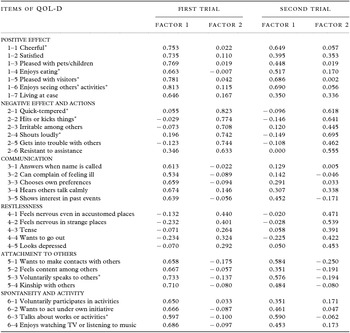
Maximum likelihood factor analysis with promax rotation was performed for all the items to categorize them into interpretable subsets. Items that were loaded highly for only one factor (>0.500) and low for other factors (<0.200) were retained. Items not falling into these criteria were excluded.
The items were grouped into two dimensions according to the factor load. The dimension scores and the total scores of the short QOL-D are the unweighted averages of item scores and range from 1 to 4. To make the meaning clearly apparent, the score of items in the negative dimension group was reversed so that high score means a better QOL (new score = 4 – original score).
Reliability and validity
Within the total short QOL-D and each domain of the short QOL-D, Cronbach's coefficient α was used to evaluate internal consistency reliability. Cronbach's coefficient α > 0.70 is conventionally considered acceptable. In addition to the data collection in the sample, the data for 21 patients with dementia were rated by four different evaluators (only the short QOL-D). Inter-rater reliability was assessed using the intraclass correlation coefficients (ICC).
Criterion validity was examined using the 31-item QOL-D as a reference. The percentage of variance of the QOL-D total scores that could be explained by the short QOL-D total scores was computed using the linear regression analysis. For each domain of the short QOL-D (positive and negative dimensions), a similar analysis was performed. The percentage of variance of the positive QOL-D domain scores (positive effect, ability to communicate, spontaneity and activity, and attachment to others) that could be explained by the positive dimension score of short QOL-D was calculated. The percentage of variance of the negative QOL-D domain scores (negative effect and restlessness) that could be explained by the negative dimension score of short QOL-D was also calculated.
Agreement between QOL-D and short QOL-D was also examined at a group level by computing the correlation coefficient of positive (positive effect, ability to communicate, spontaneity and activity, and attachment to others), negative (negative effect and restlessness), and total scores of QOL-D with the corresponding scores of short QOL-D.
Statistics
Statistical analysis was performed using the SPSS 19.0j software program (SPSS Inc., Chicago, IL). The correlation analysis of the short QOL-D scores to the scores of other instruments was done using Pearson's correlation coefficient. The significance for the hypothesis testing analyses was set at p < 0.05.
For the development of short QOL-D, we used the scree plot analysis to determine the number of factors. For item selection, maximum likelihood factor analysis with promax rotation was performed. Items that were loaded highly for only one factor (>0.500) and low for other factors (<0.200) were retained. Cronbach's coefficient α was used to evaluate internal consistency reliability, and inter-rater reliability was assessed by ICC. The criterion validity of short QOL-D was examined using the 31-item QOL-D as a reference.
Results
Number of factors in short QOL-D
The scree plot analysis of both first and second samples was performed. The scree plot analysis of the first sample revealed a two-factor structure: factor 1 (eigenvalue 8.810; variance 32.6%) and factor 2 (eigenvalue 4.468, variance 16.5%). In the second sample, the scree plot analysis also indicated a two-factor structure: factor 1 (eigenvalue 6.404, variance 20.7%) and factor 2 (eigenvalue 3.269, variance 10.5%).
Item selection for short QOL-D
No item showed a concentration of one answer (>70%) or a high rate of no answer (>2%) in both first and second samples. The maximum likelihood factor analysis with promax rotation reduced 31 items to nine items (factor pattern 0.50 or higher for one factor and 0.20 or lower for the other factor; Table 1), and two meaningful domains were identified: (1) positive dimension (six items) and (2) negative dimension (three items). No two of the nine items had a correlation coefficient of 0.70 or higher compared with each other in both first and second samples. Thus, the final version comprised only nine items grouped into two response sets, each with its own scale.
Rotated factor pattern

Notes: QOL-D: Quality of life questionnaire for dementia.
*Items retained for short QOL-D.
Reliability of short QOL-D and relationship between QOL-D and short QOL-D
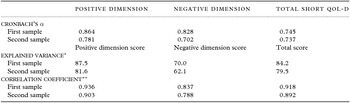
The Cronbach's coefficient α values of positive dimension, negative dimension, and total short QOL-D scores were 0.864, 0.828, and 0.745 respectively in the first sample, and 0.781, 0.702, and 0.737 respectively in the second sample (Table 2). Inter-rater reliability was assessed using ICC. The average ICC between the four evaluators for positive dimension, negative dimension, and total scores were 0.859, 0.941, and 0.877 respectively.
Internal consistency and criterion validity of short QOL-D

Notes: QOL-D: Quality of life questionnaire for dementia.
*Explained variance; the percentage of variance of QOL-D scores (total, positive dimension, negative dimension) explained by the corresponding short QOL-D scores.
**Correlation coefficient; correlation coefficient of short QOL-D scores to the corresponding QOL-D scores.
The percentage of explained variance was high in all the samples, with the lowest percentage, 62.1%, in the negative dimension of the second sample (Table 2). The correlation coefficients of short and total QOL-D were very high in total scores (0.892–0.918) and the positive dimension (0.903–0.936), and was high in the negative dimension (0.788–0.837; Table 2).
Relationship of short QOL-D with the scores of various instruments, and relationship between the two dimensions of short QOL-D
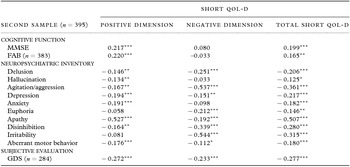
The positive dimension score showed a moderate correlation to the apathy score of NPI scale (r = −0.527) and a weak correlation to MMSE and FAB scores (r = 0.217, 0.220 respectively) of the second sample (Table 3). The negative dimension score showed a moderate correlation to the agitation/aggression and irritability scores of NPI scale (r = −0.537, −0.544 respectively), and a weak correlation to the delusion, euphoria, and disinhibition scores of NPI scale (r = −0.251, −0,212, −0.339 respectively) of the second sample. The total short QOL-D score showed a moderate correlation to the apathy score of NPI scale (r = −0.507) and a weak correlation to the delusion, agitation/aggression, depression, disinhibition, and irritability scores of NPI scale (r = −0.206, −0.361, −0.217, −0.280, −0.315 respectively) of the second sample.
Correlation coefficient of short QOL-D scores to cognitive function, NPI scores, and subjective evaluation

Notes: QOL-D: Quality of life questionnaire for dementia; GDS: Geriatric depression scale.
*p < 0.05; **p < 0.01; ***p < 0.001.
All three scores of short QOL-D (positive dimension, negative dimension, and total scores) showed a significant correlation with GDS scores of the second sample (Table 3).
Correlation between the two dimensions of short QOL-D was non-existent in the first sample (r = −0.058, p > 0.05) and low in the second sample (r = 0.181, p < 0.001).
Discussion
We developed a short version of QOL-D, named short QOL-D, that appeared to be a valid summary of the original 31-item QOL-D for patients with dementia. This short-form questionnaire correlated highly with the original QOL-D. The main advantage of this short version is that the questionnaire has 22 items and thus reduces the administration time by an estimated 10–15 minutes. The short QOL-D takes about five minutes to administer. This makes the shorter form easier to administer and therefore a more practical tool in clinical settings (Post et al., Reference Post, Boosman, van Zandvoort, Passier, Rinkel and Visser-Meily2011).
The positive, negative, and total scores of short QOL-D are significantly correlated to subjective depressive mood and objective depressive mood. The positive scores correlated with apathy and depression scores and negative scores correlated with agitation/aggression and irritability scores of NPI. These correlations are mostly in the expected directions, and we suppose that significant correlation demonstrates the validity of short QOL-D to some degree.
In order to increase the generalizability of study results, two different patient samples were used for the development and validation of short version. Specifically, the first sample primarily comprised patients with moderate to severe dementia, and the second sample mostly comprised patients with mild cognitive impairment and mild dementia. The utility of short QOL-D appears robust because the QOL-D of both patient samples could be easily assessed and reliably evaluated, although the two samples included patients with different stages of dementia. Therefore, the short QOL-D is thought to be useful for patients with mild cognitive impairment than for patients with severe dementia in both nursing facilities and home. Further, not only the care staff but family caregivers can also use short QOL-D. Thus, the short QOL-D can be used generally in various settings.
Positive mood and engagement in pleasurable activities are essential features of a good QOL for dementia patients (Logsdon et al., Reference Logsdon, McCurry and Teri2007). However, in most short QOL scales for dementia, evaluation of mood status constitutes only a very small part of total scores or is paid no attention at all (Ready and Otto, Reference Ready and Ott2003; Ettema et al., Reference Ettema, Dröes, de Lange, Mellenbergh and Ribbe2005; Schölzel-Dorenbos et al., Reference Schölzel-Dorenbos2007; Gertz and Berwig, Reference Gertz and Berwig2008; Banerjee et al., Reference Banerjee2009). In that sense, the short QOL-D, which focuses on positive mood or engagement in activities, is useful.
Both the Quality of Life in Late-stage Dementia scale (QUALID) and the Psychological Well-Being in Cognitively Impaired Persons (PWB-CIP) are 11-item QOL scales (Weiner et al., Reference Weiner, Martin-Cook, Svetlik, Saine, Foster and Fontaine2000; Burgener et al., Reference Burgener, Twigg and Popovich2005). These scales are similar to short QOL-D and have no cognitive or functional items. The QUALID has five positive and six negative items (Weiner et al., Reference Weiner, Martin-Cook, Svetlik, Saine, Foster and Fontaine2000). The PWB-CIP has three or four positive items and seven or eight negative items (Burgener et al., Reference Burgener, Twigg and Popovich2005). Both QUALID and PWB-CIP produce only total scores, and have no subscale scores (namely, positive or negative dimensions). In contrast, the short QOL-D makes it possible to calculate subscale scores on positive and negative items.
A two-factor structure of effects was proposed by Lawton et al. (Reference Lawton, Van Haitsma and Klapper1996). According to the theory, positive and negative effects are supposed to be imperfectly or scarcely correlated (Lawton, Reference Lawton1994). There was no or low significant correlation between positive and negative dimensions in our study. This is congruent with the assertion that negative and positive effects are almost mutually independent (Lawton, Reference Lawton1994; Brod et al., Reference Brod, Stewart, Sands and Walton1999). Therefore, we think the two subscales in the short QOL-D are useful in the evaluation of positive and negative dimensions separately.
Several limitations are discussed. First, many studies reported the reliability of subjective measures of QOL, especially in the early stages of dementia (Brod et al., Reference Brod, Stewart, Sands and Walton1999). However, the total evaluation of QOL always needs objective as well as subjective evaluation (Lawton, Reference Lawton1994; Lawton et al., Reference Lawton, Van Haitsma and Klapper1996). Therefore, we suppose the short QOL-D (objective measure) is useful, even in the early stages. It would be better to combine subjective and objective QOL scales in the early stages of dementia. Second, the short QOL-D appears to assess primarily positive and negative effects (with seven of the nine items assessing these areas). This is a comparative shortcoming of short QOL-D. However, other domains, such as cognitive function, ADL, instrumental activities of daily living (IADL), and NPS can be assessed using many other familiar scales. Therefore, a short objective QOL scale focusing on the effects of dementia patients is useful and needed, especially in the severe stages of dementia. Third, it is difficult to decide whether a shorter scale is necessarily a preferable one. We do not think that shorter is always better. If there is enough time, investigations of a number of aspects is desirable to estimate QOL. Fourth, the short QOL-D has not been tested for sensitivity to change or for clinical utility. Further research is necessary to clarify these issues. Fifth, the short QOL-D data were derived from two samples. Data were collected over a period of more than ten years, and two types of raters were used: the care staff in the first sample, and chief family caregivers in the second sample. These differences may have affected the results. Regardless of these limitations, the short QOL-D is a promising simple objective QOL measure for dementia patients.
Conflict of interest
None.
Description of authors' roles
Seishi Terada designed the study, analyzed the data, and wrote the paper. Etsuko Oshima, Chikako Ikeda, Satoshi Hayashi, and Osamu Yokota collected the data and assisted with writing the paper. Yosuke Uchitomi supervised the study design, participated in data analysis, and assisted with writing the paper.
Acknowledgments
We thank Ms. Horiuchi, Imai, Yabe, and Fukushima for their skillful assistance for this study. This work was supported by a grant from the Japanese Ministry of Education, Culture, Sports, Science and Technology (21591517) and the Zikei Institute of Psychiatry.